Meiosis KM 1
Meiosis and genetic variation
pp193-196
Meiosis KM 2
Genome
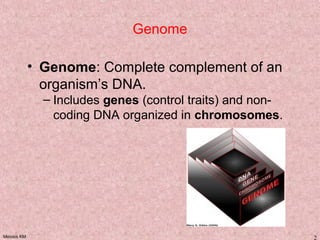
• Genome: Complete complement of an
organism’s DNA.
– Includes genes (control traits) and non-
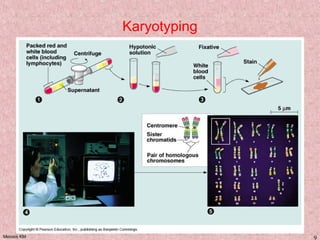
coding DNA organized in chromosomes.
Meiosis KM 3
Genes
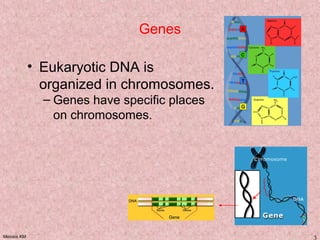
• Eukaryotic DNA is
organized in chromosomes.
– Genes have specific places
on chromosomes.
Meiosis KM 4
Heredity
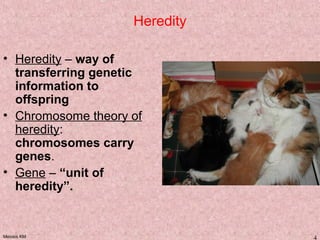
• Heredity – way of
transferring genetic
information to
offspring
• Chromosome theory of
heredity:
chromosomes carry
genes.
• Gene – “unit of
heredity”.
Meiosis KM 5
Reproduction
• Asexual
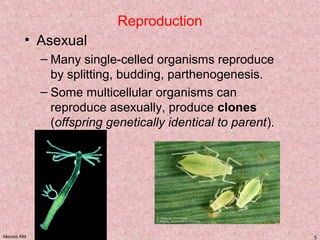
– Many single-celled organisms reproduce
by splitting, budding, parthenogenesis.
– Some multicellular organisms can
reproduce asexually, produce clones
(offspring genetically identical to parent).
Meiosis KM 6
Sexual reproduction
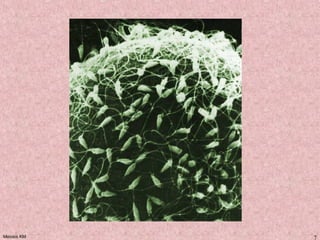
• Fusion of two gametes to produce a
single zygote.
• Introduces greater genetic variation,
allows genetic recombination.
• With exception of self-fertilizing
organisms (e.g. some plants), zygote
has gametes from two different parents.
Meiosis KM 7
Meiosis KM 8
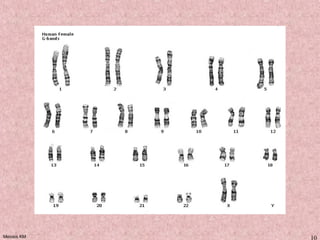
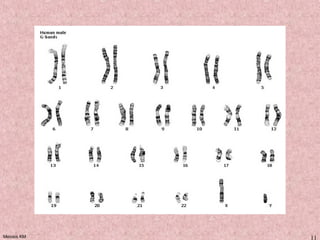
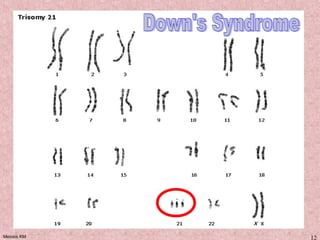
Chromosomes
• Karyotype:
– ordered display of an individual’s
chromosomes.
– Collection of chromosomes from mitotic
cells.
– Staining can reveal visible band patterns,
gross anomalies.
Meiosis KM 9
Karyotyping
Meiosis KM 10
Meiosis KM 11
Meiosis KM 12
Meiosis KM 13
http://gslc.genetics.utah.edu/units/disorders/karyotype/karyotype.cfm
Karyotype Activity
Meiosis KM 14
Homologues
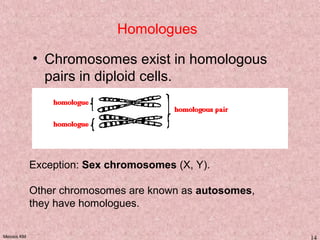
• Chromosomes exist in homologous
pairs in diploid cells.
Exception: Sex chromosomes (X, Y).
Other chromosomes are known as autosomes,
they have homologues.
Meiosis KM 15
In humans …
• 23 chromosomes donated by each parent
(total = 46 or 23 pairs).
• Gametes (sperm/ova):
– Contain 22 autosomes and 1 sex chromosome.
– Are haploid (haploid number “n” = 23 in humans).
• Fertilization/syngamy results in zygote with 2
haploid sets of chromosomes - now diploid.
– Diploid cell; 2n = 46. (n=23 in humans)
• Most cells in the body produced by mitosis.
• Only gametes are produced by meiosis.
Meiosis KM 16
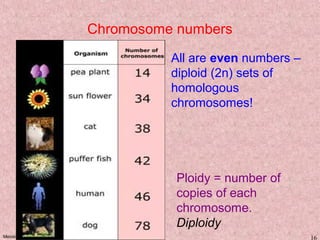
Chromosome numbers
All are even numbers –
diploid (2n) sets of
homologous
chromosomes!
Ploidy = number of
copies of each
chromosome.
Diploidy
Meiosis KM 17
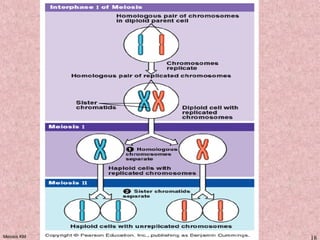
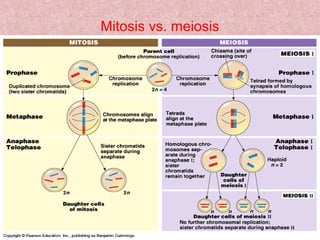
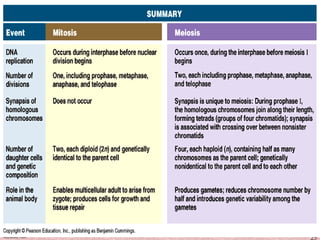
Meiosis – key differences from mitosis
• Meiosis reduces the number of chromosomes by half.
• Daughter cells differ from parent, and each other.
• Meiosis involves two divisions, Mitosis only one.
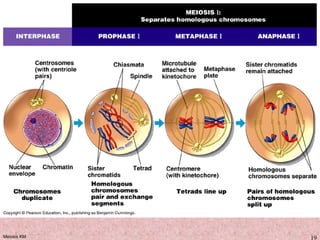
• Meiosis I involves:
– Synapsis – homologous chromosomes pair up.
Chiasmata form (crossing over of non-sister
chromatids).
– In Metaphase I, homologous pairs line up at
metaphase plate.
– In Anaphase I, sister chromatids do NOT separate.
– Overall, separation of homologous pairs of
chromosomes, rather than sister chromatids of
individual chromosome.
Meiosis KM 18
Meiosis KM 19
Meiosis KM 20
Meiosis KM 21
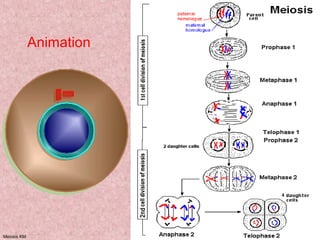
Animation
Meiosis KM 22
Meiosis 1
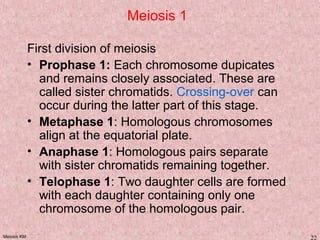
First division of meiosis
• Prophase 1: Each chromosome dupicates
and remains closely associated. These are
called sister chromatids. Crossing-over can
occur during the latter part of this stage.
• Metaphase 1: Homologous chromosomes
align at the equatorial plate.
• Anaphase 1: Homologous pairs separate
with sister chromatids remaining together.
• Telophase 1: Two daughter cells are formed
with each daughter containing only one
chromosome of the homologous pair.
Meiosis KM 23
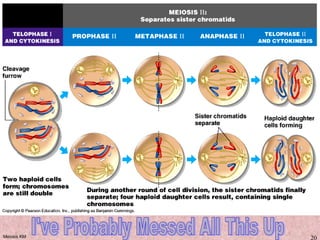
Meiosis II
Second division of meiosis: Gamete formation
• Prophase 2: DNA does not replicate.
• Metaphase 2: Chromosomes align at
the equatorial plate.
• Anaphase 2: Centromeres divide and
sister chromatids migrate separately to
each pole.
• Telophase 2: Cell division is complete.
Four haploid daughter cells are
obtained.
Meiosis KM 24
Mitosis vs. meiosis
Meiosis KM 25
Meiosis KM 26
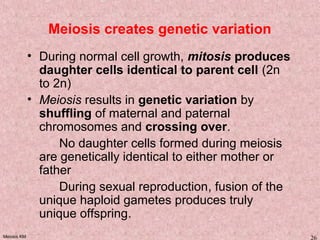
Meiosis creates genetic variation
• During normal cell growth, mitosis produces
daughter cells identical to parent cell (2n
to 2n)
• Meiosis results in genetic variation by
shuffling of maternal and paternal
chromosomes and crossing over.
No daughter cells formed during meiosis
are genetically identical to either mother or
father
During sexual reproduction, fusion of the
unique haploid gametes produces truly
unique offspring.
Meiosis KM 27
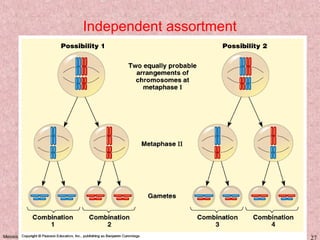
Independent assortment
Meiosis KM 28
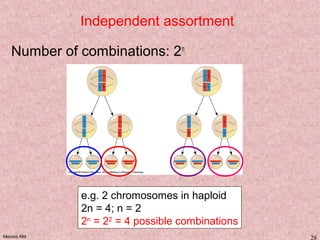
Independent assortment
Number of combinations: 2n
e.g. 2 chromosomes in haploid
2n = 4; n = 2
2n
= 22
= 4 possible combinations
Meiosis KM 29
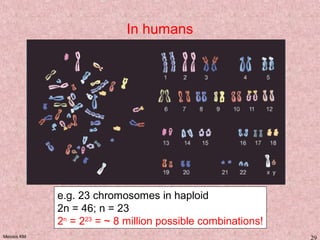
In humans
e.g. 23 chromosomes in haploid
2n = 46; n = 23
2n
= 223
= ~ 8 million possible combinations!
Meiosis KM 30
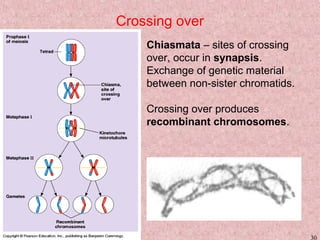
Crossing over
Chiasmata – sites of crossing
over, occur in synapsis.
Exchange of genetic material
between non-sister chromatids.
Crossing over produces
recombinant chromosomes.
Meiosis KM 31
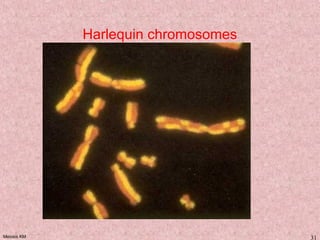
Harlequin chromosomes
Meiosis KM 32
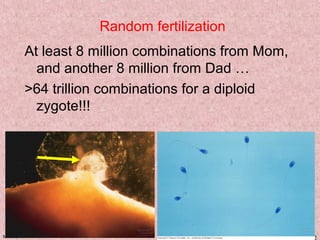
Random fertilization
At least 8 million combinations from Mom,
and another 8 million from Dad …
>64 trillion combinations for a diploid
zygote!!!
Meiosis KM 33
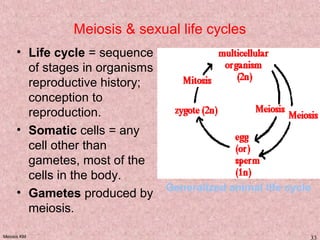
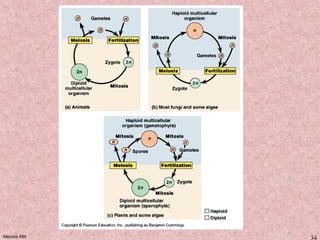
Meiosis & sexual life cycles
• Life cycle = sequence
of stages in organisms
reproductive history;
conception to
reproduction.
• Somatic cells = any
cell other than
gametes, most of the
cells in the body.
• Gametes produced by
meiosis.
Generalized animal life cycle
Meiosis KM 34
Meiosis KM 35
Sex is costly!
• Large amounts of energy required to find a
mate and do the mating: specialized
structures and behavior required
• Intimate contact provides route for infection
by parasites (AIDS, syphillis, etc.)
• Genetic costs: in sex, we pass on only half of
genes to offspring.
• Males are an expensive luxury - in most
species they contribute little to rearing
offspring.
Meiosis KM 36
But …
• More genetic diversity: more potential for survival
of species when environmental conditions
change.
– Shuffling of genes in meiosis
– Crossing-over in meiosis
– Fertilization: combines genes from 2 separate
individuals
• DNA back-up and repair.
– Asexual organisms don't have back-up copies of genes,
sexual organisms have 2 sets of chromosomes and
one can act as a back-up if the other is damaged.
– Sexual mechanisms, especially recombination, are
used to repair damaged DNA - the undamaged
chromosome acts as a template and eventually both
chromosomes end up with the correct gene.
Meiosis KM 37
Vocabulary
• centriole
• centromere:
• crossing over:
• gamete:
• meiosis:
• zygote:
Meiosis KM 38
Study Questions
• 1. What happens as homologous
chromosomes pair up during prophase I
of meiosis?
• 2. How does metaphase of mitosis
differ from metaphase I of meiosis?
• 3. What is the sole purpose of
meiosis?
• 4. What specific activities, involving
DNA, occur during interphase prior to
both mitosis and meiosis?
Meiosis KM 39
5. Compare mitosis and meiosis on the
following points:
• a. number of daughter cells
produced.
• b. the amount of DNA in the
daughter cells in contrast to the original
cell.
• c. mechanism for introducing
genetic variation.
• 6.  What is a zygote and how is it
formed?

Meiosis2

  • 1.
    Meiosis KM 1 Meiosisand genetic variation pp193-196
  • 2.
    Meiosis KM 2 Genome •Genome: Complete complement of an organism’s DNA. – Includes genes (control traits) and non- coding DNA organized in chromosomes.
  • 3.
    Meiosis KM 3 Genes •Eukaryotic DNA is organized in chromosomes. – Genes have specific places on chromosomes.
  • 4.
    Meiosis KM 4 Heredity •Heredity – way of transferring genetic information to offspring • Chromosome theory of heredity: chromosomes carry genes. • Gene – “unit of heredity”.
  • 5.
    Meiosis KM 5 Reproduction •Asexual – Many single-celled organisms reproduce by splitting, budding, parthenogenesis. – Some multicellular organisms can reproduce asexually, produce clones (offspring genetically identical to parent).
  • 6.
    Meiosis KM 6 Sexualreproduction • Fusion of two gametes to produce a single zygote. • Introduces greater genetic variation, allows genetic recombination. • With exception of self-fertilizing organisms (e.g. some plants), zygote has gametes from two different parents.
  • 7.
  • 8.
    Meiosis KM 8 Chromosomes •Karyotype: – ordered display of an individual’s chromosomes. – Collection of chromosomes from mitotic cells. – Staining can reveal visible band patterns, gross anomalies.
  • 9.
  • 10.
  • 11.
  • 12.
  • 13.
  • 14.
    Meiosis KM 14 Homologues •Chromosomes exist in homologous pairs in diploid cells. Exception: Sex chromosomes (X, Y). Other chromosomes are known as autosomes, they have homologues.
  • 15.
    Meiosis KM 15 Inhumans … • 23 chromosomes donated by each parent (total = 46 or 23 pairs). • Gametes (sperm/ova): – Contain 22 autosomes and 1 sex chromosome. – Are haploid (haploid number “n” = 23 in humans). • Fertilization/syngamy results in zygote with 2 haploid sets of chromosomes - now diploid. – Diploid cell; 2n = 46. (n=23 in humans) • Most cells in the body produced by mitosis. • Only gametes are produced by meiosis.
  • 16.
    Meiosis KM 16 Chromosomenumbers All are even numbers – diploid (2n) sets of homologous chromosomes! Ploidy = number of copies of each chromosome. Diploidy
  • 17.
    Meiosis KM 17 Meiosis– key differences from mitosis • Meiosis reduces the number of chromosomes by half. • Daughter cells differ from parent, and each other. • Meiosis involves two divisions, Mitosis only one. • Meiosis I involves: – Synapsis – homologous chromosomes pair up. Chiasmata form (crossing over of non-sister chromatids). – In Metaphase I, homologous pairs line up at metaphase plate. – In Anaphase I, sister chromatids do NOT separate. – Overall, separation of homologous pairs of chromosomes, rather than sister chromatids of individual chromosome.
  • 18.
  • 19.
  • 20.
  • 21.
  • 22.
    Meiosis KM 22 Meiosis1 First division of meiosis • Prophase 1: Each chromosome dupicates and remains closely associated. These are called sister chromatids. Crossing-over can occur during the latter part of this stage. • Metaphase 1: Homologous chromosomes align at the equatorial plate. • Anaphase 1: Homologous pairs separate with sister chromatids remaining together. • Telophase 1: Two daughter cells are formed with each daughter containing only one chromosome of the homologous pair.
  • 23.
    Meiosis KM 23 MeiosisII Second division of meiosis: Gamete formation • Prophase 2: DNA does not replicate. • Metaphase 2: Chromosomes align at the equatorial plate. • Anaphase 2: Centromeres divide and sister chromatids migrate separately to each pole. • Telophase 2: Cell division is complete. Four haploid daughter cells are obtained.
  • 24.
  • 25.
  • 26.
    Meiosis KM 26 Meiosiscreates genetic variation • During normal cell growth, mitosis produces daughter cells identical to parent cell (2n to 2n) • Meiosis results in genetic variation by shuffling of maternal and paternal chromosomes and crossing over. No daughter cells formed during meiosis are genetically identical to either mother or father During sexual reproduction, fusion of the unique haploid gametes produces truly unique offspring.
  • 27.
  • 28.
    Meiosis KM 28 Independentassortment Number of combinations: 2n e.g. 2 chromosomes in haploid 2n = 4; n = 2 2n = 22 = 4 possible combinations
  • 29.
    Meiosis KM 29 Inhumans e.g. 23 chromosomes in haploid 2n = 46; n = 23 2n = 223 = ~ 8 million possible combinations!
  • 30.
    Meiosis KM 30 Crossingover Chiasmata – sites of crossing over, occur in synapsis. Exchange of genetic material between non-sister chromatids. Crossing over produces recombinant chromosomes.
  • 31.
  • 32.
    Meiosis KM 32 Randomfertilization At least 8 million combinations from Mom, and another 8 million from Dad … >64 trillion combinations for a diploid zygote!!!
  • 33.
    Meiosis KM 33 Meiosis& sexual life cycles • Life cycle = sequence of stages in organisms reproductive history; conception to reproduction. • Somatic cells = any cell other than gametes, most of the cells in the body. • Gametes produced by meiosis. Generalized animal life cycle
  • 34.
  • 35.
    Meiosis KM 35 Sexis costly! • Large amounts of energy required to find a mate and do the mating: specialized structures and behavior required • Intimate contact provides route for infection by parasites (AIDS, syphillis, etc.) • Genetic costs: in sex, we pass on only half of genes to offspring. • Males are an expensive luxury - in most species they contribute little to rearing offspring.
  • 36.
    Meiosis KM 36 But… • More genetic diversity: more potential for survival of species when environmental conditions change. – Shuffling of genes in meiosis – Crossing-over in meiosis – Fertilization: combines genes from 2 separate individuals • DNA back-up and repair. – Asexual organisms don't have back-up copies of genes, sexual organisms have 2 sets of chromosomes and one can act as a back-up if the other is damaged. – Sexual mechanisms, especially recombination, are used to repair damaged DNA - the undamaged chromosome acts as a template and eventually both chromosomes end up with the correct gene.
  • 37.
    Meiosis KM 37 Vocabulary •centriole • centromere: • crossing over: • gamete: • meiosis: • zygote:
  • 38.
    Meiosis KM 38 StudyQuestions • 1. What happens as homologous chromosomes pair up during prophase I of meiosis? • 2. How does metaphase of mitosis differ from metaphase I of meiosis? • 3. What is the sole purpose of meiosis? • 4. What specific activities, involving DNA, occur during interphase prior to both mitosis and meiosis?
  • 39.
    Meiosis KM 39 5.Compare mitosis and meiosis on the following points: • a. number of daughter cells produced. • b. the amount of DNA in the daughter cells in contrast to the original cell. • c. mechanism for introducing genetic variation. • 6.  What is a zygote and how is it formed?

Editor's Notes

  • #17 All even, as all are diploid, contain pairs of chromosomes.