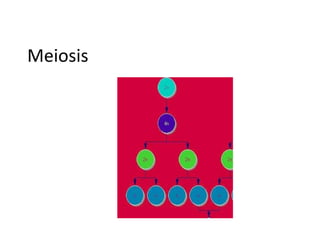
Meiosis
Pg.  Title: Meiosis Date: 01/27/10 Obj:  Describe how spermatogenesis & oogenesis occur through meiosis. Ess:  Explain how sperm & egg contain only 23 chromosomes each through meiosis.
Pg.  Title: Meiosis I & II Date: 1/27/10 In: Almost all human cells contain 46 chromosomes.  If a sperm has 46 chromosomes & an egg has 46 chromosomes then how many chromosomes will the “baby” have? Is that a good thing???
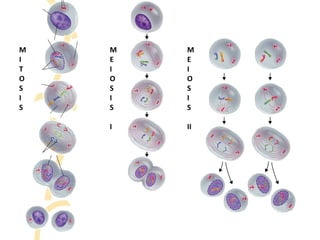
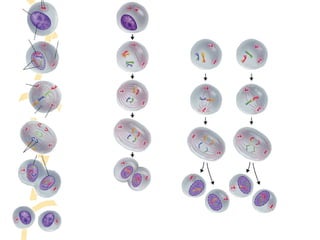
M I T O S I S M E I O S I S I M E I O S I S II
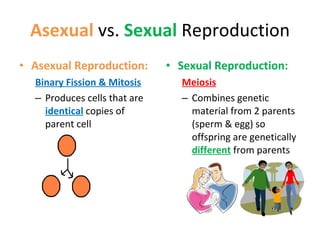
Asexual  vs.  Sexual  Reproduction Asexual Reproduction: Binary Fission & Mitosis Produces cells that are  identical  copies of parent cell Sexual Reproduction: Meiosis Combines genetic material from 2 parents (sperm & egg) so offspring are genetically  different  from parents
How many chromosomes in human cells? Humans have 46 (23 pairs) chromosomes 44 chromosomes (22pairs): autosomal 2 chromosomes (1 pair): sex chromosomes (XX, XY) 2 sets of chromosomes 1 from mom  &  1 from dad
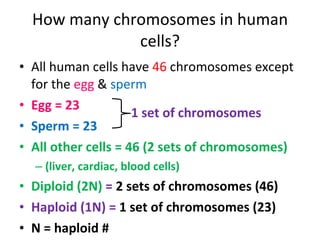
How many chromosomes in human cells? All human cells have  46  chromosomes except for the  egg  &  sperm Egg = 23 Sperm = 23 All other cells = 46 (2 sets of chromosomes) (liver, cardiac, blood cells) Diploid (2N)  =  2 sets of chromosomes (46) Haploid (1N) =  1 set of chromosomes (23) N = haploid # 1 set of chromosomes
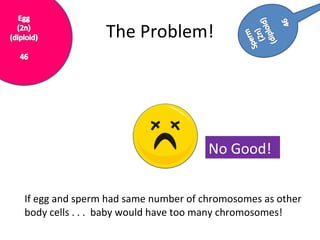
If egg and sperm had same number of chromosomes as other body cells . . .  baby would have too many chromosomes! No Good! The Problem!
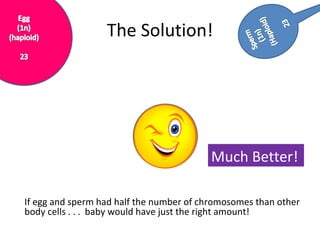
The Solution! Much Better! If egg and sperm had half the number of chromosomes than other body cells . . .  baby would have just the right amount!
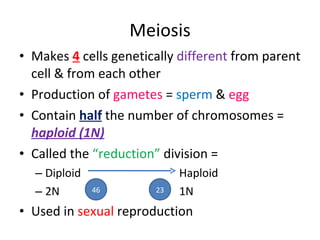
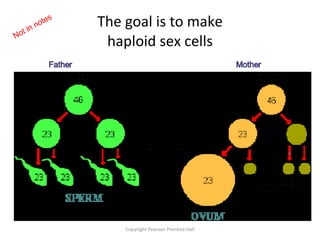
Meiosis Makes  4   cells genetically  different   from parent cell & from each other Production of  gametes  =  sperm  &  egg Contain  half  the number of chromosomes =  haploid (1N) Called the  “reduction”  division = Diploid Haploid 2N 1N Used in  sexual  reproduction 46 23
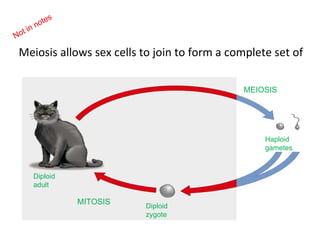
Meiosis allows sex cells to join to form a complete set of chromosomes/instructions to make a new organism. Copyright Pearson Prentice Hall Haploid gametes MEIOSIS Diploid zygote MITOSIS Diploid adult Not in notes
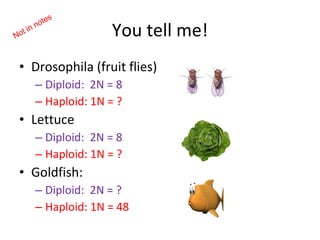
You tell me! Drosophila (fruit flies) Diploid:  2N = 8 Haploid: 1N = ? Lettuce Diploid:  2N = 8 Haploid: 1N = ? Goldfish: Diploid:  2N = ? Haploid: 1N = 48 Not in notes
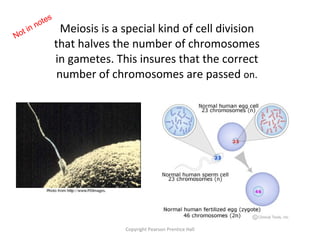
Meiosis is a special kind of cell division that halves the number of chromosomes in gametes. This insures that the correct number of chromosomes are passed  on. Copyright Pearson Prentice Hall Not in notes
The goal is to make haploid sex cells Copyright Pearson Prentice Hall 1 st  division 2 nd  division Not in notes
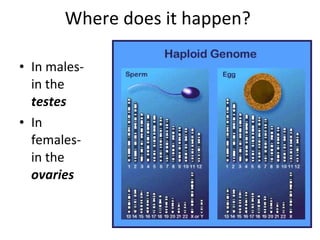
Where does it happen?  In males- in the  testes In females- in the  ovaries
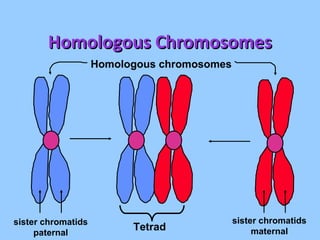
Homologous Chromosomes Homologous chromosomes sister chromatids paternal sister chromatids maternal Tetrad
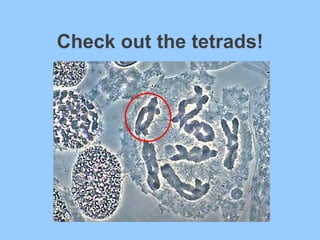
Check out the tetrads!
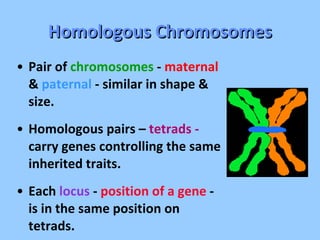
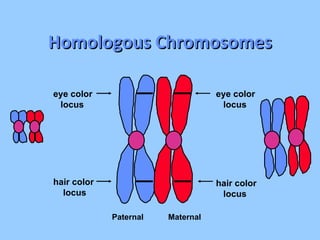
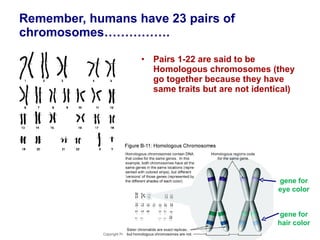
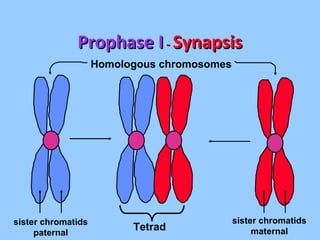
Homologous Chromosomes Pair of  chromosomes  -  maternal  &  paternal  - similar in shape & size. Homologous pairs –  tetrads -  carry genes controlling the same inherited traits. Each  locus  -  position of a gene  -   is in the same position on tetrads.
Homologous Chromosomes Paternal Maternal eye color locus eye color locus hair color locus hair color locus
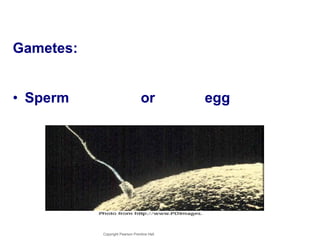
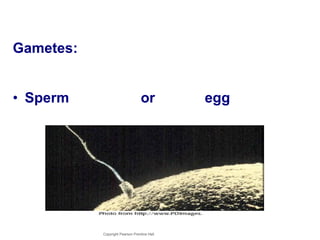
Gametes: Sperm or  egg Copyright Pearson Prentice Hall
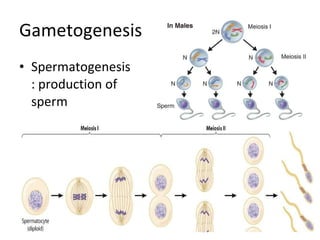
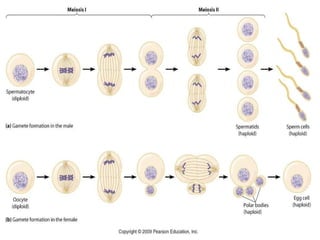
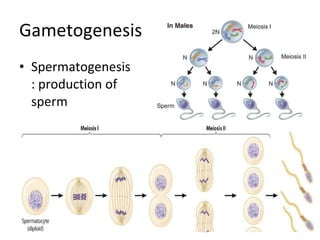
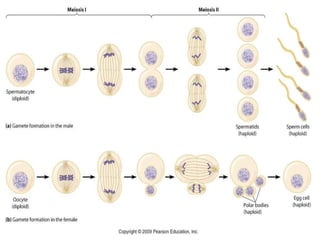
Gametogenesis Spermatogenesis: production of sperm
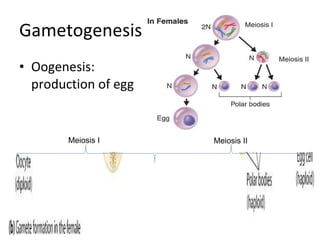
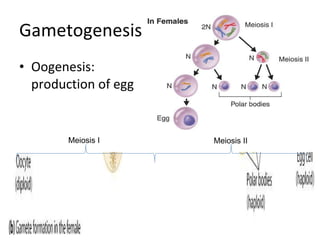
Gametogenesis Oogenesis: production of egg Meiosis I Meiosis II
 
Remember, humans have 23 pairs of chromosomes……………. Pairs 1-22 are said to be Homologous chromosomes (they go together because they have same traits but are not identical) Copyright Pearson Prentice Hall gene for eye color gene for hair color
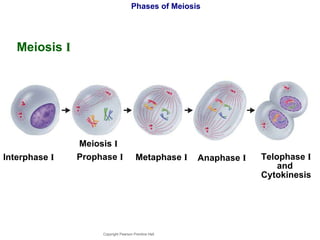
Phases of Meiosis Meiosis  I Copyright Pearson Prentice Hall Prophase  I Metaphase  I Anaphase  I Telophase  I  and  Cytokinesis Interphase  I Meiosis  I
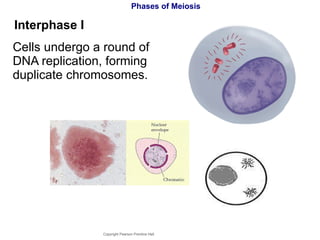
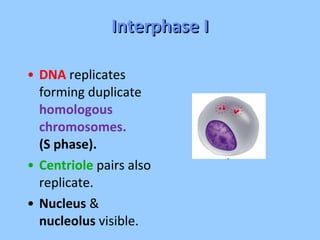
Phases of Meiosis Cells undergo a round of DNA replication, forming duplicate chromosomes. Copyright Pearson Prentice Hall Interphase I
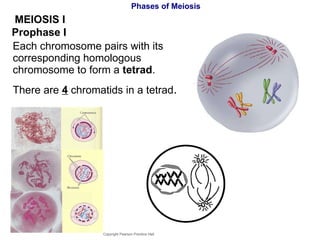
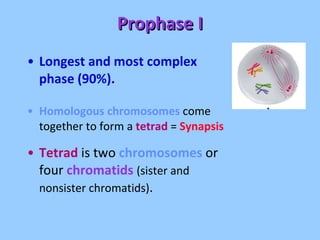
Phases of Meiosis Each chromosome pairs with its corresponding homologous chromosome to form a  tetrad . There are  4  chromatids in a tetrad . Copyright Pearson Prentice Hall MEIOSIS I  Prophase   I
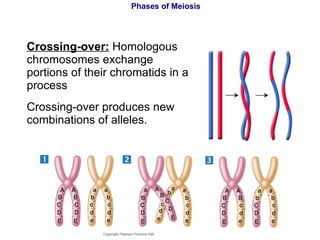
Phases of Meiosis Crossing-over:  Homologous chromosomes exchange portions of their chromatids in a process Crossing-over produces new combinations of alleles. Copyright Pearson Prentice Hall
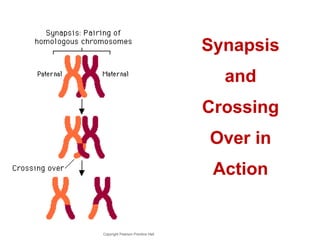
Synapsis and Crossing Over in Action Copyright Pearson Prentice Hall
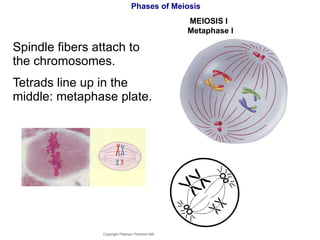
Phases of Meiosis Spindle fibers attach to the chromosomes. Tetrads line up in the middle: metaphase plate. Copyright Pearson Prentice Hall MEIOSIS I  Metaphase I
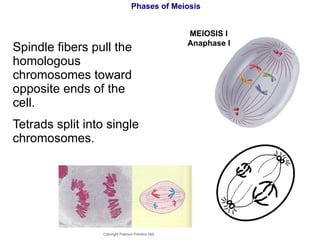
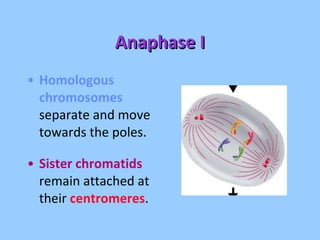
Phases of Meiosis Spindle fibers pull the homologous chromosomes toward opposite ends of the cell. Tetrads split into single chromosomes. Copyright Pearson Prentice Hall MEIOSIS I  Anaphase I
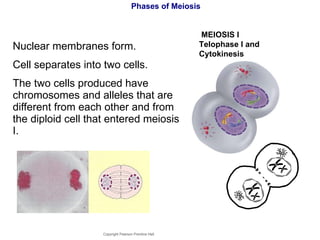
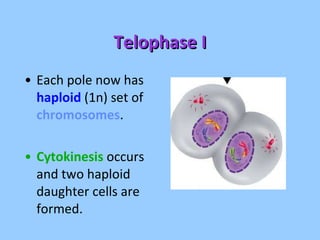
Phases of Meiosis Nuclear membranes form.  Cell separates into two cells. The two cells produced have chromosomes and alleles that are different from each other and from the diploid cell that entered meiosis I. Copyright Pearson Prentice Hall MEIOSIS I  Telophase I and  Cytokinesis
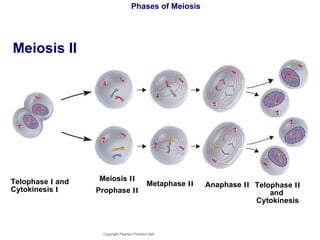
Phases of Meiosis Meiosis II The two cells produced by meiosis I now enter a second meiotic division. Unlike meiosis I, neither cell goes through chromosome replication. Each of the cell’s chromosomes has 2 chromatids. Copyright Pearson Prentice Hall
Phases of Meiosis Meiosis II Copyright Pearson Prentice Hall Telophase  II  and  Cytokinesis Prophase  II Metaphase  II Anaphase  II Telophase  I  and  Cytokinesis  I Meiosis  II
Phases of Meiosis Meiosis I results in two haploid (N) daughter cells, each with half the number of chromosomes as the original cell. Copyright Pearson Prentice Hall MEIOSIS II Prophase II
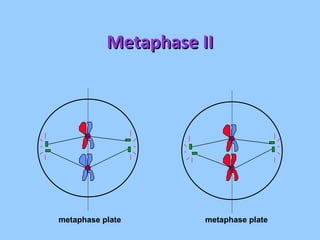
Phases of Meiosis The chromosomes line up in the center of cell. Copyright Pearson Prentice Hall MEIOSIS II  Metaphase II
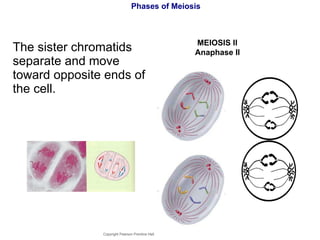
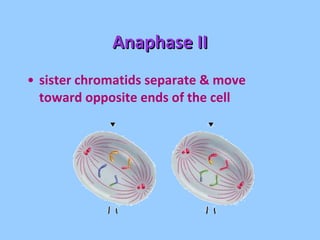
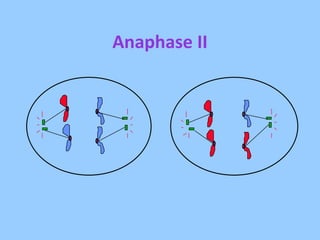
Phases of Meiosis The sister chromatids separate and move toward opposite ends of the cell. Copyright Pearson Prentice Hall MEIOSIS II  Anaphase II
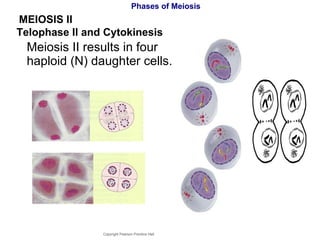
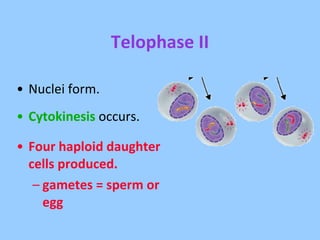
Phases of Meiosis Meiosis II results in four haploid (N) daughter cells. Copyright Pearson Prentice Hall MEIOSIS II  Telophase II and Cytokinesis
Gametes: Sperm or  egg Copyright Pearson Prentice Hall
Gametogenesis Spermatogenesis: production of sperm
Gametogenesis Oogenesis: production of egg Meiosis I Meiosis II
 
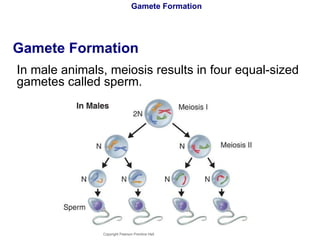
Gamete Formation Gamete Formation In male animals, meiosis results in four equal-sized gametes called sperm. Copyright Pearson Prentice Hall
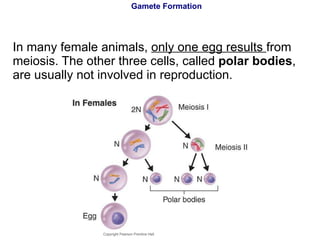
Gamete Formation In many female animals,  only one egg results  from meiosis. The other three cells, called  polar bodies , are usually not involved in reproduction. Copyright Pearson Prentice Hall
Interphase I DNA   replicates forming duplicate  homologous chromosomes.  (S phase). Centriole  pairs also replicate. Nucleus  &  nucleolus  visible.
Meiosis I Cell division  that reduces the  chromosome  number by  one-half. four phases : a. prophase I b. metaphase I c. anaphase I d. telophase I & cytokinesis Prophase I Metaphase I Anaphase I Telophase I & Cytokinesis
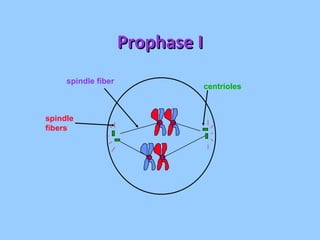
Prophase I Longest and most complex phase (90%). Homologous chromosomes  come together to form a  tetrad  =  Synapsis Tetrad  is two  chromosomes  or four  chromatids   (sister and nonsister chromatids) .
Prophase I  -  Synapsis Homologous chromosomes sister chromatids paternal sister chromatids maternal Tetrad
Prophase I centrioles spindle fiber spindle fibers
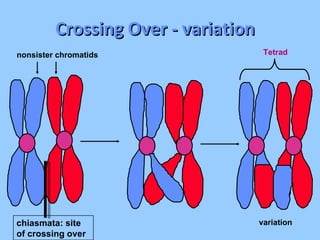
Crossing Over Segments of non-sister  chromatids  break and reattach to the other  chromatid . May occur between non-sister  chromatids  at the  chiasmata . Chiasmata (chiasma)  -  sites of  crossing over .
Crossing Over - variation  variation nonsister chromatids chiasmata: site of crossing over Tetrad
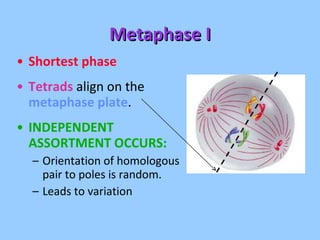
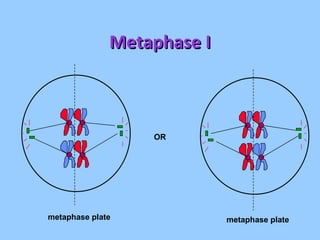
Metaphase I Shortest phase Tetrads  align on the  metaphase plate . INDEPENDENT ASSORTMENT OCCURS: Orientation of homologous pair to poles is random. Leads to variation
Metaphase I metaphase plate OR metaphase plate
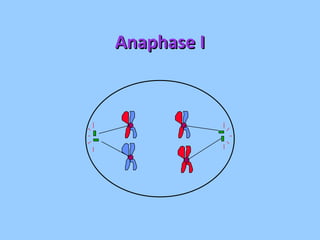
Anaphase I Homologous chromosomes  separate and move towards the poles. Sister chromatids  remain attached at their  centromeres .
Anaphase I
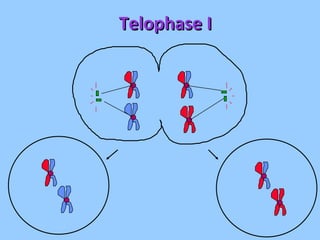
Telophase I Each pole now has  haploid  (1n) set of  chromosomes . Cytokinesis  occurs and two haploid daughter cells are formed.
Telophase I
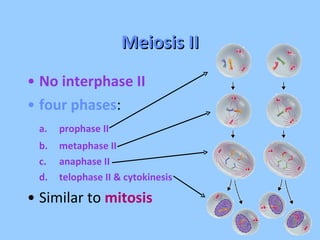
Meiosis II No interphase II  four phases : a. prophase II b. metaphase II c. anaphase II d. telophase II & cytokinesis Similar to  mitosis
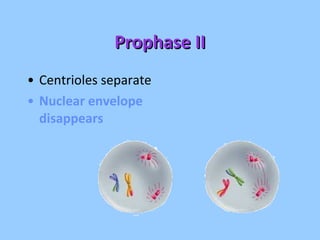
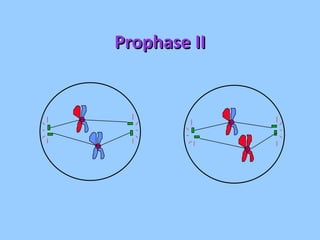
Prophase II Centrioles separate Nuclear envelope disappears
Prophase II
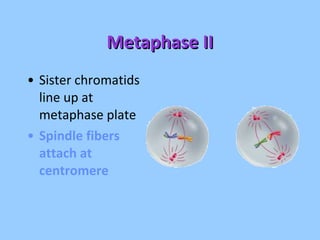
Metaphase II Sister chromatids line up at metaphase plate Spindle fibers attach at centromere
Metaphase II metaphase plate metaphase plate
Anaphase II sister chromatids separate & move  toward opposite ends of the cell
Anaphase II
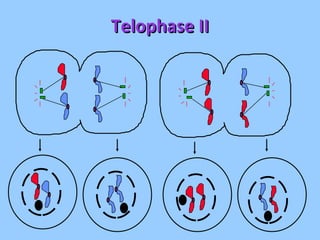
Telophase II Nuclei form. Cytokinesis  occurs. Four haploid daughter cells produced. gametes = sperm or egg
Telophase II
 
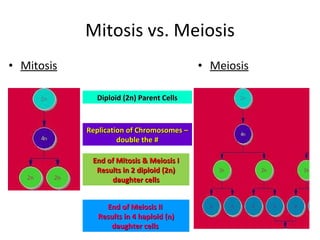
Mitosis vs. Meiosis Mitosis Meiosis Diploid (2n) Parent Cells Replication of Chromosomes – double the # End of Mitosis & Meiosis I Results in 2 diploid (2n) daughter cells End of Meiosis II  Results in 4 haploid (n) daughter cells
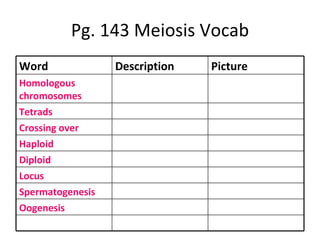
Pg. 143 Meiosis Vocab Word Description Picture Homologous chromosomes Tetrads Crossing over Haploid Diploid Locus Spermatogenesis Oogenesis

Meiosis 2

  • 1.
  • 2.
    Pg. Title:Meiosis Date: 01/27/10 Obj: Describe how spermatogenesis & oogenesis occur through meiosis. Ess: Explain how sperm & egg contain only 23 chromosomes each through meiosis.
  • 3.
    Pg. Title:Meiosis I & II Date: 1/27/10 In: Almost all human cells contain 46 chromosomes. If a sperm has 46 chromosomes & an egg has 46 chromosomes then how many chromosomes will the “baby” have? Is that a good thing???
  • 4.
    M I TO S I S M E I O S I S I M E I O S I S II
  • 5.
    Asexual vs. Sexual Reproduction Asexual Reproduction: Binary Fission & Mitosis Produces cells that are identical copies of parent cell Sexual Reproduction: Meiosis Combines genetic material from 2 parents (sperm & egg) so offspring are genetically different from parents
  • 6.
    How many chromosomesin human cells? Humans have 46 (23 pairs) chromosomes 44 chromosomes (22pairs): autosomal 2 chromosomes (1 pair): sex chromosomes (XX, XY) 2 sets of chromosomes 1 from mom & 1 from dad
  • 7.
    How many chromosomesin human cells? All human cells have 46 chromosomes except for the egg & sperm Egg = 23 Sperm = 23 All other cells = 46 (2 sets of chromosomes) (liver, cardiac, blood cells) Diploid (2N) = 2 sets of chromosomes (46) Haploid (1N) = 1 set of chromosomes (23) N = haploid # 1 set of chromosomes
  • 8.
    If egg andsperm had same number of chromosomes as other body cells . . . baby would have too many chromosomes! No Good! The Problem!
  • 9.
    The Solution! MuchBetter! If egg and sperm had half the number of chromosomes than other body cells . . . baby would have just the right amount!
  • 10.
    Meiosis Makes 4 cells genetically different from parent cell & from each other Production of gametes = sperm & egg Contain half the number of chromosomes = haploid (1N) Called the “reduction” division = Diploid Haploid 2N 1N Used in sexual reproduction 46 23
  • 11.
    Meiosis allows sexcells to join to form a complete set of chromosomes/instructions to make a new organism. Copyright Pearson Prentice Hall Haploid gametes MEIOSIS Diploid zygote MITOSIS Diploid adult Not in notes
  • 12.
    You tell me!Drosophila (fruit flies) Diploid: 2N = 8 Haploid: 1N = ? Lettuce Diploid: 2N = 8 Haploid: 1N = ? Goldfish: Diploid: 2N = ? Haploid: 1N = 48 Not in notes
  • 13.
    Meiosis is aspecial kind of cell division that halves the number of chromosomes in gametes. This insures that the correct number of chromosomes are passed on. Copyright Pearson Prentice Hall Not in notes
  • 14.
    The goal isto make haploid sex cells Copyright Pearson Prentice Hall 1 st division 2 nd division Not in notes
  • 15.
    Where does ithappen? In males- in the testes In females- in the ovaries
  • 16.
    Homologous Chromosomes Homologouschromosomes sister chromatids paternal sister chromatids maternal Tetrad
  • 17.
    Check out thetetrads!
  • 18.
    Homologous Chromosomes Pairof chromosomes - maternal & paternal - similar in shape & size. Homologous pairs – tetrads - carry genes controlling the same inherited traits. Each locus - position of a gene - is in the same position on tetrads.
  • 19.
    Homologous Chromosomes PaternalMaternal eye color locus eye color locus hair color locus hair color locus
  • 20.
    Gametes: Sperm or egg Copyright Pearson Prentice Hall
  • 21.
  • 22.
    Gametogenesis Oogenesis: productionof egg Meiosis I Meiosis II
  • 23.
  • 24.
    Remember, humans have23 pairs of chromosomes……………. Pairs 1-22 are said to be Homologous chromosomes (they go together because they have same traits but are not identical) Copyright Pearson Prentice Hall gene for eye color gene for hair color
  • 25.
    Phases of MeiosisMeiosis I Copyright Pearson Prentice Hall Prophase I Metaphase I Anaphase I Telophase I and Cytokinesis Interphase I Meiosis I
  • 26.
    Phases of MeiosisCells undergo a round of DNA replication, forming duplicate chromosomes. Copyright Pearson Prentice Hall Interphase I
  • 27.
    Phases of MeiosisEach chromosome pairs with its corresponding homologous chromosome to form a tetrad . There are 4 chromatids in a tetrad . Copyright Pearson Prentice Hall MEIOSIS I Prophase I
  • 28.
    Phases of MeiosisCrossing-over: Homologous chromosomes exchange portions of their chromatids in a process Crossing-over produces new combinations of alleles. Copyright Pearson Prentice Hall
  • 29.
    Synapsis and CrossingOver in Action Copyright Pearson Prentice Hall
  • 30.
    Phases of MeiosisSpindle fibers attach to the chromosomes. Tetrads line up in the middle: metaphase plate. Copyright Pearson Prentice Hall MEIOSIS I Metaphase I
  • 31.
    Phases of MeiosisSpindle fibers pull the homologous chromosomes toward opposite ends of the cell. Tetrads split into single chromosomes. Copyright Pearson Prentice Hall MEIOSIS I Anaphase I
  • 32.
    Phases of MeiosisNuclear membranes form. Cell separates into two cells. The two cells produced have chromosomes and alleles that are different from each other and from the diploid cell that entered meiosis I. Copyright Pearson Prentice Hall MEIOSIS I Telophase I and Cytokinesis
  • 33.
    Phases of MeiosisMeiosis II The two cells produced by meiosis I now enter a second meiotic division. Unlike meiosis I, neither cell goes through chromosome replication. Each of the cell’s chromosomes has 2 chromatids. Copyright Pearson Prentice Hall
  • 34.
    Phases of MeiosisMeiosis II Copyright Pearson Prentice Hall Telophase II and Cytokinesis Prophase II Metaphase II Anaphase II Telophase I and Cytokinesis I Meiosis II
  • 35.
    Phases of MeiosisMeiosis I results in two haploid (N) daughter cells, each with half the number of chromosomes as the original cell. Copyright Pearson Prentice Hall MEIOSIS II Prophase II
  • 36.
    Phases of MeiosisThe chromosomes line up in the center of cell. Copyright Pearson Prentice Hall MEIOSIS II Metaphase II
  • 37.
    Phases of MeiosisThe sister chromatids separate and move toward opposite ends of the cell. Copyright Pearson Prentice Hall MEIOSIS II Anaphase II
  • 38.
    Phases of MeiosisMeiosis II results in four haploid (N) daughter cells. Copyright Pearson Prentice Hall MEIOSIS II Telophase II and Cytokinesis
  • 39.
    Gametes: Sperm or egg Copyright Pearson Prentice Hall
  • 40.
  • 41.
    Gametogenesis Oogenesis: productionof egg Meiosis I Meiosis II
  • 42.
  • 43.
    Gamete Formation GameteFormation In male animals, meiosis results in four equal-sized gametes called sperm. Copyright Pearson Prentice Hall
  • 44.
    Gamete Formation Inmany female animals, only one egg results from meiosis. The other three cells, called polar bodies , are usually not involved in reproduction. Copyright Pearson Prentice Hall
  • 45.
    Interphase I DNA replicates forming duplicate homologous chromosomes. (S phase). Centriole pairs also replicate. Nucleus & nucleolus visible.
  • 46.
    Meiosis I Celldivision that reduces the chromosome number by one-half. four phases : a. prophase I b. metaphase I c. anaphase I d. telophase I & cytokinesis Prophase I Metaphase I Anaphase I Telophase I & Cytokinesis
  • 47.
    Prophase I Longestand most complex phase (90%). Homologous chromosomes come together to form a tetrad = Synapsis Tetrad is two chromosomes or four chromatids (sister and nonsister chromatids) .
  • 48.
    Prophase I - Synapsis Homologous chromosomes sister chromatids paternal sister chromatids maternal Tetrad
  • 49.
    Prophase I centriolesspindle fiber spindle fibers
  • 50.
    Crossing Over Segmentsof non-sister chromatids break and reattach to the other chromatid . May occur between non-sister chromatids at the chiasmata . Chiasmata (chiasma) - sites of crossing over .
  • 51.
    Crossing Over -variation variation nonsister chromatids chiasmata: site of crossing over Tetrad
  • 52.
    Metaphase I Shortestphase Tetrads align on the metaphase plate . INDEPENDENT ASSORTMENT OCCURS: Orientation of homologous pair to poles is random. Leads to variation
  • 53.
    Metaphase I metaphaseplate OR metaphase plate
  • 54.
    Anaphase I Homologouschromosomes separate and move towards the poles. Sister chromatids remain attached at their centromeres .
  • 55.
  • 56.
    Telophase I Eachpole now has haploid (1n) set of chromosomes . Cytokinesis occurs and two haploid daughter cells are formed.
  • 57.
  • 58.
    Meiosis II Nointerphase II four phases : a. prophase II b. metaphase II c. anaphase II d. telophase II & cytokinesis Similar to mitosis
  • 59.
    Prophase II Centriolesseparate Nuclear envelope disappears
  • 60.
  • 61.
    Metaphase II Sisterchromatids line up at metaphase plate Spindle fibers attach at centromere
  • 62.
    Metaphase II metaphaseplate metaphase plate
  • 63.
    Anaphase II sisterchromatids separate & move toward opposite ends of the cell
  • 64.
  • 65.
    Telophase II Nucleiform. Cytokinesis occurs. Four haploid daughter cells produced. gametes = sperm or egg
  • 66.
  • 67.
  • 68.
    Mitosis vs. MeiosisMitosis Meiosis Diploid (2n) Parent Cells Replication of Chromosomes – double the # End of Mitosis & Meiosis I Results in 2 diploid (2n) daughter cells End of Meiosis II Results in 4 haploid (n) daughter cells
  • 69.
    Pg. 143 MeiosisVocab Word Description Picture Homologous chromosomes Tetrads Crossing over Haploid Diploid Locus Spermatogenesis Oogenesis