Chapter five :
Cell Division Cycle
Part 1: MITOSIS
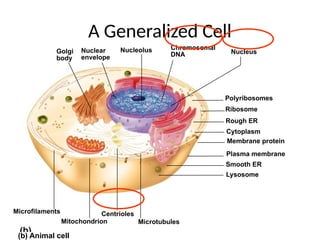
A Generalized Cell
Golgi
body
Nuclear
envelope
Chromosomal
DNA Nucleus
Nucleolus
Polyribosomes
Ribosome
Rough ER
Cytoplasm
Membrane protein
Plasma membrane
Smooth ER
Mitochondrion
Centrioles
Microtubules
Microfilaments
Lysosome
(b) Animal cell
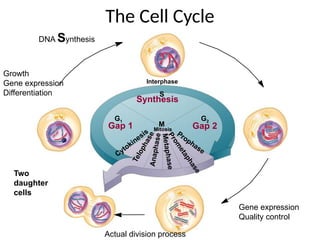
The Cell Cycle
G1 G2
S
Two
daughter
cells
M
Cytokinesis
T
e
l
o
p
h
a
s
e
A
n
a
p
h
a
s
e
M
e
t
a
p
h
a
s
e
P
r
o
m
e
t
a
p
h
a
s
e
Prophase
Mitosis
Interphase
Gap 1 Gap 2
Synthesis
Growth
Gene expression
Differentiation
DNA Synthesis
Gene expression
Quality control
Actual division process
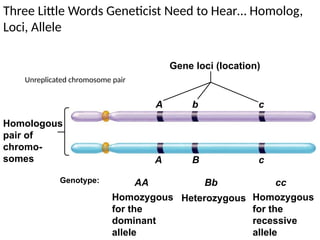
Three Little Words Geneticist Need to Hear… Homolog,
Loci, Allele
Homologous
pair of
chromo-
somes
Gene loci (location)
A b c
A B c
AA Bb cc
Genotype:
Homozygous
for the
dominant
allele
Heterozygous Homozygous
for the
recessive
allele
Unreplicated chromosome pair
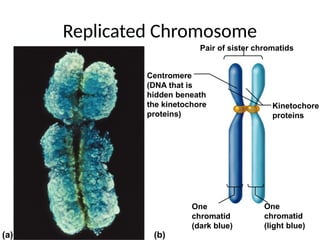
Replicated Chromosome
Pair of sister chromatids
Kinetochore
proteins
Centromere
(DNA that is
hidden beneath
the kinetochore
proteins)
One
chromatid
(dark blue)
One
chromatid
(light blue)
(b)
(a)
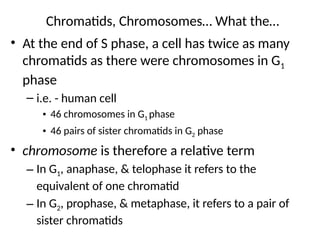
• At the end of S phase, a cell has twice as many
chromatids as there were chromosomes in G1
phase
– i.e. - human cell
• 46 chromosomes in G1 phase
• 46 pairs of sister chromatids in G2 phase
• chromosome is therefore a relative term
– In G1, anaphase, & telophase it refers to the
equivalent of one chromatid
– In G2, prophase, & metaphase, it refers to a pair of
sister chromatids
Chromatids, Chromosomes… What the…
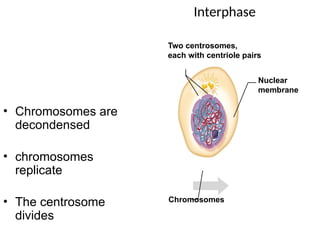
Interphase
• Chromosomes are
decondensed
• chromosomes
replicate
• The centrosome
divides
Nuclear
membrane
Chromosomes
Two centrosomes,
each with centriole pairs
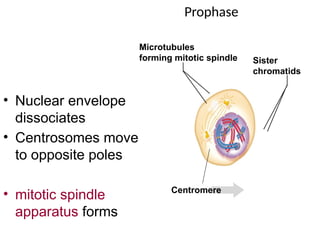
Prophase
• Nuclear envelope
dissociates
• Centrosomes move
to opposite poles
• mitotic spindle
apparatus forms
Microtubules
forming mitotic spindle Sister
chromatids
Centromere
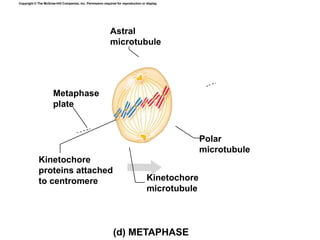
Copyright © The McGraw-Hill Companies, Inc. Permission required for reproduction or display.
Polar
microtubule
Kinetochore
proteins attached
to centromere Kinetochore
microtubule
Astral
microtubule
Metaphase
plate
(d) METAPHASE
Spindle Apparatus
• Composed of microtubules originated from
centrioles
• Microtubules are formed polymerization of tubulin
proteins
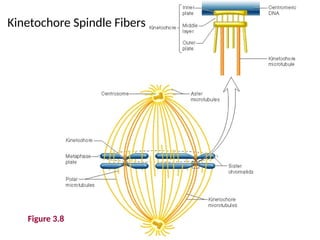
• 3 types of spindle microtubules
– Aster microtubules
• Important for positioning of the spindle apparatus
– Polar microtubules
• Help to “push” the poles away from each other
– Kinetochore microtubules
• Attach to kinetochore , at the centromere
Figure 3.8
Kinetochore Spindle Fibers
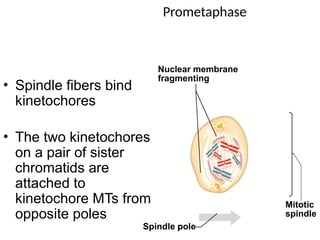
Prometaphase
• Spindle fibers bind
kinetochores
• The two kinetochores
on a pair of sister
chromatids are
attached to
kinetochore MTs from
opposite poles
Nuclear membrane
fragmenting
Spindle pole
Mitotic
spindle
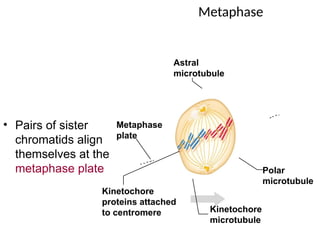
Metaphase
• Pairs of sister
chromatids align
themselves at the
metaphase plate Polar
microtubule
Kinetochore
proteins attached
to centromere Kinetochore
microtubule
Astral
microtubule
Metaphase
plate
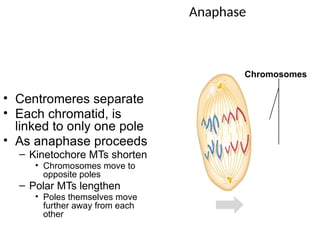
Anaphase
• Centromeres separate
• Each chromatid, is
linked to only one pole
• As anaphase proceeds
– Kinetochore MTs shorten
• Chromosomes move to
opposite poles
– Polar MTs lengthen
• Poles themselves move
further away from each
other
Chromosomes
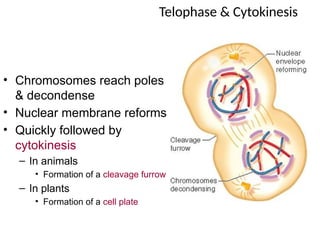
Telophase & Cytokinesis
• Chromosomes reach poles
& decondense
• Nuclear membrane reforms
• Quickly followed by
cytokinesis
– In animals
• Formation of a cleavage furrow
– In plants
• Formation of a cell plate
• Mitosis ultimately produces two daughter
cells genetically identical to the mother cell
– Barring rare mutations
• Processes requireing mitotic cell division
– Development of multicellularity
– Organismal growth
– Wound repair
– Tissue regeneration
Some Key Points
Cell division
Part 2:
MEIOSIS
Organisms that reproduce Sexually are made
up of two different types of cells.
1. Somatic Cells are “body” cells and contain the normal
number of chromosomes ….called the “Diploid”
number (the symbol is 2n). Examples would be … skin
cells, brain cells, etc.
2. Gametes are the “sex” cells and contain only ½ the
normal number of chromosomes…. called the
“Haploid” number (the symbol is n)….. Sperm cells and
ova are gametes.
n = number of chromosomes in the set… so….2n means 2 chromosomes in the
set…. Polyploid cells have more than two chromosomes per set… example: 3n (3
chromosomes per set)
Gametes
• The Male Gamete is the Sperm and is produced
in the male gonad the Testes.
• The Female Gamete is the Ovum (ova = pl.) and is
produced in the female gonad the Ovaries.
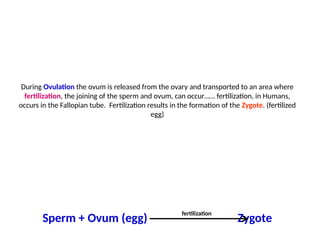
During Ovulation the ovum is released from the ovary and transported to an area where
fertilization, the joining of the sperm and ovum, can occur…… fertilization, in Humans,
occurs in the Fallopian tube. Fertilization results in the formation of the Zygote. (fertilized
egg)
Sperm + Ovum (egg) Zygote
fertilization
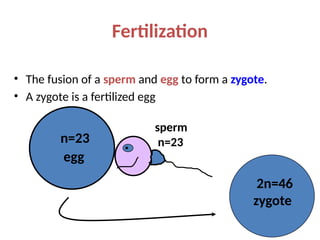
Fertilization
• The fusion of a sperm and egg to form a zygote.
• A zygote is a fertilized egg
n=23
egg
sperm
n=23
2n=46
zygote
Chromosomes
• If an organism has the Diploid number (2n) it has two
matching homologues per set. One of the homologues
comes from the mother (and has the mother’s DNA).…
the other homologue comes from the father (and has the
father’s DNA).
• Most organisms are diploid. Humans have 23 sets of
chromosomes… therefore humans have 46 total
chromosomes….. The diploid number for humans is 46
(46 chromosomes per cell).
Homologous Chromosomes
• Pair of chromosomes (maternal and paternal) that are similar in
shape and size.
• Homologous pairs (tetrads) carry genes controlling the same
inherited traits.
• Each locus (position of a gene) is in the same position on
homologues.
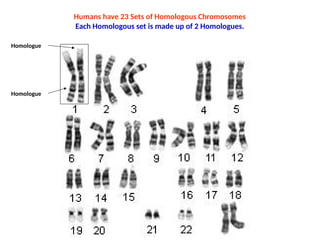
• Humans have 23 pairs of homologous chromosomes.
22 pairs of autosomes
1 pair of sex chromosomes
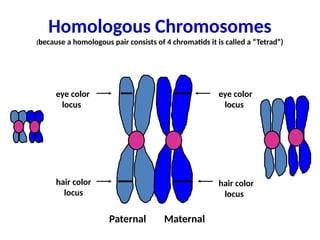
Homologous Chromosomes
(because a homologous pair consists of 4 chromatids it is called a “Tetrad”)
Paternal Maternal
eye color
locus
eye color
locus
hair color
locus
hair color
locus
Humans have 23 Sets of Homologous Chromosomes
Each Homologous set is made up of 2 Homologues.
Homologue
Homologue
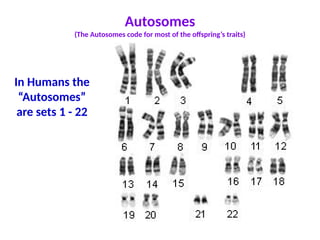
Autosomes
(The Autosomes code for most of the offspring’s traits)
In Humans the
“Autosomes”
are sets 1 - 22
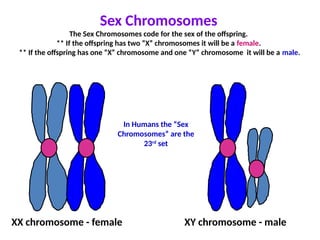
Sex Chromosomes
The Sex Chromosomes code for the sex of the offspring.
** If the offspring has two “X” chromosomes it will be a female.
** If the offspring has one “X” chromosome and one “Y” chromosome it will be a male.
XX chromosome - female XY chromosome - male
In Humans the “Sex
Chromosomes” are the
23rd
set
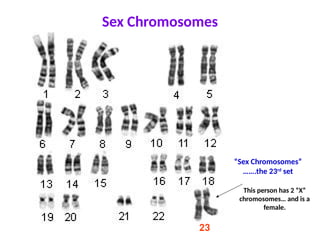
Sex Chromosomes
“Sex Chromosomes”
…….the 23rd
set
23
This person has 2 “X”
chromosomes… and is a
female.
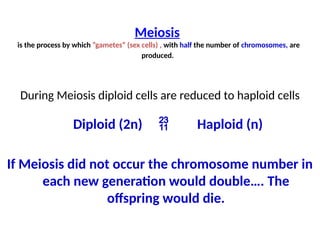
Meiosis
is the process by which ”gametes” (sex cells) , with half the number of chromosomes, are
produced.
During Meiosis diploid cells are reduced to haploid cells
Diploid (2n)  Haploid (n)
If Meiosis did not occur the chromosome number in
each new generation would double…. The
offspring would die.
Meiosis
Meiosis is Two cell divisions
(called meiosis I and meiosis II)
with only one duplication of chromosomes.
Meiosis in males is called spermatogenesis
and produces sperm.
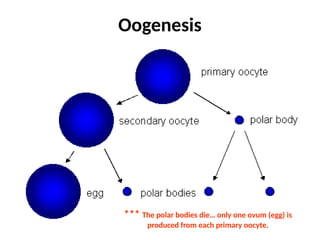
Meiosis in females is called oogenesis and
produces ova.
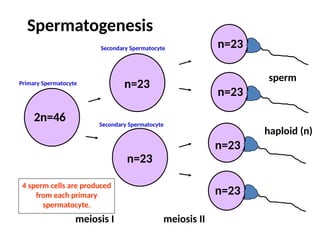
Spermatogenesis
2n=46
human
sex cell
diploid (2n)
n=23
n=23
meiosis I
n=23
n=23
n=23
n=23
sperm
haploid (n)
meiosis II
4 sperm cells are produced
from each primary
spermatocyte.
Primary Spermatocyte
Secondary Spermatocyte
Oogenesis
*** The polar bodies die… only one ovum (egg) is
produced from each primary oocyte.
Interphase I
• Similar to mitosis interphase.
• Chromosomes replicate (S phase).
• Each duplicated chromosome consist of two identical
sister chromatids attached at their centromeres.
• Centriole pairs also replicate.
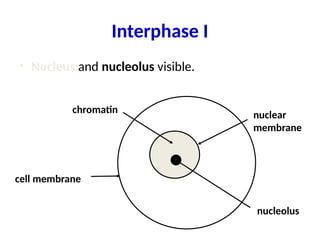
Interphase I
• Nucleus and nucleolus visible.
nuclear
membrane
nucleolus
cell membrane
chromatin
Meiosis I (four phases)
• Cell division that reduces the chromosome number
by one-half.
• four phases:
a. prophase I
b. metaphase I
c. anaphase I
d. telophase I
Prophase I
• Longest and most complex phase.
• 90% of the meiotic process is spent in Prophase I
• Chromosomes condense.
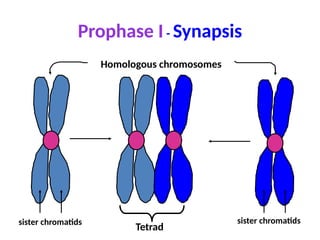
• Synapsis occurs: homologous chromosomes come together
to form a tetrad.
• Tetrad is two chromosomes or four chromatids (sister and
nonsister chromatids).
Prophase I - Synapsis
Homologous chromosomes
sister chromatids sister chromatids
Tetrad
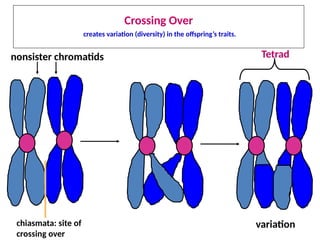
During Prophase I
“Crossing Over” occurs.
• During Crossing over segments of nonsister
chromatids break and reattach to the other
chromatid. The Chiasmata (chiasma) are the
sites of crossing over.
Crossing Over is one of the Two major occurrences of Meiosis
(The other is Non-disjunction)
Crossing Over
creates variation (diversity) in the offspring’s traits.
nonsister chromatids
chiasmata: site of
crossing over
variation
Tetrad
Question:
• A cell containing 20 chromosomes (diploid) at
the beginning of meiosis would, at its completion,
produce cells containing how many
chromosomes?
Answer:
• 10 chromosomes (haploid)
Question:
• A cell containing 40 chromatids at the beginning of
meiosis would, at its completion, produce cells
containing how many chromosomes?
Answer:
• 10 chromosomes
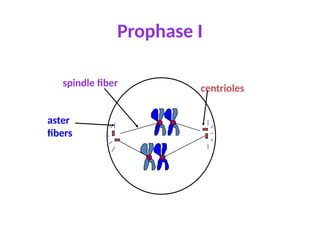
Prophase I
centrioles
spindle fiber
aster
fibers
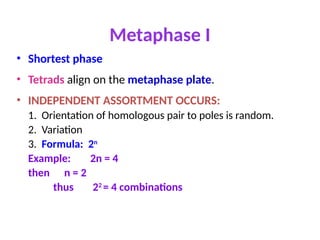
Metaphase I
• Shortest phase
• Tetrads align on the metaphase plate.
• INDEPENDENT ASSORTMENT OCCURS:
1. Orientation of homologous pair to poles is random.
2. Variation
3. Formula: 2n
Example: 2n = 4
then n = 2
thus 22
= 4 combinations
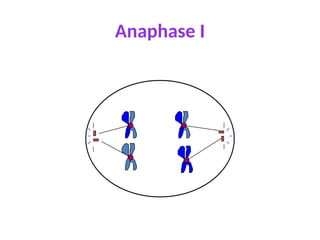
Anaphase I
• Homologous chromosomes separate and move
towards the poles.
• Sister chromatids remain attached at their
centromeres.
Anaphase I
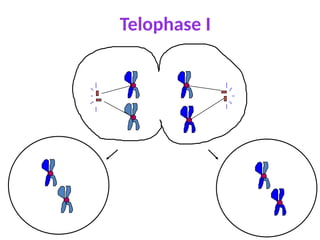
Telophase I
• Each pole now has haploid set of chromosomes.
• Cytokinesis occurs and two haploid daughter cells
are formed.
Telophase I
Meiosis II
• No interphase II
(or very short - no more DNA replication)
• Remember: Meiosis II is similar to mitosis
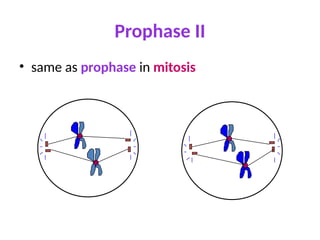
Prophase II
• same as prophase in mitosis
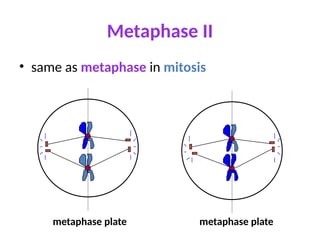
Metaphase II
• same as metaphase in mitosis
metaphase plate
metaphase plate
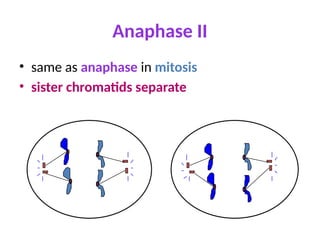
Anaphase II
• same as anaphase in mitosis
• sister chromatids separate
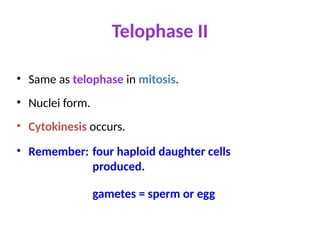
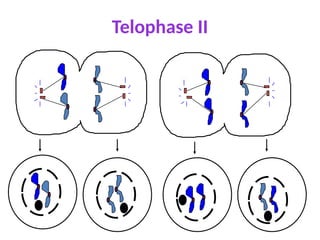
Telophase II
• Same as telophase in mitosis.
• Nuclei form.
• Cytokinesis occurs.
• Remember: four haploid daughter cells
produced.
gametes = sperm or egg
Telophase II
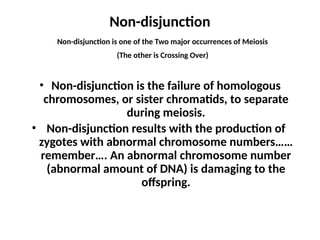
Non-disjunction
• Non-disjunction is the failure of homologous
chromosomes, or sister chromatids, to separate
during meiosis.
• Non-disjunction results with the production of
zygotes with abnormal chromosome numbers……
remember…. An abnormal chromosome number
(abnormal amount of DNA) is damaging to the
offspring.
Non-disjunction is one of the Two major occurrences of Meiosis
(The other is Crossing Over)

chapter five cell division cycle mitosis.pptx

  • 1.
    Chapter five : CellDivision Cycle Part 1: MITOSIS
  • 2.
    A Generalized Cell Golgi body Nuclear envelope Chromosomal DNANucleus Nucleolus Polyribosomes Ribosome Rough ER Cytoplasm Membrane protein Plasma membrane Smooth ER Mitochondrion Centrioles Microtubules Microfilaments Lysosome (b) Animal cell
  • 3.
    The Cell Cycle G1G2 S Two daughter cells M Cytokinesis T e l o p h a s e A n a p h a s e M e t a p h a s e P r o m e t a p h a s e Prophase Mitosis Interphase Gap 1 Gap 2 Synthesis Growth Gene expression Differentiation DNA Synthesis Gene expression Quality control Actual division process
  • 4.
    Three Little WordsGeneticist Need to Hear… Homolog, Loci, Allele Homologous pair of chromo- somes Gene loci (location) A b c A B c AA Bb cc Genotype: Homozygous for the dominant allele Heterozygous Homozygous for the recessive allele Unreplicated chromosome pair
  • 5.
    Replicated Chromosome Pair ofsister chromatids Kinetochore proteins Centromere (DNA that is hidden beneath the kinetochore proteins) One chromatid (dark blue) One chromatid (light blue) (b) (a)
  • 6.
    • At theend of S phase, a cell has twice as many chromatids as there were chromosomes in G1 phase – i.e. - human cell • 46 chromosomes in G1 phase • 46 pairs of sister chromatids in G2 phase • chromosome is therefore a relative term – In G1, anaphase, & telophase it refers to the equivalent of one chromatid – In G2, prophase, & metaphase, it refers to a pair of sister chromatids Chromatids, Chromosomes… What the…
  • 7.
    Interphase • Chromosomes are decondensed •chromosomes replicate • The centrosome divides Nuclear membrane Chromosomes Two centrosomes, each with centriole pairs
  • 8.
    Prophase • Nuclear envelope dissociates •Centrosomes move to opposite poles • mitotic spindle apparatus forms Microtubules forming mitotic spindle Sister chromatids Centromere
  • 9.
    Copyright © TheMcGraw-Hill Companies, Inc. Permission required for reproduction or display. Polar microtubule Kinetochore proteins attached to centromere Kinetochore microtubule Astral microtubule Metaphase plate (d) METAPHASE
  • 10.
    Spindle Apparatus • Composedof microtubules originated from centrioles • Microtubules are formed polymerization of tubulin proteins • 3 types of spindle microtubules – Aster microtubules • Important for positioning of the spindle apparatus – Polar microtubules • Help to “push” the poles away from each other – Kinetochore microtubules • Attach to kinetochore , at the centromere
  • 11.
  • 12.
    Prometaphase • Spindle fibersbind kinetochores • The two kinetochores on a pair of sister chromatids are attached to kinetochore MTs from opposite poles Nuclear membrane fragmenting Spindle pole Mitotic spindle
  • 13.
    Metaphase • Pairs ofsister chromatids align themselves at the metaphase plate Polar microtubule Kinetochore proteins attached to centromere Kinetochore microtubule Astral microtubule Metaphase plate
  • 14.
    Anaphase • Centromeres separate •Each chromatid, is linked to only one pole • As anaphase proceeds – Kinetochore MTs shorten • Chromosomes move to opposite poles – Polar MTs lengthen • Poles themselves move further away from each other Chromosomes
  • 15.
    Telophase & Cytokinesis •Chromosomes reach poles & decondense • Nuclear membrane reforms • Quickly followed by cytokinesis – In animals • Formation of a cleavage furrow – In plants • Formation of a cell plate
  • 16.
    • Mitosis ultimatelyproduces two daughter cells genetically identical to the mother cell – Barring rare mutations • Processes requireing mitotic cell division – Development of multicellularity – Organismal growth – Wound repair – Tissue regeneration Some Key Points
  • 17.
  • 18.
    Organisms that reproduceSexually are made up of two different types of cells. 1. Somatic Cells are “body” cells and contain the normal number of chromosomes ….called the “Diploid” number (the symbol is 2n). Examples would be … skin cells, brain cells, etc. 2. Gametes are the “sex” cells and contain only ½ the normal number of chromosomes…. called the “Haploid” number (the symbol is n)….. Sperm cells and ova are gametes. n = number of chromosomes in the set… so….2n means 2 chromosomes in the set…. Polyploid cells have more than two chromosomes per set… example: 3n (3 chromosomes per set)
  • 19.
    Gametes • The MaleGamete is the Sperm and is produced in the male gonad the Testes. • The Female Gamete is the Ovum (ova = pl.) and is produced in the female gonad the Ovaries.
  • 20.
    During Ovulation theovum is released from the ovary and transported to an area where fertilization, the joining of the sperm and ovum, can occur…… fertilization, in Humans, occurs in the Fallopian tube. Fertilization results in the formation of the Zygote. (fertilized egg) Sperm + Ovum (egg) Zygote fertilization
  • 21.
    Fertilization • The fusionof a sperm and egg to form a zygote. • A zygote is a fertilized egg n=23 egg sperm n=23 2n=46 zygote
  • 22.
    Chromosomes • If anorganism has the Diploid number (2n) it has two matching homologues per set. One of the homologues comes from the mother (and has the mother’s DNA).… the other homologue comes from the father (and has the father’s DNA). • Most organisms are diploid. Humans have 23 sets of chromosomes… therefore humans have 46 total chromosomes….. The diploid number for humans is 46 (46 chromosomes per cell).
  • 23.
    Homologous Chromosomes • Pairof chromosomes (maternal and paternal) that are similar in shape and size. • Homologous pairs (tetrads) carry genes controlling the same inherited traits. • Each locus (position of a gene) is in the same position on homologues. • Humans have 23 pairs of homologous chromosomes. 22 pairs of autosomes 1 pair of sex chromosomes
  • 24.
    Homologous Chromosomes (because ahomologous pair consists of 4 chromatids it is called a “Tetrad”) Paternal Maternal eye color locus eye color locus hair color locus hair color locus
  • 25.
    Humans have 23Sets of Homologous Chromosomes Each Homologous set is made up of 2 Homologues. Homologue Homologue
  • 26.
    Autosomes (The Autosomes codefor most of the offspring’s traits) In Humans the “Autosomes” are sets 1 - 22
  • 27.
    Sex Chromosomes The SexChromosomes code for the sex of the offspring. ** If the offspring has two “X” chromosomes it will be a female. ** If the offspring has one “X” chromosome and one “Y” chromosome it will be a male. XX chromosome - female XY chromosome - male In Humans the “Sex Chromosomes” are the 23rd set
  • 28.
    Sex Chromosomes “Sex Chromosomes” …….the23rd set 23 This person has 2 “X” chromosomes… and is a female.
  • 29.
    Meiosis is the processby which ”gametes” (sex cells) , with half the number of chromosomes, are produced. During Meiosis diploid cells are reduced to haploid cells Diploid (2n)  Haploid (n) If Meiosis did not occur the chromosome number in each new generation would double…. The offspring would die.
  • 30.
    Meiosis Meiosis is Twocell divisions (called meiosis I and meiosis II) with only one duplication of chromosomes.
  • 31.
    Meiosis in malesis called spermatogenesis and produces sperm. Meiosis in females is called oogenesis and produces ova.
  • 32.
    Spermatogenesis 2n=46 human sex cell diploid (2n) n=23 n=23 meiosisI n=23 n=23 n=23 n=23 sperm haploid (n) meiosis II 4 sperm cells are produced from each primary spermatocyte. Primary Spermatocyte Secondary Spermatocyte Secondary Spermatocyte
  • 33.
    Oogenesis *** The polarbodies die… only one ovum (egg) is produced from each primary oocyte.
  • 34.
    Interphase I • Similarto mitosis interphase. • Chromosomes replicate (S phase). • Each duplicated chromosome consist of two identical sister chromatids attached at their centromeres. • Centriole pairs also replicate.
  • 35.
    Interphase I • Nucleusand nucleolus visible. nuclear membrane nucleolus cell membrane chromatin
  • 36.
    Meiosis I (fourphases) • Cell division that reduces the chromosome number by one-half. • four phases: a. prophase I b. metaphase I c. anaphase I d. telophase I
  • 37.
    Prophase I • Longestand most complex phase. • 90% of the meiotic process is spent in Prophase I • Chromosomes condense. • Synapsis occurs: homologous chromosomes come together to form a tetrad. • Tetrad is two chromosomes or four chromatids (sister and nonsister chromatids).
  • 38.
    Prophase I -Synapsis Homologous chromosomes sister chromatids sister chromatids Tetrad
  • 39.
    During Prophase I “CrossingOver” occurs. • During Crossing over segments of nonsister chromatids break and reattach to the other chromatid. The Chiasmata (chiasma) are the sites of crossing over. Crossing Over is one of the Two major occurrences of Meiosis (The other is Non-disjunction)
  • 40.
    Crossing Over creates variation(diversity) in the offspring’s traits. nonsister chromatids chiasmata: site of crossing over variation Tetrad
  • 41.
    Question: • A cellcontaining 20 chromosomes (diploid) at the beginning of meiosis would, at its completion, produce cells containing how many chromosomes?
  • 42.
  • 43.
    Question: • A cellcontaining 40 chromatids at the beginning of meiosis would, at its completion, produce cells containing how many chromosomes?
  • 44.
  • 45.
  • 46.
    Metaphase I • Shortestphase • Tetrads align on the metaphase plate. • INDEPENDENT ASSORTMENT OCCURS: 1. Orientation of homologous pair to poles is random. 2. Variation 3. Formula: 2n Example: 2n = 4 then n = 2 thus 22 = 4 combinations
  • 47.
    Anaphase I • Homologouschromosomes separate and move towards the poles. • Sister chromatids remain attached at their centromeres.
  • 48.
  • 49.
    Telophase I • Eachpole now has haploid set of chromosomes. • Cytokinesis occurs and two haploid daughter cells are formed.
  • 50.
  • 51.
    Meiosis II • Nointerphase II (or very short - no more DNA replication) • Remember: Meiosis II is similar to mitosis
  • 52.
    Prophase II • sameas prophase in mitosis
  • 53.
    Metaphase II • sameas metaphase in mitosis metaphase plate metaphase plate
  • 54.
    Anaphase II • sameas anaphase in mitosis • sister chromatids separate
  • 55.
    Telophase II • Sameas telophase in mitosis. • Nuclei form. • Cytokinesis occurs. • Remember: four haploid daughter cells produced. gametes = sperm or egg
  • 56.
  • 57.
    Non-disjunction • Non-disjunction isthe failure of homologous chromosomes, or sister chromatids, to separate during meiosis. • Non-disjunction results with the production of zygotes with abnormal chromosome numbers…… remember…. An abnormal chromosome number (abnormal amount of DNA) is damaging to the offspring. Non-disjunction is one of the Two major occurrences of Meiosis (The other is Crossing Over)