Th
e
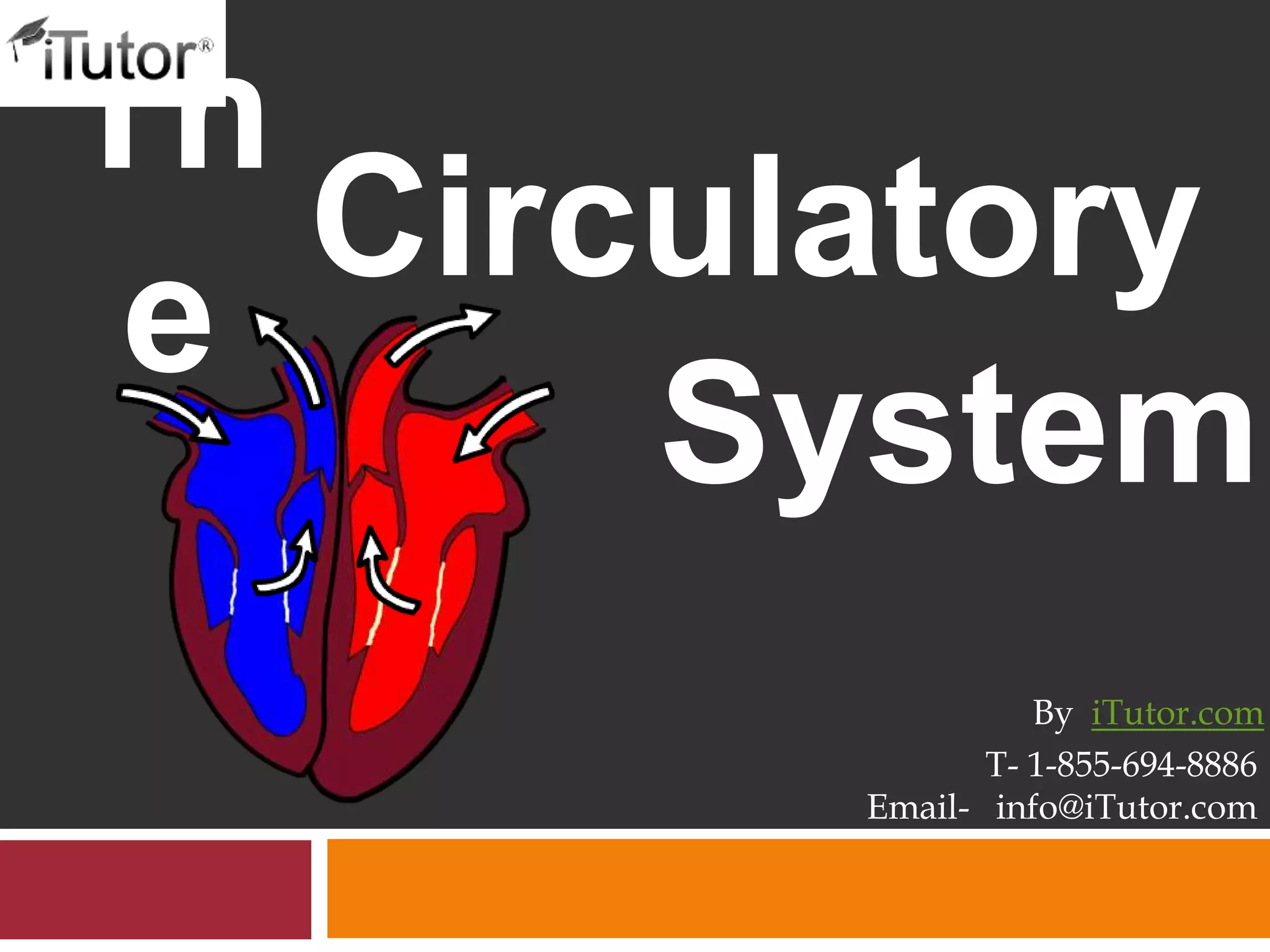
Circulatory
System
T- 1-855-694-8886
Email- info@iTutor.com
By iTutor.com
 The Circulatory System is responsible
for transporting materials throughout
the entire body.
 It transports nutrients, water, and
oxygen to your billions of body cells
and carries away wastes such as
carbon dioxide that body cells
produce.
 It is an amazing highway that travels
through your entire body connecting
all your body cells.
© iTutor. 2000-2013. All Rights Reserved
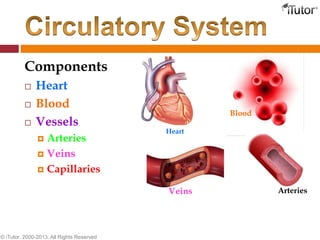
Components
 Heart
 Blood
 Vessels
 Arteries
 Veins
 Capillaries
Heart
Blood
ArteriesVeins
© iTutor. 2000-2013. All Rights Reserved
 Which gases are transported to and from the body’s
cells by the blood flowing in the circulatory system?
carbon
dioxide
oxygen
Oxygen is the gas needed for respiration and is
transported to the body’s cells.
© iTutor. 2000-2013. All Rights Reserved
 The circulatory system carries two types of blood
 Arrangement of the circulatory system means that these
two types of blood do not mix.
Oxygen-rich
blood
c
Oxygen-poor
blood
 Blood travelling
to the body cells
 High oxygen content
 Low carbon dioxide content
 Blood travelling
away from the body cells
 Low oxygen content
 High carbon dioxide content
© iTutor. 2000-2013. All Rights Reserved
 The heart is the organ at the centre of the circulatory
system. It pumps blood around the body.
© iTutor. 2000-2013. All Rights Reserved
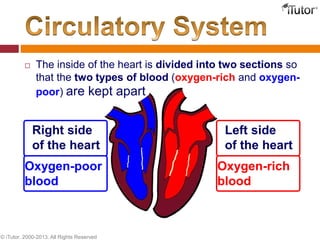
 The inside of the heart is divided into two sections so
that the two types of blood (oxygen-rich and oxygen-
poor) are kept apart
Oxygen-poor
blood
Right side
of the heart
Oxygen-rich
blood
Left side
of the heart
© iTutor. 2000-2013. All Rights Reserved
 Heart coverings
 Pericardium
 Covers the heart and large blood vessels attached to
the heart
 Visceral pericardium
 Innermost layer
 Directly on the heart
 Parietal pericardium
 Layer on top of the visceral pericardium
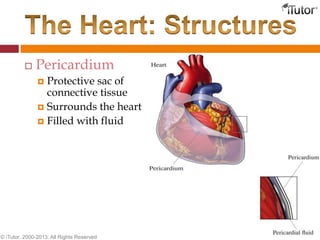
 Pericardium
 Protective sac of
connective tissue
 Surrounds the heart
 Filled with fluid
© iTutor. 2000-2013. All Rights Reserved
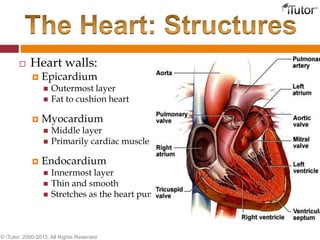
 Heart walls:
 Epicardium
 Outermost layer
 Fat to cushion heart
 Myocardium
 Middle layer
 Primarily cardiac muscle
 Endocardium
 Innermost layer
 Thin and smooth
 Stretches as the heart pumps
© iTutor. 2000-2013. All Rights Reserved
 Myocardium
 The muscle of the heart
 Strong and thick
 Composed of spontaneously
contracting cardiac muscle
fibers
 Can conduct electricity like
nerves.
 It’s blood supply comes
from the coronary arteries.
© iTutor. 2000-2013. All Rights Reserved
 The right and left sides of the heart are separated by a
septum, or wall.
 The septum prevents the mixing of oxygen rich and
oxygen poor blood.
 On each side of the septum are two chambers.
 The upper chamber (receives blood) is the atrium.
 The lower chamber (pumps blood out of heart) is the
ventricle.
© iTutor. 2000-2013. All Rights Reserved
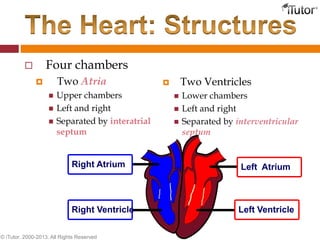
 Four chambers
 Two Atria
 Upper chambers
 Left and right
 Separated by interatrial
septum
 Two Ventricles
 Lower chambers
 Left and right
 Separated by interventricular
septum
© iTutor. 2000-2013. All Rights Reserved
Right Ventricle
Right Atrium
Left Ventricle
Left Atrium
 The chambers of the heart have different functions:
blood to
the body
blood from
the body
blood to
the lungs
blood from
the lungs
The Atria
collect blood
that enters the
heart.
The ventricles
pump blood
out of the
heart.
© iTutor. 2000-2013. All Rights Reserved
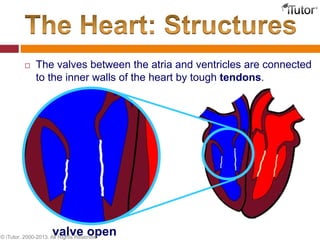
 The valves between the atria and ventricles are connected
to the inner walls of the heart by tough tendons.
valve open© iTutor. 2000-2013. All Rights Reserved
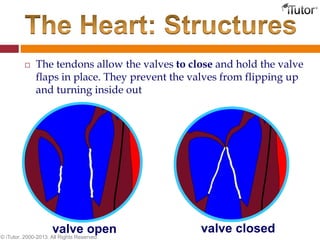
 The tendons allow the valves to close and hold the valve
flaps in place. They prevent the valves from flipping up
and turning inside out
valve open valve closed
© iTutor. 2000-2013. All Rights Reserved
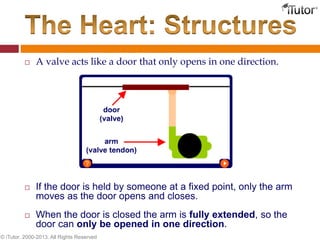
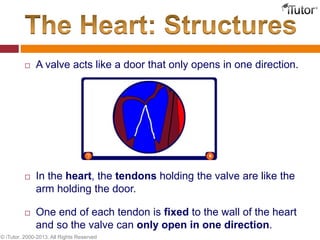
 A valve acts like a door that only opens in one direction.
 If the door is held by someone at a fixed point, only the arm
moves as the door opens and closes.
 When the door is closed the arm is fully extended, so the
door can only be opened in one direction.
© iTutor. 2000-2013. All Rights Reserved
 A valve acts like a door that only opens in one direction.
 In the heart, the tendons holding the valve are like the
arm holding the door.
 One end of each tendon is fixed to the wall of the heart
and so the valve can only open in one direction.
© iTutor. 2000-2013. All Rights Reserved
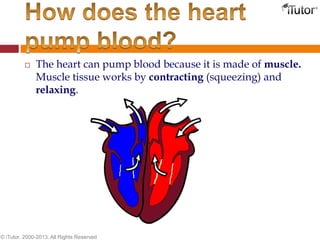
 The heart can pump blood because it is made of muscle.
Muscle tissue works by contracting (squeezing) and
relaxing.
© iTutor. 2000-2013. All Rights Reserved
 All the parts of the heart on
either side, work together in a
repeated sequence.
 The two atria contract and
relax; then the two ventricles
contract and relax.
 This is how blood moves
through the heart and is
pumped to the lungs and the
body.
 One complete sequence of
contraction and relaxation is
called a heartbeat.
© iTutor. 2000-2013. All Rights Reserved
 As blood moves through the
circulatory system it moves
through 3 types of blood
vessels:
 Arteries: Carry blood away
from the heart .
 Capillaries: Link arterioles to
veins.
 Veins: Carry blood towards
the heart
© iTutor. 2000-2013. All Rights Reserved
Arteries
 Large vessels
 Carry blood from heart to tissues of body.
 Carry oxygen rich blood, with the exception of pulmonary
arteries.
 Thick walls-need to withstand pressure produced when heart
pushes blood into them.
© iTutor. 2000-2013. All Rights Reserved
 Smallest blood vessels
 Walls are only one cell thick and very narrow.
 Important for bringing nutrients and oxygen to tissues
and absorbing CO2 and other waste products.
Capillaries
 Once blood has passed through the capillary systems it
must be returned to the heart. Done by veins
 Walls contains connective tissue and smooth muscle.
 Largest veins contain one way valves that keep blood
flowing toward heart.
 Many found near skeletal muscles. When muscles
contract, blood is forced through veins.
© iTutor. 2000-2013. All Rights Reserved
 The heart produces pressure
 The force of blood on the wall of the arteries is
known as blood pressure.
 Blood pressure decreases as the heart relaxes,
but the rest of the circulatory system is still
under pressure.
© iTutor. 2000-2013. All Rights Reserved
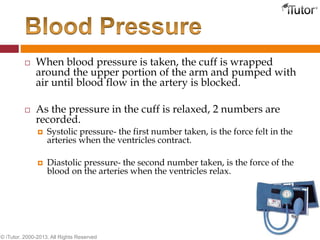
 When blood pressure is taken, the cuff is wrapped
around the upper portion of the arm and pumped with
air until blood flow in the artery is blocked.
 As the pressure in the cuff is relaxed, 2 numbers are
recorded.
 Systolic pressure- the first number taken, is the force felt in the
arteries when the ventricles contract.
 Diastolic pressure- the second number taken, is the force of the
blood on the arteries when the ventricles relax.
© iTutor. 2000-2013. All Rights Reserved
Blood
 What percent of your body is blood?
 How much blood do we contain?
 On average 4-6 liters
 We contain about a pint of
blood for every 15 pounds
of body weight
 Composition of Blood:
 What percent of your blood is
cellular?
 What percent of your blood is
plasma?
8%
45%
55%
© iTutor. 2000-2013. All Rights Reserved
Blood
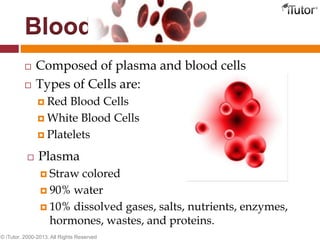
 Composed of plasma and blood cells
 Types of Cells are:
 Red Blood Cells
 White Blood Cells
 Platelets
© iTutor. 2000-2013. All Rights Reserved
 Plasma
 Straw colored
 90% water
 10% dissolved gases, salts, nutrients, enzymes,
hormones, wastes, and proteins.
Blood
 Plasma proteins
 3 Types: Albumins, globulins and fibrinogen.
 Albumins and Globulins- transport substances such as fatty
acids, hormones and vitamins.
 Fibrinogen- Responsible for blood’s ability to clot
© iTutor. 2000-2013. All Rights Reserved
 Red Blood Cells
 Most numerous type
 Transport oxygen
 Get color from hemoglobin
 Disk shaped
 Made in red bone marrow
 Circulate for 120 days
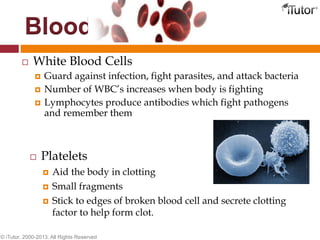
 White Blood Cells
 Guard against infection, fight parasites, and attack bacteria
 Number of WBC’s increases when body is fighting
 Lymphocytes produce antibodies which fight pathogens
and remember them
Blood
© iTutor. 2000-2013. All Rights Reserved
 Platelets
 Aid the body in clotting
 Small fragments
 Stick to edges of broken blood cell and secrete clotting
factor to help form clot.
Blood
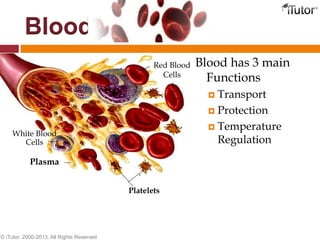
Blood has 3 main
Functions
 Transport
 Protection
 Temperature
Regulation
© iTutor. 2000-2013. All Rights Reserved
Plasma
Red Blood
Cells
Platelets
White Blood
Cells
Call us for
more
information:
www.iTutor.com
1-855-694-
8886
Visit

Circulatory system itutorial

  • 1.
  • 2.
     The CirculatorySystem is responsible for transporting materials throughout the entire body.  It transports nutrients, water, and oxygen to your billions of body cells and carries away wastes such as carbon dioxide that body cells produce.  It is an amazing highway that travels through your entire body connecting all your body cells. © iTutor. 2000-2013. All Rights Reserved
  • 3.
    Components  Heart  Blood Vessels  Arteries  Veins  Capillaries Heart Blood ArteriesVeins © iTutor. 2000-2013. All Rights Reserved
  • 4.
     Which gasesare transported to and from the body’s cells by the blood flowing in the circulatory system? carbon dioxide oxygen Oxygen is the gas needed for respiration and is transported to the body’s cells. © iTutor. 2000-2013. All Rights Reserved
  • 5.
     The circulatorysystem carries two types of blood  Arrangement of the circulatory system means that these two types of blood do not mix. Oxygen-rich blood c Oxygen-poor blood  Blood travelling to the body cells  High oxygen content  Low carbon dioxide content  Blood travelling away from the body cells  Low oxygen content  High carbon dioxide content © iTutor. 2000-2013. All Rights Reserved
  • 6.
     The heartis the organ at the centre of the circulatory system. It pumps blood around the body. © iTutor. 2000-2013. All Rights Reserved
  • 7.
     The insideof the heart is divided into two sections so that the two types of blood (oxygen-rich and oxygen- poor) are kept apart Oxygen-poor blood Right side of the heart Oxygen-rich blood Left side of the heart © iTutor. 2000-2013. All Rights Reserved
  • 8.
     Heart coverings Pericardium  Covers the heart and large blood vessels attached to the heart  Visceral pericardium  Innermost layer  Directly on the heart  Parietal pericardium  Layer on top of the visceral pericardium
  • 9.
     Pericardium  Protectivesac of connective tissue  Surrounds the heart  Filled with fluid © iTutor. 2000-2013. All Rights Reserved
  • 10.
     Heart walls: Epicardium  Outermost layer  Fat to cushion heart  Myocardium  Middle layer  Primarily cardiac muscle  Endocardium  Innermost layer  Thin and smooth  Stretches as the heart pumps © iTutor. 2000-2013. All Rights Reserved
  • 11.
     Myocardium  Themuscle of the heart  Strong and thick  Composed of spontaneously contracting cardiac muscle fibers  Can conduct electricity like nerves.  It’s blood supply comes from the coronary arteries. © iTutor. 2000-2013. All Rights Reserved
  • 12.
     The rightand left sides of the heart are separated by a septum, or wall.  The septum prevents the mixing of oxygen rich and oxygen poor blood.  On each side of the septum are two chambers.  The upper chamber (receives blood) is the atrium.  The lower chamber (pumps blood out of heart) is the ventricle. © iTutor. 2000-2013. All Rights Reserved
  • 13.
     Four chambers Two Atria  Upper chambers  Left and right  Separated by interatrial septum  Two Ventricles  Lower chambers  Left and right  Separated by interventricular septum © iTutor. 2000-2013. All Rights Reserved Right Ventricle Right Atrium Left Ventricle Left Atrium
  • 14.
     The chambersof the heart have different functions: blood to the body blood from the body blood to the lungs blood from the lungs The Atria collect blood that enters the heart. The ventricles pump blood out of the heart. © iTutor. 2000-2013. All Rights Reserved
  • 15.
     The valvesbetween the atria and ventricles are connected to the inner walls of the heart by tough tendons. valve open© iTutor. 2000-2013. All Rights Reserved
  • 16.
     The tendonsallow the valves to close and hold the valve flaps in place. They prevent the valves from flipping up and turning inside out valve open valve closed © iTutor. 2000-2013. All Rights Reserved
  • 17.
     A valveacts like a door that only opens in one direction.  If the door is held by someone at a fixed point, only the arm moves as the door opens and closes.  When the door is closed the arm is fully extended, so the door can only be opened in one direction. © iTutor. 2000-2013. All Rights Reserved
  • 18.
     A valveacts like a door that only opens in one direction.  In the heart, the tendons holding the valve are like the arm holding the door.  One end of each tendon is fixed to the wall of the heart and so the valve can only open in one direction. © iTutor. 2000-2013. All Rights Reserved
  • 19.
     The heartcan pump blood because it is made of muscle. Muscle tissue works by contracting (squeezing) and relaxing. © iTutor. 2000-2013. All Rights Reserved
  • 20.
     All theparts of the heart on either side, work together in a repeated sequence.  The two atria contract and relax; then the two ventricles contract and relax.  This is how blood moves through the heart and is pumped to the lungs and the body.  One complete sequence of contraction and relaxation is called a heartbeat. © iTutor. 2000-2013. All Rights Reserved
  • 21.
     As bloodmoves through the circulatory system it moves through 3 types of blood vessels:  Arteries: Carry blood away from the heart .  Capillaries: Link arterioles to veins.  Veins: Carry blood towards the heart © iTutor. 2000-2013. All Rights Reserved
  • 22.
    Arteries  Large vessels Carry blood from heart to tissues of body.  Carry oxygen rich blood, with the exception of pulmonary arteries.  Thick walls-need to withstand pressure produced when heart pushes blood into them. © iTutor. 2000-2013. All Rights Reserved  Smallest blood vessels  Walls are only one cell thick and very narrow.  Important for bringing nutrients and oxygen to tissues and absorbing CO2 and other waste products. Capillaries
  • 23.
     Once bloodhas passed through the capillary systems it must be returned to the heart. Done by veins  Walls contains connective tissue and smooth muscle.  Largest veins contain one way valves that keep blood flowing toward heart.  Many found near skeletal muscles. When muscles contract, blood is forced through veins. © iTutor. 2000-2013. All Rights Reserved
  • 24.
    © iTutor. 2000-2013.All Rights Reserved
  • 25.
     The heartproduces pressure  The force of blood on the wall of the arteries is known as blood pressure.  Blood pressure decreases as the heart relaxes, but the rest of the circulatory system is still under pressure. © iTutor. 2000-2013. All Rights Reserved
  • 26.
     When bloodpressure is taken, the cuff is wrapped around the upper portion of the arm and pumped with air until blood flow in the artery is blocked.  As the pressure in the cuff is relaxed, 2 numbers are recorded.  Systolic pressure- the first number taken, is the force felt in the arteries when the ventricles contract.  Diastolic pressure- the second number taken, is the force of the blood on the arteries when the ventricles relax. © iTutor. 2000-2013. All Rights Reserved
  • 27.
    Blood  What percentof your body is blood?  How much blood do we contain?  On average 4-6 liters  We contain about a pint of blood for every 15 pounds of body weight  Composition of Blood:  What percent of your blood is cellular?  What percent of your blood is plasma? 8% 45% 55% © iTutor. 2000-2013. All Rights Reserved
  • 28.
    Blood  Composed ofplasma and blood cells  Types of Cells are:  Red Blood Cells  White Blood Cells  Platelets © iTutor. 2000-2013. All Rights Reserved  Plasma  Straw colored  90% water  10% dissolved gases, salts, nutrients, enzymes, hormones, wastes, and proteins.
  • 29.
    Blood  Plasma proteins 3 Types: Albumins, globulins and fibrinogen.  Albumins and Globulins- transport substances such as fatty acids, hormones and vitamins.  Fibrinogen- Responsible for blood’s ability to clot © iTutor. 2000-2013. All Rights Reserved  Red Blood Cells  Most numerous type  Transport oxygen  Get color from hemoglobin  Disk shaped  Made in red bone marrow  Circulate for 120 days
  • 30.
     White BloodCells  Guard against infection, fight parasites, and attack bacteria  Number of WBC’s increases when body is fighting  Lymphocytes produce antibodies which fight pathogens and remember them Blood © iTutor. 2000-2013. All Rights Reserved  Platelets  Aid the body in clotting  Small fragments  Stick to edges of broken blood cell and secrete clotting factor to help form clot.
  • 31.
    Blood Blood has 3main Functions  Transport  Protection  Temperature Regulation © iTutor. 2000-2013. All Rights Reserved Plasma Red Blood Cells Platelets White Blood Cells
  • 32.