MOSAICISM AND
CHIMERISM
S. SHANMUGAPRIYA,
Final Year,
Biomedical sciences,
Sri ramachandra university.
MOSAICISM AND CHIMERISM
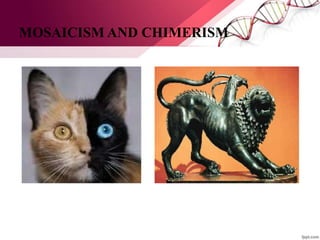
• Mosaicism and chimerism refers to one organism
with two or more distinct populations of cells.
• But they are two different concepts.
• Because mosaics start with the same genome, but
chimeras is a fusion of two different genomes.
• Mosaicism and chimerism differ in the mechanisms
by which each is prevented
MOSAICISM
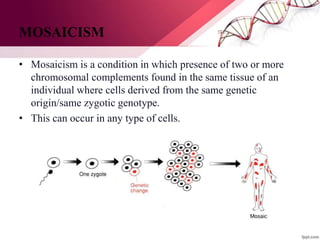
• Mosaicism is a condition in which presence of two or more
chromosomal complements found in the same tissue of an
individual where cells derived from the same genetic
origin/same zygotic genotype.
• This can occur in any type of cells.
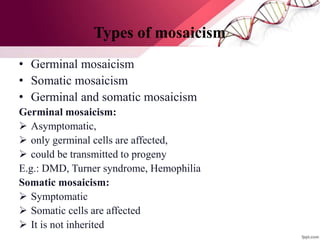
• Mosaicism can arise when there is a mutation in early
development so there can be group of cells that
behave differently.
• This can happen on a gene level or even whole
chromosomes.
• For example, a girl has a mixture of 45X and 46XY
cells in her body. One cell early in development
dropped the Y chromosome and the majority of her
cells are 45X.
• Pattern of inheritance: Both autosomal dominant
and recessive
Mechanism Of Mosaic Formation
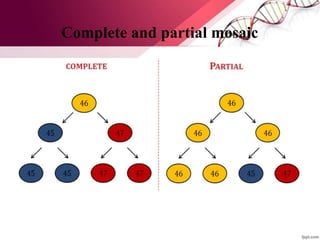
Complete and partial mosaic
Types of mosaicism
• Germinal mosaicism
• Somatic mosaicism
• Germinal and somatic mosaicism
Germinal mosaicism:
 Asymptomatic,
 only germinal cells are affected,
 could be transmitted to progeny
E.g.: DMD, Turner syndrome, Hemophilia
Somatic mosaicism:
 Symptomatic
 Somatic cells are affected
 It is not inherited
Non disjunction
• E.g: cancer, down syndrome
Germinal and somatic mosaicism: presence of both somatic
and germline mosaic.
Diagnosis: FISH, Karyotype
Impact of mosaic on disease: depends on stage of mutation,
nature of chromosomal abnormality, proportion between mosaic
and normal cells, nature of affected cells.
Disease:
Heteroplasmy: somatic mosaicism results in random segregation
and propagation of mutant mitochondria.
Cancer: several recent studies shows that probability of cancer
progression depends on the degree of mosaicism.
CHIMERISM
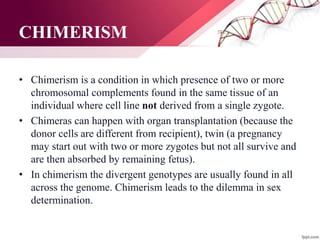
• Chimerism is a condition in which presence of two or more
chromosomal complements found in the same tissue of an
individual where cell line not derived from a single zygote.
• Chimeras can happen with organ transplantation (because the
donor cells are different from recipient), twin (a pregnancy
may start out with two or more zygotes but not all survive and
are then absorbed by remaining fetus).
• In chimerism the divergent genotypes are usually found in all
across the genome. Chimerism leads to the dilemma in sex
determination.
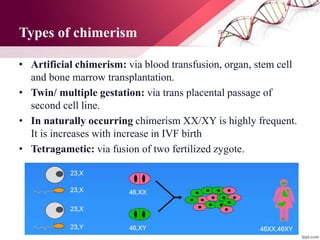
Types of chimerism
• Artificial chimerism: via blood transfusion, organ, stem cell
and bone marrow transplantation.
• Twin/ multiple gestation: via trans placental passage of
second cell line.
• In naturally occurring chimerism XX/XY is highly frequent.
It is increases with increase in IVF birth
• Tetragametic: via fusion of two fertilized zygote.
Types of natural chimera:
• Fetal- maternal chimera
• Blood sharing and twin chimera
• Whole body or dispermic chimera
• Tumor chimera
• Germ cell chimera
• Test to done before transplantation are, HLA, red
cells phenotype studies, peripheral blood and skin
fibroblast karyotyping, FISH study.
References
• Mosaicism and chimerism as components of intraorganismal
genetic heterogeneity, B.SANTELICES, J . EVOL. B IOL. 17
(2004 ) 1187–1188
• Mechanisms of mosaicism, chimerism and uniparental disomy
identified by single nucleotide polymorphism array analysis
Laura K. Conlin, Brian D. Thiel, Carsten G. Bonnemann,
Livija Medne, Linda M. Ernst, Elaine H. Zackai, Matthew A.
Deardorff, Ian D. Krantz, Hakon Hakonarson and Nancy B.
Spinner
• www.genegeek.com
• OMIM

Mosaicism and chimerism

  • 1.
    MOSAICISM AND CHIMERISM S. SHANMUGAPRIYA, FinalYear, Biomedical sciences, Sri ramachandra university.
  • 2.
  • 3.
    MOSAICISM AND CHIMERISM •Mosaicism and chimerism refers to one organism with two or more distinct populations of cells. • But they are two different concepts. • Because mosaics start with the same genome, but chimeras is a fusion of two different genomes. • Mosaicism and chimerism differ in the mechanisms by which each is prevented
  • 4.
    MOSAICISM • Mosaicism isa condition in which presence of two or more chromosomal complements found in the same tissue of an individual where cells derived from the same genetic origin/same zygotic genotype. • This can occur in any type of cells.
  • 5.
    • Mosaicism canarise when there is a mutation in early development so there can be group of cells that behave differently. • This can happen on a gene level or even whole chromosomes. • For example, a girl has a mixture of 45X and 46XY cells in her body. One cell early in development dropped the Y chromosome and the majority of her cells are 45X. • Pattern of inheritance: Both autosomal dominant and recessive
  • 6.
  • 7.
  • 8.
    Types of mosaicism •Germinal mosaicism • Somatic mosaicism • Germinal and somatic mosaicism Germinal mosaicism:  Asymptomatic,  only germinal cells are affected,  could be transmitted to progeny E.g.: DMD, Turner syndrome, Hemophilia Somatic mosaicism:  Symptomatic  Somatic cells are affected  It is not inherited
  • 9.
  • 10.
    • E.g: cancer,down syndrome Germinal and somatic mosaicism: presence of both somatic and germline mosaic. Diagnosis: FISH, Karyotype Impact of mosaic on disease: depends on stage of mutation, nature of chromosomal abnormality, proportion between mosaic and normal cells, nature of affected cells. Disease: Heteroplasmy: somatic mosaicism results in random segregation and propagation of mutant mitochondria. Cancer: several recent studies shows that probability of cancer progression depends on the degree of mosaicism.
  • 11.
    CHIMERISM • Chimerism isa condition in which presence of two or more chromosomal complements found in the same tissue of an individual where cell line not derived from a single zygote. • Chimeras can happen with organ transplantation (because the donor cells are different from recipient), twin (a pregnancy may start out with two or more zygotes but not all survive and are then absorbed by remaining fetus). • In chimerism the divergent genotypes are usually found in all across the genome. Chimerism leads to the dilemma in sex determination.
  • 12.
    Types of chimerism •Artificial chimerism: via blood transfusion, organ, stem cell and bone marrow transplantation. • Twin/ multiple gestation: via trans placental passage of second cell line. • In naturally occurring chimerism XX/XY is highly frequent. It is increases with increase in IVF birth • Tetragametic: via fusion of two fertilized zygote.
  • 13.
    Types of naturalchimera: • Fetal- maternal chimera • Blood sharing and twin chimera • Whole body or dispermic chimera • Tumor chimera • Germ cell chimera
  • 14.
    • Test todone before transplantation are, HLA, red cells phenotype studies, peripheral blood and skin fibroblast karyotyping, FISH study.
  • 15.
    References • Mosaicism andchimerism as components of intraorganismal genetic heterogeneity, B.SANTELICES, J . EVOL. B IOL. 17 (2004 ) 1187–1188 • Mechanisms of mosaicism, chimerism and uniparental disomy identified by single nucleotide polymorphism array analysis Laura K. Conlin, Brian D. Thiel, Carsten G. Bonnemann, Livija Medne, Linda M. Ernst, Elaine H. Zackai, Matthew A. Deardorff, Ian D. Krantz, Hakon Hakonarson and Nancy B. Spinner • www.genegeek.com • OMIM