Continental Drift Activity Packet Name________________
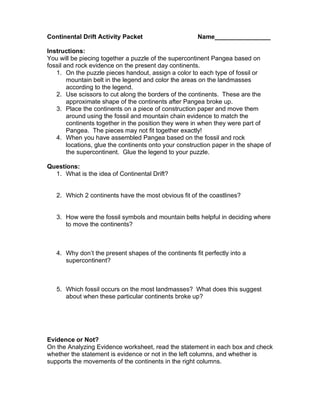
Instructions:
You will be piecing together a puzzle of the supercontinent Pangea based on
fossil and rock evidence on the present day continents.
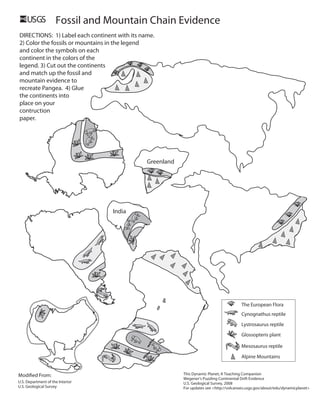
1. On the puzzle pieces handout, assign a color to each type of fossil or
mountain belt in the legend and color the areas on the landmasses
according to the legend.
2. Use scissors to cut along the borders of the continents. These are the
approximate shape of the continents after Pangea broke up.
3. Place the continents on a piece of construction paper and move them
around using the fossil and mountain chain evidence to match the
continents together in the position they were in when they were part of
Pangea. The pieces may not fit together exactly!
4. When you have assembled Pangea based on the fossil and rock
locations, glue the continents onto your construction paper in the shape of
the supercontinent. Glue the legend to your puzzle.
Questions:
1. What is the idea of Continental Drift?
2. Which 2 continents have the most obvious fit of the coastlines?
3. How were the fossil symbols and mountain belts helpful in deciding where
to move the continents?
4. Why don’t the present shapes of the continents fit perfectly into a
supercontinent?
5. Which fossil occurs on the most landmasses? What does this suggest
about when these particular continents broke up?
Evidence or Not?
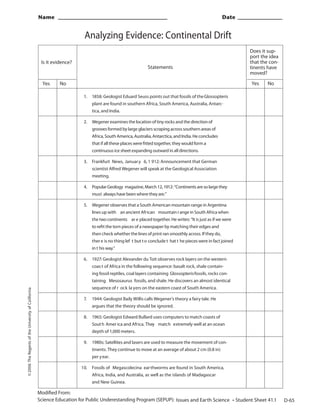
On the Analyzing Evidence worksheet, read the statement in each box and check
whether the statement is evidence or not in the left columns, and whether is
supports the movements of the continents in the right columns.
DIRECTIONS: 1) Label each continent with its name.
2) Color the fossils or mountains in the legend
and color the symbols on each
continent in the colors of the
legend. 3) Cut out the continents
and match up the fossil and
mountain evidence to
recreate Pangea. 4) Glue
the continents into
place on your
contruction
paper.
India
Fossil and Mountain Chain Evidence
U.S. Department of the Interior
U.S. Geological Survey
This Dynamic Planet; A Teaching Companion
Wegener’s Puzzling Continental Drift Evidence
U.S. Geological Survey, 2008
For updates see <http://volcanoes.usgs.gov/about/edu/dynamicplanet>
Greenland
The European Flora
Cynognathus reptile
Lystrosaurus reptile
Glossopteris plant
Mesosaurus reptile
Alpine Mountains
Modified From:
GUS S
Name Date
Issues and Earth Science • Student Sheet 41.1
Analyzing Evidence: Continental Drift
©2006TheRegentsoftheUniversityofCalifornia
D-65
1. 1858: Geologist Eduard Seuss points out that fossils of theGlossopteris
plant are found in southern Africa, South America, Australia, Antarc-
tica, and India.
2. Wegener examines the location of tiny rocks and the direction of
grooves formed by large glaciers scraping across southern areas of
Africa, South America, Australia, Antarctica, and India. He concludes
that if all these places were fitted together, they would form a
continuous ice sheet expanding outward in all directions.
3. Frankfurt News, January 6, 1 912: Announcement that German
scientist Alfred Wegener will speak at the Geological Association
meeting.
4. PopularGeology magazine,March12,1912:“Continentsaresolargethey
must alwayshavebeenwheretheyare.”
5. Wegener observes that a South American mountain range in Argentina
lines up with an ancient African mountain range in South Africa when
the two continents ar e placed together. He writes: “It is just as if we were
to refit the torn pieces of a newspaper by matching their edges and
then check whether the lines of print ran smoothly across. If they do,
there is no thing lef t but to conclude t hat t he pieces were in fact joined
in t his way.”
6. 1927: Geologist Alexander du Toit observes rock layers on the western
coas t of Africa in the following sequence: basalt rock, shale contain-
ing fossil reptiles, coal layers containing Glossopterisfossils, rocks con-
taining Mesosaurus fossils, and shale. He discovers an almost identical
sequence of r ock la yers on the eastern coast of South America.
7. 1944: Geologist Baily Willis calls Wegener’s theory a fairy tale. He
argues that the theory should be ignored.
8. 1965: Geologist Edward Bullard uses computers to match coasts of
South Amer ica and Africa. They match extremely well at an ocean
depth of 1,000 meters.
9. 1980s: Satellites and lasers are used to measure the movement of con-
tinents. They continue to move at an average of about 2 cm (0.8 in)
per year.
10. Fossils of Megascolecina earthworms are found in South America,
Africa, India, and Australia, as well as the islands of Madagascar
and New Guinea.
Yes NoYes No
Does it sup-
port the idea
that the con-
tinents have
moved?
Is it evidence?
Statements
Modified From:
Science Education for Public Underestanding Program (SEPUP):

Activity continentaldrift

  • 1.
    Continental Drift ActivityPacket Name________________ Instructions: You will be piecing together a puzzle of the supercontinent Pangea based on fossil and rock evidence on the present day continents. 1. On the puzzle pieces handout, assign a color to each type of fossil or mountain belt in the legend and color the areas on the landmasses according to the legend. 2. Use scissors to cut along the borders of the continents. These are the approximate shape of the continents after Pangea broke up. 3. Place the continents on a piece of construction paper and move them around using the fossil and mountain chain evidence to match the continents together in the position they were in when they were part of Pangea. The pieces may not fit together exactly! 4. When you have assembled Pangea based on the fossil and rock locations, glue the continents onto your construction paper in the shape of the supercontinent. Glue the legend to your puzzle. Questions: 1. What is the idea of Continental Drift? 2. Which 2 continents have the most obvious fit of the coastlines? 3. How were the fossil symbols and mountain belts helpful in deciding where to move the continents? 4. Why don’t the present shapes of the continents fit perfectly into a supercontinent? 5. Which fossil occurs on the most landmasses? What does this suggest about when these particular continents broke up? Evidence or Not? On the Analyzing Evidence worksheet, read the statement in each box and check whether the statement is evidence or not in the left columns, and whether is supports the movements of the continents in the right columns.
  • 2.
    DIRECTIONS: 1) Labeleach continent with its name. 2) Color the fossils or mountains in the legend and color the symbols on each continent in the colors of the legend. 3) Cut out the continents and match up the fossil and mountain evidence to recreate Pangea. 4) Glue the continents into place on your contruction paper. India Fossil and Mountain Chain Evidence U.S. Department of the Interior U.S. Geological Survey This Dynamic Planet; A Teaching Companion Wegener’s Puzzling Continental Drift Evidence U.S. Geological Survey, 2008 For updates see <http://volcanoes.usgs.gov/about/edu/dynamicplanet> Greenland The European Flora Cynognathus reptile Lystrosaurus reptile Glossopteris plant Mesosaurus reptile Alpine Mountains Modified From: GUS S
  • 3.
    Name Date Issues andEarth Science • Student Sheet 41.1 Analyzing Evidence: Continental Drift ©2006TheRegentsoftheUniversityofCalifornia D-65 1. 1858: Geologist Eduard Seuss points out that fossils of theGlossopteris plant are found in southern Africa, South America, Australia, Antarc- tica, and India. 2. Wegener examines the location of tiny rocks and the direction of grooves formed by large glaciers scraping across southern areas of Africa, South America, Australia, Antarctica, and India. He concludes that if all these places were fitted together, they would form a continuous ice sheet expanding outward in all directions. 3. Frankfurt News, January 6, 1 912: Announcement that German scientist Alfred Wegener will speak at the Geological Association meeting. 4. PopularGeology magazine,March12,1912:“Continentsaresolargethey must alwayshavebeenwheretheyare.” 5. Wegener observes that a South American mountain range in Argentina lines up with an ancient African mountain range in South Africa when the two continents ar e placed together. He writes: “It is just as if we were to refit the torn pieces of a newspaper by matching their edges and then check whether the lines of print ran smoothly across. If they do, there is no thing lef t but to conclude t hat t he pieces were in fact joined in t his way.” 6. 1927: Geologist Alexander du Toit observes rock layers on the western coas t of Africa in the following sequence: basalt rock, shale contain- ing fossil reptiles, coal layers containing Glossopterisfossils, rocks con- taining Mesosaurus fossils, and shale. He discovers an almost identical sequence of r ock la yers on the eastern coast of South America. 7. 1944: Geologist Baily Willis calls Wegener’s theory a fairy tale. He argues that the theory should be ignored. 8. 1965: Geologist Edward Bullard uses computers to match coasts of South Amer ica and Africa. They match extremely well at an ocean depth of 1,000 meters. 9. 1980s: Satellites and lasers are used to measure the movement of con- tinents. They continue to move at an average of about 2 cm (0.8 in) per year. 10. Fossils of Megascolecina earthworms are found in South America, Africa, India, and Australia, as well as the islands of Madagascar and New Guinea. Yes NoYes No Does it sup- port the idea that the con- tinents have moved? Is it evidence? Statements Modified From: Science Education for Public Underestanding Program (SEPUP):