


CHAPTER 1
Origin of the Universe
KNIP
The study of materials and
processes that occur
beneath and upon Earth's
surface.
Geology
KNIP
The study of our Earth.
Earth Science
KNIP
The study of the universe,
planet's origin and members of
solar sytem.
Astronomy
KNIP
Study of composition and
movements of seawater, coastal
processes, seafloor, topography
and marine life.
Oceanography
KNIP
Study of atmosphere and
elements that produce
weather.
Meteorology
KNIP
Origin of the Universe
Cosmology - is the study of the universe,
including its properties, structure and evolution.
10-15 billion years ago - the universe began
when the primordial explosion called Big Bang
occured.
KNIP
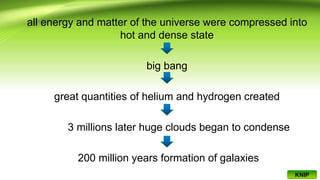
all energy and matter of the universe were compressed into
hot and dense state
big bang
great quantities of helium and hydrogen created
3 millions later huge clouds began to condense
200 million years formation of galaxies
KNIP
Examples of Galaxies
• Milky Way
• Large Magellanic Cloud
• Andromeda
• Cigar Galaxy
• Tadpole Galaxy
• Sombrero Galaxy
• Pinwheel Galaxy
KNIP
Universe - derives from the Old French word univers, which
in turn derives from the Latin word universum
is all of space and time (spacetime) and its
contents, which includes planets, moons, minor
planets, stars, galaxies, the contents of intergalactic
space and all matter and energy.
sometime called cosmos
geocentric ---- Nicolaus Copernicus ---- heliocentric mode
KNIP
Theories on the Origin of the
Universe
Theories of the Origin of the Universe_low.mp4
KNIP
BIG BANG THEORY
All of the energy and matter of the universe were
compressed into hot and dense state. About 13.7
billion years our universe began as a cataclysmic
explosion, which continued to expand, cool and
evolve its current state. Temperature decreased
sufficiently to allow clumps of matter to collect. these
materials formed the first nebulae, which evolved
into the first stars and galaxies. Our sun and
planetary system formed 5 billion years later.
Stephen Hawking - The Big Bang_low.mp4
KNIP
CREATIONIST THEORY
This theory states that God, the
Supreme Being created the whole universe
out of nothing. The proof can be read in the
Holy Bible stipulating that God created the
heaven and the Earth including man.
KNIP
OSCILLATING UNIVERSE THEORY
• proposed by a Russian-born US cosmologist
GEORGE GAMOW
• he said that the expansion of the universe will
eventually come to a halt then it collapses up
to the time that the universe will return to its
original form and form another Big Bang will
occur. This process will happen as a cycle.
KNIP
STEADY STATE THEORY
This theory states that the universe
has always been the same since the
beginning and will remain in its present
state until eternity. It further claims that
the new galaxies appear as a result of
the drifting of other galaxies.
KNIP
Our Expanding Universe
The universe is still expanding in a
Doppler red shift in the light we
receive. It shows an icreasing
distance between us and other
galaxies in the universe. It also shows
that the universe is expanding slowly.
KNIP
SOLAR NEBULAR THEORY
• The Solar Nebular Theory supposes that
planets formed in the rotating disks of gas and
dust around the young stars.
• The Earth and other planets of the solar
system formed billions of years ago as the
Sun condensed from a cloud of interstellar
gas and dust.
SOLAR NEBULAR THEORY
How do planets were formed in the solar
system ?
• A rotating cloud of gas contracts and flattens
• To become a thin disk of gas and dust around
the forming sun at the center.
• Planets grow from gas and dust in the disk
and are left in orbit when the disk clears.
Evaluation
KNIP
QUESTIONS
• What are the Theories explaining the origin of the
universe?
• How does Big Bang Theory explains the origin of
the universe?
• How can you state that the universe is still
expanding?
• How do the solar system and including the planets
were formed?
IDENTIFICATION
1. The study of the entire universe,
2. The widely accepted theory about the origin of the
universe.
3. This theory states that the universe has always been the
same and will continue to be the same forever.
4. This theory suggests that the universe expanded from a
small ball and it is still expanding.
5. The other term for universe.
KNIP
Answer the following:
1. How can you prove that the universe is expanding?
2. If you are to formulate your own theory about the origin of
the universe, how would you explain it?
KNIP
ASSIGNMENT
Research on the other theories about
the origin of thuniverse. Summarize
their main assumptions.
KNIP
THANK YOU :)
KNIP
REFERENCES:
• www.google.com
• www.youtube.com
• Salandanan, Gloria G.,Faltado III, Ruben E., and Lopez,
Merle B., Earth and Life Sciences for Senior High School,
2016,Lorimar Publishing, Inc.,pp.4-8

Chapter1 originoftheuniverse

  • 1.
    CHAPTER 1 Origin ofthe Universe KNIP
  • 2.
    The study ofmaterials and processes that occur beneath and upon Earth's surface. Geology KNIP
  • 3.
    The study ofour Earth. Earth Science KNIP
  • 4.
    The study ofthe universe, planet's origin and members of solar sytem. Astronomy KNIP
  • 5.
    Study of compositionand movements of seawater, coastal processes, seafloor, topography and marine life. Oceanography KNIP
  • 6.
    Study of atmosphereand elements that produce weather. Meteorology KNIP
  • 7.
    Origin of theUniverse Cosmology - is the study of the universe, including its properties, structure and evolution. 10-15 billion years ago - the universe began when the primordial explosion called Big Bang occured. KNIP
  • 8.
    all energy andmatter of the universe were compressed into hot and dense state big bang great quantities of helium and hydrogen created 3 millions later huge clouds began to condense 200 million years formation of galaxies KNIP
  • 9.
    Examples of Galaxies •Milky Way • Large Magellanic Cloud • Andromeda • Cigar Galaxy • Tadpole Galaxy • Sombrero Galaxy • Pinwheel Galaxy KNIP
  • 10.
    Universe - derivesfrom the Old French word univers, which in turn derives from the Latin word universum is all of space and time (spacetime) and its contents, which includes planets, moons, minor planets, stars, galaxies, the contents of intergalactic space and all matter and energy. sometime called cosmos geocentric ---- Nicolaus Copernicus ---- heliocentric mode KNIP
  • 11.
    Theories on theOrigin of the Universe Theories of the Origin of the Universe_low.mp4 KNIP
  • 12.
    BIG BANG THEORY Allof the energy and matter of the universe were compressed into hot and dense state. About 13.7 billion years our universe began as a cataclysmic explosion, which continued to expand, cool and evolve its current state. Temperature decreased sufficiently to allow clumps of matter to collect. these materials formed the first nebulae, which evolved into the first stars and galaxies. Our sun and planetary system formed 5 billion years later. Stephen Hawking - The Big Bang_low.mp4 KNIP
  • 13.
    CREATIONIST THEORY This theorystates that God, the Supreme Being created the whole universe out of nothing. The proof can be read in the Holy Bible stipulating that God created the heaven and the Earth including man. KNIP
  • 14.
    OSCILLATING UNIVERSE THEORY •proposed by a Russian-born US cosmologist GEORGE GAMOW • he said that the expansion of the universe will eventually come to a halt then it collapses up to the time that the universe will return to its original form and form another Big Bang will occur. This process will happen as a cycle. KNIP
  • 15.
    STEADY STATE THEORY Thistheory states that the universe has always been the same since the beginning and will remain in its present state until eternity. It further claims that the new galaxies appear as a result of the drifting of other galaxies. KNIP
  • 16.
    Our Expanding Universe Theuniverse is still expanding in a Doppler red shift in the light we receive. It shows an icreasing distance between us and other galaxies in the universe. It also shows that the universe is expanding slowly. KNIP
  • 17.
    SOLAR NEBULAR THEORY •The Solar Nebular Theory supposes that planets formed in the rotating disks of gas and dust around the young stars. • The Earth and other planets of the solar system formed billions of years ago as the Sun condensed from a cloud of interstellar gas and dust.
  • 18.
    SOLAR NEBULAR THEORY Howdo planets were formed in the solar system ? • A rotating cloud of gas contracts and flattens • To become a thin disk of gas and dust around the forming sun at the center. • Planets grow from gas and dust in the disk and are left in orbit when the disk clears.
  • 19.
  • 20.
    QUESTIONS • What arethe Theories explaining the origin of the universe? • How does Big Bang Theory explains the origin of the universe? • How can you state that the universe is still expanding? • How do the solar system and including the planets were formed?
  • 21.
    IDENTIFICATION 1. The studyof the entire universe, 2. The widely accepted theory about the origin of the universe. 3. This theory states that the universe has always been the same and will continue to be the same forever. 4. This theory suggests that the universe expanded from a small ball and it is still expanding. 5. The other term for universe. KNIP
  • 22.
    Answer the following: 1.How can you prove that the universe is expanding? 2. If you are to formulate your own theory about the origin of the universe, how would you explain it? KNIP
  • 23.
    ASSIGNMENT Research on theother theories about the origin of thuniverse. Summarize their main assumptions. KNIP
  • 24.
  • 25.
    REFERENCES: • www.google.com • www.youtube.com •Salandanan, Gloria G.,Faltado III, Ruben E., and Lopez, Merle B., Earth and Life Sciences for Senior High School, 2016,Lorimar Publishing, Inc.,pp.4-8

Editor's Notes

  • #11 intergalactic - existing or occuring between galaxies While the size of the entire Universe is still unknown, the earliest scientific models of the Universe were developed by ancient Greek and Indian philosophers and were geocentric, placing Earth at the centre of the Universe.[13][14] Over the centuries, more precise astronomical observations led Nicolaus Copernicus (1473–1543) to develop the heliocentric model with the Sun at the centre of the Solar System.
  • #13 nebulae- a cloud of gas or dust in space that can sometimes be seen at night. a group of stars that are very far away and look like a bright cloud at night. GALAXY milky way
  • #15 who helped explain the big bang theory
  • #16 drift- small or gradual movement or change from one place, condition to another.
  • #17 cosmological red shift