CONTROL ENGINEERING
Course Code 18ME71 CIE Marks 40
Teaching Hours / Week (L:T:P) 3:0:0 SEE Marks 60
Credits 03 Exam Hours 03
[AS PER CHOICE BASED CREDIT SYSTEM (CBCS) SCHEME]
SEMESTER – VII
Dr. Mohammed Imran
B. E. IN MECHANICAL ENGINEERING
CONTROL ENGINEERING
Course Code 18ME71 CIE Marks 40
Teaching Hours / Week (L:T:P) 3:0:0 SEE Marks 60
Credits 03 Exam Hours 03
[AS PER CHOICE BASED CREDIT SYSTEM (CBCS) SCHEME]
SEMESTER – VII
Dr. Mohammed Imran
B. E. IN MECHANICAL ENGINEERING
Course Objectives
 To develop comprehensive knowledge and understanding of
modern control theory, industrial automation, and systems
analysis.
 To model mechanical, hydraulic, pneumatic and electrical
systems.
 To represent system elements by blocks and its reduction
techniques.
 To understand transient and steady state response analysis
of a system.
 To carry out frequency response analysis using polar plot,
Bode plot.
 To analyse a system using root locus plots.
 To study different system compensators and characteristics
of linear systems.
Dr. Mohammed Imran
Course outcomes
On completion of the course the student will be able to
CO1: Identify the type of control and control actions.
CO2: Develop the mathematical model of the physical systems.
CO3: Estimate the response and error in response of first and
second order systems subjected standard input signals.
CO4: Represent the complex physical system using block diagram
and signal flow graph and obtain transfer function.
CO5: Analyse a linear feedback control system for stability using
Hurwitz criterion, Routh‟s criterion an root Locus technique in
complex domain.
CO6: Analyse the stability of linear feedback control systems in
frequency domain using polar plots, Nyquist and Bode plots.
Dr. Mohammed Imran
Module-2
 Time domain performance of control
systems:
 Typical test signal,
Unit step response and time domain
 Unit step response and time domain
specifications of first order,
 Unit step response and time domain
specifications of second order system.
 Steady state error, error constants.
10 Hours
Dr. Mohammed Imran
Text Books:
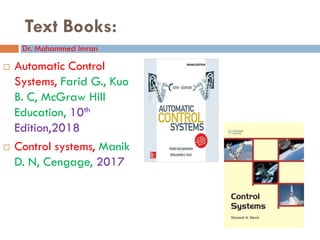
 Automatic Control
Systems, Farid G., Kuo
B. C, McGraw Hill
Education, 10th
Edition,2018
Dr. Mohammed Imran
Edition,2018
 Control systems, Manik
D. N, Cengage, 2017
Reference Books:
 Modern control Engineering K. Ogeta Pearson 5th
Edition, 2010
 Control Systems Engineering Norman S Nice Fourth
Edition, 2007
Modern control Systems Richard C Dorf Pearson
Dr. Mohammed Imran
 Modern control Systems Richard C Dorf Pearson
2017
 Control Systems Engineering IjNagrath, M Gopal
New Age International (P) Ltd 2018
 Control Systems Engineering S Palani Tata McGraw
Hill Publishing Co Ltd ISBN-13 9780070671935
MODULE -2
PART-A
PART-A
Dr. Mohammed Imran CONTROL ENGINEERING
Module-2
Time domain performance of control systems:
 The most control systems, time is used as an independent variable, so
control systems are inherently Time-domain system. Therefore, response
analysis of a control system has become an important factor for the
design and analysis of control system.
 Response analysis means study of the system output behavior as a function
of time, when subjected to known input. This is also known as time
response.
response.
 This output behavior with respect to time must be with in specified limits
for obtaining satisfactory performance.
 The time response analysis of control system helps in evaluating the
stability of the system, accuracy of the system.
 Therefore., in most control system, the complete or final evaluation of the
performance of the system is based on the time response analysis and
corresponding results
 Definition : The time response of a control system is the output of the
system as a function time, when subjected to known input
Dr. Mohammed Imran
Time domain performance of control systems:
Parts of Time Response
The time response of a control system is usually consists of two pans :
1. The Transient response and
2. The Steady-State response
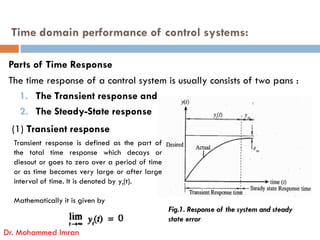
(1) Transient response
Dr. Mohammed Imran
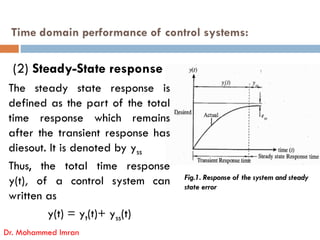
Fig.1. Response of the system and steady
state error
Transient response is defined as the part of
the total time response which decays or
diesout or goes to zero over a period of time
or as time becomes very large or after large
interval of time. It is denoted by yt(t).
Mathematically it is given by
Time domain performance of control systems:
(2) Steady-State response
The steady state response is
defined as the part of the total
time response which remains
after the transient response has
diesout. It is denoted by yss
Thus, the total time response
y(t), of a control system can
written as
y(t) = yt(t)+ yss(t)
Dr. Mohammed Imran
Fig.1. Response of the system and steady
state error
Time domain performance of control systems:
Response of the system and steady state error
 In general, all the control systems exhibit transient behaviour to
some extent before a steady state is attained because of energy
stating elements such as, spring mass etc. which are always part
of a control system and cannot he avoided. Due to these energy
stetting elements, the response of the control system cannot follow
sudden changes in the input instantaneously and transients are
observed. Thus, transient response analysis is necessarily
Dr. Mohammed Imran
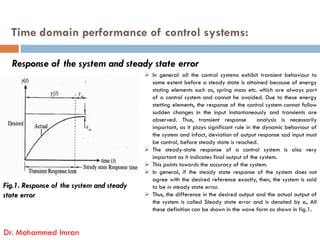
Fig.1. Response of the system and steady
state error
observed. Thus, transient response analysis is necessarily
important, as it plays significant rule in the dynamic behaviour of
the system and infact, deviation of output response sad input must
be control, before steady state is reached.
 The steady-state response of a control system is also very
important as it indicates final output of the system.
 This points towards the accuracy of the system.
 In general, if the steady state response of the system does not
agree with the desired reference exactly, then, the system is said
to be in steady state error.
 Thus, the difference in the desired output and the actual output of
the system is called Sleady state error and is denoted by e„ All
these definition can be shown in the wave form as shown in fig.1.
1. Typical test signal or Standard Test Inputs
 In evaluating performance of a system, it is necessary to
assume some basic standard test input signals.
 By assuming these standard test signals, not only
mathematical analysis of the system is made easy but also
these input signals response allows to predict the system's
performance to other more complex inputs.
Dr. Mohammed Imran
performance to other more complex inputs.
 So for the ease of the time-domain analysis, following
standard test signals sue used
1. Step Input
2. Ramp Input
3. Parabolic Input
4. Impulse Input
1. Typical test signal or Standard Test Inputs
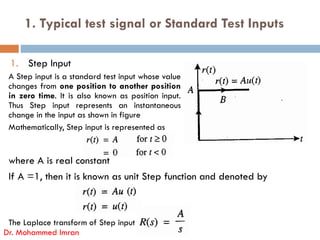
1. Step Input
A Step input is a standard test input whose value
changes from one position to another position
in zero time. It is also known as position input.
Thus Step input represents an instantaneous
change in the input as shown in figure
where A is real constant
If A =1, then it is known as unit Step function and denoted by
The Laplace transform of Step input is
Dr. Mohammed Imran
Mathematically, Step input is represented as
1. Typical test signal or Standard Test Inputs
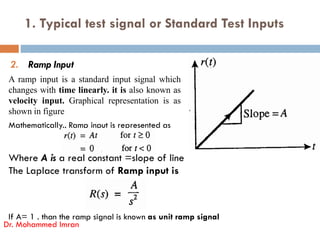
2. Ramp Input
A ramp input is a standard input signal which
changes with time linearly. it is also known as
velocity input. Graphical representation is as
shown in figure
Mathematically., Ramp input is represented as
Where A is a real constant =slope of line
The Laplace transform of Ramp input is
If A= 1 . than the ramp signal is known as unit ramp signal
Dr. Mohammed Imran
Mathematically., Ramp input is represented as
1. Typical test signal or Standard Test Inputs
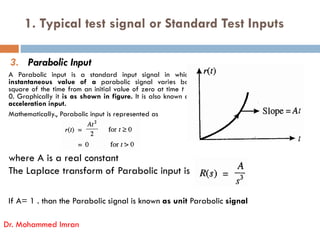
3. Parabolic Input
A Parabolic input is a standard input signal in which
instantaneous value of a parabolic signal varies bas
square of the time from an initial value of zero at time t =
0. Graphically it is as shown in figure. It is also known as
acceleration input.
Mathematically., Parabolic input is represented as
where A is a real constant
The Laplace transform of Parabolic input is
If A= 1 . than the Parabolic signal is known as unit Parabolic signal
Dr. Mohammed Imran
1. Typical test signal or Standard Test Inputs
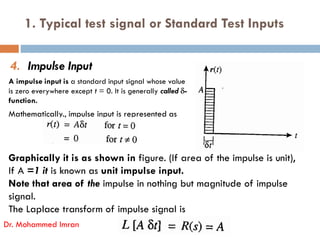
4. Impulse Input
A impulse input is a standard input signal whose value
is zero everywhere except t = 0. It is generally called -
function.
Mathematically., impulse input is represented as
Graphically it is as shown in figure. (If area of the impulse is unit),
If A =1 it is known as unit impulse input.
Note that area of the impulse in nothing but magnitude of impulse
signal.
The Laplace transform of impulse signal is
Dr. Mohammed Imran
1. Typical test signal or Standard Test Inputs
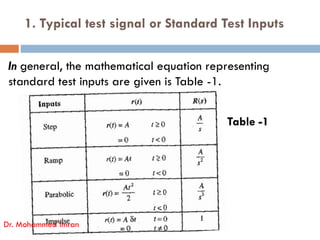
In general, the mathematical equation representing
standard test inputs are given is Table -1.
Table -1
Dr. Mohammed Imran
Table -1
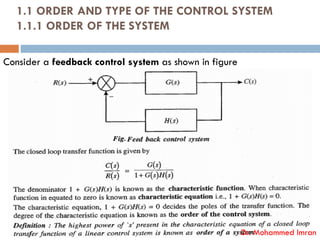
1.1 ORDER AND TYPE OF THE CONTROL SYSTEM
1.1.1 ORDER OF THE SYSTEM
Consider a feedback control system as shown in figure
Dr. Mohammed Imran
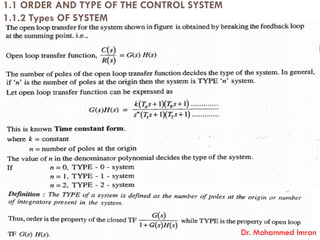
1.1 ORDER AND TYPE OF THE CONTROL SYSTEM
1.1.2 Types OF SYSTEM
Dr. Mohammed Imran
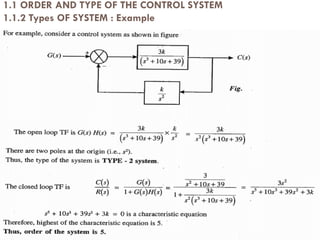
1.1 ORDER AND TYPE OF THE CONTROL SYSTEM
1.1.2 Types OF SYSTEM : Example
Dr. Mohammed Imran
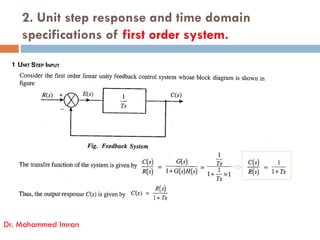
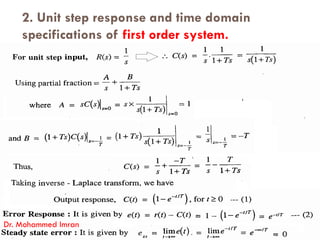
2. Unit step response and time domain
specifications of first order system.
Dr. Mohammed Imran
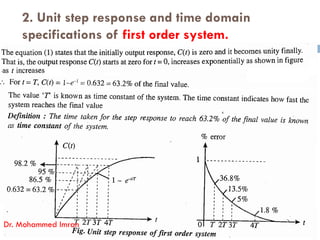
2. Unit step response and time domain
specifications of first order system.
Dr. Mohammed Imran
2. Unit step response and time domain
specifications of first order system.
Dr. Mohammed Imran
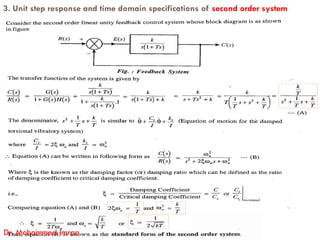
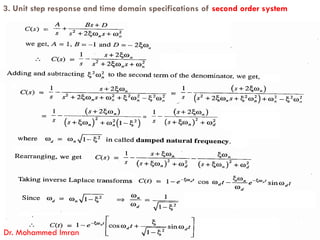
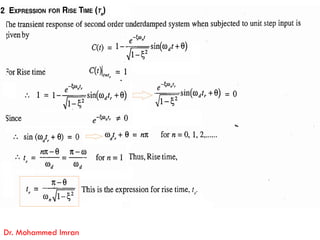
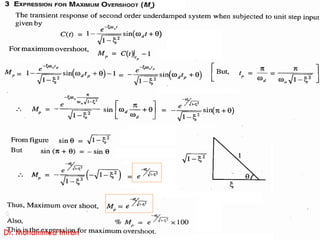
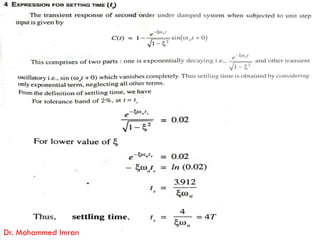
3. Unit step response and time domain specifications of second order system
Dr. Mohammed Imran
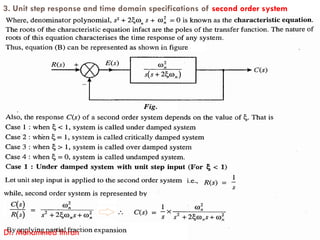
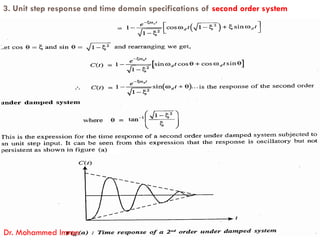
3. Unit step response and time domain specifications of second order system
Dr. Mohammed Imran
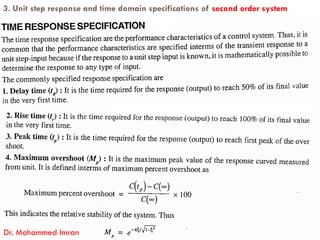
3. Unit step response and time domain specifications of second order system
Dr. Mohammed Imran
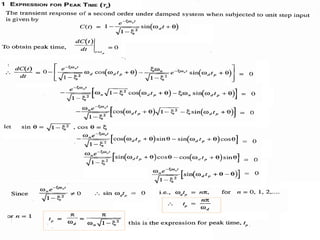
3. Unit step response and time domain specifications of second order system
Dr. Mohammed Imran
3. Unit step response and time domain specifications of second order system
Dr. Mohammed Imran
Dr. Mohammed Imran
Dr. Mohammed Imran
Dr. Mohammed Imran
Dr. Mohammed Imran
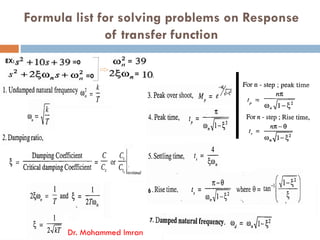
Formula list for solving problems on Response
of transfer function
Dr. Mohammed Imran
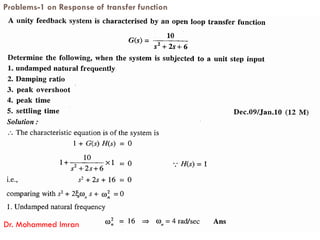
Problems-1 on Response of transfer function
Dr. Mohammed Imran
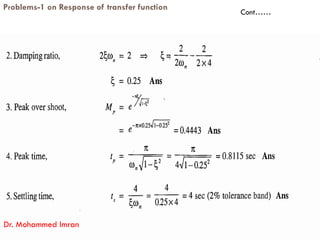
Problems-1 on Response of transfer function
Cont……
Dr. Mohammed Imran
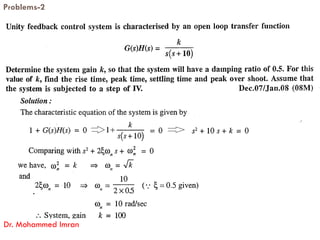
Problems-2
Dr. Mohammed Imran
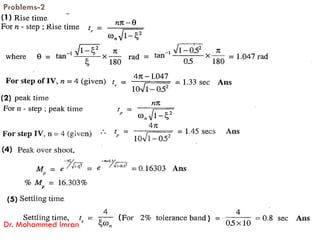
Problems-2
Dr. Mohammed Imran
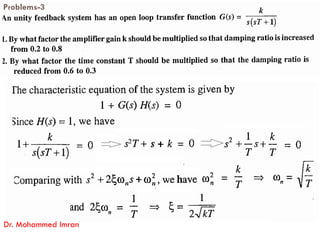
Problems-3
Dr. Mohammed Imran
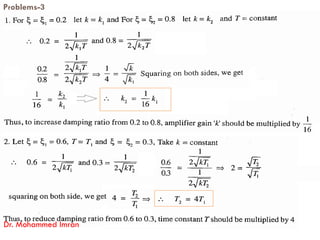
Problems-3
Dr. Mohammed Imran
MODULE -2
PART-B
PART-B
Dr. Mohammed Imran CONTROL ENGINEERING
Module-2
4. Steady state error, error constants.
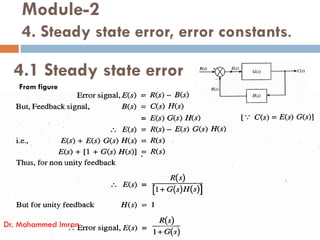
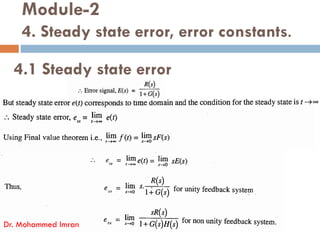
4.1 Steady state error
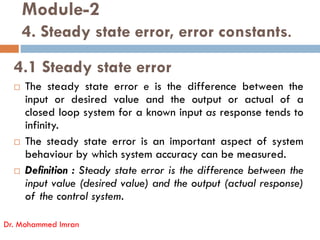
 The steady state error e is the difference between the
input or desired value and the output or actual of a
closed loop system for a known input as response tends to
infinity.
Dr. Mohammed Imran
infinity.
 The steady state error is an important aspect of system
behaviour by which system accuracy can be measured.
 Definition : Steady state error is the difference between the
input value (desired value) and the output (actual response)
of the control system.
Module-2
4. Steady state error, error constants.
4.1 Steady state error
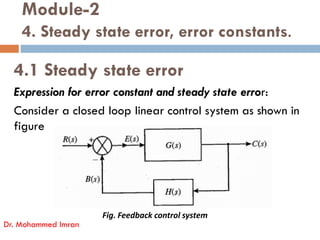
Expression for error constant and steady state error:
Consider a closed loop linear control system as shown in
figure
Dr. Mohammed Imran
figure
Fig. Feedback control system
Module-2
4. Steady state error, error constants.
4.1 Steady state error
From figure
Dr. Mohammed Imran
Module-2
4. Steady state error, error constants.
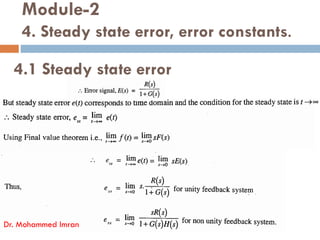
4.1 Steady state error
Dr. Mohammed Imran
Module-2
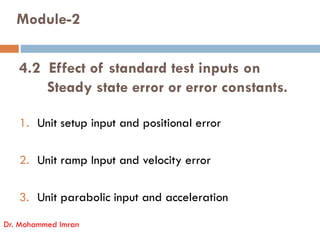
4.2 Effect of standard test inputs on
Steady state error or error constants.
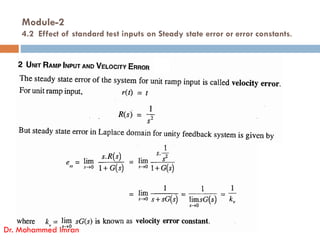
1. Unit setup input and positional error
2. Unit ramp Input and velocity error
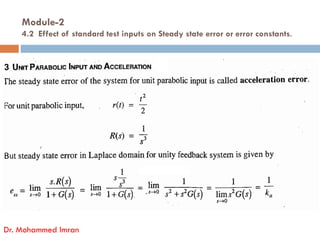
3. Unit parabolic input and acceleration
Dr. Mohammed Imran
Module-2
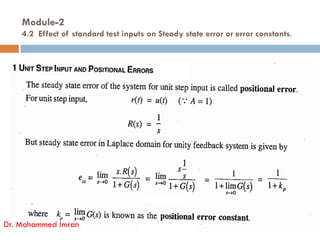
4.2 Effect of standard test inputs on Steady state error or error constants.
Dr. Mohammed Imran
Module-2
4.2 Effect of standard test inputs on Steady state error or error constants.
Dr. Mohammed Imran
Module-2
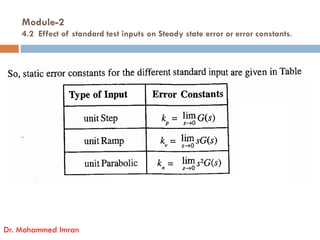
4.2 Effect of standard test inputs on Steady state error or error constants.
Dr. Mohammed Imran
Module-2
4.2 Effect of standard test inputs on Steady state error or error constants.
Dr. Mohammed Imran
Module-2
4. Steady state error, error constants.
4.1 Steady state error
Dr. Mohammed Imran
Module-2
4.3 Types of Steady state error
1. Steady state error of Type-0 with
unity feed back
2. Steady state error of Type-1 with
Dr. Mohammed Imran
2. Steady state error of Type-1 with
unity feed back
3. Steady state error of Type-2 with
unity feed back
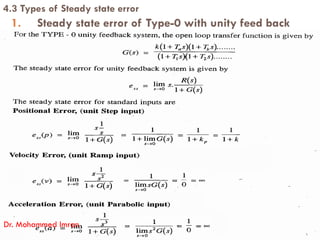
4.3 Types of Steady state error
1. Steady state error of Type-0 with unity feed back
Dr. Mohammed Imran
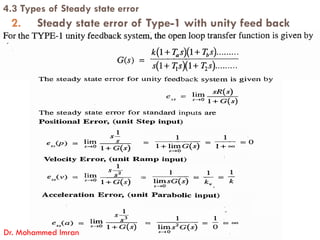
4.3 Types of Steady state error
2. Steady state error of Type-1 with unity feed back
Dr. Mohammed Imran
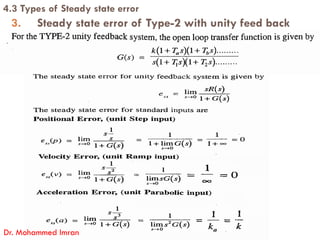
4.3 Types of Steady state error
3. Steady state error of Type-2 with unity feed back
Dr. Mohammed Imran
Module-2
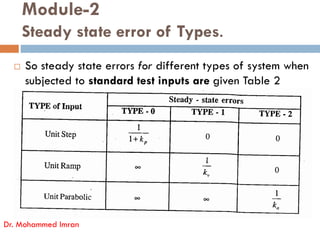
Steady state error of Types.
 So steady state errors for different types of system when
subjected to standard test inputs are given Table 2
Dr. Mohammed Imran
Module-2
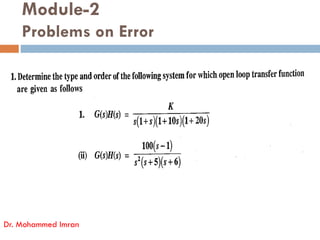
Problems on Error
Dr. Mohammed Imran
Module-2
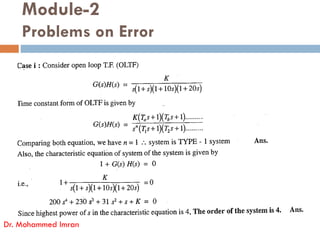
Problems on Error
Dr. Mohammed Imran
Module-2
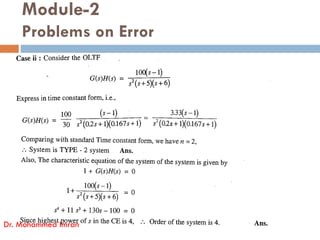
Problems on Error
Dr. Mohammed Imran

Control engineering module 2 18ME71 (PPT Cum Notes)

  • 1.
    CONTROL ENGINEERING Course Code18ME71 CIE Marks 40 Teaching Hours / Week (L:T:P) 3:0:0 SEE Marks 60 Credits 03 Exam Hours 03 [AS PER CHOICE BASED CREDIT SYSTEM (CBCS) SCHEME] SEMESTER – VII Dr. Mohammed Imran B. E. IN MECHANICAL ENGINEERING
  • 2.
    CONTROL ENGINEERING Course Code18ME71 CIE Marks 40 Teaching Hours / Week (L:T:P) 3:0:0 SEE Marks 60 Credits 03 Exam Hours 03 [AS PER CHOICE BASED CREDIT SYSTEM (CBCS) SCHEME] SEMESTER – VII Dr. Mohammed Imran B. E. IN MECHANICAL ENGINEERING
  • 3.
    Course Objectives  Todevelop comprehensive knowledge and understanding of modern control theory, industrial automation, and systems analysis.  To model mechanical, hydraulic, pneumatic and electrical systems.  To represent system elements by blocks and its reduction  To represent system elements by blocks and its reduction techniques.  To understand transient and steady state response analysis of a system.  To carry out frequency response analysis using polar plot, Bode plot.  To analyse a system using root locus plots.  To study different system compensators and characteristics of linear systems. Dr. Mohammed Imran
  • 4.
    Course outcomes On completionof the course the student will be able to CO1: Identify the type of control and control actions. CO2: Develop the mathematical model of the physical systems. CO3: Estimate the response and error in response of first and second order systems subjected standard input signals. second order systems subjected standard input signals. CO4: Represent the complex physical system using block diagram and signal flow graph and obtain transfer function. CO5: Analyse a linear feedback control system for stability using Hurwitz criterion, Routh‟s criterion an root Locus technique in complex domain. CO6: Analyse the stability of linear feedback control systems in frequency domain using polar plots, Nyquist and Bode plots. Dr. Mohammed Imran
  • 5.
    Module-2  Time domainperformance of control systems:  Typical test signal, Unit step response and time domain  Unit step response and time domain specifications of first order,  Unit step response and time domain specifications of second order system.  Steady state error, error constants. 10 Hours Dr. Mohammed Imran
  • 6.
    Text Books:  AutomaticControl Systems, Farid G., Kuo B. C, McGraw Hill Education, 10th Edition,2018 Dr. Mohammed Imran Edition,2018  Control systems, Manik D. N, Cengage, 2017
  • 7.
    Reference Books:  Moderncontrol Engineering K. Ogeta Pearson 5th Edition, 2010  Control Systems Engineering Norman S Nice Fourth Edition, 2007 Modern control Systems Richard C Dorf Pearson Dr. Mohammed Imran  Modern control Systems Richard C Dorf Pearson 2017  Control Systems Engineering IjNagrath, M Gopal New Age International (P) Ltd 2018  Control Systems Engineering S Palani Tata McGraw Hill Publishing Co Ltd ISBN-13 9780070671935
  • 8.
    MODULE -2 PART-A PART-A Dr. MohammedImran CONTROL ENGINEERING
  • 9.
    Module-2 Time domain performanceof control systems:  The most control systems, time is used as an independent variable, so control systems are inherently Time-domain system. Therefore, response analysis of a control system has become an important factor for the design and analysis of control system.  Response analysis means study of the system output behavior as a function of time, when subjected to known input. This is also known as time response. response.  This output behavior with respect to time must be with in specified limits for obtaining satisfactory performance.  The time response analysis of control system helps in evaluating the stability of the system, accuracy of the system.  Therefore., in most control system, the complete or final evaluation of the performance of the system is based on the time response analysis and corresponding results  Definition : The time response of a control system is the output of the system as a function time, when subjected to known input Dr. Mohammed Imran
  • 10.
    Time domain performanceof control systems: Parts of Time Response The time response of a control system is usually consists of two pans : 1. The Transient response and 2. The Steady-State response (1) Transient response Dr. Mohammed Imran Fig.1. Response of the system and steady state error Transient response is defined as the part of the total time response which decays or diesout or goes to zero over a period of time or as time becomes very large or after large interval of time. It is denoted by yt(t). Mathematically it is given by
  • 11.
    Time domain performanceof control systems: (2) Steady-State response The steady state response is defined as the part of the total time response which remains time response which remains after the transient response has diesout. It is denoted by yss Thus, the total time response y(t), of a control system can written as y(t) = yt(t)+ yss(t) Dr. Mohammed Imran Fig.1. Response of the system and steady state error
  • 12.
    Time domain performanceof control systems: Response of the system and steady state error  In general, all the control systems exhibit transient behaviour to some extent before a steady state is attained because of energy stating elements such as, spring mass etc. which are always part of a control system and cannot he avoided. Due to these energy stetting elements, the response of the control system cannot follow sudden changes in the input instantaneously and transients are observed. Thus, transient response analysis is necessarily Dr. Mohammed Imran Fig.1. Response of the system and steady state error observed. Thus, transient response analysis is necessarily important, as it plays significant rule in the dynamic behaviour of the system and infact, deviation of output response sad input must be control, before steady state is reached.  The steady-state response of a control system is also very important as it indicates final output of the system.  This points towards the accuracy of the system.  In general, if the steady state response of the system does not agree with the desired reference exactly, then, the system is said to be in steady state error.  Thus, the difference in the desired output and the actual output of the system is called Sleady state error and is denoted by e„ All these definition can be shown in the wave form as shown in fig.1.
  • 13.
    1. Typical testsignal or Standard Test Inputs  In evaluating performance of a system, it is necessary to assume some basic standard test input signals.  By assuming these standard test signals, not only mathematical analysis of the system is made easy but also these input signals response allows to predict the system's performance to other more complex inputs. Dr. Mohammed Imran performance to other more complex inputs.  So for the ease of the time-domain analysis, following standard test signals sue used 1. Step Input 2. Ramp Input 3. Parabolic Input 4. Impulse Input
  • 14.
    1. Typical testsignal or Standard Test Inputs 1. Step Input A Step input is a standard test input whose value changes from one position to another position in zero time. It is also known as position input. Thus Step input represents an instantaneous change in the input as shown in figure where A is real constant If A =1, then it is known as unit Step function and denoted by The Laplace transform of Step input is Dr. Mohammed Imran Mathematically, Step input is represented as
  • 15.
    1. Typical testsignal or Standard Test Inputs 2. Ramp Input A ramp input is a standard input signal which changes with time linearly. it is also known as velocity input. Graphical representation is as shown in figure Mathematically., Ramp input is represented as Where A is a real constant =slope of line The Laplace transform of Ramp input is If A= 1 . than the ramp signal is known as unit ramp signal Dr. Mohammed Imran Mathematically., Ramp input is represented as
  • 16.
    1. Typical testsignal or Standard Test Inputs 3. Parabolic Input A Parabolic input is a standard input signal in which instantaneous value of a parabolic signal varies bas square of the time from an initial value of zero at time t = 0. Graphically it is as shown in figure. It is also known as acceleration input. Mathematically., Parabolic input is represented as where A is a real constant The Laplace transform of Parabolic input is If A= 1 . than the Parabolic signal is known as unit Parabolic signal Dr. Mohammed Imran
  • 17.
    1. Typical testsignal or Standard Test Inputs 4. Impulse Input A impulse input is a standard input signal whose value is zero everywhere except t = 0. It is generally called - function. Mathematically., impulse input is represented as Graphically it is as shown in figure. (If area of the impulse is unit), If A =1 it is known as unit impulse input. Note that area of the impulse in nothing but magnitude of impulse signal. The Laplace transform of impulse signal is Dr. Mohammed Imran
  • 18.
    1. Typical testsignal or Standard Test Inputs In general, the mathematical equation representing standard test inputs are given is Table -1. Table -1 Dr. Mohammed Imran Table -1
  • 19.
    1.1 ORDER ANDTYPE OF THE CONTROL SYSTEM 1.1.1 ORDER OF THE SYSTEM Consider a feedback control system as shown in figure Dr. Mohammed Imran
  • 20.
    1.1 ORDER ANDTYPE OF THE CONTROL SYSTEM 1.1.2 Types OF SYSTEM Dr. Mohammed Imran
  • 21.
    1.1 ORDER ANDTYPE OF THE CONTROL SYSTEM 1.1.2 Types OF SYSTEM : Example Dr. Mohammed Imran
  • 22.
    2. Unit stepresponse and time domain specifications of first order system. Dr. Mohammed Imran
  • 23.
    2. Unit stepresponse and time domain specifications of first order system. Dr. Mohammed Imran
  • 24.
    2. Unit stepresponse and time domain specifications of first order system. Dr. Mohammed Imran
  • 25.
    3. Unit stepresponse and time domain specifications of second order system Dr. Mohammed Imran
  • 26.
    3. Unit stepresponse and time domain specifications of second order system Dr. Mohammed Imran
  • 27.
    3. Unit stepresponse and time domain specifications of second order system Dr. Mohammed Imran
  • 28.
    3. Unit stepresponse and time domain specifications of second order system Dr. Mohammed Imran
  • 29.
    3. Unit stepresponse and time domain specifications of second order system Dr. Mohammed Imran
  • 30.
  • 31.
  • 32.
  • 33.
  • 34.
    Formula list forsolving problems on Response of transfer function Dr. Mohammed Imran
  • 35.
    Problems-1 on Responseof transfer function Dr. Mohammed Imran
  • 36.
    Problems-1 on Responseof transfer function Cont…… Dr. Mohammed Imran
  • 37.
  • 38.
  • 39.
  • 40.
  • 41.
    MODULE -2 PART-B PART-B Dr. MohammedImran CONTROL ENGINEERING
  • 42.
    Module-2 4. Steady stateerror, error constants. 4.1 Steady state error  The steady state error e is the difference between the input or desired value and the output or actual of a closed loop system for a known input as response tends to infinity. Dr. Mohammed Imran infinity.  The steady state error is an important aspect of system behaviour by which system accuracy can be measured.  Definition : Steady state error is the difference between the input value (desired value) and the output (actual response) of the control system.
  • 43.
    Module-2 4. Steady stateerror, error constants. 4.1 Steady state error Expression for error constant and steady state error: Consider a closed loop linear control system as shown in figure Dr. Mohammed Imran figure Fig. Feedback control system
  • 44.
    Module-2 4. Steady stateerror, error constants. 4.1 Steady state error From figure Dr. Mohammed Imran
  • 45.
    Module-2 4. Steady stateerror, error constants. 4.1 Steady state error Dr. Mohammed Imran
  • 46.
    Module-2 4.2 Effect ofstandard test inputs on Steady state error or error constants. 1. Unit setup input and positional error 1. Unit setup input and positional error 2. Unit ramp Input and velocity error 3. Unit parabolic input and acceleration Dr. Mohammed Imran
  • 47.
    Module-2 4.2 Effect ofstandard test inputs on Steady state error or error constants. Dr. Mohammed Imran
  • 48.
    Module-2 4.2 Effect ofstandard test inputs on Steady state error or error constants. Dr. Mohammed Imran
  • 49.
    Module-2 4.2 Effect ofstandard test inputs on Steady state error or error constants. Dr. Mohammed Imran
  • 50.
    Module-2 4.2 Effect ofstandard test inputs on Steady state error or error constants. Dr. Mohammed Imran
  • 51.
    Module-2 4. Steady stateerror, error constants. 4.1 Steady state error Dr. Mohammed Imran
  • 52.
    Module-2 4.3 Types ofSteady state error 1. Steady state error of Type-0 with unity feed back 2. Steady state error of Type-1 with Dr. Mohammed Imran 2. Steady state error of Type-1 with unity feed back 3. Steady state error of Type-2 with unity feed back
  • 53.
    4.3 Types ofSteady state error 1. Steady state error of Type-0 with unity feed back Dr. Mohammed Imran
  • 54.
    4.3 Types ofSteady state error 2. Steady state error of Type-1 with unity feed back Dr. Mohammed Imran
  • 55.
    4.3 Types ofSteady state error 3. Steady state error of Type-2 with unity feed back Dr. Mohammed Imran
  • 56.
    Module-2 Steady state errorof Types.  So steady state errors for different types of system when subjected to standard test inputs are given Table 2 Dr. Mohammed Imran
  • 57.
  • 58.
  • 59.