Medication History
Dr. Ramesh Bhandari
Asst. Professor
Dept. of Pharmacy Practice
KLE College of Pharmacy,
Belagavi
LEARNING OBJECTIVES
• Know the Definition Of ‘medication history’
• Understand the components of medication history
• Understand the Steps Involved In medication history
interview
INTRODUCTION
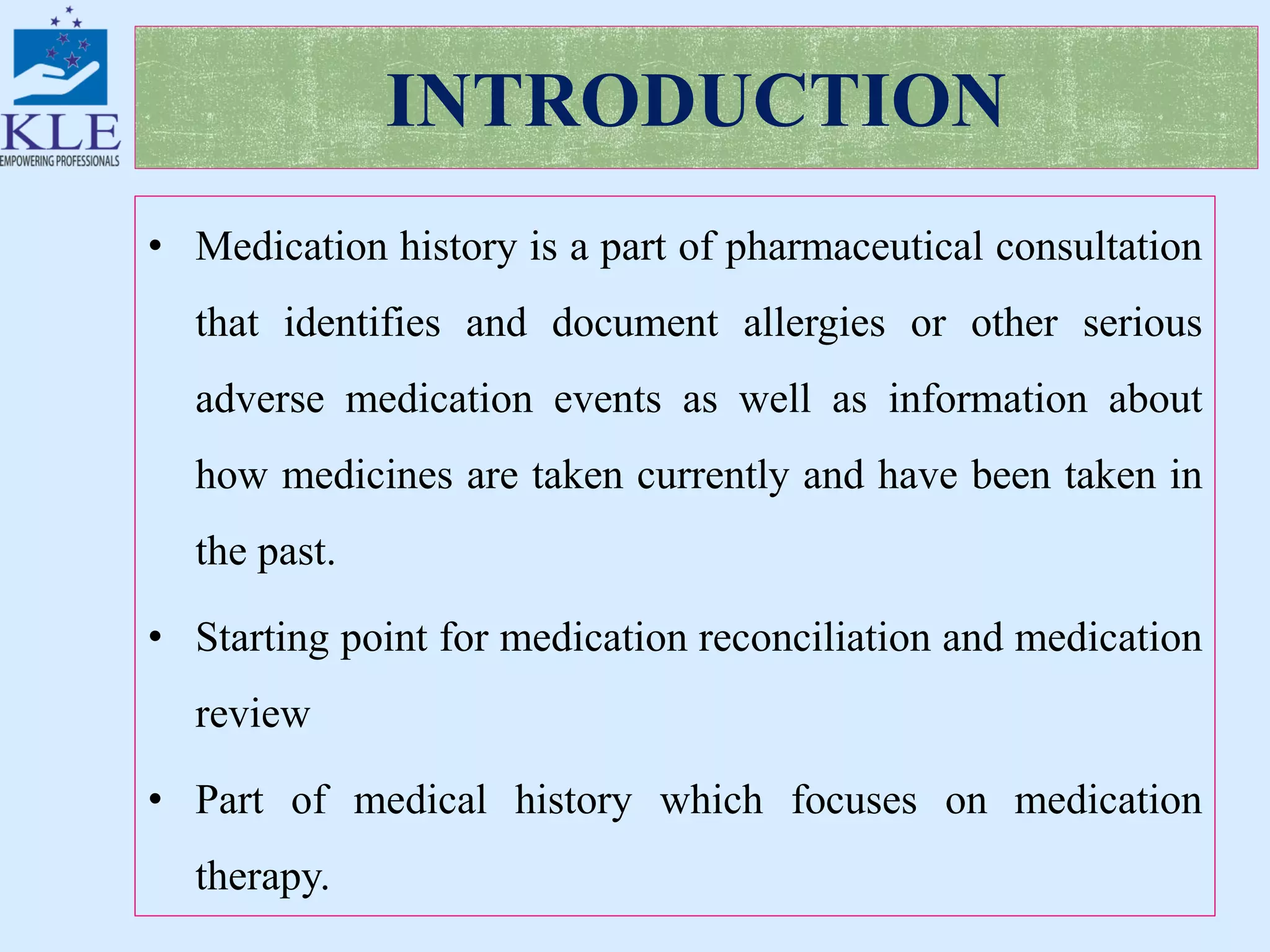
• Medication history is a part of pharmaceutical consultation
that identifies and document allergies or other serious
adverse medication events as well as information about
how medicines are taken currently and have been taken in
the past.
• Starting point for medication reconciliation and medication
review
• Part of medical history which focuses on medication
therapy.
GOALS OF MEDICATION HISTORY
• To gain information on
Prescription and nonprescription medications
Perceived benefit or adverse effects of the
therapy
Medication allergy/intolerance
• Identification of potential medication problems
• To develop more through assessment and
pharmaceutical care plan.
• Better patient outcomes
Types of Data Collection
• Subjective:
Information provided by the patient
Cannot confirmed/observed/measured
Other measure to validate it
• Objective:
Measurable and observed
Not influenced by the opinion/perception of the
patient
• Patient interview
• Medical records
• Pharmacy dispensing records
• Health care providers
• Care giver/family members
Sources of Patient Data
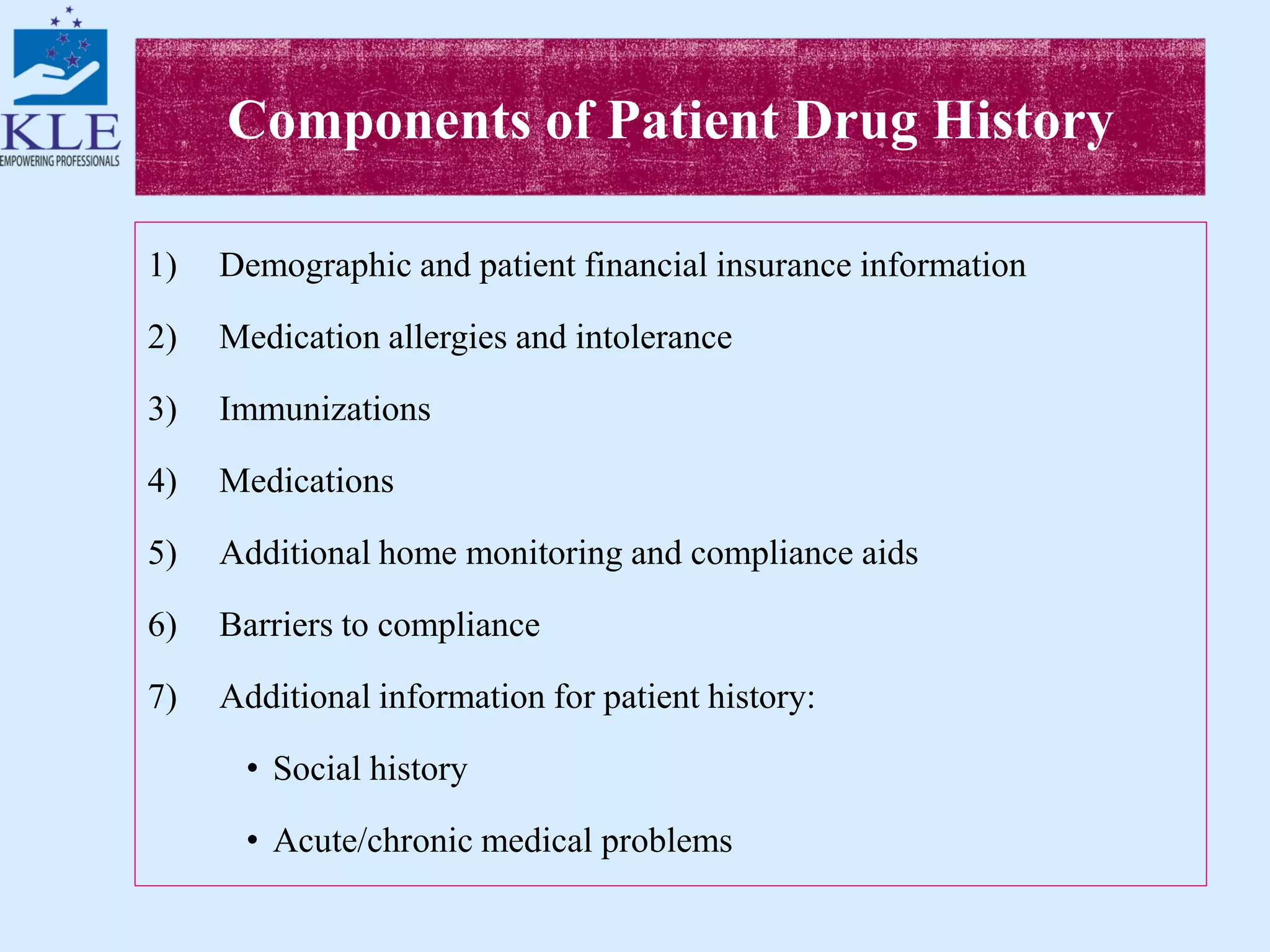
Components of Patient Drug History
1) Demographic and patient financial insurance information
2) Medication allergies and intolerance
3) Immunizations
4) Medications
5) Additional home monitoring and compliance aids
6) Barriers to compliance
7) Additional information for patient history:
• Social history
• Acute/chronic medical problems
Aspects of medication use obtained from medication
history interview
• History of previous allergies/ADR
• Perceived efficacy
• Perceived side effects
• Adherence to medication
• Medication administration techniques
• Specific problems related to medicine use
• Possibility of pregnancy in women of child
bearing age.
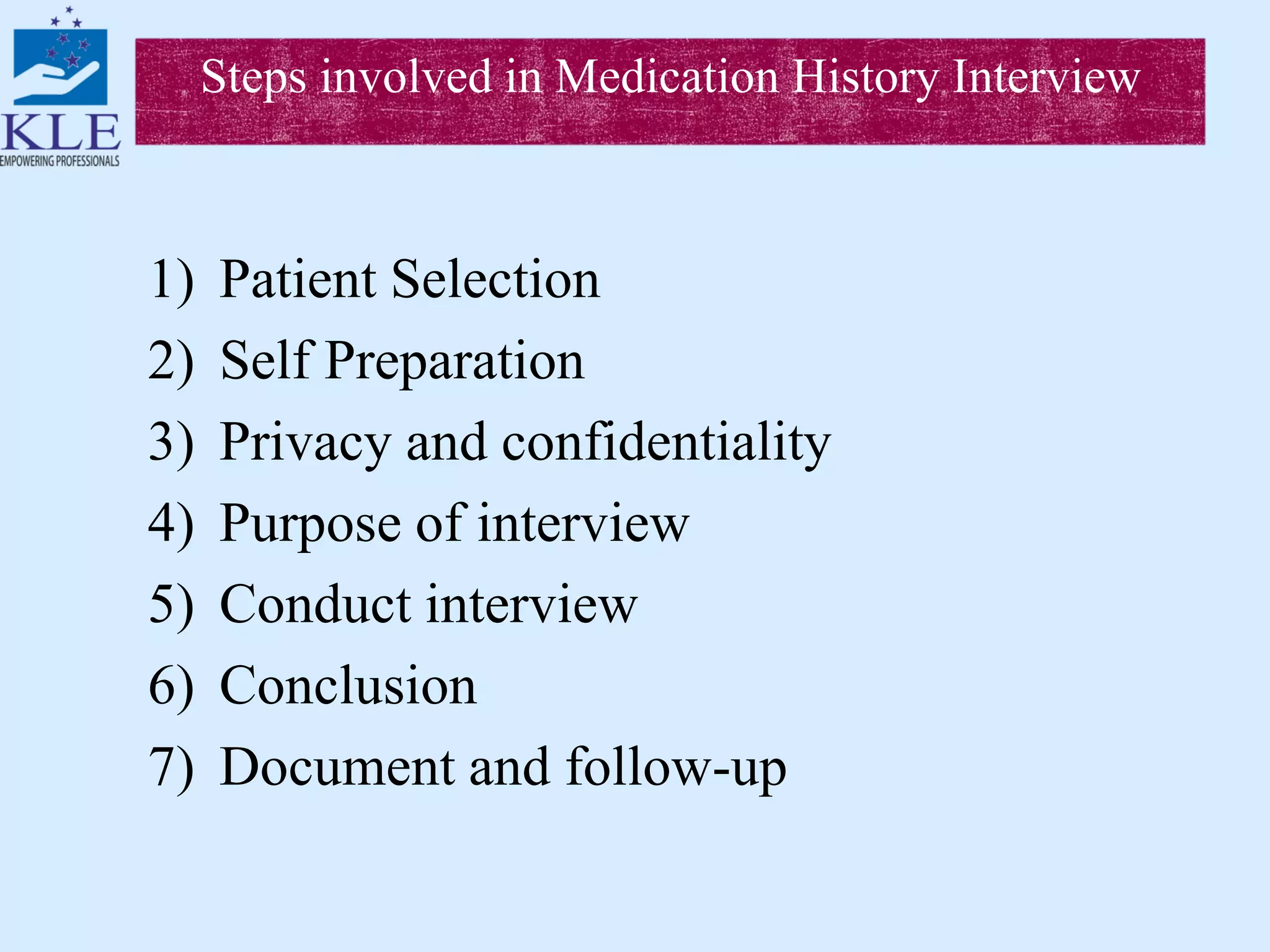
Steps involved in Medication History Interview
1) Patient Selection
2) Self Preparation
3) Privacy and confidentiality
4) Purpose of interview
5) Conduct interview
6) Conclusion
7) Document and follow-up
1) Patient Selection
 Ideally all Patient
 If not possible priority should be given to
those who are more likely to get benefit.
 Eg: Patient with polypharmacy, Multiple
and chronic diseases.
Certain diseases it is not possible to take
medication history interview like
psychiatric disorders, impaired cognition
etc.
Consider family members or relatives.
2) Self Preparation
 Collect all the relevant data including co-
morbid conditions
 Make use of various sources of data
 Provisional list of medications can be
made through medical notes
 Preparation of list of questions can be
helpful
3) Privacy and Confidentiality
 Consider privacy and confidentiality of the
patient
 Hospital setting – difficult to maintain
because interviews are taken at bedside
 Patient unable to communicate – family
members can be involved
 Must maintain confidentiality of the data
except for exchange of information with
other health care professionals.
4) Purpose of interview
Introduce him/herself and explain the
purpose of interview
Possible benefits should also be explained
Respect patient right to decline the
interview
5) Conduct Interview
Use proper communication skills during
interview
Where possible ask open ended questions
Close ended questions may be useful to
confirm details
All the questions asked appropriately
6) Conclusion
Check whether all important and relevant
details obtained
Ask patient if he/she has any questions
relating to the medications.
7) Documentation and follow up
All information should be documented
Documented medications should be
compared with the information obtained
from health care professionals for any
discrepancies.
If any discrepancies – informed to the
concerned physician
Documented information will be helpful for
ongoing pharmaceutical care
References
• G. Parthasarathi, Karin Nyfort Hansen, Milap C
Nahata. A textbook of clinical pharmacy practice
Essential concepts and skills. Universities Press.
2nd edition.
• Joseph T. Dipiro. Encyclopedia of Clinical
Pharmacy. Taylor and Francis Group. New York:
London.
Medication history Interview

Medication history Interview

  • 1.
    Medication History Dr. RameshBhandari Asst. Professor Dept. of Pharmacy Practice KLE College of Pharmacy, Belagavi
  • 2.
    LEARNING OBJECTIVES • Knowthe Definition Of ‘medication history’ • Understand the components of medication history • Understand the Steps Involved In medication history interview
  • 3.
    INTRODUCTION • Medication historyis a part of pharmaceutical consultation that identifies and document allergies or other serious adverse medication events as well as information about how medicines are taken currently and have been taken in the past. • Starting point for medication reconciliation and medication review • Part of medical history which focuses on medication therapy.
  • 4.
    GOALS OF MEDICATIONHISTORY • To gain information on Prescription and nonprescription medications Perceived benefit or adverse effects of the therapy Medication allergy/intolerance • Identification of potential medication problems • To develop more through assessment and pharmaceutical care plan. • Better patient outcomes
  • 5.
    Types of DataCollection • Subjective: Information provided by the patient Cannot confirmed/observed/measured Other measure to validate it • Objective: Measurable and observed Not influenced by the opinion/perception of the patient
  • 6.
    • Patient interview •Medical records • Pharmacy dispensing records • Health care providers • Care giver/family members Sources of Patient Data
  • 7.
    Components of PatientDrug History 1) Demographic and patient financial insurance information 2) Medication allergies and intolerance 3) Immunizations 4) Medications 5) Additional home monitoring and compliance aids 6) Barriers to compliance 7) Additional information for patient history: • Social history • Acute/chronic medical problems
  • 8.
    Aspects of medicationuse obtained from medication history interview • History of previous allergies/ADR • Perceived efficacy • Perceived side effects • Adherence to medication • Medication administration techniques • Specific problems related to medicine use • Possibility of pregnancy in women of child bearing age.
  • 9.
    Steps involved inMedication History Interview 1) Patient Selection 2) Self Preparation 3) Privacy and confidentiality 4) Purpose of interview 5) Conduct interview 6) Conclusion 7) Document and follow-up
  • 10.
    1) Patient Selection Ideally all Patient  If not possible priority should be given to those who are more likely to get benefit.  Eg: Patient with polypharmacy, Multiple and chronic diseases. Certain diseases it is not possible to take medication history interview like psychiatric disorders, impaired cognition etc. Consider family members or relatives.
  • 11.
    2) Self Preparation Collect all the relevant data including co- morbid conditions  Make use of various sources of data  Provisional list of medications can be made through medical notes  Preparation of list of questions can be helpful
  • 12.
    3) Privacy andConfidentiality  Consider privacy and confidentiality of the patient  Hospital setting – difficult to maintain because interviews are taken at bedside  Patient unable to communicate – family members can be involved  Must maintain confidentiality of the data except for exchange of information with other health care professionals.
  • 13.
    4) Purpose ofinterview Introduce him/herself and explain the purpose of interview Possible benefits should also be explained Respect patient right to decline the interview
  • 14.
    5) Conduct Interview Useproper communication skills during interview Where possible ask open ended questions Close ended questions may be useful to confirm details All the questions asked appropriately
  • 15.
    6) Conclusion Check whetherall important and relevant details obtained Ask patient if he/she has any questions relating to the medications.
  • 16.
    7) Documentation andfollow up All information should be documented Documented medications should be compared with the information obtained from health care professionals for any discrepancies. If any discrepancies – informed to the concerned physician Documented information will be helpful for ongoing pharmaceutical care
  • 17.
    References • G. Parthasarathi,Karin Nyfort Hansen, Milap C Nahata. A textbook of clinical pharmacy practice Essential concepts and skills. Universities Press. 2nd edition. • Joseph T. Dipiro. Encyclopedia of Clinical Pharmacy. Taylor and Francis Group. New York: London.