PATIENT
MEDICATION
HISTORY INTERVIEW
Mr. Mangesh Bansod
Introduction
 A medication history comes under pharmaceutical consultation that identifies and
documents allergies or other serious adverse events caused by a drug. It also
includes information on the current and past considerations about medicines. It is a
beginning for medicines reconciliation and review. A positive effect on patient care is
observed when accurate and complete medication histories are taken.
 Medication history interview involves interviewing a patient for collecting the data
medical history.
 The history attained by the medical team and the pharmacist may differ and fall into
two categories, i.e., intentional (when medical team makes a decision of changing
the regimen) or unintentional (when complete record was not available).
Differences should be clarified with the prescriber or the senior pharmacist.
 Firstly the pharmacist should get familiarise with the patient charts to know the
present medical status and background particulars of the patient.
 The interview should be started with introduction and the reason for interview.
 The patient’s name, address, age, and past medication history should be jotted
down.
Introduction
 Direct or indirect questions can be put forward on primary issues , like prescribed
medication, self-medication, allergies, undesirable effect of any drug, compliance to
prescribed medication, and smoking, drinking and eating habits.
 The language or terminologies should be simple and easy to understand by the
patient.
 If the patient has difficulty in understanding specific terms, the pharmacist should
explain it properly.
 Secondary relevant areas for questioning are constipation, diarrhoea, cough and
cold, lay fever, allergies, vitamins, tonics and skin preparations.
 At last , when patient’s confidence is achieved by the pharmacist through the
interview, questions on patient’s medication compliance could be asked. It is
supportive information for the drug therapy.
 All the details gained during the interview are noted down in a sheet, one copy of
which is sent to the physician.
Need for the Patient Medication History Interview
 It gives information about the drugs taken by the patient in the past or being taken
at the present time. Information on the responses of drugs administered in the past
help in planning the future treatment.
 It informs about the drug effects, as drugs may give rise to a disease either directly
or due to an interaction.
 The drugs the patient is currently taking can mask clinical signs; for example , β-
adrenoceptor antagonists prevent tachycardia in a patient with haemorrhage;
corticosteroids prevent abdominal pain and rigidity in a patient with perforated
duodenal ulcer.
 Drugs the patient is currently taking can also affect the results of diagnosis;
for example, amiodarone alters the results of thyroid tests.
 An inaccurate history on admission to hospital results in unwanted duplication of
drugs, drug interactions, discontinuation of long-term medications, and failure to
detect drug -related problems. Such prescription errors can be prevented by
medication history.

Need for the Patient Medication History Interview
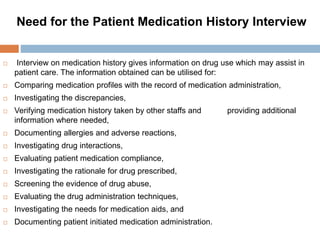
 Interview on medication history gives information on drug use which may assist in
patient care. The information obtained can be utilised for:
 Comparing medication profiles with the record of medication administration,
 Investigating the discrepancies,
 Verifying medication history taken by other staffs and providing additional
information where needed,
 Documenting allergies and adverse reactions,
 Investigating drug interactions,
 Evaluating patient medication compliance,
 Investigating the rationale for drug prescribed,
 Screening the evidence of drug abuse,
 Evaluating the drug administration techniques,
 Investigating the needs for medication aids, and
 Documenting patient initiated medication administration.
Components
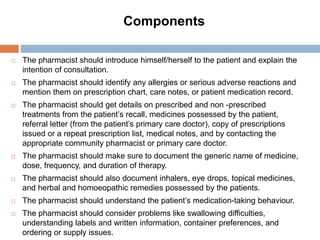
 The pharmacist should introduce himself/herself to the patient and explain the
intention of consultation.
 The pharmacist should identify any allergies or serious adverse reactions and
mention them on prescription chart, care notes, or patient medication record.
 The pharmacist should get details on prescribed and non -prescribed
treatments from the patient’s recall, medicines possessed by the patient,
referral letter (from the patient’s primary care doctor), copy of prescriptions
issued or a repeat prescription list, medical notes, and by contacting the
appropriate community pharmacist or primary care doctor.
 The pharmacist should make sure to document the generic name of medicine,
dose, frequency, and duration of therapy.
 The pharmacist should also document inhalers, eye drops, topical medicines,
and herbal and homoeopathic remedies possessed by the patients.
 The pharmacist should understand the patient’s medication-taking behaviour.
 The pharmacist should consider problems like swallowing difficulties,
understanding labels and written information, container preferences, and
ordering or supply issues.
Components
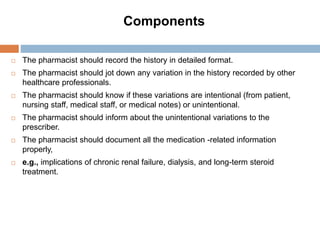
 The pharmacist should record the history in detailed format.
 The pharmacist should jot down any variation in the history recorded by other
healthcare professionals.
 The pharmacist should know if these variations are intentional (from patient,
nursing staff, medical staff, or medical notes) or unintentional.
 The pharmacist should inform about the unintentional variations to the
prescriber.
 The pharmacist should document all the medication -related information
properly,
 e.g., implications of chronic renal failure, dialysis, and long-term steroid
treatment.
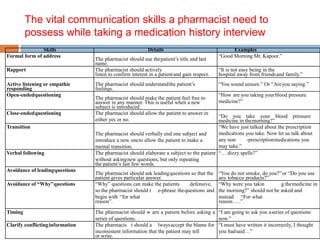
The vital communication skills a pharmacist need to
possess while taking a medication history interview
Skills Details Examples
Formal form of address
The pharmacist should use thepatient’s title and last
name.
“Good Morning Mr. Kapoor.”
Rapport The pharmacist should actively
listen to confirm interest in a patientand gain respect.
“It is not easy being in the
hospital away from friendsand family.”
Active listening or empathic
responding
The pharmacist should understandthe patient’s
feelings.
“You sound unsure.” Or “Areyou saying.”
Open-endedquestioning
The pharmacist should make the patient feel free to
answer in any manner. This is useful when a new
subject is introduced.
“How are you taking yourblood pressure
medicine?”
Close-endedquestioning The pharmacist should allow the patient to answer in
either yes or no.
“Do you take your blood pressure
medicine in themorning?”
Transition
The pharmacist should verbally end one subject and
introduce a new oneto allow the patient to make a
mental transition.
“We have just talked about the prescription
medications you take. Now let us talk about
any non -prescriptionmedications you
may take.”
Verbal following The pharmacist should elaborate a subject to the patient
without askingnew questions, but only repeating
the patient’s last few words.
“… dizzy spells?”
Avoidance of leadingquestions
The pharmacist should ask leadingquestions so that the
patient gives particular answer.
“You do not smoke, do you?”or “Do you use
any tobacco products?”
Avoidance of “Why”questions “Why” questions can make the patients defensive,
so the pharmacist should r e-phrase thequestions and
begin with “for what
reason”.
“Why were you takin g themedicine in
the morning?” should not be asked and
instead “For what
reason…..”.
Timing The pharmacist should w arn a patient before asking a
series of questions.
“I am going to ask you aseries of questions
now.”
Clarify conflictinginformation The pharmacis t should a lwaysaccept the blame for
inconsistent information that the patient may tell
or write.
“I must have written it incorrectly, I thought
you hadsaid…”
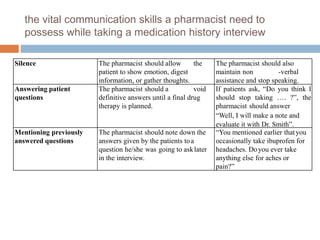
the vital communication skills a pharmacist need to
possess while taking a medication history interview
Silence The pharmacist should allow the
patient to show emotion, digest
information, or gather thoughts.
The pharmacist should also
maintain non -verbal
assistance and stop speaking.
Answering patient
questions
The pharmacist should a void
definitive answers until a final drug
therapy is planned.
If patients ask, “Do you think I
should stop taking …. ?”, the
pharmacist should answer
“Well, I will make a note and
evaluate it with Dr. Smith”.
Mentioning previously
answered questions
The pharmacist should note down the
answers given by the patients toa
question he/she was going to asklater
in the interview.
“You mentioned earlier thatyou
occasionally take ibuprofen for
headaches. Doyou ever take
anything else for aches or
pain?”
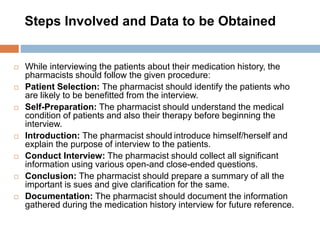
Steps Involved and Data to be Obtained
 While interviewing the patients about their medication history, the
pharmacists should follow the given procedure:
 Patient Selection: The pharmacist should identify the patients who
are likely to be benefitted from the interview.
 Self-Preparation: The pharmacist should understand the medical
condition of patients and also their therapy before beginning the
interview.
 Introduction: The pharmacist should introduce himself/herself and
explain the purpose of interview to the patients.
 Conduct Interview: The pharmacist should collect all significant
information using various open-and close-ended questions.
 Conclusion: The pharmacist should prepare a summary of all the
important is sues and give clarification for the same.
 Documentation: The pharmacist should document the information
gathered during the medication history interview for future reference.
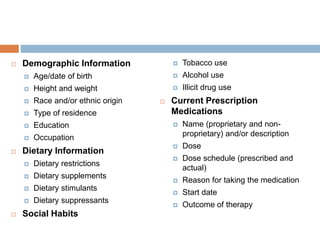
 Demographic Information
 Age/date of birth
 Height and weight
 Race and/or ethnic origin
 Type of residence
 Education
 Occupation
 Dietary Information
 Dietary restrictions
 Dietary supplements
 Dietary stimulants
 Dietary suppressants
 Social Habits
 Tobacco use
 Alcohol use
 Illicit drug use
 Current Prescription
Medications
 Name (proprietary and non-
proprietary) and/or description
 Dose
 Dose schedule (prescribed and
actual)
 Reason for taking the medication
 Start date
 Outcome of therapy
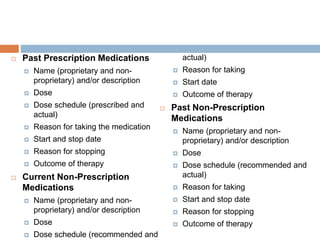
 Past Prescription Medications
 Name (proprietary and non-
proprietary) and/or description
 Dose
 Dose schedule (prescribed and
actual)
 Reason for taking the medication
 Start and stop date
 Reason for stopping
 Outcome of therapy
 Current Non-Prescription
Medications
 Name (proprietary and non-
proprietary) and/or description
 Dose
 Dose schedule (recommended and
actual)
 Reason for taking
 Start date
 Outcome of therapy
 Past Non-Prescription
Medications
 Name (proprietary and non-
proprietary) and/or description
 Dose
 Dose schedule (recommended and
actual)
 Reason for taking
 Start and stop date
 Reason for stopping
 Outcome of therapy
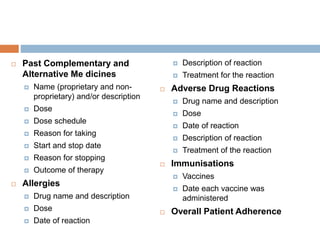
 Past Complementary and
Alternative Me dicines
 Name (proprietary and non-
proprietary) and/or description
 Dose
 Dose schedule
 Reason for taking
 Start and stop date
 Reason for stopping
 Outcome of therapy
 Allergies
 Drug name and description
 Dose
 Date of reaction
 Description of reaction
 Treatment for the reaction
 Adverse Drug Reactions
 Drug name and description
 Dose
 Date of reaction
 Description of reaction
 Treatment of the reaction
 Immunisations
 Vaccines
 Date each vaccine was
administered
 Overall Patient Adherence
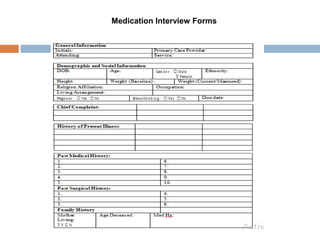
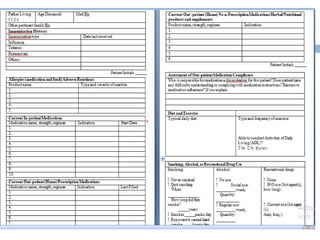
Medication Interview Forms
Patient Medication History Interview.pptx

Patient Medication History Interview.pptx

  • 1.
  • 2.
    Introduction  A medicationhistory comes under pharmaceutical consultation that identifies and documents allergies or other serious adverse events caused by a drug. It also includes information on the current and past considerations about medicines. It is a beginning for medicines reconciliation and review. A positive effect on patient care is observed when accurate and complete medication histories are taken.  Medication history interview involves interviewing a patient for collecting the data medical history.  The history attained by the medical team and the pharmacist may differ and fall into two categories, i.e., intentional (when medical team makes a decision of changing the regimen) or unintentional (when complete record was not available). Differences should be clarified with the prescriber or the senior pharmacist.  Firstly the pharmacist should get familiarise with the patient charts to know the present medical status and background particulars of the patient.  The interview should be started with introduction and the reason for interview.  The patient’s name, address, age, and past medication history should be jotted down.
  • 3.
    Introduction  Direct orindirect questions can be put forward on primary issues , like prescribed medication, self-medication, allergies, undesirable effect of any drug, compliance to prescribed medication, and smoking, drinking and eating habits.  The language or terminologies should be simple and easy to understand by the patient.  If the patient has difficulty in understanding specific terms, the pharmacist should explain it properly.  Secondary relevant areas for questioning are constipation, diarrhoea, cough and cold, lay fever, allergies, vitamins, tonics and skin preparations.  At last , when patient’s confidence is achieved by the pharmacist through the interview, questions on patient’s medication compliance could be asked. It is supportive information for the drug therapy.  All the details gained during the interview are noted down in a sheet, one copy of which is sent to the physician.
  • 4.
    Need for thePatient Medication History Interview  It gives information about the drugs taken by the patient in the past or being taken at the present time. Information on the responses of drugs administered in the past help in planning the future treatment.  It informs about the drug effects, as drugs may give rise to a disease either directly or due to an interaction.  The drugs the patient is currently taking can mask clinical signs; for example , β- adrenoceptor antagonists prevent tachycardia in a patient with haemorrhage; corticosteroids prevent abdominal pain and rigidity in a patient with perforated duodenal ulcer.  Drugs the patient is currently taking can also affect the results of diagnosis; for example, amiodarone alters the results of thyroid tests.  An inaccurate history on admission to hospital results in unwanted duplication of drugs, drug interactions, discontinuation of long-term medications, and failure to detect drug -related problems. Such prescription errors can be prevented by medication history. 
  • 5.
    Need for thePatient Medication History Interview  Interview on medication history gives information on drug use which may assist in patient care. The information obtained can be utilised for:  Comparing medication profiles with the record of medication administration,  Investigating the discrepancies,  Verifying medication history taken by other staffs and providing additional information where needed,  Documenting allergies and adverse reactions,  Investigating drug interactions,  Evaluating patient medication compliance,  Investigating the rationale for drug prescribed,  Screening the evidence of drug abuse,  Evaluating the drug administration techniques,  Investigating the needs for medication aids, and  Documenting patient initiated medication administration.
  • 6.
    Components  The pharmacistshould introduce himself/herself to the patient and explain the intention of consultation.  The pharmacist should identify any allergies or serious adverse reactions and mention them on prescription chart, care notes, or patient medication record.  The pharmacist should get details on prescribed and non -prescribed treatments from the patient’s recall, medicines possessed by the patient, referral letter (from the patient’s primary care doctor), copy of prescriptions issued or a repeat prescription list, medical notes, and by contacting the appropriate community pharmacist or primary care doctor.  The pharmacist should make sure to document the generic name of medicine, dose, frequency, and duration of therapy.  The pharmacist should also document inhalers, eye drops, topical medicines, and herbal and homoeopathic remedies possessed by the patients.  The pharmacist should understand the patient’s medication-taking behaviour.  The pharmacist should consider problems like swallowing difficulties, understanding labels and written information, container preferences, and ordering or supply issues.
  • 7.
    Components  The pharmacistshould record the history in detailed format.  The pharmacist should jot down any variation in the history recorded by other healthcare professionals.  The pharmacist should know if these variations are intentional (from patient, nursing staff, medical staff, or medical notes) or unintentional.  The pharmacist should inform about the unintentional variations to the prescriber.  The pharmacist should document all the medication -related information properly,  e.g., implications of chronic renal failure, dialysis, and long-term steroid treatment.
  • 8.
    The vital communicationskills a pharmacist need to possess while taking a medication history interview Skills Details Examples Formal form of address The pharmacist should use thepatient’s title and last name. “Good Morning Mr. Kapoor.” Rapport The pharmacist should actively listen to confirm interest in a patientand gain respect. “It is not easy being in the hospital away from friendsand family.” Active listening or empathic responding The pharmacist should understandthe patient’s feelings. “You sound unsure.” Or “Areyou saying.” Open-endedquestioning The pharmacist should make the patient feel free to answer in any manner. This is useful when a new subject is introduced. “How are you taking yourblood pressure medicine?” Close-endedquestioning The pharmacist should allow the patient to answer in either yes or no. “Do you take your blood pressure medicine in themorning?” Transition The pharmacist should verbally end one subject and introduce a new oneto allow the patient to make a mental transition. “We have just talked about the prescription medications you take. Now let us talk about any non -prescriptionmedications you may take.” Verbal following The pharmacist should elaborate a subject to the patient without askingnew questions, but only repeating the patient’s last few words. “… dizzy spells?” Avoidance of leadingquestions The pharmacist should ask leadingquestions so that the patient gives particular answer. “You do not smoke, do you?”or “Do you use any tobacco products?” Avoidance of “Why”questions “Why” questions can make the patients defensive, so the pharmacist should r e-phrase thequestions and begin with “for what reason”. “Why were you takin g themedicine in the morning?” should not be asked and instead “For what reason…..”. Timing The pharmacist should w arn a patient before asking a series of questions. “I am going to ask you aseries of questions now.” Clarify conflictinginformation The pharmacis t should a lwaysaccept the blame for inconsistent information that the patient may tell or write. “I must have written it incorrectly, I thought you hadsaid…”
  • 9.
    the vital communicationskills a pharmacist need to possess while taking a medication history interview Silence The pharmacist should allow the patient to show emotion, digest information, or gather thoughts. The pharmacist should also maintain non -verbal assistance and stop speaking. Answering patient questions The pharmacist should a void definitive answers until a final drug therapy is planned. If patients ask, “Do you think I should stop taking …. ?”, the pharmacist should answer “Well, I will make a note and evaluate it with Dr. Smith”. Mentioning previously answered questions The pharmacist should note down the answers given by the patients toa question he/she was going to asklater in the interview. “You mentioned earlier thatyou occasionally take ibuprofen for headaches. Doyou ever take anything else for aches or pain?”
  • 10.
    Steps Involved andData to be Obtained  While interviewing the patients about their medication history, the pharmacists should follow the given procedure:  Patient Selection: The pharmacist should identify the patients who are likely to be benefitted from the interview.  Self-Preparation: The pharmacist should understand the medical condition of patients and also their therapy before beginning the interview.  Introduction: The pharmacist should introduce himself/herself and explain the purpose of interview to the patients.  Conduct Interview: The pharmacist should collect all significant information using various open-and close-ended questions.  Conclusion: The pharmacist should prepare a summary of all the important is sues and give clarification for the same.  Documentation: The pharmacist should document the information gathered during the medication history interview for future reference.
  • 11.
     Demographic Information Age/date of birth  Height and weight  Race and/or ethnic origin  Type of residence  Education  Occupation  Dietary Information  Dietary restrictions  Dietary supplements  Dietary stimulants  Dietary suppressants  Social Habits  Tobacco use  Alcohol use  Illicit drug use  Current Prescription Medications  Name (proprietary and non- proprietary) and/or description  Dose  Dose schedule (prescribed and actual)  Reason for taking the medication  Start date  Outcome of therapy
  • 12.
     Past PrescriptionMedications  Name (proprietary and non- proprietary) and/or description  Dose  Dose schedule (prescribed and actual)  Reason for taking the medication  Start and stop date  Reason for stopping  Outcome of therapy  Current Non-Prescription Medications  Name (proprietary and non- proprietary) and/or description  Dose  Dose schedule (recommended and actual)  Reason for taking  Start date  Outcome of therapy  Past Non-Prescription Medications  Name (proprietary and non- proprietary) and/or description  Dose  Dose schedule (recommended and actual)  Reason for taking  Start and stop date  Reason for stopping  Outcome of therapy
  • 13.
     Past Complementaryand Alternative Me dicines  Name (proprietary and non- proprietary) and/or description  Dose  Dose schedule  Reason for taking  Start and stop date  Reason for stopping  Outcome of therapy  Allergies  Drug name and description  Dose  Date of reaction  Description of reaction  Treatment for the reaction  Adverse Drug Reactions  Drug name and description  Dose  Date of reaction  Description of reaction  Treatment of the reaction  Immunisations  Vaccines  Date each vaccine was administered  Overall Patient Adherence
  • 14.