MICROBIOLOGICAL
CULTURE SENSITIVITY
TESTS
Dr. Ramesh Bhandari
Asst. Professor,
Department of Pharmacy Practice
KLE College of Pharmacy, Belagavi
Dr.
Ramesh
Bhandari
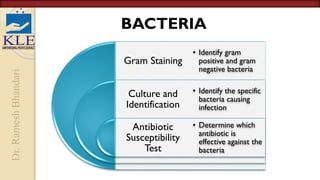
Gram Staining
Culture and
Identification
Antibiotic
Susceptibility
Test
• Identify gram
positive and gram
negative bacteria
• Identify the specific
bacteria causing
infection
• Determine which
antibiotic is
effective against the
bacteria
BACTERIA
Dr.
Ramesh
Bhandari
Gram Staining
 Most common staining method for examination of
bacteria
 Provides preliminary information regarding potential infecting
bacteria
 Evaluation of Fluids (CSF, Synovial, pleural), respiratory tract
secretions, wounds, abscess swabs or aspirates.
 Classifies bacteria in one of the following classes:
 Gram positive
 Gram Negative
Dr.
Ramesh
Bhandari
Gram Staining Procedure
 Apply, dry, and heat-fix a thin smear of a biological specimen to a clean
glass slide.
 Once the slide has cooled, it is then rinsed with crystal or gentian violet (a
purple dye) followed by Gram’s iodine,
 Decolorized with an ethanol or acetone rinse, and
 Counterstained with safranin (a pink or red dye) with a gentle,
 The slide is then blotted dry and examined under a microscope using the
oil immersion lens
Note: Tap water rinse performed between each of these steps. Gram-positive
bacteria stain purple due to retention of the crystal violet-iodine complex in
their cell walls, while gram-negative bacteria stain red because they do not
retain crystal violet and are counterstained by safranin.
Dr.
Ramesh
Bhandari
Gram Staining
 Provide rapid (within minutes) preliminary information about
the potential infecting organism that can be used to guide empiric
antibiotic therapy while waiting for culture results, which may
take 24–48 hours or more.
 Gram stain does not provide an exact identification of the
infecting organism.
 Gram stain is useful for characterizing most clinically relevant
bacteria, but is unable to detect intracellular bacteria (e.g., Chlamydia)
bacteria without cell walls.
Dr.
Ramesh
Bhandari
Culture and Identification
 Clinical specimen (blood, stool, respiratory secretions,
or body fluids i.e., saliva, urine) is also processed to
facilitate bacterial growth in culture and then observed
for growth characteristics.
 For a bacteria to be grown successfully in culture, the
specific nutritional and environmental growth
requirements (oxygen, carbon dioxide, moisture
content, temperature pH) of the bacteria must be taken
into consideration.
Dr.
Ramesh
Bhandari
Culture and Identification
 Nutritive or enrichment media - support the growth
of different types of aerobic and anaerobic bacteria
 Blood agar is also considered to be differential media
because it can distinguish between organisms based on
certain growth characteristics.
(Note: After culture of the bacteria in artificial media they
should be observed for the characteristics under
microscope for identification.)
Dr.
Ramesh
Bhandari
Culture and Identification
 The currently available rapid bacterial identification
tests are either immunologically based, nucleic acid
(NA)–based (nonamplified and amplified), or proteomic-
based.3,11,14-16 Immunologic methods employ
immunofluorescent or enzyme-linked immunosorbent
assay (ELISA) antigen or antibody detection.
 These tests will be helpful to identify the organism in 15
minutes to 12 hours.
Dr.
Ramesh
Bhandari
Culture and Identification
 Colonization: Colonized with normal flora.
 Contamination: An organism is accidentally
introduced into a biologic specimen during specimen
collection, transport, or processing.
 Infection: An organism invades and damages host
tissues eliciting a host response and symptoms
consistent with an infectious process.
Dr.
Ramesh
Bhandari
Antibiotic Susceptibility Test
 Once an organism has been cultured further testing is
performed to determine the antibiotic susceptibility of
the infecting organism.
 Because of the continual emergence of resistance in
many organisms, bacterial susceptibility testing is
imperative for determining the antimicrobial agents that
should be used for the treatment of the patient’s
infection.
Dr.
Ramesh
Bhandari
Antibiotic Susceptibility Test
 Methods that directly measures antibiotic activity:
1. Dilution Method
a) Macro dilution
b) Micro dilution
2. Disk Diffusion Method
Dr.
Ramesh
Bhandari
Antibiotic Susceptibility Test
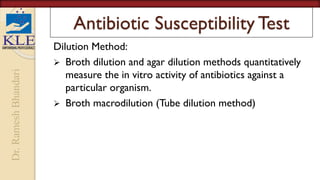
Dilution Method:
 Broth dilution and agar dilution methods quantitatively
measure the in vitro activity of antibiotics against a
particular organism.
 Broth macrodilution (Tube dilution method)
Dr.
Ramesh
Bhandari
Antibiotic Susceptibility Test
Broth macrodilution Method:
100
mg/ml
50
mg/ml
25
mg/ml
12.5
mg/ml
6.25
mg/ml
3.125
mg/ml
1.56
mg/ml
Broth Culture
overnight
Dr.
Ramesh
Bhandari
Antibiotic Susceptibility Test
Broth macrodilution Method:
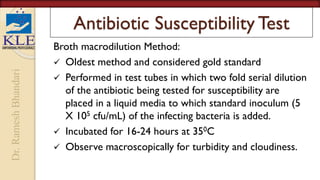
 Oldest method and considered gold standard
 Performed in test tubes in which two fold serial dilution
of the antibiotic being tested for susceptibility are
placed in a liquid media to which standard inoculum (5
X 105 cfu/mL) of the infecting bacteria is added.
 Incubated for 16-24 hours at 350C
 Observe macroscopically for turbidity and cloudiness.
Dr.
Ramesh
Bhandari
Antibiotic Susceptibility Test
Broth macrodilution Method:
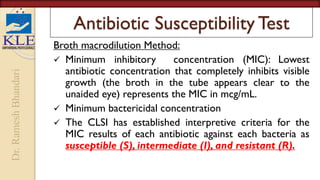
 Minimum inhibitory concentration (MIC): Lowest
antibiotic concentration that completely inhibits visible
growth (the broth in the tube appears clear to the
unaided eye) represents the MIC in mcg/mL.
 Minimum bactericidal concentration
 The CLSI has established interpretive criteria for the
MIC results of each antibiotic against each bacteria as
susceptible (S), intermediate (I), and resistant (R).
Dr.
Ramesh
Bhandari
Antibiotic Susceptibility Test
Disc Diffusion Method:
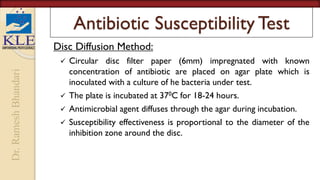
 Circular disc filter paper (6mm) impregnated with known
concentration of antibiotic are placed on agar plate which is
inoculated with a culture of he bacteria under test.
 The plate is incubated at 370C for 18-24 hours.
 Antimicrobial agent diffuses through the agar during incubation.
 Susceptibility effectiveness is proportional to the diameter of the
inhibition zone around the disc.
Dr.
Ramesh
Bhandari
Antibiotic Susceptibility Test
Disc Diffusion Method:
Incubation at 370C
18-24 hours
Filter paper with known
conc. of antibiotic
Agar plate inoculated
with bacteria under test
Zone of Inhibition
Dr.
Ramesh
Bhandari
Antibiotic Susceptibility Test
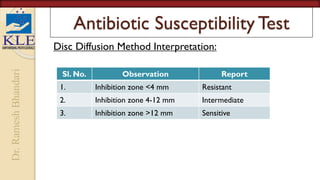
Disc Diffusion Method Interpretation:
Sl. No. Observation Report
1. Inhibition zone <4 mm Resistant
2. Inhibition zone 4-12 mm Intermediate
3. Inhibition zone >12 mm Sensitive
Dr.
Ramesh
Bhandari

Microbiological culture sensitivity tests

  • 1.
    MICROBIOLOGICAL CULTURE SENSITIVITY TESTS Dr. RameshBhandari Asst. Professor, Department of Pharmacy Practice KLE College of Pharmacy, Belagavi
  • 2.
    Dr. Ramesh Bhandari Gram Staining Culture and Identification Antibiotic Susceptibility Test •Identify gram positive and gram negative bacteria • Identify the specific bacteria causing infection • Determine which antibiotic is effective against the bacteria BACTERIA
  • 3.
    Dr. Ramesh Bhandari Gram Staining  Mostcommon staining method for examination of bacteria  Provides preliminary information regarding potential infecting bacteria  Evaluation of Fluids (CSF, Synovial, pleural), respiratory tract secretions, wounds, abscess swabs or aspirates.  Classifies bacteria in one of the following classes:  Gram positive  Gram Negative
  • 4.
    Dr. Ramesh Bhandari Gram Staining Procedure Apply, dry, and heat-fix a thin smear of a biological specimen to a clean glass slide.  Once the slide has cooled, it is then rinsed with crystal or gentian violet (a purple dye) followed by Gram’s iodine,  Decolorized with an ethanol or acetone rinse, and  Counterstained with safranin (a pink or red dye) with a gentle,  The slide is then blotted dry and examined under a microscope using the oil immersion lens Note: Tap water rinse performed between each of these steps. Gram-positive bacteria stain purple due to retention of the crystal violet-iodine complex in their cell walls, while gram-negative bacteria stain red because they do not retain crystal violet and are counterstained by safranin.
  • 5.
    Dr. Ramesh Bhandari Gram Staining  Providerapid (within minutes) preliminary information about the potential infecting organism that can be used to guide empiric antibiotic therapy while waiting for culture results, which may take 24–48 hours or more.  Gram stain does not provide an exact identification of the infecting organism.  Gram stain is useful for characterizing most clinically relevant bacteria, but is unable to detect intracellular bacteria (e.g., Chlamydia) bacteria without cell walls.
  • 6.
    Dr. Ramesh Bhandari Culture and Identification Clinical specimen (blood, stool, respiratory secretions, or body fluids i.e., saliva, urine) is also processed to facilitate bacterial growth in culture and then observed for growth characteristics.  For a bacteria to be grown successfully in culture, the specific nutritional and environmental growth requirements (oxygen, carbon dioxide, moisture content, temperature pH) of the bacteria must be taken into consideration.
  • 7.
    Dr. Ramesh Bhandari Culture and Identification Nutritive or enrichment media - support the growth of different types of aerobic and anaerobic bacteria  Blood agar is also considered to be differential media because it can distinguish between organisms based on certain growth characteristics. (Note: After culture of the bacteria in artificial media they should be observed for the characteristics under microscope for identification.)
  • 8.
    Dr. Ramesh Bhandari Culture and Identification The currently available rapid bacterial identification tests are either immunologically based, nucleic acid (NA)–based (nonamplified and amplified), or proteomic- based.3,11,14-16 Immunologic methods employ immunofluorescent or enzyme-linked immunosorbent assay (ELISA) antigen or antibody detection.  These tests will be helpful to identify the organism in 15 minutes to 12 hours.
  • 9.
    Dr. Ramesh Bhandari Culture and Identification Colonization: Colonized with normal flora.  Contamination: An organism is accidentally introduced into a biologic specimen during specimen collection, transport, or processing.  Infection: An organism invades and damages host tissues eliciting a host response and symptoms consistent with an infectious process.
  • 10.
    Dr. Ramesh Bhandari Antibiotic Susceptibility Test Once an organism has been cultured further testing is performed to determine the antibiotic susceptibility of the infecting organism.  Because of the continual emergence of resistance in many organisms, bacterial susceptibility testing is imperative for determining the antimicrobial agents that should be used for the treatment of the patient’s infection.
  • 11.
    Dr. Ramesh Bhandari Antibiotic Susceptibility Test Methods that directly measures antibiotic activity: 1. Dilution Method a) Macro dilution b) Micro dilution 2. Disk Diffusion Method
  • 12.
    Dr. Ramesh Bhandari Antibiotic Susceptibility Test DilutionMethod:  Broth dilution and agar dilution methods quantitatively measure the in vitro activity of antibiotics against a particular organism.  Broth macrodilution (Tube dilution method)
  • 13.
    Dr. Ramesh Bhandari Antibiotic Susceptibility Test Brothmacrodilution Method: 100 mg/ml 50 mg/ml 25 mg/ml 12.5 mg/ml 6.25 mg/ml 3.125 mg/ml 1.56 mg/ml Broth Culture overnight
  • 14.
    Dr. Ramesh Bhandari Antibiotic Susceptibility Test Brothmacrodilution Method:  Oldest method and considered gold standard  Performed in test tubes in which two fold serial dilution of the antibiotic being tested for susceptibility are placed in a liquid media to which standard inoculum (5 X 10⁵ cfu/mL) of the infecting bacteria is added.  Incubated for 16-24 hours at 350C  Observe macroscopically for turbidity and cloudiness.
  • 15.
    Dr. Ramesh Bhandari Antibiotic Susceptibility Test Brothmacrodilution Method:  Minimum inhibitory concentration (MIC): Lowest antibiotic concentration that completely inhibits visible growth (the broth in the tube appears clear to the unaided eye) represents the MIC in mcg/mL.  Minimum bactericidal concentration  The CLSI has established interpretive criteria for the MIC results of each antibiotic against each bacteria as susceptible (S), intermediate (I), and resistant (R).
  • 16.
    Dr. Ramesh Bhandari Antibiotic Susceptibility Test DiscDiffusion Method:  Circular disc filter paper (6mm) impregnated with known concentration of antibiotic are placed on agar plate which is inoculated with a culture of he bacteria under test.  The plate is incubated at 370C for 18-24 hours.  Antimicrobial agent diffuses through the agar during incubation.  Susceptibility effectiveness is proportional to the diameter of the inhibition zone around the disc.
  • 17.
    Dr. Ramesh Bhandari Antibiotic Susceptibility Test DiscDiffusion Method: Incubation at 370C 18-24 hours Filter paper with known conc. of antibiotic Agar plate inoculated with bacteria under test Zone of Inhibition
  • 18.
    Dr. Ramesh Bhandari Antibiotic Susceptibility Test DiscDiffusion Method Interpretation: Sl. No. Observation Report 1. Inhibition zone <4 mm Resistant 2. Inhibition zone 4-12 mm Intermediate 3. Inhibition zone >12 mm Sensitive
  • 19.