MEDICAL STATISTICSMEDICAL STATISTICS
prof. Amany R. Abo-El-Seoud
DATA
SOURCES
Records, Census
Survey, Research studies
(sampling)
PRESENTATION
Tables
Summarization
Graphs
Analysis &
interpretation
information
Planning for health programs
SamplingSampling
Objectives:
• List the benefits of sampling
• Describe types of sampling
• Enumerate factors affecting sample size
Definition:
• A sample is a small group of population
(people or things) selected carefully to be
representative for that population
Benefits :
Less time, less effort, less expensive
Can be repeated
Types of samples
Non-
probability
Probability
Accessibility
Quota
Simple random
systematic
stratified
cluster
multistage
QUIZQUIZ
 How can you select a sample of 100 diabeticHow can you select a sample of 100 diabetic
patient from the outpatient clinic?patient from the outpatient clinic?
 How can you select 200 student from aHow can you select 200 student from a
primary school (all students are 4000)?primary school (all students are 4000)?
 How can you select 50 males and 50 femalesHow can you select 50 males and 50 females
from faculty employee (their number is 2000)from faculty employee (their number is 2000)
 How can you select a village from sharkia?How can you select a village from sharkia?
SAMPLE SIZESAMPLE SIZE
Determinants :Determinants :
 Type of studyType of study
 Relative risk / Odd’s ratio /Prevalence of theRelative risk / Odd’s ratio /Prevalence of the
study problemstudy problem
 MoneyMoney
 TimeTime
 Equipments availableEquipments available
Sample size estimation for tests betweenSample size estimation for tests between
two independent sample proportionstwo independent sample proportions
 FormulaFormula

wherewhere
 N= the sample size estimateN= the sample size estimate
Zcv=Z critical value for alpha (.05 alpha has a Zcv ofZcv=Z critical value for alpha (.05 alpha has a Zcv of
1.96)1.96)
Zpower=Z value for 1-beta (.80 power has a Z ofZpower=Z value for 1-beta (.80 power has a Z of
0.842)0.842)
P1=expected proportion for sample 1P1=expected proportion for sample 1
P2=expected proportion for sample 2P2=expected proportion for sample 2
Sample size estimation for tests betweenSample size estimation for tests between
two independent sample meanstwo independent sample means
where
N= the sample size estimate
Zcv=Z critical value for alpha (.05 alpha has a Zcv of
1.96)
Zpower=Z value for 1-beta (.80 power has a Z of
0.842)
s=standard deviation
D=the expected difference between the two means
INFERENTIAL STATISTICSINFERENTIAL STATISTICS
Objectives:
• Understand the meaning of inference,
hypothesis testing
• Identify different types of statistical tests
Inference = generalization of results
obtained from sample -‫استنتاج‬ ‫استدلل‬
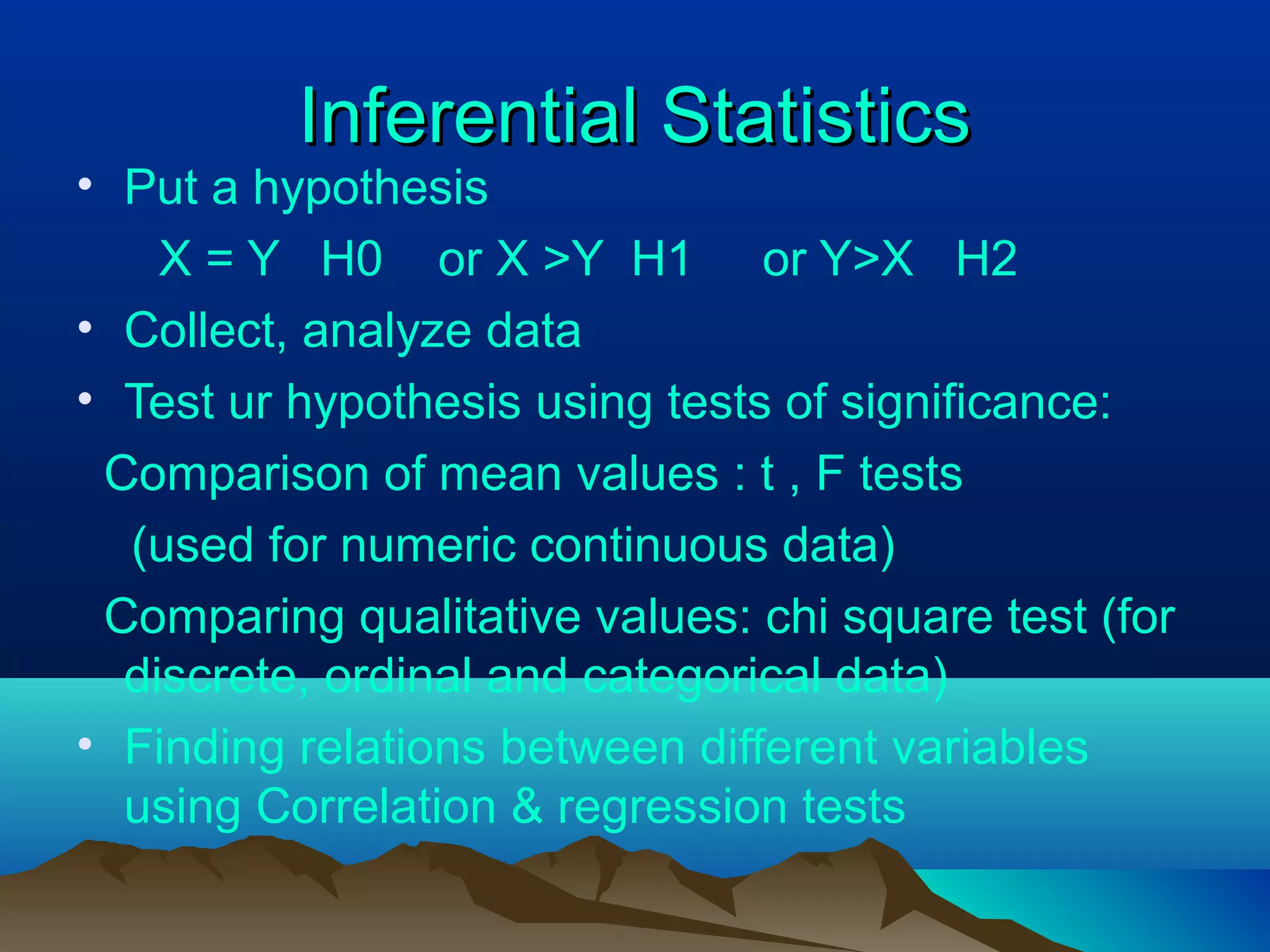
Inferential StatisticsInferential Statistics
• Put a hypothesis
X = Y H0 or X >Y H1 or Y>X H2
• Collect, analyze data
• Test ur hypothesis using tests of significance:
Comparison of mean values : t , F tests
(used for numeric continuous data)
Comparing qualitative values: chi square test (for
discrete, ordinal and categorical data)
• Finding relations between different variables
using Correlation & regression tests
Tests of significanceTests of significance
Comparison of mean valuesComparison of mean values
(1) Z test: for normally distributed data and
the sample size >60
z= mean of popul- mean of sample /SD
If z>2 ( outside the C.I.) then the sample
differs from population and lies in 5% out
the normal distribution curve
(2) student’s t test
Comparing 2 sample means
For small sample size (6 – <60)
Degree of freedom= n1 + n2 - 2
Search for the difference in t tables
under d.f at 0.05 level
(3) Paired t test: comparing paired data or
data for the same person before and
after intervention
pt= 1st
reading – 2nd
reading/sq r of SD2 of
difference/number of sample
d.f=n - 1
(4) F or ANOVA test: to compare more than
two sample means.
Significant test means that there is real
difference between groups not because of
chance. i.e the probability of chance in this
difference < 5%
For qualitative data
(1) Chi squared test : to find significant
relation between 2 variables or order
distributions or categorical data.
(2) Difference between proportions
as t test but use percentage instead of
mean values
Correlation testCorrelation test
To find a relation between 2/more variables in
direction & strength (one is dependent =
response. It is plotted on the y axis) &(the
other/s is independent = explanatory or risk.
It is plotted on the x axis)
• Correlation does not mean causation.
• Spurious correlation: significant statistically
but insignificant clinically
Steps for simple correlation test:Steps for simple correlation test:
1- choose the 2 variables from your data
that you think they make a relationship
that support the aim of study.
2- do a scatter diagram from the drawing
window for the selected 2 variables.
3- if the scatter diagram shows an
association so you can do correlation test
to get level of significance of that
relationship
 In studying the relationship between two variables it is
advisable to plot the data on a graph as a first step. This allows
visual examination of the extent of association between the
variables.
 The chart used for this purpose is known as a scatter diagram
which is a graph on which each plotted points represents an
observed pair of values of the dependent (Y) and independent
(X) variables.
Scatter diagram:
Regression and correlation analysis
0 1 2 3 4 5 6 7
0
1
2
3
4
5
6
7
Dose (mg/kg)
Numberofdeadanimals
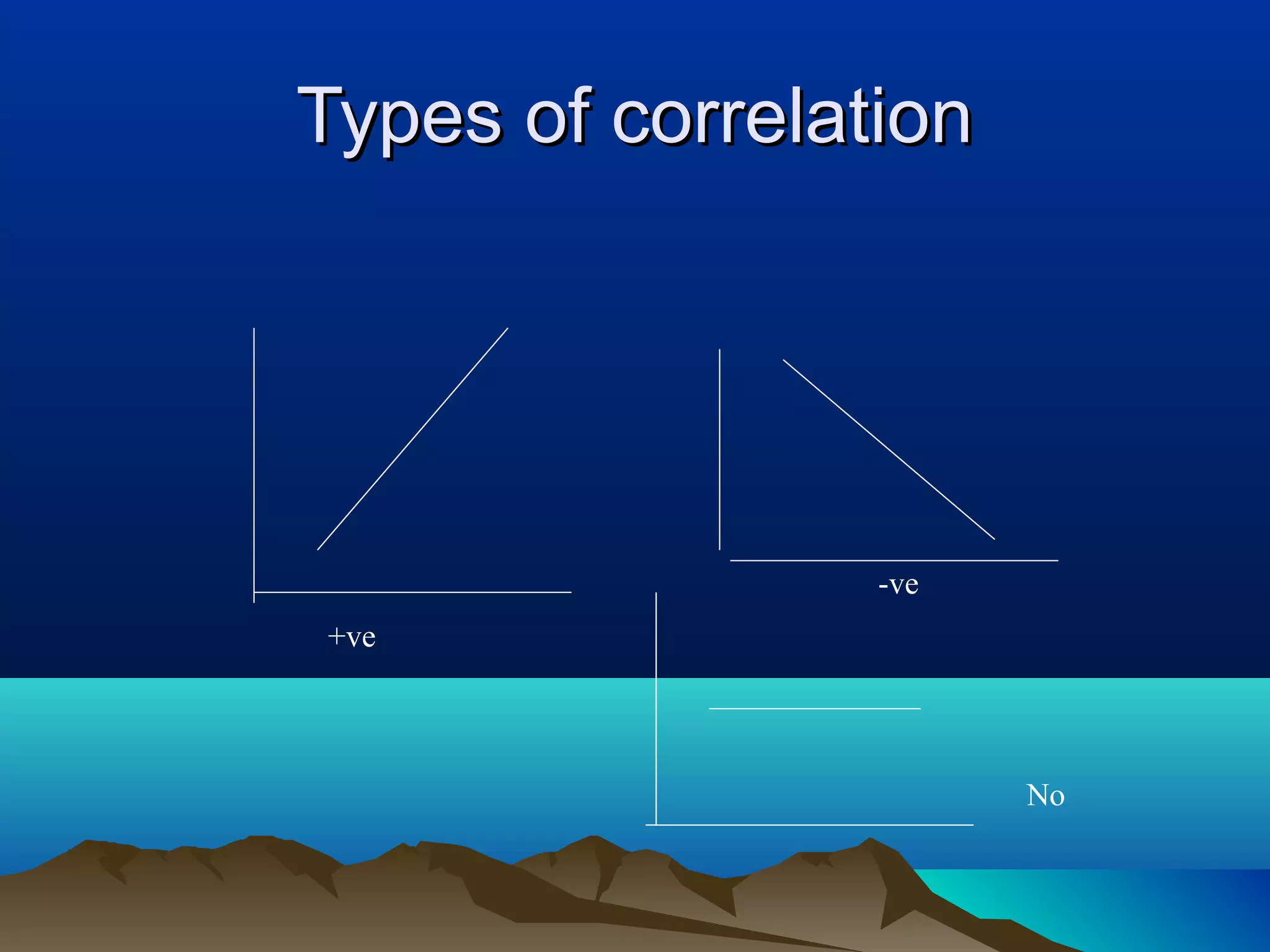
Types of correlationTypes of correlation
+ve
-ve
No
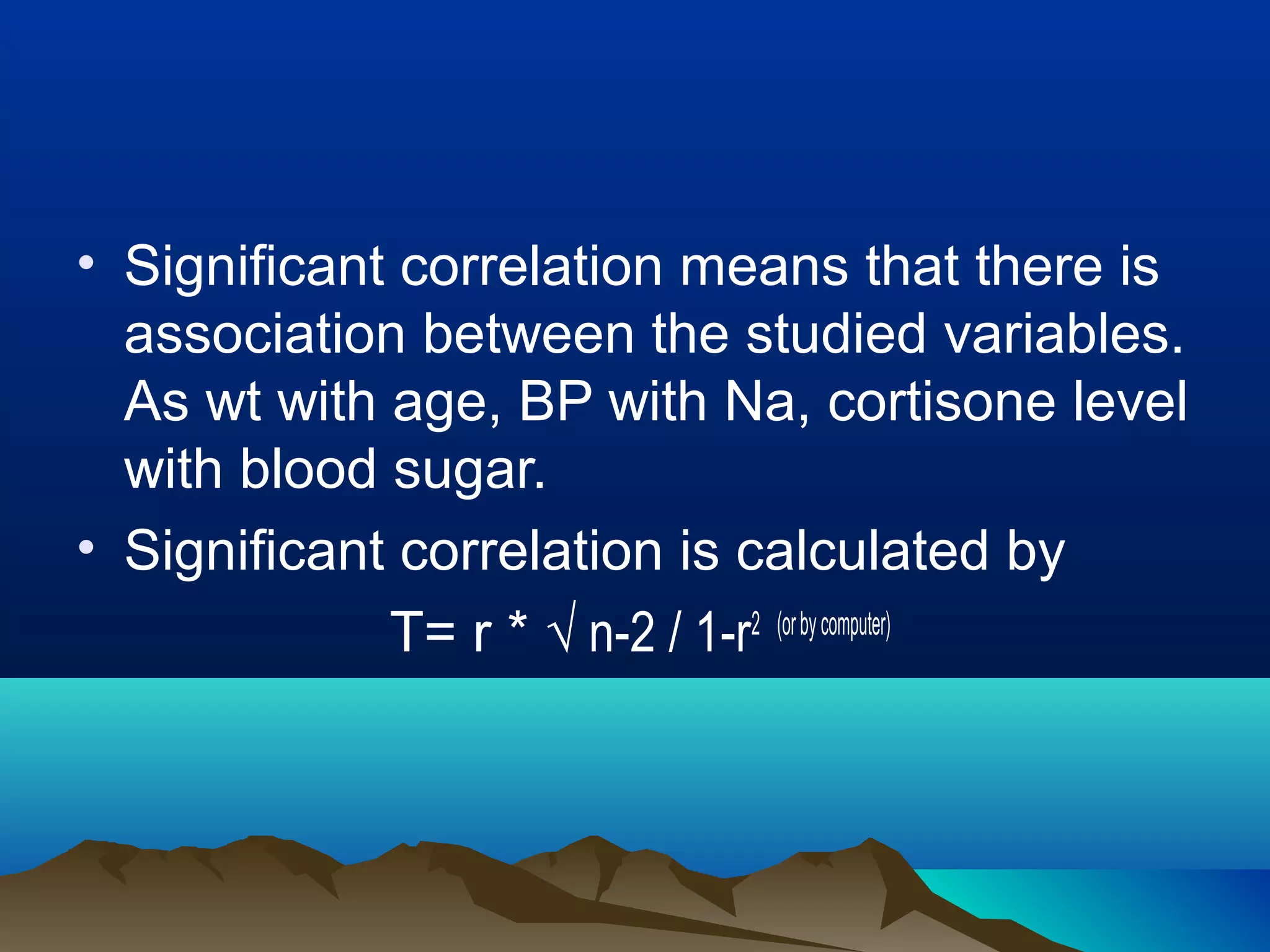
• Significant correlation means that there is
association between the studied variables.
As wt with age, BP with Na, cortisone level
with blood sugar.
• Significant correlation is calculated by
T= r * √ n-2 / 1-r2 (orbycomputer)
Coefficient of correlation “r” ranges from 0 to 1 It is
either +ve or -ve in direction
(r=0.5 p=0.02), (r=- 0.6,p=0.01) (r= 0.1,p=0.98)
Coefficient of determination R 2
: to quantify the variation of
one variable that is contributed to the other variable.
Types of correlation: I) single (simple) & multiple
II) Pearson : numeric, normally distributed,linear
Spearman : ordinal, non linear,not normally distributed
Regression analysis:Regression analysis:
To predict a dependent variable from another
known variable (s).
• Linear: dependent = intercept +/- b coefficient x
independent variable
e.g. birth wt = y +/- b x gestational age
= 2000 + 5 x 36
• Multiple
e.g. Birth wt= y +/- b1*gest+/- B2*HC
Thank you

Medical statistics2

  • 1.
  • 2.
    DATA SOURCES Records, Census Survey, Researchstudies (sampling) PRESENTATION Tables Summarization Graphs Analysis & interpretation information Planning for health programs
  • 3.
    SamplingSampling Objectives: • List thebenefits of sampling • Describe types of sampling • Enumerate factors affecting sample size
  • 4.
    Definition: • A sampleis a small group of population (people or things) selected carefully to be representative for that population Benefits : Less time, less effort, less expensive Can be repeated
  • 5.
    Types of samples Non- probability Probability Accessibility Quota Simplerandom systematic stratified cluster multistage
  • 6.
    QUIZQUIZ  How canyou select a sample of 100 diabeticHow can you select a sample of 100 diabetic patient from the outpatient clinic?patient from the outpatient clinic?  How can you select 200 student from aHow can you select 200 student from a primary school (all students are 4000)?primary school (all students are 4000)?  How can you select 50 males and 50 femalesHow can you select 50 males and 50 females from faculty employee (their number is 2000)from faculty employee (their number is 2000)  How can you select a village from sharkia?How can you select a village from sharkia?
  • 7.
    SAMPLE SIZESAMPLE SIZE Determinants:Determinants :  Type of studyType of study  Relative risk / Odd’s ratio /Prevalence of theRelative risk / Odd’s ratio /Prevalence of the study problemstudy problem  MoneyMoney  TimeTime  Equipments availableEquipments available
  • 8.
    Sample size estimationfor tests betweenSample size estimation for tests between two independent sample proportionstwo independent sample proportions  FormulaFormula  wherewhere  N= the sample size estimateN= the sample size estimate Zcv=Z critical value for alpha (.05 alpha has a Zcv ofZcv=Z critical value for alpha (.05 alpha has a Zcv of 1.96)1.96) Zpower=Z value for 1-beta (.80 power has a Z ofZpower=Z value for 1-beta (.80 power has a Z of 0.842)0.842) P1=expected proportion for sample 1P1=expected proportion for sample 1 P2=expected proportion for sample 2P2=expected proportion for sample 2
  • 9.
    Sample size estimationfor tests betweenSample size estimation for tests between two independent sample meanstwo independent sample means where N= the sample size estimate Zcv=Z critical value for alpha (.05 alpha has a Zcv of 1.96) Zpower=Z value for 1-beta (.80 power has a Z of 0.842) s=standard deviation D=the expected difference between the two means
  • 10.
    INFERENTIAL STATISTICSINFERENTIAL STATISTICS Objectives: •Understand the meaning of inference, hypothesis testing • Identify different types of statistical tests Inference = generalization of results obtained from sample -‫استنتاج‬ ‫استدلل‬
  • 11.
    Inferential StatisticsInferential Statistics •Put a hypothesis X = Y H0 or X >Y H1 or Y>X H2 • Collect, analyze data • Test ur hypothesis using tests of significance: Comparison of mean values : t , F tests (used for numeric continuous data) Comparing qualitative values: chi square test (for discrete, ordinal and categorical data) • Finding relations between different variables using Correlation & regression tests
  • 12.
    Tests of significanceTestsof significance Comparison of mean valuesComparison of mean values (1) Z test: for normally distributed data and the sample size >60 z= mean of popul- mean of sample /SD If z>2 ( outside the C.I.) then the sample differs from population and lies in 5% out the normal distribution curve
  • 13.
    (2) student’s ttest Comparing 2 sample means For small sample size (6 – <60) Degree of freedom= n1 + n2 - 2 Search for the difference in t tables under d.f at 0.05 level
  • 14.
    (3) Paired ttest: comparing paired data or data for the same person before and after intervention pt= 1st reading – 2nd reading/sq r of SD2 of difference/number of sample d.f=n - 1
  • 15.
    (4) F orANOVA test: to compare more than two sample means. Significant test means that there is real difference between groups not because of chance. i.e the probability of chance in this difference < 5%
  • 16.
    For qualitative data (1)Chi squared test : to find significant relation between 2 variables or order distributions or categorical data. (2) Difference between proportions as t test but use percentage instead of mean values
  • 17.
    Correlation testCorrelation test Tofind a relation between 2/more variables in direction & strength (one is dependent = response. It is plotted on the y axis) &(the other/s is independent = explanatory or risk. It is plotted on the x axis) • Correlation does not mean causation. • Spurious correlation: significant statistically but insignificant clinically
  • 18.
    Steps for simplecorrelation test:Steps for simple correlation test: 1- choose the 2 variables from your data that you think they make a relationship that support the aim of study. 2- do a scatter diagram from the drawing window for the selected 2 variables. 3- if the scatter diagram shows an association so you can do correlation test to get level of significance of that relationship
  • 19.
     In studyingthe relationship between two variables it is advisable to plot the data on a graph as a first step. This allows visual examination of the extent of association between the variables.  The chart used for this purpose is known as a scatter diagram which is a graph on which each plotted points represents an observed pair of values of the dependent (Y) and independent (X) variables. Scatter diagram: Regression and correlation analysis 0 1 2 3 4 5 6 7 0 1 2 3 4 5 6 7 Dose (mg/kg) Numberofdeadanimals
  • 20.
    Types of correlationTypesof correlation +ve -ve No
  • 22.
    • Significant correlationmeans that there is association between the studied variables. As wt with age, BP with Na, cortisone level with blood sugar. • Significant correlation is calculated by T= r * √ n-2 / 1-r2 (orbycomputer)
  • 23.
    Coefficient of correlation“r” ranges from 0 to 1 It is either +ve or -ve in direction (r=0.5 p=0.02), (r=- 0.6,p=0.01) (r= 0.1,p=0.98) Coefficient of determination R 2 : to quantify the variation of one variable that is contributed to the other variable. Types of correlation: I) single (simple) & multiple II) Pearson : numeric, normally distributed,linear Spearman : ordinal, non linear,not normally distributed
  • 24.
    Regression analysis:Regression analysis: Topredict a dependent variable from another known variable (s). • Linear: dependent = intercept +/- b coefficient x independent variable e.g. birth wt = y +/- b x gestational age = 2000 + 5 x 36 • Multiple e.g. Birth wt= y +/- b1*gest+/- B2*HC
  • 25.