Association vs. Causation
Patrick B. Barlow
PhD Candidate in Evaluation, Statistics, & Measurement
The University of Tennessee

This and many other lecture materials are available at www.slideshare.net/pbbarlow1
In this Presentation…
Section I: Association vs. Causation, what does it look like?
 Conceptually speaking

 Casual Pathways

Section II: Methods for judging strength of causal relationship
 Bradford Hill Criteria
 Pyramid of Clinical Evidence
Some Terms
Association
Causation
Causal Pathway
Interaction / Effect Modification
Confounding / Mediation
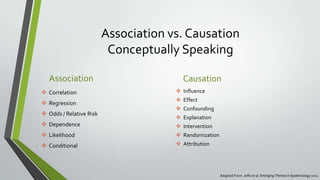
Association vs. Causation
Conceptually Speaking
Association
 Correlation
 Regression

 Odds / Relative Risk

Causation
 Influence
 Effect
 Confounding
 Explanation

 Dependence

 Intervention

 Likelihood

 Randomization

 Conditional

 Attribution

Adapted From: Joffe et al. Emerging Themes in Epidemiology 2012
Association vs. Causation
Conceptually Speaking
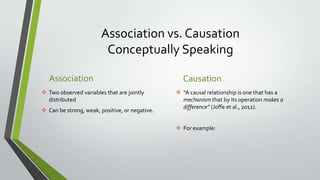
Association
 Two observed variables that are jointly
distributed
 Can be strong, weak, positive, or negative.

Causation
 “A causal relationship is one that has a
mechanism that by its operation makes a
difference” (Joffe et al., 2012).
 For example:
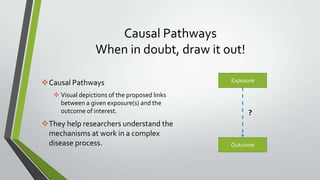
Causal Pathways
When in doubt, draw it out!
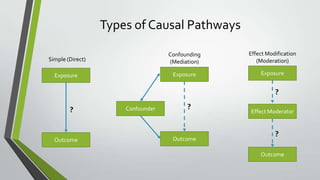
Causal Pathways
 Visual depictions of the proposed links
between a given exposure(s) and the
outcome of interest.

They help researchers understand the
mechanisms at work in a complex
disease process.

Exposure

?

Outcome
Types of Causal Pathways
Simple (Direct)

Confounding
(Mediation)

Effect Modification
(Moderation)

Exposure

Exposure

Exposure

?
?

Outcome

Confounder

?

Outcome

Effect Moderator

?
Outcome
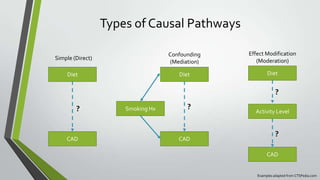
Types of Causal Pathways
Simple (Direct)

Confounding
(Mediation)

Effect Modification
(Moderation)

Diet

Diet

Diet

?
?

CAD

Smoking Hx

?

CAD

Activity Level

?
CAD

Examples adapted from CTSPedia.com
Methods for Judging Strength of Causal
Relationship
Bradford Hill Criteria
Pyramid of Clinical Evidence
The Bradford Hill Criteria
 Provides researchers with seven criteria for assessing strength of evidence.
 Strength of association (i.e. effect size)
 Consistency (i.e. reliability)
 Specificity
 Temporal relationship
 Biological gradient
 Plausibility
 Coherence
 Experiment (reversibility)

 Analogy (consideration of alternate explanations)
The Bradford Hill Criteria
a closer look…
 Strength of association (i.e. effect size)
 Is the magnitude of the association both statistically and clinically meaningful?

 Consistency (i.e. reliability)
 Can these results be reproduced? Do they coincide with existing research on the same phenomenon?

 Specificity
 Association is specific when the exposure is associated with only one disease

 Temporal relationship
 Does the exposure (cause) precede the outcome (effect)?
The Bradford Hill Criteria
a closer look…
 Biological gradient
 Dose-response relationship can be established

 Biological Plausibility
 Is the association coherent with the current body of biologic knowledge?

 Coherence
 Is the association plausible given what we already know about the disease or disorder?

 Experimental evidence
 Has this association been shown in a randomized experimental trial?

 Analogy (consideration of alternate explanations)
 Have all other plausible alternative explanations been considered and ruled out? “The third variable
issue”
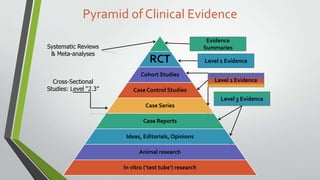
Strength of Evidence & Study Design
Which criteria are difficult to satisfy with…
 Case – Control studies?
 Cross – Sectional studies?
 Cohort – Studies?
Pyramid of Clinical Evidence
Systematic Reviews
& Meta-analyses

Cross-Sectional
Studies: Level “2.3”

Evidence
Summaries

RCT
Cohort Studies

Level 1 Evidence
Level 2 Evidence

Case Control Studies
Level 3 Evidence
Case Series
Case Reports
Ideas, Editorials, Opinions

Animal research
In vitro (‘test tube’) research
So, when reading an article…
Whenever digging into a new controversy or research area, it is helpful to
use methods for judging the strength of the relationship being discussed.
 What type of study design are the using? (Pyramid of evidence)
 How strong is the evidence? (Bradford Hill Criteria)
 What is the clinical vs. statistical significance being presented?
Brief Look at Association vs causation

Brief Look at Association vs causation

  • 1.
    Association vs. Causation PatrickB. Barlow PhD Candidate in Evaluation, Statistics, & Measurement The University of Tennessee This and many other lecture materials are available at www.slideshare.net/pbbarlow1
  • 2.
    In this Presentation… SectionI: Association vs. Causation, what does it look like?  Conceptually speaking  Casual Pathways Section II: Methods for judging strength of causal relationship  Bradford Hill Criteria  Pyramid of Clinical Evidence
  • 3.
    Some Terms Association Causation Causal Pathway Interaction/ Effect Modification Confounding / Mediation
  • 4.
    Association vs. Causation ConceptuallySpeaking Association  Correlation  Regression  Odds / Relative Risk Causation  Influence  Effect  Confounding  Explanation  Dependence  Intervention  Likelihood  Randomization  Conditional  Attribution Adapted From: Joffe et al. Emerging Themes in Epidemiology 2012
  • 5.
    Association vs. Causation ConceptuallySpeaking Association  Two observed variables that are jointly distributed  Can be strong, weak, positive, or negative. Causation  “A causal relationship is one that has a mechanism that by its operation makes a difference” (Joffe et al., 2012).  For example:
  • 6.
    Causal Pathways When indoubt, draw it out! Causal Pathways  Visual depictions of the proposed links between a given exposure(s) and the outcome of interest. They help researchers understand the mechanisms at work in a complex disease process. Exposure ? Outcome
  • 7.
    Types of CausalPathways Simple (Direct) Confounding (Mediation) Effect Modification (Moderation) Exposure Exposure Exposure ? ? Outcome Confounder ? Outcome Effect Moderator ? Outcome
  • 8.
    Types of CausalPathways Simple (Direct) Confounding (Mediation) Effect Modification (Moderation) Diet Diet Diet ? ? CAD Smoking Hx ? CAD Activity Level ? CAD Examples adapted from CTSPedia.com
  • 9.
    Methods for JudgingStrength of Causal Relationship Bradford Hill Criteria Pyramid of Clinical Evidence
  • 10.
    The Bradford HillCriteria  Provides researchers with seven criteria for assessing strength of evidence.  Strength of association (i.e. effect size)  Consistency (i.e. reliability)  Specificity  Temporal relationship  Biological gradient  Plausibility  Coherence  Experiment (reversibility)  Analogy (consideration of alternate explanations)
  • 11.
    The Bradford HillCriteria a closer look…  Strength of association (i.e. effect size)  Is the magnitude of the association both statistically and clinically meaningful?  Consistency (i.e. reliability)  Can these results be reproduced? Do they coincide with existing research on the same phenomenon?  Specificity  Association is specific when the exposure is associated with only one disease  Temporal relationship  Does the exposure (cause) precede the outcome (effect)?
  • 12.
    The Bradford HillCriteria a closer look…  Biological gradient  Dose-response relationship can be established  Biological Plausibility  Is the association coherent with the current body of biologic knowledge?  Coherence  Is the association plausible given what we already know about the disease or disorder?  Experimental evidence  Has this association been shown in a randomized experimental trial?  Analogy (consideration of alternate explanations)  Have all other plausible alternative explanations been considered and ruled out? “The third variable issue”
  • 13.
    Strength of Evidence& Study Design Which criteria are difficult to satisfy with…  Case – Control studies?  Cross – Sectional studies?  Cohort – Studies?
  • 14.
    Pyramid of ClinicalEvidence Systematic Reviews & Meta-analyses Cross-Sectional Studies: Level “2.3” Evidence Summaries RCT Cohort Studies Level 1 Evidence Level 2 Evidence Case Control Studies Level 3 Evidence Case Series Case Reports Ideas, Editorials, Opinions Animal research In vitro (‘test tube’) research
  • 15.
    So, when readingan article… Whenever digging into a new controversy or research area, it is helpful to use methods for judging the strength of the relationship being discussed.  What type of study design are the using? (Pyramid of evidence)  How strong is the evidence? (Bradford Hill Criteria)  What is the clinical vs. statistical significance being presented?

Editor's Notes

  • #15 Cross-sectional Studies considered 2.3 by the OBGYN journal I looked at, but it is not technically a “Clinical” study.Double check to see if this is the same pyramid of evidence you see used in Epi.