AMANY RASHAD ABOEL-SEOUD
Prof. COMMUNITY MEDICINE
Zagazig University, EGYPT
 Definitions, sociology in relation to health
and disease.
 Health concept, Determinants of Health
 Health promotion
 Changing health behavior
 Communication & Health Education
 Social Marketing
 The role of health institutions and health
professionals in society
 Society: system of inter relationships of man in his
group. May be country, village, school, factory.. etc
 Social science deals with man behavior in his society,
including history, geography, civics and politics.
 Medical sociology: deals with relation between health
and social factors as environmental conditions
surrounding man and affects his health, traditions,
lifestyle behaviors, self treatment, values, customs and
cultures. It is concerned also with the distribution of
health care services and in particular the inequalities
in health care (health disparities)
 Social security/ Social insurance: ‫الضمان‬
‫االجتماعى‬ security given to man by social
governmental or private organizations for risks
he is exposed as sickness, loss of work, violence,
death, accidents, fire and disability
 Social defense: for protection against antisocial,
criminal behaviors of man as beggary,
prostitution, alcoholism. Social system that
defends the society against crime by treating
and defending the offended.
 Social disease: diseases that have social stigma
and human interactions as TB, AIDS and leprosy
 Social problems: poverty, crime, starvation,
alcoholism, STD, addiction, street children,
lonely elderly , discrimination.
 Social factors affecting health & disease:
level of socioeconomic standard determine
health status of individuals as per-capita
income, family size, literacy, poverty,
malnutrition, unemployment.
Social conditions affect & are affected by
health and disease
Comprises different elements including:
 Social epidemiology: the study of socioeconomic,
demographic, and behavioral factors in relation
to the causes of disease and mortality diagnosis
 Development and organizational dynamics of
occupations and professions in healthcare services,
hospitals, health maintenance and long-term care
organizations. It includes inter-organizational
relationships between patient and physicians ttt
 The reactions of societies to illness, including
cultural meanings and normative expectations
 The social policies, social movements, and
economic conditions that shape and are shaped by
health and disease within countries, as well as in
a comparative, international context
 The social patterns of the utilization of health
services, the relationship of health care delivery
systems to other social institutions, and social
policies toward health.
Social causes of disease and
illness
Reasons for seeking particular
types of medical service
Patient compliance or
noncompliance with medical
advice.
Health services
For S.vulnerable groups
 Social behavior plays a critical role in
determining or/and influencing the health of
individuals, groups, and the larger society.
 The most important thing for all specialties
in Medicine is the diagnosis of disease in
patients but studying the underlying cause of
disease, spread, cultural effects, the ability
to control among all family members and
friends, neighborhood (family diagnosis) is
also important for control that disease in the
community.
 Many facts relating social conditions to
diseases as low social classes had higher
morbidities and mortalities than higher
classes
 The spread of diseases is heavily influenced
by: the socioeconomic status of individuals,
ethnic traditions or beliefs, cultural factors
and types of nutrition
 More than one individual in the same family
are affected by the disease
 Socioeconomic / demographic data: as age,
family size, education, occupation, habits,
income, residence, position in siblings, etc..
 Conditions of house: available facilities
 Nutritional status, breast feeding,, types of
food, food habits
 Marital status: divorce, death of parents
 Satisfaction with available services,
attendance, immunization coverage
 Prevailing health services, types
 Political, legal, religious aspects affecting H
 Health promotion of all people: life style
modification, health education.
 Co-operation with other sectors affecting
health, change polices, put legislations
 Research studies to improve health,
prevent diseases, help handicaps
 Diagnosis & treatment of diseased,
prevent spread to others. Acceptable,
qualified health services
 Health impact assessment for all projects
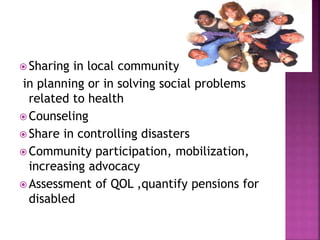
 Sharing in local community
in planning or in solving social problems
related to health
 Counseling
 Share in controlling disasters
 Community participation, mobilization,
increasing advocacy
 Assessment of QOL ,quantify pensions for
disabled
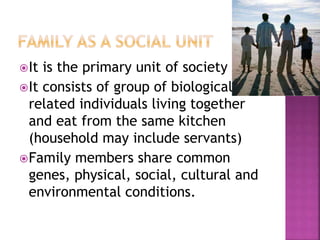
It is the primary unit of society
It consists of group of biologically
related individuals living together
and eat from the same kitchen
(household may include servants)
Family members share common
genes, physical, social, cultural and
environmental conditions.
 Formation: marriage
 Extension: birth of 1st child
 Complete extension: birth of last child
 Contraction: 1st child leave home, death of
members
 Complete contraction: last child leave, death
of parents.
 Not all family cycles are the same
 Nuclear family: married couples &
Their dependent children
 Joint family: extended, includes married
couples and their children, in rural areas,
usually men are related by blood. All
properties in house belong to all. Senior man
has the authority, they give strength to each
other, continue family name.
 Three generation family: children,parents
and grandparents.
 Broken family: divorce, died , separated
 Residence: to offer clean comfortable
place
 Distribution of functions
 Reproduction, child rearing
 Socialization of children before school
 Economic support * Health care
 Social support during labor, stress, insults,
care of elderly, handicapped
Family acts as placenta feeding its members
with filtered beneficial habits required to be
physically, socially & mentally healthy
 Concept of disease etiology, treatment: evil
eye, god’s will, past mistakes, spirit or ghost.
use of folk remedies, plants, zar, hegab
 Unsanitary disposal of sewage, refuse: in
street, public places, in water, animal
breading inside houses.
 Food habits: vegetarians, fasting, certain
type of cooking, utensils, additives, food
staffs, male eats more and first
 Child labor:by daya, no antenatal care, kohl
wrapping, no bath, breast feeding
 Personal hygiene: no bath, oral /teeth
hygiene, shared shaving, circumcision,
drinking from same cup, cutting nails,
wearing shoes. Smoking sheesha
 Early marriage, childbirth
Sociology

Sociology

  • 1.
    AMANY RASHAD ABOEL-SEOUD Prof.COMMUNITY MEDICINE Zagazig University, EGYPT
  • 2.
     Definitions, sociologyin relation to health and disease.  Health concept, Determinants of Health  Health promotion  Changing health behavior  Communication & Health Education  Social Marketing  The role of health institutions and health professionals in society
  • 3.
     Society: systemof inter relationships of man in his group. May be country, village, school, factory.. etc  Social science deals with man behavior in his society, including history, geography, civics and politics.  Medical sociology: deals with relation between health and social factors as environmental conditions surrounding man and affects his health, traditions, lifestyle behaviors, self treatment, values, customs and cultures. It is concerned also with the distribution of health care services and in particular the inequalities in health care (health disparities)
  • 4.
     Social security/Social insurance: ‫الضمان‬ ‫االجتماعى‬ security given to man by social governmental or private organizations for risks he is exposed as sickness, loss of work, violence, death, accidents, fire and disability  Social defense: for protection against antisocial, criminal behaviors of man as beggary, prostitution, alcoholism. Social system that defends the society against crime by treating and defending the offended.  Social disease: diseases that have social stigma and human interactions as TB, AIDS and leprosy
  • 5.
     Social problems:poverty, crime, starvation, alcoholism, STD, addiction, street children, lonely elderly , discrimination.  Social factors affecting health & disease: level of socioeconomic standard determine health status of individuals as per-capita income, family size, literacy, poverty, malnutrition, unemployment. Social conditions affect & are affected by health and disease
  • 6.
    Comprises different elementsincluding:  Social epidemiology: the study of socioeconomic, demographic, and behavioral factors in relation to the causes of disease and mortality diagnosis  Development and organizational dynamics of occupations and professions in healthcare services, hospitals, health maintenance and long-term care organizations. It includes inter-organizational relationships between patient and physicians ttt
  • 7.
     The reactionsof societies to illness, including cultural meanings and normative expectations  The social policies, social movements, and economic conditions that shape and are shaped by health and disease within countries, as well as in a comparative, international context  The social patterns of the utilization of health services, the relationship of health care delivery systems to other social institutions, and social policies toward health.
  • 8.
    Social causes ofdisease and illness Reasons for seeking particular types of medical service Patient compliance or noncompliance with medical advice. Health services For S.vulnerable groups
  • 9.
     Social behaviorplays a critical role in determining or/and influencing the health of individuals, groups, and the larger society.  The most important thing for all specialties in Medicine is the diagnosis of disease in patients but studying the underlying cause of disease, spread, cultural effects, the ability to control among all family members and friends, neighborhood (family diagnosis) is also important for control that disease in the community.
  • 10.
     Many factsrelating social conditions to diseases as low social classes had higher morbidities and mortalities than higher classes  The spread of diseases is heavily influenced by: the socioeconomic status of individuals, ethnic traditions or beliefs, cultural factors and types of nutrition  More than one individual in the same family are affected by the disease
  • 11.
     Socioeconomic /demographic data: as age, family size, education, occupation, habits, income, residence, position in siblings, etc..  Conditions of house: available facilities  Nutritional status, breast feeding,, types of food, food habits  Marital status: divorce, death of parents  Satisfaction with available services, attendance, immunization coverage  Prevailing health services, types  Political, legal, religious aspects affecting H
  • 12.
     Health promotionof all people: life style modification, health education.  Co-operation with other sectors affecting health, change polices, put legislations  Research studies to improve health, prevent diseases, help handicaps  Diagnosis & treatment of diseased, prevent spread to others. Acceptable, qualified health services  Health impact assessment for all projects
  • 13.
     Sharing inlocal community in planning or in solving social problems related to health  Counseling  Share in controlling disasters  Community participation, mobilization, increasing advocacy  Assessment of QOL ,quantify pensions for disabled
  • 14.
    It is theprimary unit of society It consists of group of biologically related individuals living together and eat from the same kitchen (household may include servants) Family members share common genes, physical, social, cultural and environmental conditions.
  • 15.
     Formation: marriage Extension: birth of 1st child  Complete extension: birth of last child  Contraction: 1st child leave home, death of members  Complete contraction: last child leave, death of parents.  Not all family cycles are the same
  • 16.
     Nuclear family:married couples & Their dependent children  Joint family: extended, includes married couples and their children, in rural areas, usually men are related by blood. All properties in house belong to all. Senior man has the authority, they give strength to each other, continue family name.  Three generation family: children,parents and grandparents.  Broken family: divorce, died , separated
  • 17.
     Residence: tooffer clean comfortable place  Distribution of functions  Reproduction, child rearing  Socialization of children before school  Economic support * Health care  Social support during labor, stress, insults, care of elderly, handicapped Family acts as placenta feeding its members with filtered beneficial habits required to be physically, socially & mentally healthy
  • 18.
     Concept ofdisease etiology, treatment: evil eye, god’s will, past mistakes, spirit or ghost. use of folk remedies, plants, zar, hegab  Unsanitary disposal of sewage, refuse: in street, public places, in water, animal breading inside houses.  Food habits: vegetarians, fasting, certain type of cooking, utensils, additives, food staffs, male eats more and first  Child labor:by daya, no antenatal care, kohl wrapping, no bath, breast feeding
  • 19.
     Personal hygiene:no bath, oral /teeth hygiene, shared shaving, circumcision, drinking from same cup, cutting nails, wearing shoes. Smoking sheesha  Early marriage, childbirth