X- Rays
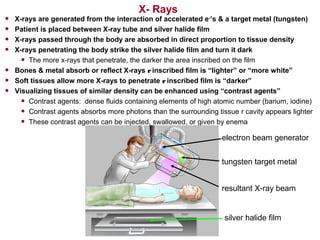
• X-rays are generated from the interaction of accelerated e-
’s & a target metal (tungsten)
• Patient is placed between X-ray tube and silver halide film
• X-rays passed through the body are absorbed in direct proportion to tissue density
• X-rays penetrating the body strike the silver halide film and turn it dark
• The more x-rays that penetrate, the darker the area inscribed on the film
• Bones & metal absorb or reflect X-rays rinscribed film is “lighter” or “more white”
• Soft tissues allow more X-rays to penetrate rinscribed film is “darker”
• Visualizing tissues of similar density can be enhanced using “contrast agents”
• Contrast agents: dense fluids containing elements of high atomic number (barium, iodine)
• Contrast agents absorbs more photons than the surrounding tissue r cavity appears lighter
• These contrast agents can be injected, swallowed, or given by enema
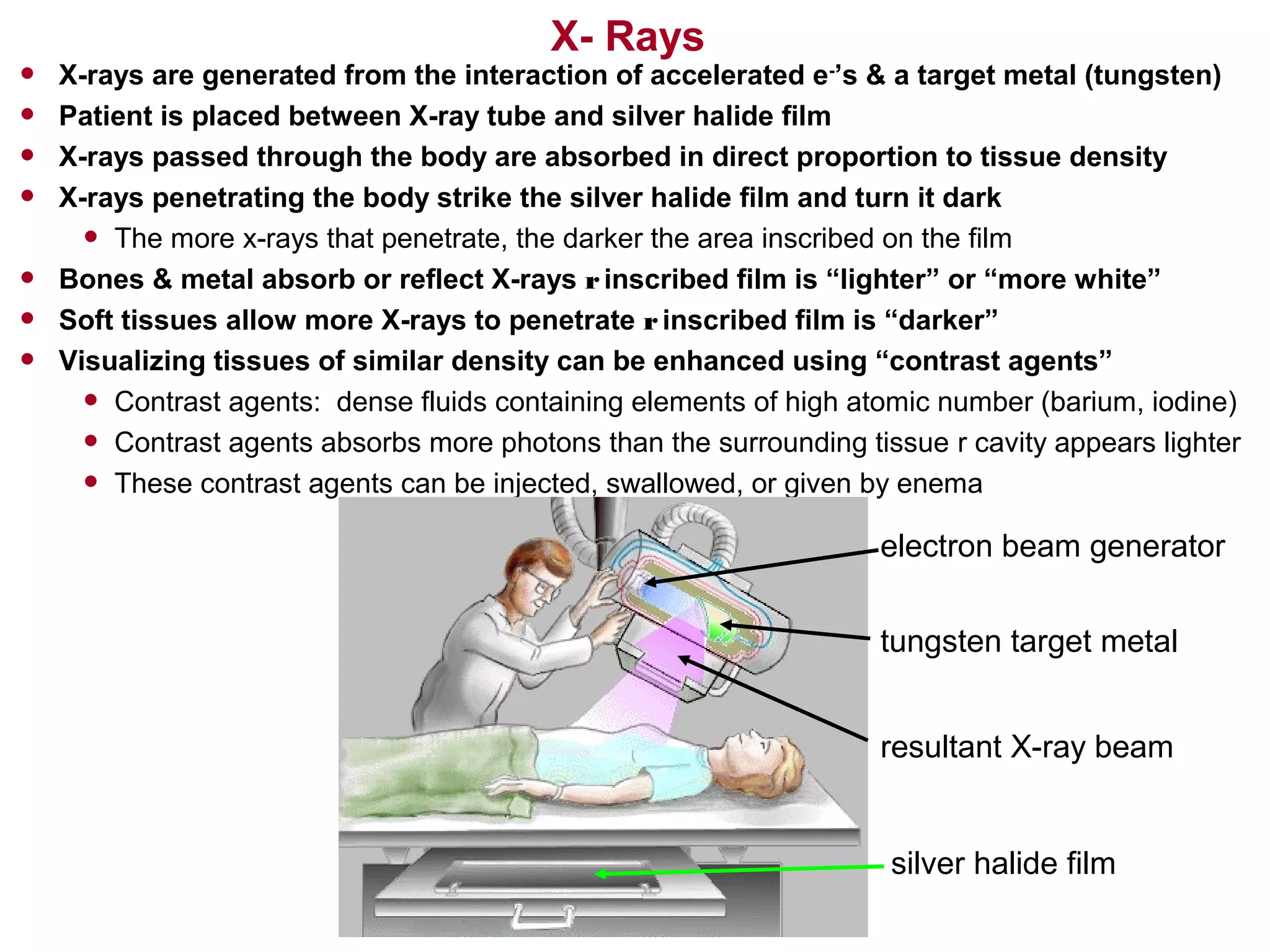
electron beam generator
tungsten target metal
resultant X-ray beam
silver halide film
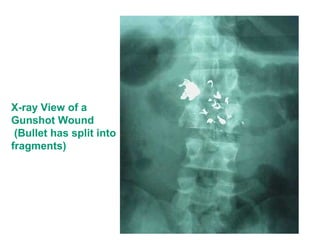
X-ray View of a
Gunshot Wound
(Bullet has split into
fragments)
For Emma…..
We Will Always Remember !!
Normal Breast
Breast with Cysts
and Fibrotic
Changes
Breast Cancer !
X-Ray Mammography
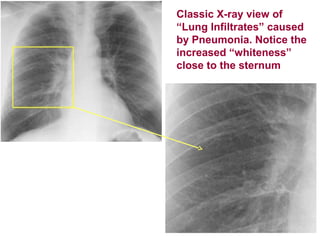
Classic X-ray view of
“Lung Infiltrates” caused
by Pneumonia. Notice the
increased “whiteness”
close to the sternum
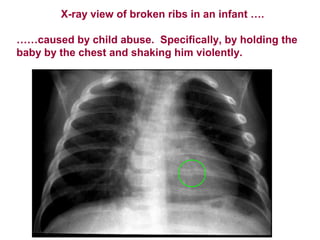
X-ray view of broken ribs in an infant ….
……caused by child abuse. Specifically, by holding the
baby by the chest and shaking him violently.
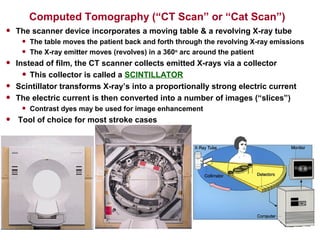
• The scanner device incorporates a moving table & a revolving X-ray tube
• The table moves the patient back and forth through the revolving X-ray emissions
• The X-ray emitter moves (revolves) in a 360o
arc around the patient
• Instead of film, the CT scanner collects emitted X-rays via a collector
• This collector is called a SCINTILLATOR
• Scintillator transforms X-ray’s into a proportionally strong electric current
• The electric current is then converted into a number of images (“slices”)
• Contrast dyes may be used for image enhancement
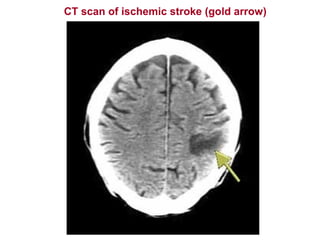
• Tool of choice for most stroke cases
Computed Tomography (“CT Scan” or “Cat Scan”)
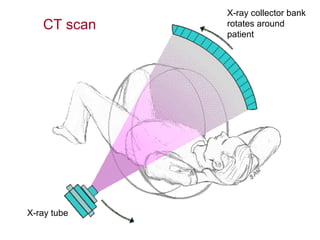
X-ray collector bank
rotates around
patient
X-ray tube
CT scan
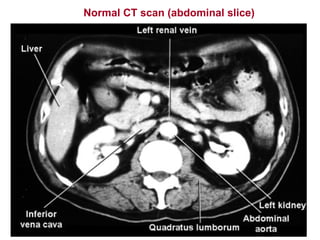
Normal CT scan (abdominal slice)
CT scan of ischemic stroke (gold arrow)
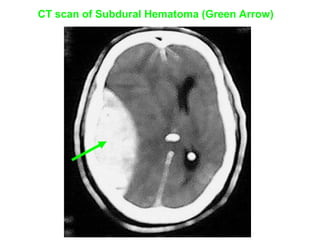
CT scan of Subdural Hematoma (Green Arrow)
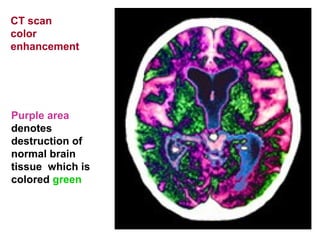
Purple area
denotes
destruction of
normal brain
tissue which is
colored green
CT scan
color
enhancement
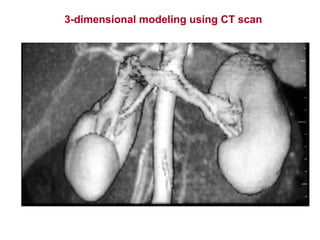
3-dimensional modeling using CT scan
Magnetic Resonance Imaging
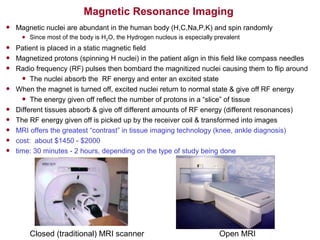
• Magnetic nuclei are abundant in the human body (H,C,Na,P,K) and spin randomly
• Since most of the body is H2O, the Hydrogen nucleus is especially prevalent
• Patient is placed in a static magnetic field
• Magnetized protons (spinning H nuclei) in the patient align in this field like compass needles
• Radio frequency (RF) pulses then bombard the magnitized nuclei causing them to flip around
• The nuclei absorb the RF energy and enter an excited state
• When the magnet is turned off, excited nuclei return to normal state & give off RF energy
• The energy given off reflect the number of protons in a “slice” of tissue
• Different tissues absorb & give off different amounts of RF energy (different resonances)
• The RF energy given off is picked up by the receiver coil & transformed into images
• MRI offers the greatest “contrast” in tissue imaging technology (knee, ankle diagnosis)
• cost: about $1450 - $2000
• time: 30 minutes - 2 hours, depending on the type of study being done
Open MRIClosed (traditional) MRI scanner
Magnetic Resonance Imaging
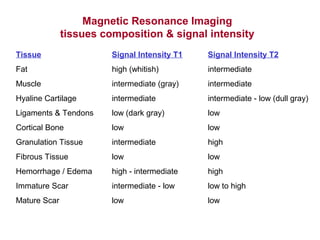
tissues composition & signal intensity
Tissue Signal Intensity T1 Signal Intensity T2
Fat high (whitish) intermediate
Muscle intermediate (gray) intermediate
Hyaline Cartilage intermediate intermediate - low (dull gray)
Ligaments & Tendons low (dark gray) low
Cortical Bone low low
Granulation Tissue intermediate high
Fibrous Tissue low low
Hemorrhage / Edema high - intermediate high
Immature Scar intermediate - low low to high
Mature Scar low low
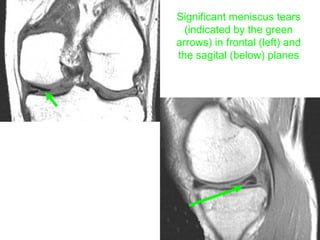
Significant meniscus tears
(indicated by the green
arrows) in frontal (left) and
the sagital (below) planes
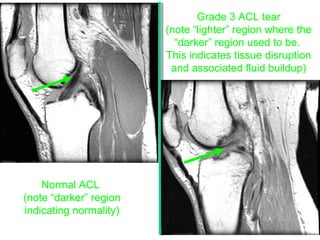
Normal ACL
(note “darker” region
indicating normality)
Grade 3 ACL tear
(note “lighter” region where the
“darker” region used to be.
This indicates tissue disruption
and associated fluid buildup)
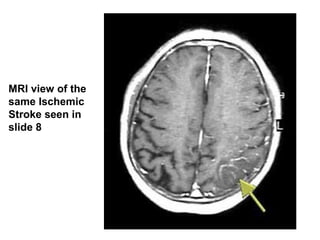
MRI view of the
same Ischemic
Stroke seen in
slide 8
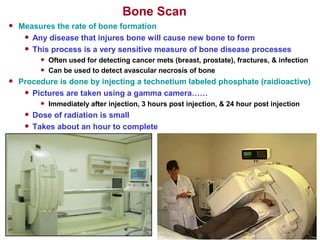
Bone Scan
• Measures the rate of bone formation
• Any disease that injures bone will cause new bone to form
• This process is a very sensitive measure of bone disease processes
• Often used for detecting cancer mets (breast, prostate), fractures, & infection
• Can be used to detect avascular necrosis of bone
• Procedure is done by injecting a technetium labeled phosphate (raidioactive)
• Pictures are taken using a gamma camera……
• Immediately after injection, 3 hours post injection, & 24 hour post injection
• Dose of radiation is small
• Takes about an hour to complete
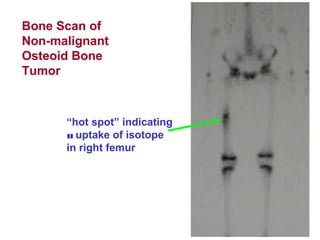
Bone Scan of
Non-malignant
Osteoid Bone
Tumor
“hot spot” indicating
u uptake of isotope
in right femur
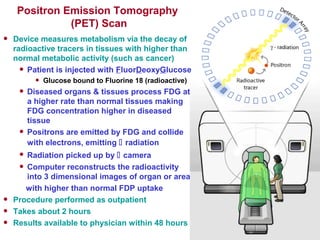
Positron Emission Tomography
(PET) Scan
• Device measures metabolism via the decay of
radioactive tracers in tissues with higher than
normal metabolic activity (such as cancer)
• Patient is injected with FluorDeoxyGlucose
• Glucose bound to Fluorine 18 (radioactive)
• Diseased organs & tissues process FDG at
a higher rate than normal tissues making
FDG concentration higher in diseased
tissue
• Positrons are emitted by FDG and collide
with electrons, emitting  radiation
• Radiation picked up by  camera
• Computer reconstructs the radioactivity
into 3 dimensional images of organ or area
with higher than normal FDP uptake
• Procedure performed as outpatient
• Takes about 2 hours
• Results available to physician within 48 hours
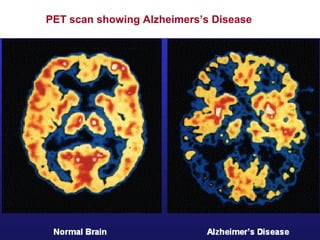
PET scan showing Alzheimers’s Disease
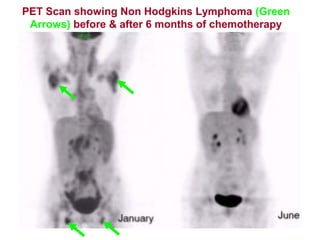
PET Scan showing Non Hodgkins Lymphoma (Green
Arrows) before & after 6 months of chemotherapy
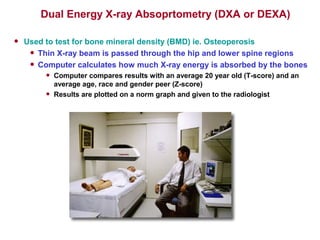
Dual Energy X-ray Absoprtometry (DXA or DEXA)
• Used to test for bone mineral density (BMD) ie. Osteoperosis
• Thin X-ray beam is passed through the hip and lower spine regions
• Computer calculates how much X-ray energy is absorbed by the bones
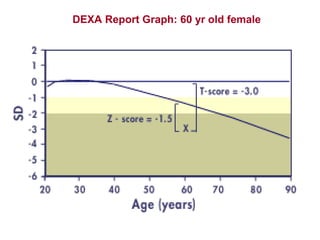
• Computer compares results with an average 20 year old (T-score) and an
average age, race and gender peer (Z-score)
• Results are plotted on a norm graph and given to the radiologist
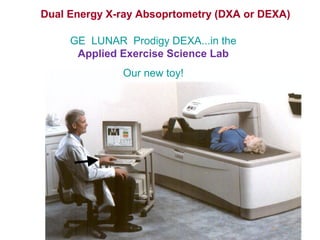
Dual Energy X-ray Absoprtometry (DXA or DEXA)
GE LUNAR Prodigy DEXA...in the
Applied Exercise Science Lab
Our new toy!
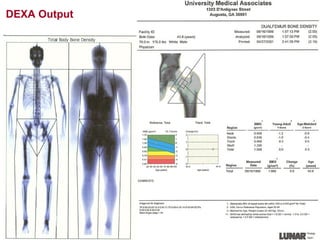
DEXA Output
T-score (sd’s)
(WHO standard reference)
Fracture Risk Medical Action
Normal Test: T > -1.0 Low Lifestyle advice
dBone Mass: T -1.0 to -2.5
(Possible Osteopenia)
Above Average
Lifestyle advice, HRT in
women 50 – 60 , Calcium
and Vitamin D
supplementation
Osteoperosis: T < -2.5 High
All of above plus consider
Bisphosphonate Drugs
(FOSOMAX, ACTINEL….)
Established Osteoporosis
plus the occurrence of one
or more fractures
Very High
All of above plus consider
possible pain control and
referral to specialist
DEXA Standards
DEXA Report Graph: 60 yr old female
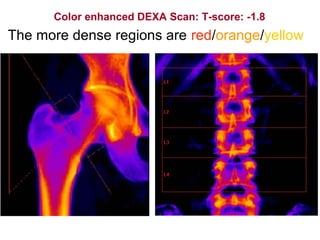
Color enhanced DEXA Scan: T-score: -1.8
The more dense regions are red/orange/yellow

Medical imaging- Overview

  • 1.
    X- Rays • X-raysare generated from the interaction of accelerated e- ’s & a target metal (tungsten) • Patient is placed between X-ray tube and silver halide film • X-rays passed through the body are absorbed in direct proportion to tissue density • X-rays penetrating the body strike the silver halide film and turn it dark • The more x-rays that penetrate, the darker the area inscribed on the film • Bones & metal absorb or reflect X-rays rinscribed film is “lighter” or “more white” • Soft tissues allow more X-rays to penetrate rinscribed film is “darker” • Visualizing tissues of similar density can be enhanced using “contrast agents” • Contrast agents: dense fluids containing elements of high atomic number (barium, iodine) • Contrast agents absorbs more photons than the surrounding tissue r cavity appears lighter • These contrast agents can be injected, swallowed, or given by enema electron beam generator tungsten target metal resultant X-ray beam silver halide film
  • 2.
    X-ray View ofa Gunshot Wound (Bullet has split into fragments)
  • 3.
    For Emma….. We WillAlways Remember !! Normal Breast Breast with Cysts and Fibrotic Changes Breast Cancer ! X-Ray Mammography
  • 4.
    Classic X-ray viewof “Lung Infiltrates” caused by Pneumonia. Notice the increased “whiteness” close to the sternum
  • 5.
    X-ray view ofbroken ribs in an infant …. ……caused by child abuse. Specifically, by holding the baby by the chest and shaking him violently.
  • 6.
    • The scannerdevice incorporates a moving table & a revolving X-ray tube • The table moves the patient back and forth through the revolving X-ray emissions • The X-ray emitter moves (revolves) in a 360o arc around the patient • Instead of film, the CT scanner collects emitted X-rays via a collector • This collector is called a SCINTILLATOR • Scintillator transforms X-ray’s into a proportionally strong electric current • The electric current is then converted into a number of images (“slices”) • Contrast dyes may be used for image enhancement • Tool of choice for most stroke cases Computed Tomography (“CT Scan” or “Cat Scan”)
  • 7.
    X-ray collector bank rotatesaround patient X-ray tube CT scan
  • 8.
    Normal CT scan(abdominal slice)
  • 9.
    CT scan ofischemic stroke (gold arrow)
  • 10.
    CT scan ofSubdural Hematoma (Green Arrow)
  • 11.
    Purple area denotes destruction of normalbrain tissue which is colored green CT scan color enhancement
  • 12.
  • 13.
    Magnetic Resonance Imaging •Magnetic nuclei are abundant in the human body (H,C,Na,P,K) and spin randomly • Since most of the body is H2O, the Hydrogen nucleus is especially prevalent • Patient is placed in a static magnetic field • Magnetized protons (spinning H nuclei) in the patient align in this field like compass needles • Radio frequency (RF) pulses then bombard the magnitized nuclei causing them to flip around • The nuclei absorb the RF energy and enter an excited state • When the magnet is turned off, excited nuclei return to normal state & give off RF energy • The energy given off reflect the number of protons in a “slice” of tissue • Different tissues absorb & give off different amounts of RF energy (different resonances) • The RF energy given off is picked up by the receiver coil & transformed into images • MRI offers the greatest “contrast” in tissue imaging technology (knee, ankle diagnosis) • cost: about $1450 - $2000 • time: 30 minutes - 2 hours, depending on the type of study being done Open MRIClosed (traditional) MRI scanner
  • 14.
    Magnetic Resonance Imaging tissuescomposition & signal intensity Tissue Signal Intensity T1 Signal Intensity T2 Fat high (whitish) intermediate Muscle intermediate (gray) intermediate Hyaline Cartilage intermediate intermediate - low (dull gray) Ligaments & Tendons low (dark gray) low Cortical Bone low low Granulation Tissue intermediate high Fibrous Tissue low low Hemorrhage / Edema high - intermediate high Immature Scar intermediate - low low to high Mature Scar low low
  • 15.
    Significant meniscus tears (indicatedby the green arrows) in frontal (left) and the sagital (below) planes
  • 16.
    Normal ACL (note “darker”region indicating normality) Grade 3 ACL tear (note “lighter” region where the “darker” region used to be. This indicates tissue disruption and associated fluid buildup)
  • 17.
    MRI view ofthe same Ischemic Stroke seen in slide 8
  • 18.
    Bone Scan • Measuresthe rate of bone formation • Any disease that injures bone will cause new bone to form • This process is a very sensitive measure of bone disease processes • Often used for detecting cancer mets (breast, prostate), fractures, & infection • Can be used to detect avascular necrosis of bone • Procedure is done by injecting a technetium labeled phosphate (raidioactive) • Pictures are taken using a gamma camera…… • Immediately after injection, 3 hours post injection, & 24 hour post injection • Dose of radiation is small • Takes about an hour to complete
  • 19.
    Bone Scan of Non-malignant OsteoidBone Tumor “hot spot” indicating u uptake of isotope in right femur
  • 20.
    Positron Emission Tomography (PET)Scan • Device measures metabolism via the decay of radioactive tracers in tissues with higher than normal metabolic activity (such as cancer) • Patient is injected with FluorDeoxyGlucose • Glucose bound to Fluorine 18 (radioactive) • Diseased organs & tissues process FDG at a higher rate than normal tissues making FDG concentration higher in diseased tissue • Positrons are emitted by FDG and collide with electrons, emitting  radiation • Radiation picked up by  camera • Computer reconstructs the radioactivity into 3 dimensional images of organ or area with higher than normal FDP uptake • Procedure performed as outpatient • Takes about 2 hours • Results available to physician within 48 hours
  • 21.
    PET scan showingAlzheimers’s Disease
  • 22.
    PET Scan showingNon Hodgkins Lymphoma (Green Arrows) before & after 6 months of chemotherapy
  • 23.
    Dual Energy X-rayAbsoprtometry (DXA or DEXA) • Used to test for bone mineral density (BMD) ie. Osteoperosis • Thin X-ray beam is passed through the hip and lower spine regions • Computer calculates how much X-ray energy is absorbed by the bones • Computer compares results with an average 20 year old (T-score) and an average age, race and gender peer (Z-score) • Results are plotted on a norm graph and given to the radiologist
  • 24.
    Dual Energy X-rayAbsoprtometry (DXA or DEXA) GE LUNAR Prodigy DEXA...in the Applied Exercise Science Lab Our new toy!
  • 25.
  • 26.
    T-score (sd’s) (WHO standardreference) Fracture Risk Medical Action Normal Test: T > -1.0 Low Lifestyle advice dBone Mass: T -1.0 to -2.5 (Possible Osteopenia) Above Average Lifestyle advice, HRT in women 50 – 60 , Calcium and Vitamin D supplementation Osteoperosis: T < -2.5 High All of above plus consider Bisphosphonate Drugs (FOSOMAX, ACTINEL….) Established Osteoporosis plus the occurrence of one or more fractures Very High All of above plus consider possible pain control and referral to specialist DEXA Standards
  • 27.
    DEXA Report Graph:60 yr old female
  • 28.
    Color enhanced DEXAScan: T-score: -1.8 The more dense regions are red/orange/yellow