What have you learned from your audience feedback?
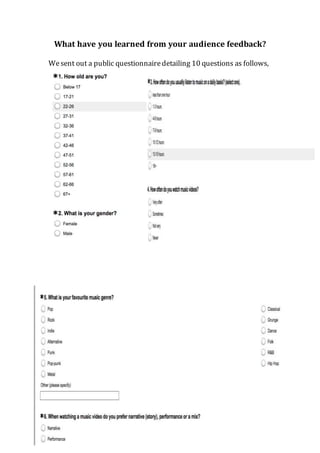
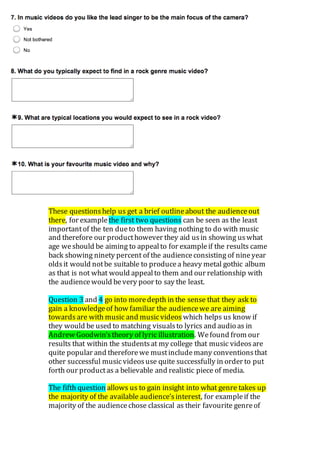
Wesent out a public questionnairedetailing 10 questions as follows,
These questionshelp us get a brief outlineabout the audienceout
there, for example the first two questions can be seen as the least
importantof the ten dueto them having nothing to do with music
and therefore our producthowever they aid usin showing uswhat
age weshould be aiming to appealto for exampleif the results came
back showing ninety percent of the audienceconsisting of nineyear
oldsit would notbe suitable to producea heavy metal gothic album
as that is not what would appealto them and our relationship with
the audiencewould bevery poor to say the least.
Question 3 and 4 go into moredepth in the sense that they ask to
gain a knowledgeof how familiar the audiencewe are aiming
towardsare with music and musicvideos which helps us know if
they would be used to matching visualsto lyrics and audio as in
Andrew Goodwin’stheory of lyric illustration. Wefound from our
results that within the studentsat my college that music videosare
quite popular and thereforewe mustincludemany conventionsthat
other successful music videosuse quite successfully in order to put
forth our productas a believable and realistic piece of media.
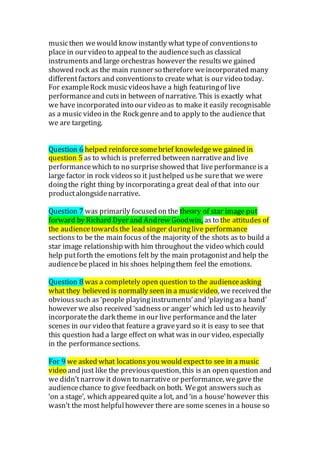
The fifth question allows us to gain insight into what genre takes up
the majority of the available audience’sinterest, for exampleif the
majority of the audiencechose classical as their favourite genreof
musicthen wewould know instantly what typeof conventionsto
place in our video to appeal to the audiencesuch as classical
instrumentsand large orchestras however the resultswe gained
showed rock as the main runner so therefore weincorporated many
differentfactors and conventionsto create what is our video today.
For exampleRock musicvideoshave a high featuringof live
performanceand cutsin between of narrative. This is exactly what
we have incorporated into our video as to make it easily recognisable
as a music video in the Rock genre and to apply to the audiencethat
we are targeting.
Question 6 helped reinforcesomebrief knowledgewe gained in
question 5 as to which is preferred between narrativeand live
performancewhich to no surpriseshowed that liveperformanceis a
large factor in rock videosso it justhelped usbe surethat we were
doingthe right thing by incorporatinga great deal of that into our
productalongsidenarrative.
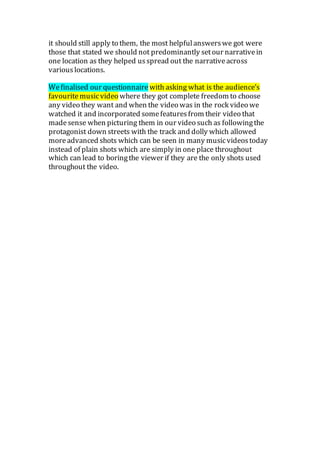
Question 7 was primarily focused on the theory of star image put
forward by Richard Dyer and Andrew Goodwin, asto the attitudes of
the audiencetowardsthe lead singer duringlive performance
sections to be the main focus of the majority of the shots as to build a
star image relationship with him throughout the video which could
help putforth the emotions felt by the main protagonistand help the
audiencebe placed in his shoes helpingthem feel the emotions.
Question 8 was a completely open question to the audienceasking
what they believed is normally seen in a musicvideo, we received the
obvioussuch as ‘people playinginstruments’and ‘playingasa band’
however we also received ‘sadness or anger’which led usto heavily
incorporatethe dark theme in our live performanceand the later
scenes in our video that feature a graveyard so it is easy to see that
this question had a large effect on what was in our video, especially
in the performancesections.
For 9 we asked what locations you would expectto see in a music
video and just like the previousquestion, this is an open question and
we didn’tnarrow it down to narrative or performance, wegave the
audiencechance to give feedback on both. Wegot answerssuch as
‘on a stage’, which appeared quite a lot, and ‘in a house’however this
wasn’t the most helpfulhowever there are some scenes in a house so
it should still apply to them, the most helpfulanswerswe got were
those that stated we should not predominantly setour narrativein
one location as they helped usspread out the narrativeacross
variouslocations.
Wefinalised our questionnaire with asking what is the audience’s
favouritemusicvideo where they got complete freedom to choose
any video they want and when the video was in the rock video we
watched it and incorporated somefeaturesfrom their video that
madesense when picturing them in our video such as followingthe
protagonist down streets with the track and dolly which allowed
moreadvanced shots which can be seen in many musicvideostoday
instead of plain shots which are simply in one place throughout
which can lead to boringthe viewer if they are the only shots used
throughout the video.

Media Evaluation Question 3 - Initial Draft

  • 1.
    What have youlearned from your audience feedback? Wesent out a public questionnairedetailing 10 questions as follows,
  • 2.
    These questionshelp usget a brief outlineabout the audienceout there, for example the first two questions can be seen as the least importantof the ten dueto them having nothing to do with music and therefore our producthowever they aid usin showing uswhat age weshould be aiming to appealto for exampleif the results came back showing ninety percent of the audienceconsisting of nineyear oldsit would notbe suitable to producea heavy metal gothic album as that is not what would appealto them and our relationship with the audiencewould bevery poor to say the least. Question 3 and 4 go into moredepth in the sense that they ask to gain a knowledgeof how familiar the audiencewe are aiming towardsare with music and musicvideos which helps us know if they would be used to matching visualsto lyrics and audio as in Andrew Goodwin’stheory of lyric illustration. Wefound from our results that within the studentsat my college that music videosare quite popular and thereforewe mustincludemany conventionsthat other successful music videosuse quite successfully in order to put forth our productas a believable and realistic piece of media. The fifth question allows us to gain insight into what genre takes up the majority of the available audience’sinterest, for exampleif the majority of the audiencechose classical as their favourite genreof
  • 3.
    musicthen wewould knowinstantly what typeof conventionsto place in our video to appeal to the audiencesuch as classical instrumentsand large orchestras however the resultswe gained showed rock as the main runner so therefore weincorporated many differentfactors and conventionsto create what is our video today. For exampleRock musicvideoshave a high featuringof live performanceand cutsin between of narrative. This is exactly what we have incorporated into our video as to make it easily recognisable as a music video in the Rock genre and to apply to the audiencethat we are targeting. Question 6 helped reinforcesomebrief knowledgewe gained in question 5 as to which is preferred between narrativeand live performancewhich to no surpriseshowed that liveperformanceis a large factor in rock videosso it justhelped usbe surethat we were doingthe right thing by incorporatinga great deal of that into our productalongsidenarrative. Question 7 was primarily focused on the theory of star image put forward by Richard Dyer and Andrew Goodwin, asto the attitudes of the audiencetowardsthe lead singer duringlive performance sections to be the main focus of the majority of the shots as to build a star image relationship with him throughout the video which could help putforth the emotions felt by the main protagonistand help the audiencebe placed in his shoes helpingthem feel the emotions. Question 8 was a completely open question to the audienceasking what they believed is normally seen in a musicvideo, we received the obvioussuch as ‘people playinginstruments’and ‘playingasa band’ however we also received ‘sadness or anger’which led usto heavily incorporatethe dark theme in our live performanceand the later scenes in our video that feature a graveyard so it is easy to see that this question had a large effect on what was in our video, especially in the performancesections. For 9 we asked what locations you would expectto see in a music video and just like the previousquestion, this is an open question and we didn’tnarrow it down to narrative or performance, wegave the audiencechance to give feedback on both. Wegot answerssuch as ‘on a stage’, which appeared quite a lot, and ‘in a house’however this wasn’t the most helpfulhowever there are some scenes in a house so
  • 4.
    it should stillapply to them, the most helpfulanswerswe got were those that stated we should not predominantly setour narrativein one location as they helped usspread out the narrativeacross variouslocations. Wefinalised our questionnaire with asking what is the audience’s favouritemusicvideo where they got complete freedom to choose any video they want and when the video was in the rock video we watched it and incorporated somefeaturesfrom their video that madesense when picturing them in our video such as followingthe protagonist down streets with the track and dolly which allowed moreadvanced shots which can be seen in many musicvideostoday instead of plain shots which are simply in one place throughout which can lead to boringthe viewer if they are the only shots used throughout the video.