In what ways does your media
product use, develop or
challenge forms and
conventions of real media
products?
BY MAISIE LEGG
How my research&planning affected my
product
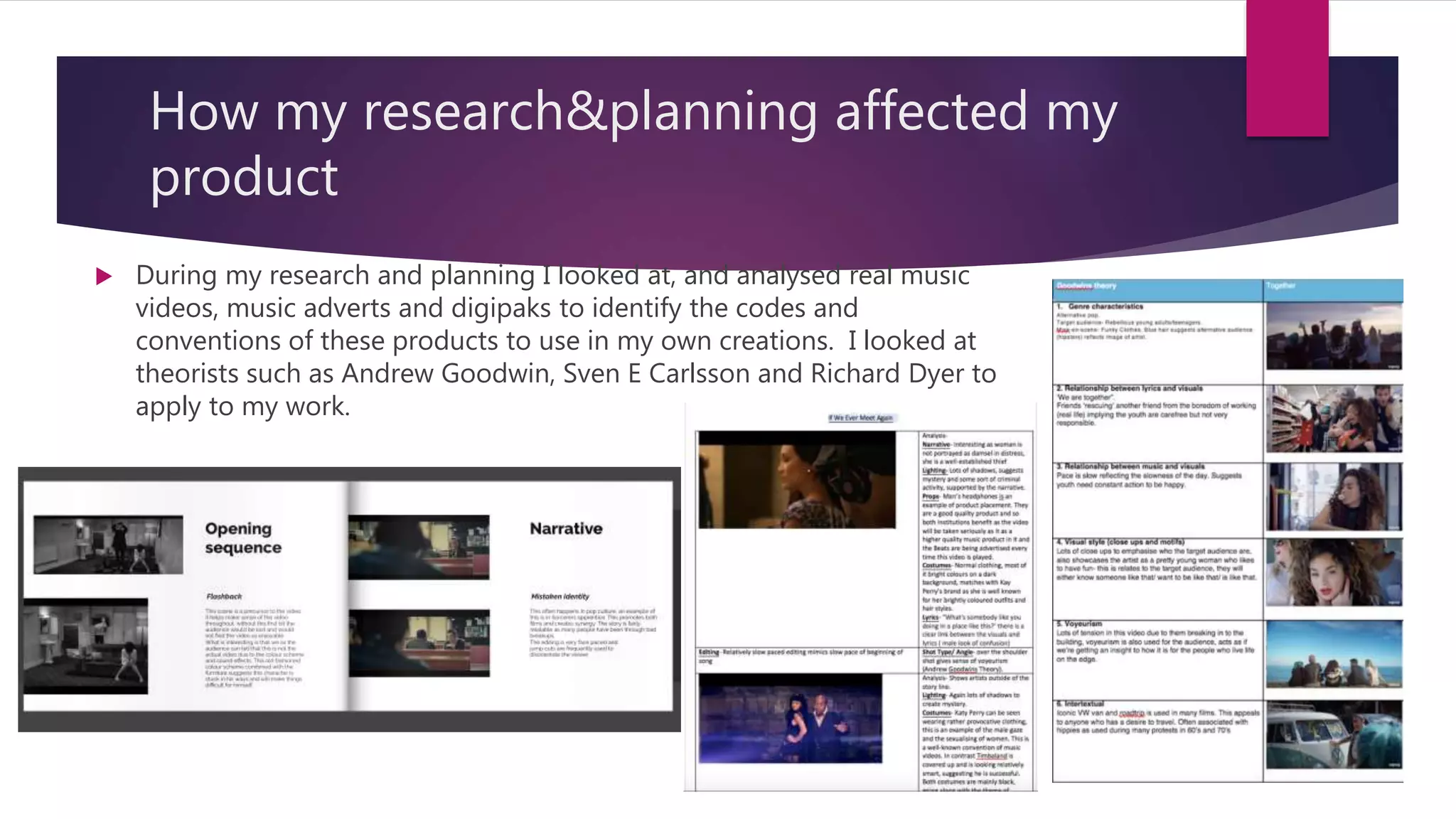
 During my research and planning I looked at, and analysed real music
videos, music adverts and digipaks to identify the codes and
conventions of these products to use in my own creations. I looked at
theorists such as Andrew Goodwin, Sven E Carlsson and Richard Dyer to
apply to my work.
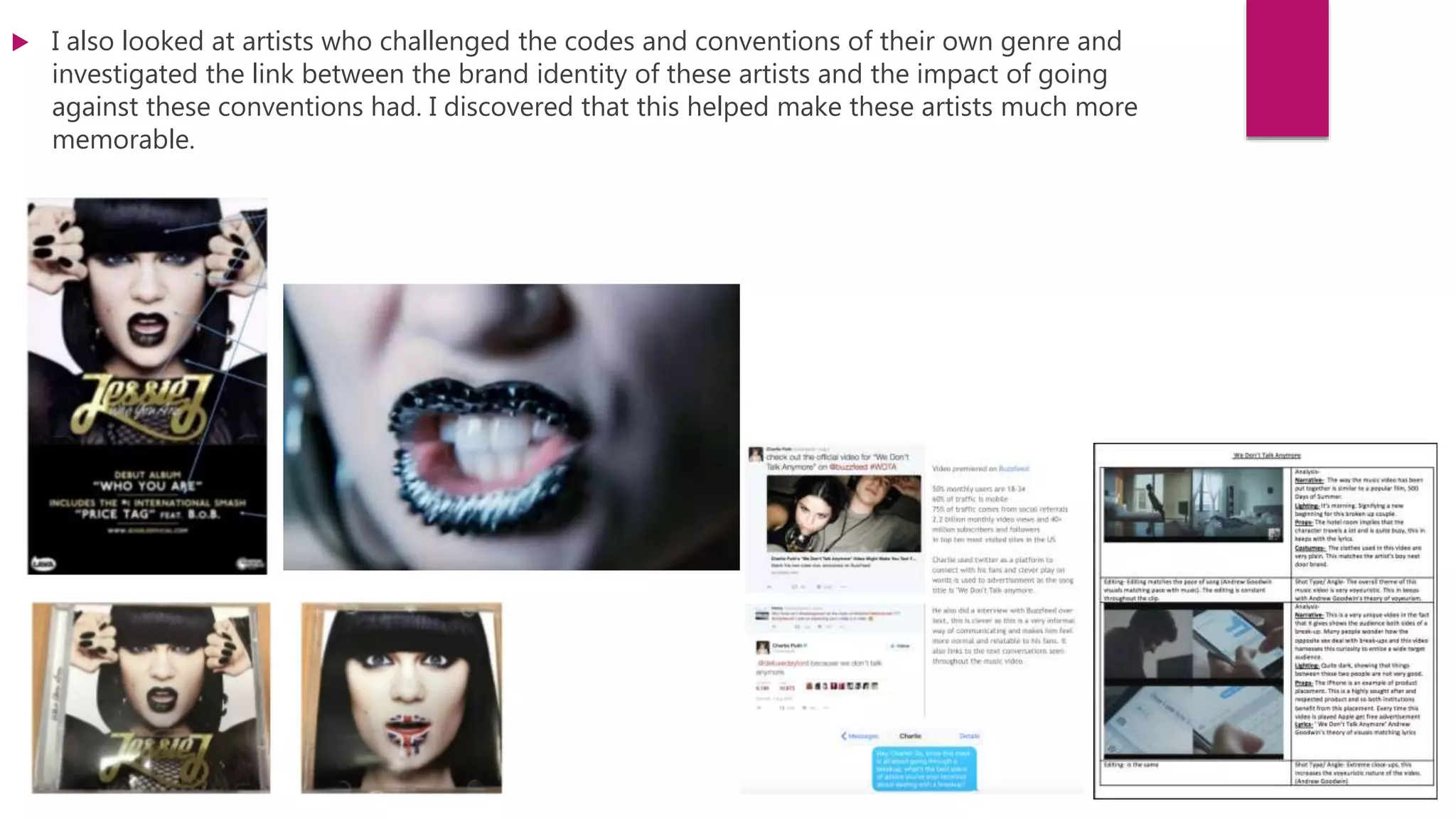
 I also looked at artists who challenged the codes and conventions of their own genre and
investigated the link between the brand identity of these artists and the impact of going
against these conventions had. I discovered that this helped make these artists much more
memorable.
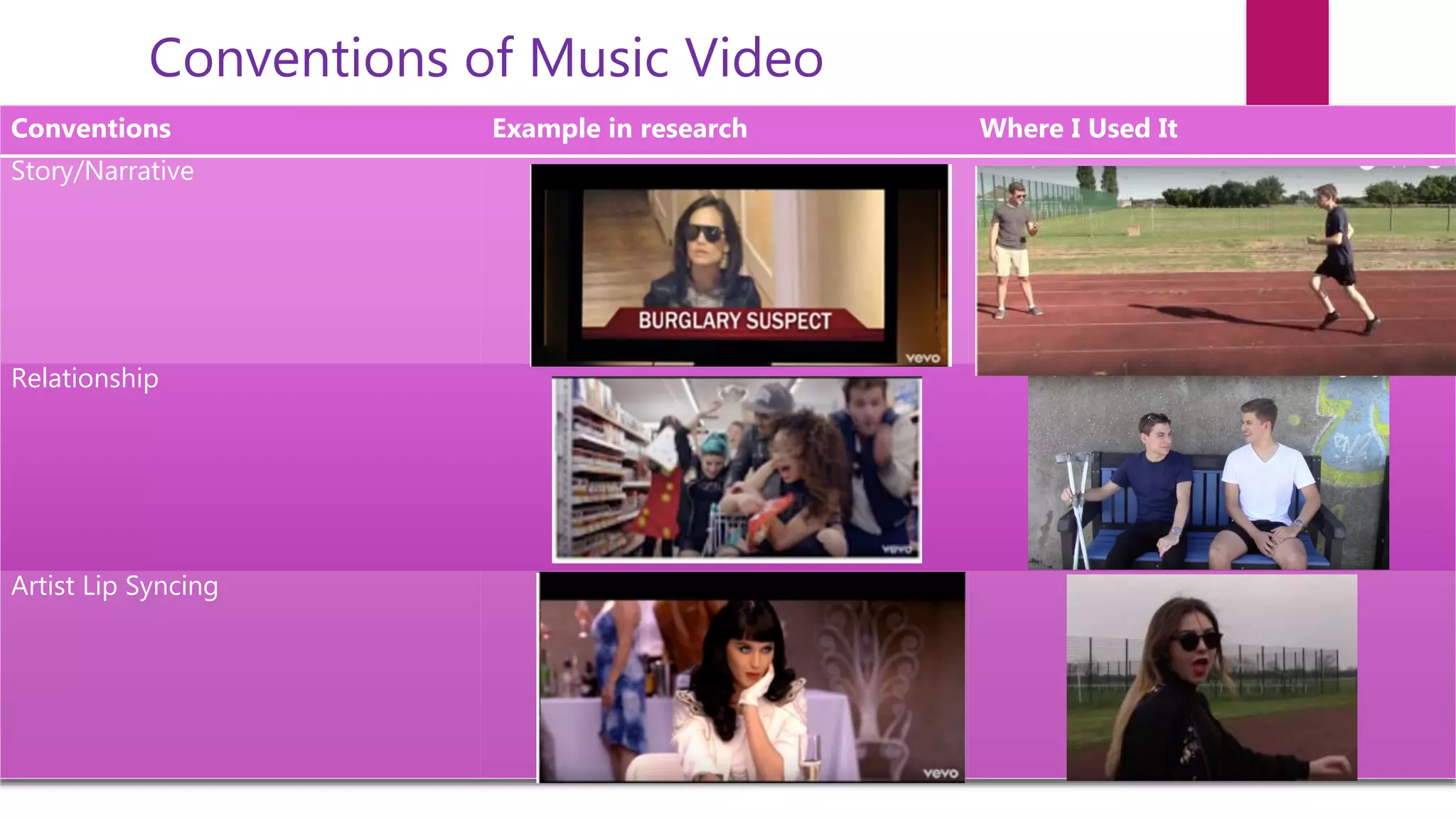
Conventions of Music Video
Conventions Example in research Where I Used It
Story/Narrative
Relationship
Artist Lip Syncing
Conventions Example in research Where I Used It
Resolution at the end of the video
Variety of shot types and movement
Close ups of important characters
Conventions Example in research Where I Used It
Each genre has different colour
schemes attached, e.g- Pop, bright
colours
Artist involved in storyline
From this I was able to make an informed decision on what codes and conventions I would use in my
products, and understand the impact they would have.
Why I chose those Conventions
 Graeme Burton suggests that
media products use a process of
repetition and recognition
leading to anticipation and
expectation. I believe this is
displayed clearly throughout my
video by utilising conventions
such as props and costumes to
show my protagonist is a soldier
and injured as well as a stop
watch to create that sense of
anticipation. Audiences expect
to see conventions of the genre
in a product.
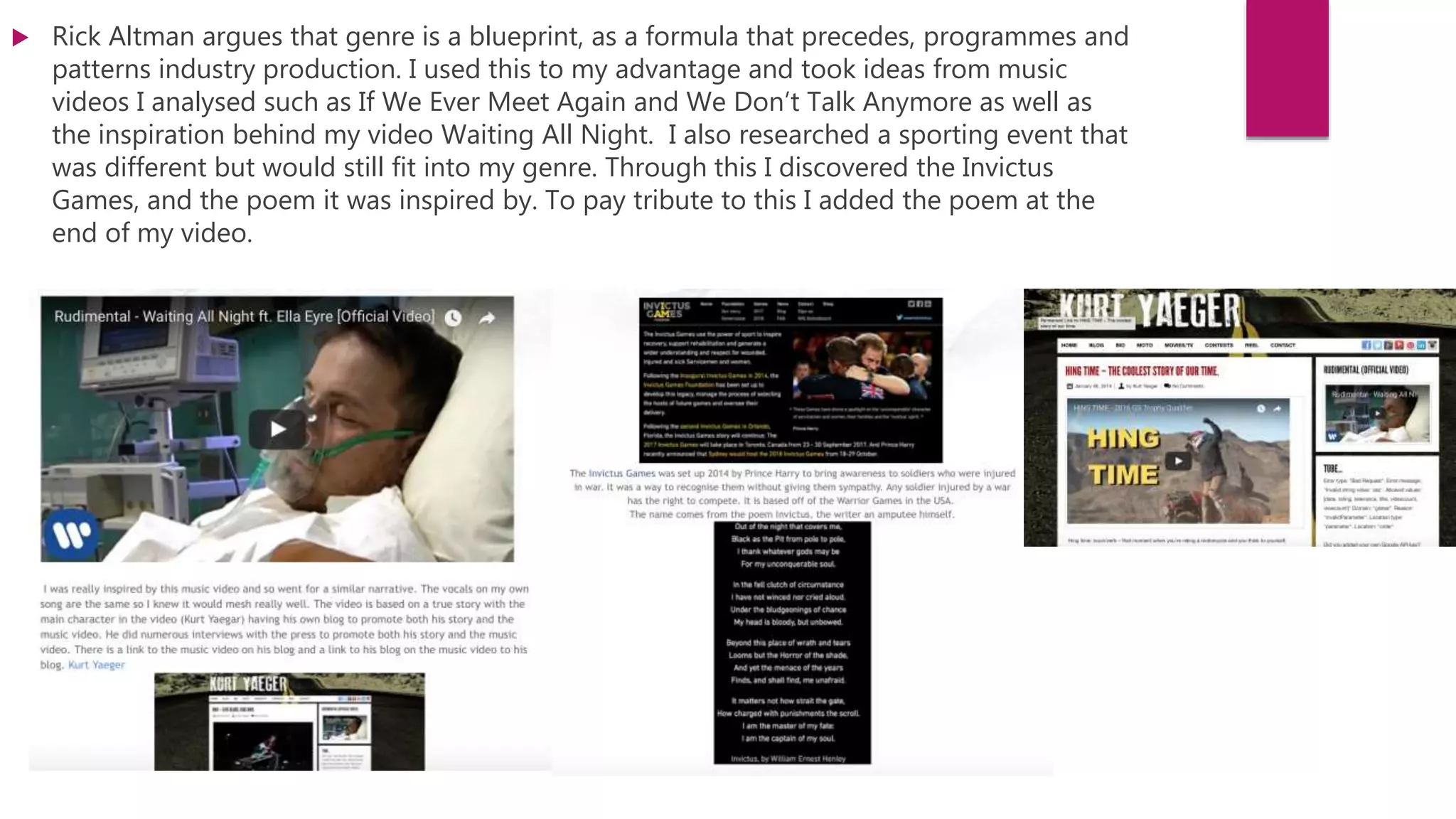
 Rick Altman argues that genre is a blueprint, as a formula that precedes, programmes and
patterns industry production. I used this to my advantage and took ideas from music
videos I analysed such as If We Ever Meet Again and We Don’t Talk Anymore as well as
the inspiration behind my video Waiting All Night. I also researched a sporting event that
was different but would still fit into my genre. Through this I discovered the Invictus
Games, and the poem it was inspired by. To pay tribute to this I added the poem at the
end of my video.
 Sven E Carlsson would argue that my artist is the televised bard of his modern
mythic embodiment. You identify this due to the conventions of having a serious
story, various longshots of areas of interest as well as medium shots of the
struggling soldier. The artist is also filmed only in areas that the main characters of
the story also have. It appears to the audience that she is the one to tell the story.
Most of the close-ups are of my artist as that fitted in with the conventions of the
dance/pop genre, whereas the story has more medium shots to mimic the feeling
of the scenes. I still used the convention of having a relationship in a music video,
but I changed it to suit my own needs, rather than have a romantic relationship I
decided to use a friendship which I believed better fit the lyrics of the song,
therefore you could argue I challenged this convention.
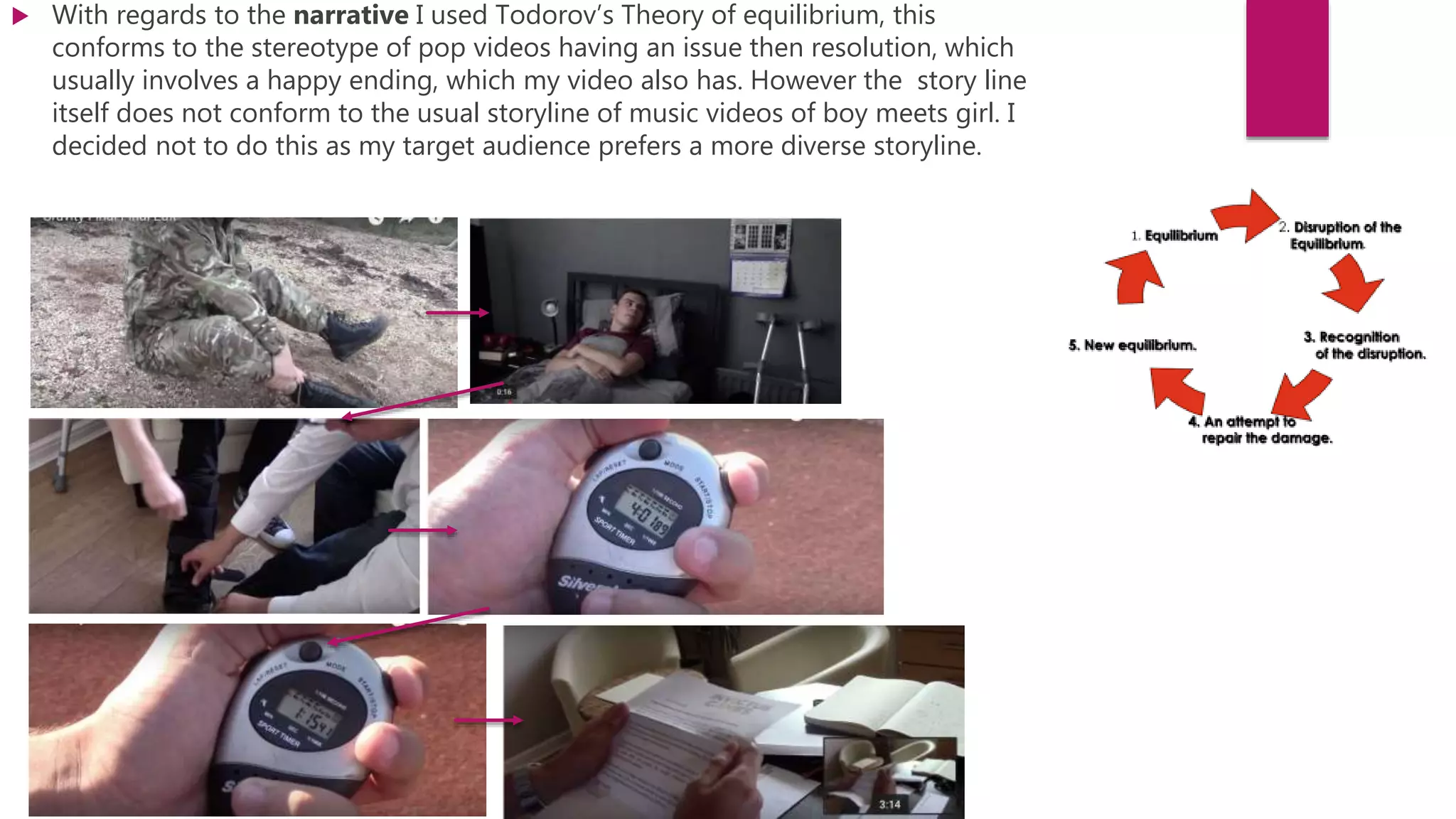
 With regards to the narrative I used Todorov’s Theory of equilibrium, this
conforms to the stereotype of pop videos having an issue then resolution, which
usually involves a happy ending, which my video also has. However the story line
itself does not conform to the usual storyline of music videos of boy meets girl. I
decided not to do this as my target audience prefers a more diverse storyline.
 I also used Andrew Goodwin’s theory of the pace matching the visuals. While the
soldier is learning to deal with his injuries the pace of the song is very slow, once
he learnt to deal with the issues and took up running thanks to his friend the
songs pace increases to match the pace of the editing.
Continued
 The colour scheme I chose for my video was based on my research, A common
theme for colour schemes was to use three complimentary colours, arguably I
went against the typical pop convention of having bright colours for the artist. I
did this because I portrayed my artist as a serious one, but still slightly fun. For
example the bright red lips featured throughout, on the digipak, front cover and in
the music video.
Conventions of Digipak
Conventions Example in research Where I Used It
Close-up of artist on front cover
Song Titles
Conventions Example in research Where I Used It
Barcode
Serial Number
Record Label
Example in research Where I Used It
Consistent colour scheme Common themes of Bright bold
colours for pop, black and white for
ballards.
Black White and Red Used on all
covers of digipak
Disclaimer
Multiple images of artist
Conventions Example in research Where I Used It
Album Name on front
Album name on spine
Artist Name on Front
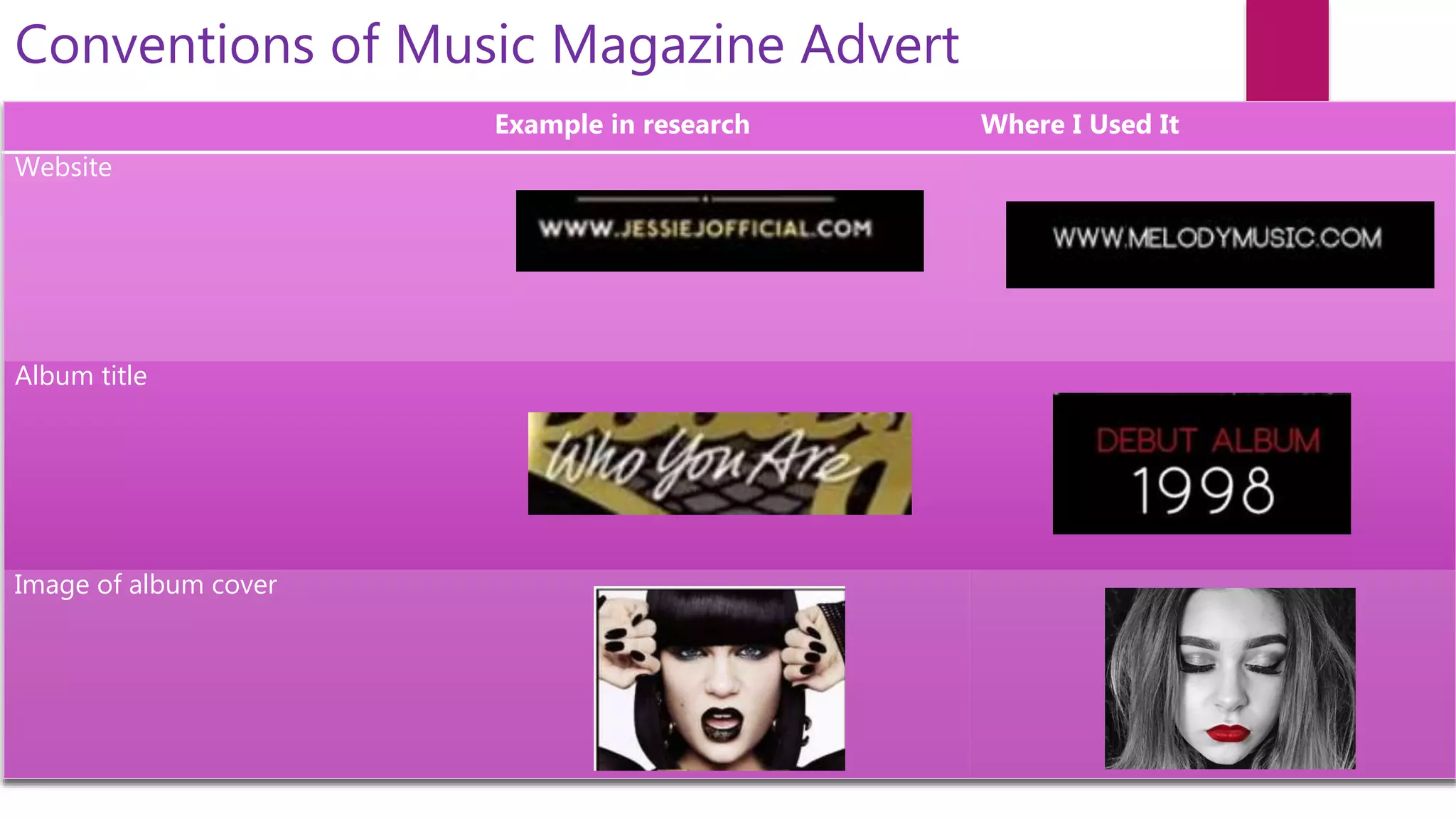
Conventions of Music Magazine Advert
Example in research Where I Used It
Website
Album title
Image of album cover
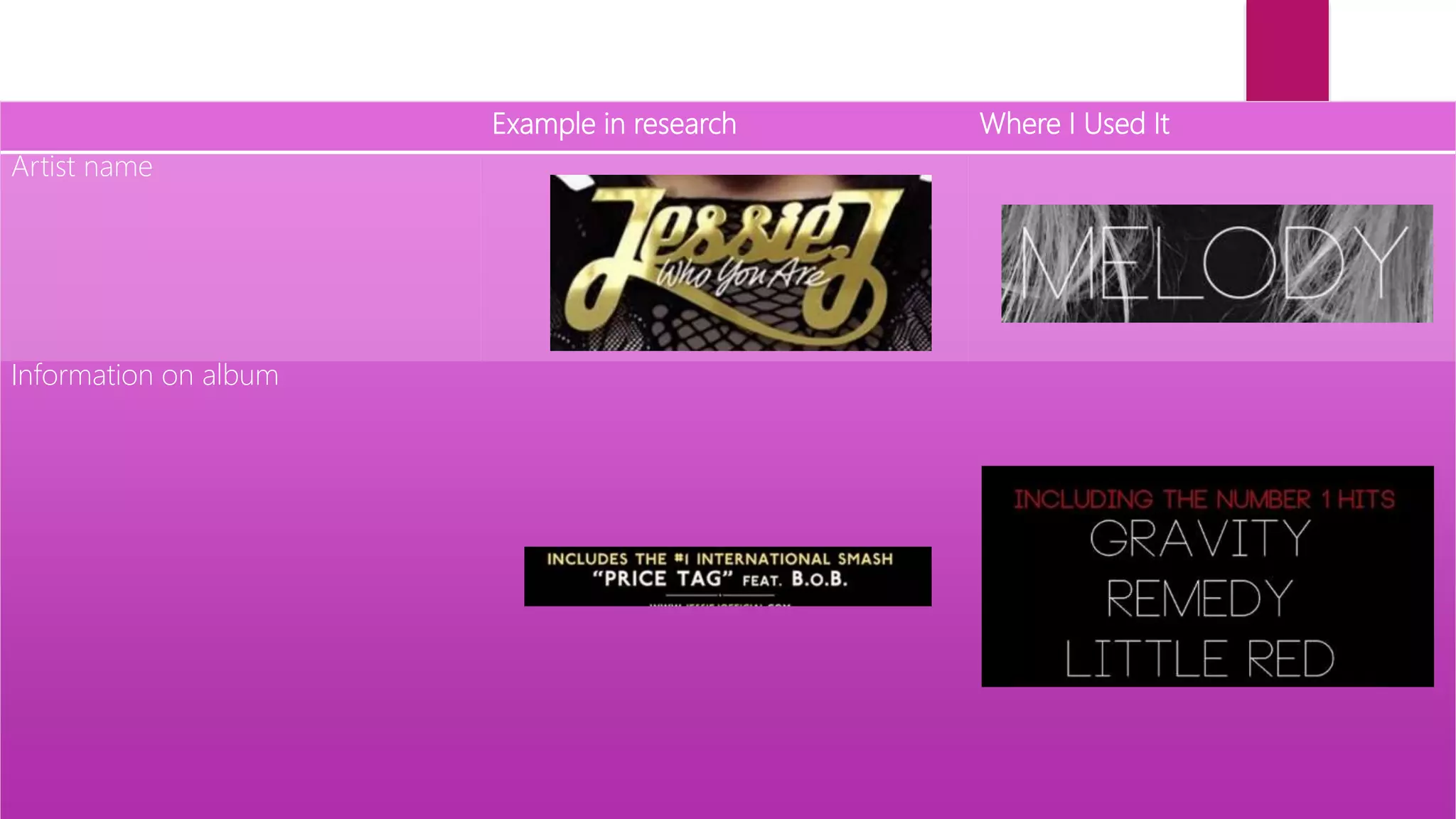
Example in research Where I Used It
Artist name
Information on album
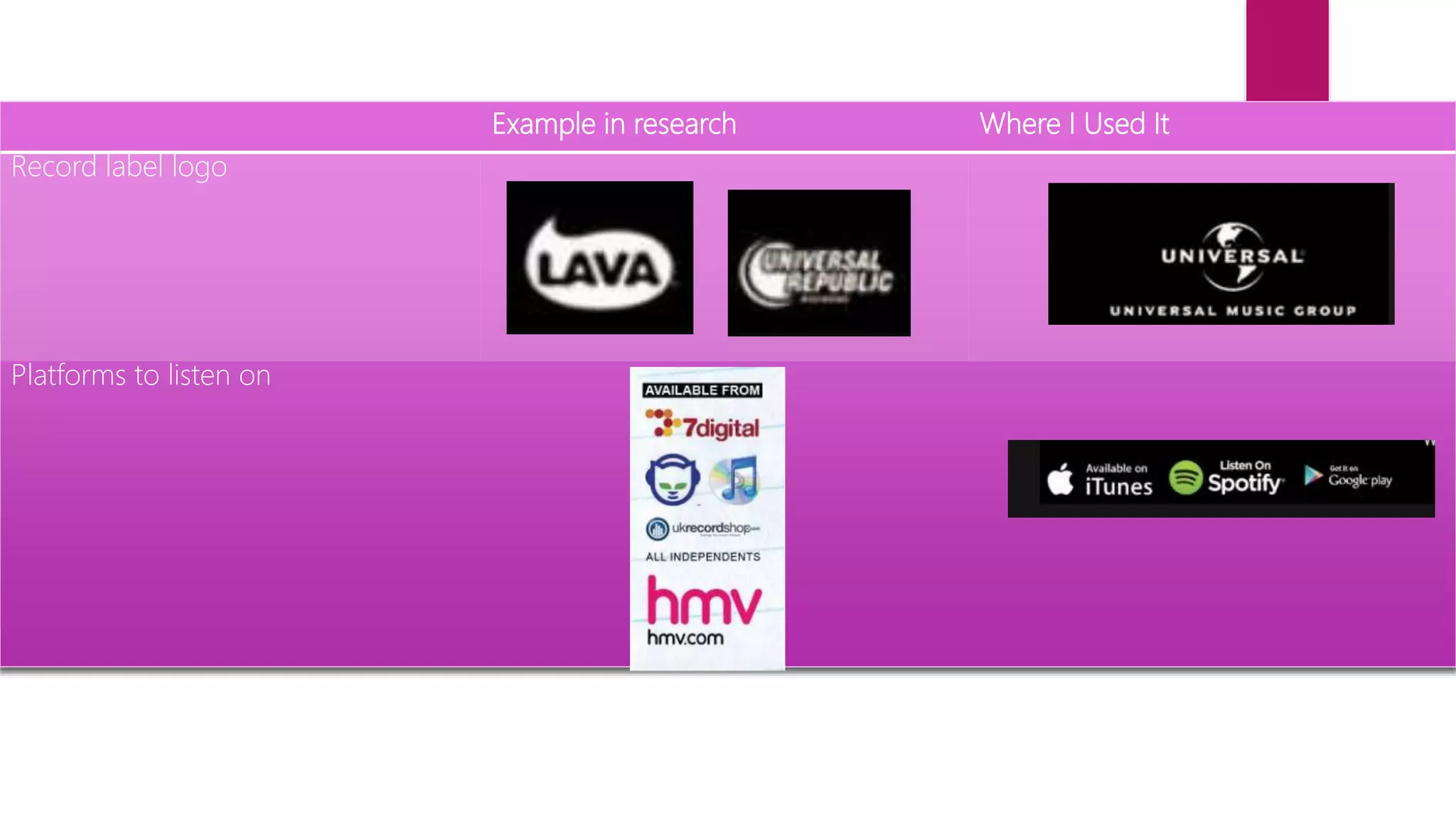
Example in research Where I Used It
Record label logo
Platforms to listen on
Why I chose to use these conventions
 My artist is a pop singer but the song itself was put together by a DJ and so is
classed into the dance-pop sub genre. The conventions I used to make my music
promotion into a brand was things such as using the same typography and colour
scheme across both the digipak, music advert and music video. I also used similar
imagery throughout all products, for example the shot of the artist looking out at
sea is used in the digipak and music video.
Music Video
Music Magazine
Advert
DigipakDigipak
 I chose not to use a direct mode of address as I believed
that it would fit better with the brand of my artist. It helped
anchor the representation of my artist and better appealed
to my target audience. I also identified examples in my
research and modelled it off of that. I also did not have a
direct mode of address in my music video, you could apply
Barthes’ Enigma Code to this, it made the artist more
unattainable to the audience, therefore meaning that they
would like the artist even more for that.

Eval q1

  • 1.
    In what waysdoes your media product use, develop or challenge forms and conventions of real media products? BY MAISIE LEGG
  • 2.
    How my research&planningaffected my product  During my research and planning I looked at, and analysed real music videos, music adverts and digipaks to identify the codes and conventions of these products to use in my own creations. I looked at theorists such as Andrew Goodwin, Sven E Carlsson and Richard Dyer to apply to my work.
  • 3.
     I alsolooked at artists who challenged the codes and conventions of their own genre and investigated the link between the brand identity of these artists and the impact of going against these conventions had. I discovered that this helped make these artists much more memorable.
  • 4.
    Conventions of MusicVideo Conventions Example in research Where I Used It Story/Narrative Relationship Artist Lip Syncing
  • 5.
    Conventions Example inresearch Where I Used It Resolution at the end of the video Variety of shot types and movement Close ups of important characters
  • 6.
    Conventions Example inresearch Where I Used It Each genre has different colour schemes attached, e.g- Pop, bright colours Artist involved in storyline From this I was able to make an informed decision on what codes and conventions I would use in my products, and understand the impact they would have.
  • 7.
    Why I chosethose Conventions  Graeme Burton suggests that media products use a process of repetition and recognition leading to anticipation and expectation. I believe this is displayed clearly throughout my video by utilising conventions such as props and costumes to show my protagonist is a soldier and injured as well as a stop watch to create that sense of anticipation. Audiences expect to see conventions of the genre in a product.
  • 8.
     Rick Altmanargues that genre is a blueprint, as a formula that precedes, programmes and patterns industry production. I used this to my advantage and took ideas from music videos I analysed such as If We Ever Meet Again and We Don’t Talk Anymore as well as the inspiration behind my video Waiting All Night. I also researched a sporting event that was different but would still fit into my genre. Through this I discovered the Invictus Games, and the poem it was inspired by. To pay tribute to this I added the poem at the end of my video.
  • 9.
     Sven ECarlsson would argue that my artist is the televised bard of his modern mythic embodiment. You identify this due to the conventions of having a serious story, various longshots of areas of interest as well as medium shots of the struggling soldier. The artist is also filmed only in areas that the main characters of the story also have. It appears to the audience that she is the one to tell the story. Most of the close-ups are of my artist as that fitted in with the conventions of the dance/pop genre, whereas the story has more medium shots to mimic the feeling of the scenes. I still used the convention of having a relationship in a music video, but I changed it to suit my own needs, rather than have a romantic relationship I decided to use a friendship which I believed better fit the lyrics of the song, therefore you could argue I challenged this convention.
  • 10.
     With regardsto the narrative I used Todorov’s Theory of equilibrium, this conforms to the stereotype of pop videos having an issue then resolution, which usually involves a happy ending, which my video also has. However the story line itself does not conform to the usual storyline of music videos of boy meets girl. I decided not to do this as my target audience prefers a more diverse storyline.
  • 11.
     I alsoused Andrew Goodwin’s theory of the pace matching the visuals. While the soldier is learning to deal with his injuries the pace of the song is very slow, once he learnt to deal with the issues and took up running thanks to his friend the songs pace increases to match the pace of the editing.
  • 12.
    Continued  The colourscheme I chose for my video was based on my research, A common theme for colour schemes was to use three complimentary colours, arguably I went against the typical pop convention of having bright colours for the artist. I did this because I portrayed my artist as a serious one, but still slightly fun. For example the bright red lips featured throughout, on the digipak, front cover and in the music video.
  • 13.
    Conventions of Digipak ConventionsExample in research Where I Used It Close-up of artist on front cover Song Titles
  • 14.
    Conventions Example inresearch Where I Used It Barcode Serial Number Record Label
  • 15.
    Example in researchWhere I Used It Consistent colour scheme Common themes of Bright bold colours for pop, black and white for ballards. Black White and Red Used on all covers of digipak Disclaimer Multiple images of artist
  • 16.
    Conventions Example inresearch Where I Used It Album Name on front Album name on spine Artist Name on Front
  • 17.
    Conventions of MusicMagazine Advert Example in research Where I Used It Website Album title Image of album cover
  • 18.
    Example in researchWhere I Used It Artist name Information on album
  • 19.
    Example in researchWhere I Used It Record label logo Platforms to listen on
  • 20.
    Why I choseto use these conventions  My artist is a pop singer but the song itself was put together by a DJ and so is classed into the dance-pop sub genre. The conventions I used to make my music promotion into a brand was things such as using the same typography and colour scheme across both the digipak, music advert and music video. I also used similar imagery throughout all products, for example the shot of the artist looking out at sea is used in the digipak and music video. Music Video Music Magazine Advert DigipakDigipak
  • 21.
     I chosenot to use a direct mode of address as I believed that it would fit better with the brand of my artist. It helped anchor the representation of my artist and better appealed to my target audience. I also identified examples in my research and modelled it off of that. I also did not have a direct mode of address in my music video, you could apply Barthes’ Enigma Code to this, it made the artist more unattainable to the audience, therefore meaning that they would like the artist even more for that.