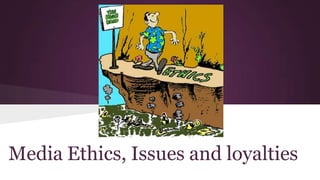
Media Ethics, Issues and loyalties
Shahab Ali
Islamic International University Islamabad
MS-3rd
Mass Communication
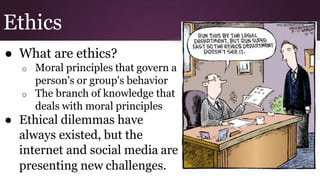
Ethics
● What are ethics?
o Moral principles that govern a
person's or group's behavior
o The branch of knowledge that
deals with moral principles
● Ethical dilemmas have
always existed, but the
internet and social media are
presenting new challenges.
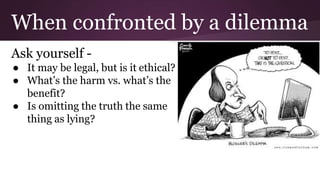
When confronted by a dilemma
Ask yourself -
● It may be legal, but is it ethical?
● What’s the harm vs. what’s the
benefit?
● Is omitting the truth the same
thing as lying?
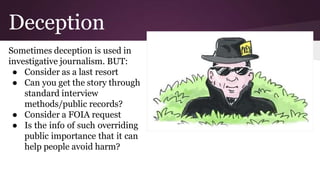
Deception
Sometimes deception is used in
investigative journalism. BUT:
● Consider as a last resort
● Can you get the story through
standard interview
methods/public records?
● Consider a FOIA request
● Is the info of such overriding
public importance that it can
help people avoid harm?
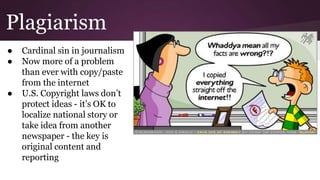
Plagiarism
● Cardinal sin in journalism
● Now more of a problem
than ever with copy/paste
from the internet
● U.S. Copyright laws don’t
protect ideas - it’s OK to
localize national story or
take idea from another
newspaper - the key is
original content and
reporting
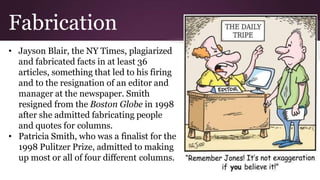
Fabrication
• Jayson Blair, the NY Times, plagiarized
and fabricated facts in at least 36
articles, something that led to his firing
and to the resignation of an editor and
manager at the newspaper. Smith
resigned from the Boston Globe in 1998
after she admitted fabricating people
and quotes for columns.
• Patricia Smith, who was a finalist for the
1998 Pulitzer Prize, admitted to making
up most or all of four different columns.
Conflicts of interest
These occur whenever
reporters face competing
loyalties. If you cover student
council and your best friend
is president of student
council, you may feel
inclined to be less skeptical
of the council’s decisions
because of your friendship.
Your loyalty to your friend
and to your readers is in
conflict.
Types Of Loyalty
George fletcher identifies two
types of Loyalty.
1.Minimal loyalty
Do not betray me
2.Maximum Loyalty
“Be one with me”
Between these two poles is a range
of Possibilities for allegiance and
for corresponding media behavior
Conflicting loyalties
1.Loyalities arising from shared humanity
2.Loyalities arising from Professional Practices
3.Loyalities arising from employment
4.Loyalities arising from media role in public life
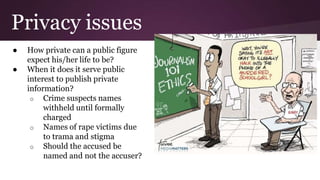
Privacy issues
● How private can a public figure
expect his/her life to be?
● When it does it serve public
interest to publish private
information?
o Crime suspects names
withheld until formally
charged
o Names of rape victims due
to trama and stigma
o Should the accused be
named and not the accuser?
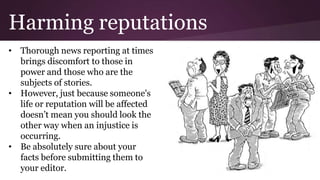
Harming reputations
• Thorough news reporting at times
brings discomfort to those in
power and those who are the
subjects of stories.
• However, just because someone's
life or reputation will be affected
doesn’t mean you should look the
other way when an injustice is
occurring.
• Be absolutely sure about your
facts before submitting them to
your editor.
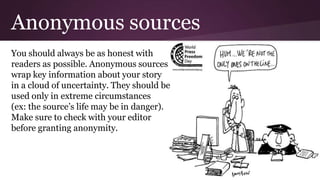
Anonymous sources
You should always be as honest with
readers as possible. Anonymous sources
wrap key information about your story
in a cloud of uncertainty. They should be
used only in extreme circumstances
(ex: the source’s life may be in danger).
Make sure to check with your editor
before granting anonymity.
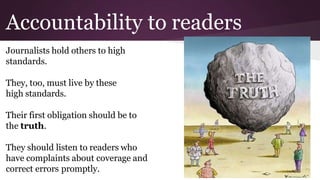
Accountability to readers
Journalists hold others to high
standards.
They, too, must live by these
high standards.
Their first obligation should be to
the truth.
They should listen to readers who
have complaints about coverage and
correct errors promptly.
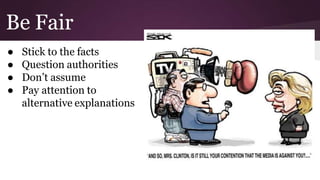
Be Fair
● Stick to the facts
● Question authorities
● Don’t assume
● Pay attention to
alternative explanations
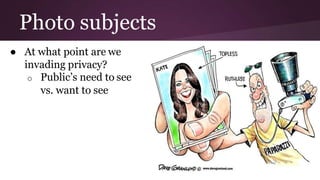
Photo subjects
● At what point are we
invading privacy?
o Public’s need to see
vs. want to see
“We do our jobs
when we give
readers all the
news – no matter
how painful or
ugly….Personal
feelings cannot
dissuade us from
our mission to
provide the facts
upon which an
informed citizenry
can make
decisions.”
~Inquirer managing
editor Anne Gordon
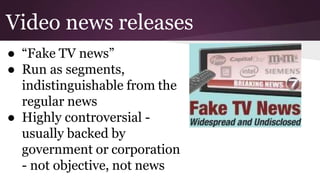
Video news releases
● “Fake TV news”
● Run as segments,
indistinguishable from the
regular news
● Highly controversial -
usually backed by
government or corporation
- not objective, not news
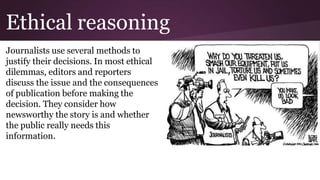
Ethical reasoning
Journalists use several methods to
justify their decisions. In most ethical
dilemmas, editors and reporters
discuss the issue and the consequences
of publication before making the
decision. They consider how
newsworthy the story is and whether
the public really needs this
information.
Ethical reasoning
1. Define the dilemma. Consider all the problems the
story or photograph will pose
2. Examine all your alternatives. For example, you
can publish, not publish, wait for more information,
display the story or photo prominently or in a lesser
position or choose other options
3. Justify your decision. Weigh the harms and the
benefits of publication, or weigh such factors as
relevance and importance of the story to the public
Poynter Institute Model
1. Why am I concerned about this story, photo or graphic?
2. What is the news? What good would publication do?
3. Is the information complete and accurate, to the best of my knowledge?
4. Am I missing an important point of view
5. What does my reader need to know?
6. How would I feel if the story or photo were about me or a member of my family?
7. What are the likely consequences of publication? What good or harm could result?
8. What are my alternatives?
9. Will I be able to clearly and honestly explain my decision to anyone who
challenges it?
Poynter Institute code of ethics
Code of Ethics
1. The Poynter Institute is a nonprofit school for journalists and a publisher of
original journalism. Since 1975, Poynter has hosted seminars on news media
ethics, written about ethical controversies and provided news organizations with
advice on ethical decision-making — often on deadline.
2. These guidelines describe the values, standards and practices we pursue in our
journalism, our teaching and our fundraising to support our mission. It is a living
document that we expect will mature and evolve with our work. It is broken into
three sections: core values, business practices and privacy.
Poynter Institute code of ethics
Core Values
Five core values guide our work: accuracy, independence, collaboration, fairness and
transparency. All Poynter employees are responsible for ensuring our work lives up to
these ideals.
1.Accuracy
We do our best to make sure that everything we publish is accurate and true to the
facts. This ranges from the easily confirmed, e.g. the spelling of names, to the
nuanced and more debatable, e.g. characterizations of political initiatives.
2.Independence
We are an independent, 501(c)(3), nonpartisan, nonprofit journalism education and
research institute. We manage our conflicts of interest and seek to remain free of
influences that might interfere with journalism or teaching that is accurate, fair,
transparent, professional and helpful.
Poynter Institute code of ethics
3.Collaboration
In order to fulfill its mission, Poynter must cultivate and nourish relationships
throughout the broader journalism and technology community. These relationships
make us smarter, more relevant and more capable of supporting journalism and
democracy.
4.Fairness
We strive to act justly, to respect people and their privacy, to present different points
of view and to minimize harm. These guidelines serve as checks and balances on the
perspectives and personal biases that each of us brings to our journalism.
5.Transparency
We shine a light on our own journalistic processes, explaining how and why we make
decisions. We do our best to disclose relevant information that may have influenced
or affected our decisions.
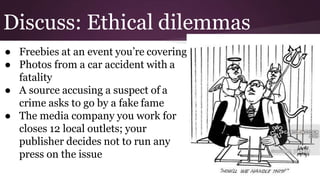
Discuss: Ethical dilemmas
● Freebies at an event you’re covering
● Photos from a car accident with a
fatality
● A source accusing a suspect of a
crime asks to go by a fake fame
● The media company you work for
closes 12 local outlets; your
publisher decides not to run any
press on the issue
Codes of Ethics
The Society of Professional Journalists Code of Ethics is a
statement of abiding principles supported by additional
explanations and position papers (at spj.org) that address
changing journalistic practices. It is not a set of rules, rather a
guide that encourages all who engage in journalism to take
responsibility for the information they provide, regardless of
medium. The code should be read as a whole; individual
principles should not be taken out of context. It is not, nor can it
be under the First Amendment, legally enforceable.
http://www.spj.org/ethicscode.asp
References
● New York Times:
http://www.nytco.com/who-we-
are/culture/standards-and-ethics/
● Washington Post:
http://asne.org/content.asp?pl=236&sl=19&
contentid=335
● Poynter
● https://www.poynter.org/poynter-institute-code-
ethics/

Media Ethics, Issues and Loyalties

  • 1.
    Media Ethics, Issuesand loyalties
  • 2.
    Shahab Ali Islamic InternationalUniversity Islamabad MS-3rd Mass Communication
  • 3.
    Ethics ● What areethics? o Moral principles that govern a person's or group's behavior o The branch of knowledge that deals with moral principles ● Ethical dilemmas have always existed, but the internet and social media are presenting new challenges.
  • 4.
    When confronted bya dilemma Ask yourself - ● It may be legal, but is it ethical? ● What’s the harm vs. what’s the benefit? ● Is omitting the truth the same thing as lying?
  • 5.
    Deception Sometimes deception isused in investigative journalism. BUT: ● Consider as a last resort ● Can you get the story through standard interview methods/public records? ● Consider a FOIA request ● Is the info of such overriding public importance that it can help people avoid harm?
  • 6.
    Plagiarism ● Cardinal sinin journalism ● Now more of a problem than ever with copy/paste from the internet ● U.S. Copyright laws don’t protect ideas - it’s OK to localize national story or take idea from another newspaper - the key is original content and reporting
  • 7.
    Fabrication • Jayson Blair,the NY Times, plagiarized and fabricated facts in at least 36 articles, something that led to his firing and to the resignation of an editor and manager at the newspaper. Smith resigned from the Boston Globe in 1998 after she admitted fabricating people and quotes for columns. • Patricia Smith, who was a finalist for the 1998 Pulitzer Prize, admitted to making up most or all of four different columns.
  • 8.
    Conflicts of interest Theseoccur whenever reporters face competing loyalties. If you cover student council and your best friend is president of student council, you may feel inclined to be less skeptical of the council’s decisions because of your friendship. Your loyalty to your friend and to your readers is in conflict.
  • 9.
    Types Of Loyalty Georgefletcher identifies two types of Loyalty. 1.Minimal loyalty Do not betray me 2.Maximum Loyalty “Be one with me” Between these two poles is a range of Possibilities for allegiance and for corresponding media behavior
  • 10.
    Conflicting loyalties 1.Loyalities arisingfrom shared humanity 2.Loyalities arising from Professional Practices 3.Loyalities arising from employment 4.Loyalities arising from media role in public life
  • 11.
    Privacy issues ● Howprivate can a public figure expect his/her life to be? ● When it does it serve public interest to publish private information? o Crime suspects names withheld until formally charged o Names of rape victims due to trama and stigma o Should the accused be named and not the accuser?
  • 12.
    Harming reputations • Thoroughnews reporting at times brings discomfort to those in power and those who are the subjects of stories. • However, just because someone's life or reputation will be affected doesn’t mean you should look the other way when an injustice is occurring. • Be absolutely sure about your facts before submitting them to your editor.
  • 13.
    Anonymous sources You shouldalways be as honest with readers as possible. Anonymous sources wrap key information about your story in a cloud of uncertainty. They should be used only in extreme circumstances (ex: the source’s life may be in danger). Make sure to check with your editor before granting anonymity.
  • 14.
    Accountability to readers Journalistshold others to high standards. They, too, must live by these high standards. Their first obligation should be to the truth. They should listen to readers who have complaints about coverage and correct errors promptly.
  • 15.
    Be Fair ● Stickto the facts ● Question authorities ● Don’t assume ● Pay attention to alternative explanations
  • 16.
    Photo subjects ● Atwhat point are we invading privacy? o Public’s need to see vs. want to see
  • 17.
    “We do ourjobs when we give readers all the news – no matter how painful or ugly….Personal feelings cannot dissuade us from our mission to provide the facts upon which an informed citizenry can make decisions.” ~Inquirer managing editor Anne Gordon
  • 18.
    Video news releases ●“Fake TV news” ● Run as segments, indistinguishable from the regular news ● Highly controversial - usually backed by government or corporation - not objective, not news
  • 19.
    Ethical reasoning Journalists useseveral methods to justify their decisions. In most ethical dilemmas, editors and reporters discuss the issue and the consequences of publication before making the decision. They consider how newsworthy the story is and whether the public really needs this information.
  • 20.
    Ethical reasoning 1. Definethe dilemma. Consider all the problems the story or photograph will pose 2. Examine all your alternatives. For example, you can publish, not publish, wait for more information, display the story or photo prominently or in a lesser position or choose other options 3. Justify your decision. Weigh the harms and the benefits of publication, or weigh such factors as relevance and importance of the story to the public
  • 21.
    Poynter Institute Model 1.Why am I concerned about this story, photo or graphic? 2. What is the news? What good would publication do? 3. Is the information complete and accurate, to the best of my knowledge? 4. Am I missing an important point of view 5. What does my reader need to know? 6. How would I feel if the story or photo were about me or a member of my family? 7. What are the likely consequences of publication? What good or harm could result? 8. What are my alternatives? 9. Will I be able to clearly and honestly explain my decision to anyone who challenges it?
  • 22.
    Poynter Institute codeof ethics Code of Ethics 1. The Poynter Institute is a nonprofit school for journalists and a publisher of original journalism. Since 1975, Poynter has hosted seminars on news media ethics, written about ethical controversies and provided news organizations with advice on ethical decision-making — often on deadline. 2. These guidelines describe the values, standards and practices we pursue in our journalism, our teaching and our fundraising to support our mission. It is a living document that we expect will mature and evolve with our work. It is broken into three sections: core values, business practices and privacy.
  • 23.
    Poynter Institute codeof ethics Core Values Five core values guide our work: accuracy, independence, collaboration, fairness and transparency. All Poynter employees are responsible for ensuring our work lives up to these ideals. 1.Accuracy We do our best to make sure that everything we publish is accurate and true to the facts. This ranges from the easily confirmed, e.g. the spelling of names, to the nuanced and more debatable, e.g. characterizations of political initiatives. 2.Independence We are an independent, 501(c)(3), nonpartisan, nonprofit journalism education and research institute. We manage our conflicts of interest and seek to remain free of influences that might interfere with journalism or teaching that is accurate, fair, transparent, professional and helpful.
  • 24.
    Poynter Institute codeof ethics 3.Collaboration In order to fulfill its mission, Poynter must cultivate and nourish relationships throughout the broader journalism and technology community. These relationships make us smarter, more relevant and more capable of supporting journalism and democracy. 4.Fairness We strive to act justly, to respect people and their privacy, to present different points of view and to minimize harm. These guidelines serve as checks and balances on the perspectives and personal biases that each of us brings to our journalism. 5.Transparency We shine a light on our own journalistic processes, explaining how and why we make decisions. We do our best to disclose relevant information that may have influenced or affected our decisions.
  • 25.
    Discuss: Ethical dilemmas ●Freebies at an event you’re covering ● Photos from a car accident with a fatality ● A source accusing a suspect of a crime asks to go by a fake fame ● The media company you work for closes 12 local outlets; your publisher decides not to run any press on the issue
  • 26.
    Codes of Ethics TheSociety of Professional Journalists Code of Ethics is a statement of abiding principles supported by additional explanations and position papers (at spj.org) that address changing journalistic practices. It is not a set of rules, rather a guide that encourages all who engage in journalism to take responsibility for the information they provide, regardless of medium. The code should be read as a whole; individual principles should not be taken out of context. It is not, nor can it be under the First Amendment, legally enforceable. http://www.spj.org/ethicscode.asp
  • 27.
    References ● New YorkTimes: http://www.nytco.com/who-we- are/culture/standards-and-ethics/ ● Washington Post: http://asne.org/content.asp?pl=236&sl=19& contentid=335 ● Poynter ● https://www.poynter.org/poynter-institute-code- ethics/