Packages 
The Backbone 
of 
Contemporary TV Newscasts
Types of TV News Stories 
 Package (PKG): 
 Great advantage: Precision of editing pictures, sound, and 
narration. 
 50 seconds - 3:00 + in length. Depends on the overall quality of 
the story (importance, visual appeal, strong writing, etc.). 
 Provides depth and complexity. 
 Demonstrates firsthand knowledge.
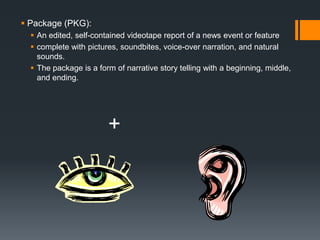
 Package (PKG): 
 An edited, self-contained videotape report of a news event or feature 
 complete with pictures, soundbites, voice-over narration, and natural 
sounds. 
 The package is a form of narrative story telling with a beginning, middle, 
and ending. 
+
Research! 
Secondary Sources 
Newspapers 
 Internet 
Records 
Books 
Primary Sources 
 Informal/off-camera interviews with informed 
people of multiple vantage points conducted via 
email, phone, or in person
Writing Packages 
 Elements of a Package: 
 Focus or Commitment 
Beginning: 
 Anchor (or Studio) Intro 
 Package Lead: 
Narrative Lead 
Visual Lead (+ nat. sound) 
 Middle: 
 3-4 Main Points (stay focused!)
Writing Packages 
 End: 
Final narrative 
Final visual (+ nat. sound) 
 Anchor Tag: 
A concluding thought 
A bit of information not included in the 
package 
Provides transition to next story.
Writing Packages 
 Anchor Intro: 
 Write it first, not last! 
 Must pass the “so what” test. 
 Must include enough information to let viewers know why they 
should watch (2-3 sentences minimum), but not so much that 
they already know the outcome. 
 Can be written as “hard lead” or “soft lead.”
Writing Packages 
 Focus: 
 In one simple, vivid, declarative sentence: 
What is this story about? 
Why should viewers care? 
What is the essential message your 
story should convey? 
What should viewers remember?
Writing Packages 
 Visual Lead: 
 Most important or compelling video. 
 Item most likely to be remembered later (along with closing 
visual). 
 Natural Sound is critical! 
 Make me care. Make me want to pay attention.
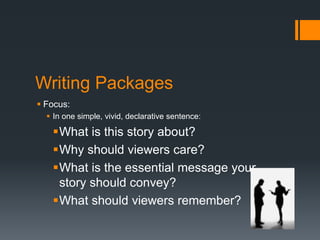
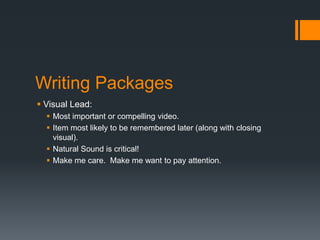
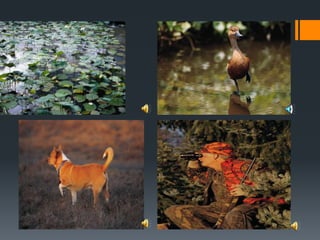
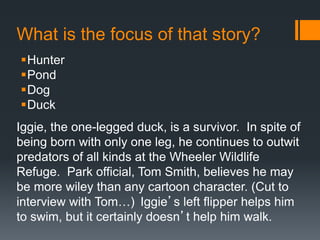
What is the focus of that story? 
Hunter 
Pond 
Dog 
Duck 
Iggie, the one-legged duck, is a survivor. In spite of 
being born with only one leg, he continues to outwit 
predators of all kinds at the Wheeler Wildlife 
Refuge. Park official, Tom Smith, believes he may 
be more wiley than any cartoon character. (Cut to 
interview with Tom…) Iggie’s left flipper helps him 
to swim, but it certainly doesn’t help him walk.
Writing Packages 
 Narrative Lead and Script: 
 Don’t force it. Be patient. 
 Write sparsely. 
 Don’t state the obvious – let pictures and sound help you tell the 
story. 
 Know when to shush. 
 Communicate with photographer/editor. 
 Stay focused.
Writing Packages 
 Anchor Tag: 
 Don’t repeat – unless it’s vital. 
 Use information that’s interesting, but perhaps slightly off focus. 
 Write with an eye toward future developments. 
 Provide closure / conclusion / transition.

News Packages

  • 1.
    Packages The Backbone of Contemporary TV Newscasts
  • 2.
    Types of TVNews Stories  Package (PKG):  Great advantage: Precision of editing pictures, sound, and narration.  50 seconds - 3:00 + in length. Depends on the overall quality of the story (importance, visual appeal, strong writing, etc.).  Provides depth and complexity.  Demonstrates firsthand knowledge.
  • 3.
     Package (PKG):  An edited, self-contained videotape report of a news event or feature  complete with pictures, soundbites, voice-over narration, and natural sounds.  The package is a form of narrative story telling with a beginning, middle, and ending. +
  • 4.
    Research! Secondary Sources Newspapers  Internet Records Books Primary Sources  Informal/off-camera interviews with informed people of multiple vantage points conducted via email, phone, or in person
  • 5.
    Writing Packages Elements of a Package:  Focus or Commitment Beginning:  Anchor (or Studio) Intro  Package Lead: Narrative Lead Visual Lead (+ nat. sound)  Middle:  3-4 Main Points (stay focused!)
  • 6.
    Writing Packages End: Final narrative Final visual (+ nat. sound)  Anchor Tag: A concluding thought A bit of information not included in the package Provides transition to next story.
  • 7.
    Writing Packages Anchor Intro:  Write it first, not last!  Must pass the “so what” test.  Must include enough information to let viewers know why they should watch (2-3 sentences minimum), but not so much that they already know the outcome.  Can be written as “hard lead” or “soft lead.”
  • 8.
    Writing Packages Focus:  In one simple, vivid, declarative sentence: What is this story about? Why should viewers care? What is the essential message your story should convey? What should viewers remember?
  • 9.
    Writing Packages Visual Lead:  Most important or compelling video.  Item most likely to be remembered later (along with closing visual).  Natural Sound is critical!  Make me care. Make me want to pay attention.
  • 11.
    What is thefocus of that story? Hunter Pond Dog Duck Iggie, the one-legged duck, is a survivor. In spite of being born with only one leg, he continues to outwit predators of all kinds at the Wheeler Wildlife Refuge. Park official, Tom Smith, believes he may be more wiley than any cartoon character. (Cut to interview with Tom…) Iggie’s left flipper helps him to swim, but it certainly doesn’t help him walk.
  • 12.
    Writing Packages Narrative Lead and Script:  Don’t force it. Be patient.  Write sparsely.  Don’t state the obvious – let pictures and sound help you tell the story.  Know when to shush.  Communicate with photographer/editor.  Stay focused.
  • 13.
    Writing Packages Anchor Tag:  Don’t repeat – unless it’s vital.  Use information that’s interesting, but perhaps slightly off focus.  Write with an eye toward future developments.  Provide closure / conclusion / transition.