By Prof. Mark Grabowski
www.markgrabowski.com
Overview
– Public thinks media is unethical
– Reasons why
– Sins to always avoid
– Other issues: grey areas
– Guidelines for handling ethics
– Sample scenarios
– Final advice
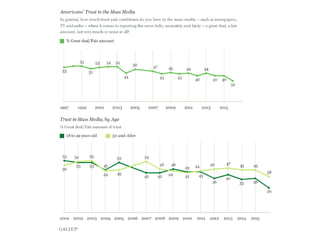
Lack of trust, hurt by election
• Only 32% of public trust media to report accurately
and fairly, a September Gallup poll found. Pollsters
blame "lower standards for journalism" in
presidential campaign coverage for "corroding
Americans' trust and confidence.”
• 55% of likely voters (including 60% independents)
say journalists are biased against Donald Trump, an
Oct. 19 Quinnipiac University poll found. While the
perception of bias depends upon one's party, it's
telling that 60 percent of independent voters believe
the media is anti-Trump.
Biased against Trump?
• A recent Center for Public Integrity study
revealed 480 reporters and editors
contributed to either presidential campaign,
with 90 percent donating to Hillary Clinton.
Journalists at The New York Times and other
legacy outlets contributed, despite newsroom
policies forbidding it.
New York Times
• The New York Times’ Aug. 8 cover story called
on reporters who believe Trump is a
"dangerous" "demagogue" to "throw out the
textbook American journalism has been using"
even though "it may not always seem fair.”
Playing favorites?
• A recent WikiLeaks release of hacked emails
revealed dozens of reporters, including
several at the New York Times and major TV
news networks, coordinated with Clinton's
campaign to provide positive coverage.
Mea culpa
• After the election, the New York Times’
publisher and top editor promised to
"rededicate ourselves to” reporting “honestly”
and “impartially.”
• CBS: “We were smug.”
http://www.cbsnews.com/news/commentary
-the-unbearable-smugness-of-the-press-
presidential-election-2016/
On the other hand
• Many people were also upset with the 24-7
media coverage of Hillary Clinton’s email
scandal the week before the election – which
the FBI later admitted was much ado about
nothing.
• WikiLeaks seemed to air only Clinton’s dirty
secrets, but not Trumps, critics say.
• Did this bias doom her in?
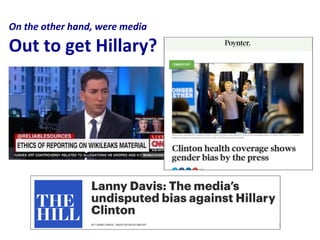
On the other hand, were media
Out to get Hillary?
Media sensationalizes
• 80% believe "journalists chase sensational
stories because they think it will sell papers,
not because they think it is important news. ”
• 85% believes that "newspapers frequently
over-dramatize some news stories just to sell
more papers."
• 80% believe sensational stories receive lots of
news coverage simply because they are
exciting, not because they are important.
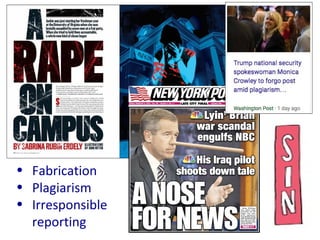
Big Scandals
• Fabrication
• Plagiarism
• Irresponsible
reporting
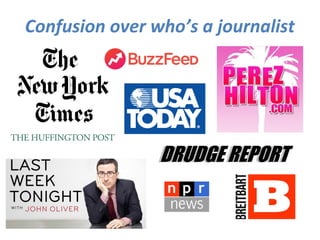
Confusion over who’s a journalist
Inability to distinguish
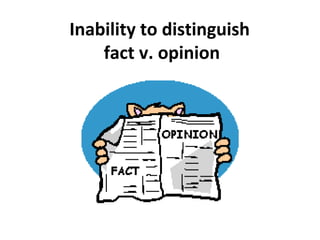
fact v. opinion
But most journalists aren’t evil
• They don’t plagiarize, fabricate.
• They want to get facts right.
• But they may be understaffed or overworked.
• Deadline pressures can affect accuracy and
judgment.
• And hairy situations may be unavoidable …
being a journalist often involves ethical
dilemmas: newsworthiness v. privacy
Guidelines
• To help deal with these dilemmas, many
media outlets follow the code of ethics
written by the Society of Professional
Journalists. It’s organized around four
principles…
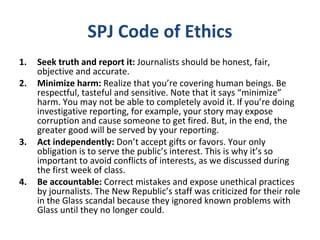
SPJ Code of Ethics
1. Seek truth and report it: Journalists should be honest, fair,
objective and accurate.
2. Minimize harm: Realize that you’re covering human beings. Be
respectful, tasteful and sensitive. Note that it says “minimize”
harm. You may not be able to completely avoid it. If you’re doing
investigative reporting, for example, your story may expose
corruption and cause someone to get fired. But, in the end, the
greater good will be served by your reporting.
3. Act independently: Don’t accept gifts or favors. Your only
obligation is to serve the public’s interest. This is why it’s so
important to avoid conflicts of interests, as we discussed during
the first week of class.
4. Be accountable: Correct mistakes and expose unethical practices
by journalists. The New Republic’s staff was criticized for their role
in the Glass scandal because they ignored known problems with
Glass until they no longer could.
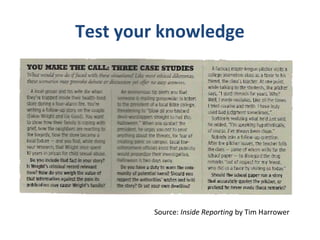
Test your knowledge
Source: Inside Reporting by Tim Harrower

Journalism Ethics

  • 1.
    By Prof. MarkGrabowski www.markgrabowski.com
  • 2.
    Overview – Public thinksmedia is unethical – Reasons why – Sins to always avoid – Other issues: grey areas – Guidelines for handling ethics – Sample scenarios – Final advice
  • 4.
    Lack of trust,hurt by election • Only 32% of public trust media to report accurately and fairly, a September Gallup poll found. Pollsters blame "lower standards for journalism" in presidential campaign coverage for "corroding Americans' trust and confidence.” • 55% of likely voters (including 60% independents) say journalists are biased against Donald Trump, an Oct. 19 Quinnipiac University poll found. While the perception of bias depends upon one's party, it's telling that 60 percent of independent voters believe the media is anti-Trump.
  • 5.
    Biased against Trump? •A recent Center for Public Integrity study revealed 480 reporters and editors contributed to either presidential campaign, with 90 percent donating to Hillary Clinton. Journalists at The New York Times and other legacy outlets contributed, despite newsroom policies forbidding it.
  • 6.
    New York Times •The New York Times’ Aug. 8 cover story called on reporters who believe Trump is a "dangerous" "demagogue" to "throw out the textbook American journalism has been using" even though "it may not always seem fair.”
  • 7.
    Playing favorites? • Arecent WikiLeaks release of hacked emails revealed dozens of reporters, including several at the New York Times and major TV news networks, coordinated with Clinton's campaign to provide positive coverage.
  • 8.
    Mea culpa • Afterthe election, the New York Times’ publisher and top editor promised to "rededicate ourselves to” reporting “honestly” and “impartially.” • CBS: “We were smug.” http://www.cbsnews.com/news/commentary -the-unbearable-smugness-of-the-press- presidential-election-2016/
  • 9.
    On the otherhand • Many people were also upset with the 24-7 media coverage of Hillary Clinton’s email scandal the week before the election – which the FBI later admitted was much ado about nothing. • WikiLeaks seemed to air only Clinton’s dirty secrets, but not Trumps, critics say. • Did this bias doom her in?
  • 10.
    On the otherhand, were media Out to get Hillary?
  • 11.
    Media sensationalizes • 80%believe "journalists chase sensational stories because they think it will sell papers, not because they think it is important news. ” • 85% believes that "newspapers frequently over-dramatize some news stories just to sell more papers." • 80% believe sensational stories receive lots of news coverage simply because they are exciting, not because they are important.
  • 12.
    Big Scandals • Fabrication •Plagiarism • Irresponsible reporting
  • 13.
  • 15.
  • 16.
    But most journalistsaren’t evil • They don’t plagiarize, fabricate. • They want to get facts right. • But they may be understaffed or overworked. • Deadline pressures can affect accuracy and judgment. • And hairy situations may be unavoidable … being a journalist often involves ethical dilemmas: newsworthiness v. privacy
  • 17.
    Guidelines • To helpdeal with these dilemmas, many media outlets follow the code of ethics written by the Society of Professional Journalists. It’s organized around four principles…
  • 18.
    SPJ Code ofEthics 1. Seek truth and report it: Journalists should be honest, fair, objective and accurate. 2. Minimize harm: Realize that you’re covering human beings. Be respectful, tasteful and sensitive. Note that it says “minimize” harm. You may not be able to completely avoid it. If you’re doing investigative reporting, for example, your story may expose corruption and cause someone to get fired. But, in the end, the greater good will be served by your reporting. 3. Act independently: Don’t accept gifts or favors. Your only obligation is to serve the public’s interest. This is why it’s so important to avoid conflicts of interests, as we discussed during the first week of class. 4. Be accountable: Correct mistakes and expose unethical practices by journalists. The New Republic’s staff was criticized for their role in the Glass scandal because they ignored known problems with Glass until they no longer could.
  • 19.
    Test your knowledge Source:Inside Reporting by Tim Harrower