Ethics in Journalism
To understand what it means to “minimize harm” To acknowledge the importance of personal responsibility in ethical decisions and behavior To review ethical dilemmas To talk specifically about ethics in digital journalism Our Agenda
Ethics  (from the Ancient Greek ἠθικός  ēthikos , the adjective of ἤθος  ēthos  "custom, habit”)  A major branch of philosophy The study of values and customs of a person or group. It covers the analysis and employment of concepts such as right and wrong, good and evil, and responsibility . Ethics : a standard of right and wrong based on analysis and thought  What Is “Ethics”?
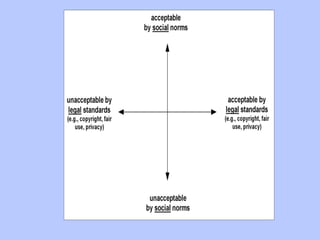
Journalism is about “truth-seeking” and so is the law. Those who work in the news system (however defined) have a public responsibility Respect for law and ethics is the mark of “professionalism” Professionalism is used to draw a boundary around the “reportorial community” Law and Ethics
 
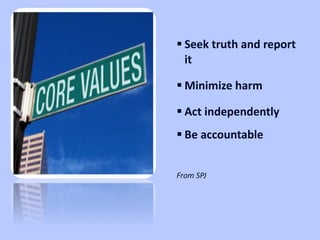
Seek truth and report it Minimize harm Act independently Be accountable From SPJ  Core Values
Sources
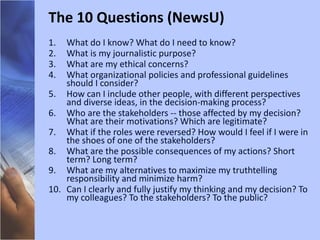
What do I know? What do I need to know?  What is my journalistic purpose?  What are my ethical concerns? What organizational policies and professional guidelines should I consider?  How can I include other people, with different perspectives and diverse ideas, in the decision-making process?  Who are the stakeholders -- those affected by my decision? What are their motivations? Which are legitimate?  What if the roles were reversed? How would I feel if I were in the shoes of one of the stakeholders?  What are the possible consequences of my actions? Short term? Long term? What are my alternatives to maximize my truthtelling responsibility and minimize harm?  Can I clearly and fully justify my thinking and my decision? To my colleagues? To the stakeholders? To the public?  The 10 Questions (NewsU)
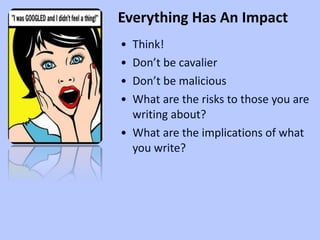
Think! Don’t be cavalier  Don’t be malicious What are the risks to those you are writing about? What are the implications of what you write? Everything Has An Impact
Some Rules Of Thumb
The most basic rule in journalism Mike Barnicle and Patricia Smith (Boston Globe), Jayson Blair (NYT), Janet Cooke and Mike Wise (WaPo), Stephen Glass (TNR), Jack Kelley (USA Today), and on and on and on Related: plagiarism is a no-no Content gathered online is subject to the same attribution rules as other content.  ~NPR News Social Media Guidelines  Related: direct quotes are exact quotes 1. Don’t Make Things Up
Do not quote or interview your family members unless you’re writing a personal essay Do not report on story in which you or family members are directly involved Do not accept gifts from sources What to do about “friends”? “ Our online data trails reflect on our professional reputations and those of The Washington Post. Be sure that your pattern of use does not suggest, for example, that you are interested only in people with one particular view of a topic or issue.”  ~ Washington Post guidance on use of social media LA Times updates social media policy 2. Avoid Conflicts of Interest
Seek out the truth and report all sides Always contact someone who is being criticized by others Write in the “objective” voice — keep your opinion to yourself Exceptions? 3. Be Fair and  Neutral
Always tell a potential source that you’re a reporter working on a story Never turn a conversation into an interview without permission 4. Identify  Yourself
We all make them Prompt and willing correction Ways to do this? Adds to your credibility 5. Admit Your  Mistakes
Archives:  Internet archive   Domain ownership:  Whois ,  IP lookup Linking:  Yahoo site explorer Hoax sites:  Snopes ,  Urban Legends Evaluating Online Sources
Identify who took the picture, what camera was used, where a digital picture was taken Remember the “too good to be true” rule! Beware of Powerpoint Be wary of manipulation. Look for where tones touch “ Read” EXIF data using applications (or Flickr) Identify who created a Word document (DocScrubber) Evaluating Online Media
BBC editorial guidance on use of social networks BBC Guidance on UGC The Journalist’s Guide to Facebook NPR News Social Media Guidelines How Social Media is Radically Changing the Newsroom Washington Post guidance on use of social media Resources
Kathy E. Gill, @kegill, wiredpen.com Creative Commons: attribution, non-commercial, share and share alike Sources: Ethical Encounters (slideshare) Ethics In Journalism -1 (slideshare) Ethics In Journalism - 2 (slideshare) Ethics Online (slideshare) NewsU tutorial on ethics Journalistic Ethics Online (slideshare) Visual Journalism Ethics (slideshare) Credits

Ethics In Journalism

  • 1.
  • 2.
    To understand whatit means to “minimize harm” To acknowledge the importance of personal responsibility in ethical decisions and behavior To review ethical dilemmas To talk specifically about ethics in digital journalism Our Agenda
  • 3.
    Ethics (fromthe Ancient Greek ἠθικός ēthikos , the adjective of ἤθος ēthos "custom, habit”) A major branch of philosophy The study of values and customs of a person or group. It covers the analysis and employment of concepts such as right and wrong, good and evil, and responsibility . Ethics : a standard of right and wrong based on analysis and thought What Is “Ethics”?
  • 4.
    Journalism is about“truth-seeking” and so is the law. Those who work in the news system (however defined) have a public responsibility Respect for law and ethics is the mark of “professionalism” Professionalism is used to draw a boundary around the “reportorial community” Law and Ethics
  • 5.
  • 6.
    Seek truth andreport it Minimize harm Act independently Be accountable From SPJ Core Values
  • 7.
  • 8.
    What do Iknow? What do I need to know? What is my journalistic purpose?  What are my ethical concerns? What organizational policies and professional guidelines should I consider? How can I include other people, with different perspectives and diverse ideas, in the decision-making process? Who are the stakeholders -- those affected by my decision? What are their motivations? Which are legitimate? What if the roles were reversed? How would I feel if I were in the shoes of one of the stakeholders? What are the possible consequences of my actions? Short term? Long term? What are my alternatives to maximize my truthtelling responsibility and minimize harm? Can I clearly and fully justify my thinking and my decision? To my colleagues? To the stakeholders? To the public? The 10 Questions (NewsU)
  • 9.
    Think! Don’t becavalier Don’t be malicious What are the risks to those you are writing about? What are the implications of what you write? Everything Has An Impact
  • 10.
  • 11.
    The most basicrule in journalism Mike Barnicle and Patricia Smith (Boston Globe), Jayson Blair (NYT), Janet Cooke and Mike Wise (WaPo), Stephen Glass (TNR), Jack Kelley (USA Today), and on and on and on Related: plagiarism is a no-no Content gathered online is subject to the same attribution rules as other content. ~NPR News Social Media Guidelines Related: direct quotes are exact quotes 1. Don’t Make Things Up
  • 12.
    Do not quoteor interview your family members unless you’re writing a personal essay Do not report on story in which you or family members are directly involved Do not accept gifts from sources What to do about “friends”? “ Our online data trails reflect on our professional reputations and those of The Washington Post. Be sure that your pattern of use does not suggest, for example, that you are interested only in people with one particular view of a topic or issue.” ~ Washington Post guidance on use of social media LA Times updates social media policy 2. Avoid Conflicts of Interest
  • 13.
    Seek out thetruth and report all sides Always contact someone who is being criticized by others Write in the “objective” voice — keep your opinion to yourself Exceptions? 3. Be Fair and Neutral
  • 14.
    Always tell apotential source that you’re a reporter working on a story Never turn a conversation into an interview without permission 4. Identify Yourself
  • 15.
    We all makethem Prompt and willing correction Ways to do this? Adds to your credibility 5. Admit Your Mistakes
  • 16.
    Archives: Internetarchive Domain ownership: Whois , IP lookup Linking: Yahoo site explorer Hoax sites: Snopes , Urban Legends Evaluating Online Sources
  • 17.
    Identify who tookthe picture, what camera was used, where a digital picture was taken Remember the “too good to be true” rule! Beware of Powerpoint Be wary of manipulation. Look for where tones touch “ Read” EXIF data using applications (or Flickr) Identify who created a Word document (DocScrubber) Evaluating Online Media
  • 18.
    BBC editorial guidanceon use of social networks BBC Guidance on UGC The Journalist’s Guide to Facebook NPR News Social Media Guidelines How Social Media is Radically Changing the Newsroom Washington Post guidance on use of social media Resources
  • 19.
    Kathy E. Gill,@kegill, wiredpen.com Creative Commons: attribution, non-commercial, share and share alike Sources: Ethical Encounters (slideshare) Ethics In Journalism -1 (slideshare) Ethics In Journalism - 2 (slideshare) Ethics Online (slideshare) NewsU tutorial on ethics Journalistic Ethics Online (slideshare) Visual Journalism Ethics (slideshare) Credits

Editor's Notes

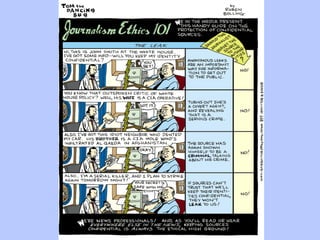
  • #8 http://www.gocomics.com/tomthedancingbug/2003/10/11/
  • #12 http://en.wikipedia.org/wiki/Mike_Barnicle#Boston_Globe_Controversy http://en.wikipedia.org/wiki/Patricia_Smith http://en.wikipedia.org/wiki/Jayson_Blair http://en.wikipedia.org/wiki/Janet_Cooke http://www.huffingtonpost.com/2010/08/31/mike-wise-suspended-from-_n_700593.html http://en.wikipedia.org/wiki/Jack_Kelley http://en.wikipedia.org/wiki/Stephen_Glass_%28reporter%29
  • #13 http://paidcontent.org/article/419-wapos-social-media-guidelines-paint-staff-into-virtual-corner/ http://latimesblogs.latimes.com/readers/2009/11/updated-social-media-guidelines.html
  • #18 http://www.takenet.or.jp/~ryuuji/minisoft/exifread/english/ http://www.javacoolsoftware.com/docscrubber.html