Media
Media Ethics:
Understanding Media Morality
Chapter Outline
History
Ethical Principles
Controversies
 Ethics –
 The study of guidelines that help people determine right from
wrong in voluntary conduct
 The Print Era -
▪ Depended on political orientation.
▪ Advancement of political point of view was more important than a
search for the truth.
▪ Objectivity
▪ Describing something based on factual elements rather than the feelings
of the one describing it (subjectivity) as a journalistic standard.
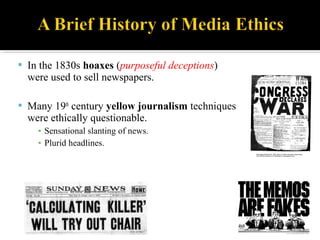
 In the 1830s hoaxes (purposeful deceptions)
were used to sell newspapers.
 Many 19th
century yellow journalism techniques
were ethically questionable.
▪ Sensational slanting of news.
▪ Plurid headlines.
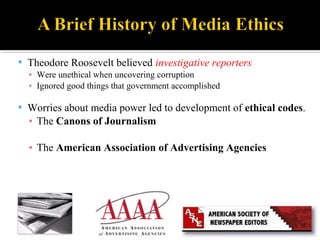
 Theodore Roosevelt believed investigative reporters
▪ Were unethical when uncovering corruption
▪ Ignored good things that government accomplished
 Worries about media power led to development of ethical codes.
▪ The Canons of Journalism
▪ The American Association of Advertising Agencies
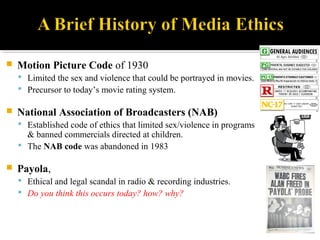
 Motion Picture Code of 1930
 Limited the sex and violence that could be portrayed in movies.
 Precursor to today’s movie rating system.
 National Association of Broadcasters (NAB)
 Established code of ethics that limited sex/violence in programs
& banned commercials directed at children.
 The NAB code was abandoned in 1983
 Payola,
 Ethical and legal scandal in radio & recording industries.
 Do you think this occurs today? how? why?
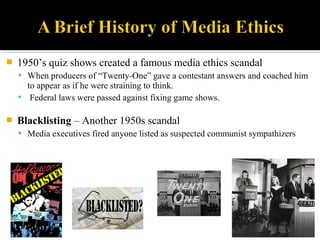
 1950’s quiz shows created a famous media ethics scandal
 When producers of “Twenty-One” gave a contestant answers and coached him
to appear as if he were straining to think.
 Federal laws were passed against fixing game shows.
 Blacklisting – Another 1950s scandal
 Media executives fired anyone listed as suspected communist sympathizers
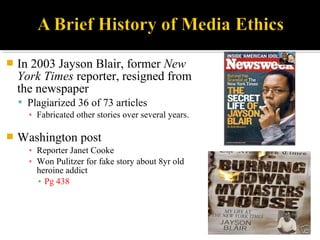
 In 2003 Jayson Blair, former New
York Times reporter, resigned from
the newspaper
 Plagiarized 36 of 73 articles
▪ Fabricated other stories over several years.
 Washington post
▪ Reporter Janet Cooke
▪ Won Pulitzer for fake story about 8yr old
heroine addict
▪ Pg 438
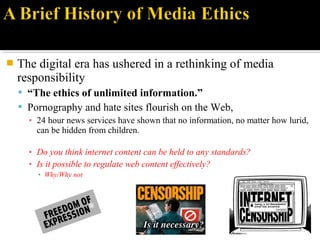
 The digital era has ushered in a rethinking of media
responsibility
 “The ethics of unlimited information.”
 Pornography and hate sites flourish on the Web,
▪ 24 hour news services have shown that no information, no matter how lurid,
can be hidden from children.
▪ Do you think internet content can be held to any standards?
▪ Is it possible to regulate web content effectively?
▪ Why/Why not
 Basic Ethical Orientations
 Absolutist Ethics
▪ Right or wrong response for every ethical decision.
▪ Often based on religious ideals, and are often rigidly adhered to.
▪ Are prescriptive
▪ Stipulate specific behaviors to be followed.
▪ Are proscriptive
▪ Stress the things that should not be done.
▪ Many news organizations have a two-source rule
▪ Nothing will be published as fact without a second independent
confirmation.
 Veil of ignorance
 Treating everyone equally
 Allows practitioners to be objective in presenting media
 Situation ethics
 Choices are made rationally without a predetermined set of rules.
 Sometimes called relativistic ethics.
 How important are ethics in the today’s society
 Can you think of media examples where ethics is/was an issue?
 What do you think about this commercial?
 Video Clip
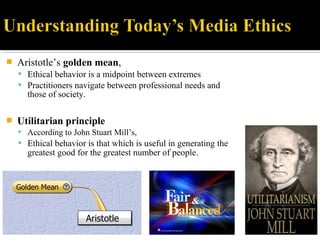
 Aristotle’s golden mean,
 Ethical behavior is a midpoint between extremes
 Practitioners navigate between professional needs and
those of society.
 Utilitarian principle
 According to John Stuart Mill’s,
 Ethical behavior is that which is useful in generating the
greatest good for the greatest number of people.
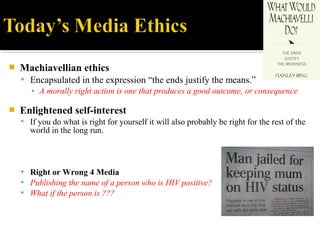
 Machiavellian ethics
 Encapsulated in the expression “the ends justify the means.”
▪ A morally right action is one that produces a good outcome, or consequence
 Enlightened self-interest
 If you do what is right for yourself it will also probably be right for the rest of the
world in the long run.
 Right or Wrong 4 Media
 Publishing the name of a person who is HIV positive?
 What if the person is ???
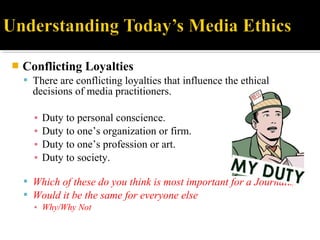
 Conflicting Loyalties
 There are conflicting loyalties that influence the ethical
decisions of media practitioners.
▪ Duty to personal conscience.
▪ Duty to one’s organization or firm.
▪ Duty to one’s profession or art.
▪ Duty to society.
 Which of these do you think is most important for a Journalist?
 Would it be the same for everyone else
▪ Why/Why Not
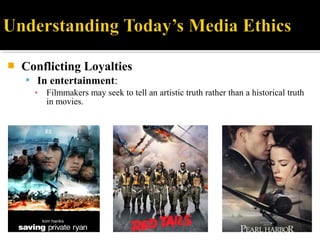
 Conflicting Loyalties
 In entertainment:
▪ Filmmakers may seek to tell an artistic truth rather than a historical truth
in movies.
 Conflicting Loyalties
 In advertising:
▪ Advertisers want a truth that depicts the satisfaction the product will bring
to the consumer.
▪ Video Clip Video Clip
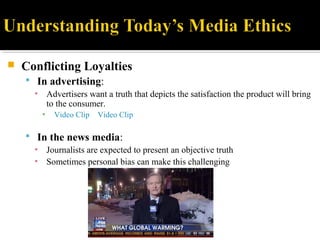
 In the news media:
▪ Journalists are expected to present an objective truth
▪ Sometimes personal bias can make this challenging
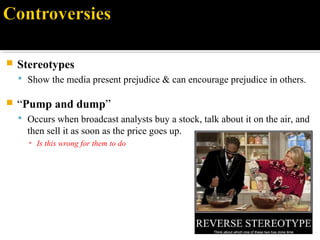
 Stereotypes
 Show the media present prejudice & can encourage prejudice in others.
 “Pump and dump”
 Occurs when broadcast analysts buy a stock, talk about it on the air, and
then sell it as soon as the price goes up.
▪ Is this wrong for them to do
 Anonymity and who deserves it
▪ The use of anonymous sources is always
controversial
▪ At least one editor must know the name of the
source before information from source is used
in an article
▪ Readers are to be told why a source is granted
anonymity
 Do you think that controversial stories should be
published if the source demands anonymity?
▪ Accusations towards a company/public figure
 Why/Why Not
 In 1960s and 1970s, TV networks had large,
powerful departments called…
 Standards and Practices
▪ To oversee the ethics of their programming.
▪ The "network censors."
▪ Standards and Practices Departments are maintained at each broadcast
and many cable networks.
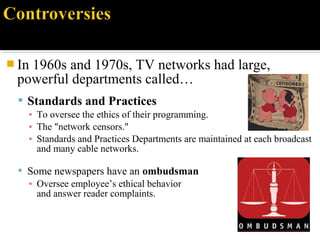
 Some newspapers have an ombudsman
▪ Oversee employee’s ethical behavior
and answer reader complaints.
 News councils
▪ Independent agencies who objectively monitor media content
 Media people also accountable to citizens’ groups,
▪ People who form associations to influence the media.
▪ Also called “pressure groups.”
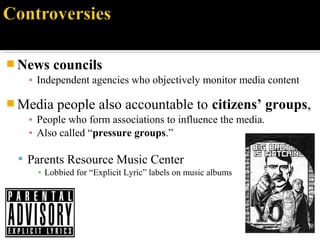
 Parents Resource Music Center
▪ Lobbied for “Explicit Lyric” labels on music albums

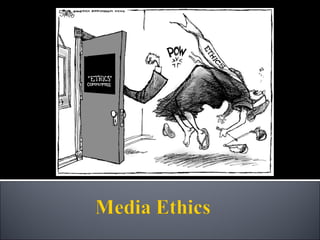
Media Ethics

  • 1.
  • 2.
    Media Ethics: Understanding MediaMorality Chapter Outline History Ethical Principles Controversies
  • 3.
     Ethics – The study of guidelines that help people determine right from wrong in voluntary conduct  The Print Era - ▪ Depended on political orientation. ▪ Advancement of political point of view was more important than a search for the truth. ▪ Objectivity ▪ Describing something based on factual elements rather than the feelings of the one describing it (subjectivity) as a journalistic standard.
  • 4.
     In the1830s hoaxes (purposeful deceptions) were used to sell newspapers.  Many 19th century yellow journalism techniques were ethically questionable. ▪ Sensational slanting of news. ▪ Plurid headlines.
  • 5.
     Theodore Rooseveltbelieved investigative reporters ▪ Were unethical when uncovering corruption ▪ Ignored good things that government accomplished  Worries about media power led to development of ethical codes. ▪ The Canons of Journalism ▪ The American Association of Advertising Agencies
  • 6.
     Motion PictureCode of 1930  Limited the sex and violence that could be portrayed in movies.  Precursor to today’s movie rating system.  National Association of Broadcasters (NAB)  Established code of ethics that limited sex/violence in programs & banned commercials directed at children.  The NAB code was abandoned in 1983  Payola,  Ethical and legal scandal in radio & recording industries.  Do you think this occurs today? how? why?
  • 7.
     1950’s quizshows created a famous media ethics scandal  When producers of “Twenty-One” gave a contestant answers and coached him to appear as if he were straining to think.  Federal laws were passed against fixing game shows.  Blacklisting – Another 1950s scandal  Media executives fired anyone listed as suspected communist sympathizers
  • 8.
     In 2003Jayson Blair, former New York Times reporter, resigned from the newspaper  Plagiarized 36 of 73 articles ▪ Fabricated other stories over several years.  Washington post ▪ Reporter Janet Cooke ▪ Won Pulitzer for fake story about 8yr old heroine addict ▪ Pg 438
  • 9.
     The digitalera has ushered in a rethinking of media responsibility  “The ethics of unlimited information.”  Pornography and hate sites flourish on the Web, ▪ 24 hour news services have shown that no information, no matter how lurid, can be hidden from children. ▪ Do you think internet content can be held to any standards? ▪ Is it possible to regulate web content effectively? ▪ Why/Why not
  • 10.
     Basic EthicalOrientations  Absolutist Ethics ▪ Right or wrong response for every ethical decision. ▪ Often based on religious ideals, and are often rigidly adhered to. ▪ Are prescriptive ▪ Stipulate specific behaviors to be followed. ▪ Are proscriptive ▪ Stress the things that should not be done. ▪ Many news organizations have a two-source rule ▪ Nothing will be published as fact without a second independent confirmation.
  • 11.
     Veil ofignorance  Treating everyone equally  Allows practitioners to be objective in presenting media  Situation ethics  Choices are made rationally without a predetermined set of rules.  Sometimes called relativistic ethics.  How important are ethics in the today’s society  Can you think of media examples where ethics is/was an issue?  What do you think about this commercial?  Video Clip
  • 12.
     Aristotle’s goldenmean,  Ethical behavior is a midpoint between extremes  Practitioners navigate between professional needs and those of society.  Utilitarian principle  According to John Stuart Mill’s,  Ethical behavior is that which is useful in generating the greatest good for the greatest number of people.
  • 13.
     Machiavellian ethics Encapsulated in the expression “the ends justify the means.” ▪ A morally right action is one that produces a good outcome, or consequence  Enlightened self-interest  If you do what is right for yourself it will also probably be right for the rest of the world in the long run.  Right or Wrong 4 Media  Publishing the name of a person who is HIV positive?  What if the person is ???
  • 14.
     Conflicting Loyalties There are conflicting loyalties that influence the ethical decisions of media practitioners. ▪ Duty to personal conscience. ▪ Duty to one’s organization or firm. ▪ Duty to one’s profession or art. ▪ Duty to society.  Which of these do you think is most important for a Journalist?  Would it be the same for everyone else ▪ Why/Why Not
  • 15.
     Conflicting Loyalties In entertainment: ▪ Filmmakers may seek to tell an artistic truth rather than a historical truth in movies.
  • 16.
     Conflicting Loyalties In advertising: ▪ Advertisers want a truth that depicts the satisfaction the product will bring to the consumer. ▪ Video Clip Video Clip  In the news media: ▪ Journalists are expected to present an objective truth ▪ Sometimes personal bias can make this challenging
  • 17.
     Stereotypes  Showthe media present prejudice & can encourage prejudice in others.  “Pump and dump”  Occurs when broadcast analysts buy a stock, talk about it on the air, and then sell it as soon as the price goes up. ▪ Is this wrong for them to do
  • 18.
     Anonymity andwho deserves it ▪ The use of anonymous sources is always controversial ▪ At least one editor must know the name of the source before information from source is used in an article ▪ Readers are to be told why a source is granted anonymity  Do you think that controversial stories should be published if the source demands anonymity? ▪ Accusations towards a company/public figure  Why/Why Not
  • 19.
     In 1960sand 1970s, TV networks had large, powerful departments called…  Standards and Practices ▪ To oversee the ethics of their programming. ▪ The "network censors." ▪ Standards and Practices Departments are maintained at each broadcast and many cable networks.  Some newspapers have an ombudsman ▪ Oversee employee’s ethical behavior and answer reader complaints.
  • 20.
     News councils ▪Independent agencies who objectively monitor media content  Media people also accountable to citizens’ groups, ▪ People who form associations to influence the media. ▪ Also called “pressure groups.”  Parents Resource Music Center ▪ Lobbied for “Explicit Lyric” labels on music albums