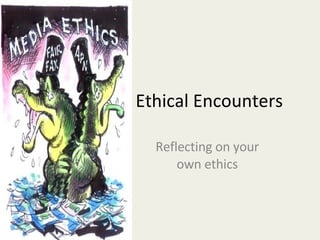
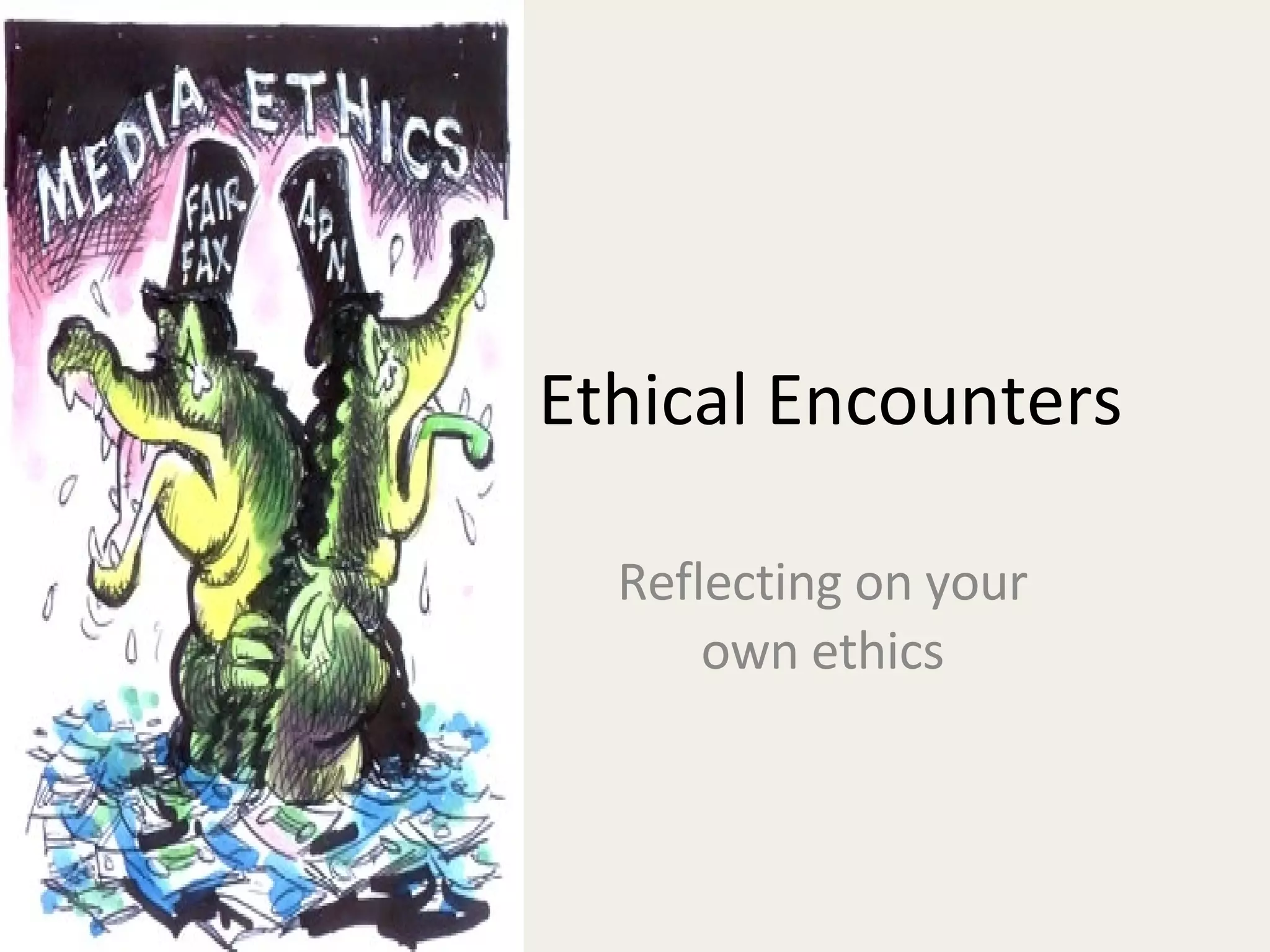
Ethical Encounters Reflecting on your own ethics
Media law  and  ethics From the journalist’s perspective not the lawyer’s Often difficult to separate legal and ethical issues when discussing events and cases from the media Journalism is about “truth-seeking”, so is the law. Ethics is based on versions of the truth
Law and ethics important because? Journalists, editors and those who work in the news system have a public responsibility Knowing about the law can help with what Pearson calls “self-preservation” Respect for law and ethics is the mark of “professionalism” Professionalism is used to draw a boundary around the “reportorial community”
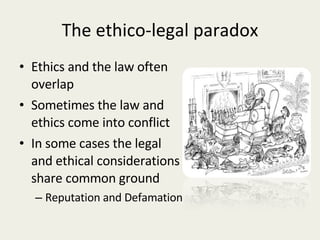
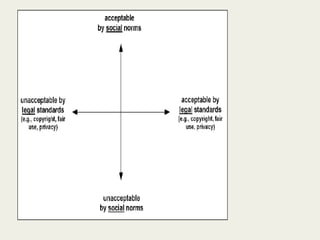
The ethico-legal paradox Ethics and the law often overlap Sometimes the law and ethics come into conflict In some cases the legal and ethical considerations share common ground Reputation and Defamation
 
Examples of the ethico-legal paradox Chequebook journalism – Why? It’s not illegal – except in some jurisdictions Proceeds of crime legislation A reporter using a hidden camera – Why? Recording vision is not illegal Recording sound without knowledge is illegal Deception may be acceptable under certain conditions – What are they?
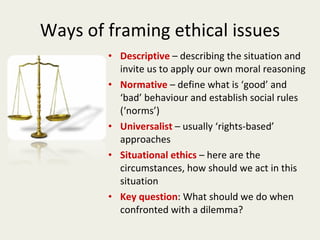
Ways of framing ethical issues Descriptive  – describing the situation and invite us to apply our own moral reasoning Normative  – define what is ‘good’ and ‘bad’ behaviour and establish social rules (‘norms’) Universalist  – usually ‘rights-based’ approaches Situational ethics  – here are the circumstances, how should we act in this situation Key question : What should we do when confronted with a dilemma?
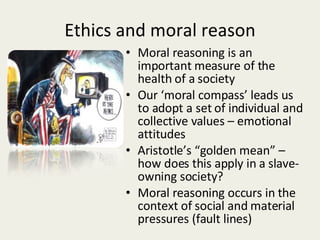
Ethics and moral reason Moral reasoning is an important measure of the health of a society Our ‘moral compass’ leads us to adopt a set of individual and collective values – emotional attitudes Aristotle’s “golden mean” – how does this apply in a slave-owning society? Moral reasoning occurs in the context of social and material pressures (fault lines)
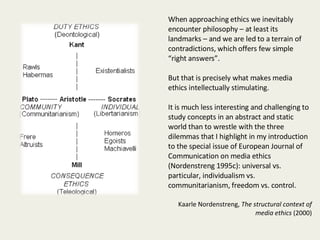
When approaching ethics we inevitably encounter philosophy – at least its landmarks – and we are led to a terrain of contradictions, which offers few simple “right answers”.  But that is precisely what makes media ethics intellectually stimulating.  It is much less interesting and challenging to study concepts in an abstract and static world than to wrestle with the three dilemmas that I highlight in my introduction to the special issue of European Journal of Communication on media ethics (Nordenstreng 1995c): universal vs. particular, individualism vs. communitarianism, freedom vs. control. Kaarle Nordenstreng,  The structural context of media ethics  (2000)
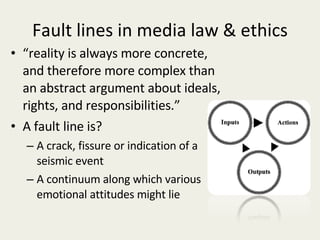
Fault lines in media law & ethics “ reality is always more concrete, and therefore more complex than an abstract argument about ideals, rights, and responsibilities.” A fault line is? A crack, fissure or indication of a seismic event A continuum along which various emotional attitudes might lie
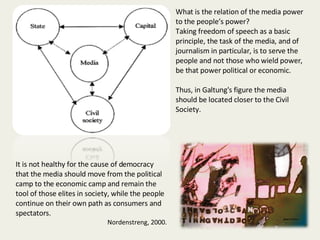
What is the relation of the media power to the people’s power?  Taking freedom of speech as a basic principle, the task of the media, and of journalism in particular, is to serve the people and not those who wield power, be that power political or economic. Thus, in Galtung's figure the media should be located closer to the Civil Society.  It is not healthy for the cause of democracy that the media should move from the political camp to the economic camp and remain the tool of those elites in society, while the people continue on their own path as consumers and spectators.  Nordenstreng, 2000.
Dialectic: freedom and responsibility Journalists argue that they need freedom to report ‘without fear or favour’ Society argues that journalists must be responsible - not report things that are untrue, or that will cause harm How do we theorise and argue a balance between freedom and responsibility? Is there a “golden mean” in this equation?
Duties and Consequences Deontology: from the Greek  deon  meaning ‘duty’. We have a duty to be ethical in our actions Teleology: from the Greek  telos  meaning ‘the end result’ Also known as ‘consequentialism’  We must be aware of the consequences of our actions
 
Core ideologies in journalism Accountability (responsibility) accountability engenders trust (MEAA code of ethics) Accuracy accuracy is about getting the story right, not just the facts Balance and bias journalism is about interpretation, hence the potential for bias interpretation involves selection and ordering of the ‘facts’
Utility and Virtue Utilitarianism: Always act in the interests of the greater social good Put society’s interests above your own Virtue Ethics: Always act in the most virtuous way possible Virtue is itself an ‘intrinsic good’ hence to act with virtue is the true test of humanity Is there any intrinsic (good) value in journalism?
Rights and Contracts Human rights are universal and this means journalists should always and every where respect fundamental human rights. Of course human rights are a social construct and hence ‘variable’ Journalists have a Social Contract with their audience to provide honest, reliable and unbiased news information. What are the moral duties and rights of a journalist?
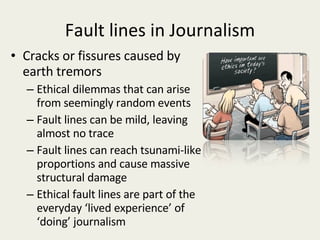
Fault lines in Journalism Cracks or fissures caused by earth tremors Ethical dilemmas that can arise from seemingly random events Fault lines can be mild, leaving almost no trace Fault lines can reach tsunami-like proportions and cause massive structural damage Ethical fault lines are part of the everyday ‘lived experience’ of ‘doing’ journalism
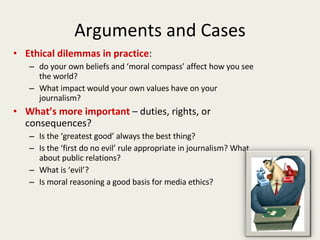
Arguments and Cases Ethical dilemmas in practice : do your own beliefs and ‘moral compass’ affect how you see the world? What impact would your own values have on your journalism? What’s more important  – duties, rights, or consequences? Is the ‘greatest good’ always the best thing? Is the ‘first do no evil’ rule appropriate in journalism? What about public relations? What is ‘evil’? Is moral reasoning a good basis for media ethics?
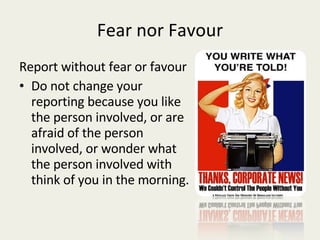
Fear nor Favour Report without fear or favour Do not change your reporting because you like the person involved, or are afraid of the person involved, or wonder what the person involved with think of you in the morning.
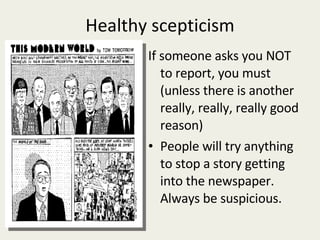
Healthy scepticism If someone asks you NOT to report, you must (unless there is another really, really, really good reason) People will try anything to stop a story getting into the newspaper. Always be suspicious.
Respect = Strength Treat everyone with respect, whoever they are. Give them the option of doing things the easy way Remember that people don’t know the media’s rules Being fair does not make you weak, but being weak does not make you fair.
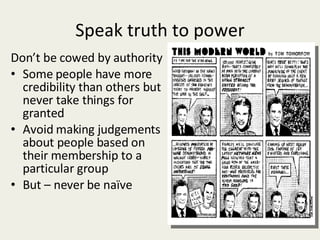
Speak truth to power Don’t be cowed by authority Some people have more credibility than others but never take things for granted Avoid making judgements about people based on their membership to a particular group But – never be naïve
Remember the questions Be consistent in your treatment of people/stories Ask WHY is this a story HOW have you covered this kind of story in the past WHAT will the results of your coverage be WHEN would you have a more complete story – should you run it now?
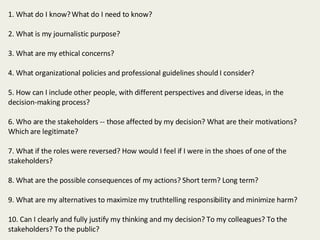
1. What do I know? What do I need to know?  2. What is my journalistic purpose?    3. What are my ethical concerns? 4. What organizational policies and professional guidelines should I consider?  5. How can I include other people, with different perspectives and diverse ideas, in the decision-making process?  6. Who are the stakeholders -- those affected by my decision? What are their motivations? Which are legitimate?  7. What if the roles were reversed? How would I feel if I were in the shoes of one of the stakeholders?  8. What are the possible consequences of my actions? Short term? Long term?   9. What are my alternatives to maximize my truthtelling responsibility and minimize harm?  10. Can I clearly and fully justify my thinking and my decision? To my colleagues? To the stakeholders? To the public?
Honesty is the best policy Be beyond reproach Don’t be compromised over anything Make all declarations (at least to your boss, ideally to the reader) Don’t associate with criminals Watch political/organisational links
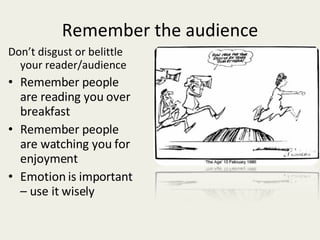
Remember the audience Don’t disgust or belittle your reader/audience Remember people are reading you over breakfast Remember people are watching you for enjoyment Emotion is important – use it wisely
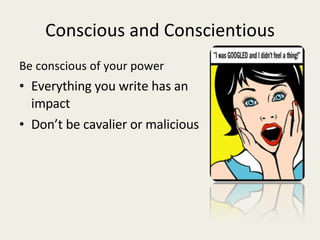
Conscious and Conscientious Be conscious of your power Everything you write has an impact Don’t be cavalier or malicious
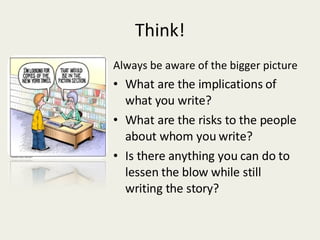
Think! Always be aware of the bigger picture What are the implications of what you write? What are the risks to the people about whom you write? Is there anything you can do to lessen the blow while still writing the story?

Ethical Encounters August 2008

  • 1.
  • 2.
    Media law and ethics From the journalist’s perspective not the lawyer’s Often difficult to separate legal and ethical issues when discussing events and cases from the media Journalism is about “truth-seeking”, so is the law. Ethics is based on versions of the truth
  • 3.
    Law and ethicsimportant because? Journalists, editors and those who work in the news system have a public responsibility Knowing about the law can help with what Pearson calls “self-preservation” Respect for law and ethics is the mark of “professionalism” Professionalism is used to draw a boundary around the “reportorial community”
  • 4.
    The ethico-legal paradoxEthics and the law often overlap Sometimes the law and ethics come into conflict In some cases the legal and ethical considerations share common ground Reputation and Defamation
  • 5.
  • 6.
    Examples of theethico-legal paradox Chequebook journalism – Why? It’s not illegal – except in some jurisdictions Proceeds of crime legislation A reporter using a hidden camera – Why? Recording vision is not illegal Recording sound without knowledge is illegal Deception may be acceptable under certain conditions – What are they?
  • 7.
    Ways of framingethical issues Descriptive – describing the situation and invite us to apply our own moral reasoning Normative – define what is ‘good’ and ‘bad’ behaviour and establish social rules (‘norms’) Universalist – usually ‘rights-based’ approaches Situational ethics – here are the circumstances, how should we act in this situation Key question : What should we do when confronted with a dilemma?
  • 8.
    Ethics and moralreason Moral reasoning is an important measure of the health of a society Our ‘moral compass’ leads us to adopt a set of individual and collective values – emotional attitudes Aristotle’s “golden mean” – how does this apply in a slave-owning society? Moral reasoning occurs in the context of social and material pressures (fault lines)
  • 9.
    When approaching ethicswe inevitably encounter philosophy – at least its landmarks – and we are led to a terrain of contradictions, which offers few simple “right answers”. But that is precisely what makes media ethics intellectually stimulating. It is much less interesting and challenging to study concepts in an abstract and static world than to wrestle with the three dilemmas that I highlight in my introduction to the special issue of European Journal of Communication on media ethics (Nordenstreng 1995c): universal vs. particular, individualism vs. communitarianism, freedom vs. control. Kaarle Nordenstreng, The structural context of media ethics (2000)
  • 10.
    Fault lines inmedia law & ethics “ reality is always more concrete, and therefore more complex than an abstract argument about ideals, rights, and responsibilities.” A fault line is? A crack, fissure or indication of a seismic event A continuum along which various emotional attitudes might lie
  • 11.
    What is therelation of the media power to the people’s power? Taking freedom of speech as a basic principle, the task of the media, and of journalism in particular, is to serve the people and not those who wield power, be that power political or economic. Thus, in Galtung's figure the media should be located closer to the Civil Society. It is not healthy for the cause of democracy that the media should move from the political camp to the economic camp and remain the tool of those elites in society, while the people continue on their own path as consumers and spectators. Nordenstreng, 2000.
  • 12.
    Dialectic: freedom andresponsibility Journalists argue that they need freedom to report ‘without fear or favour’ Society argues that journalists must be responsible - not report things that are untrue, or that will cause harm How do we theorise and argue a balance between freedom and responsibility? Is there a “golden mean” in this equation?
  • 13.
    Duties and ConsequencesDeontology: from the Greek deon meaning ‘duty’. We have a duty to be ethical in our actions Teleology: from the Greek telos meaning ‘the end result’ Also known as ‘consequentialism’ We must be aware of the consequences of our actions
  • 14.
  • 15.
    Core ideologies injournalism Accountability (responsibility) accountability engenders trust (MEAA code of ethics) Accuracy accuracy is about getting the story right, not just the facts Balance and bias journalism is about interpretation, hence the potential for bias interpretation involves selection and ordering of the ‘facts’
  • 16.
    Utility and VirtueUtilitarianism: Always act in the interests of the greater social good Put society’s interests above your own Virtue Ethics: Always act in the most virtuous way possible Virtue is itself an ‘intrinsic good’ hence to act with virtue is the true test of humanity Is there any intrinsic (good) value in journalism?
  • 17.
    Rights and ContractsHuman rights are universal and this means journalists should always and every where respect fundamental human rights. Of course human rights are a social construct and hence ‘variable’ Journalists have a Social Contract with their audience to provide honest, reliable and unbiased news information. What are the moral duties and rights of a journalist?
  • 18.
    Fault lines inJournalism Cracks or fissures caused by earth tremors Ethical dilemmas that can arise from seemingly random events Fault lines can be mild, leaving almost no trace Fault lines can reach tsunami-like proportions and cause massive structural damage Ethical fault lines are part of the everyday ‘lived experience’ of ‘doing’ journalism
  • 19.
    Arguments and CasesEthical dilemmas in practice : do your own beliefs and ‘moral compass’ affect how you see the world? What impact would your own values have on your journalism? What’s more important – duties, rights, or consequences? Is the ‘greatest good’ always the best thing? Is the ‘first do no evil’ rule appropriate in journalism? What about public relations? What is ‘evil’? Is moral reasoning a good basis for media ethics?
  • 20.
    Fear nor FavourReport without fear or favour Do not change your reporting because you like the person involved, or are afraid of the person involved, or wonder what the person involved with think of you in the morning.
  • 21.
    Healthy scepticism Ifsomeone asks you NOT to report, you must (unless there is another really, really, really good reason) People will try anything to stop a story getting into the newspaper. Always be suspicious.
  • 22.
    Respect = StrengthTreat everyone with respect, whoever they are. Give them the option of doing things the easy way Remember that people don’t know the media’s rules Being fair does not make you weak, but being weak does not make you fair.
  • 23.
    Speak truth topower Don’t be cowed by authority Some people have more credibility than others but never take things for granted Avoid making judgements about people based on their membership to a particular group But – never be naïve
  • 24.
    Remember the questionsBe consistent in your treatment of people/stories Ask WHY is this a story HOW have you covered this kind of story in the past WHAT will the results of your coverage be WHEN would you have a more complete story – should you run it now?
  • 25.
    1. What doI know? What do I need to know? 2. What is my journalistic purpose?  3. What are my ethical concerns? 4. What organizational policies and professional guidelines should I consider? 5. How can I include other people, with different perspectives and diverse ideas, in the decision-making process? 6. Who are the stakeholders -- those affected by my decision? What are their motivations? Which are legitimate? 7. What if the roles were reversed? How would I feel if I were in the shoes of one of the stakeholders? 8. What are the possible consequences of my actions? Short term? Long term? 9. What are my alternatives to maximize my truthtelling responsibility and minimize harm? 10. Can I clearly and fully justify my thinking and my decision? To my colleagues? To the stakeholders? To the public?
  • 26.
    Honesty is thebest policy Be beyond reproach Don’t be compromised over anything Make all declarations (at least to your boss, ideally to the reader) Don’t associate with criminals Watch political/organisational links
  • 27.
    Remember the audienceDon’t disgust or belittle your reader/audience Remember people are reading you over breakfast Remember people are watching you for enjoyment Emotion is important – use it wisely
  • 28.
    Conscious and ConscientiousBe conscious of your power Everything you write has an impact Don’t be cavalier or malicious
  • 29.
    Think! Always beaware of the bigger picture What are the implications of what you write? What are the risks to the people about whom you write? Is there anything you can do to lessen the blow while still writing the story?