Mechanics of Materials: Beam DeflectionsEngineered by Group 20 Christopher Webb, Anthony Williams, Carlaton Wong,  Jonathan Wong03/03/2010
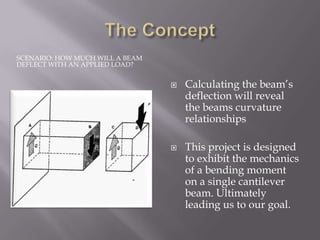
The ConceptScenario: How much will a beam deflect with an applied load?Calculating the beam’s deflection will reveal the beams curvature relationshipsThis project is designed to exhibit the mechanics of a bending moment on a single cantilever beam. Ultimately leading us to our goal.
Goals & ObjectivesExperimental GoalsHow much will aluminum and brass deflect with various applied loads?Determine the Young’s Modulus based on the deflection measuredDoes our calculated Young’s Modulus equal tabulated values?
Beam Failures
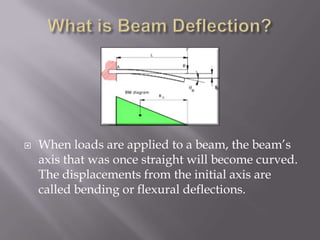
What is Beam Deflection?When loads are applied to a beam, the beam’s axis that was once straight will become curved. The displacements from the initial axis are called bending or flexural deflections.
Apparatus Design & OperationThe beam in use will be fixed onto the standing wooden plank by securing it at the top of the apparatus with a c-clamp.
At the end of the beam there will be an attachment to serve as the applied load.
This experiment used strategically filled water bottles for the applied loads.Apparatus Design & Operation (cont.)The deflection of the beam by the applied load can be recorded at the point of loading.
Cantilever beams are interchangeable allowing for supplemental testing of differing materials & structural make-ups .
Negligible factors:
Load’s tiny distance from free end of member
Small bend in beam after multiple loadsCost Factors Involved
Our Cantilever Beam
Superposition Table
MatLab Codehold on; grid onplot(x/in_m,v2*100,'g-*',x/in_m,v1*100,'ro-',x/in_m,v1*100+v2*100,'b*-')title('Beam Deflection of Brass w/ 0.3lb Load')xlabel('Beam Length (in)')ylabel('Deflection (cm)')legend('DistributedLoad','ConcentratedLoad','Total Deflection',3)V_max=(q*L+F)/(b*h);%Max shear stresssigma_max=(.5*q*L^2+F*L)*(h*0.5)/I;v_max_tot=(v1(end)+v2(end))*100;     %Analysis of Aluminum Beamclose all;clearall;clc%Conversion Factorsin_m=0.0254; %inch to meter lb_N=0.22481;%Pound force to Newton %Material PropertiesE=69*10^9;%Pa Aluminum%Geometric Properties(in SI units)%Al bar datah=(1/8)*in_m;%Cross section heightb=(3/4)*in_m;%Cross sect widthL=15*in_m;%Length of Beam (m)I=(b*h^3)/12; %second momemnt of inertia(m^4)%Analysis of Brass beamclose all;clearall;clc%Conversion Factorsin_m=0.0254; %inch to meter lb_N=0.22481;%Pound force to Newton %Material PropertiesE=100*10^9;%Pa Brass%Geometric Properties(in SI units)%Brass Bar datah=(.064)*in_m;%Cross section heightb=(3/4)*in_m;%Cross sect widthL=9*in_m;%Length of Beam (m)I=(b*h^3)/12; %second momemnt of inertia(m^4)%Applied forceF=(.3)/lb_N; %(N)%Calculating deflectionx=linspace(0,L,50);v1=(F*x.^3/6 - F*L*x.^2/2)/(E*I);%Deflection due to concentrated loadq=79.7*10^-3*9.81/(12*.0254);v2=zeros(1,length(x));for i=1:length(x)v2(i)=-q*x(i)^2/(24*E*I)*(6*L^2-4*L*x(i) + x(i)^2);%Deflection due to weight of barend%Applied forceF=(.3)/lb_N;%Calculating deflection    %Concetrated loadx=linspace(0,L,50);    v1=(F*x.^3/6 - F*L*x.^2/2)/(E*I);%Deflection in (m)    %Distributed weightq=74*10^-3*9.81/(18.5*.0254);    v2=zeros(1,length(x));    for i=1:length(x)     v2(i)=-q*x(i)^2/(24*E*I)*(6*L^2-4*L*x(i) + x(i)^2);    endhold on;grid on;    plot(x/in_m,v1*100,'ro',x/in_m,v2*100,'g*',x/in_m,v1*100+v2*100,'b*')title('Beam Deflection of Aluminum w/ 0.3lb Load')xlabel('Beam Length (in)')ylabel('Deflection (cm)')legend('DistributedLoad','ConcentratedLoad','Total Deflection',3)V_max=(q*L+F)/(b*h)%Max shear stresssigma_max=(.5*q*L^2+F*L)*(h*0.5)/I;v_max_tot=(v1(end)+v2(end))*100;
Experiment Variables Second Moment of Inertia (I) determined by measuring geometry of the beams.
 Calculated Linear Weight Density by weighing the beams on a scale.
 Water bottles with a known mass used to calculate forces applied to the beam.Results – Initial Height
Results – Brass Bar.3 Lbs Force.4 Lbs Force.5 Lbs Force
Results – Aluminum Bar.3 Lbs Force.4 Lbs Force.5 Lbs Force
Experimental ResultsAluminum :Expected Young’s Modulus:69 GPaBrass:Expected Young’s Modulus:100 GPa

Mechanical of Materials

  • 1.
    Mechanics of Materials:Beam DeflectionsEngineered by Group 20 Christopher Webb, Anthony Williams, Carlaton Wong, Jonathan Wong03/03/2010
  • 2.
    The ConceptScenario: Howmuch will a beam deflect with an applied load?Calculating the beam’s deflection will reveal the beams curvature relationshipsThis project is designed to exhibit the mechanics of a bending moment on a single cantilever beam. Ultimately leading us to our goal.
  • 3.
    Goals & ObjectivesExperimentalGoalsHow much will aluminum and brass deflect with various applied loads?Determine the Young’s Modulus based on the deflection measuredDoes our calculated Young’s Modulus equal tabulated values?
  • 4.
  • 5.
    What is BeamDeflection?When loads are applied to a beam, the beam’s axis that was once straight will become curved. The displacements from the initial axis are called bending or flexural deflections.
  • 6.
    Apparatus Design &OperationThe beam in use will be fixed onto the standing wooden plank by securing it at the top of the apparatus with a c-clamp.
  • 7.
    At the endof the beam there will be an attachment to serve as the applied load.
  • 8.
    This experiment usedstrategically filled water bottles for the applied loads.Apparatus Design & Operation (cont.)The deflection of the beam by the applied load can be recorded at the point of loading.
  • 9.
    Cantilever beams areinterchangeable allowing for supplemental testing of differing materials & structural make-ups .
  • 10.
  • 11.
    Load’s tiny distancefrom free end of member
  • 12.
    Small bend inbeam after multiple loadsCost Factors Involved
  • 13.
  • 14.
  • 15.
    MatLab Codehold on;grid onplot(x/in_m,v2*100,'g-*',x/in_m,v1*100,'ro-',x/in_m,v1*100+v2*100,'b*-')title('Beam Deflection of Brass w/ 0.3lb Load')xlabel('Beam Length (in)')ylabel('Deflection (cm)')legend('DistributedLoad','ConcentratedLoad','Total Deflection',3)V_max=(q*L+F)/(b*h);%Max shear stresssigma_max=(.5*q*L^2+F*L)*(h*0.5)/I;v_max_tot=(v1(end)+v2(end))*100;     %Analysis of Aluminum Beamclose all;clearall;clc%Conversion Factorsin_m=0.0254; %inch to meter lb_N=0.22481;%Pound force to Newton %Material PropertiesE=69*10^9;%Pa Aluminum%Geometric Properties(in SI units)%Al bar datah=(1/8)*in_m;%Cross section heightb=(3/4)*in_m;%Cross sect widthL=15*in_m;%Length of Beam (m)I=(b*h^3)/12; %second momemnt of inertia(m^4)%Analysis of Brass beamclose all;clearall;clc%Conversion Factorsin_m=0.0254; %inch to meter lb_N=0.22481;%Pound force to Newton %Material PropertiesE=100*10^9;%Pa Brass%Geometric Properties(in SI units)%Brass Bar datah=(.064)*in_m;%Cross section heightb=(3/4)*in_m;%Cross sect widthL=9*in_m;%Length of Beam (m)I=(b*h^3)/12; %second momemnt of inertia(m^4)%Applied forceF=(.3)/lb_N; %(N)%Calculating deflectionx=linspace(0,L,50);v1=(F*x.^3/6 - F*L*x.^2/2)/(E*I);%Deflection due to concentrated loadq=79.7*10^-3*9.81/(12*.0254);v2=zeros(1,length(x));for i=1:length(x)v2(i)=-q*x(i)^2/(24*E*I)*(6*L^2-4*L*x(i) + x(i)^2);%Deflection due to weight of barend%Applied forceF=(.3)/lb_N;%Calculating deflection %Concetrated loadx=linspace(0,L,50); v1=(F*x.^3/6 - F*L*x.^2/2)/(E*I);%Deflection in (m) %Distributed weightq=74*10^-3*9.81/(18.5*.0254); v2=zeros(1,length(x)); for i=1:length(x) v2(i)=-q*x(i)^2/(24*E*I)*(6*L^2-4*L*x(i) + x(i)^2); endhold on;grid on; plot(x/in_m,v1*100,'ro',x/in_m,v2*100,'g*',x/in_m,v1*100+v2*100,'b*')title('Beam Deflection of Aluminum w/ 0.3lb Load')xlabel('Beam Length (in)')ylabel('Deflection (cm)')legend('DistributedLoad','ConcentratedLoad','Total Deflection',3)V_max=(q*L+F)/(b*h)%Max shear stresssigma_max=(.5*q*L^2+F*L)*(h*0.5)/I;v_max_tot=(v1(end)+v2(end))*100;
  • 17.
    Experiment Variables SecondMoment of Inertia (I) determined by measuring geometry of the beams.
  • 18.
    Calculated LinearWeight Density by weighing the beams on a scale.
  • 19.
    Water bottleswith a known mass used to calculate forces applied to the beam.Results – Initial Height
  • 20.
    Results – BrassBar.3 Lbs Force.4 Lbs Force.5 Lbs Force
  • 21.
    Results – AluminumBar.3 Lbs Force.4 Lbs Force.5 Lbs Force
  • 22.
    Experimental ResultsAluminum :ExpectedYoung’s Modulus:69 GPaBrass:Expected Young’s Modulus:100 GPa