Ashis Kumar Samal Int. Journal of Engineering Research and Applications www.ijera.com
ISSN: 2248-9622, Vol. 6, Issue 1, (Part - 4) January 2016, pp.119-126
www.ijera.com 119|P a g e
Analysis of Stress and Deflection of Cantilever Beam and its
Validation Using ANSYS
Ashis Kumar Samal, T. Eswara Rao
Abstract
This study investigates the deflection and stress distribution in a long, slender cantilever beam of uniform
rectangular cross section made of linear elastic material properties that are homogeneous and isotropic. The
deflection of a cantilever beam is essentially a three dimensional problem. An elastic stretching in one direction
is accompanied by a compression in perpendicular directions. The beam is modeled under the action of three
different loading conditions: vertical concentrated
load applied at the free end, uniformly distributed load and uniformly varying load which runs over the whole
span. The weight of the beam is assumed to be negligible. It is also assumed that the beam is inextensible and so
the strains are also negligible. Considering this assumptions at first using the Bernoulli-Euler’s bending-
moment curvature relationship, the approximate solutions of the cantilever beam was obtained from the general
set of equations. Then assuming a particular set of dimensions, the deflection and stress values of the beam are
calculated analytically. Finite element analysis of the beam was done considering various types of elements
under different loading conditions in ANSYS 14.5. The various numerical results were generated at different
nodal points by taking the origin of the Cartesian coordinate system at the fixed end of the beam. The nodal
solutions were analyzed and compared. On comparing the computational and analytical solutions it was found
that for stresses the 8 node brick element gives the most consistent results and the variation with the analytical
results is minimum.
Keywords: Cantilever, loading, ANSYS, element, Cartesian Coordinate System.
I. Introduction
In this paper cantilever beam [1] has been analyzed.
All the following cases represents statically
determinate beam since the reactions at the support
can be determined from the equation of statics. The
measure to which a structural member gets deviated
from the initial position is called deflection. The
deflected distance of a member under a load is
directly related to the slope of the deflected shape of
the member under that load. While the beam gets
deflected under the loads, bending occurs in the same
plane due to which stresses are developed. Here the
deflection of the beam element is calculated by using
the Euler-Bernoulli’s beam equation [2] and the
bending stresses using the general standard bending
equation analytically. ANSYS [3] has been used to
do the computational analysis. It is general purpose
finite element analysis [4] software which enables the
product development process at less computational
and financial expenditure. Researchers [5-9] have
used Ansys for the calculation and validation of
experimental results.
II. Theoretical Calculations
First a uniform rectangular cross-sectional beam of
linear elastic isotropic homogeneous material has
been considered. The beam is taken mass less and
inextensible hence have developed no strains. It is
subjected to a vertical point load at the tip of its free
end and the differential equation is developed
mathematically. Similarly it is done with the same
value of uniformly distributed load and uniformly
varying load over the whole span. Using the
Bernoulli-Euler’s elastic curve equation [1] the
following relationship is obtained:
EI (d2
y/dx2) =M (1)
Where E is modulus of elasticity which is of constant
value.
I is moment of inertia=bh3
/12, b=width of beam,
h=height of beam.
M=moment developed.
Case 1: Cantilever beam of length L subjected to a
vertical point load ‘F’ at its free end .
Fig. 1: Cantilever with vertical load at free end
The B.M equation at section X-X at a distance x from
fixed end is given by:
Eid2
y/dx2= -F(L-x) (2)
On integrating and solving the above eq. with
required boundary conditions we get the downward
deflection of beam as: FL3
/3 EI .
RESEARCH ARTICLE OPEN ACCESS
Ashis Kumar Samal Int. Journal of Engineering Research and Applications www.ijera.com
ISSN: 2248-9622, Vol. 6, Issue 1, (Part - 4) January 2016, pp.119-126
www.ijera.com 120|P a g e
Assuming L=100m,
b=10m,h=10m,ν=0.3,E=2×10⁵
N/m, F=500N.
Analytic Deflection, sB= 1.000004 m.
Using the equation: (M/I) = (E/R) = (s/Y), Analytic
Stress developed sB=300N/m2
Case 2: Cantilever beam subjected to a uniformly
distributed load ‘q’ per unit run over the whole
length.
Fig. 2: Cantilever with Uniformly distributed load.
The B.M equation at section X-X at a distance x from
fixed end is given by
EId2
y/dx2
= -W/2(L-x)2
(3)
On integrating and solving the above eq. with
required boundary conditions we get
the downward deflection of beam as : qL4
/8EI.
Assuming
L=100m,b=10m,h=10m,ν=0.3,E=2×10,F=500N
Deflection, dB= 37.5 m.
Using the equation: (M/I)=(E/R)=(s/Y), Stress
developed s5N/m2,sB=150 N/m2
Case 3: Cantilever beam subjected to a uniformly
varying load ‘q0 ’per unit run over the whole length.
Fig. 3: Cantilever with Uniformly varying load.
The B.M equation at section X-X at a distance x from
fixed end is given by:
EId2
y/dx2= -qo(L-x)3
/6L
(4)
On integrating and solving the above eq. with
required boundary conditions we get the downward
deflection of beam as: 11qoL4/120EI.
Assuming
L=100m,b=10m,h=10m,ν=0.3,E=2×10N/m,F=500N.
Deflection, dB= 27.5 m.
Case 2: Cantilever beam subjected to a uniformly
distributed load ‘q’ per unit run over the whole
length.
III. Computational Results
Case 1: Cantilever beam of length L subjected to a
vertical point load ‘F’ at its free end
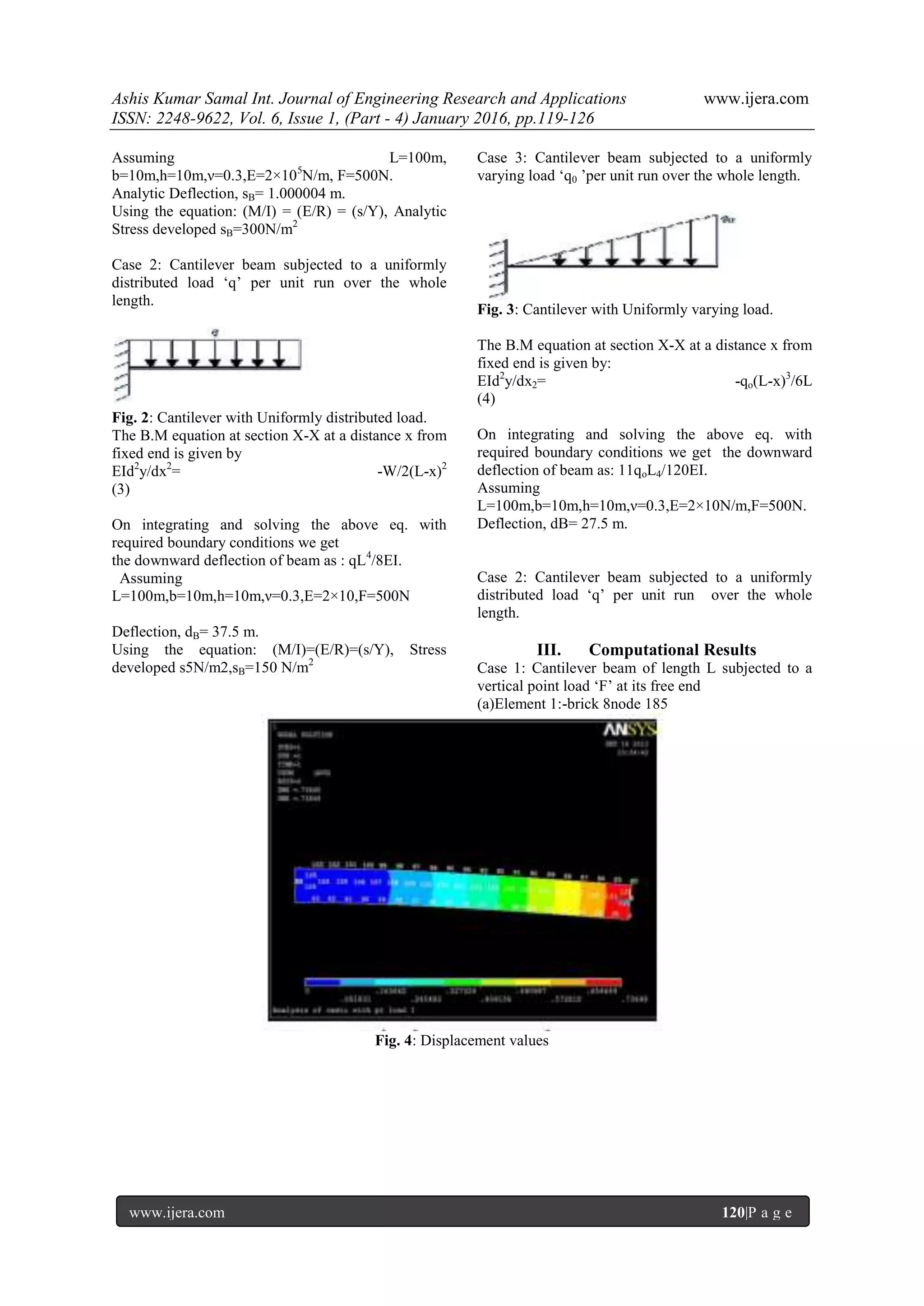
(a)Element 1:-brick 8node 185
Fig. 4: Displacement values
Ashis Kumar Samal Int. Journal of Engineering Research and Applications www.ijera.com
ISSN: 2248-9622, Vol. 6, Issue 1, (Part - 4) January 2016, pp.119-126
www.ijera.com 121|P a g e
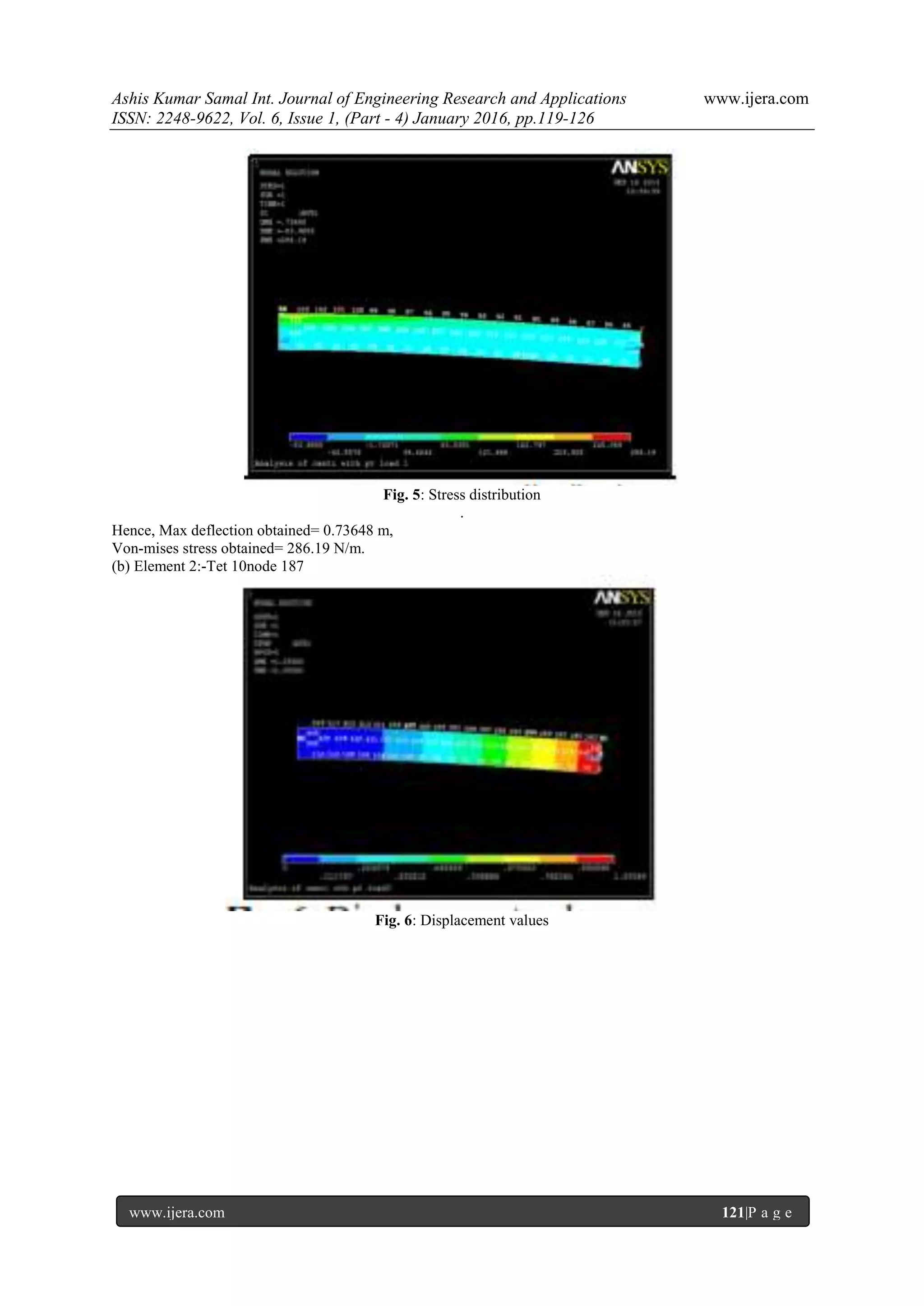
Fig. 5: Stress distribution
.
Hence, Max deflection obtained= 0.73648 m,
Von-mises stress obtained= 286.19 N/m.
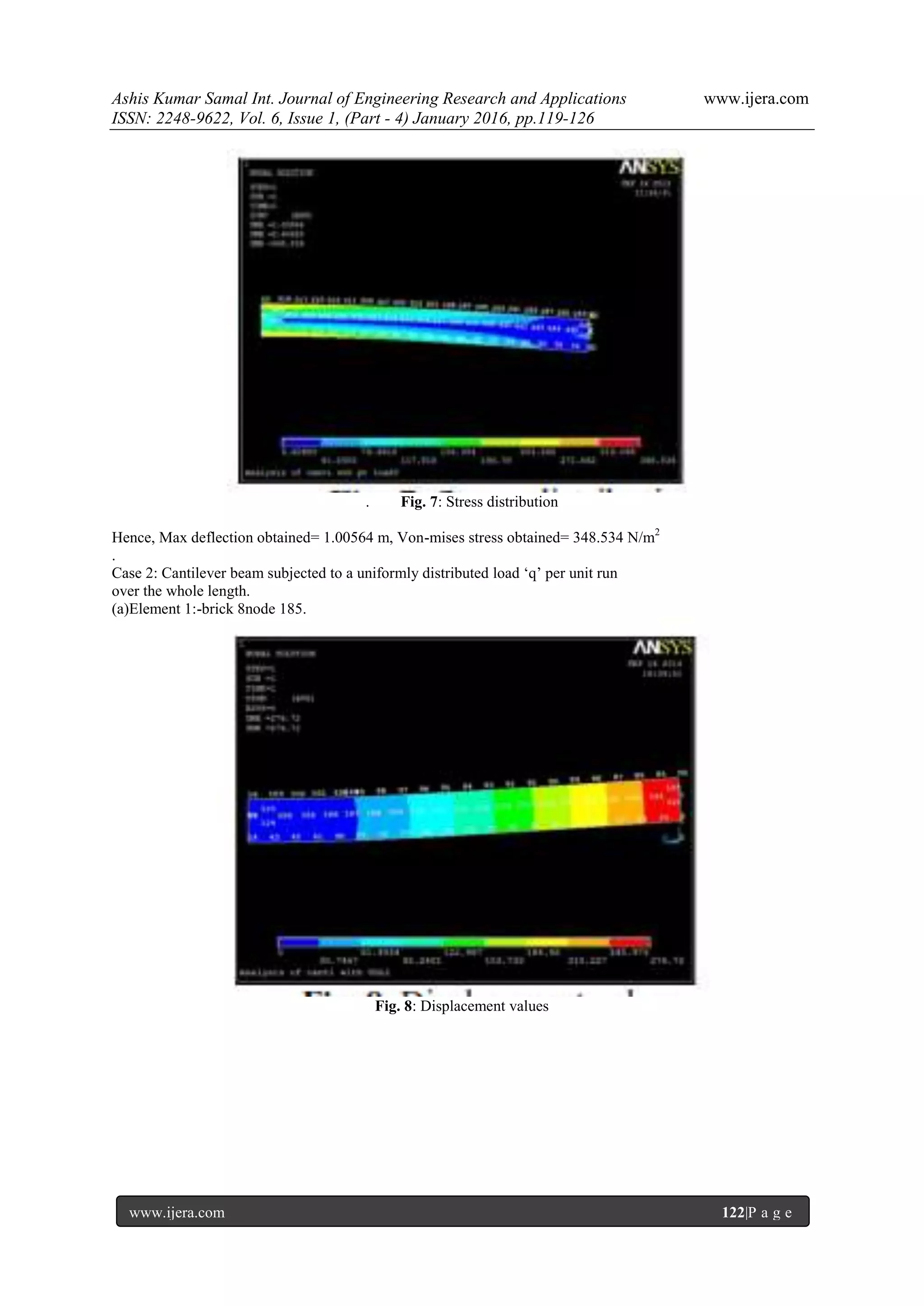
(b) Element 2:-Tet 10node 187
Fig. 6: Displacement values
Ashis Kumar Samal Int. Journal of Engineering Research and Applications www.ijera.com
ISSN: 2248-9622, Vol. 6, Issue 1, (Part - 4) January 2016, pp.119-126
www.ijera.com 122|P a g e
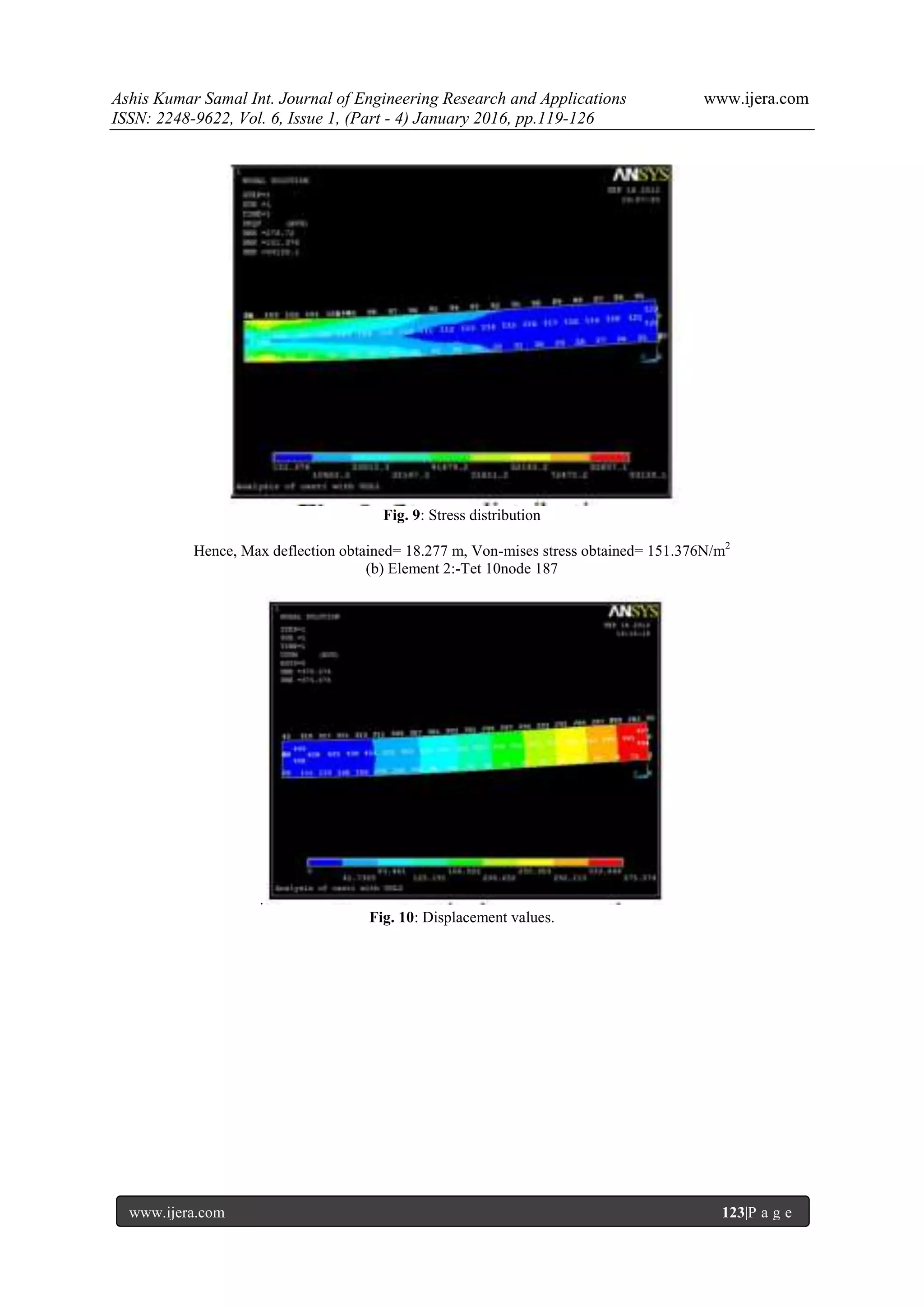
. Fig. 7: Stress distribution
Hence, Max deflection obtained= 1.00564 m, Von-mises stress obtained= 348.534 N/m2
.
Case 2: Cantilever beam subjected to a uniformly distributed load ‘q’ per unit run
over the whole length.
(a)Element 1:-brick 8node 185.
Fig. 8: Displacement values
Ashis Kumar Samal Int. Journal of Engineering Research and Applications www.ijera.com
ISSN: 2248-9622, Vol. 6, Issue 1, (Part - 4) January 2016, pp.119-126
www.ijera.com 123|P a g e
Fig. 9: Stress distribution
Hence, Max deflection obtained= 18.277 m, Von-mises stress obtained= 151.376N/m2
(b) Element 2:-Tet 10node 187
.
Fig. 10: Displacement values.
Ashis Kumar Samal Int. Journal of Engineering Research and Applications www.ijera.com
ISSN: 2248-9622, Vol. 6, Issue 1, (Part - 4) January 2016, pp.119-126
www.ijera.com 124|P a g e
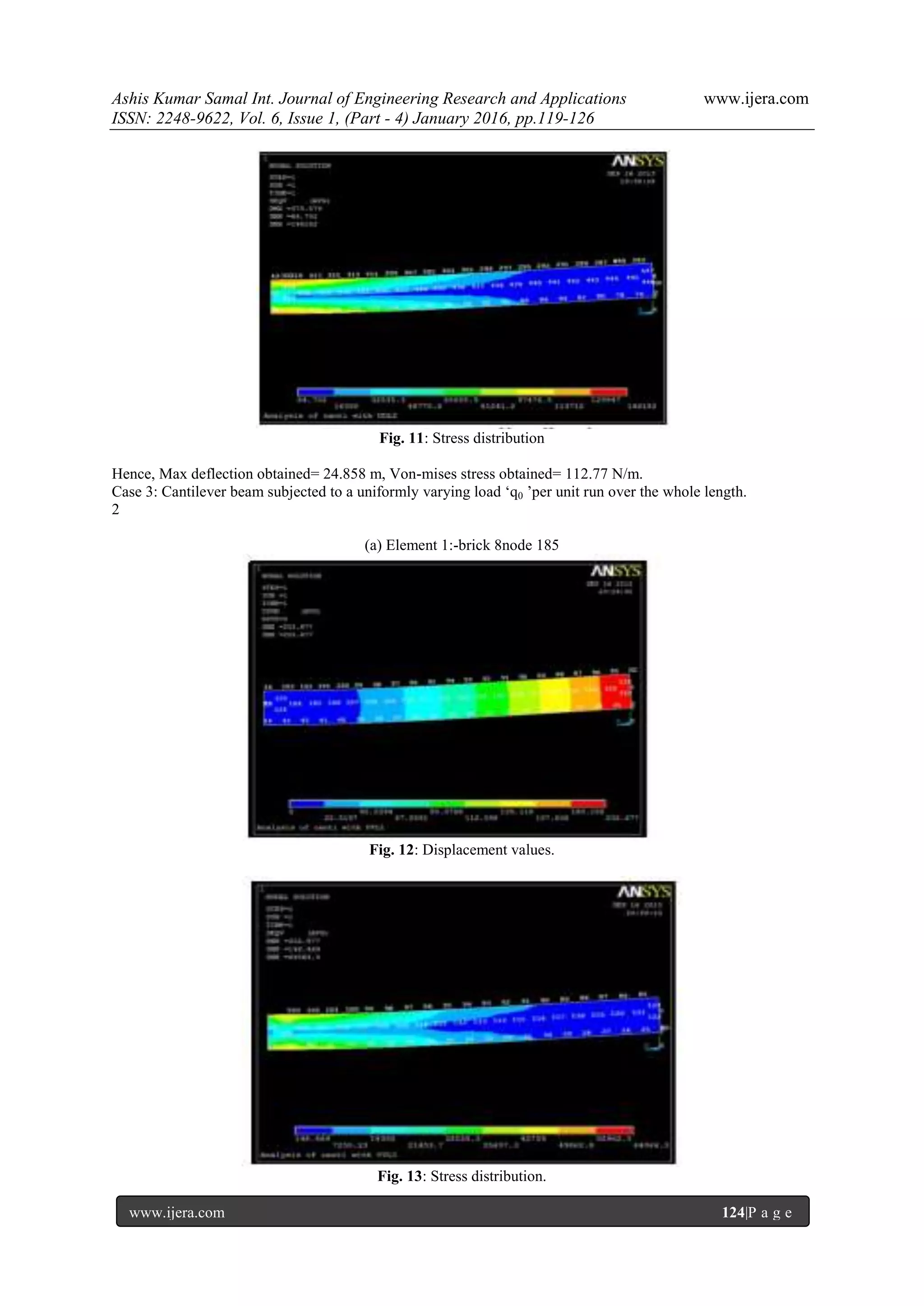
Fig. 11: Stress distribution
Hence, Max deflection obtained= 24.858 m, Von-mises stress obtained= 112.77 N/m.
Case 3: Cantilever beam subjected to a uniformly varying load ‘q0 ’per unit run over the whole length.
2
(a) Element 1:-brick 8node 185
Fig. 12: Displacement values.
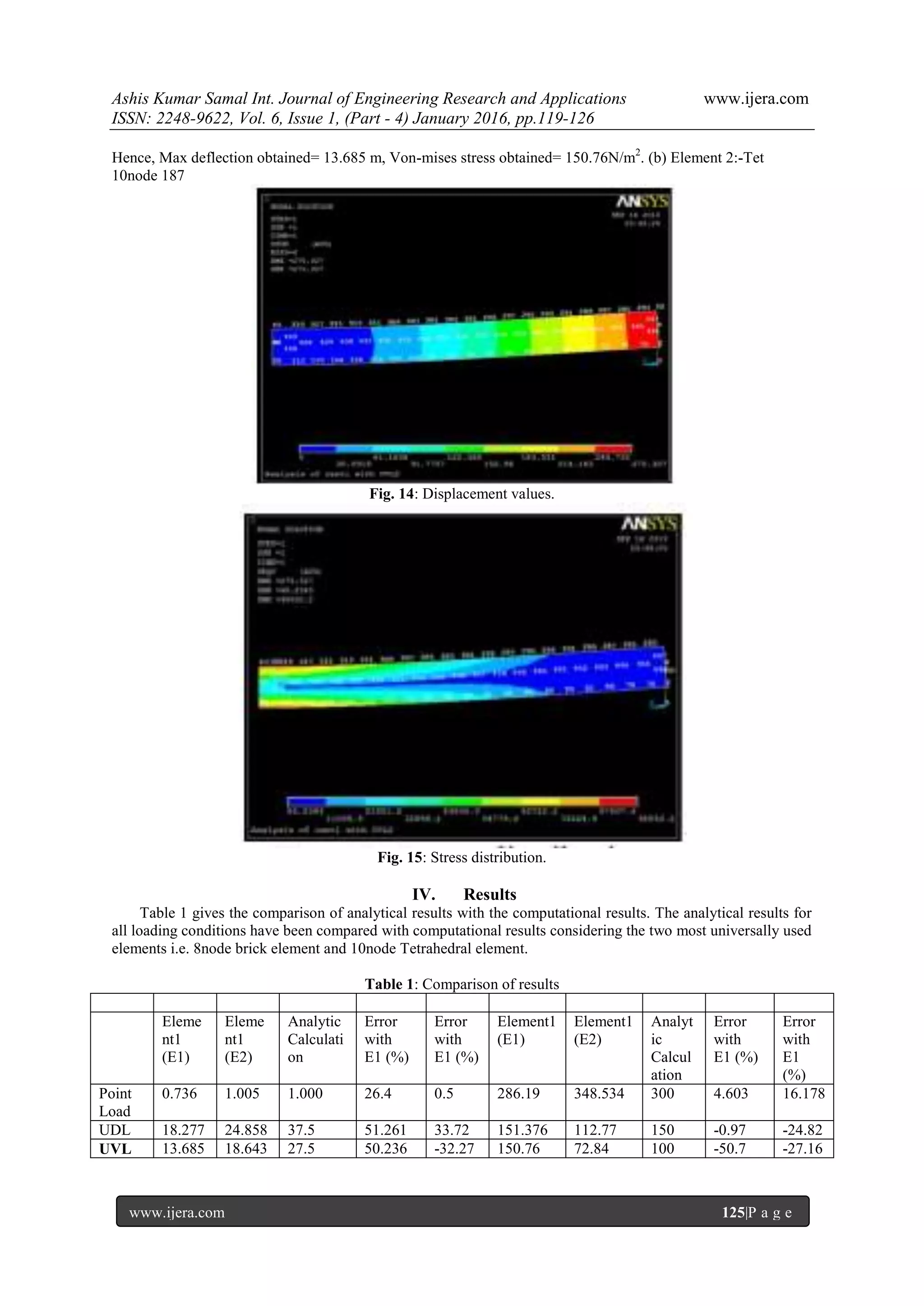
Fig. 13: Stress distribution.
Ashis Kumar Samal Int. Journal of Engineering Research and Applications www.ijera.com
ISSN: 2248-9622, Vol. 6, Issue 1, (Part - 4) January 2016, pp.119-126
www.ijera.com 125|P a g e
Hence, Max deflection obtained= 13.685 m, Von-mises stress obtained= 150.76N/m2
. (b) Element 2:-Tet
10node 187
Fig. 14: Displacement values.
Fig. 15: Stress distribution.
IV. Results
Table 1 gives the comparison of analytical results with the computational results. The analytical results for
all loading conditions have been compared with computational results considering the two most universally used
elements i.e. 8node brick element and 10node Tetrahedral element.
Table 1: Comparison of results
Eleme
nt1
(E1)
Eleme
nt1
(E2)
Analytic
Calculati
on
Error
with
E1 (%)
Error
with
E1 (%)
Element1
(E1)
Element1
(E2)
Analyt
ic
Calcul
ation
Error
with
E1 (%)
Error
with
E1
(%)
Point
Load
0.736 1.005 1.000 26.4 0.5 286.19 348.534 300 4.603 16.178
UDL 18.277 24.858 37.5 51.261 33.72 151.376 112.77 150 -0.97 -24.82
UVL 13.685 18.643 27.5 50.236 -32.27 150.76 72.84 100 -50.7 -27.16
Ashis Kumar Samal Int. Journal of Engineering Research and Applications www.ijera.com
ISSN: 2248-9622, Vol. 6, Issue 1, (Part - 4) January 2016, pp.119-126
www.ijera.com 126|P a g e
V. Conclusions:
From the above table it can be concluded that
using Ansys the deflection is more accurate when
element 2 i.e. 10node Tetrahedral element is used but
for stresses 8node brick element gives a better results.
Hence for determination of deflection 10node
Tetrahedral element should be used whereas for
stresses 8node brick element is more appropriate.
References:
[1] Hool, George A.; Johnson, Nathan Clarke
(1920). "Elements of Structural Theory -
Definitions". Handbook of Building
Construction (Google Books).vol. 1 (1st
ed.).New York McGraw-Hill. p. 2.
Retrieved 2008-10-01. "A cantilever beam is
a beam having one end rigidly fixed and the
other end free."
[2] Timoshenko, S., (1953), History of strength
of materials, McGraw-Hill New York.
[3] ANSYS.11.0 documentation.
[4] Strang, Gilbert; Fix, George (1973). An
Analysis of The Finite Element Method.
Prentice Hall. ISBN 0-13-032946-0.
[5] Timoshenko, S.P. and D.H. Young.
Elements of Strength of Materials, 5th
edition. (MKS System).
[6 ] Babuška, Ivo; Banerjee, Uday; Osborn,
John E. (June 2004). "Generalized Finite
Element Methods: Main Ideas, Results, and
Perspective".International Journal of
Computational Methods 1 (1): 67–103.
doi:10.1142/S0219876204000083].
[7] E.A. Witmer (1991-1992). "Elementary
Bernoulli-Euler Beam Theory". MIT
Unified Engineering Course Notes.
[8] Ballarini, Roberto (April 18, 2003). "The Da
Vinci-Euler-Bernoulli Beam Theory?".
Mechanical Engineering Magazine Online.
Retrieved 2006-07-22.
[9] Truesdell, C., (1960), The rational
mechanics of flexible or elastic bodies 1638-
1788, Venditioni Exponunt Orell Fussli
Turici.

Analysis of Stress and Deflection of Cantilever Beam and its Validation Using ANSYS

  • 1.
    Ashis Kumar SamalInt. Journal of Engineering Research and Applications www.ijera.com ISSN: 2248-9622, Vol. 6, Issue 1, (Part - 4) January 2016, pp.119-126 www.ijera.com 119|P a g e Analysis of Stress and Deflection of Cantilever Beam and its Validation Using ANSYS Ashis Kumar Samal, T. Eswara Rao Abstract This study investigates the deflection and stress distribution in a long, slender cantilever beam of uniform rectangular cross section made of linear elastic material properties that are homogeneous and isotropic. The deflection of a cantilever beam is essentially a three dimensional problem. An elastic stretching in one direction is accompanied by a compression in perpendicular directions. The beam is modeled under the action of three different loading conditions: vertical concentrated load applied at the free end, uniformly distributed load and uniformly varying load which runs over the whole span. The weight of the beam is assumed to be negligible. It is also assumed that the beam is inextensible and so the strains are also negligible. Considering this assumptions at first using the Bernoulli-Euler’s bending- moment curvature relationship, the approximate solutions of the cantilever beam was obtained from the general set of equations. Then assuming a particular set of dimensions, the deflection and stress values of the beam are calculated analytically. Finite element analysis of the beam was done considering various types of elements under different loading conditions in ANSYS 14.5. The various numerical results were generated at different nodal points by taking the origin of the Cartesian coordinate system at the fixed end of the beam. The nodal solutions were analyzed and compared. On comparing the computational and analytical solutions it was found that for stresses the 8 node brick element gives the most consistent results and the variation with the analytical results is minimum. Keywords: Cantilever, loading, ANSYS, element, Cartesian Coordinate System. I. Introduction In this paper cantilever beam [1] has been analyzed. All the following cases represents statically determinate beam since the reactions at the support can be determined from the equation of statics. The measure to which a structural member gets deviated from the initial position is called deflection. The deflected distance of a member under a load is directly related to the slope of the deflected shape of the member under that load. While the beam gets deflected under the loads, bending occurs in the same plane due to which stresses are developed. Here the deflection of the beam element is calculated by using the Euler-Bernoulli’s beam equation [2] and the bending stresses using the general standard bending equation analytically. ANSYS [3] has been used to do the computational analysis. It is general purpose finite element analysis [4] software which enables the product development process at less computational and financial expenditure. Researchers [5-9] have used Ansys for the calculation and validation of experimental results. II. Theoretical Calculations First a uniform rectangular cross-sectional beam of linear elastic isotropic homogeneous material has been considered. The beam is taken mass less and inextensible hence have developed no strains. It is subjected to a vertical point load at the tip of its free end and the differential equation is developed mathematically. Similarly it is done with the same value of uniformly distributed load and uniformly varying load over the whole span. Using the Bernoulli-Euler’s elastic curve equation [1] the following relationship is obtained: EI (d2 y/dx2) =M (1) Where E is modulus of elasticity which is of constant value. I is moment of inertia=bh3 /12, b=width of beam, h=height of beam. M=moment developed. Case 1: Cantilever beam of length L subjected to a vertical point load ‘F’ at its free end . Fig. 1: Cantilever with vertical load at free end The B.M equation at section X-X at a distance x from fixed end is given by: Eid2 y/dx2= -F(L-x) (2) On integrating and solving the above eq. with required boundary conditions we get the downward deflection of beam as: FL3 /3 EI . RESEARCH ARTICLE OPEN ACCESS
  • 2.
    Ashis Kumar SamalInt. Journal of Engineering Research and Applications www.ijera.com ISSN: 2248-9622, Vol. 6, Issue 1, (Part - 4) January 2016, pp.119-126 www.ijera.com 120|P a g e Assuming L=100m, b=10m,h=10m,ν=0.3,E=2×10⁵ N/m, F=500N. Analytic Deflection, sB= 1.000004 m. Using the equation: (M/I) = (E/R) = (s/Y), Analytic Stress developed sB=300N/m2 Case 2: Cantilever beam subjected to a uniformly distributed load ‘q’ per unit run over the whole length. Fig. 2: Cantilever with Uniformly distributed load. The B.M equation at section X-X at a distance x from fixed end is given by EId2 y/dx2 = -W/2(L-x)2 (3) On integrating and solving the above eq. with required boundary conditions we get the downward deflection of beam as : qL4 /8EI. Assuming L=100m,b=10m,h=10m,ν=0.3,E=2×10,F=500N Deflection, dB= 37.5 m. Using the equation: (M/I)=(E/R)=(s/Y), Stress developed s5N/m2,sB=150 N/m2 Case 3: Cantilever beam subjected to a uniformly varying load ‘q0 ’per unit run over the whole length. Fig. 3: Cantilever with Uniformly varying load. The B.M equation at section X-X at a distance x from fixed end is given by: EId2 y/dx2= -qo(L-x)3 /6L (4) On integrating and solving the above eq. with required boundary conditions we get the downward deflection of beam as: 11qoL4/120EI. Assuming L=100m,b=10m,h=10m,ν=0.3,E=2×10N/m,F=500N. Deflection, dB= 27.5 m. Case 2: Cantilever beam subjected to a uniformly distributed load ‘q’ per unit run over the whole length. III. Computational Results Case 1: Cantilever beam of length L subjected to a vertical point load ‘F’ at its free end (a)Element 1:-brick 8node 185 Fig. 4: Displacement values
  • 3.
    Ashis Kumar SamalInt. Journal of Engineering Research and Applications www.ijera.com ISSN: 2248-9622, Vol. 6, Issue 1, (Part - 4) January 2016, pp.119-126 www.ijera.com 121|P a g e Fig. 5: Stress distribution . Hence, Max deflection obtained= 0.73648 m, Von-mises stress obtained= 286.19 N/m. (b) Element 2:-Tet 10node 187 Fig. 6: Displacement values
  • 4.
    Ashis Kumar SamalInt. Journal of Engineering Research and Applications www.ijera.com ISSN: 2248-9622, Vol. 6, Issue 1, (Part - 4) January 2016, pp.119-126 www.ijera.com 122|P a g e . Fig. 7: Stress distribution Hence, Max deflection obtained= 1.00564 m, Von-mises stress obtained= 348.534 N/m2 . Case 2: Cantilever beam subjected to a uniformly distributed load ‘q’ per unit run over the whole length. (a)Element 1:-brick 8node 185. Fig. 8: Displacement values
  • 5.
    Ashis Kumar SamalInt. Journal of Engineering Research and Applications www.ijera.com ISSN: 2248-9622, Vol. 6, Issue 1, (Part - 4) January 2016, pp.119-126 www.ijera.com 123|P a g e Fig. 9: Stress distribution Hence, Max deflection obtained= 18.277 m, Von-mises stress obtained= 151.376N/m2 (b) Element 2:-Tet 10node 187 . Fig. 10: Displacement values.
  • 6.
    Ashis Kumar SamalInt. Journal of Engineering Research and Applications www.ijera.com ISSN: 2248-9622, Vol. 6, Issue 1, (Part - 4) January 2016, pp.119-126 www.ijera.com 124|P a g e Fig. 11: Stress distribution Hence, Max deflection obtained= 24.858 m, Von-mises stress obtained= 112.77 N/m. Case 3: Cantilever beam subjected to a uniformly varying load ‘q0 ’per unit run over the whole length. 2 (a) Element 1:-brick 8node 185 Fig. 12: Displacement values. Fig. 13: Stress distribution.
  • 7.
    Ashis Kumar SamalInt. Journal of Engineering Research and Applications www.ijera.com ISSN: 2248-9622, Vol. 6, Issue 1, (Part - 4) January 2016, pp.119-126 www.ijera.com 125|P a g e Hence, Max deflection obtained= 13.685 m, Von-mises stress obtained= 150.76N/m2 . (b) Element 2:-Tet 10node 187 Fig. 14: Displacement values. Fig. 15: Stress distribution. IV. Results Table 1 gives the comparison of analytical results with the computational results. The analytical results for all loading conditions have been compared with computational results considering the two most universally used elements i.e. 8node brick element and 10node Tetrahedral element. Table 1: Comparison of results Eleme nt1 (E1) Eleme nt1 (E2) Analytic Calculati on Error with E1 (%) Error with E1 (%) Element1 (E1) Element1 (E2) Analyt ic Calcul ation Error with E1 (%) Error with E1 (%) Point Load 0.736 1.005 1.000 26.4 0.5 286.19 348.534 300 4.603 16.178 UDL 18.277 24.858 37.5 51.261 33.72 151.376 112.77 150 -0.97 -24.82 UVL 13.685 18.643 27.5 50.236 -32.27 150.76 72.84 100 -50.7 -27.16
  • 8.
    Ashis Kumar SamalInt. Journal of Engineering Research and Applications www.ijera.com ISSN: 2248-9622, Vol. 6, Issue 1, (Part - 4) January 2016, pp.119-126 www.ijera.com 126|P a g e V. Conclusions: From the above table it can be concluded that using Ansys the deflection is more accurate when element 2 i.e. 10node Tetrahedral element is used but for stresses 8node brick element gives a better results. Hence for determination of deflection 10node Tetrahedral element should be used whereas for stresses 8node brick element is more appropriate. References: [1] Hool, George A.; Johnson, Nathan Clarke (1920). "Elements of Structural Theory - Definitions". Handbook of Building Construction (Google Books).vol. 1 (1st ed.).New York McGraw-Hill. p. 2. Retrieved 2008-10-01. "A cantilever beam is a beam having one end rigidly fixed and the other end free." [2] Timoshenko, S., (1953), History of strength of materials, McGraw-Hill New York. [3] ANSYS.11.0 documentation. [4] Strang, Gilbert; Fix, George (1973). An Analysis of The Finite Element Method. Prentice Hall. ISBN 0-13-032946-0. [5] Timoshenko, S.P. and D.H. Young. Elements of Strength of Materials, 5th edition. (MKS System). [6 ] Babuška, Ivo; Banerjee, Uday; Osborn, John E. (June 2004). "Generalized Finite Element Methods: Main Ideas, Results, and Perspective".International Journal of Computational Methods 1 (1): 67–103. doi:10.1142/S0219876204000083]. [7] E.A. Witmer (1991-1992). "Elementary Bernoulli-Euler Beam Theory". MIT Unified Engineering Course Notes. [8] Ballarini, Roberto (April 18, 2003). "The Da Vinci-Euler-Bernoulli Beam Theory?". Mechanical Engineering Magazine Online. Retrieved 2006-07-22. [9] Truesdell, C., (1960), The rational mechanics of flexible or elastic bodies 1638- 1788, Venditioni Exponunt Orell Fussli Turici.