Material Failure Analyses
Instructor: Group Captain Abdul Munem Khan
STRESS STRAIN RELATIONSHIP
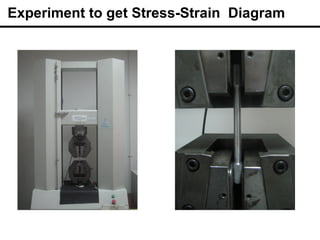
Experiment to get Stress-Strain Diagram
Stress-Strain Diagram
Strain ( ) (e/Lo)
4
1
2
3
5
Stress(F/A)
Elastic
Region
Plastic
Region
Strain
Hardening Fracture
ultimate
tensile
strength
Slope=E
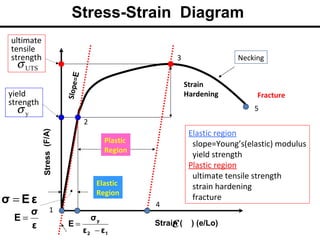
Elastic region
slope=Young’s(elastic) modulus
yield strength
Plastic region
ultimate tensile strength
strain hardening
fracture
Necking
yield
strength
UTSσ
yσ
εEσ =
ε
σ
E =
ε
12
y
εε
σ
E
−
=
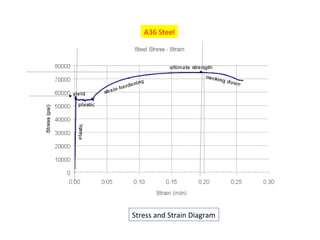
A36 Steel
Stress and Strain Diagram
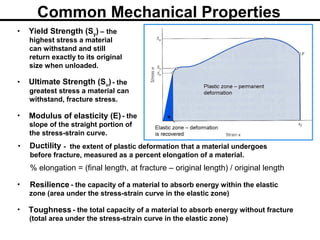
• - the extent of plastic deformation that a material undergoes
before fracture, measured as a percent elongation of a material.
% elongation = (final length, at fracture – original length) / original length
Ductility
Common Mechanical Properties
• – the
highest stress a material
can withstand and still
return exactly to its original
size when unloaded.
Yield Strength (Sy)
• - the
greatest stress a material can
withstand, fracture stress.
Ultimate Strength (Su)
• - the
slope of the straight portion of
the stress-strain curve.
Modulus of elasticity (E)
• - the capacity of a material to absorb energy within the elastic
zone (area under the stress-strain curve in the elastic zone)
Resilience
• - the total capacity of a material to absorb energy without fracture
(total area under the stress-strain curve in the elastic zone)
Toughness
Stress-Strain Diagram (cont)
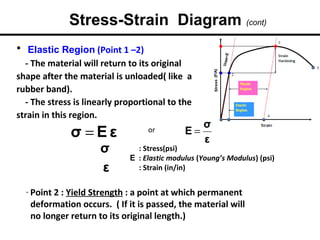
• Elastic Region (Point 1 –2)
- The material will return to its original
shape after the material is unloaded( like a
rubber band).
- The stress is linearly proportional to the
strain in this region.
εEσ =
: Stress(psi)
E : Elastic modulus (Young’s Modulus) (psi)
: Strain (in/in)
σ
ε
- Point 2 : Yield Strength : a point at which permanent
deformation occurs. ( If it is passed, the material will
no longer return to its original length.)
ε
σ
E =or
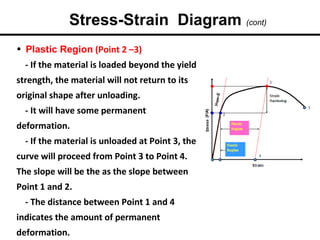
• Plastic Region (Point 2 –3)
- If the material is loaded beyond the yield
strength, the material will not return to its
original shape after unloading.
- It will have some permanent
deformation.
- If the material is unloaded at Point 3, the
curve will proceed from Point 3 to Point 4.
The slope will be the as the slope between
Point 1 and 2.
- The distance between Point 1 and 4
indicates the amount of permanent
deformation.
Stress-Strain Diagram (cont)
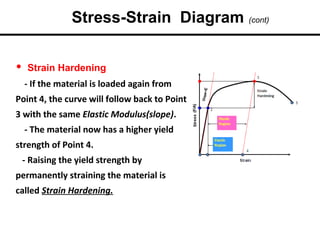
• Strain Hardening
- If the material is loaded again from
Point 4, the curve will follow back to Point
3 with the same Elastic Modulus(slope).
- The material now has a higher yield
strength of Point 4.
- Raising the yield strength by
permanently straining the material is
called Strain Hardening.
Stress-Strain Diagram (cont)
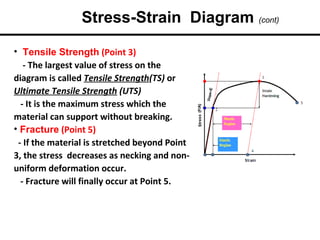
• Tensile Strength (Point 3)
- The largest value of stress on the
diagram is called Tensile Strength(TS) or
Ultimate Tensile Strength (UTS)
- It is the maximum stress which the
material can support without breaking.
• Fracture (Point 5)
- If the material is stretched beyond Point
3, the stress decreases as necking and non-
uniform deformation occur.
- Fracture will finally occur at Point 5.
Stress-Strain Diagram (cont)
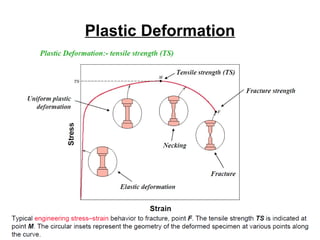
Plastic Deformation
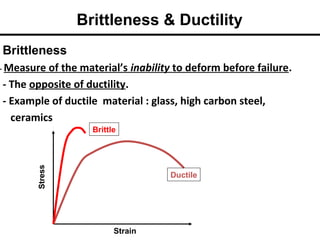
Brittleness & Ductility
Brittleness
- Measure of the material’s inability to deform before failure.
- The opposite of ductility.
- Example of ductile material : glass, high carbon steel,
ceramics
Ductile
Brittle
Stress
Strain
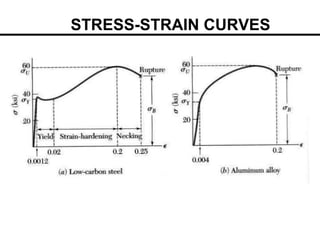
STRESS-STRAIN CURVES
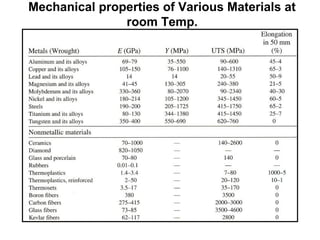
Mechanical properties of Various Materials at
room Temp.
Questions ???Questions ???

4 modulus elastisitas

  • 1.
    Material Failure Analyses Instructor:Group Captain Abdul Munem Khan STRESS STRAIN RELATIONSHIP
  • 2.
    Experiment to getStress-Strain Diagram
  • 3.
    Stress-Strain Diagram Strain () (e/Lo) 4 1 2 3 5 Stress(F/A) Elastic Region Plastic Region Strain Hardening Fracture ultimate tensile strength Slope=E Elastic region slope=Young’s(elastic) modulus yield strength Plastic region ultimate tensile strength strain hardening fracture Necking yield strength UTSσ yσ εEσ = ε σ E = ε 12 y εε σ E − =
  • 4.
    A36 Steel Stress andStrain Diagram
  • 5.
    • - theextent of plastic deformation that a material undergoes before fracture, measured as a percent elongation of a material. % elongation = (final length, at fracture – original length) / original length Ductility Common Mechanical Properties • – the highest stress a material can withstand and still return exactly to its original size when unloaded. Yield Strength (Sy) • - the greatest stress a material can withstand, fracture stress. Ultimate Strength (Su) • - the slope of the straight portion of the stress-strain curve. Modulus of elasticity (E) • - the capacity of a material to absorb energy within the elastic zone (area under the stress-strain curve in the elastic zone) Resilience • - the total capacity of a material to absorb energy without fracture (total area under the stress-strain curve in the elastic zone) Toughness
  • 6.
    Stress-Strain Diagram (cont) •Elastic Region (Point 1 –2) - The material will return to its original shape after the material is unloaded( like a rubber band). - The stress is linearly proportional to the strain in this region. εEσ = : Stress(psi) E : Elastic modulus (Young’s Modulus) (psi) : Strain (in/in) σ ε - Point 2 : Yield Strength : a point at which permanent deformation occurs. ( If it is passed, the material will no longer return to its original length.) ε σ E =or
  • 7.
    • Plastic Region(Point 2 –3) - If the material is loaded beyond the yield strength, the material will not return to its original shape after unloading. - It will have some permanent deformation. - If the material is unloaded at Point 3, the curve will proceed from Point 3 to Point 4. The slope will be the as the slope between Point 1 and 2. - The distance between Point 1 and 4 indicates the amount of permanent deformation. Stress-Strain Diagram (cont)
  • 8.
    • Strain Hardening -If the material is loaded again from Point 4, the curve will follow back to Point 3 with the same Elastic Modulus(slope). - The material now has a higher yield strength of Point 4. - Raising the yield strength by permanently straining the material is called Strain Hardening. Stress-Strain Diagram (cont)
  • 9.
    • Tensile Strength(Point 3) - The largest value of stress on the diagram is called Tensile Strength(TS) or Ultimate Tensile Strength (UTS) - It is the maximum stress which the material can support without breaking. • Fracture (Point 5) - If the material is stretched beyond Point 3, the stress decreases as necking and non- uniform deformation occur. - Fracture will finally occur at Point 5. Stress-Strain Diagram (cont)
  • 10.
  • 11.
    Brittleness & Ductility Brittleness -Measure of the material’s inability to deform before failure. - The opposite of ductility. - Example of ductile material : glass, high carbon steel, ceramics Ductile Brittle Stress Strain
  • 12.
  • 13.
    Mechanical properties ofVarious Materials at room Temp.
  • 14.