International Journal of Technical Research and Applications e-ISSN: 2320-8163,
www.ijtra.com Volume 3, Issue 1 (Jan-Feb 2015), PP. 141-144
141 | P a g e
INVESTIGATION OF STRESSES IN CANTILEVER
BEAM BY FEM AND ITS EXPERIMENTAL
VERIFICATION
1V.B.Jadhao, 2R. B. Charde, 3S.M.Dhengle
1
Department of Mech. Engg, Govt.Polytechnic, Gadchiroli-442605, Maharashtra, India.
2, 3
Department of Mech. Engg, Shri Sai Polytechnic, Chandrapur – 442401, Maharashtra, India.
1
Jadhao_vb@rediffmail.com, 2
charderaju@yahoo.com, 3
sanjay.dhengle76@gmail.com
Abstract - The main objective of this study is to
verification of stresses developed in cantilever beam. The
maximum stress is induced in the cantilever beam is at support
and failure of beam takes place at support .Hence in this work
evaluation of stresses in cantilever beam over a span is studied
using finite element method and strain gauge technique. The
stress and deflection analysis at different section is carried out.
The result of finite element method is verified with
experimental and analytical solution.
Keywords: Cantilever plate; FEM; Strain gauge; Static
loading.
I. INTRODUCTION
While analysis of stresses in cantilever beam we are
using three technique i.e. analytical analysis, FEM analysis
and experimental analysis.
The mild steel flat plate having cross section 25×5 mm
and 395mm in length used as a beam. This beam is fixed at
one end and load is applied at other end. In analytical
analysis load of 1.256kg (load with pan load) is applied at
the end of beam and stresses at a distance of 15mm,
115mm,215mm, 315mm from support is calculated with the
help of empirical relation and also calculate the tip
deflection with different load range.
In experimental technique, load is applied at the end of
beam having 1.256 kg (load with pan load) the strain gauges
are located at a distance of 15mm, 115mm , 215mm, &
315mm from the support. We are observing o/p voltage in
strain gauges and see the effect of stress and strain at a
required position of strain gauge over a cantilever beam at
different load.
In FEM technique using ANSYS 11 software again
similar load is applied on cantilever beam and observe the
effect of loading at a distance of 15mm , 115mm , 215mm
and 315mm from fixed end for the load ranges from 1.256
to 5.256 kg at a difference of 1kg.
II. METHODOLOGIES
A. Experimental analysis
In experimental analysis, actual prototype is considered
under static load. A metal foil gauge having resistance 120Ω
and gauge factor 2.0 is used for the strain measurement. The
instrumentation is developed for this work the
instrumentation measure only change in resistance i.e. ∆ R.
This change in resistance in mili volts is converting into
voltage with the help of Wheatstone bridge circuit and
digital multimeter. The four strain gauge are located on a
cantilever plate. The strain gauge no. 1, 2, 3 & 4 are located
at a distance of 15mm, 115mm, 215mm, & 315mm
respectively from the fixed support. The one end of the plate
is fixed and load pan is clamped with help of J bolt at other
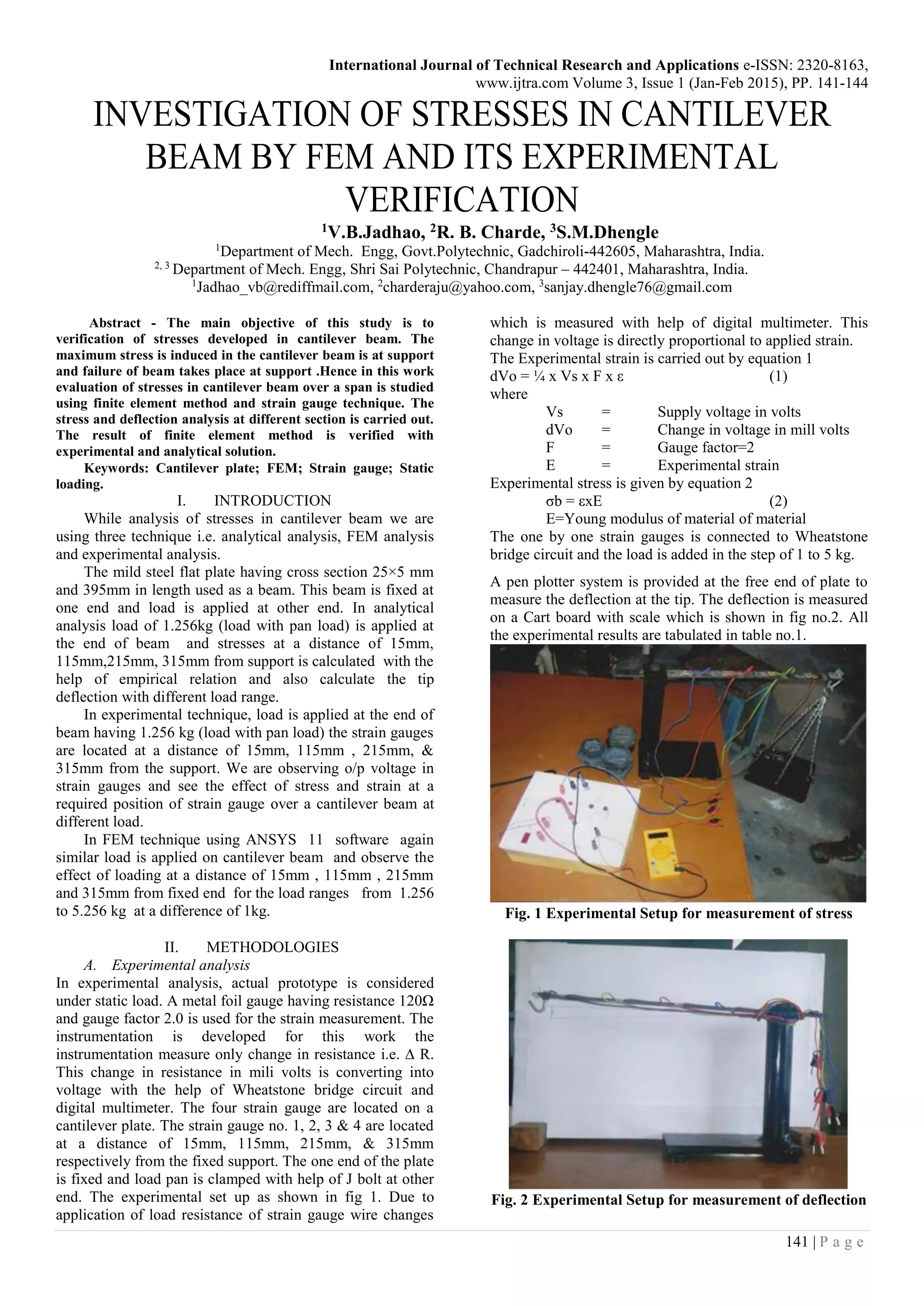
end. The experimental set up as shown in fig 1. Due to
application of load resistance of strain gauge wire changes
which is measured with help of digital multimeter. This
change in voltage is directly proportional to applied strain.
The Experimental strain is carried out by equation 1
dVo = ¼ x Vs x F x ε (1)
where
Vs = Supply voltage in volts
dVo = Change in voltage in mill volts
F = Gauge factor=2
Ε = Experimental strain
Experimental stress is given by equation 2
σb = εxE (2)
E=Young modulus of material of material
The one by one strain gauges is connected to Wheatstone
bridge circuit and the load is added in the step of 1 to 5 kg.
A pen plotter system is provided at the free end of plate to
measure the deflection at the tip. The deflection is measured
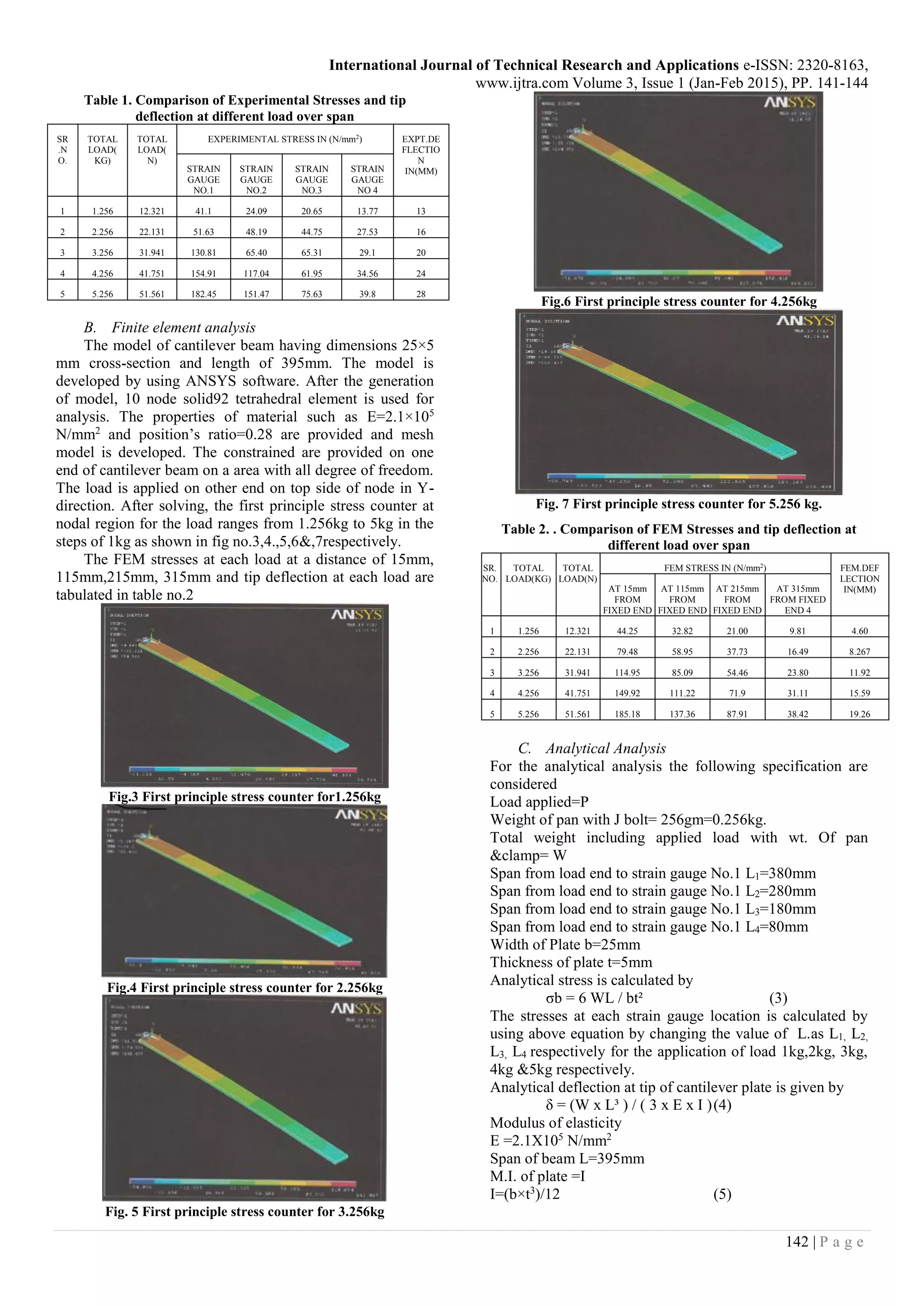
on a Cart board with scale which is shown in fig no.2. All
the experimental results are tabulated in table no.1.
Fig. 1 Experimental Setup for measurement of stress
Fig. 2 Experimental Setup for measurement of deflection
International Journal of Technical Research and Applications e-ISSN: 2320-8163,
www.ijtra.com Volume 3, Issue 1 (Jan-Feb 2015), PP. 141-144
142 | P a g e
Table 1. Comparison of Experimental Stresses and tip
deflection at different load over span
SR
.N
O.
TOTAL
LOAD(
KG)
TOTAL
LOAD(
N)
EXPERIMENTAL STRESS IN (N/mm2
) EXPT.DE
FLECTIO
N
IN(MM)STRAIN
GAUGE
NO.1
STRAIN
GAUGE
NO.2
STRAIN
GAUGE
NO.3
STRAIN
GAUGE
NO 4
1 1.256 12.321 41.1 24.09 20.65 13.77 13
2 2.256 22.131 51.63 48.19 44.75 27.53 16
3 3.256 31.941 130.81 65.40 65.31 29.1 20
4 4.256 41.751 154.91 117.04 61.95 34.56 24
5 5.256 51.561 182.45 151.47 75.63 39.8 28
B. Finite element analysis
The model of cantilever beam having dimensions 25×5
mm cross-section and length of 395mm. The model is
developed by using ANSYS software. After the generation
of model, 10 node solid92 tetrahedral element is used for
analysis. The properties of material such as E=2.1×10⁵
N/mm2
and position’s ratio=0.28 are provided and mesh
model is developed. The constrained are provided on one
end of cantilever beam on a area with all degree of freedom.
The load is applied on other end on top side of node in Y-
direction. After solving, the first principle stress counter at
nodal region for the load ranges from 1.256kg to 5kg in the
steps of 1kg as shown in fig no.3,4.,5,6&,7respectively.
The FEM stresses at each load at a distance of 15mm,
115mm,215mm, 315mm and tip deflection at each load are
tabulated in table no.2
Fig.3 First principle stress counter for1.256kg
Fig.4 First principle stress counter for 2.256kg
Fig. 5 First principle stress counter for 3.256kg
Fig.6 First principle stress counter for 4.256kg
Fig. 7 First principle stress counter for 5.256 kg.
Table 2. . Comparison of FEM Stresses and tip deflection at
different load over span
SR.
NO.
TOTAL
LOAD(KG)
TOTAL
LOAD(N)
FEM STRESS IN (N/mm2
) FEM.DEF
LECTION
IN(MM)AT 15mm
FROM
FIXED END
AT 115mm
FROM
FIXED END
AT 215mm
FROM
FIXED END
AT 315mm
FROM FIXED
END 4
1 1.256 12.321 44.25 32.82 21.00 9.81 4.60
2 2.256 22.131 79.48 58.95 37.73 16.49 8.267
3 3.256 31.941 114.95 85.09 54.46 23.80 11.92
4 4.256 41.751 149.92 111.22 71.9 31.11 15.59
5 5.256 51.561 185.18 137.36 87.91 38.42 19.26
C. Analytical Analysis
For the analytical analysis the following specification are
considered
Load applied=P
Weight of pan with J bolt= 256gm=0.256kg.
Total weight including applied load with wt. Of pan
&clamp= W
Span from load end to strain gauge No.1 L1=380mm
Span from load end to strain gauge No.1 L2=280mm
Span from load end to strain gauge No.1 L3=180mm
Span from load end to strain gauge No.1 L4=80mm
Width of Plate b=25mm
Thickness of plate t=5mm
Analytical stress is calculated by
σb = 6 WL / bt² (3)
The stresses at each strain gauge location is calculated by
using above equation by changing the value of L.as L1, L2,
L3, L4 respectively for the application of load 1kg,2kg, 3kg,
4kg &5kg respectively.
Analytical deflection at tip of cantilever plate is given by
δ = (W x L³ ) / ( 3 x E x I )(4)
Modulus of elasticity
E =2.1X10⁵
N/mm2
Span of beam L=395mm
M.I. of plate =I
I=(b×t3
)/12 (5)
International Journal of Technical Research and Applications e-ISSN: 2320-8163,
www.ijtra.com Volume 3, Issue 1 (Jan-Feb 2015), PP. 141-144
143 | P a g e
The analytical stress at each strain gauge location at
adifferent load and tip deflection at different load are
tabulated in table no.3
Table 3. . Comparison of Analytical Stresses and tip deflection
at different load over span
SR.
NO.
TOTAL
LOAD
(KG)
TOTAL
LOAD (N)
ANALYTICAL STRESS IN (N/mm2
) ANALYTICAL
.DEFLECTION
IN(MM)
AT 15mm
FROM
FIXED
END
AT 115mm
FROM
FIXED
END
AT 215mm
FROM
FIXED
END
AT 315mm
FROM
FIXED END
1 1.256 12.321 44.94 33.11 21.29 9.46 4.60
2 2.256 22.131 88.73 59.48 38.24 16.99 8.31
3 3.256 31.941 116.52 85.85 55.19 24.53 11.99
4 4.256 41.751 152.30 112.22 78.14 32.06 13.68
5 5.256 51.561 188.09 138.59 88.09 39.59 19.36
III. COMPARISON OF RESULTS
For the analysis purpose the FE stresses and deflections
on cantilever plate is carried out at a distance of 15mm,
115mm, 215mm & 315mm from the support. The
comparative FE, experimental and analytical stress results
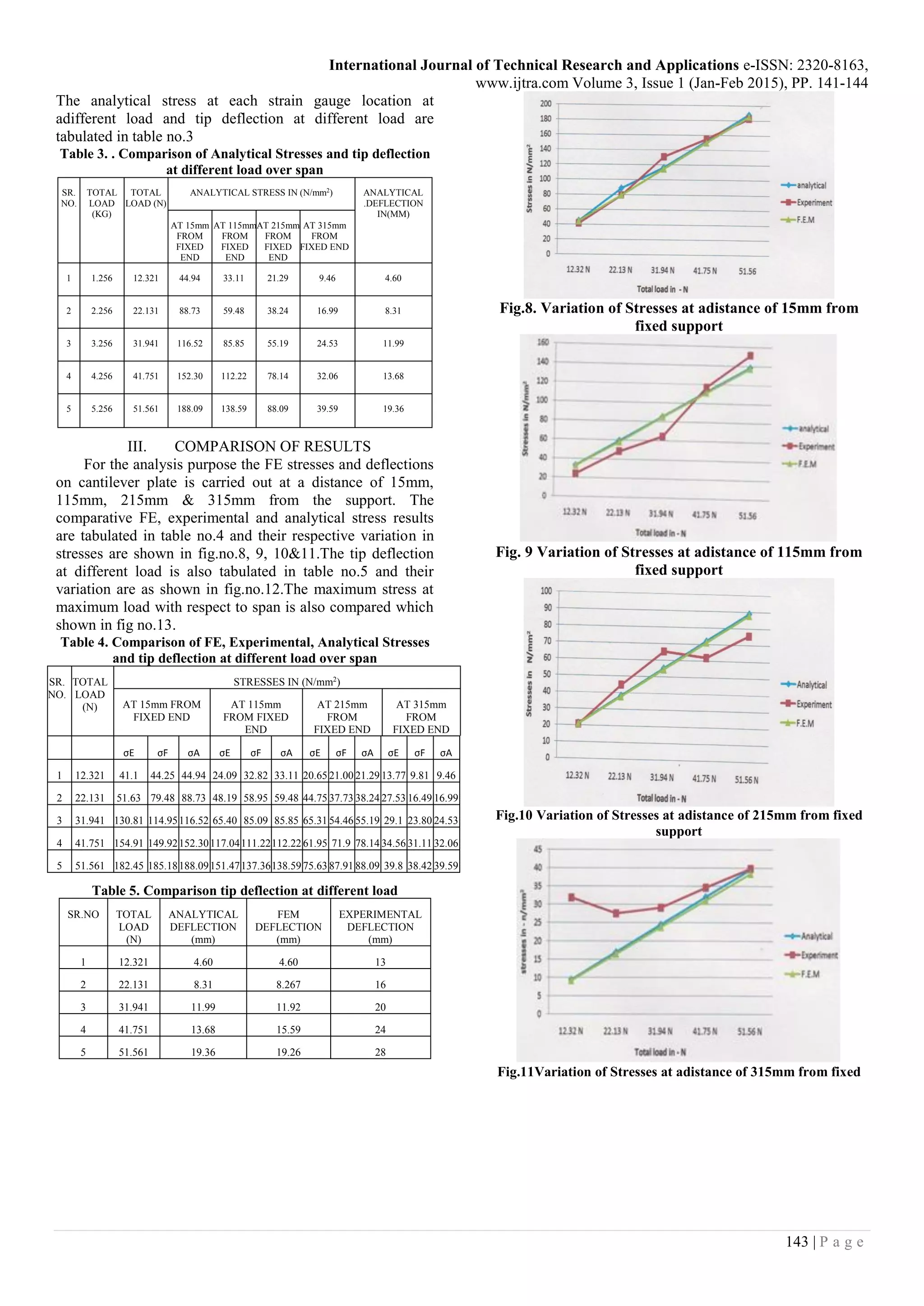
are tabulated in table no.4 and their respective variation in
stresses are shown in fig.no.8, 9, 10&11.The tip deflection
at different load is also tabulated in table no.5 and their
variation are as shown in fig.no.12.The maximum stress at
maximum load with respect to span is also compared which
shown in fig no.13.
Table 4. Comparison of FE, Experimental, Analytical Stresses
and tip deflection at different load over span
SR.
NO.
TOTAL
LOAD
(N)
STRESSES IN (N/mm2
)
AT 15mm FROM
FIXED END
AT 115mm
FROM FIXED
END
AT 215mm
FROM
FIXED END
AT 315mm
FROM
FIXED END
σE σF σA σE σF σA σE σF σA σE σF σA
1 12.321 41.1 44.25 44.94 24.09 32.82 33.11 20.65 21.00 21.29 13.77 9.81 9.46
2 22.131 51.63 79.48 88.73 48.19 58.95 59.48 44.75 37.73 38.24 27.53 16.49 16.99
3 31.941 130.81 114.95116.52 65.40 85.09 85.85 65.31 54.46 55.19 29.1 23.80 24.53
4 41.751 154.91 149.92152.30117.04111.22112.22 61.95 71.9 78.14 34.56 31.11 32.06
5 51.561 182.45 185.18188.09151.47137.36138.59 75.63 87.91 88.09 39.8 38.42 39.59
Table 5. Comparison tip deflection at different load
SR.NO TOTAL
LOAD
(N)
ANALYTICAL
DEFLECTION
(mm)
FEM
DEFLECTION
(mm)
EXPERIMENTAL
DEFLECTION
(mm)
1 12.321 4.60 4.60 13
2 22.131 8.31 8.267 16
3 31.941 11.99 11.92 20
4 41.751 13.68 15.59 24
5 51.561 19.36 19.26 28
Fig.8. Variation of Stresses at adistance of 15mm from
fixed support
Fig. 9 Variation of Stresses at adistance of 115mm from
fixed support
Fig.10 Variation of Stresses at adistance of 215mm from fixed
support
Fig.11Variation of Stresses at adistance of 315mm from fixed
International Journal of Technical Research and Applications e-ISSN: 2320-8163,
www.ijtra.com Volume 3, Issue 1 (Jan-Feb 2015), PP. 141-144
144 | P a g e
Fig.12. Variation of tip deflection at different load
Fig13. Variation of stresses at max. load with respect to span
IV. DISCUSSION AND CONCLUSION
Though the detailed results are presented in earlier, here an
attempt is made to compare the results obtained analytically,
by FEM and experimentation. For comparison of stresses
first principle stress is considered.
A. Variation of stress and deflection in cantilever
plate
From the Fig. no 8, 9, 10&11 it is observed that FE
stresses and analytical stresses is closely matched but in
experimental the stress is slightly differ.
The strain gauges at a distance of 15mm and 115mm from
fixed support all three analysis are in good agreement with
each other, but at a distance of 215mm from fixed support
the experimental stress is closely matched at a lower load
and when the load increases, it quit differs.
At a distance of 315mm from fixed support the FE and
analytical stresses are closely matched, but in
experimentation at a lower load the experimental stress
highly differs than the analytical and FE stresses. When the
load are increasing, all these stresses are closer to each
other.
From fig no. 13 it is observed that, at a higher load the
nature of the graph of FE, analytical and experimental
stresses over a span obtained in the same nature as that of
stresses occurred in cantilever beam.
From fig. no.12 it is observed that at the end of the beam,
where the load is applied, the analytical and FEM deflection
are in good agreement but experimental deflection is quit
differ from the above two analysis because of due to inertia
and properties of material.
B. Overall conclusion
From this study it is conclude that in the analytical and
FEM analysis of a beam, observing stresses are nearer to
each other, but in experimental analysis as the load increases
the experimental stress is nearer to the FE and analytical
stresses and also follows the cantilever beam theory. In the
deflection concern, the analytical and FE deflection is in
good agreement but, the experimental deflection is quite
differs from above two analysis because due to inertia
effect, material properties and length of beam.
REFERENCES
[1] Gargi Majumdar., (2013) “Deflection and stress analysis of
cantilever beam and its validation using ANSYS”.
Intiernational Journal of Mechanicl engg. ISSN 2249-OO19,
Vol. 3. PP. 655 – 662.
[2] Bellagundu; (2002) “Finite element in engineering”, 3rd
Edition, Prentice Hall India.
[3] Khurmi, R. S.; Gupta, J. K.; (1999) “A textbook of Machine
Design” EPH Publication.
[4] Satphy S.M.;(2014)” A project of dynamic analysis of
cantilever beam & its experimental validation”,Dept.of
Mech. Engg.,National institute of Technology,Rourkela.
[5] A.Kursun, M.Tunay Certin; (2014) “Elastic Stress analysis
of composite cantilever beam loaded uniformly”,
Intenational Journal of Mechanical, Aerospace, Industrial
and Mechatronics Engineering. Vol;8, No:2.
[6] K.Vijaykumar ;(2014) “Tungsten Cantilever Beam using
Ansys, (Model Analysis)”, IJES,ISSN 2319-1813
Volume3,P.P .53-59
[7] Tarsicio Belendez; (2003) “Numerical and Experimental
Analysis of a Cantilever Beam; a Laboratory project to
Introduce Geometric Nonlinearity in Mechanics of
Material”, Int.J.Engg.Ed, vol.19,No.6,P.P 885-892.

INVESTIGATION OF STRESSES IN CANTILEVER BEAM BY FEM AND ITS EXPERIMENTAL VERIFICATION

  • 1.
    International Journal ofTechnical Research and Applications e-ISSN: 2320-8163, www.ijtra.com Volume 3, Issue 1 (Jan-Feb 2015), PP. 141-144 141 | P a g e INVESTIGATION OF STRESSES IN CANTILEVER BEAM BY FEM AND ITS EXPERIMENTAL VERIFICATION 1V.B.Jadhao, 2R. B. Charde, 3S.M.Dhengle 1 Department of Mech. Engg, Govt.Polytechnic, Gadchiroli-442605, Maharashtra, India. 2, 3 Department of Mech. Engg, Shri Sai Polytechnic, Chandrapur – 442401, Maharashtra, India. 1 Jadhao_vb@rediffmail.com, 2 charderaju@yahoo.com, 3 sanjay.dhengle76@gmail.com Abstract - The main objective of this study is to verification of stresses developed in cantilever beam. The maximum stress is induced in the cantilever beam is at support and failure of beam takes place at support .Hence in this work evaluation of stresses in cantilever beam over a span is studied using finite element method and strain gauge technique. The stress and deflection analysis at different section is carried out. The result of finite element method is verified with experimental and analytical solution. Keywords: Cantilever plate; FEM; Strain gauge; Static loading. I. INTRODUCTION While analysis of stresses in cantilever beam we are using three technique i.e. analytical analysis, FEM analysis and experimental analysis. The mild steel flat plate having cross section 25×5 mm and 395mm in length used as a beam. This beam is fixed at one end and load is applied at other end. In analytical analysis load of 1.256kg (load with pan load) is applied at the end of beam and stresses at a distance of 15mm, 115mm,215mm, 315mm from support is calculated with the help of empirical relation and also calculate the tip deflection with different load range. In experimental technique, load is applied at the end of beam having 1.256 kg (load with pan load) the strain gauges are located at a distance of 15mm, 115mm , 215mm, & 315mm from the support. We are observing o/p voltage in strain gauges and see the effect of stress and strain at a required position of strain gauge over a cantilever beam at different load. In FEM technique using ANSYS 11 software again similar load is applied on cantilever beam and observe the effect of loading at a distance of 15mm , 115mm , 215mm and 315mm from fixed end for the load ranges from 1.256 to 5.256 kg at a difference of 1kg. II. METHODOLOGIES A. Experimental analysis In experimental analysis, actual prototype is considered under static load. A metal foil gauge having resistance 120Ω and gauge factor 2.0 is used for the strain measurement. The instrumentation is developed for this work the instrumentation measure only change in resistance i.e. ∆ R. This change in resistance in mili volts is converting into voltage with the help of Wheatstone bridge circuit and digital multimeter. The four strain gauge are located on a cantilever plate. The strain gauge no. 1, 2, 3 & 4 are located at a distance of 15mm, 115mm, 215mm, & 315mm respectively from the fixed support. The one end of the plate is fixed and load pan is clamped with help of J bolt at other end. The experimental set up as shown in fig 1. Due to application of load resistance of strain gauge wire changes which is measured with help of digital multimeter. This change in voltage is directly proportional to applied strain. The Experimental strain is carried out by equation 1 dVo = ¼ x Vs x F x ε (1) where Vs = Supply voltage in volts dVo = Change in voltage in mill volts F = Gauge factor=2 Ε = Experimental strain Experimental stress is given by equation 2 σb = εxE (2) E=Young modulus of material of material The one by one strain gauges is connected to Wheatstone bridge circuit and the load is added in the step of 1 to 5 kg. A pen plotter system is provided at the free end of plate to measure the deflection at the tip. The deflection is measured on a Cart board with scale which is shown in fig no.2. All the experimental results are tabulated in table no.1. Fig. 1 Experimental Setup for measurement of stress Fig. 2 Experimental Setup for measurement of deflection
  • 2.
    International Journal ofTechnical Research and Applications e-ISSN: 2320-8163, www.ijtra.com Volume 3, Issue 1 (Jan-Feb 2015), PP. 141-144 142 | P a g e Table 1. Comparison of Experimental Stresses and tip deflection at different load over span SR .N O. TOTAL LOAD( KG) TOTAL LOAD( N) EXPERIMENTAL STRESS IN (N/mm2 ) EXPT.DE FLECTIO N IN(MM)STRAIN GAUGE NO.1 STRAIN GAUGE NO.2 STRAIN GAUGE NO.3 STRAIN GAUGE NO 4 1 1.256 12.321 41.1 24.09 20.65 13.77 13 2 2.256 22.131 51.63 48.19 44.75 27.53 16 3 3.256 31.941 130.81 65.40 65.31 29.1 20 4 4.256 41.751 154.91 117.04 61.95 34.56 24 5 5.256 51.561 182.45 151.47 75.63 39.8 28 B. Finite element analysis The model of cantilever beam having dimensions 25×5 mm cross-section and length of 395mm. The model is developed by using ANSYS software. After the generation of model, 10 node solid92 tetrahedral element is used for analysis. The properties of material such as E=2.1×10⁵ N/mm2 and position’s ratio=0.28 are provided and mesh model is developed. The constrained are provided on one end of cantilever beam on a area with all degree of freedom. The load is applied on other end on top side of node in Y- direction. After solving, the first principle stress counter at nodal region for the load ranges from 1.256kg to 5kg in the steps of 1kg as shown in fig no.3,4.,5,6&,7respectively. The FEM stresses at each load at a distance of 15mm, 115mm,215mm, 315mm and tip deflection at each load are tabulated in table no.2 Fig.3 First principle stress counter for1.256kg Fig.4 First principle stress counter for 2.256kg Fig. 5 First principle stress counter for 3.256kg Fig.6 First principle stress counter for 4.256kg Fig. 7 First principle stress counter for 5.256 kg. Table 2. . Comparison of FEM Stresses and tip deflection at different load over span SR. NO. TOTAL LOAD(KG) TOTAL LOAD(N) FEM STRESS IN (N/mm2 ) FEM.DEF LECTION IN(MM)AT 15mm FROM FIXED END AT 115mm FROM FIXED END AT 215mm FROM FIXED END AT 315mm FROM FIXED END 4 1 1.256 12.321 44.25 32.82 21.00 9.81 4.60 2 2.256 22.131 79.48 58.95 37.73 16.49 8.267 3 3.256 31.941 114.95 85.09 54.46 23.80 11.92 4 4.256 41.751 149.92 111.22 71.9 31.11 15.59 5 5.256 51.561 185.18 137.36 87.91 38.42 19.26 C. Analytical Analysis For the analytical analysis the following specification are considered Load applied=P Weight of pan with J bolt= 256gm=0.256kg. Total weight including applied load with wt. Of pan &clamp= W Span from load end to strain gauge No.1 L1=380mm Span from load end to strain gauge No.1 L2=280mm Span from load end to strain gauge No.1 L3=180mm Span from load end to strain gauge No.1 L4=80mm Width of Plate b=25mm Thickness of plate t=5mm Analytical stress is calculated by σb = 6 WL / bt² (3) The stresses at each strain gauge location is calculated by using above equation by changing the value of L.as L1, L2, L3, L4 respectively for the application of load 1kg,2kg, 3kg, 4kg &5kg respectively. Analytical deflection at tip of cantilever plate is given by δ = (W x L³ ) / ( 3 x E x I )(4) Modulus of elasticity E =2.1X10⁵ N/mm2 Span of beam L=395mm M.I. of plate =I I=(b×t3 )/12 (5)
  • 3.
    International Journal ofTechnical Research and Applications e-ISSN: 2320-8163, www.ijtra.com Volume 3, Issue 1 (Jan-Feb 2015), PP. 141-144 143 | P a g e The analytical stress at each strain gauge location at adifferent load and tip deflection at different load are tabulated in table no.3 Table 3. . Comparison of Analytical Stresses and tip deflection at different load over span SR. NO. TOTAL LOAD (KG) TOTAL LOAD (N) ANALYTICAL STRESS IN (N/mm2 ) ANALYTICAL .DEFLECTION IN(MM) AT 15mm FROM FIXED END AT 115mm FROM FIXED END AT 215mm FROM FIXED END AT 315mm FROM FIXED END 1 1.256 12.321 44.94 33.11 21.29 9.46 4.60 2 2.256 22.131 88.73 59.48 38.24 16.99 8.31 3 3.256 31.941 116.52 85.85 55.19 24.53 11.99 4 4.256 41.751 152.30 112.22 78.14 32.06 13.68 5 5.256 51.561 188.09 138.59 88.09 39.59 19.36 III. COMPARISON OF RESULTS For the analysis purpose the FE stresses and deflections on cantilever plate is carried out at a distance of 15mm, 115mm, 215mm & 315mm from the support. The comparative FE, experimental and analytical stress results are tabulated in table no.4 and their respective variation in stresses are shown in fig.no.8, 9, 10&11.The tip deflection at different load is also tabulated in table no.5 and their variation are as shown in fig.no.12.The maximum stress at maximum load with respect to span is also compared which shown in fig no.13. Table 4. Comparison of FE, Experimental, Analytical Stresses and tip deflection at different load over span SR. NO. TOTAL LOAD (N) STRESSES IN (N/mm2 ) AT 15mm FROM FIXED END AT 115mm FROM FIXED END AT 215mm FROM FIXED END AT 315mm FROM FIXED END σE σF σA σE σF σA σE σF σA σE σF σA 1 12.321 41.1 44.25 44.94 24.09 32.82 33.11 20.65 21.00 21.29 13.77 9.81 9.46 2 22.131 51.63 79.48 88.73 48.19 58.95 59.48 44.75 37.73 38.24 27.53 16.49 16.99 3 31.941 130.81 114.95116.52 65.40 85.09 85.85 65.31 54.46 55.19 29.1 23.80 24.53 4 41.751 154.91 149.92152.30117.04111.22112.22 61.95 71.9 78.14 34.56 31.11 32.06 5 51.561 182.45 185.18188.09151.47137.36138.59 75.63 87.91 88.09 39.8 38.42 39.59 Table 5. Comparison tip deflection at different load SR.NO TOTAL LOAD (N) ANALYTICAL DEFLECTION (mm) FEM DEFLECTION (mm) EXPERIMENTAL DEFLECTION (mm) 1 12.321 4.60 4.60 13 2 22.131 8.31 8.267 16 3 31.941 11.99 11.92 20 4 41.751 13.68 15.59 24 5 51.561 19.36 19.26 28 Fig.8. Variation of Stresses at adistance of 15mm from fixed support Fig. 9 Variation of Stresses at adistance of 115mm from fixed support Fig.10 Variation of Stresses at adistance of 215mm from fixed support Fig.11Variation of Stresses at adistance of 315mm from fixed
  • 4.
    International Journal ofTechnical Research and Applications e-ISSN: 2320-8163, www.ijtra.com Volume 3, Issue 1 (Jan-Feb 2015), PP. 141-144 144 | P a g e Fig.12. Variation of tip deflection at different load Fig13. Variation of stresses at max. load with respect to span IV. DISCUSSION AND CONCLUSION Though the detailed results are presented in earlier, here an attempt is made to compare the results obtained analytically, by FEM and experimentation. For comparison of stresses first principle stress is considered. A. Variation of stress and deflection in cantilever plate From the Fig. no 8, 9, 10&11 it is observed that FE stresses and analytical stresses is closely matched but in experimental the stress is slightly differ. The strain gauges at a distance of 15mm and 115mm from fixed support all three analysis are in good agreement with each other, but at a distance of 215mm from fixed support the experimental stress is closely matched at a lower load and when the load increases, it quit differs. At a distance of 315mm from fixed support the FE and analytical stresses are closely matched, but in experimentation at a lower load the experimental stress highly differs than the analytical and FE stresses. When the load are increasing, all these stresses are closer to each other. From fig no. 13 it is observed that, at a higher load the nature of the graph of FE, analytical and experimental stresses over a span obtained in the same nature as that of stresses occurred in cantilever beam. From fig. no.12 it is observed that at the end of the beam, where the load is applied, the analytical and FEM deflection are in good agreement but experimental deflection is quit differ from the above two analysis because of due to inertia and properties of material. B. Overall conclusion From this study it is conclude that in the analytical and FEM analysis of a beam, observing stresses are nearer to each other, but in experimental analysis as the load increases the experimental stress is nearer to the FE and analytical stresses and also follows the cantilever beam theory. In the deflection concern, the analytical and FE deflection is in good agreement but, the experimental deflection is quite differs from above two analysis because due to inertia effect, material properties and length of beam. REFERENCES [1] Gargi Majumdar., (2013) “Deflection and stress analysis of cantilever beam and its validation using ANSYS”. Intiernational Journal of Mechanicl engg. ISSN 2249-OO19, Vol. 3. PP. 655 – 662. [2] Bellagundu; (2002) “Finite element in engineering”, 3rd Edition, Prentice Hall India. [3] Khurmi, R. S.; Gupta, J. K.; (1999) “A textbook of Machine Design” EPH Publication. [4] Satphy S.M.;(2014)” A project of dynamic analysis of cantilever beam & its experimental validation”,Dept.of Mech. Engg.,National institute of Technology,Rourkela. [5] A.Kursun, M.Tunay Certin; (2014) “Elastic Stress analysis of composite cantilever beam loaded uniformly”, Intenational Journal of Mechanical, Aerospace, Industrial and Mechatronics Engineering. Vol;8, No:2. [6] K.Vijaykumar ;(2014) “Tungsten Cantilever Beam using Ansys, (Model Analysis)”, IJES,ISSN 2319-1813 Volume3,P.P .53-59 [7] Tarsicio Belendez; (2003) “Numerical and Experimental Analysis of a Cantilever Beam; a Laboratory project to Introduce Geometric Nonlinearity in Mechanics of Material”, Int.J.Engg.Ed, vol.19,No.6,P.P 885-892.