








Introduction
Types of bearings
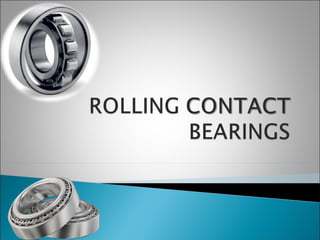
Rolling Contact Bearings
Construction
Classification
Bearing Types
Bearing Life
Merits & Demerits
Introduction to bearings
 Objective of bearing is to provide relative
positioning and rotational freedom while
transmitting a load between two parts.
In rolling contact bearings as the name implies
the friction is of rolling type.
It is much smaller than the sliding type.
Types of bearings
Rolling Contact Bearings
load is transferred through rolling elements such as balls,
straight and tapered cylinders and spherical rollers.

Journal (sleeve) Bearings
(oil).

load is transferred through a thin film of lubricant
Rolling Contact Bearings
Rolling contact bearings are also known as antifriction
bearings.
The load, speed, and operating viscosity of the lubricant
affect the friction characteristics of a rolling bearing.
These bearings provide coefficients of friction between
0.001 and 0.002.
The designer must deal with such matters as fatigue,
friction, heat, lubrication, kinematics problems, material
properties, machining tolerances, assembly, use and cost
The rolling contact bearings are composed of four
elements.
i.Outer race
ii.Inner race
iii.Rolling element
iv.Cage of retaining ring
Construction Diagram :

Roller contact bearing
With its parts
i.Outer ring (or) Outer
race
ii.Inner ring (or) inner
race
iii.Rolling elements
iv.Cage or retaining ring
Classification of rolling bearings
Classified into two types

i.Ball Bearing

•Deep groove (Conrad) bearing
•Filling notch ball bearing
•Angular contact bearings (AC)

ii. Roller Bearing 
•Cylindrical bearings
•Needle bearings
•Tapered bearings
•Spherical bearings
Ball Bearings
Deep groove bearing

 Single row of deep groove ball bearing can combinational of

radial and thrust load.
Load capacity is limited by the number of balls
Primarily designed to support radial loads, the thrust capacity
is about 70% of radial load capacity
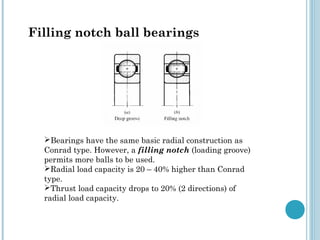
Filling notch ball bearings

Bearings have the same basic radial construction as
Conrad type. However, a filling notch (loading groove)
permits more balls to be used.
Radial load capacity is 20 – 40% higher than Conrad
type.
Thrust load capacity drops to 20% (2 directions) of
radial load capacity.
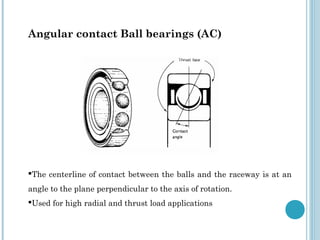
Angular contact Ball bearings (AC)

The centerline of contact between the balls and the raceway is at an
angle to the plane perpendicular to the axis of rotation.
Used for high radial and thrust load applications
RADIAL AND ANGULAR BEARING
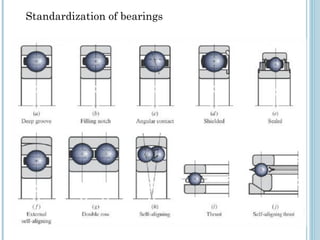
Standardization of bearings
Roller Bearings
Roller bearings have higher load capacity than ball bearings,
load is transmitted through line contact instead of point contact.
Helical rollers are made by winding rectangular material into
roller. Due to inherent flexibility they are capable of taking considerable
misalignment.
A roller with length much larger than diameter is known as
needle roller and are used where radial space is limited. Cage nay be
absent in needle roller bearings.
ROLLER BEARINGS
If a bearing is clean, properly lubricated and mounted and is
operating at reasonable temp., failure is due to fatigue caused by
repeated contact stresses (Hertzian stress)
Fatigue failure consists of a spalling or pitting of the curved surfaces

Spalling
crack initiates below the curved surface at the location of
maximum shear stress, propagates to the surface causing surface
damage.
Failure criterion – spalling or pitting of an area of 0.01 in 2,
Timken company (tapered bearings)
LIFE number of revolution or hours of operation, at constant speed,
required for the failure criterion to develop.
– defines the number of revolution or hours of
operation, at constant speed, in such a way that
of the
bearings tested (from the same group) will complete or exceed
before the first evidence of failure develops. This is known as
life.
For ball bearings and spherical bearings:
L10 = 500 (hours) x 33.33 (rpm) x 60 = 106 = 1 million
revolutions
For tapered bearings manufactured by Timken:
L10 = 3000 (hours) x 500 (rpm) x 60 = 90 x 106 = 90 million
revolutions
Basic Dynamic Load Rating, C constant radial load that a group
of bearings can carry for L10 life.
Bearing Life
Bearing life
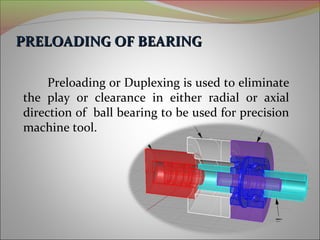
PRELOADING OF BEARING
Preloading or Duplexing is used to eliminate
the play or clearance in either radial or axial
direction of ball bearing to be used for precision
machine tool.
Merits of Rolling contact bearings
•

Low starting and good operating friction torque.

•

East of lubrication

•

Requiring less axial space.

•

Generally, taking both radial and axial loads.

•

Rapid replacement

•

Warning of impending failure by increasing noisiness.

•

Good low-temperature starting.
Demerits of rolling element bearings:

•

Greater diametric space.

•

More severe alignment requirements.

•

Higher initial cost.

•

Noisier normal operation.

•

Finite life due to eventual failure by fatigue.

•

Ease of damage by foreign matter.

•

Poor damping ability.
Rolling contact bearings

Rolling contact bearings

  • 2.
            Introduction Types of bearings RollingContact Bearings Construction Classification Bearing Types Bearing Life Merits & Demerits
  • 3.
    Introduction to bearings Objective of bearing is to provide relative positioning and rotational freedom while transmitting a load between two parts. In rolling contact bearings as the name implies the friction is of rolling type. It is much smaller than the sliding type.
  • 4.
    Types of bearings RollingContact Bearings load is transferred through rolling elements such as balls, straight and tapered cylinders and spherical rollers. Journal (sleeve) Bearings (oil). load is transferred through a thin film of lubricant
  • 5.
    Rolling Contact Bearings Rollingcontact bearings are also known as antifriction bearings. The load, speed, and operating viscosity of the lubricant affect the friction characteristics of a rolling bearing. These bearings provide coefficients of friction between 0.001 and 0.002. The designer must deal with such matters as fatigue, friction, heat, lubrication, kinematics problems, material properties, machining tolerances, assembly, use and cost
  • 6.
    The rolling contactbearings are composed of four elements. i.Outer race ii.Inner race iii.Rolling element iv.Cage of retaining ring
  • 7.
    Construction Diagram : Rollercontact bearing With its parts i.Outer ring (or) Outer race ii.Inner ring (or) inner race iii.Rolling elements iv.Cage or retaining ring
  • 8.
    Classification of rollingbearings Classified into two types i.Ball Bearing •Deep groove (Conrad) bearing •Filling notch ball bearing •Angular contact bearings (AC) ii. Roller Bearing  •Cylindrical bearings •Needle bearings •Tapered bearings •Spherical bearings
  • 9.
    Ball Bearings Deep groovebearing  Single row of deep groove ball bearing can combinational of radial and thrust load. Load capacity is limited by the number of balls Primarily designed to support radial loads, the thrust capacity is about 70% of radial load capacity
  • 10.
    Filling notch ballbearings Bearings have the same basic radial construction as Conrad type. However, a filling notch (loading groove) permits more balls to be used. Radial load capacity is 20 – 40% higher than Conrad type. Thrust load capacity drops to 20% (2 directions) of radial load capacity.
  • 11.
    Angular contact Ballbearings (AC) The centerline of contact between the balls and the raceway is at an angle to the plane perpendicular to the axis of rotation. Used for high radial and thrust load applications
  • 12.
  • 13.
  • 14.
    Roller Bearings Roller bearingshave higher load capacity than ball bearings, load is transmitted through line contact instead of point contact. Helical rollers are made by winding rectangular material into roller. Due to inherent flexibility they are capable of taking considerable misalignment. A roller with length much larger than diameter is known as needle roller and are used where radial space is limited. Cage nay be absent in needle roller bearings.
  • 15.
  • 16.
    If a bearingis clean, properly lubricated and mounted and is operating at reasonable temp., failure is due to fatigue caused by repeated contact stresses (Hertzian stress) Fatigue failure consists of a spalling or pitting of the curved surfaces Spalling crack initiates below the curved surface at the location of maximum shear stress, propagates to the surface causing surface damage. Failure criterion – spalling or pitting of an area of 0.01 in 2, Timken company (tapered bearings)
  • 17.
    LIFE number ofrevolution or hours of operation, at constant speed, required for the failure criterion to develop. – defines the number of revolution or hours of operation, at constant speed, in such a way that of the bearings tested (from the same group) will complete or exceed before the first evidence of failure develops. This is known as life. For ball bearings and spherical bearings: L10 = 500 (hours) x 33.33 (rpm) x 60 = 106 = 1 million revolutions For tapered bearings manufactured by Timken: L10 = 3000 (hours) x 500 (rpm) x 60 = 90 x 106 = 90 million revolutions Basic Dynamic Load Rating, C constant radial load that a group of bearings can carry for L10 life.
  • 18.
  • 19.
  • 20.
    PRELOADING OF BEARING Preloadingor Duplexing is used to eliminate the play or clearance in either radial or axial direction of ball bearing to be used for precision machine tool.
  • 21.
    Merits of Rollingcontact bearings • Low starting and good operating friction torque. • East of lubrication • Requiring less axial space. • Generally, taking both radial and axial loads. • Rapid replacement • Warning of impending failure by increasing noisiness. • Good low-temperature starting.
  • 22.
    Demerits of rollingelement bearings: • Greater diametric space. • More severe alignment requirements. • Higher initial cost. • Noisier normal operation. • Finite life due to eventual failure by fatigue. • Ease of damage by foreign matter. • Poor damping ability.