MEASUREMENT OF HARDNESS
IN RUBBER COMPOUNDS
Luis Tormento
October/2017
Introduction
• A question we often ask: what is the meaning of hardness
in an artifact? However, in itself, the hardness represents
little to determine the use of an artifact: we must add
other characteristics such as tensile strength and
elongation.
• But what actually represents hardness, be it Shore A or
IRHD? They are defined by standardized methods.
• Standard methods for measuring hardness of rubber and
plastics use such nomenclatures as Shore A and D or IRHD
methods (N, H, L and M); these methods are specified in
ISO 868 and BS903 / ISO 48, respectively. Through the use
of these techniques we have the best accuracy of the
measurement process.
Shore Hardness
• Shore hardness specifies methods for determining the hardness of
materials by means of two types of hardness: type A for soft materials
and type D for hard materials, even if the ASTM standard has 8 types of
scales.
• The method allows the initial penetration on the artifact surface to be
measured after a short period of time. The measure of hardness is
inversely proportional to this penetration; that is, the higher the
penetration, the softer the product (the lower the hardness). It is a
property that depends on the elastic modulus and the viscoelasticity of
the material.
• The shape of the penetrator, the force applied, and the duration of the
test influence the results.
• The Shore A durometer consists of a support base, a penetrator, an
indicating device, and a calibrated spring that applies force to the
penetrator. The difference between the Shore A hardness and the D
hardness is in the form of the penetrator and the calibrated spring.
Shore Hardness
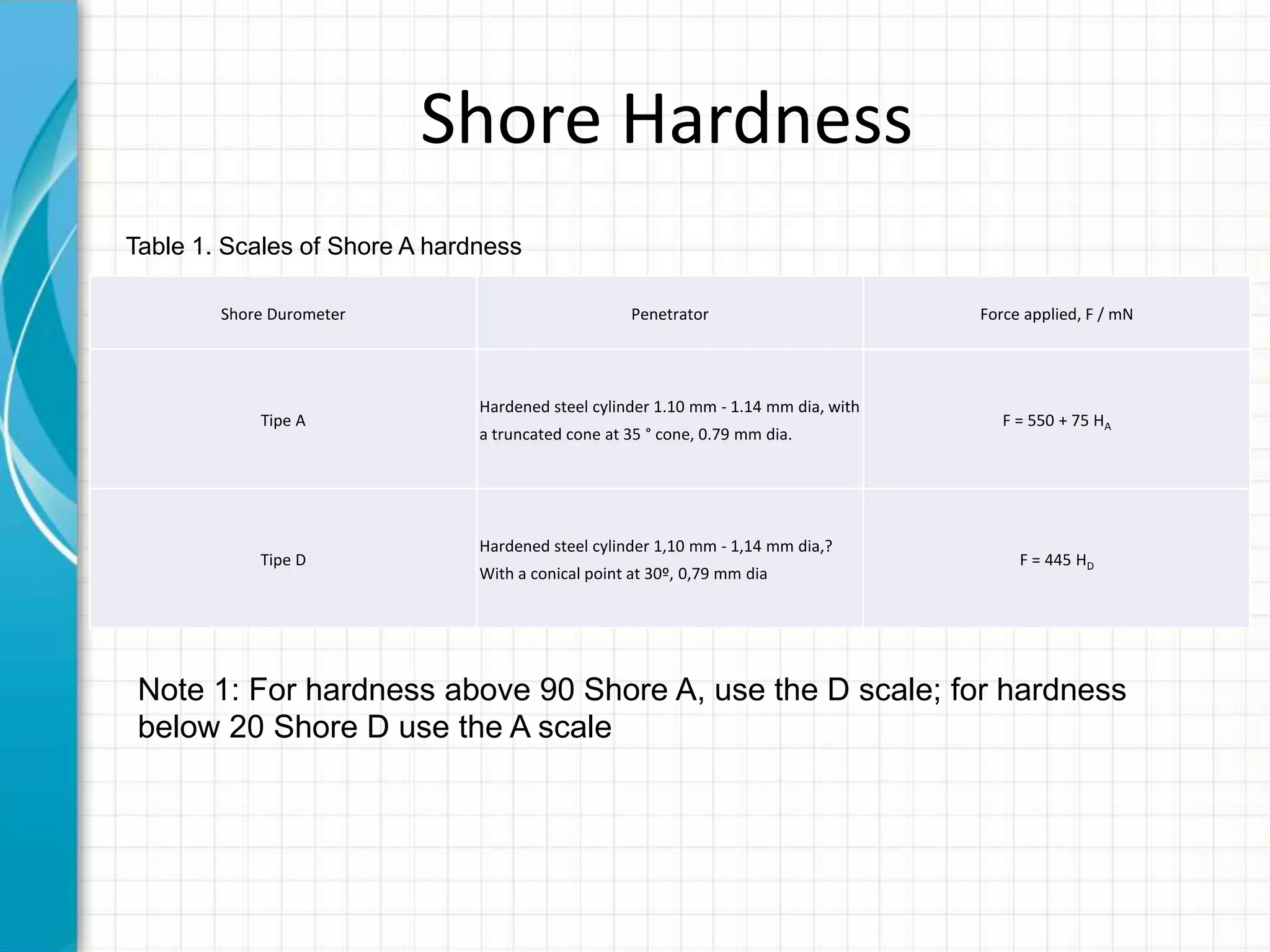
Shore Durometer Penetrator Force applied, F / mN
Tipe A
Hardened steel cylinder 1.10 mm - 1.14 mm dia, with
a truncated cone at 35 ° cone, 0.79 mm dia.
F = 550 + 75 HA
Tipe D
Hardened steel cylinder 1,10 mm - 1,14 mm dia,?
With a conical point at 30º, 0,79 mm dia
F = 445 HD
Table 1. Scales of Shore A hardness
Note 1: For hardness above 90 Shore A, use the D scale; for hardness
below 20 Shore D use the A scale
Shore Hardness
• The hardness units range from 0 (with total
cylinder penetration from 2.50 mm) to 100
without penetration.
• The force is applied as soon as possible without
shock, and the hardness is measured after 15 +/-
1 s. If the instant reading is specified, this time
will be 1s. The relationship between the
different results obtained by a durometer may
be different from those obtained by other
measuring equipment.
IRHD Hardness
• In fact, the IRHD (International Rubber Hardness Degrees)
has four different degrees of measurement for the
hardness measurement in vulcanized or thermoplastic
rubbers (N, H, L and M), and four methods for determining
the apparent hardness of curved surfaces (CN, CH, CL and
CM).
• The test consists of measuring the difference between the
penetration depth of a sphere on the rubber surface
under an initial contact force followed by the total
application of the contact force. The methods differ in the
diameter of the penetration sphere and the magnitude of
the penetration force, selected according to the hardness
of the rubber.
IRHD Hardness
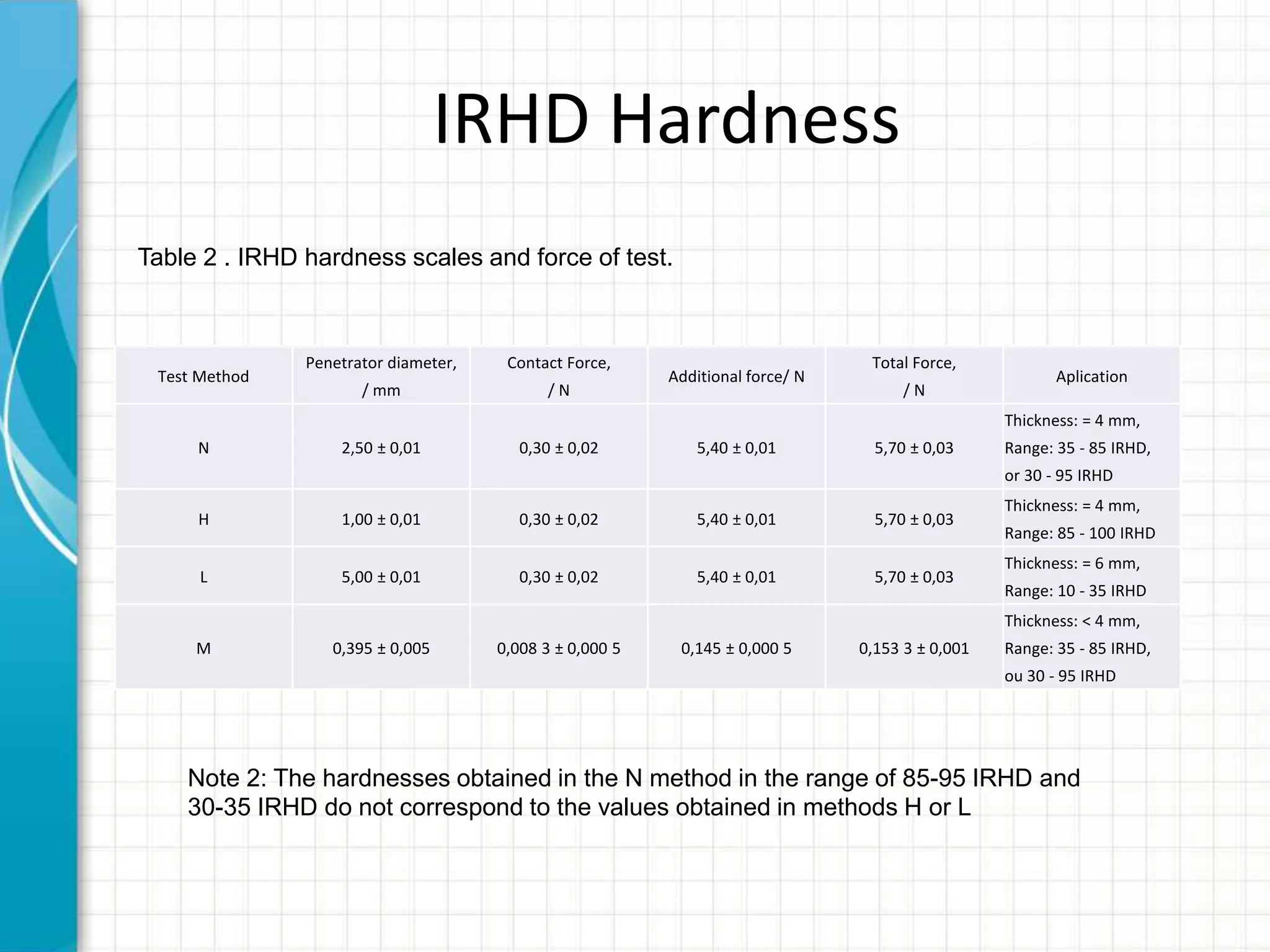
Test Method
Penetrator diameter,
/ mm
Contact Force,
/ N
Additional force/ N
Total Force,
/ N
Aplication
N 2,50 ± 0,01 0,30 ± 0,02 5,40 ± 0,01 5,70 ± 0,03
Thickness: = 4 mm,
Range: 35 - 85 IRHD,
or 30 - 95 IRHD
H 1,00 ± 0,01 0,30 ± 0,02 5,40 ± 0,01 5,70 ± 0,03
Thickness: = 4 mm,
Range: 85 - 100 IRHD
L 5,00 ± 0,01 0,30 ± 0,02 5,40 ± 0,01 5,70 ± 0,03
Thickness: = 6 mm,
Range: 10 - 35 IRHD
M 0,395 ± 0,005 0,008 3 ± 0,000 5 0,145 ± 0,000 5 0,153 3 ± 0,001
Thickness: < 4 mm,
Range: 35 - 85 IRHD,
ou 30 - 95 IRHD
Table 2 . IRHD hardness scales and force of test.
Note 2: The hardnesses obtained in the N method in the range of 85-95 IRHD and
30-35 IRHD do not correspond to the values obtained in methods H or L
Contact
LT Químicos
Av. Pedro Severino Jr., 366 Cjto 35
04310-060 – São Paulo – SP – Brasil
Luis Tormento
NPD Director
Luis.tormento@ltquimicos.com.br
Tel: +55 (11) 5581-0708

Measurement of hardness

  • 1.
    MEASUREMENT OF HARDNESS INRUBBER COMPOUNDS Luis Tormento October/2017
  • 2.
    Introduction • A questionwe often ask: what is the meaning of hardness in an artifact? However, in itself, the hardness represents little to determine the use of an artifact: we must add other characteristics such as tensile strength and elongation. • But what actually represents hardness, be it Shore A or IRHD? They are defined by standardized methods. • Standard methods for measuring hardness of rubber and plastics use such nomenclatures as Shore A and D or IRHD methods (N, H, L and M); these methods are specified in ISO 868 and BS903 / ISO 48, respectively. Through the use of these techniques we have the best accuracy of the measurement process.
  • 3.
    Shore Hardness • Shorehardness specifies methods for determining the hardness of materials by means of two types of hardness: type A for soft materials and type D for hard materials, even if the ASTM standard has 8 types of scales. • The method allows the initial penetration on the artifact surface to be measured after a short period of time. The measure of hardness is inversely proportional to this penetration; that is, the higher the penetration, the softer the product (the lower the hardness). It is a property that depends on the elastic modulus and the viscoelasticity of the material. • The shape of the penetrator, the force applied, and the duration of the test influence the results. • The Shore A durometer consists of a support base, a penetrator, an indicating device, and a calibrated spring that applies force to the penetrator. The difference between the Shore A hardness and the D hardness is in the form of the penetrator and the calibrated spring.
  • 4.
    Shore Hardness Shore DurometerPenetrator Force applied, F / mN Tipe A Hardened steel cylinder 1.10 mm - 1.14 mm dia, with a truncated cone at 35 ° cone, 0.79 mm dia. F = 550 + 75 HA Tipe D Hardened steel cylinder 1,10 mm - 1,14 mm dia,? With a conical point at 30º, 0,79 mm dia F = 445 HD Table 1. Scales of Shore A hardness Note 1: For hardness above 90 Shore A, use the D scale; for hardness below 20 Shore D use the A scale
  • 5.
    Shore Hardness • Thehardness units range from 0 (with total cylinder penetration from 2.50 mm) to 100 without penetration. • The force is applied as soon as possible without shock, and the hardness is measured after 15 +/- 1 s. If the instant reading is specified, this time will be 1s. The relationship between the different results obtained by a durometer may be different from those obtained by other measuring equipment.
  • 6.
    IRHD Hardness • Infact, the IRHD (International Rubber Hardness Degrees) has four different degrees of measurement for the hardness measurement in vulcanized or thermoplastic rubbers (N, H, L and M), and four methods for determining the apparent hardness of curved surfaces (CN, CH, CL and CM). • The test consists of measuring the difference between the penetration depth of a sphere on the rubber surface under an initial contact force followed by the total application of the contact force. The methods differ in the diameter of the penetration sphere and the magnitude of the penetration force, selected according to the hardness of the rubber.
  • 7.
    IRHD Hardness Test Method Penetratordiameter, / mm Contact Force, / N Additional force/ N Total Force, / N Aplication N 2,50 ± 0,01 0,30 ± 0,02 5,40 ± 0,01 5,70 ± 0,03 Thickness: = 4 mm, Range: 35 - 85 IRHD, or 30 - 95 IRHD H 1,00 ± 0,01 0,30 ± 0,02 5,40 ± 0,01 5,70 ± 0,03 Thickness: = 4 mm, Range: 85 - 100 IRHD L 5,00 ± 0,01 0,30 ± 0,02 5,40 ± 0,01 5,70 ± 0,03 Thickness: = 6 mm, Range: 10 - 35 IRHD M 0,395 ± 0,005 0,008 3 ± 0,000 5 0,145 ± 0,000 5 0,153 3 ± 0,001 Thickness: < 4 mm, Range: 35 - 85 IRHD, ou 30 - 95 IRHD Table 2 . IRHD hardness scales and force of test. Note 2: The hardnesses obtained in the N method in the range of 85-95 IRHD and 30-35 IRHD do not correspond to the values obtained in methods H or L
  • 8.
    Contact LT Químicos Av. PedroSeverino Jr., 366 Cjto 35 04310-060 – São Paulo – SP – Brasil Luis Tormento NPD Director Luis.tormento@ltquimicos.com.br Tel: +55 (11) 5581-0708

Editor's Notes

  • #2 Measurement of hardness in rubber compounds
  • #3 Measurement of hardness in rubber compounds
  • #4 Measurement of hardness in rubber compounds
  • #5 Measurement of hardness in rubber compounds
  • #6 Measurement of hardness in rubber compounds
  • #7 Measurement of hardness in rubber compounds
  • #8 Measurement of hardness in rubber compounds
  • #9 Measurement of hardness in rubber compounds