Learning Ontologies
    By Alexander De Leon

        Feb 9, 2009
What is an Ontology?
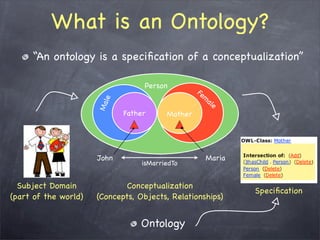
     “An ontology is a specification of a conceptualization”

                                  Person


                                                  Fe
                        le


                                                     m
                      Ma


                                                    al
                                                      e
                             Father      Mother


                      John                          Maria
                                  isMarriedTo


  Subject Domain              Conceptualization
                                                            Specification
(part of the world)   (Concepts, Objects, Relationships)


                                 Ontology
What is an Ontology?
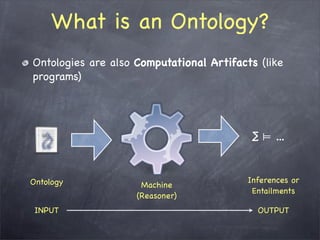
Ontologies are also Computational Artifacts (like
programs)


                                          ∑ ⊨ ...


Ontology                                  Inferences or
                     Machine
                                           Entailments
                    (Reasoner)
 INPUT                                      OUTPUT
What can we do with
       Ontologies?
Ontologies allow us to represent domain knowledge,
so that we can:

  Share common understanding.

  Enable reuse.

  Make domain assumptions explicit.

  Separate domain knowledge from operational
  knowledge.
What can we do with
        Ontologies?
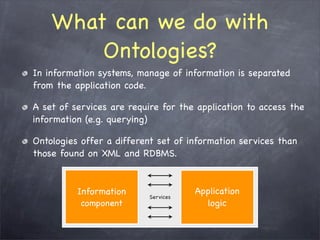
In information systems, manage of information is separated
from the application code.

A set of services are require for the application to access the
information (e.g. querying)

Ontologies offer a different set of information services than
those found on XML and RDBMS.


          Information                 Application
                           Services
           component                    logic
Reasoning Services in
         OWL-DL
Consistency checking
Subsumption
Satisfiability
Entailment
Instance checking
Query Answering
Others: explanations, approximations, etc.
Semantics vs. Syntax
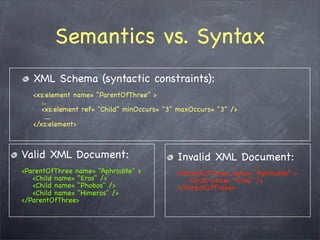
   XML Schema (syntactic constraints):
   <xs:element name= "ParentOfThree" >
      ...
      <xs:element ref= "Child" minOccurs= "3" maxOccurs= "3" />
        ....
   </xs:element>


Valid XML Document:                          Invalid XML Document:
<ParentOfThree name= "Aphrodite" >           <ParentOfThree name= "Aphrodite" >
   <Child name= "Eros" />                       <Child name= "Eros" />
   <Child name= "Phobos" />                  </ParentOfThree>
   <Child name= "Himeros" />
</ParentOfThree>
Semantics vs. Syntax
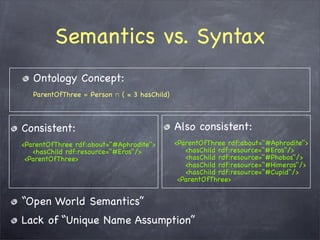
   Ontology Concept:
   ParentOfThree ≡ Person ⊓ ( = 3 hasChild)


Consistent:                                   Also consistent:
<ParentOfThree rdf:about="#Aphrodite">        <ParentOfThree rdf:about="#Aphrodite">
   <hasChild rdf:resource="#Eros"/>              <hasChild rdf:resource="#Eros"/>
 <ParentOfThree>                                 <hasChild rdf:resource="#Phobos"/>
                                                 <hasChild rdf:resource="#Himeros"/>
                                                 <hasChild rdf:resource="#Cupid"/>
                                               <ParentOfThree>


“Open World Semantics”
Lack of “Unique Name Assumption”
OWL
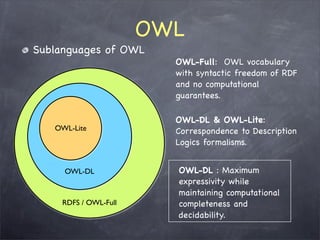
Sublanguages of OWL
                         OWL-Full: OWL vocabulary
                         with syntactic freedom of RDF
                         and no computational
                         guarantees.

                         OWL-DL & OWL-Lite:
   OWL-Lite              Correspondence to Description
                         Logics formalisms.


     OWL-DL              OWL-DL : Maximum
                         expressivity while
                         maintaining computational
     RDFS / OWL-Full     completeness and
                         decidability.
OWL
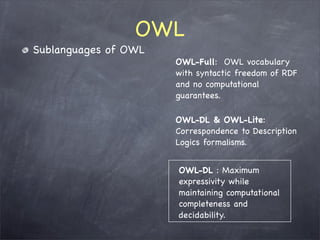
Sublanguages of OWL
                      OWL-Full: OWL vocabulary
                      with syntactic freedom of RDF
                      and no computational
                      guarantees.

                      OWL-DL & OWL-Lite:
                      Correspondence to Description
                      Logics formalisms.


                      OWL-DL : Maximum
                      expressivity while
                      maintaining computational
                      completeness and
                      decidability.
OWL
Entities of an OWL ontology are identified by URIs
(e.g. http://dumontierlab.com/students/alex)

The basic entities are:

 Class (a concept, e.g. Person)

 Individual (an object, e.g. John)

 Object Property (a relationship between two
 individuals, e.g. loves(John, Susan) )

 Data Property (an association between an individual
 an a piece of data, e.g. age(Alex, 26) )

Learning ontologies

  • 1.
    Learning Ontologies By Alexander De Leon Feb 9, 2009
  • 2.
    What is anOntology? “An ontology is a specification of a conceptualization” Person Fe le m Ma al e Father Mother John Maria isMarriedTo Subject Domain Conceptualization Specification (part of the world) (Concepts, Objects, Relationships) Ontology
  • 3.
    What is anOntology? Ontologies are also Computational Artifacts (like programs) ∑ ⊨ ... Ontology Inferences or Machine Entailments (Reasoner) INPUT OUTPUT
  • 4.
    What can wedo with Ontologies? Ontologies allow us to represent domain knowledge, so that we can: Share common understanding. Enable reuse. Make domain assumptions explicit. Separate domain knowledge from operational knowledge.
  • 5.
    What can wedo with Ontologies? In information systems, manage of information is separated from the application code. A set of services are require for the application to access the information (e.g. querying) Ontologies offer a different set of information services than those found on XML and RDBMS. Information Application Services component logic
  • 6.
    Reasoning Services in OWL-DL Consistency checking Subsumption Satisfiability Entailment Instance checking Query Answering Others: explanations, approximations, etc.
  • 7.
    Semantics vs. Syntax XML Schema (syntactic constraints): <xs:element name= "ParentOfThree" > ... <xs:element ref= "Child" minOccurs= "3" maxOccurs= "3" /> .... </xs:element> Valid XML Document: Invalid XML Document: <ParentOfThree name= "Aphrodite" > <ParentOfThree name= "Aphrodite" > <Child name= "Eros" /> <Child name= "Eros" /> <Child name= "Phobos" /> </ParentOfThree> <Child name= "Himeros" /> </ParentOfThree>
  • 8.
    Semantics vs. Syntax Ontology Concept: ParentOfThree ≡ Person ⊓ ( = 3 hasChild) Consistent: Also consistent: <ParentOfThree rdf:about="#Aphrodite"> <ParentOfThree rdf:about="#Aphrodite"> <hasChild rdf:resource="#Eros"/> <hasChild rdf:resource="#Eros"/> <ParentOfThree> <hasChild rdf:resource="#Phobos"/> <hasChild rdf:resource="#Himeros"/> <hasChild rdf:resource="#Cupid"/> <ParentOfThree> “Open World Semantics” Lack of “Unique Name Assumption”
  • 9.
    OWL Sublanguages of OWL OWL-Full: OWL vocabulary with syntactic freedom of RDF and no computational guarantees. OWL-DL & OWL-Lite: OWL-Lite Correspondence to Description Logics formalisms. OWL-DL OWL-DL : Maximum expressivity while maintaining computational RDFS / OWL-Full completeness and decidability.
  • 10.
    OWL Sublanguages of OWL OWL-Full: OWL vocabulary with syntactic freedom of RDF and no computational guarantees. OWL-DL & OWL-Lite: Correspondence to Description Logics formalisms. OWL-DL : Maximum expressivity while maintaining computational completeness and decidability.
  • 11.
    OWL Entities of anOWL ontology are identified by URIs (e.g. http://dumontierlab.com/students/alex) The basic entities are: Class (a concept, e.g. Person) Individual (an object, e.g. John) Object Property (a relationship between two individuals, e.g. loves(John, Susan) ) Data Property (an association between an individual an a piece of data, e.g. age(Alex, 26) )