+

Rules

Mariano Rodriguez-Muro,
Free University of Bozen-Bolzano
+

Disclaimer


License


This work is licensed under a
Creative Commons Attribution-Share Alike 3.0 License
(http://creativecommons.org/licenses/by-sa/3.0/)
+

Reading material


Chapter 7. Semantic Web Programming



Chapter 6. Foundations of Semantic Web.
+

What are rules


Means of representing knowledge



An ontology language



Can be seen as conditions statements:
if []
then []


if x is a Man and x hasChild y Father(x)
+

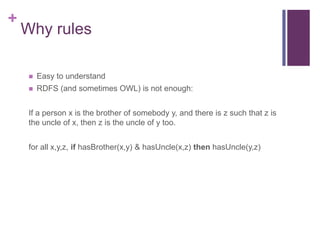
Why rules


Easy to understand



RDFS (and sometimes OWL) is not enough:

If a person x is the brother of somebody y, and there is z such that z is
the uncle of x, then z is the uncle of y too.
for all x,y,z, if hasBrother(x,y) & hasUncle(x,z) then hasUncle(y,z)
+
SWRL
+

7

SWRL


How can datalog and OWL be combined?



SWRL – Semantic Web Rule Language [swirl]

•

Proposal for a rule based Semantic Web Language (W3C member
submission)
http://www.w3.org/Submission/SWRL/

•

Idea: datalog rules referring to RDF classes/properties
Symbols in rules can be OWL identifiers or new symbols

•

Various further features and syntactic forms

•

Support in inference engines (very wide spread support)
+

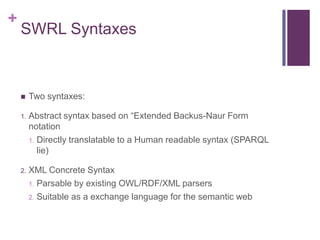
SWRL Syntaxes



Two syntaxes:

1.

Abstract syntax based on “Extended Backus-Naur Form
notation
1. Directly translatable to a Human readable syntax (SPARQL
lie)

2.

XML Concrete Syntax
1. Parsable by existing OWL/RDF/XML parsers
2. Suitable as a exchange language for the semantic web
+

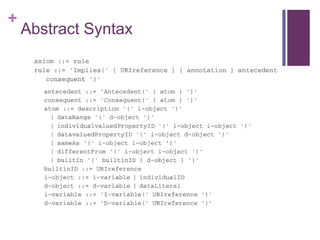
Abstract Syntax
+

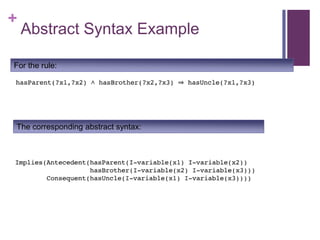
Abstract Syntax Example

For the rule:

The corresponding abstract syntax:
+

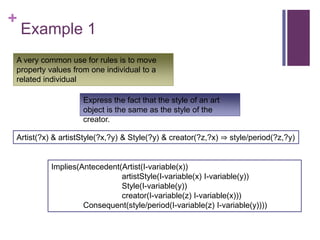
Example 1

A very common use for rules is to move
property values from one individual to a
related individual
Express the fact that the style of an art
object is the same as the style of the
creator.

Artist(?x) & artistStyle(?x,?y) & Style(?y) & creator(?z,?x) ⇒ style/period(?z,?y)

Implies(Antecedent(Artist(I-variable(x))
artistStyle(I-variable(x) I-variable(y))
Style(I-variable(y))
creator(I-variable(z) I-variable(x)))
Consequent(style/period(I-variable(z) I-variable(y))))
+

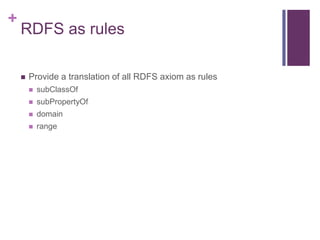
RDFS as rules


Provide a translation of all RDFS axiom as rules


subClassOf



subPropertyOf



domain



range
+

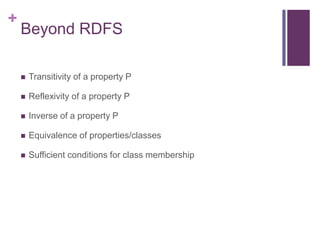
Beyond RDFS


Transitivity of a property P



Reflexivity of a property P



Inverse of a property P



Equivalence of properties/classes



Sufficient conditions for class membership
+

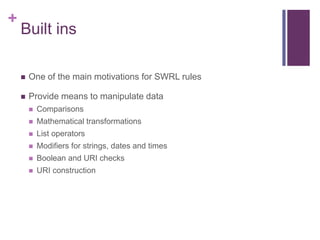
Built ins


One of the main motivations for SWRL rules



Provide means to manipulate data


Comparisons



Mathematical transformations



List operators



Modifiers for strings, dates and times



Boolean and URI checks



URI construction
+

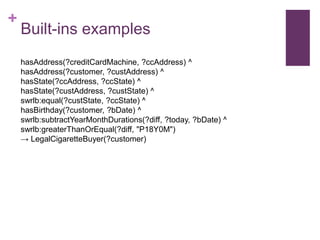
Built-ins examples
hasAddress(?creditCardMachine, ?ccAddress) ^
hasAddress(?customer, ?custAddress) ^
hasState(?ccAddress, ?ccState) ^
hasState(?custAddress, ?custState) ^
swrlb:equal(?custState, ?ccState) ^
hasBirthday(?customer, ?bDate) ^
swrlb:subtractYearMonthDurations(?diff, ?today, ?bDate) ^
swrlb:greaterThanOrEqual(?diff, "P18Y0M")
→ LegalCigaretteBuyer(?customer)
+

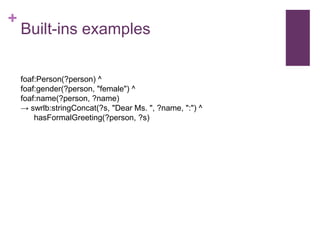
Built-ins examples
foaf:Person(?person) ^
foaf:gender(?person, "female") ^
foaf:name(?person, ?name)
→ swrlb:stringConcat(?s, "Dear Ms. ", ?name, ":") ^
hasFormalGreeting(?person, ?s)
+

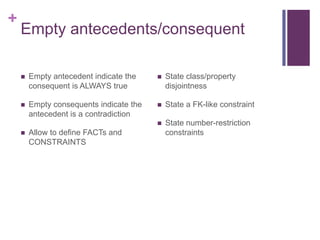
Empty antecedents/consequent


Empty antecedent indicate the
consequent is ALWAYS true



State class/property
disjointness



Empty consequents indicate the
antecedent is a contradiction



State a FK-like constraint



State number-restriction
constraints



Allow to define FACTs and
CONSTRAINTS
+

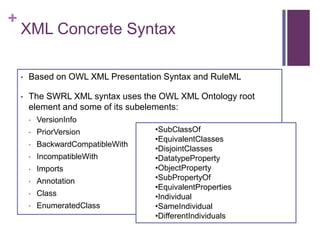
XML Concrete Syntax
•

Based on OWL XML Presentation Syntax and RuleML

•

The SWRL XML syntax uses the OWL XML Ontology root
element and some of its subelements:
•

VersionInfo

•

PriorVersion

•

BackwardCompatibleWith

•

IncompatibleWith

•

Imports

•

Annotation

•

Class

•

EnumeratedClass

•SubClassOf
•EquivalentClasses
•DisjointClasses
•DatatypeProperty
•ObjectProperty
•SubPropertyOf
•EquivalentProperties
•Individual
•SameIndividual
•DifferentIndividuals
+

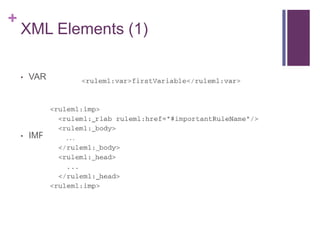
XML Elements (1)
•

VAR

•

IMP
+

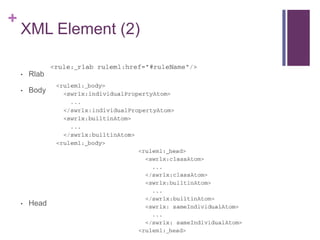
XML Element (2)
•

Rlab

•

Body

•

Head
+

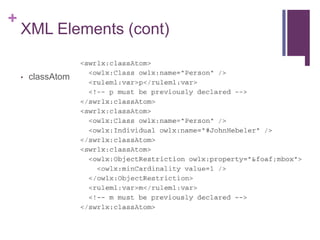
XML Elements (cont)
•

classAtom
+

XML Elements (cont)
•

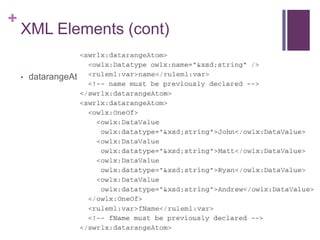
datarangeAtom
+

XML Elements (cont)
•

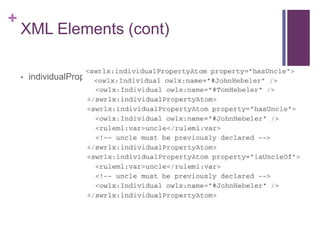
individualPropertyAxiom
+

XML Elements (cont)
•

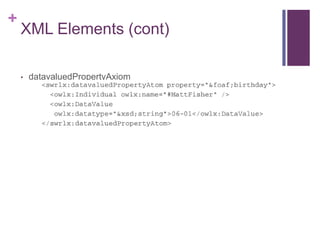
datavaluedPropertyAxiom
+

XML Elements (cont)
•

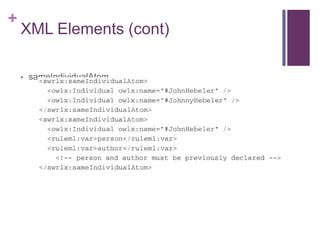
sameIndividualAtom
+

XML Elements (cont)
•

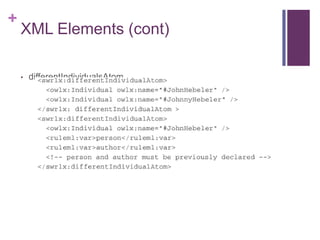
differentIndividualsAtom
+

XML Elements (cont)
•

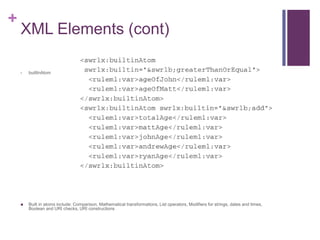
builtInAtom



Built in atoms include: Comparison, Mathematical transformations, List operators, Modifiers for strings, dates and times,
Boolean and URI checks, URI constructions
+

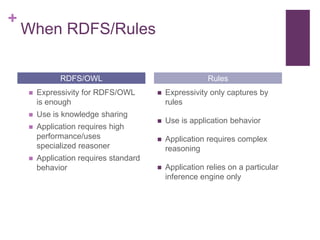
When RDFS/Rules
RDFS/OWL


Expressivity for RDFS/OWL
is enough



Use is knowledge sharing



Application requires high
performance/uses
specialized reasoner



Application requires standard
behavior

Rules


Expressivity only captures by
rules



Use is application behavior



Application requires complex
reasoning



Application relies on a particular
inference engine only
+

Conclusion


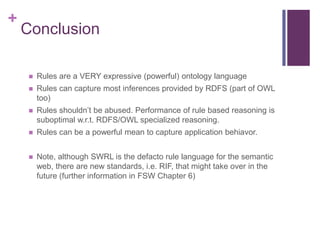
Rules are a VERY expressive (powerful) ontology language



Rules can capture most inferences provided by RDFS (part of OWL
too)



Rules shouldn’t be abused. Performance of rule based reasoning is
suboptimal w.r.t. RDFS/OWL specialized reasoning.



Rules can be a powerful mean to capture application behiavor.



Note, although SWRL is the defacto rule language for the semantic
web, there are new standards, i.e. RIF, that might take over in the
future (further information in FSW Chapter 6)

SWT Lecture Session 8 - Rules

  • 1.
  • 2.
    + Disclaimer  License  This work islicensed under a Creative Commons Attribution-Share Alike 3.0 License (http://creativecommons.org/licenses/by-sa/3.0/)
  • 3.
    + Reading material  Chapter 7.Semantic Web Programming  Chapter 6. Foundations of Semantic Web.
  • 4.
    + What are rules  Meansof representing knowledge  An ontology language  Can be seen as conditions statements: if [] then []  if x is a Man and x hasChild y Father(x)
  • 5.
    + Why rules  Easy tounderstand  RDFS (and sometimes OWL) is not enough: If a person x is the brother of somebody y, and there is z such that z is the uncle of x, then z is the uncle of y too. for all x,y,z, if hasBrother(x,y) & hasUncle(x,z) then hasUncle(y,z)
  • 6.
  • 7.
    + 7 SWRL  How can datalogand OWL be combined?  SWRL – Semantic Web Rule Language [swirl] • Proposal for a rule based Semantic Web Language (W3C member submission) http://www.w3.org/Submission/SWRL/ • Idea: datalog rules referring to RDF classes/properties Symbols in rules can be OWL identifiers or new symbols • Various further features and syntactic forms • Support in inference engines (very wide spread support)
  • 8.
    + SWRL Syntaxes  Two syntaxes: 1. Abstractsyntax based on “Extended Backus-Naur Form notation 1. Directly translatable to a Human readable syntax (SPARQL lie) 2. XML Concrete Syntax 1. Parsable by existing OWL/RDF/XML parsers 2. Suitable as a exchange language for the semantic web
  • 9.
  • 10.
    + Abstract Syntax Example Forthe rule: The corresponding abstract syntax:
  • 11.
    + Example 1 A verycommon use for rules is to move property values from one individual to a related individual Express the fact that the style of an art object is the same as the style of the creator. Artist(?x) & artistStyle(?x,?y) & Style(?y) & creator(?z,?x) ⇒ style/period(?z,?y) Implies(Antecedent(Artist(I-variable(x)) artistStyle(I-variable(x) I-variable(y)) Style(I-variable(y)) creator(I-variable(z) I-variable(x))) Consequent(style/period(I-variable(z) I-variable(y))))
  • 12.
    + RDFS as rules  Providea translation of all RDFS axiom as rules  subClassOf  subPropertyOf  domain  range
  • 13.
    + Beyond RDFS  Transitivity ofa property P  Reflexivity of a property P  Inverse of a property P  Equivalence of properties/classes  Sufficient conditions for class membership
  • 14.
    + Built ins  One ofthe main motivations for SWRL rules  Provide means to manipulate data  Comparisons  Mathematical transformations  List operators  Modifiers for strings, dates and times  Boolean and URI checks  URI construction
  • 15.
    + Built-ins examples hasAddress(?creditCardMachine, ?ccAddress)^ hasAddress(?customer, ?custAddress) ^ hasState(?ccAddress, ?ccState) ^ hasState(?custAddress, ?custState) ^ swrlb:equal(?custState, ?ccState) ^ hasBirthday(?customer, ?bDate) ^ swrlb:subtractYearMonthDurations(?diff, ?today, ?bDate) ^ swrlb:greaterThanOrEqual(?diff, "P18Y0M") → LegalCigaretteBuyer(?customer)
  • 16.
    + Built-ins examples foaf:Person(?person) ^ foaf:gender(?person,"female") ^ foaf:name(?person, ?name) → swrlb:stringConcat(?s, "Dear Ms. ", ?name, ":") ^ hasFormalGreeting(?person, ?s)
  • 17.
    + Empty antecedents/consequent  Empty antecedentindicate the consequent is ALWAYS true  State class/property disjointness  Empty consequents indicate the antecedent is a contradiction  State a FK-like constraint  State number-restriction constraints  Allow to define FACTs and CONSTRAINTS
  • 18.
    + XML Concrete Syntax • Basedon OWL XML Presentation Syntax and RuleML • The SWRL XML syntax uses the OWL XML Ontology root element and some of its subelements: • VersionInfo • PriorVersion • BackwardCompatibleWith • IncompatibleWith • Imports • Annotation • Class • EnumeratedClass •SubClassOf •EquivalentClasses •DisjointClasses •DatatypeProperty •ObjectProperty •SubPropertyOf •EquivalentProperties •Individual •SameIndividual •DifferentIndividuals
  • 19.
  • 20.
  • 21.
  • 22.
  • 23.
  • 24.
  • 25.
  • 26.
  • 27.
    + XML Elements (cont) • builtInAtom  Builtin atoms include: Comparison, Mathematical transformations, List operators, Modifiers for strings, dates and times, Boolean and URI checks, URI constructions
  • 28.
    + When RDFS/Rules RDFS/OWL  Expressivity forRDFS/OWL is enough  Use is knowledge sharing  Application requires high performance/uses specialized reasoner  Application requires standard behavior Rules  Expressivity only captures by rules  Use is application behavior  Application requires complex reasoning  Application relies on a particular inference engine only
  • 29.
    + Conclusion  Rules are aVERY expressive (powerful) ontology language  Rules can capture most inferences provided by RDFS (part of OWL too)  Rules shouldn’t be abused. Performance of rule based reasoning is suboptimal w.r.t. RDFS/OWL specialized reasoning.  Rules can be a powerful mean to capture application behiavor.  Note, although SWRL is the defacto rule language for the semantic web, there are new standards, i.e. RIF, that might take over in the future (further information in FSW Chapter 6)

Editor's Notes

  • #5 soundness, completeness, termintion
  • #6 soundness, completeness, termintion
  • #29 soundness, completeness, termintion
  • #30 soundness, completeness, termintion