Chapter 3:  Relational Model Structure of Relational Databases Relational Algebra Tuple Relational Calculus Domain Relational Calculus Extended Relational-Algebra-Operations Modification of the Database Views
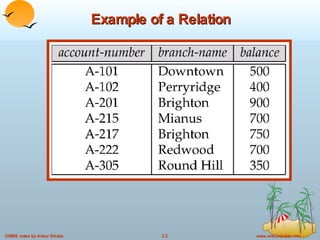
Example of a Relation
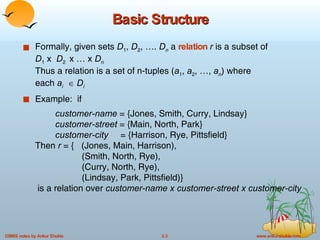
Basic Structure Formally, given sets  D 1 ,  D 2 , ….  D n  a  relation  r  is a subset of  D 1  x  D 2  x … x  D n Thus a relation is a set of n-tuples ( a 1 ,  a 2 , …,  a n ) where  each  a i      D i Example:  if customer-name  = {Jones, Smith, Curry, Lindsay} customer-street  = {Main, North, Park} customer-city   = {Harrison, Rye, Pittsfield} Then  r  = {  (Jones, Main, Harrison),    (Smith, North, Rye),   (Curry, North, Rye),   (Lindsay, Park, Pittsfield)}  is a relation over  customer-name x customer-street x customer-city
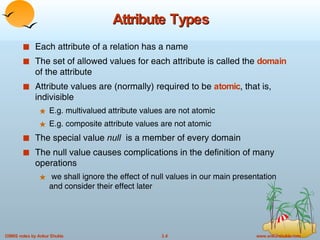
Attribute Types Each attribute of a relation has a name The set of allowed values for each attribute is called the  domain  of the attribute Attribute values are (normally) required to be  atomic , that is, indivisible E.g. multivalued attribute values are not atomic E.g. composite attribute values are not atomic The special value  null   is a member of every domain The null value causes complications in the definition of many operations we shall ignore the effect of null values in our main presentation and consider their effect later
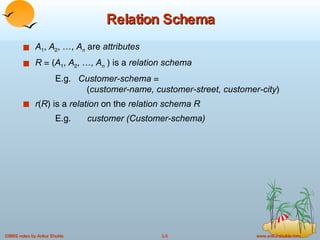
Relation Schema A 1 ,  A 2 , …,  A n   are  attributes R  = ( A 1 ,  A 2 , …,  A n  ) is a  relation schema E.g.  Customer-schema  =   ( customer-name, customer-street, customer-city ) r ( R ) is a  relation  on the  relation schema R E.g. customer (Customer-schema)
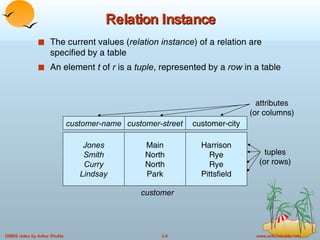
Relation Instance The current values ( relation instance ) of a relation are specified by a table An element  t  of  r  is a  tuple , represented by a  row  in a table Jones Smith Curry Lindsay customer-name Main North North Park customer-street Harrison Rye Rye Pittsfield customer-city customer attributes (or columns) tuples (or rows)
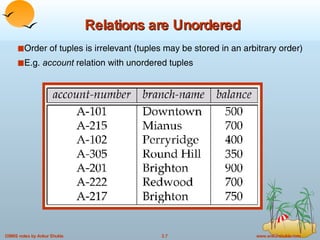
Relations are Unordered Order of tuples is irrelevant (tuples may be stored in an arbitrary order) E.g.  account  relation with unordered tuples
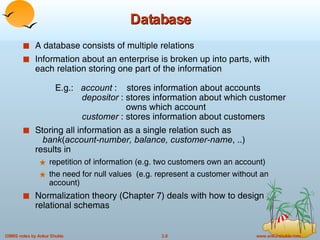
Database A database consists of multiple relations Information about an enterprise is broken up into parts, with each relation storing one part of the information E.g.:  account  :  stores information about accounts   depositor  : stores information about which customer   owns which account    customer  : stores information about customers Storing all information as a single relation such as    bank ( account-number, balance, customer-name , ..) results in repetition of information (e.g. two customers own an account) the need for null values  (e.g. represent a customer without an account) Normalization theory (Chapter 7) deals with how to design relational schemas
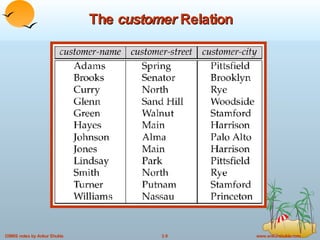
The  customer  Relation
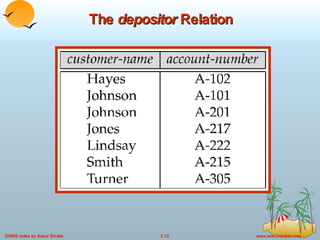
The  depositor  Relation
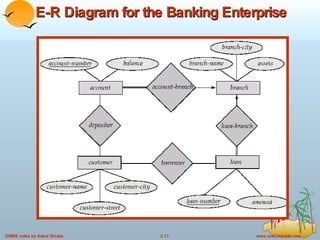
E-R Diagram for the Banking Enterprise
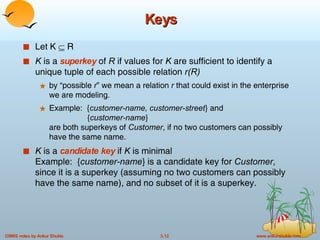
Keys Let K    R K  is a  superkey   of  R  if values for  K  are sufficient to identify a unique tuple of each possible relation  r(R)   by “possible  r ” we mean a relation  r  that could exist in the enterprise we are modeling. Example:  { customer-name, customer-street } and   { customer-name }  are both superkeys of  Customer , if no two customers can possibly have the same name. K  is a  candidate key  if  K  is minimal Example:  { customer-name } is a candidate key for  Customer , since it is a superkey (assuming no two customers can possibly have the same name), and no subset of it is a superkey.
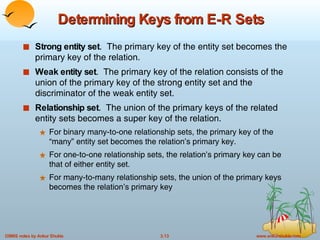
Determining Keys from E-R Sets Strong entity set .  The primary key of the entity set becomes the primary key of the relation. Weak entity set .  The primary key of the relation consists of the union of the primary key of the strong entity set and the discriminator of the weak entity set. Relationship set .  The union of the primary keys of the related  entity sets becomes a super key of the relation. For binary many-to-one relationship sets, the primary key of the “many” entity set becomes the relation’s primary key. For one-to-one relationship sets, the relation’s primary key can be that of either entity set. For many-to-many relationship sets, the union of the primary keys becomes the relation’s primary key
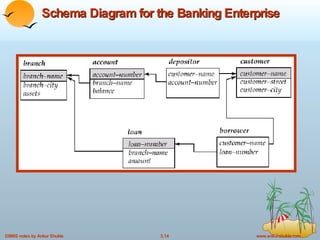
Schema Diagram for the Banking Enterprise
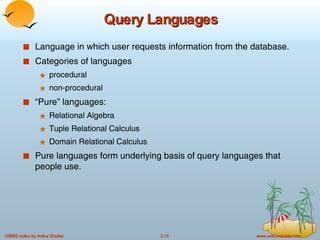
Query Languages Language in which user requests information from the database. Categories of languages procedural non-procedural “Pure” languages: Relational Algebra Tuple Relational Calculus Domain Relational Calculus Pure languages form underlying basis of query languages that people use.
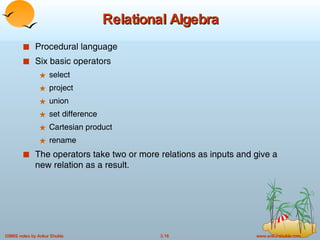
Relational Algebra Procedural language Six basic operators select project union set difference Cartesian product rename The operators take two or more relations as inputs and give a new relation as a result.
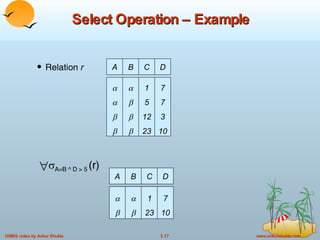
Select Operation – Example Relation  r A B C D         1 5 12 23 7 7 3 10  A=B ^ D > 5   (r) A B C D     1 23 7 10
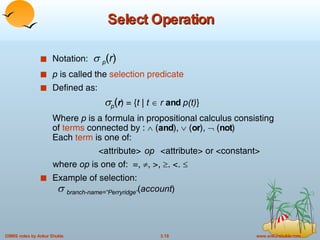
Select Operation Notation:     p ( r ) p  is called the  selection predicate Defined as:    p ( r ) = { t  |  t      r   and  p(t) } Where  p  is a formula in propositional calculus consisting of  terms  connected by :    ( and ),    ( or ),    ( not ) Each  term  is one of: <attribute> op   <attribute> or <constant> where  op  is one of:  =,   , >,   . <.   Example of selection:      branch-name=“Perryridge ” ( account )
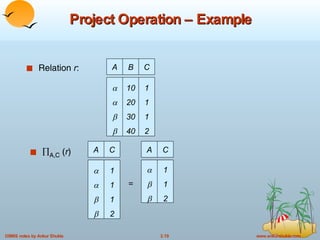
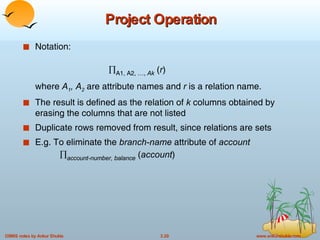
Project Operation – Example Relation  r : A B C     10 20 30 40 1 1 1 2 A C     1 1 1 2 = A C    1 1 2  A,C  ( r )
Project Operation Notation:  A1, A2, …,  Ak  ( r ) where  A 1 , A 2  are attribute names and  r  is a relation name. The result is defined as the relation of  k  columns obtained by erasing the columns that are not listed Duplicate rows removed from result, since relations are sets E.g. To eliminate the  branch-name  attribute of  account    account-number, balance  ( account )
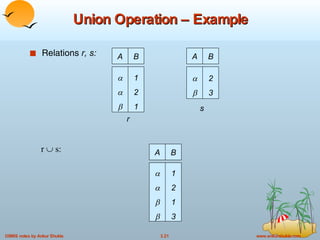
Union Operation – Example Relations  r, s: r    s: A B    1 2 1 A B   2 3 r s A B     1 2 1 3
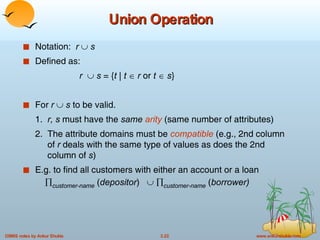
Union Operation Notation:  r      s Defined as:  r      s  = { t  |  t      r  or  t      s } For  r      s  to be valid. 1.  r,   s  must have the  same  arity  (same number of attributes) 2.  The attribute domains must be  compatible  (e.g., 2nd column    of  r  deals with the same type of values as does the 2nd    column of  s ) E.g. to find all customers with either an account or a loan    customer-name  ( depositor )      customer-name  ( borrower)
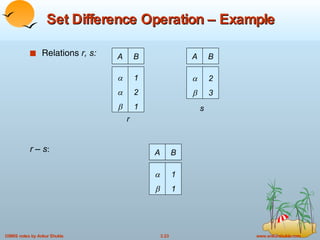
Set Difference Operation – Example Relations  r, s: r – s : A B    1 2 1 A B   2 3 r s A B   1 1
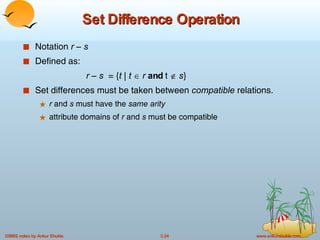
Set Difference Operation Notation  r – s Defined as:   r – s   = { t  |  t      r   and  t     s } Set differences must be taken between  compatible  relations. r  and  s  must have the  same arity attribute domains of  r  and  s  must be compatible
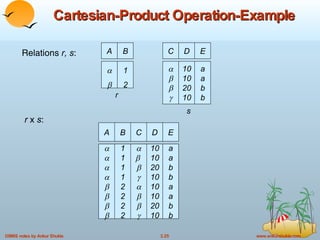
Cartesian-Product Operation-Example Relations  r, s : r  x  s : A B   1 2 A B         1 1 1 1 2 2 2 2 C D           10 10 20 10 10 10 20 10 E a a b b a a b b C D     10 10 20 10 E a a b b r s
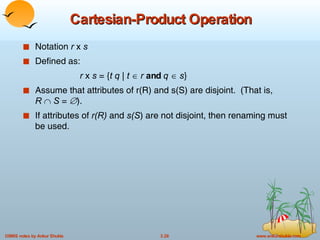
Cartesian-Product Operation Notation  r  x  s Defined as: r  x  s  = { t q  |  t    r  and  q     s } Assume that attributes of r(R) and s(S) are disjoint.  (That is,  R     S  =   ). If attributes of  r(R)  and  s(S ) are not disjoint, then renaming must be used.
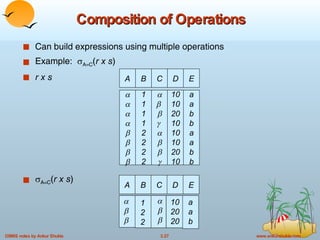
Composition of Operations Can build expressions using multiple operations Example:   A=C ( r x s ) r x s  A=C ( r x s ) A B         1 1 1 1 2 2 2 2 C D             10 10 20 10 10 10 20 10 E a a b b a a b b A B C D E    1 2 2    10 20 20 a a b
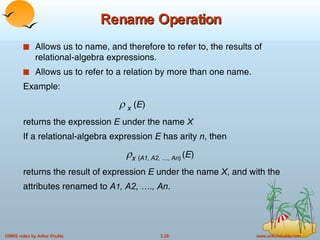
Rename Operation Allows us to name, and therefore to refer to, the results of relational-algebra expressions. Allows us to refer to a relation by more than one name. Example:    x  ( E ) returns the expression  E  under the name  X If a relational-algebra expression  E  has arity  n , then   x   ( A1, A2, …, An )   ( E ) returns the result of expression  E  under the name  X , and with the attributes renamed to  A 1 , A2, …., An .
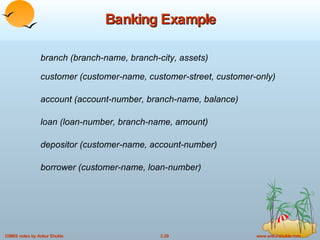
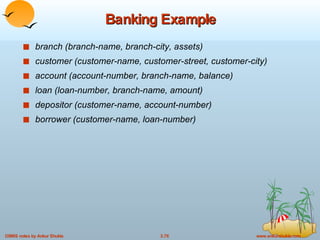
Banking Example branch (branch-name, branch-city, assets) customer (customer-name, customer-street, customer-only) account (account-number, branch-name, balance) loan (loan-number, branch-name, amount) depositor (customer-name, account-number) borrower (customer-name, loan-number)
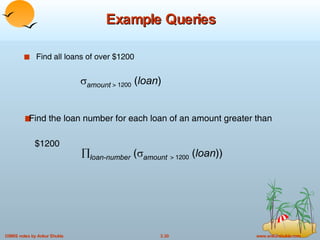
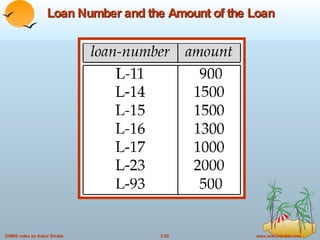
Example Queries Find all loans of over $1200 Find the loan number for each loan of an amount greater than  $1200  amount   > 1200  ( loan )  loan-number  (  amount   > 1200  ( loan ))
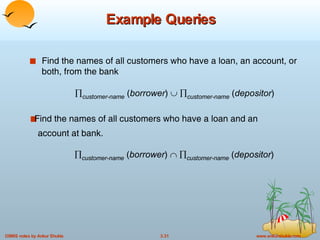
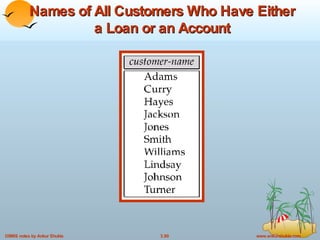
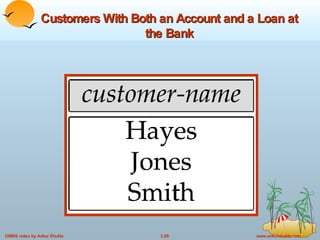
Example Queries Find the names of all customers who have a loan, an account, or both, from the bank Find the names of all customers who have a loan and an  account at bank.  customer-name  ( borrower )      customer-name  ( depositor )  customer-name  ( borrower )      customer-name  ( depositor )
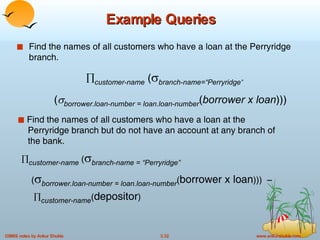
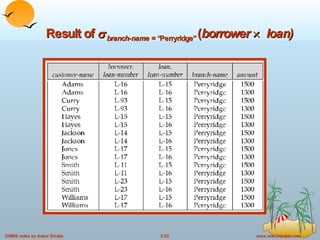
Example Queries Find the names of all customers who have a loan at the Perryridge branch. Find the names of all customers who have a loan at the    Perryridge branch but do not have an account at any branch of    the bank.  customer-name  (  branch-name = “Perryridge” (  borrower.loan-number = loan.loan-number ( borrower x loan )))  –     customer-name ( depositor )  customer-name  (  branch-name=“Perryridge ” (  borrower.loan-number = loan.loan-number ( borrower x loan )))
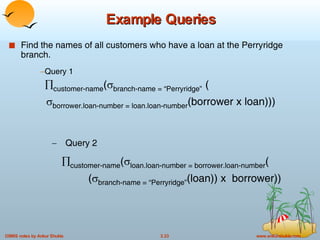
Example Queries Find the names of all customers who have a loan at the Perryridge branch.  Query 2  customer-name (  loan.loan-number = borrower.loan-number (   (  branch-name = “Perryridge” (loan)) x  borrower)) Query 1    customer-name (  branch-name = “Perryridge”   (    borrower.loan-number = loan.loan-number (borrower x loan)))
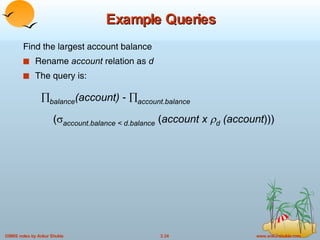
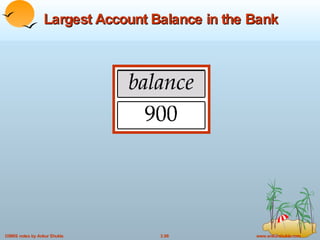
Example Queries Find the largest account balance Rename  account  relation as  d The query is:  balance (account)  -   account.balance (  account.balance < d.balance   ( account x   d  (account )))
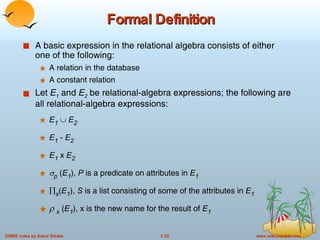
Formal Definition A basic expression in the relational algebra consists of either one of the following: A relation in the database A constant relation Let  E 1  and  E 2  be relational-algebra expressions; the following are all relational-algebra expressions: E 1      E 2 E 1  -  E 2 E 1  x  E 2  p  ( E 1 ),  P  is a predicate on attributes in  E 1  s ( E 1 ),  S  is a list consisting of some of the attributes in  E 1    x   ( E 1 ), x is the new name for the result of  E 1
Additional Operations We define additional operations that do not add any power to the relational algebra, but that simplify common queries. Set intersection Natural join Division Assignment
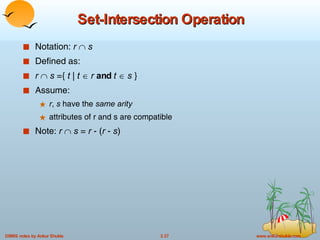
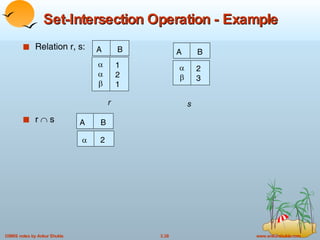
Set-Intersection Operation Notation:  r      s Defined as: r      s  ={  t  |  t      r   and   t      s  } Assume:  r ,  s  have the  same arity   attributes of r and s are compatible Note:  r      s  =  r  - ( r  -  s )
Set-Intersection Operation - Example Relation r, s: r    s A  B    1 2 1 A  B   2 3 r s A  B    2
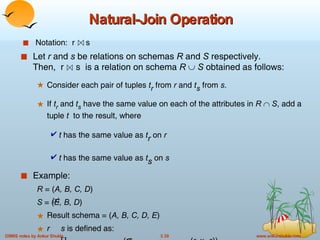
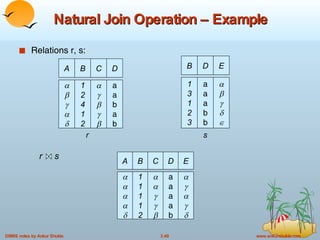
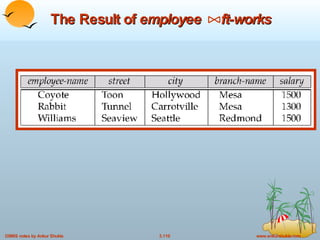
Natural-Join Operation Let  r  and  s  be relations on schemas  R  and  S  respectively.  Then,  r  s  is a relation on schema  R     S  obtained as follows: Consider each pair of tuples  t r  from  r  and  t s  from  s .  If  t r  and  t s  have the same value on each of the attributes in  R      S , add a tuple  t   to the result, where t  has the same value as  t r  on  r t  has the same value as  t s  on  s Example: R  = ( A, B, C, D ) S  = ( E, B, D ) Result schema = ( A, B, C, D, E ) r   s  is defined as:    r.A, r.B, r.C, r.D, s.E  (  r.B = s.B    r.D = s.D  ( r  x  s )) Notation:  r  s
Natural Join Operation – Example Relations r, s: A B      1 2 4 1 2 C D      a a b a b B 1 3 1 2 3 D a a a b b E      r A B      1 1 1 1 2 C D      a a a a b E      s r  s
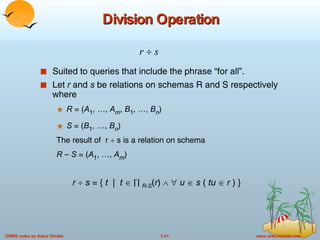
Division Operation Suited to queries that include the phrase “for all”. Let  r  and  s  be relations on schemas R and S respectively where R  = ( A 1 , …,  A m ,  B 1 , …,  B n ) S  = ( B 1 , …,  B n ) The result of  r    s is a relation on schema R  –  S  = ( A 1 , …,  A m ) r     s  = {  t   |  t        R-S ( r )        u     s  (  tu     r  ) }  r     s
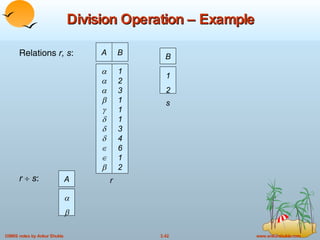
Division Operation – Example Relations  r, s : r      s : A B   1 2 A B            1 2 3 1 1 1 3 4 6 1 2 r s
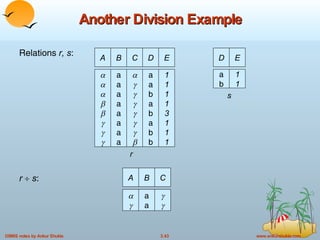
Another Division Example A B         a a a a a a a a C D         a a b a b a b b E 1 1 1 1 3 1 1 1 Relations  r, s : r      s : D a b E 1 1 A B   a a C   r s
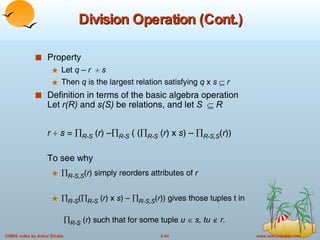
Division Operation (Cont.) Property  Let  q – r    s Then  q  is the largest relation satisfying  q  x  s      r Definition in terms of the basic algebra operation Let  r(R)  and  s(S)  be relations, and let  S     R r      s  =   R-S  ( r ) –  R-S  ( (  R-S   ( r ) x  s ) –   R-S,S ( r )) To see why  R-S,S ( r ) simply reorders attributes of  r  R-S (  R-S   ( r ) x  s ) –   R-S,S ( r )) gives those tuples t in     R-S   ( r ) such that for some tuple  u     s, tu     r .
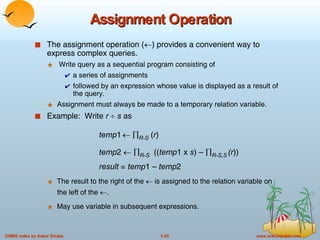
Assignment Operation The assignment operation (  ) provides a convenient way to express complex queries.  Write query as a sequential program consisting of a series of assignments  followed by an expression whose value is displayed as a result of the query. Assignment must always be made to a temporary relation variable. Example:  Write  r      s  as  temp 1       R-S  ( r )  temp 2      R-S   (( temp 1 x  s ) –   R-S,S   (r )) result  =  temp 1 –  temp 2 The result to the right of the    is assigned to the relation variable on the left of the   . May use variable in subsequent expressions.
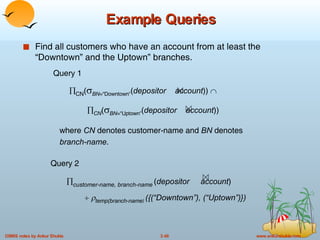
Example Queries Find all customers who have an account from at least the “Downtown” and the Uptown” branches. where  CN  denotes customer-name and  BN  denotes  branch-name . Query 1  CN (  BN =“Downtown ” ( depositor   account ))    CN (  BN =“Uptown ” ( depositor   account )) Query 2  customer-name, branch-name   ( depositor   account )       temp(branch-name )  ({(“Downtown”), (“Uptown”)})
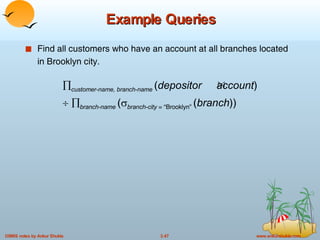
Find all customers who have an account at all branches located in Brooklyn city. Example Queries  customer-name, branch-name   ( depositor   account )     branch-name  (  branch-city  = “Brooklyn”  ( branch ))
Extended Relational-Algebra-Operations Generalized Projection Outer Join Aggregate Functions
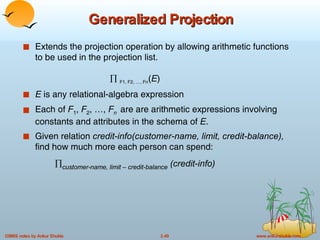
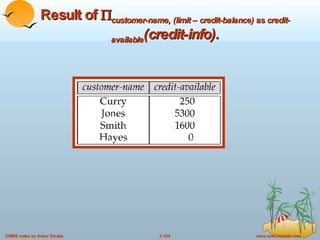
Generalized Projection Extends the projection operation by allowing arithmetic functions to be used in the projection list.    F1, F2, …, Fn ( E ) E  is any relational-algebra expression Each of  F 1 ,  F 2 , …,  F n   are are arithmetic expressions involving constants and attributes in the schema of  E . Given relation  credit-info(customer-name, limit, credit-balance),  find how much more each person can spend:   customer-name, limit – credit-balance  (credit-info)
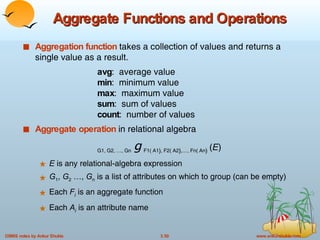
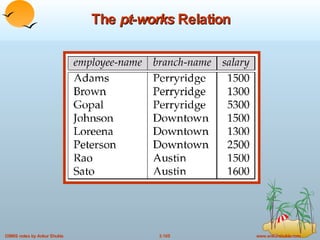
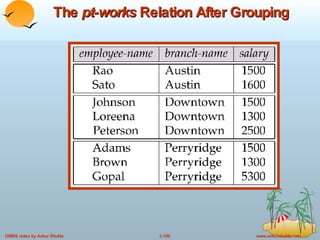
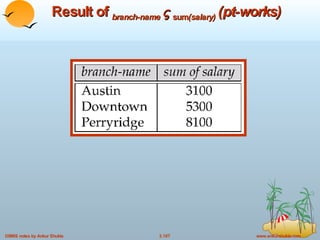
Aggregate Functions and Operations Aggregation function  takes a collection of values and returns a single value as a result. avg :  average value min :  minimum value max :  maximum value sum :  sum of values count :  number of values Aggregate operation  in relational algebra  G1, G2, …, Gn   g   F1( A1 ) , F2( A2 ) ,…, Fn( An )   ( E ) E  is any relational-algebra expression G 1 ,  G 2  …,  G n  is a list of attributes on which to group (can be empty) Each  F i   is an aggregate function Each  A i   is an attribute name
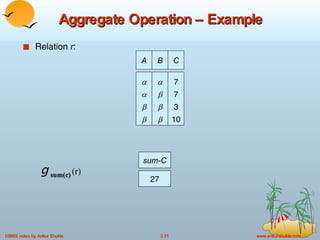
Aggregate Operation – Example Relation  r : A B         C 7 7 3 10 g   sum(c)   (r) sum-C 27
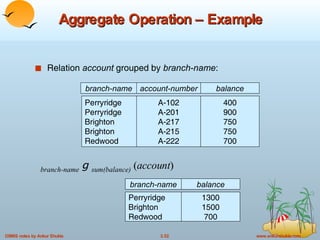
Aggregate Operation – Example Relation  account  grouped by  branch-name : branch-name   g  sum(balance)  ( account ) branch-name account-number balance Perryridge Perryridge Brighton Brighton Redwood A-102 A-201 A-217 A-215 A-222 400 900 750 750 700 branch-name balance Perryridge Brighton Redwood 1300 1500 700
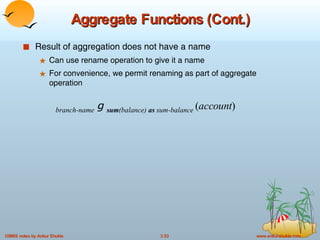
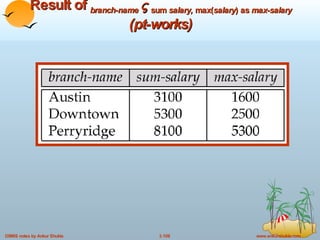
Aggregate Functions (Cont.) Result of aggregation does not have a name Can use rename operation to give it a name For convenience, we permit renaming as part of aggregate operation branch-name   g  sum (balance)  as  sum-balance  ( account )
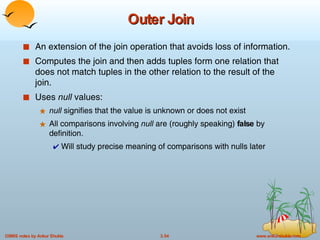
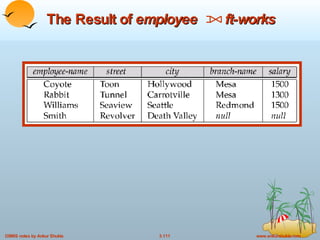
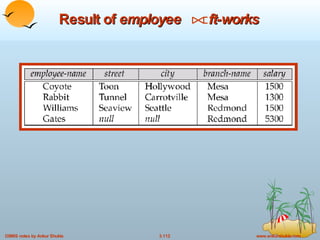
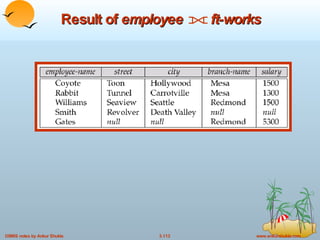
Outer Join An extension of the join operation that avoids loss of information. Computes the join and then adds tuples form one relation that does not match tuples in the other relation to the result of the join.  Uses  null  values: null  signifies that the value is unknown or does not exist  All comparisons involving  null  are (roughly speaking)  false  by definition. Will study precise meaning of comparisons with nulls later
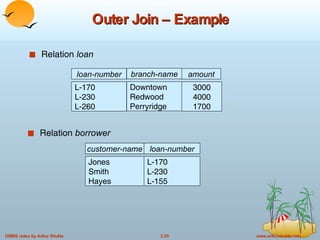
Outer Join – Example Relation  loan Relation  borrower customer-name loan-number Jones Smith Hayes L-170 L-230 L-155 3000 4000 1700 loan-number amount L-170 L-230 L-260 branch-name Downtown Redwood Perryridge
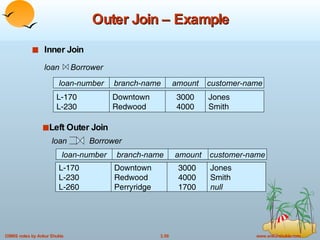
Outer Join – Example Inner Join loan  Borrower loan-number amount L-170 L-230 3000 4000 customer-name Jones Smith branch-name Downtown Redwood Jones Smith null loan-number amount L-170 L-230 L-260 3000 4000 1700 customer-name branch-name Downtown Redwood Perryridge Left Outer Join loan  Borrower
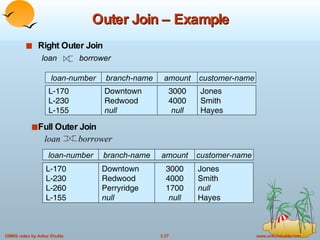
Outer Join – Example Right Outer Join loan   borrower loan  borrower Full Outer Join loan-number amount L-170 L-230 L-155 3000 4000 null customer-name Jones Smith Hayes branch-name Downtown Redwood null loan-number amount L-170 L-230 L-260 L-155 3000 4000 1700 null customer-name Jones Smith null Hayes branch-name Downtown Redwood Perryridge null
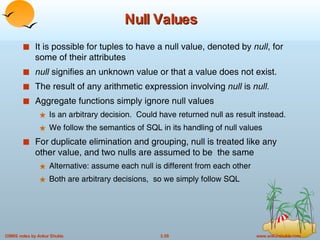
Null Values It is possible for tuples to have a null value, denoted by  null , for some of their attributes null  signifies an unknown value or that a value does not exist. The result of any arithmetic expression involving  null  is  null. Aggregate functions simply ignore null values Is an arbitrary decision.  Could have returned null as result instead. We follow the semantics of SQL in its handling of null values For duplicate elimination and grouping, null is treated like any other value, and two nulls are assumed to be  the same Alternative: assume each null is different from each other Both are arbitrary decisions,  so we simply follow SQL
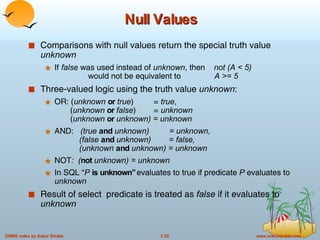
Null Values Comparisons with null values return the special truth value  unknown If  false  was used instead of  unknown , then  not (A < 5)     would not be equivalent to  A >= 5 Three-valued logic using the truth value  unknown : OR: ( unknown   or   true )  =  true ,    ( unknown   or   false )  =  unknown   ( unknown  or  unknown) = unknown AND:   (true  and  unknown)  = unknown,    (false  and  unknown)  = false,   (unknown  and  unknown) = unknown NOT :  ( not  unknown) = unknown In SQL “ P  is unknown”  evaluates to true if predicate  P  evaluates to  unknown Result of select   predicate is treated as  false  if it evaluates to  unknown
Modification of the Database The content of the database may be modified using the following operations: Deletion Insertion Updating All these operations are expressed using the assignment operator.
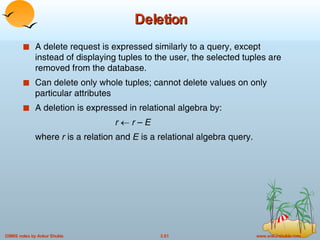
Deletion A delete request is expressed similarly to a query, except instead of displaying tuples to the user, the selected tuples are removed from the database. Can delete only whole tuples; cannot delete values on only particular attributes A deletion is expressed in relational algebra by: r      r  –  E where  r  is a relation and  E  is a relational algebra query.
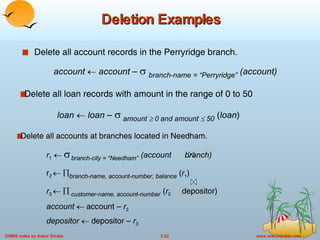
Deletion Examples Delete all account records in the Perryridge branch. Delete all accounts at branches located in Needham. Delete all loan records with amount in the range of 0 to 50 loan     loan  –    amount   0  and amount    50  ( loan ) account     account  –   branch-name = “Perryridge”  (account) r 1        branch-city = “Needham”   (account  branch) r 2      branch-name, account-number, balance  ( r 1 ) r 3        customer-name, account-number   ( r 2   depositor) account    account –  r 2 depositor    depositor –  r 3
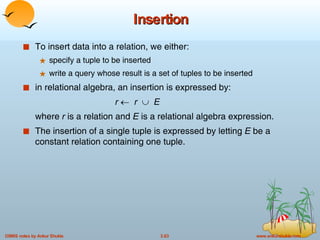
Insertion To insert data into a relation, we either: specify a tuple to be inserted write a query whose result is a set of tuples to be inserted in relational algebra, an insertion is expressed by: r     r      E where  r  is a relation and  E  is a relational algebra expression. The insertion of a single tuple is expressed by letting  E  be a constant relation containing one tuple.
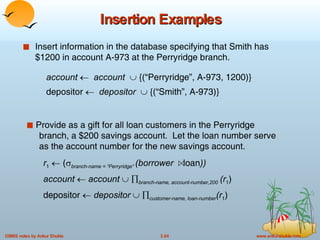
Insertion Examples Insert information in the database specifying that Smith has $1200 in account A-973 at the Perryridge branch. Provide as a gift for all loan customers in the Perryridge   branch, a $200 savings account.  Let the loan number serve   as the account number for the new savings account. account     account     {(“Perryridge”, A-973, 1200)} depositor     depositor     {(“Smith”, A-973)} r 1     (  branch-name = “Perryridge”  (borrower  loan )) account     account       branch-name, account-number,200   (r 1 ) depositor     depositor      customer-name, loan-number (r 1 )
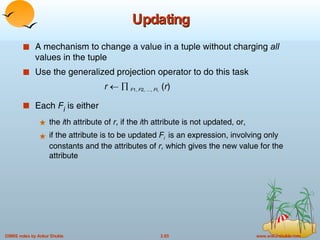
Updating A mechanism to change a value in a tuple without charging  all  values in the tuple Use the generalized projection operator to do this task r         F 1,  F 2, …,  F I,  ( r ) Each  F i  is either  the  i th attribute of  r , if the  i th attribute is not updated, or, if the attribute is to be updated  F i   is an expression, involving only constants and the attributes of  r , which gives the new value for the attribute
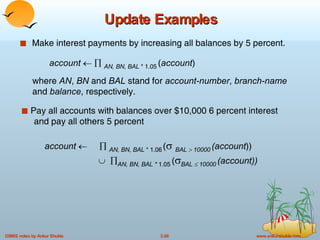
Update Examples Make interest payments by increasing all balances by 5 percent. Pay all accounts with balances over $10,000 6 percent interest    and pay all others 5 percent  account         AN, BN, BAL  * 1.06   (    BAL    10000   (account ))       AN, BN, BAL *  1.05   (  BAL    10000   (account)) account        AN, BN, BAL  * 1.05   ( account ) where  AN ,  BN   and  BAL   stand for  account-number ,  branch-name  and  balance , respectively.
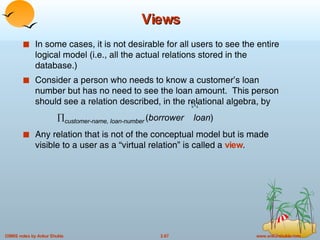
Views In some cases, it is not desirable for all users to see the entire logical model (i.e., all the actual relations stored in the database.) Consider a person who needs to know a customer’s loan number but has no need to see the loan amount.  This person should see a relation described, in the relational algebra, by   customer-name, loan-number   ( borrower  loan ) Any relation that is not of the conceptual model but is made visible to a user as a “virtual relation” is called a  view .
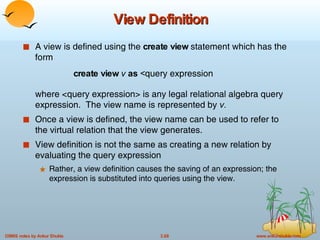
View Definition A view is defined using the  create view  statement which has the form create view  v  as  < query expression where <query expression> is any legal relational algebra query expression.  The view name is represented by  v. Once a view is defined, the view name can be used to refer to the virtual relation that the view generates. View definition is not the same as creating a new relation by evaluating the query expression  Rather, a view definition causes the saving of an expression; the expression is substituted into queries using the view.
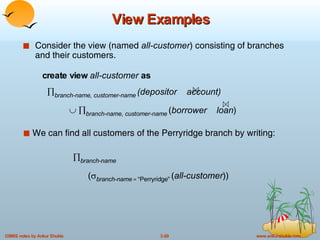
View Examples Consider the view (named  all-customer ) consisting of branches and their customers. We can find all customers of the Perryridge branch by writing:  branch-name   (  branch-name   =  “Perryridge”   ( all-customer )) create view  all-customer  as  branch-name, customer-name   (depositor  account)     branch-name, customer-name   ( borrower   loan )
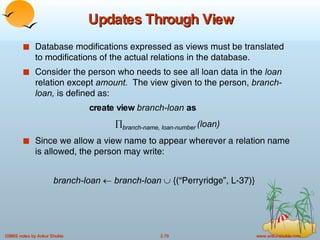
Updates Through View Database modifications expressed as views must be translated to modifications of the actual relations in the database. Consider the person who needs to see all loan data in the  loan  relation except  amount.   The view given to the person,  branch-loan,  is defined as:  create view  branch-loan  as  branch-name, loan-number   (loan) Since we allow a view name to appear wherever a relation name is allowed, the person may write: branch-loan     branch-loan    {(“Perryridge”, L-37)}
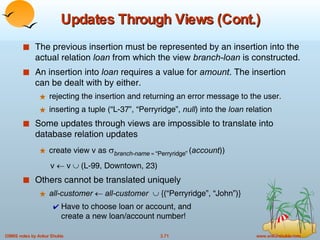
Updates Through Views (Cont.) The previous insertion must be represented by an insertion into the actual relation  loan  from which the view  branch-loan  is constructed. An insertion into  loan  requires a value for  amount . The insertion can be dealt with by either. rejecting the insertion and returning an error message to the user. inserting a tuple (“L-37”, “Perryridge”,  null ) into the  loan  relation Some updates through views are impossible to translate into database relation updates create view v as   branch-name   =  “Perryridge”   ( account )) v    v    (L-99, Downtown, 23) Others cannot be translated uniquely all-customer      all-customer     {(“Perryridge”, “John”)} Have to choose loan or account, and  create a new loan/account number!
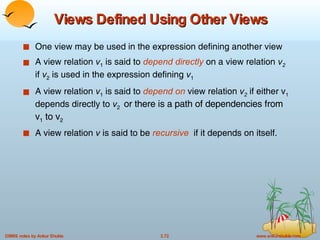
Views Defined Using Other Views One view may be used in the expression defining another view  A view relation  v 1  is said to  depend directly   on a view relation  v 2   if  v 2  is used in the expression defining  v 1 A view relation  v 1  is said to  depend on  view relation  v 2   if either v 1  depends directly to  v 2  or there is a path of dependencies from v 1  to v 2   A view relation  v  is said to be  recursive   if it depends on itself.
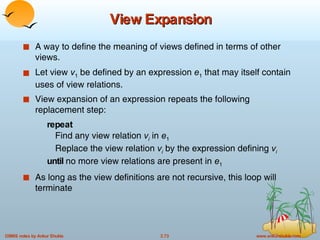
View Expansion A way to define the meaning of views defined in terms of other views. Let view  v 1  be defined by an expression  e 1  that may itself contain uses of view relations. View expansion of an expression repeats the following replacement step: repeat Find any view relation  v i  in  e 1 Replace the view relation  v i  by the expression defining  v i   until  no more view relations are present in  e 1 As long as the view definitions are not recursive, this loop will terminate
Tuple Relational Calculus A nonprocedural query language, where each query is of the form { t  |  P  ( t ) } It is the set of all tuples  t  such that predicate  P  is true for  t t  is a  tuple variable ,  t [ A ] denotes the value of tuple  t  on attribute  A t      r  denotes that tuple  t  is in relation  r P  is a  formula  similar to that of the predicate calculus
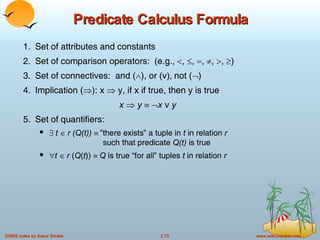
Predicate Calculus Formula 1. Set of attributes and constants 2. Set of comparison operators:  (e.g.,   ,   ,   ,   ,   ,   ) 3. Set of connectives:  and (  ), or (v)‚ not (  ) 4. Implication (  ): x    y, if x if true, then y is true x      y    x  v  y 5. Set of quantifiers:   t    r (Q(t))    ”there exists” a tuple in  t  in relation  r   such that predicate  Q(t)  is true  t   r  ( Q ( t ))   Q  is true “for all” tuples  t  in relation  r
Banking Example branch (branch-name, branch-city, assets)  customer (customer-name, customer-street, customer-city)  account (account-number, branch-name, balance)  loan (loan-number, branch-name, amount) depositor (customer-name, account-number) borrower (customer-name, loan-number)
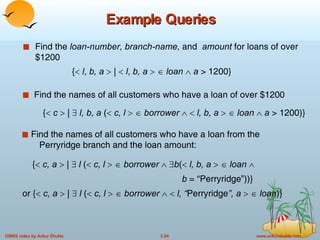
Example Queries Find the  loan-number, branch-name,  and  amount  for loans of over $1200 Find the loan number for each loan of an amount greater than $1200 Notice that a relation on schema [ loan-number ] is implicitly defined by the query { t |    s   loan ( t [ loan-number ] =  s [ loan-number ]     s  [ amount ]    1200)} { t  |  t      loan      t  [ amount ]    1200}
Example Queries Find the names of all customers having a loan, an account, or both at the bank { t |   s     borrower( t [ customer-name ] =  s [ customer-name ])       u     depositor (  t [ customer-name ] =  u [ customer-name ]) Find the names of all customers who have a loan and an account    at the bank { t |   s     borrower( t [ customer-name ] =  s [ customer-name ])       u     depositor (  t [ customer-name ] =  u [ customer-name ])
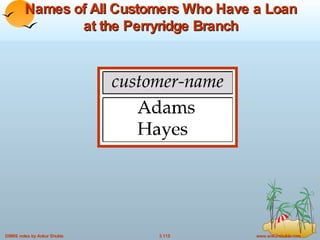
Example Queries Find the names of all customers having a loan at the Perryridge branch { t |   s     borrower( t [ customer-name ] =  s [customer-name]       u     loan ( u [ branch-name ] = “Perryridge”      u [ loan-number ] =  s [loan- number ]))      not    v     depositor  ( v [ customer-name ] =    t [customer-name]) } Find the names of all customers who have a loan at the    Perryridge branch, but no account at any branch of the bank { t |   s     borrower(t [ customer-name ] =  s [ customer-name ]        u     loan ( u [ branch-name ] = “Perryridge”      u [ loan-number ] =  s [ loan-number ]))}
Example Queries Find the names of all customers having a loan from the Perryridge branch, and the cities they live in { t |   s     loan(s [ branch-name ] = “Perryridge”       u     borrower (u [ loan-number ] =  s [ loan-number ]      t  [ customer-name ] =  u [ customer-name ])        v     customer (u [ customer-name ] =  v [ customer-name ]      t [ customer-city ] =  v [ customer-city ])))}
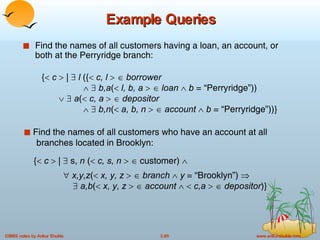
Example Queries Find the names of all customers who have an account at all branches located in Brooklyn: { t |    c    customer ( t [customer.name] = c[customer-name])        s     branch(s [ branch-city ] = “Brooklyn”          u     account ( s [ branch-name ] =  u [branch-name]        s     depositor (  t [ customer-name ] =  s [customer-name]      s [ account-number ] =  u [account-number] )) )}
Safety of Expressions It is possible to write tuple calculus expressions that generate infinite relations. For example, {t |     t    r } results in an infinite relation if the domain of any attribute of relation  r  is infinite To guard against the problem, we restrict the set of allowable expressions to safe expressions. An expression { t  |  P ( t )}   in the tuple relational calculus is  safe  if every component of  t  appears in one of the relations, tuples, or constants that appear in  P NOTE: this is more than just a syntax condition.  E.g. {  t  |  t [ A ]=5     true  } is not safe --- it defines an infinite set with attribute values that do not appear in any relation or tuples or constants in  P .
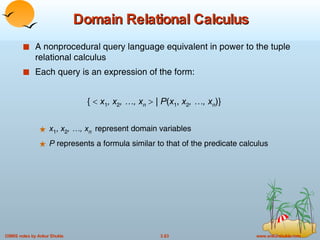
Domain Relational Calculus A nonprocedural query language equivalent in power to the tuple relational calculus Each query is an expression of the form: {     x 1 , x 2 , …, x n     |  P ( x 1 ,  x 2 , …, x n )} x 1 ,  x 2 , …, x n   represent domain variables P  represents a formula similar to that of the predicate calculus
Example Queries Find the  loan-number, branch-name,  and  amount  for loans of over $1200 {    c, a     |     l  (    c, l         borrower      b (    l, b, a        loan      b  = “Perryridge”))} or {    c, a     |     l  (    c, l         borrower        l, “ Perryridge ”, a        loan )} Find the names of all customers who have a loan from the    Perryridge branch and the loan amount: {    c     |     l, b, a  (    c, l        borrower        l, b, a        loan      a  > 1200)} Find the names of all customers who have a loan of over $1200 {    l ,  b, a    |     l ,  b, a        loan      a  > 1200}
Example Queries Find the names of all customers having a loan, an account, or both at the Perryridge branch: {    c     |    s,  n  (    c, s, n        customer)      x,y,z (    x, y, z        branch      y  = “Brooklyn”)        a,b (    x, y, z        account         c,a         depositor )}  Find the names of all customers who have an account at all    branches located in Brooklyn: {    c     |     l  ({    c, l         borrower          b,a (    l, b, a        loan      b  = “Perryridge”))         a (    c, a         depositor         b,n (    a, b, n        account      b  = “Perryridge”))}
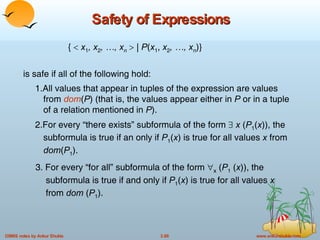
Safety of Expressions {     x 1 , x 2 , …, x n     |  P ( x 1 ,  x 2 , …, x n )} is safe if all of the following hold: 1. All values that appear in tuples of the expression are values   from  dom ( P ) (that is, the values appear either in  P  or in a tuple   of a relation mentioned in  P ). 2. For every “there exists” subformula of the form     x  ( P 1 ( x )), the   subformula is true if an only if  P 1 ( x ) is true for all values  x  from    dom ( P 1 ). 3. For every “for all” subformula of the form   x  ( P 1  ( x )), the    subformula is true if and only if  P 1 ( x ) is true for all values  x     from  dom  ( P 1 ).
End of Chapter 3
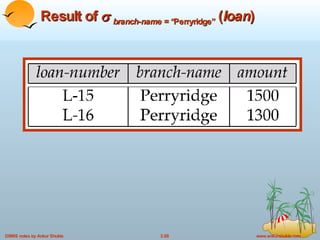
Result of     branch-name =  “Perryridge”  ( loan )
Loan Number and the Amount of the Loan
Names of All Customers Who Have Either a Loan or an Account
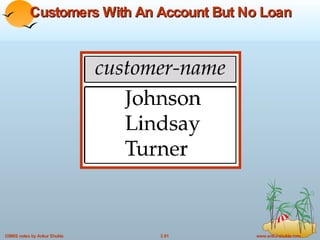
Customers With An Account But No Loan
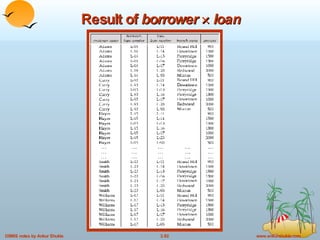
Result of  borrower     loan
Result of    branch-name =  “Perryridge”  ( borrower     loan)
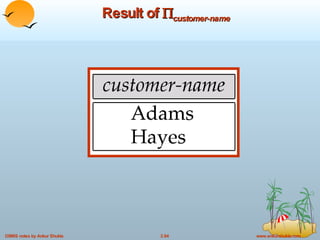
Result of   customer-name
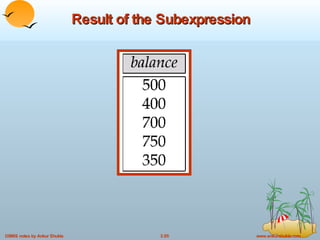
Result of the Subexpression
Largest Account Balance in the Bank
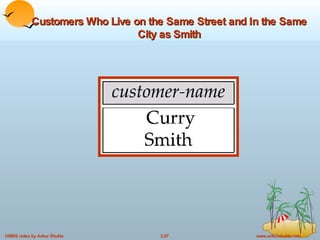
Customers Who Live on the Same Street and In the Same City as Smith
Customers With Both an Account and a Loan at the Bank
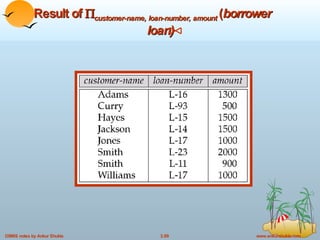
Result of   customer-name, loan-number, amount   ( borrower  loan)
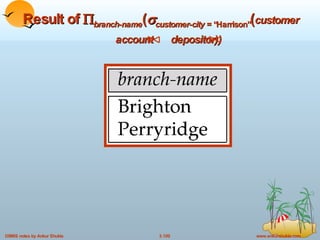
Result of   branch-name (  customer-city =  “Harrison” ( customer   account  depositor))
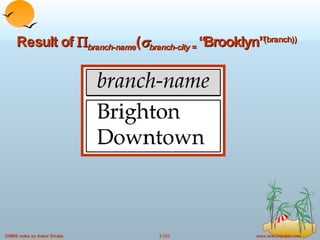
Result of   branch-name (  branch-city =  “Brooklyn” (branch))
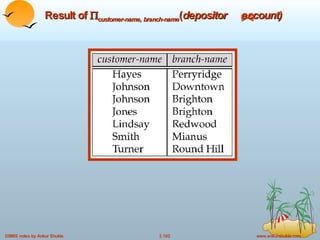
Result of   customer-name, branch-name ( depositor  account)
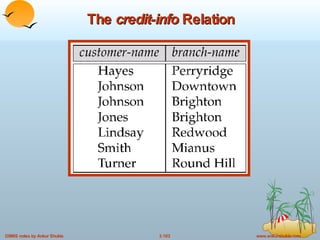
The  credit-info  Relation
Result of   customer-name, (limit – credit-balance)  as  credit-available (credit-info).
The  pt-works  Relation
The  pt-works  Relation After Grouping
Result of  branch-name     sum (salary)  (pt-works)
Result of  branch-name     sum  salary,  max( salary ) as  max-salary  (pt-works)
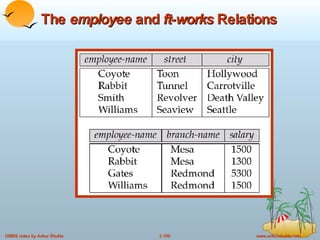
The  employee  and  ft-works  Relations
The Result of  employee  ft-works
The Result of  employee   ft-works
Result of  employee  ft-works
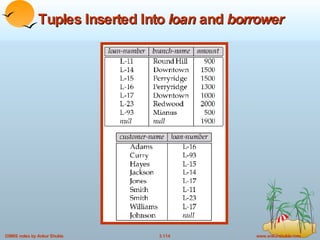
Tuples Inserted Into  loan  and  borrower
Names of All Customers Who Have a Loan at the Perryridge Branch
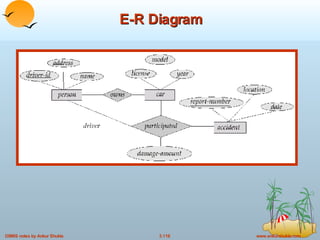
E-R Diagram
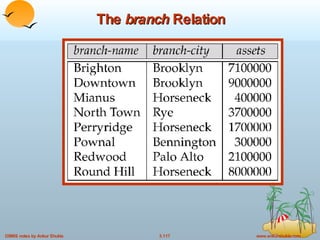
The  branch  Relation
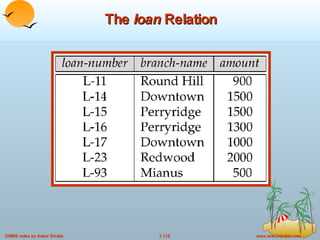
The  loan  Relation
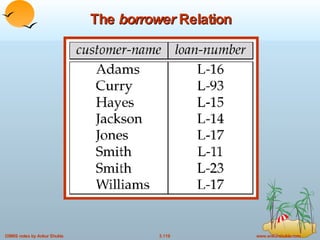
The  borrower  Relation

3. Relational Models in DBMS

  • 1.
    Chapter 3: Relational Model Structure of Relational Databases Relational Algebra Tuple Relational Calculus Domain Relational Calculus Extended Relational-Algebra-Operations Modification of the Database Views
  • 2.
    Example of aRelation
  • 3.
    Basic Structure Formally,given sets D 1 , D 2 , …. D n a relation r is a subset of D 1 x D 2 x … x D n Thus a relation is a set of n-tuples ( a 1 , a 2 , …, a n ) where each a i  D i Example: if customer-name = {Jones, Smith, Curry, Lindsay} customer-street = {Main, North, Park} customer-city = {Harrison, Rye, Pittsfield} Then r = { (Jones, Main, Harrison), (Smith, North, Rye), (Curry, North, Rye), (Lindsay, Park, Pittsfield)} is a relation over customer-name x customer-street x customer-city
  • 4.
    Attribute Types Eachattribute of a relation has a name The set of allowed values for each attribute is called the domain of the attribute Attribute values are (normally) required to be atomic , that is, indivisible E.g. multivalued attribute values are not atomic E.g. composite attribute values are not atomic The special value null is a member of every domain The null value causes complications in the definition of many operations we shall ignore the effect of null values in our main presentation and consider their effect later
  • 5.
    Relation Schema A1 , A 2 , …, A n are attributes R = ( A 1 , A 2 , …, A n ) is a relation schema E.g. Customer-schema = ( customer-name, customer-street, customer-city ) r ( R ) is a relation on the relation schema R E.g. customer (Customer-schema)
  • 6.
    Relation Instance Thecurrent values ( relation instance ) of a relation are specified by a table An element t of r is a tuple , represented by a row in a table Jones Smith Curry Lindsay customer-name Main North North Park customer-street Harrison Rye Rye Pittsfield customer-city customer attributes (or columns) tuples (or rows)
  • 7.
    Relations are UnorderedOrder of tuples is irrelevant (tuples may be stored in an arbitrary order) E.g. account relation with unordered tuples
  • 8.
    Database A databaseconsists of multiple relations Information about an enterprise is broken up into parts, with each relation storing one part of the information E.g.: account : stores information about accounts depositor : stores information about which customer owns which account customer : stores information about customers Storing all information as a single relation such as bank ( account-number, balance, customer-name , ..) results in repetition of information (e.g. two customers own an account) the need for null values (e.g. represent a customer without an account) Normalization theory (Chapter 7) deals with how to design relational schemas
  • 9.
    The customer Relation
  • 10.
    The depositor Relation
  • 11.
    E-R Diagram forthe Banking Enterprise
  • 12.
    Keys Let K  R K is a superkey of R if values for K are sufficient to identify a unique tuple of each possible relation r(R) by “possible r ” we mean a relation r that could exist in the enterprise we are modeling. Example: { customer-name, customer-street } and { customer-name } are both superkeys of Customer , if no two customers can possibly have the same name. K is a candidate key if K is minimal Example: { customer-name } is a candidate key for Customer , since it is a superkey (assuming no two customers can possibly have the same name), and no subset of it is a superkey.
  • 13.
    Determining Keys fromE-R Sets Strong entity set . The primary key of the entity set becomes the primary key of the relation. Weak entity set . The primary key of the relation consists of the union of the primary key of the strong entity set and the discriminator of the weak entity set. Relationship set . The union of the primary keys of the related entity sets becomes a super key of the relation. For binary many-to-one relationship sets, the primary key of the “many” entity set becomes the relation’s primary key. For one-to-one relationship sets, the relation’s primary key can be that of either entity set. For many-to-many relationship sets, the union of the primary keys becomes the relation’s primary key
  • 14.
    Schema Diagram forthe Banking Enterprise
  • 15.
    Query Languages Languagein which user requests information from the database. Categories of languages procedural non-procedural “Pure” languages: Relational Algebra Tuple Relational Calculus Domain Relational Calculus Pure languages form underlying basis of query languages that people use.
  • 16.
    Relational Algebra Procedurallanguage Six basic operators select project union set difference Cartesian product rename The operators take two or more relations as inputs and give a new relation as a result.
  • 17.
    Select Operation –Example Relation r A B C D         1 5 12 23 7 7 3 10  A=B ^ D > 5 (r) A B C D     1 23 7 10
  • 18.
    Select Operation Notation:  p ( r ) p is called the selection predicate Defined as:  p ( r ) = { t | t  r and p(t) } Where p is a formula in propositional calculus consisting of terms connected by :  ( and ),  ( or ),  ( not ) Each term is one of: <attribute> op <attribute> or <constant> where op is one of: =,  , >,  . <.  Example of selection:  branch-name=“Perryridge ” ( account )
  • 19.
    Project Operation –Example Relation r : A B C     10 20 30 40 1 1 1 2 A C     1 1 1 2 = A C    1 1 2  A,C ( r )
  • 20.
    Project Operation Notation: A1, A2, …, Ak ( r ) where A 1 , A 2 are attribute names and r is a relation name. The result is defined as the relation of k columns obtained by erasing the columns that are not listed Duplicate rows removed from result, since relations are sets E.g. To eliminate the branch-name attribute of account  account-number, balance ( account )
  • 21.
    Union Operation –Example Relations r, s: r  s: A B    1 2 1 A B   2 3 r s A B     1 2 1 3
  • 22.
    Union Operation Notation: r  s Defined as: r  s = { t | t  r or t  s } For r  s to be valid. 1. r, s must have the same arity (same number of attributes) 2. The attribute domains must be compatible (e.g., 2nd column of r deals with the same type of values as does the 2nd column of s ) E.g. to find all customers with either an account or a loan  customer-name ( depositor )   customer-name ( borrower)
  • 23.
    Set Difference Operation– Example Relations r, s: r – s : A B    1 2 1 A B   2 3 r s A B   1 1
  • 24.
    Set Difference OperationNotation r – s Defined as: r – s = { t | t  r and t  s } Set differences must be taken between compatible relations. r and s must have the same arity attribute domains of r and s must be compatible
  • 25.
    Cartesian-Product Operation-Example Relations r, s : r x s : A B   1 2 A B         1 1 1 1 2 2 2 2 C D         10 10 20 10 10 10 20 10 E a a b b a a b b C D     10 10 20 10 E a a b b r s
  • 26.
    Cartesian-Product Operation Notation r x s Defined as: r x s = { t q | t  r and q  s } Assume that attributes of r(R) and s(S) are disjoint. (That is, R  S =  ). If attributes of r(R) and s(S ) are not disjoint, then renaming must be used.
  • 27.
    Composition of OperationsCan build expressions using multiple operations Example:  A=C ( r x s ) r x s  A=C ( r x s ) A B         1 1 1 1 2 2 2 2 C D         10 10 20 10 10 10 20 10 E a a b b a a b b A B C D E    1 2 2    10 20 20 a a b
  • 28.
    Rename Operation Allowsus to name, and therefore to refer to, the results of relational-algebra expressions. Allows us to refer to a relation by more than one name. Example:  x ( E ) returns the expression E under the name X If a relational-algebra expression E has arity n , then  x ( A1, A2, …, An ) ( E ) returns the result of expression E under the name X , and with the attributes renamed to A 1 , A2, …., An .
  • 29.
    Banking Example branch(branch-name, branch-city, assets) customer (customer-name, customer-street, customer-only) account (account-number, branch-name, balance) loan (loan-number, branch-name, amount) depositor (customer-name, account-number) borrower (customer-name, loan-number)
  • 30.
    Example Queries Findall loans of over $1200 Find the loan number for each loan of an amount greater than $1200  amount > 1200 ( loan )  loan-number (  amount > 1200 ( loan ))
  • 31.
    Example Queries Findthe names of all customers who have a loan, an account, or both, from the bank Find the names of all customers who have a loan and an account at bank.  customer-name ( borrower )   customer-name ( depositor )  customer-name ( borrower )   customer-name ( depositor )
  • 32.
    Example Queries Findthe names of all customers who have a loan at the Perryridge branch. Find the names of all customers who have a loan at the Perryridge branch but do not have an account at any branch of the bank.  customer-name (  branch-name = “Perryridge” (  borrower.loan-number = loan.loan-number ( borrower x loan ))) –  customer-name ( depositor )  customer-name (  branch-name=“Perryridge ” (  borrower.loan-number = loan.loan-number ( borrower x loan )))
  • 33.
    Example Queries Findthe names of all customers who have a loan at the Perryridge branch.  Query 2  customer-name (  loan.loan-number = borrower.loan-number ( (  branch-name = “Perryridge” (loan)) x borrower)) Query 1  customer-name (  branch-name = “Perryridge” (  borrower.loan-number = loan.loan-number (borrower x loan)))
  • 34.
    Example Queries Findthe largest account balance Rename account relation as d The query is:  balance (account) -  account.balance (  account.balance < d.balance ( account x  d (account )))
  • 35.
    Formal Definition Abasic expression in the relational algebra consists of either one of the following: A relation in the database A constant relation Let E 1 and E 2 be relational-algebra expressions; the following are all relational-algebra expressions: E 1  E 2 E 1 - E 2 E 1 x E 2  p ( E 1 ), P is a predicate on attributes in E 1  s ( E 1 ), S is a list consisting of some of the attributes in E 1  x ( E 1 ), x is the new name for the result of E 1
  • 36.
    Additional Operations Wedefine additional operations that do not add any power to the relational algebra, but that simplify common queries. Set intersection Natural join Division Assignment
  • 37.
    Set-Intersection Operation Notation: r  s Defined as: r  s ={ t | t  r and t  s } Assume: r , s have the same arity attributes of r and s are compatible Note: r  s = r - ( r - s )
  • 38.
    Set-Intersection Operation -Example Relation r, s: r  s A B    1 2 1 A B   2 3 r s A B  2
  • 39.
    Natural-Join Operation Let r and s be relations on schemas R and S respectively. Then, r s is a relation on schema R  S obtained as follows: Consider each pair of tuples t r from r and t s from s . If t r and t s have the same value on each of the attributes in R  S , add a tuple t to the result, where t has the same value as t r on r t has the same value as t s on s Example: R = ( A, B, C, D ) S = ( E, B, D ) Result schema = ( A, B, C, D, E ) r s is defined as:  r.A, r.B, r.C, r.D, s.E (  r.B = s.B  r.D = s.D ( r x s )) Notation: r s
  • 40.
    Natural Join Operation– Example Relations r, s: A B      1 2 4 1 2 C D      a a b a b B 1 3 1 2 3 D a a a b b E      r A B      1 1 1 1 2 C D      a a a a b E      s r s
  • 41.
    Division Operation Suitedto queries that include the phrase “for all”. Let r and s be relations on schemas R and S respectively where R = ( A 1 , …, A m , B 1 , …, B n ) S = ( B 1 , …, B n ) The result of r  s is a relation on schema R – S = ( A 1 , …, A m ) r  s = { t | t   R-S ( r )   u  s ( tu  r ) } r  s
  • 42.
    Division Operation –Example Relations r, s : r  s : A B   1 2 A B            1 2 3 1 1 1 3 4 6 1 2 r s
  • 43.
    Another Division ExampleA B         a a a a a a a a C D         a a b a b a b b E 1 1 1 1 3 1 1 1 Relations r, s : r  s : D a b E 1 1 A B   a a C   r s
  • 44.
    Division Operation (Cont.)Property Let q – r  s Then q is the largest relation satisfying q x s  r Definition in terms of the basic algebra operation Let r(R) and s(S) be relations, and let S  R r  s =  R-S ( r ) –  R-S ( (  R-S ( r ) x s ) –  R-S,S ( r )) To see why  R-S,S ( r ) simply reorders attributes of r  R-S (  R-S ( r ) x s ) –  R-S,S ( r )) gives those tuples t in  R-S ( r ) such that for some tuple u  s, tu  r .
  • 45.
    Assignment Operation Theassignment operation (  ) provides a convenient way to express complex queries. Write query as a sequential program consisting of a series of assignments followed by an expression whose value is displayed as a result of the query. Assignment must always be made to a temporary relation variable. Example: Write r  s as temp 1   R-S ( r ) temp 2   R-S (( temp 1 x s ) –  R-S,S (r )) result = temp 1 – temp 2 The result to the right of the  is assigned to the relation variable on the left of the  . May use variable in subsequent expressions.
  • 46.
    Example Queries Findall customers who have an account from at least the “Downtown” and the Uptown” branches. where CN denotes customer-name and BN denotes branch-name . Query 1  CN (  BN =“Downtown ” ( depositor account ))   CN (  BN =“Uptown ” ( depositor account )) Query 2  customer-name, branch-name ( depositor account )   temp(branch-name ) ({(“Downtown”), (“Uptown”)})
  • 47.
    Find all customerswho have an account at all branches located in Brooklyn city. Example Queries  customer-name, branch-name ( depositor account )   branch-name (  branch-city = “Brooklyn” ( branch ))
  • 48.
    Extended Relational-Algebra-Operations GeneralizedProjection Outer Join Aggregate Functions
  • 49.
    Generalized Projection Extendsthe projection operation by allowing arithmetic functions to be used in the projection list.  F1, F2, …, Fn ( E ) E is any relational-algebra expression Each of F 1 , F 2 , …, F n are are arithmetic expressions involving constants and attributes in the schema of E . Given relation credit-info(customer-name, limit, credit-balance), find how much more each person can spend:  customer-name, limit – credit-balance (credit-info)
  • 50.
    Aggregate Functions andOperations Aggregation function takes a collection of values and returns a single value as a result. avg : average value min : minimum value max : maximum value sum : sum of values count : number of values Aggregate operation in relational algebra G1, G2, …, Gn g F1( A1 ) , F2( A2 ) ,…, Fn( An ) ( E ) E is any relational-algebra expression G 1 , G 2 …, G n is a list of attributes on which to group (can be empty) Each F i is an aggregate function Each A i is an attribute name
  • 51.
    Aggregate Operation –Example Relation r : A B         C 7 7 3 10 g sum(c) (r) sum-C 27
  • 52.
    Aggregate Operation –Example Relation account grouped by branch-name : branch-name g sum(balance) ( account ) branch-name account-number balance Perryridge Perryridge Brighton Brighton Redwood A-102 A-201 A-217 A-215 A-222 400 900 750 750 700 branch-name balance Perryridge Brighton Redwood 1300 1500 700
  • 53.
    Aggregate Functions (Cont.)Result of aggregation does not have a name Can use rename operation to give it a name For convenience, we permit renaming as part of aggregate operation branch-name g sum (balance) as sum-balance ( account )
  • 54.
    Outer Join Anextension of the join operation that avoids loss of information. Computes the join and then adds tuples form one relation that does not match tuples in the other relation to the result of the join. Uses null values: null signifies that the value is unknown or does not exist All comparisons involving null are (roughly speaking) false by definition. Will study precise meaning of comparisons with nulls later
  • 55.
    Outer Join –Example Relation loan Relation borrower customer-name loan-number Jones Smith Hayes L-170 L-230 L-155 3000 4000 1700 loan-number amount L-170 L-230 L-260 branch-name Downtown Redwood Perryridge
  • 56.
    Outer Join –Example Inner Join loan Borrower loan-number amount L-170 L-230 3000 4000 customer-name Jones Smith branch-name Downtown Redwood Jones Smith null loan-number amount L-170 L-230 L-260 3000 4000 1700 customer-name branch-name Downtown Redwood Perryridge Left Outer Join loan Borrower
  • 57.
    Outer Join –Example Right Outer Join loan borrower loan borrower Full Outer Join loan-number amount L-170 L-230 L-155 3000 4000 null customer-name Jones Smith Hayes branch-name Downtown Redwood null loan-number amount L-170 L-230 L-260 L-155 3000 4000 1700 null customer-name Jones Smith null Hayes branch-name Downtown Redwood Perryridge null
  • 58.
    Null Values Itis possible for tuples to have a null value, denoted by null , for some of their attributes null signifies an unknown value or that a value does not exist. The result of any arithmetic expression involving null is null. Aggregate functions simply ignore null values Is an arbitrary decision. Could have returned null as result instead. We follow the semantics of SQL in its handling of null values For duplicate elimination and grouping, null is treated like any other value, and two nulls are assumed to be the same Alternative: assume each null is different from each other Both are arbitrary decisions, so we simply follow SQL
  • 59.
    Null Values Comparisonswith null values return the special truth value unknown If false was used instead of unknown , then not (A < 5) would not be equivalent to A >= 5 Three-valued logic using the truth value unknown : OR: ( unknown or true ) = true , ( unknown or false ) = unknown ( unknown or unknown) = unknown AND: (true and unknown) = unknown, (false and unknown) = false, (unknown and unknown) = unknown NOT : ( not unknown) = unknown In SQL “ P is unknown” evaluates to true if predicate P evaluates to unknown Result of select predicate is treated as false if it evaluates to unknown
  • 60.
    Modification of theDatabase The content of the database may be modified using the following operations: Deletion Insertion Updating All these operations are expressed using the assignment operator.
  • 61.
    Deletion A deleterequest is expressed similarly to a query, except instead of displaying tuples to the user, the selected tuples are removed from the database. Can delete only whole tuples; cannot delete values on only particular attributes A deletion is expressed in relational algebra by: r  r – E where r is a relation and E is a relational algebra query.
  • 62.
    Deletion Examples Deleteall account records in the Perryridge branch. Delete all accounts at branches located in Needham. Delete all loan records with amount in the range of 0 to 50 loan  loan –   amount  0  and amount  50 ( loan ) account  account –  branch-name = “Perryridge” (account) r 1    branch-city = “Needham” (account branch) r 2   branch-name, account-number, balance ( r 1 ) r 3   customer-name, account-number ( r 2 depositor) account  account – r 2 depositor  depositor – r 3
  • 63.
    Insertion To insertdata into a relation, we either: specify a tuple to be inserted write a query whose result is a set of tuples to be inserted in relational algebra, an insertion is expressed by: r  r  E where r is a relation and E is a relational algebra expression. The insertion of a single tuple is expressed by letting E be a constant relation containing one tuple.
  • 64.
    Insertion Examples Insertinformation in the database specifying that Smith has $1200 in account A-973 at the Perryridge branch. Provide as a gift for all loan customers in the Perryridge branch, a $200 savings account. Let the loan number serve as the account number for the new savings account. account  account  {(“Perryridge”, A-973, 1200)} depositor  depositor  {(“Smith”, A-973)} r 1  (  branch-name = “Perryridge” (borrower loan )) account  account   branch-name, account-number,200 (r 1 ) depositor  depositor   customer-name, loan-number (r 1 )
  • 65.
    Updating A mechanismto change a value in a tuple without charging all values in the tuple Use the generalized projection operator to do this task r   F 1, F 2, …, F I, ( r ) Each F i is either the i th attribute of r , if the i th attribute is not updated, or, if the attribute is to be updated F i is an expression, involving only constants and the attributes of r , which gives the new value for the attribute
  • 66.
    Update Examples Makeinterest payments by increasing all balances by 5 percent. Pay all accounts with balances over $10,000 6 percent interest and pay all others 5 percent account   AN, BN, BAL * 1.06 (  BAL  10000 (account ))   AN, BN, BAL * 1.05 (  BAL  10000 (account)) account   AN, BN, BAL * 1.05 ( account ) where AN , BN and BAL stand for account-number , branch-name and balance , respectively.
  • 67.
    Views In somecases, it is not desirable for all users to see the entire logical model (i.e., all the actual relations stored in the database.) Consider a person who needs to know a customer’s loan number but has no need to see the loan amount. This person should see a relation described, in the relational algebra, by  customer-name, loan-number ( borrower loan ) Any relation that is not of the conceptual model but is made visible to a user as a “virtual relation” is called a view .
  • 68.
    View Definition Aview is defined using the create view statement which has the form create view v as < query expression where <query expression> is any legal relational algebra query expression. The view name is represented by v. Once a view is defined, the view name can be used to refer to the virtual relation that the view generates. View definition is not the same as creating a new relation by evaluating the query expression Rather, a view definition causes the saving of an expression; the expression is substituted into queries using the view.
  • 69.
    View Examples Considerthe view (named all-customer ) consisting of branches and their customers. We can find all customers of the Perryridge branch by writing:  branch-name (  branch-name = “Perryridge” ( all-customer )) create view all-customer as  branch-name, customer-name (depositor account)   branch-name, customer-name ( borrower loan )
  • 70.
    Updates Through ViewDatabase modifications expressed as views must be translated to modifications of the actual relations in the database. Consider the person who needs to see all loan data in the loan relation except amount. The view given to the person, branch-loan, is defined as: create view branch-loan as  branch-name, loan-number (loan) Since we allow a view name to appear wherever a relation name is allowed, the person may write: branch-loan  branch-loan  {(“Perryridge”, L-37)}
  • 71.
    Updates Through Views(Cont.) The previous insertion must be represented by an insertion into the actual relation loan from which the view branch-loan is constructed. An insertion into loan requires a value for amount . The insertion can be dealt with by either. rejecting the insertion and returning an error message to the user. inserting a tuple (“L-37”, “Perryridge”, null ) into the loan relation Some updates through views are impossible to translate into database relation updates create view v as  branch-name = “Perryridge” ( account )) v  v  (L-99, Downtown, 23) Others cannot be translated uniquely all-customer  all-customer  {(“Perryridge”, “John”)} Have to choose loan or account, and create a new loan/account number!
  • 72.
    Views Defined UsingOther Views One view may be used in the expression defining another view A view relation v 1 is said to depend directly on a view relation v 2 if v 2 is used in the expression defining v 1 A view relation v 1 is said to depend on view relation v 2 if either v 1 depends directly to v 2 or there is a path of dependencies from v 1 to v 2 A view relation v is said to be recursive if it depends on itself.
  • 73.
    View Expansion Away to define the meaning of views defined in terms of other views. Let view v 1 be defined by an expression e 1 that may itself contain uses of view relations. View expansion of an expression repeats the following replacement step: repeat Find any view relation v i in e 1 Replace the view relation v i by the expression defining v i until no more view relations are present in e 1 As long as the view definitions are not recursive, this loop will terminate
  • 74.
    Tuple Relational CalculusA nonprocedural query language, where each query is of the form { t | P ( t ) } It is the set of all tuples t such that predicate P is true for t t is a tuple variable , t [ A ] denotes the value of tuple t on attribute A t  r denotes that tuple t is in relation r P is a formula similar to that of the predicate calculus
  • 75.
    Predicate Calculus Formula1. Set of attributes and constants 2. Set of comparison operators: (e.g.,  ,  ,  ,  ,  ,  ) 3. Set of connectives: and (  ), or (v)‚ not (  ) 4. Implication (  ): x  y, if x if true, then y is true x  y  x v y 5. Set of quantifiers:   t   r (Q(t))   ”there exists” a tuple in t in relation r such that predicate Q(t) is true  t  r ( Q ( t ))  Q is true “for all” tuples t in relation r
  • 76.
    Banking Example branch(branch-name, branch-city, assets) customer (customer-name, customer-street, customer-city) account (account-number, branch-name, balance) loan (loan-number, branch-name, amount) depositor (customer-name, account-number) borrower (customer-name, loan-number)
  • 77.
    Example Queries Findthe loan-number, branch-name, and amount for loans of over $1200 Find the loan number for each loan of an amount greater than $1200 Notice that a relation on schema [ loan-number ] is implicitly defined by the query { t |  s  loan ( t [ loan-number ] = s [ loan-number ]  s [ amount ]  1200)} { t | t  loan  t [ amount ]  1200}
  • 78.
    Example Queries Findthe names of all customers having a loan, an account, or both at the bank { t |  s  borrower( t [ customer-name ] = s [ customer-name ])   u  depositor ( t [ customer-name ] = u [ customer-name ]) Find the names of all customers who have a loan and an account at the bank { t |  s  borrower( t [ customer-name ] = s [ customer-name ])   u  depositor ( t [ customer-name ] = u [ customer-name ])
  • 79.
    Example Queries Findthe names of all customers having a loan at the Perryridge branch { t |  s  borrower( t [ customer-name ] = s [customer-name]   u  loan ( u [ branch-name ] = “Perryridge”  u [ loan-number ] = s [loan- number ]))  not  v  depositor ( v [ customer-name ] = t [customer-name]) } Find the names of all customers who have a loan at the Perryridge branch, but no account at any branch of the bank { t |  s  borrower(t [ customer-name ] = s [ customer-name ]   u  loan ( u [ branch-name ] = “Perryridge”  u [ loan-number ] = s [ loan-number ]))}
  • 80.
    Example Queries Findthe names of all customers having a loan from the Perryridge branch, and the cities they live in { t |  s  loan(s [ branch-name ] = “Perryridge”   u  borrower (u [ loan-number ] = s [ loan-number ]  t [ customer-name ] = u [ customer-name ])   v  customer (u [ customer-name ] = v [ customer-name ]  t [ customer-city ] = v [ customer-city ])))}
  • 81.
    Example Queries Findthe names of all customers who have an account at all branches located in Brooklyn: { t |  c  customer ( t [customer.name] = c[customer-name])   s  branch(s [ branch-city ] = “Brooklyn”   u  account ( s [ branch-name ] = u [branch-name]   s  depositor ( t [ customer-name ] = s [customer-name]  s [ account-number ] = u [account-number] )) )}
  • 82.
    Safety of ExpressionsIt is possible to write tuple calculus expressions that generate infinite relations. For example, {t |  t  r } results in an infinite relation if the domain of any attribute of relation r is infinite To guard against the problem, we restrict the set of allowable expressions to safe expressions. An expression { t | P ( t )} in the tuple relational calculus is safe if every component of t appears in one of the relations, tuples, or constants that appear in P NOTE: this is more than just a syntax condition. E.g. { t | t [ A ]=5  true } is not safe --- it defines an infinite set with attribute values that do not appear in any relation or tuples or constants in P .
  • 83.
    Domain Relational CalculusA nonprocedural query language equivalent in power to the tuple relational calculus Each query is an expression of the form: {  x 1 , x 2 , …, x n  | P ( x 1 , x 2 , …, x n )} x 1 , x 2 , …, x n represent domain variables P represents a formula similar to that of the predicate calculus
  • 84.
    Example Queries Findthe loan-number, branch-name, and amount for loans of over $1200 {  c, a  |  l (  c, l   borrower   b (  l, b, a   loan  b = “Perryridge”))} or {  c, a  |  l (  c, l   borrower   l, “ Perryridge ”, a   loan )} Find the names of all customers who have a loan from the Perryridge branch and the loan amount: {  c  |  l, b, a (  c, l   borrower   l, b, a   loan  a > 1200)} Find the names of all customers who have a loan of over $1200 {  l , b, a  |  l , b, a   loan  a > 1200}
  • 85.
    Example Queries Findthe names of all customers having a loan, an account, or both at the Perryridge branch: {  c  |  s, n (  c, s, n   customer)   x,y,z (  x, y, z   branch  y = “Brooklyn”)   a,b (  x, y, z   account   c,a   depositor )} Find the names of all customers who have an account at all branches located in Brooklyn: {  c  |  l ({  c, l   borrower   b,a (  l, b, a   loan  b = “Perryridge”))   a (  c, a   depositor   b,n (  a, b, n   account  b = “Perryridge”))}
  • 86.
    Safety of Expressions{  x 1 , x 2 , …, x n  | P ( x 1 , x 2 , …, x n )} is safe if all of the following hold: 1. All values that appear in tuples of the expression are values from dom ( P ) (that is, the values appear either in P or in a tuple of a relation mentioned in P ). 2. For every “there exists” subformula of the form  x ( P 1 ( x )), the subformula is true if an only if P 1 ( x ) is true for all values x from dom ( P 1 ). 3. For every “for all” subformula of the form  x ( P 1 ( x )), the subformula is true if and only if P 1 ( x ) is true for all values x from dom ( P 1 ).
  • 87.
  • 88.
    Result of  branch-name = “Perryridge” ( loan )
  • 89.
    Loan Number andthe Amount of the Loan
  • 90.
    Names of AllCustomers Who Have Either a Loan or an Account
  • 91.
    Customers With AnAccount But No Loan
  • 92.
    Result of borrower  loan
  • 93.
    Result of  branch-name = “Perryridge” ( borrower  loan)
  • 94.
    Result of  customer-name
  • 95.
    Result of theSubexpression
  • 96.
  • 97.
    Customers Who Liveon the Same Street and In the Same City as Smith
  • 98.
    Customers With Bothan Account and a Loan at the Bank
  • 99.
    Result of  customer-name, loan-number, amount ( borrower loan)
  • 100.
    Result of  branch-name (  customer-city = “Harrison” ( customer account depositor))
  • 101.
    Result of  branch-name (  branch-city = “Brooklyn” (branch))
  • 102.
    Result of  customer-name, branch-name ( depositor account)
  • 103.
    The credit-info Relation
  • 104.
    Result of  customer-name, (limit – credit-balance) as credit-available (credit-info).
  • 105.
    The pt-works Relation
  • 106.
    The pt-works Relation After Grouping
  • 107.
    Result of branch-name  sum (salary) (pt-works)
  • 108.
    Result of branch-name  sum salary, max( salary ) as max-salary (pt-works)
  • 109.
    The employee and ft-works Relations
  • 110.
    The Result of employee ft-works
  • 111.
    The Result of employee ft-works
  • 112.
    Result of employee ft-works
  • 113.
    Result of employee ft-works
  • 114.
    Tuples Inserted Into loan and borrower
  • 115.
    Names of AllCustomers Who Have a Loan at the Perryridge Branch
  • 116.
  • 117.
    The branch Relation
  • 118.
    The loan Relation
  • 119.
    The borrower Relation