©2013 Cengage Learning. All Rights Reserved. May not be scanned, copied or duplicated, or posted to a publicly accessible website, in whole or in part.
9
©2013 Cengage Learning. All Rights Reserved.
May not be scanned, copied or duplicated, or posted to a publicly accessible website, in whole or in
part.
Work Teams and
Groups
©2013 Cengage Learning. All Rights Reserved. May not be scanned, copied or duplicated, or posted to a publicly accessible website, in whole or in part.
Learning Objectives
©2013 Cengage Learning. All Rights Reserved. May not be scanned, copied or duplicated, or posted to a publicly accessible website, in whole or in part.
1 Define group and work team.
2 Explain four important aspects of group
behavior.
3 Describe group formation, the stages of
group development, and the characteristics
of a mature group.
4 Explain the task and maintenance functions
in groups.
2
©2013 Cengage Learning. All Rights Reserved. May not be scanned, copied or duplicated, or posted to a publicly accessible website, in whole or in part.
Learning Objectives continued
©2013 Cengage Learning. All Rights Reserved. May not be scanned, copied or duplicated, or posted to a publicly accessible website, in whole or in part.
5 Identify the social benefits of group and
team membership.
6 Discuss diversity and creativity in teams.
7 Discuss teamwork and self-managed teams.
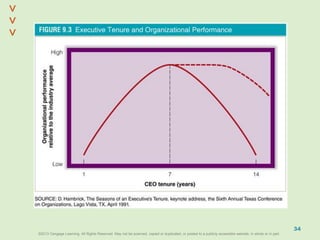
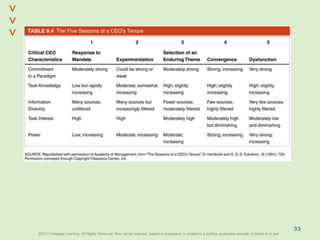
8 Explain the importance of upper echelons
and top management teams.
3
©2013 Cengage Learning. All Rights Reserved. May not be scanned, copied or duplicated, or posted to a publicly accessible website, in whole or in part.©2013 Cengage Learning. All Rights Reserved. May not be scanned, copied or duplicated, or posted to a publicly accessible website, in whole or in part.
^
^
Groups and Work Teams
Group: two or more people with common
interests, objectives, and continuing
interaction
Work team: a group of people with
complementary skills who are committed to a
common mission, performance goals, and
approach for which they hold themselves
mutually accountable
4
©2013 Cengage Learning. All Rights Reserved. May not be scanned, copied or duplicated, or posted to a publicly accessible website, in whole or in part.©2013 Cengage Learning. All Rights Reserved. May not be scanned, copied or duplicated, or posted to a publicly accessible website, in whole or in part.
^
^
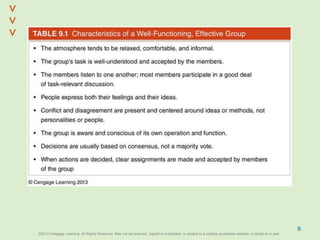
5
©2013 Cengage Learning. All Rights Reserved. May not be scanned, copied or duplicated, or posted to a publicly accessible website, in whole or in part.©2013 Cengage Learning. All Rights Reserved. May not be scanned, copied or duplicated, or posted to a publicly accessible website, in whole or in part.
^
^
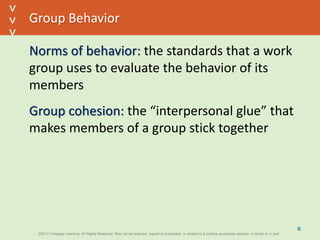
Group Behavior
Norms of behavior: the standards that a work
group uses to evaluate the behavior of its
members
Group cohesion: the “interpersonal glue” that
makes members of a group stick together
6
©2013 Cengage Learning. All Rights Reserved. May not be scanned, copied or duplicated, or posted to a publicly accessible website, in whole or in part.©2013 Cengage Learning. All Rights Reserved. May not be scanned, copied or duplicated, or posted to a publicly accessible website, in whole or in part.
^
^
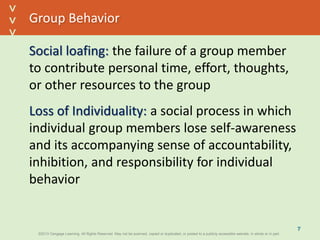
Group Behavior
Social loafing: the failure of a group member
to contribute personal time, effort, thoughts,
or other resources to the group
Loss of Individuality: a social process in which
individual group members lose self-awareness
and its accompanying sense of accountability,
inhibition, and responsibility for individual
behavior
7
©2013 Cengage Learning. All Rights Reserved. May not be scanned, copied or duplicated, or posted to a publicly accessible website, in whole or in part.©2013 Cengage Learning. All Rights Reserved. May not be scanned, copied or duplicated, or posted to a publicly accessible website, in whole or in part.
^
^
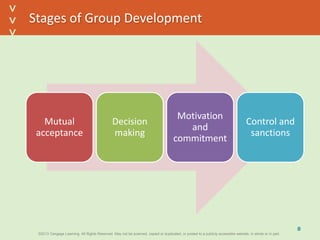
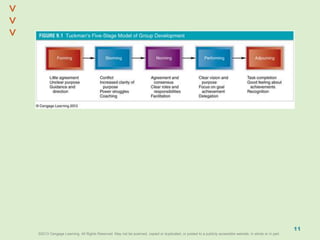
Stages of Group Development
Mutual
acceptance
Decision
making
Motivation
and
commitment
Control and
sanctions
8
©2013 Cengage Learning. All Rights Reserved. May not be scanned, copied or duplicated, or posted to a publicly accessible website, in whole or in part.©2013 Cengage Learning. All Rights Reserved. May not be scanned, copied or duplicated, or posted to a publicly accessible website, in whole or in part.
^
^
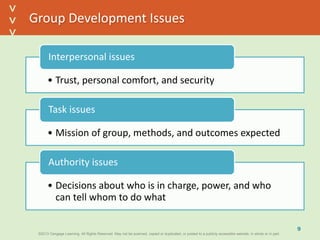
Group Development Issues
• Trust, personal comfort, and security
Interpersonal issues
• Mission of group, methods, and outcomes expected
Task issues
• Decisions about who is in charge, power, and who
can tell whom to do what
Authority issues
9
©2013 Cengage Learning. All Rights Reserved. May not be scanned, copied or duplicated, or posted to a publicly accessible website, in whole or in part.©2013 Cengage Learning. All Rights Reserved. May not be scanned, copied or duplicated, or posted to a publicly accessible website, in whole or in part.
^
^
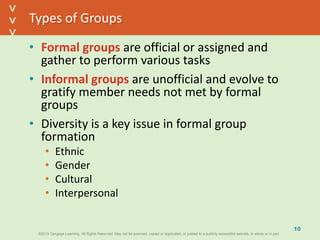
Types of Groups
• Formal groups are official or assigned and
gather to perform various tasks
• Informal groups are unofficial and evolve to
gratify member needs not met by formal
groups
• Diversity is a key issue in formal group
formation
• Ethnic
• Gender
• Cultural
• Interpersonal
10
©2013 Cengage Learning. All Rights Reserved. May not be scanned, copied or duplicated, or posted to a publicly accessible website, in whole or in part.©2013 Cengage Learning. All Rights Reserved. May not be scanned, copied or duplicated, or posted to a publicly accessible website, in whole or in part.
^
^
11
©2013 Cengage Learning. All Rights Reserved. May not be scanned, copied or duplicated, or posted to a publicly accessible website, in whole or in part.©2013 Cengage Learning. All Rights Reserved. May not be scanned, copied or duplicated, or posted to a publicly accessible website, in whole or in part.
^
^
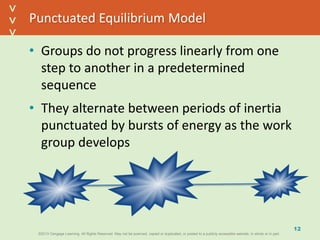
Punctuated Equilibrium Model
• Groups do not progress linearly from one
step to another in a predetermined
sequence
• They alternate between periods of inertia
punctuated by bursts of energy as the work
group develops
12
©2013 Cengage Learning. All Rights Reserved. May not be scanned, copied or duplicated, or posted to a publicly accessible website, in whole or in part.©2013 Cengage Learning. All Rights Reserved. May not be scanned, copied or duplicated, or posted to a publicly accessible website, in whole or in part.
^
^
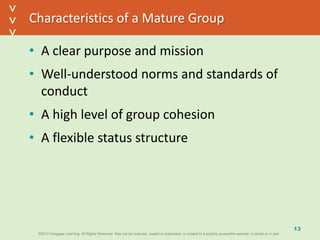
Characteristics of a Mature Group
• A clear purpose and mission
• Well-understood norms and standards of
conduct
• A high level of group cohesion
• A flexible status structure
13
©2013 Cengage Learning. All Rights Reserved. May not be scanned, copied or duplicated, or posted to a publicly accessible website, in whole or in part.©2013 Cengage Learning. All Rights Reserved. May not be scanned, copied or duplicated, or posted to a publicly accessible website, in whole or in part.
^
^
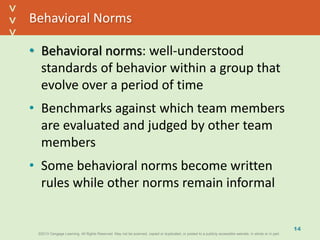
Behavioral Norms
• Behavioral norms: well-understood
standards of behavior within a group that
evolve over a period of time
• Benchmarks against which team members
are evaluated and judged by other team
members
• Some behavioral norms become written
rules while other norms remain informal
14
©2013 Cengage Learning. All Rights Reserved. May not be scanned, copied or duplicated, or posted to a publicly accessible website, in whole or in part.©2013 Cengage Learning. All Rights Reserved. May not be scanned, copied or duplicated, or posted to a publicly accessible website, in whole or in part.
^
^
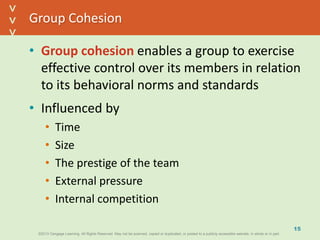
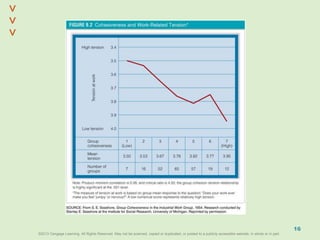
Group Cohesion
• Group cohesion enables a group to exercise
effective control over its members in relation
to its behavioral norms and standards
• Influenced by
• Time
• Size
• The prestige of the team
• External pressure
• Internal competition
15
©2013 Cengage Learning. All Rights Reserved. May not be scanned, copied or duplicated, or posted to a publicly accessible website, in whole or in part.©2013 Cengage Learning. All Rights Reserved. May not be scanned, copied or duplicated, or posted to a publicly accessible website, in whole or in part.
^
^
16
©2013 Cengage Learning. All Rights Reserved. May not be scanned, copied or duplicated, or posted to a publicly accessible website, in whole or in part.©2013 Cengage Learning. All Rights Reserved. May not be scanned, copied or duplicated, or posted to a publicly accessible website, in whole or in part.
^
^
Status Structure
Status structure: the set of authority and task
relations among a group’s members
• An effective status structure results in role
interrelatedness among group members
• May be hierarchical or egalitarian
• While groups tend to have one leader, teams
tend to share leadership
17
©2013 Cengage Learning. All Rights Reserved. May not be scanned, copied or duplicated, or posted to a publicly accessible website, in whole or in part.©2013 Cengage Learning. All Rights Reserved. May not be scanned, copied or duplicated, or posted to a publicly accessible website, in whole or in part.
^
^
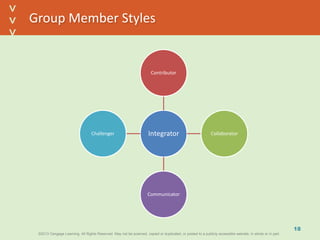
Group Member Styles
18
Integrator
Contributor
Collaborator
Communicator
Challenger
©2013 Cengage Learning. All Rights Reserved. May not be scanned, copied or duplicated, or posted to a publicly accessible website, in whole or in part.©2013 Cengage Learning. All Rights Reserved. May not be scanned, copied or duplicated, or posted to a publicly accessible website, in whole or in part.
^
^
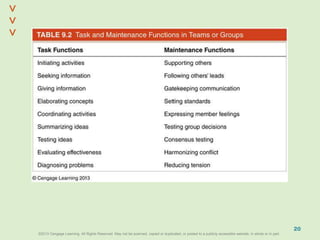
Task and Maintenance Functions
• Task functions: those activities directly
related to the effective completion of the
team’s work
• Maintenance functions: those activities
essential to the effective, satisfying
interpersonal relationships within a group or
team
19
©2013 Cengage Learning. All Rights Reserved. May not be scanned, copied or duplicated, or posted to a publicly accessible website, in whole or in part.©2013 Cengage Learning. All Rights Reserved. May not be scanned, copied or duplicated, or posted to a publicly accessible website, in whole or in part.
^
^
20
©2013 Cengage Learning. All Rights Reserved. May not be scanned, copied or duplicated, or posted to a publicly accessible website, in whole or in part.©2013 Cengage Learning. All Rights Reserved. May not be scanned, copied or duplicated, or posted to a publicly accessible website, in whole or in part.
^
^
Work Teams
• Work team: a task-oriented group
• Valuable in performing work that is
• Complicated
• Complex
• Interrelated
• Voluminous
21
©2013 Cengage Learning. All Rights Reserved. May not be scanned, copied or duplicated, or posted to a publicly accessible website, in whole or in part.©2013 Cengage Learning. All Rights Reserved. May not be scanned, copied or duplicated, or posted to a publicly accessible website, in whole or in part.
^
^
22
©2013 Cengage Learning. All Rights Reserved. May not be scanned, copied or duplicated, or posted to a publicly accessible website, in whole or in part.©2013 Cengage Learning. All Rights Reserved. May not be scanned, copied or duplicated, or posted to a publicly accessible website, in whole or in part.
^
^
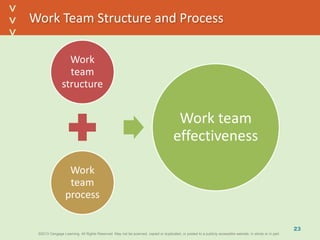
Work Team Structure and Process
Work
team
structure
Work
team
process
Work team
effectiveness
23
©2013 Cengage Learning. All Rights Reserved. May not be scanned, copied or duplicated, or posted to a publicly accessible website, in whole or in part.©2013 Cengage Learning. All Rights Reserved. May not be scanned, copied or duplicated, or posted to a publicly accessible website, in whole or in part.
^
^
Work Team Structure
• Goals and objectives
• Operating guidelines
• Performance measures
• Specification of roles
24
©2013 Cengage Learning. All Rights Reserved. May not be scanned, copied or duplicated, or posted to a publicly accessible website, in whole or in part.©2013 Cengage Learning. All Rights Reserved. May not be scanned, copied or duplicated, or posted to a publicly accessible website, in whole or in part.
^
^
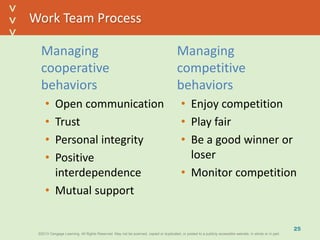
Work Team Process
Managing
cooperative
behaviors
• Open communication
• Trust
• Personal integrity
• Positive
interdependence
• Mutual support
Managing
competitive
behaviors
• Enjoy competition
• Play fair
• Be a good winner or
loser
• Monitor competition
25
©2013 Cengage Learning. All Rights Reserved. May not be scanned, copied or duplicated, or posted to a publicly accessible website, in whole or in part.©2013 Cengage Learning. All Rights Reserved. May not be scanned, copied or duplicated, or posted to a publicly accessible website, in whole or in part.
^
^
Quality Teams and Circles
• Quality team: a team that is part of an
organization’s structure and is empowered
to act on its decisions regarding product and
service quality
• Quality circle: small groups of employees
who work voluntarily on company time to
address work-related problems
26
©2013 Cengage Learning. All Rights Reserved. May not be scanned, copied or duplicated, or posted to a publicly accessible website, in whole or in part.©2013 Cengage Learning. All Rights Reserved. May not be scanned, copied or duplicated, or posted to a publicly accessible website, in whole or in part.
^
^
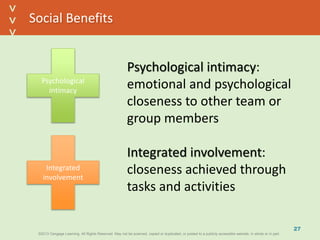
Social Benefits
27
Psychological
intimacy
Psychological intimacy:
emotional and psychological
closeness to other team or
group members
Integrated involvement:
closeness achieved through
tasks and activities
Integrated
involvement
©2013 Cengage Learning. All Rights Reserved. May not be scanned, copied or duplicated, or posted to a publicly accessible website, in whole or in part.©2013 Cengage Learning. All Rights Reserved. May not be scanned, copied or duplicated, or posted to a publicly accessible website, in whole or in part.
^
^
Diversity and Dissimilarity in Teams
• Dissimilarity influences
• Absenteeism
• Commitment
• Turnover intentions
• Work group relationships
• Self-esteem
• Organizational citizenship behavior
• Team performance
• Dissimilarity may have positive or negative
effects in teams and on team members
28
©2013 Cengage Learning. All Rights Reserved. May not be scanned, copied or duplicated, or posted to a publicly accessible website, in whole or in part.©2013 Cengage Learning. All Rights Reserved. May not be scanned, copied or duplicated, or posted to a publicly accessible website, in whole or in part.
^
^
Creativity in Teams
Team creativity and divergent thinking can
be enhanced by
• Increasing diversity in teams
• Brainwriting
• Training of facilitators
• Changing membership in teams
• Electronic brainstorming
• Building a playground
29
©2013 Cengage Learning. All Rights Reserved. May not be scanned, copied or duplicated, or posted to a publicly accessible website, in whole or in part.©2013 Cengage Learning. All Rights Reserved. May not be scanned, copied or duplicated, or posted to a publicly accessible website, in whole or in part.
^
^
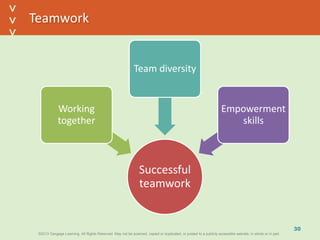
Teamwork
Successful
teamwork
Working
together
Team diversity
Empowerment
skills
30
©2013 Cengage Learning. All Rights Reserved. May not be scanned, copied or duplicated, or posted to a publicly accessible website, in whole or in part.©2013 Cengage Learning. All Rights Reserved. May not be scanned, copied or duplicated, or posted to a publicly accessible website, in whole or in part.
^
^
Self-Managed Teams
• Broad-based work teams that deal with
issues beyond quality
• Make decisions once reserved for managers
• Also known as self-directed teams or
autonomous work groups
31
©2013 Cengage Learning. All Rights Reserved. May not be scanned, copied or duplicated, or posted to a publicly accessible website, in whole or in part.©2013 Cengage Learning. All Rights Reserved. May not be scanned, copied or duplicated, or posted to a publicly accessible website, in whole or in part.
^
^
Teams at the Top
• Upper echelons: self-managed teams at the
top of the organization or top-level executive
teams
• Play a key role in defining the organization
over time
• The values, competence, ethics, and unique
characteristics of the top management team
are eventually reflected throughout the
organization
32
©2013 Cengage Learning. All Rights Reserved. May not be scanned, copied or duplicated, or posted to a publicly accessible website, in whole or in part.©2013 Cengage Learning. All Rights Reserved. May not be scanned, copied or duplicated, or posted to a publicly accessible website, in whole or in part.
^
^
33
©2013 Cengage Learning. All Rights Reserved. May not be scanned, copied or duplicated, or posted to a publicly accessible website, in whole or in part.©2013 Cengage Learning. All Rights Reserved. May not be scanned, copied or duplicated, or posted to a publicly accessible website, in whole or in part.
^
^
34
©2013 Cengage Learning. All Rights Reserved. May not be scanned, copied or duplicated, or posted to a publicly accessible website, in whole or in part.©2013 Cengage Learning. All Rights Reserved. May not be scanned, copied or duplicated, or posted to a publicly accessible website, in whole or in part.
^
^
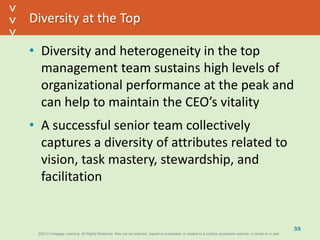
Diversity at the Top
• Diversity and heterogeneity in the top
management team sustains high levels of
organizational performance at the peak and
can help to maintain the CEO’s vitality
• A successful senior team collectively
captures a diversity of attributes related to
vision, task mastery, stewardship, and
facilitation
35
©2013 Cengage Learning. All Rights Reserved. May not be scanned, copied or duplicated, or posted to a publicly accessible website, in whole or in part.©2013 Cengage Learning. All Rights Reserved. May not be scanned, copied or duplicated, or posted to a publicly accessible website, in whole or in part.
^
^
36
©2013 Cengage Learning. All Rights Reserved. May not be scanned, copied or duplicated, or posted to a publicly accessible website, in whole or in part.©2013 Cengage Learning. All Rights Reserved. May not be scanned, copied or duplicated, or posted to a publicly accessible website, in whole or in part.
^
^
^
Chapter 9: Reflect & Discuss
Friends with Money Video Clip
• This chapter defined a group as “two or more people having
common interests, objectives, and continuing interaction.” Does
this film sequence have examples of each part of the definition?
Identify specific moments that fit the definition.
• Review the section “Stages of Team Development.” Apply that
discussion to both film sequences. You should see examples of
each stage.
• Does the small group in these film sequences appear cohesive?
Cite some specific moments from the film sequences to support
your conclusion.
37

MBA 635 chapter 9

  • 1.
    ©2013 Cengage Learning.All Rights Reserved. May not be scanned, copied or duplicated, or posted to a publicly accessible website, in whole or in part. 9 ©2013 Cengage Learning. All Rights Reserved. May not be scanned, copied or duplicated, or posted to a publicly accessible website, in whole or in part. Work Teams and Groups
  • 2.
    ©2013 Cengage Learning.All Rights Reserved. May not be scanned, copied or duplicated, or posted to a publicly accessible website, in whole or in part. Learning Objectives ©2013 Cengage Learning. All Rights Reserved. May not be scanned, copied or duplicated, or posted to a publicly accessible website, in whole or in part. 1 Define group and work team. 2 Explain four important aspects of group behavior. 3 Describe group formation, the stages of group development, and the characteristics of a mature group. 4 Explain the task and maintenance functions in groups. 2
  • 3.
    ©2013 Cengage Learning.All Rights Reserved. May not be scanned, copied or duplicated, or posted to a publicly accessible website, in whole or in part. Learning Objectives continued ©2013 Cengage Learning. All Rights Reserved. May not be scanned, copied or duplicated, or posted to a publicly accessible website, in whole or in part. 5 Identify the social benefits of group and team membership. 6 Discuss diversity and creativity in teams. 7 Discuss teamwork and self-managed teams. 8 Explain the importance of upper echelons and top management teams. 3
  • 4.
    ©2013 Cengage Learning.All Rights Reserved. May not be scanned, copied or duplicated, or posted to a publicly accessible website, in whole or in part.©2013 Cengage Learning. All Rights Reserved. May not be scanned, copied or duplicated, or posted to a publicly accessible website, in whole or in part. ^ ^ Groups and Work Teams Group: two or more people with common interests, objectives, and continuing interaction Work team: a group of people with complementary skills who are committed to a common mission, performance goals, and approach for which they hold themselves mutually accountable 4
  • 5.
    ©2013 Cengage Learning.All Rights Reserved. May not be scanned, copied or duplicated, or posted to a publicly accessible website, in whole or in part.©2013 Cengage Learning. All Rights Reserved. May not be scanned, copied or duplicated, or posted to a publicly accessible website, in whole or in part. ^ ^ 5
  • 6.
    ©2013 Cengage Learning.All Rights Reserved. May not be scanned, copied or duplicated, or posted to a publicly accessible website, in whole or in part.©2013 Cengage Learning. All Rights Reserved. May not be scanned, copied or duplicated, or posted to a publicly accessible website, in whole or in part. ^ ^ Group Behavior Norms of behavior: the standards that a work group uses to evaluate the behavior of its members Group cohesion: the “interpersonal glue” that makes members of a group stick together 6
  • 7.
    ©2013 Cengage Learning.All Rights Reserved. May not be scanned, copied or duplicated, or posted to a publicly accessible website, in whole or in part.©2013 Cengage Learning. All Rights Reserved. May not be scanned, copied or duplicated, or posted to a publicly accessible website, in whole or in part. ^ ^ Group Behavior Social loafing: the failure of a group member to contribute personal time, effort, thoughts, or other resources to the group Loss of Individuality: a social process in which individual group members lose self-awareness and its accompanying sense of accountability, inhibition, and responsibility for individual behavior 7
  • 8.
    ©2013 Cengage Learning.All Rights Reserved. May not be scanned, copied or duplicated, or posted to a publicly accessible website, in whole or in part.©2013 Cengage Learning. All Rights Reserved. May not be scanned, copied or duplicated, or posted to a publicly accessible website, in whole or in part. ^ ^ Stages of Group Development Mutual acceptance Decision making Motivation and commitment Control and sanctions 8
  • 9.
    ©2013 Cengage Learning.All Rights Reserved. May not be scanned, copied or duplicated, or posted to a publicly accessible website, in whole or in part.©2013 Cengage Learning. All Rights Reserved. May not be scanned, copied or duplicated, or posted to a publicly accessible website, in whole or in part. ^ ^ Group Development Issues • Trust, personal comfort, and security Interpersonal issues • Mission of group, methods, and outcomes expected Task issues • Decisions about who is in charge, power, and who can tell whom to do what Authority issues 9
  • 10.
    ©2013 Cengage Learning.All Rights Reserved. May not be scanned, copied or duplicated, or posted to a publicly accessible website, in whole or in part.©2013 Cengage Learning. All Rights Reserved. May not be scanned, copied or duplicated, or posted to a publicly accessible website, in whole or in part. ^ ^ Types of Groups • Formal groups are official or assigned and gather to perform various tasks • Informal groups are unofficial and evolve to gratify member needs not met by formal groups • Diversity is a key issue in formal group formation • Ethnic • Gender • Cultural • Interpersonal 10
  • 11.
    ©2013 Cengage Learning.All Rights Reserved. May not be scanned, copied or duplicated, or posted to a publicly accessible website, in whole or in part.©2013 Cengage Learning. All Rights Reserved. May not be scanned, copied or duplicated, or posted to a publicly accessible website, in whole or in part. ^ ^ 11
  • 12.
    ©2013 Cengage Learning.All Rights Reserved. May not be scanned, copied or duplicated, or posted to a publicly accessible website, in whole or in part.©2013 Cengage Learning. All Rights Reserved. May not be scanned, copied or duplicated, or posted to a publicly accessible website, in whole or in part. ^ ^ Punctuated Equilibrium Model • Groups do not progress linearly from one step to another in a predetermined sequence • They alternate between periods of inertia punctuated by bursts of energy as the work group develops 12
  • 13.
    ©2013 Cengage Learning.All Rights Reserved. May not be scanned, copied or duplicated, or posted to a publicly accessible website, in whole or in part.©2013 Cengage Learning. All Rights Reserved. May not be scanned, copied or duplicated, or posted to a publicly accessible website, in whole or in part. ^ ^ Characteristics of a Mature Group • A clear purpose and mission • Well-understood norms and standards of conduct • A high level of group cohesion • A flexible status structure 13
  • 14.
    ©2013 Cengage Learning.All Rights Reserved. May not be scanned, copied or duplicated, or posted to a publicly accessible website, in whole or in part.©2013 Cengage Learning. All Rights Reserved. May not be scanned, copied or duplicated, or posted to a publicly accessible website, in whole or in part. ^ ^ Behavioral Norms • Behavioral norms: well-understood standards of behavior within a group that evolve over a period of time • Benchmarks against which team members are evaluated and judged by other team members • Some behavioral norms become written rules while other norms remain informal 14
  • 15.
    ©2013 Cengage Learning.All Rights Reserved. May not be scanned, copied or duplicated, or posted to a publicly accessible website, in whole or in part.©2013 Cengage Learning. All Rights Reserved. May not be scanned, copied or duplicated, or posted to a publicly accessible website, in whole or in part. ^ ^ Group Cohesion • Group cohesion enables a group to exercise effective control over its members in relation to its behavioral norms and standards • Influenced by • Time • Size • The prestige of the team • External pressure • Internal competition 15
  • 16.
    ©2013 Cengage Learning.All Rights Reserved. May not be scanned, copied or duplicated, or posted to a publicly accessible website, in whole or in part.©2013 Cengage Learning. All Rights Reserved. May not be scanned, copied or duplicated, or posted to a publicly accessible website, in whole or in part. ^ ^ 16
  • 17.
    ©2013 Cengage Learning.All Rights Reserved. May not be scanned, copied or duplicated, or posted to a publicly accessible website, in whole or in part.©2013 Cengage Learning. All Rights Reserved. May not be scanned, copied or duplicated, or posted to a publicly accessible website, in whole or in part. ^ ^ Status Structure Status structure: the set of authority and task relations among a group’s members • An effective status structure results in role interrelatedness among group members • May be hierarchical or egalitarian • While groups tend to have one leader, teams tend to share leadership 17
  • 18.
    ©2013 Cengage Learning.All Rights Reserved. May not be scanned, copied or duplicated, or posted to a publicly accessible website, in whole or in part.©2013 Cengage Learning. All Rights Reserved. May not be scanned, copied or duplicated, or posted to a publicly accessible website, in whole or in part. ^ ^ Group Member Styles 18 Integrator Contributor Collaborator Communicator Challenger
  • 19.
    ©2013 Cengage Learning.All Rights Reserved. May not be scanned, copied or duplicated, or posted to a publicly accessible website, in whole or in part.©2013 Cengage Learning. All Rights Reserved. May not be scanned, copied or duplicated, or posted to a publicly accessible website, in whole or in part. ^ ^ Task and Maintenance Functions • Task functions: those activities directly related to the effective completion of the team’s work • Maintenance functions: those activities essential to the effective, satisfying interpersonal relationships within a group or team 19
  • 20.
    ©2013 Cengage Learning.All Rights Reserved. May not be scanned, copied or duplicated, or posted to a publicly accessible website, in whole or in part.©2013 Cengage Learning. All Rights Reserved. May not be scanned, copied or duplicated, or posted to a publicly accessible website, in whole or in part. ^ ^ 20
  • 21.
    ©2013 Cengage Learning.All Rights Reserved. May not be scanned, copied or duplicated, or posted to a publicly accessible website, in whole or in part.©2013 Cengage Learning. All Rights Reserved. May not be scanned, copied or duplicated, or posted to a publicly accessible website, in whole or in part. ^ ^ Work Teams • Work team: a task-oriented group • Valuable in performing work that is • Complicated • Complex • Interrelated • Voluminous 21
  • 22.
    ©2013 Cengage Learning.All Rights Reserved. May not be scanned, copied or duplicated, or posted to a publicly accessible website, in whole or in part.©2013 Cengage Learning. All Rights Reserved. May not be scanned, copied or duplicated, or posted to a publicly accessible website, in whole or in part. ^ ^ 22
  • 23.
    ©2013 Cengage Learning.All Rights Reserved. May not be scanned, copied or duplicated, or posted to a publicly accessible website, in whole or in part.©2013 Cengage Learning. All Rights Reserved. May not be scanned, copied or duplicated, or posted to a publicly accessible website, in whole or in part. ^ ^ Work Team Structure and Process Work team structure Work team process Work team effectiveness 23
  • 24.
    ©2013 Cengage Learning.All Rights Reserved. May not be scanned, copied or duplicated, or posted to a publicly accessible website, in whole or in part.©2013 Cengage Learning. All Rights Reserved. May not be scanned, copied or duplicated, or posted to a publicly accessible website, in whole or in part. ^ ^ Work Team Structure • Goals and objectives • Operating guidelines • Performance measures • Specification of roles 24
  • 25.
    ©2013 Cengage Learning.All Rights Reserved. May not be scanned, copied or duplicated, or posted to a publicly accessible website, in whole or in part.©2013 Cengage Learning. All Rights Reserved. May not be scanned, copied or duplicated, or posted to a publicly accessible website, in whole or in part. ^ ^ Work Team Process Managing cooperative behaviors • Open communication • Trust • Personal integrity • Positive interdependence • Mutual support Managing competitive behaviors • Enjoy competition • Play fair • Be a good winner or loser • Monitor competition 25
  • 26.
    ©2013 Cengage Learning.All Rights Reserved. May not be scanned, copied or duplicated, or posted to a publicly accessible website, in whole or in part.©2013 Cengage Learning. All Rights Reserved. May not be scanned, copied or duplicated, or posted to a publicly accessible website, in whole or in part. ^ ^ Quality Teams and Circles • Quality team: a team that is part of an organization’s structure and is empowered to act on its decisions regarding product and service quality • Quality circle: small groups of employees who work voluntarily on company time to address work-related problems 26
  • 27.
    ©2013 Cengage Learning.All Rights Reserved. May not be scanned, copied or duplicated, or posted to a publicly accessible website, in whole or in part.©2013 Cengage Learning. All Rights Reserved. May not be scanned, copied or duplicated, or posted to a publicly accessible website, in whole or in part. ^ ^ Social Benefits 27 Psychological intimacy Psychological intimacy: emotional and psychological closeness to other team or group members Integrated involvement: closeness achieved through tasks and activities Integrated involvement
  • 28.
    ©2013 Cengage Learning.All Rights Reserved. May not be scanned, copied or duplicated, or posted to a publicly accessible website, in whole or in part.©2013 Cengage Learning. All Rights Reserved. May not be scanned, copied or duplicated, or posted to a publicly accessible website, in whole or in part. ^ ^ Diversity and Dissimilarity in Teams • Dissimilarity influences • Absenteeism • Commitment • Turnover intentions • Work group relationships • Self-esteem • Organizational citizenship behavior • Team performance • Dissimilarity may have positive or negative effects in teams and on team members 28
  • 29.
    ©2013 Cengage Learning.All Rights Reserved. May not be scanned, copied or duplicated, or posted to a publicly accessible website, in whole or in part.©2013 Cengage Learning. All Rights Reserved. May not be scanned, copied or duplicated, or posted to a publicly accessible website, in whole or in part. ^ ^ Creativity in Teams Team creativity and divergent thinking can be enhanced by • Increasing diversity in teams • Brainwriting • Training of facilitators • Changing membership in teams • Electronic brainstorming • Building a playground 29
  • 30.
    ©2013 Cengage Learning.All Rights Reserved. May not be scanned, copied or duplicated, or posted to a publicly accessible website, in whole or in part.©2013 Cengage Learning. All Rights Reserved. May not be scanned, copied or duplicated, or posted to a publicly accessible website, in whole or in part. ^ ^ Teamwork Successful teamwork Working together Team diversity Empowerment skills 30
  • 31.
    ©2013 Cengage Learning.All Rights Reserved. May not be scanned, copied or duplicated, or posted to a publicly accessible website, in whole or in part.©2013 Cengage Learning. All Rights Reserved. May not be scanned, copied or duplicated, or posted to a publicly accessible website, in whole or in part. ^ ^ Self-Managed Teams • Broad-based work teams that deal with issues beyond quality • Make decisions once reserved for managers • Also known as self-directed teams or autonomous work groups 31
  • 32.
    ©2013 Cengage Learning.All Rights Reserved. May not be scanned, copied or duplicated, or posted to a publicly accessible website, in whole or in part.©2013 Cengage Learning. All Rights Reserved. May not be scanned, copied or duplicated, or posted to a publicly accessible website, in whole or in part. ^ ^ Teams at the Top • Upper echelons: self-managed teams at the top of the organization or top-level executive teams • Play a key role in defining the organization over time • The values, competence, ethics, and unique characteristics of the top management team are eventually reflected throughout the organization 32
  • 33.
    ©2013 Cengage Learning.All Rights Reserved. May not be scanned, copied or duplicated, or posted to a publicly accessible website, in whole or in part.©2013 Cengage Learning. All Rights Reserved. May not be scanned, copied or duplicated, or posted to a publicly accessible website, in whole or in part. ^ ^ 33
  • 34.
    ©2013 Cengage Learning.All Rights Reserved. May not be scanned, copied or duplicated, or posted to a publicly accessible website, in whole or in part.©2013 Cengage Learning. All Rights Reserved. May not be scanned, copied or duplicated, or posted to a publicly accessible website, in whole or in part. ^ ^ 34
  • 35.
    ©2013 Cengage Learning.All Rights Reserved. May not be scanned, copied or duplicated, or posted to a publicly accessible website, in whole or in part.©2013 Cengage Learning. All Rights Reserved. May not be scanned, copied or duplicated, or posted to a publicly accessible website, in whole or in part. ^ ^ Diversity at the Top • Diversity and heterogeneity in the top management team sustains high levels of organizational performance at the peak and can help to maintain the CEO’s vitality • A successful senior team collectively captures a diversity of attributes related to vision, task mastery, stewardship, and facilitation 35
  • 36.
    ©2013 Cengage Learning.All Rights Reserved. May not be scanned, copied or duplicated, or posted to a publicly accessible website, in whole or in part.©2013 Cengage Learning. All Rights Reserved. May not be scanned, copied or duplicated, or posted to a publicly accessible website, in whole or in part. ^ ^ 36
  • 37.
    ©2013 Cengage Learning.All Rights Reserved. May not be scanned, copied or duplicated, or posted to a publicly accessible website, in whole or in part.©2013 Cengage Learning. All Rights Reserved. May not be scanned, copied or duplicated, or posted to a publicly accessible website, in whole or in part. ^ ^ ^ Chapter 9: Reflect & Discuss Friends with Money Video Clip • This chapter defined a group as “two or more people having common interests, objectives, and continuing interaction.” Does this film sequence have examples of each part of the definition? Identify specific moments that fit the definition. • Review the section “Stages of Team Development.” Apply that discussion to both film sequences. You should see examples of each stage. • Does the small group in these film sequences appear cohesive? Cite some specific moments from the film sequences to support your conclusion. 37