Foundations of
Group Behavior
Groups
• Two or more individuals,
interacting and interdependent,
who come together to achieve
particular objectives
• Formal – defined by the
organization’s structure
• Informal – neither formally
structured nor organizationally
determined
Four Types of Groups
• Command – determined by the organization
chart
• Task – working together to complete a job task
• Interest – affiliate to attain a specific objective
of shared interest
• Friendship – members have one or more
common characteristics
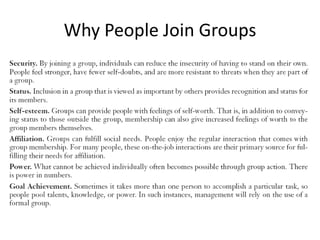
Why People Join Groups
Group Properties
• Roles
• Norms
• Status
• Size
• Cohesiveness
Roles
• To engage in a set of expected behavior
patterns that are attributed to occupying a
given position in a social unit
• Role Identity – attitudes and behaviors
consistent with a role
• Role Perception – our view of how we’re
supposed to act in a given situation
Roles
• Role Expectations – how others believe you should
act in a given situation
• Psychological contract – an unwritten agreement
between employees and employer setting out
mutual expectations
• Role conflict – when an individual finds that
compliance with one role requirement may make it
more difficult to comply with another
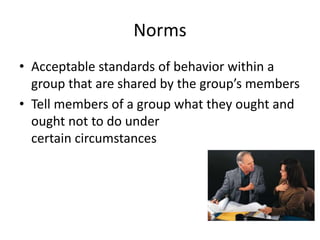
Norms
• Acceptable standards of behavior within a
group that are shared by the group’s members
• Tell members of a group what they ought and
ought not to do under
certain circumstances
The Hawthorne Studies
• A worker’s behavior and sentiments were closely
related.
• Group influences were significant in affecting
individual behavior.
• Group standards were highly effective in establishing
individual worker output.
• Money was less a factor in determining worker
output than were group standards, sentiments, and
security.
Conformity and the Asch Studies
• Members desire to be one of the group and
avoid being visibly different
• Members with differing opinions feel
extensive pressure to align with others
• Level of conformity has
declined since 1950’s
Deviant Workplace Behavior
• Voluntary behavior that violates significant
organizational norms and, in doing so,
threatens the well-being of the organization or
its members
• Is likely to flourish where it is supported by
group norms
Status
• A socially defined position or rank given to
groups or group members by others
What Determines Status?
• The power a person wields over others
• A person’s ability to contribute to a group’s
goals
• An individual’s personal characteristics
Impact of Status
• High-status members of groups often are
given more freedom to deviate from norms
• Interaction among members of groups is
influenced by status
• When inequity is perceived, it results in
various types of corrective behavior
• Cultural differences affect status
How Size Affects a Group
• Smaller groups are faster at completing tasks
• Individuals perform better in smaller groups
• Large groups are consistently better at
problem solving
• Social loafing - tendency to expend less effort
in a group than as an individual
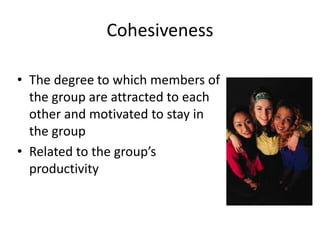
Cohesiveness
• The degree to which members of
the group are attracted to each
other and motivated to stay in
the group
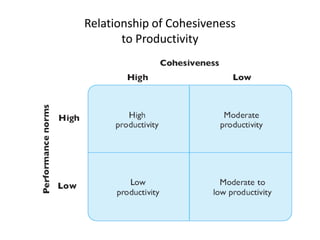
• Related to the group’s
productivity
Relationship of Cohesiveness
to Productivity
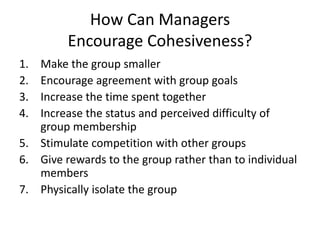
How Can Managers
Encourage Cohesiveness?
1. Make the group smaller
2. Encourage agreement with group goals
3. Increase the time spent together
4. Increase the status and perceived difficulty of
group membership
5. Stimulate competition with other groups
6. Give rewards to the group rather than to individual
members
7. Physically isolate the group
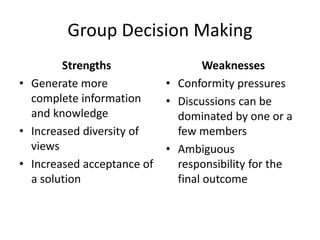
Group Decision Making
Strengths
• Generate more
complete information
and knowledge
• Increased diversity of
views
• Increased acceptance of
a solution
Weaknesses
• Conformity pressures
• Discussions can be
dominated by one or a
few members
• Ambiguous
responsibility for the
final outcome
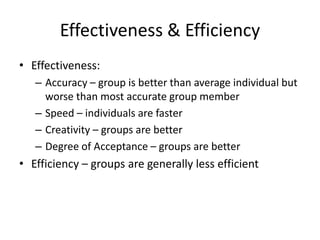
Effectiveness & Efficiency
• Effectiveness:
– Accuracy – group is better than average individual but
worse than most accurate group member
– Speed – individuals are faster
– Creativity – groups are better
– Degree of Acceptance – groups are better
• Efficiency – groups are generally less efficient
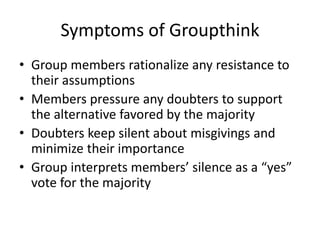
Symptoms of Groupthink
• Group members rationalize any resistance to
their assumptions
• Members pressure any doubters to support
the alternative favored by the majority
• Doubters keep silent about misgivings and
minimize their importance
• Group interprets members’ silence as a “yes”
vote for the majority
Groupthink occurs
most often when
• A clear group identity exists
• Members hold a positive image of their group
that they want to protect
• The group perceives a
collective threat to this
positive image
Minimizing Groupthink
• Limit group size to 10 or less
• Encourage group leaders to actively seek input
from all members and avoid expressing their
own opinions, especially in the early stages of
deliberation
• Appoint a “devil’s advocate”
Groupshift
• Decision of the group reflects the dominant
decision-making norm that develops during
the group’s discussion
• Exaggerates the initial
position of the
members and more
often to greater risk
Group Decision-Making Techniques
• Reduce common problems with:
– Brainstorming – technique to encourage any and
all alternatives while withholding any criticism of
the alternatives
– Nominal group technique – restricts discussion
during the process to encourage independent
thinking
– Electronic meetings – use computers to
anonymously give honest input
Performance Implications for Managers
• Positive relationship between role perception
and performance
• Norms help explain behavior
• Status inequities adversely impact
productivity and performance
• Set group size based on task at hand
• Cohesiveness can influence productivity
Satisfaction Implication for Managers
• High congruence between boss and employee
on perception of job shows significant
association with employee satisfaction
• Satisfaction is greater when job minimizes
interaction with individuals of lower status
• Larger groups are associated with lower
satisfaction
Summary
1. Differentiated between formal and informal groups
2. Described how role requirements change in different
situations
3. Described how norms exert influence on an individual’s
behavior
4. Explained what determines status
5. Defined social loafing and its effect on group performance
6. Identified the benefits and disadvantages of cohesive
groups
7. Listed the strengths and weaknesses of group decision
making
8. Contrasted the effectiveness of interacting, brainstorming,
nominal and electronic meeting groups
Understanding
Work Teams
Why Have Teams Become So
Popular
• Teams typically outperform individuals.
• Teams use employee talents better.
• Teams are more flexible and responsive to
changes in the environment.
• Teams facilitate employee involvement.
• Teams are an effective way to democratize
and organization and increase motivation.
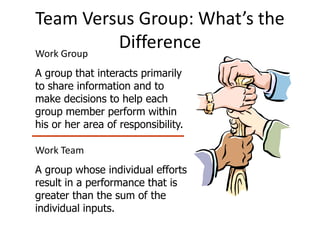
Team Versus Group: What’s the
Difference
Work Group
A group that interacts primarily
to share information and to
make decisions to help each
group member perform within
his or her area of responsibility.
Work Team
A group whose individual efforts
result in a performance that is
greater than the sum of the
individual inputs.
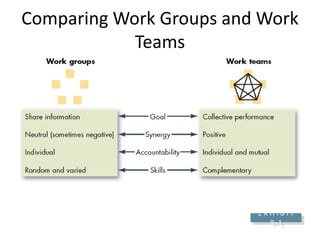
Comparing Work Groups and Work
Teams
E X H I B I T
9–1
Types of Teams
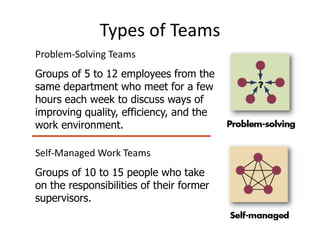
Problem-Solving Teams
Groups of 5 to 12 employees from the
same department who meet for a few
hours each week to discuss ways of
improving quality, efficiency, and the
work environment.
Self-Managed Work Teams
Groups of 10 to 15 people who take
on the responsibilities of their former
supervisors.
Types of Teams (cont’d)
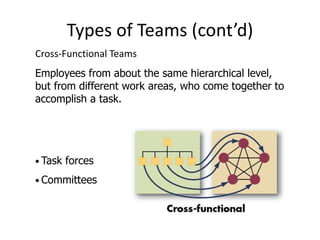
• Task forces
• Committees
Cross-Functional Teams
Employees from about the same hierarchical level,
but from different work areas, who come together to
accomplish a task.
Types of Teams (cont’d)
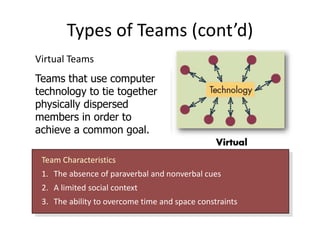
Team Characteristics
1. The absence of paraverbal and nonverbal cues
2. A limited social context
3. The ability to overcome time and space constraints
Virtual Teams
Teams that use computer
technology to tie together
physically dispersed
members in order to
achieve a common goal.
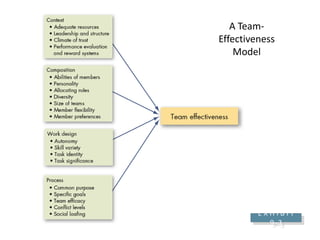
A Team-
Effectiveness
Model
E X H I B I T
9–3
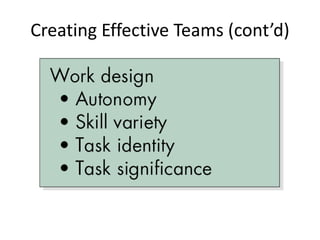
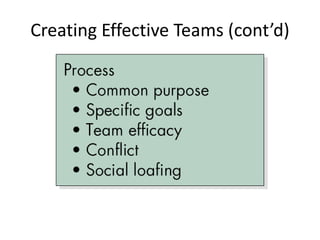
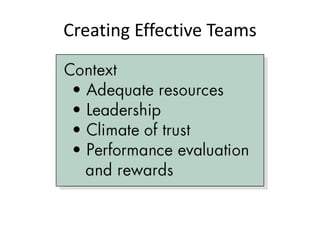
Creating Effective Teams
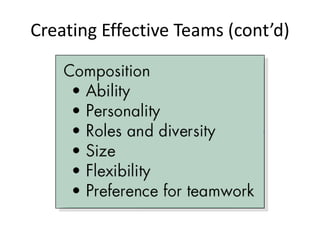
Creating Effective Teams (cont’d)
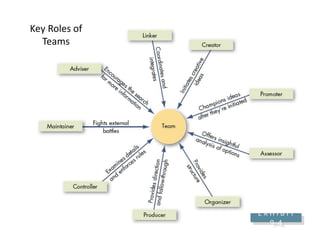
Key Roles of
Teams
E X H I B I T
9–4
Creating Effective Teams (cont’d)
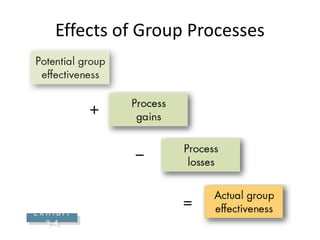
Effects of Group Processes
+
–
=
E X H I B I T
9–4
Creating Effective Teams: Diversity
Group Demography
The degree to which members of a group share a
common demographic attribute, such as age, sex,
race, educational level, or length of service in the
organization, and the impact of this attribute on
turnover.
Cohorts
Individuals who, as part of
a group, hold a common
attribute.
Turning Individuals Into Team
Players
• The Challenges
– Overcoming individual resistance to team
membership.
– Countering the influence of individualistic
cultures.
– Introducing teams in an organization that has
historically valued individual achievement.
• Shaping Team Players
– Selecting employees who can fulfill their team
Teams and Quality Management
• Team Effectiveness and Quality Management
Requires That Teams:
1. Are small enough to be efficient and effective.
2. Are properly trained in required skills.
3. Allocated enough time to work on problems.
4. Are given authority to resolve problems and take
corrective action.
5. Have a designated “champion” to call on when
needed.
Beware: Teams Aren’t Always the
Answer
• Three tests to see if a team fits the situation:
– Is the work complex and is there a need for
different perspectives?
– Does the work create a common purpose or set of
goals for the group that is larger than the
aggregate of the goals for individuals?
– Are members of the group involved in
interdependent tasks?

groupbehavior-090913125847-phpapp02.ppt

  • 1.
  • 2.
    Groups • Two ormore individuals, interacting and interdependent, who come together to achieve particular objectives • Formal – defined by the organization’s structure • Informal – neither formally structured nor organizationally determined
  • 3.
    Four Types ofGroups • Command – determined by the organization chart • Task – working together to complete a job task • Interest – affiliate to attain a specific objective of shared interest • Friendship – members have one or more common characteristics
  • 4.
  • 5.
    Group Properties • Roles •Norms • Status • Size • Cohesiveness
  • 6.
    Roles • To engagein a set of expected behavior patterns that are attributed to occupying a given position in a social unit • Role Identity – attitudes and behaviors consistent with a role • Role Perception – our view of how we’re supposed to act in a given situation
  • 7.
    Roles • Role Expectations– how others believe you should act in a given situation • Psychological contract – an unwritten agreement between employees and employer setting out mutual expectations • Role conflict – when an individual finds that compliance with one role requirement may make it more difficult to comply with another
  • 8.
    Norms • Acceptable standardsof behavior within a group that are shared by the group’s members • Tell members of a group what they ought and ought not to do under certain circumstances
  • 9.
    The Hawthorne Studies •A worker’s behavior and sentiments were closely related. • Group influences were significant in affecting individual behavior. • Group standards were highly effective in establishing individual worker output. • Money was less a factor in determining worker output than were group standards, sentiments, and security.
  • 10.
    Conformity and theAsch Studies • Members desire to be one of the group and avoid being visibly different • Members with differing opinions feel extensive pressure to align with others • Level of conformity has declined since 1950’s
  • 11.
    Deviant Workplace Behavior •Voluntary behavior that violates significant organizational norms and, in doing so, threatens the well-being of the organization or its members • Is likely to flourish where it is supported by group norms
  • 12.
    Status • A sociallydefined position or rank given to groups or group members by others
  • 13.
    What Determines Status? •The power a person wields over others • A person’s ability to contribute to a group’s goals • An individual’s personal characteristics
  • 14.
    Impact of Status •High-status members of groups often are given more freedom to deviate from norms • Interaction among members of groups is influenced by status • When inequity is perceived, it results in various types of corrective behavior • Cultural differences affect status
  • 15.
    How Size Affectsa Group • Smaller groups are faster at completing tasks • Individuals perform better in smaller groups • Large groups are consistently better at problem solving • Social loafing - tendency to expend less effort in a group than as an individual
  • 16.
    Cohesiveness • The degreeto which members of the group are attracted to each other and motivated to stay in the group • Related to the group’s productivity
  • 17.
  • 18.
    How Can Managers EncourageCohesiveness? 1. Make the group smaller 2. Encourage agreement with group goals 3. Increase the time spent together 4. Increase the status and perceived difficulty of group membership 5. Stimulate competition with other groups 6. Give rewards to the group rather than to individual members 7. Physically isolate the group
  • 19.
    Group Decision Making Strengths •Generate more complete information and knowledge • Increased diversity of views • Increased acceptance of a solution Weaknesses • Conformity pressures • Discussions can be dominated by one or a few members • Ambiguous responsibility for the final outcome
  • 20.
    Effectiveness & Efficiency •Effectiveness: – Accuracy – group is better than average individual but worse than most accurate group member – Speed – individuals are faster – Creativity – groups are better – Degree of Acceptance – groups are better • Efficiency – groups are generally less efficient
  • 21.
    Symptoms of Groupthink •Group members rationalize any resistance to their assumptions • Members pressure any doubters to support the alternative favored by the majority • Doubters keep silent about misgivings and minimize their importance • Group interprets members’ silence as a “yes” vote for the majority
  • 22.
    Groupthink occurs most oftenwhen • A clear group identity exists • Members hold a positive image of their group that they want to protect • The group perceives a collective threat to this positive image
  • 23.
    Minimizing Groupthink • Limitgroup size to 10 or less • Encourage group leaders to actively seek input from all members and avoid expressing their own opinions, especially in the early stages of deliberation • Appoint a “devil’s advocate”
  • 24.
    Groupshift • Decision ofthe group reflects the dominant decision-making norm that develops during the group’s discussion • Exaggerates the initial position of the members and more often to greater risk
  • 25.
    Group Decision-Making Techniques •Reduce common problems with: – Brainstorming – technique to encourage any and all alternatives while withholding any criticism of the alternatives – Nominal group technique – restricts discussion during the process to encourage independent thinking – Electronic meetings – use computers to anonymously give honest input
  • 26.
    Performance Implications forManagers • Positive relationship between role perception and performance • Norms help explain behavior • Status inequities adversely impact productivity and performance • Set group size based on task at hand • Cohesiveness can influence productivity
  • 27.
    Satisfaction Implication forManagers • High congruence between boss and employee on perception of job shows significant association with employee satisfaction • Satisfaction is greater when job minimizes interaction with individuals of lower status • Larger groups are associated with lower satisfaction
  • 28.
    Summary 1. Differentiated betweenformal and informal groups 2. Described how role requirements change in different situations 3. Described how norms exert influence on an individual’s behavior 4. Explained what determines status 5. Defined social loafing and its effect on group performance 6. Identified the benefits and disadvantages of cohesive groups 7. Listed the strengths and weaknesses of group decision making 8. Contrasted the effectiveness of interacting, brainstorming, nominal and electronic meeting groups
  • 29.
  • 30.
    Why Have TeamsBecome So Popular • Teams typically outperform individuals. • Teams use employee talents better. • Teams are more flexible and responsive to changes in the environment. • Teams facilitate employee involvement. • Teams are an effective way to democratize and organization and increase motivation.
  • 31.
    Team Versus Group:What’s the Difference Work Group A group that interacts primarily to share information and to make decisions to help each group member perform within his or her area of responsibility. Work Team A group whose individual efforts result in a performance that is greater than the sum of the individual inputs.
  • 32.
    Comparing Work Groupsand Work Teams E X H I B I T 9–1
  • 33.
    Types of Teams Problem-SolvingTeams Groups of 5 to 12 employees from the same department who meet for a few hours each week to discuss ways of improving quality, efficiency, and the work environment. Self-Managed Work Teams Groups of 10 to 15 people who take on the responsibilities of their former supervisors.
  • 34.
    Types of Teams(cont’d) • Task forces • Committees Cross-Functional Teams Employees from about the same hierarchical level, but from different work areas, who come together to accomplish a task.
  • 35.
    Types of Teams(cont’d) Team Characteristics 1. The absence of paraverbal and nonverbal cues 2. A limited social context 3. The ability to overcome time and space constraints Virtual Teams Teams that use computer technology to tie together physically dispersed members in order to achieve a common goal.
  • 36.
  • 37.
  • 38.
  • 39.
    Key Roles of Teams EX H I B I T 9–4
  • 40.
  • 41.
  • 42.
    Effects of GroupProcesses + – = E X H I B I T 9–4
  • 43.
    Creating Effective Teams:Diversity Group Demography The degree to which members of a group share a common demographic attribute, such as age, sex, race, educational level, or length of service in the organization, and the impact of this attribute on turnover. Cohorts Individuals who, as part of a group, hold a common attribute.
  • 44.
    Turning Individuals IntoTeam Players • The Challenges – Overcoming individual resistance to team membership. – Countering the influence of individualistic cultures. – Introducing teams in an organization that has historically valued individual achievement. • Shaping Team Players – Selecting employees who can fulfill their team
  • 45.
    Teams and QualityManagement • Team Effectiveness and Quality Management Requires That Teams: 1. Are small enough to be efficient and effective. 2. Are properly trained in required skills. 3. Allocated enough time to work on problems. 4. Are given authority to resolve problems and take corrective action. 5. Have a designated “champion” to call on when needed.
  • 46.
    Beware: Teams Aren’tAlways the Answer • Three tests to see if a team fits the situation: – Is the work complex and is there a need for different perspectives? – Does the work create a common purpose or set of goals for the group that is larger than the aggregate of the goals for individuals? – Are members of the group involved in interdependent tasks?