©2013 Cengage Learning. All Rights Reserved. May not be scanned, copied or duplicated, or posted to a publicly accessible website, in whole or in part.
17
©2013 Cengage Learning. All Rights Reserved.
May not be scanned, copied or duplicated, or posted to a publicly accessible website, in whole or in
part.
Career
Management
©2013 Cengage Learning. All Rights Reserved. May not be scanned, copied or duplicated, or posted to a publicly accessible website, in whole or in part.
Learning Objectives
©2013 Cengage Learning. All Rights Reserved. May not be scanned, copied or duplicated, or posted to a publicly accessible website, in whole or in part.
1 Define career and career management.
2 Explain occupational and organizational
choice decisions.
3 Describe the four stages of the career
model.
4 Explain the psychological contract.
2
©2013 Cengage Learning. All Rights Reserved. May not be scanned, copied or duplicated, or posted to a publicly accessible website, in whole or in part.
Learning Objectives continued
©2013 Cengage Learning. All Rights Reserved. May not be scanned, copied or duplicated, or posted to a publicly accessible website, in whole or in part.
5 Describe how mentors help organizational
newcomers.
6 Describe ways to manage conflicts between
work and home.
7 Explain how career anchors help form a
career identity.
3
©2013 Cengage Learning. All Rights Reserved. May not be scanned, copied or duplicated, or posted to a publicly accessible website, in whole or in part.©2013 Cengage Learning. All Rights Reserved. May not be scanned, copied or duplicated, or posted to a publicly accessible website, in whole or in part.
^
^
Career Management Terms
Career: a pattern of work-related experiences
that spans the course of a person’s life
Career management: a lifelong process of
learning about self, jobs, and organizations;
setting personal career goals; developing
strategies for achieving the goals; and revising
the goals based on work and life experiences
4
©2013 Cengage Learning. All Rights Reserved. May not be scanned, copied or duplicated, or posted to a publicly accessible website, in whole or in part.©2013 Cengage Learning. All Rights Reserved. May not be scanned, copied or duplicated, or posted to a publicly accessible website, in whole or in part.
^
^
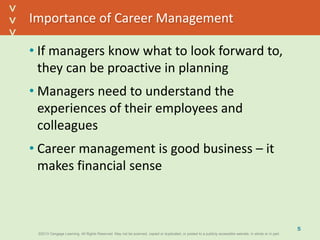
Importance of Career Management
• If managers know what to look forward to,
they can be proactive in planning
• Managers need to understand the
experiences of their employees and
colleagues
• Career management is good business – it
makes financial sense
5
©2013 Cengage Learning. All Rights Reserved. May not be scanned, copied or duplicated, or posted to a publicly accessible website, in whole or in part.©2013 Cengage Learning. All Rights Reserved. May not be scanned, copied or duplicated, or posted to a publicly accessible website, in whole or in part.
^
^
6
©2013 Cengage Learning. All Rights Reserved. May not be scanned, copied or duplicated, or posted to a publicly accessible website, in whole or in part.©2013 Cengage Learning. All Rights Reserved. May not be scanned, copied or duplicated, or posted to a publicly accessible website, in whole or in part.
^
^
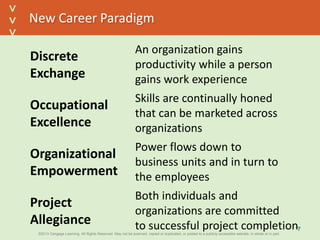
New Career Paradigm
7
Discrete
Exchange
An organization gains
productivity while a person
gains work experience
Occupational
Excellence
Skills are continually honed
that can be marketed across
organizations
Organizational
Empowerment
Power flows down to
business units and in turn to
the employees
Project
Allegiance
Both individuals and
organizations are committed
to successful project completion
©2013 Cengage Learning. All Rights Reserved. May not be scanned, copied or duplicated, or posted to a publicly accessible website, in whole or in part.©2013 Cengage Learning. All Rights Reserved. May not be scanned, copied or duplicated, or posted to a publicly accessible website, in whole or in part.
^
^
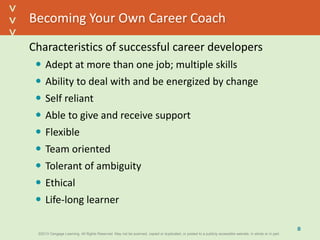
Becoming Your Own Career Coach
Characteristics of successful career developers
 Adept at more than one job; multiple skills
 Ability to deal with and be energized by change
 Self reliant
 Able to give and receive support
 Flexible
 Team oriented
 Tolerant of ambiguity
 Ethical
 Life-long learner
8
©2013 Cengage Learning. All Rights Reserved. May not be scanned, copied or duplicated, or posted to a publicly accessible website, in whole or in part.©2013 Cengage Learning. All Rights Reserved. May not be scanned, copied or duplicated, or posted to a publicly accessible website, in whole or in part.
^
^
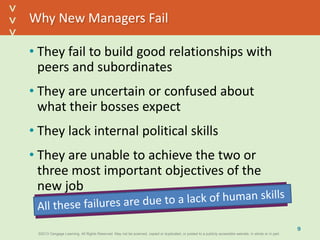
Why New Managers Fail
9
• They fail to build good relationships with
peers and subordinates
• They are uncertain or confused about
what their bosses expect
• They lack internal political skills
• They are unable to achieve the two or
three most important objectives of the
new job
©2013 Cengage Learning. All Rights Reserved. May not be scanned, copied or duplicated, or posted to a publicly accessible website, in whole or in part.©2013 Cengage Learning. All Rights Reserved. May not be scanned, copied or duplicated, or posted to a publicly accessible website, in whole or in part.
^
^
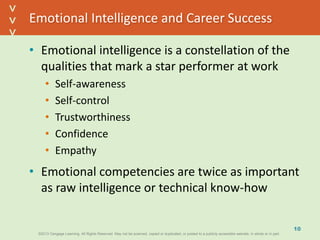
Emotional Intelligence and Career Success
• Emotional intelligence is a constellation of the
qualities that mark a star performer at work
• Self-awareness
• Self-control
• Trustworthiness
• Confidence
• Empathy
• Emotional competencies are twice as important
as raw intelligence or technical know-how
10
©2013 Cengage Learning. All Rights Reserved. May not be scanned, copied or duplicated, or posted to a publicly accessible website, in whole or in part.©2013 Cengage Learning. All Rights Reserved. May not be scanned, copied or duplicated, or posted to a publicly accessible website, in whole or in part.
^
^
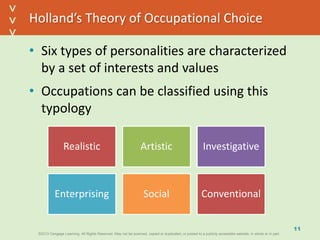
Holland’s Theory of Occupational Choice
• Six types of personalities are characterized
by a set of interests and values
• Occupations can be classified using this
typology
11
Realistic Artistic Investigative
Enterprising Social Conventional
©2013 Cengage Learning. All Rights Reserved. May not be scanned, copied or duplicated, or posted to a publicly accessible website, in whole or in part.©2013 Cengage Learning. All Rights Reserved. May not be scanned, copied or duplicated, or posted to a publicly accessible website, in whole or in part.
^
^
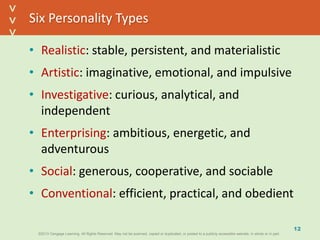
Six Personality Types
• Realistic: stable, persistent, and materialistic
• Artistic: imaginative, emotional, and impulsive
• Investigative: curious, analytical, and
independent
• Enterprising: ambitious, energetic, and
adventurous
• Social: generous, cooperative, and sociable
• Conventional: efficient, practical, and obedient
12
©2013 Cengage Learning. All Rights Reserved. May not be scanned, copied or duplicated, or posted to a publicly accessible website, in whole or in part.©2013 Cengage Learning. All Rights Reserved. May not be scanned, copied or duplicated, or posted to a publicly accessible website, in whole or in part.
^
^
Other Factors in Occupational Choice
• Social class
• Parents’ occupations
• Economic conditions
• Geography
• Passions and values
13
©2013 Cengage Learning. All Rights Reserved. May not be scanned, copied or duplicated, or posted to a publicly accessible website, in whole or in part.©2013 Cengage Learning. All Rights Reserved. May not be scanned, copied or duplicated, or posted to a publicly accessible website, in whole or in part.
^
^
14
©2013 Cengage Learning. All Rights Reserved. May not be scanned, copied or duplicated, or posted to a publicly accessible website, in whole or in part.©2013 Cengage Learning. All Rights Reserved. May not be scanned, copied or duplicated, or posted to a publicly accessible website, in whole or in part.
^
^
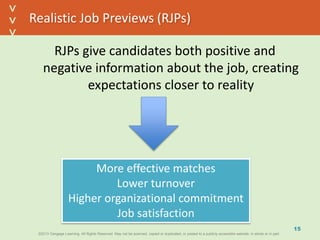
Realistic Job Previews (RJPs)
RJPs give candidates both positive and
negative information about the job, creating
expectations closer to reality
15
More effective matches
Lower turnover
Higher organizational commitment
Job satisfaction
©2013 Cengage Learning. All Rights Reserved. May not be scanned, copied or duplicated, or posted to a publicly accessible website, in whole or in part.©2013 Cengage Learning. All Rights Reserved. May not be scanned, copied or duplicated, or posted to a publicly accessible website, in whole or in part.
^
^
16
©2013 Cengage Learning. All Rights Reserved. May not be scanned, copied or duplicated, or posted to a publicly accessible website, in whole or in part.©2013 Cengage Learning. All Rights Reserved. May not be scanned, copied or duplicated, or posted to a publicly accessible website, in whole or in part.
^
^
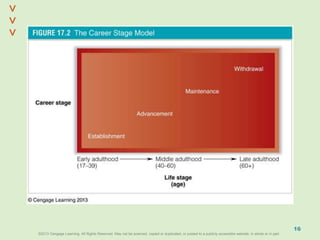
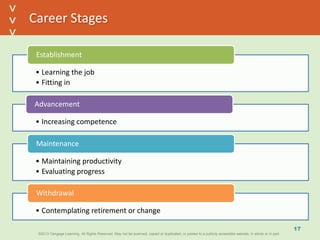
Career Stages
17
• Learning the job
• Fitting in
Establishment
• Increasing competence
Advancement
• Maintaining productivity
• Evaluating progress
Maintenance
• Contemplating retirement or change
Withdrawal
©2013 Cengage Learning. All Rights Reserved. May not be scanned, copied or duplicated, or posted to a publicly accessible website, in whole or in part.©2013 Cengage Learning. All Rights Reserved. May not be scanned, copied or duplicated, or posted to a publicly accessible website, in whole or in part.
^
^
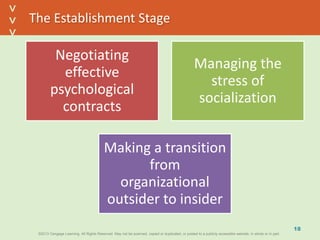
The Establishment Stage
Negotiating
effective
psychological
contracts
Managing the
stress of
socialization
Making a transition
from
organizational
outsider to insider
18
©2013 Cengage Learning. All Rights Reserved. May not be scanned, copied or duplicated, or posted to a publicly accessible website, in whole or in part.©2013 Cengage Learning. All Rights Reserved. May not be scanned, copied or duplicated, or posted to a publicly accessible website, in whole or in part.
^
^
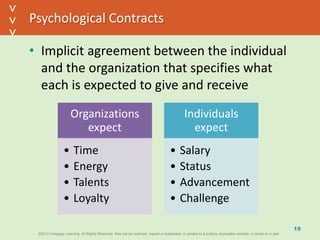
Psychological Contracts
• Implicit agreement between the individual
and the organization that specifies what
each is expected to give and receive
19
Organizations
expect
• Time
• Energy
• Talents
• Loyalty
Individuals
expect
• Salary
• Status
• Advancement
• Challenge
©2013 Cengage Learning. All Rights Reserved. May not be scanned, copied or duplicated, or posted to a publicly accessible website, in whole or in part.©2013 Cengage Learning. All Rights Reserved. May not be scanned, copied or duplicated, or posted to a publicly accessible website, in whole or in part.
^
^
20
©2013 Cengage Learning. All Rights Reserved. May not be scanned, copied or duplicated, or posted to a publicly accessible website, in whole or in part.©2013 Cengage Learning. All Rights Reserved. May not be scanned, copied or duplicated, or posted to a publicly accessible website, in whole or in part.
^
^
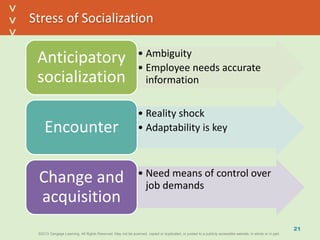
Stress of Socialization
• Ambiguity
• Employee needs accurate
information
Anticipatory
socialization
• Reality shock
• Adaptability is keyEncounter
• Need means of control over
job demands
Change and
acquisition
21
©2013 Cengage Learning. All Rights Reserved. May not be scanned, copied or duplicated, or posted to a publicly accessible website, in whole or in part.©2013 Cengage Learning. All Rights Reserved. May not be scanned, copied or duplicated, or posted to a publicly accessible website, in whole or in part.
^
^
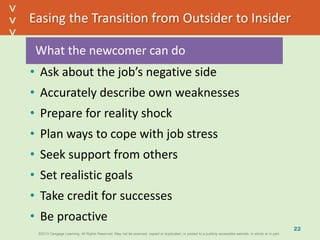
Easing the Transition from Outsider to Insider
22
• Ask about the job’s negative side
• Accurately describe own weaknesses
• Prepare for reality shock
• Plan ways to cope with job stress
• Seek support from others
• Set realistic goals
• Take credit for successes
• Be proactive
What the newcomer can do
©2013 Cengage Learning. All Rights Reserved. May not be scanned, copied or duplicated, or posted to a publicly accessible website, in whole or in part.©2013 Cengage Learning. All Rights Reserved. May not be scanned, copied or duplicated, or posted to a publicly accessible website, in whole or in part.
^
^
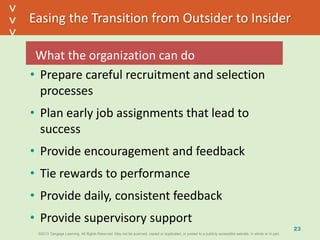
Easing the Transition from Outsider to Insider
23
• Prepare careful recruitment and selection
processes
• Plan early job assignments that lead to
success
• Provide encouragement and feedback
• Tie rewards to performance
• Provide daily, consistent feedback
• Provide supervisory support
What the organization can do
©2013 Cengage Learning. All Rights Reserved. May not be scanned, copied or duplicated, or posted to a publicly accessible website, in whole or in part.©2013 Cengage Learning. All Rights Reserved. May not be scanned, copied or duplicated, or posted to a publicly accessible website, in whole or in part.
^
^
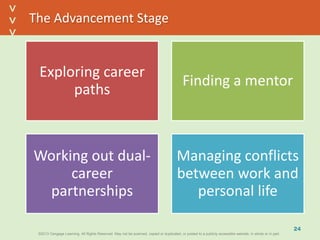
The Advancement Stage
Exploring career
paths
Finding a mentor
Working out dual-
career
partnerships
Managing conflicts
between work and
personal life
24
©2013 Cengage Learning. All Rights Reserved. May not be scanned, copied or duplicated, or posted to a publicly accessible website, in whole or in part.©2013 Cengage Learning. All Rights Reserved. May not be scanned, copied or duplicated, or posted to a publicly accessible website, in whole or in part.
^
^
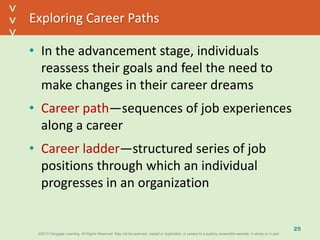
Exploring Career Paths
• In the advancement stage, individuals
reassess their goals and feel the need to
make changes in their career dreams
• Career path—sequences of job experiences
along a career
• Career ladder—structured series of job
positions through which an individual
progresses in an organization
25
©2013 Cengage Learning. All Rights Reserved. May not be scanned, copied or duplicated, or posted to a publicly accessible website, in whole or in part.©2013 Cengage Learning. All Rights Reserved. May not be scanned, copied or duplicated, or posted to a publicly accessible website, in whole or in part.
^
^
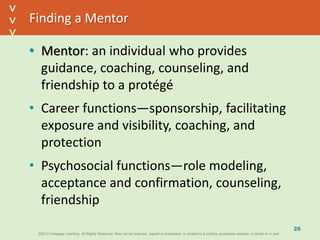
Finding a Mentor
• Mentor: an individual who provides
guidance, coaching, counseling, and
friendship to a protégé
• Career functions—sponsorship, facilitating
exposure and visibility, coaching, and
protection
• Psychosocial functions—role modeling,
acceptance and confirmation, counseling,
friendship
26
©2013 Cengage Learning. All Rights Reserved. May not be scanned, copied or duplicated, or posted to a publicly accessible website, in whole or in part.©2013 Cengage Learning. All Rights Reserved. May not be scanned, copied or duplicated, or posted to a publicly accessible website, in whole or in part.
^
^
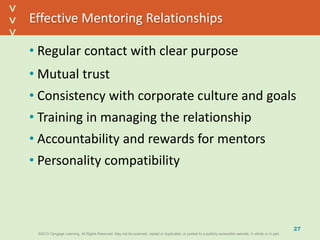
Effective Mentoring Relationships
• Regular contact with clear purpose
• Mutual trust
• Consistency with corporate culture and goals
• Training in managing the relationship
• Accountability and rewards for mentors
• Personality compatibility
27
©2013 Cengage Learning. All Rights Reserved. May not be scanned, copied or duplicated, or posted to a publicly accessible website, in whole or in part.©2013 Cengage Learning. All Rights Reserved. May not be scanned, copied or duplicated, or posted to a publicly accessible website, in whole or in part.
^
^
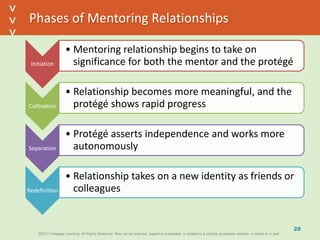
Phases of Mentoring Relationships
Initiation
• Mentoring relationship begins to take on
significance for both the mentor and the protégé
Cultivation
• Relationship becomes more meaningful, and the
protégé shows rapid progress
Separation
• Protégé asserts independence and works more
autonomously
Redefinition
• Relationship takes on a new identity as friends or
colleagues
28
©2013 Cengage Learning. All Rights Reserved. May not be scanned, copied or duplicated, or posted to a publicly accessible website, in whole or in part.©2013 Cengage Learning. All Rights Reserved. May not be scanned, copied or duplicated, or posted to a publicly accessible website, in whole or in part.
^
^
Dual-Career Partnerships
• Dual-career partnerships: relationships in
which both people have important career
roles
• Stressors include
• Gender role stereotypes
• Time pressure
• Jealousy
• Whose career takes precedence?
29
©2013 Cengage Learning. All Rights Reserved. May not be scanned, copied or duplicated, or posted to a publicly accessible website, in whole or in part.©2013 Cengage Learning. All Rights Reserved. May not be scanned, copied or duplicated, or posted to a publicly accessible website, in whole or in part.
^
^
Work-Home Conflicts
• Work-home conflicts are more likely to affect
working women
• Organizations attempt to help with
• Flexible work schedules
• Childcare
• Eldercare
• Alternative work arrangements—flextime,
compressed work weeks, telecommuting, part-
time hours, job sharing, leave options
30
©2013 Cengage Learning. All Rights Reserved. May not be scanned, copied or duplicated, or posted to a publicly accessible website, in whole or in part.©2013 Cengage Learning. All Rights Reserved. May not be scanned, copied or duplicated, or posted to a publicly accessible website, in whole or in part.
^
^
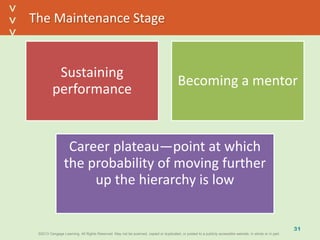
The Maintenance Stage
Sustaining
performance
Becoming a mentor
Career plateau—point at which
the probability of moving further
up the hierarchy is low
31
©2013 Cengage Learning. All Rights Reserved. May not be scanned, copied or duplicated, or posted to a publicly accessible website, in whole or in part.©2013 Cengage Learning. All Rights Reserved. May not be scanned, copied or duplicated, or posted to a publicly accessible website, in whole or in part.
^
^
The Withdrawal Stage—Retirement
• “Plan no unplanned retirement”
• The decision to retire is influenced by
• Company policy
• Financial considerations
• Family support or pressure
• Health
• Opportunities for other productive activities
32
©2013 Cengage Learning. All Rights Reserved. May not be scanned, copied or duplicated, or posted to a publicly accessible website, in whole or in part.©2013 Cengage Learning. All Rights Reserved. May not be scanned, copied or duplicated, or posted to a publicly accessible website, in whole or in part.
^
^
Retirement Options
• Complete cessation of work
• Phased retirement—a gradual reduction of
hours and/or responsibilities
• Bridge employment—retirement from full-
time work with continuing employment
33
©2013 Cengage Learning. All Rights Reserved. May not be scanned, copied or duplicated, or posted to a publicly accessible website, in whole or in part.©2013 Cengage Learning. All Rights Reserved. May not be scanned, copied or duplicated, or posted to a publicly accessible website, in whole or in part.
^
^
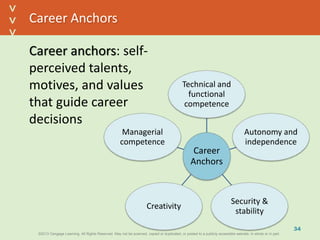
Career Anchors
Career anchors: self-
perceived talents,
motives, and values
that guide career
decisions
34
Career
Anchors
Technical and
functional
competence
Autonomy and
independence
Security &
stability
Creativity
Managerial
competence
©2013 Cengage Learning. All Rights Reserved. May not be scanned, copied or duplicated, or posted to a publicly accessible website, in whole or in part.©2013 Cengage Learning. All Rights Reserved. May not be scanned, copied or duplicated, or posted to a publicly accessible website, in whole or in part.
^
^
Managing Your Career
• Am I adding real value?
• Am I plugged into what’s happening around
me? Inside the company? The industry?
• Am I trying new ideas, new techniques, and
new technologies?
35
©2013 Cengage Learning. All Rights Reserved. May not be scanned, copied or duplicated, or posted to a publicly accessible website, in whole or in part.©2013 Cengage Learning. All Rights Reserved. May not be scanned, copied or duplicated, or posted to a publicly accessible website, in whole or in part.
^
^
^
Chapter 17: Reflect & Discuss
Baby Mama Video Clip
 Assess the emotional intelligence of each of the three
characters shown in these scenes. What level of
emotional intelligence does Carl exhibit? Assess him on
self-awareness, empathy, and self-control.
 What level of emotional intelligence does Amy show?
Assess her on self-awareness, empathy, and self-control.
 What level of emotional intelligence does Kate show?
Assess her on self-awareness, empathy, and self-control.
36

MBA 635 chapter 17

  • 1.
    ©2013 Cengage Learning.All Rights Reserved. May not be scanned, copied or duplicated, or posted to a publicly accessible website, in whole or in part. 17 ©2013 Cengage Learning. All Rights Reserved. May not be scanned, copied or duplicated, or posted to a publicly accessible website, in whole or in part. Career Management
  • 2.
    ©2013 Cengage Learning.All Rights Reserved. May not be scanned, copied or duplicated, or posted to a publicly accessible website, in whole or in part. Learning Objectives ©2013 Cengage Learning. All Rights Reserved. May not be scanned, copied or duplicated, or posted to a publicly accessible website, in whole or in part. 1 Define career and career management. 2 Explain occupational and organizational choice decisions. 3 Describe the four stages of the career model. 4 Explain the psychological contract. 2
  • 3.
    ©2013 Cengage Learning.All Rights Reserved. May not be scanned, copied or duplicated, or posted to a publicly accessible website, in whole or in part. Learning Objectives continued ©2013 Cengage Learning. All Rights Reserved. May not be scanned, copied or duplicated, or posted to a publicly accessible website, in whole or in part. 5 Describe how mentors help organizational newcomers. 6 Describe ways to manage conflicts between work and home. 7 Explain how career anchors help form a career identity. 3
  • 4.
    ©2013 Cengage Learning.All Rights Reserved. May not be scanned, copied or duplicated, or posted to a publicly accessible website, in whole or in part.©2013 Cengage Learning. All Rights Reserved. May not be scanned, copied or duplicated, or posted to a publicly accessible website, in whole or in part. ^ ^ Career Management Terms Career: a pattern of work-related experiences that spans the course of a person’s life Career management: a lifelong process of learning about self, jobs, and organizations; setting personal career goals; developing strategies for achieving the goals; and revising the goals based on work and life experiences 4
  • 5.
    ©2013 Cengage Learning.All Rights Reserved. May not be scanned, copied or duplicated, or posted to a publicly accessible website, in whole or in part.©2013 Cengage Learning. All Rights Reserved. May not be scanned, copied or duplicated, or posted to a publicly accessible website, in whole or in part. ^ ^ Importance of Career Management • If managers know what to look forward to, they can be proactive in planning • Managers need to understand the experiences of their employees and colleagues • Career management is good business – it makes financial sense 5
  • 6.
    ©2013 Cengage Learning.All Rights Reserved. May not be scanned, copied or duplicated, or posted to a publicly accessible website, in whole or in part.©2013 Cengage Learning. All Rights Reserved. May not be scanned, copied or duplicated, or posted to a publicly accessible website, in whole or in part. ^ ^ 6
  • 7.
    ©2013 Cengage Learning.All Rights Reserved. May not be scanned, copied or duplicated, or posted to a publicly accessible website, in whole or in part.©2013 Cengage Learning. All Rights Reserved. May not be scanned, copied or duplicated, or posted to a publicly accessible website, in whole or in part. ^ ^ New Career Paradigm 7 Discrete Exchange An organization gains productivity while a person gains work experience Occupational Excellence Skills are continually honed that can be marketed across organizations Organizational Empowerment Power flows down to business units and in turn to the employees Project Allegiance Both individuals and organizations are committed to successful project completion
  • 8.
    ©2013 Cengage Learning.All Rights Reserved. May not be scanned, copied or duplicated, or posted to a publicly accessible website, in whole or in part.©2013 Cengage Learning. All Rights Reserved. May not be scanned, copied or duplicated, or posted to a publicly accessible website, in whole or in part. ^ ^ Becoming Your Own Career Coach Characteristics of successful career developers  Adept at more than one job; multiple skills  Ability to deal with and be energized by change  Self reliant  Able to give and receive support  Flexible  Team oriented  Tolerant of ambiguity  Ethical  Life-long learner 8
  • 9.
    ©2013 Cengage Learning.All Rights Reserved. May not be scanned, copied or duplicated, or posted to a publicly accessible website, in whole or in part.©2013 Cengage Learning. All Rights Reserved. May not be scanned, copied or duplicated, or posted to a publicly accessible website, in whole or in part. ^ ^ Why New Managers Fail 9 • They fail to build good relationships with peers and subordinates • They are uncertain or confused about what their bosses expect • They lack internal political skills • They are unable to achieve the two or three most important objectives of the new job
  • 10.
    ©2013 Cengage Learning.All Rights Reserved. May not be scanned, copied or duplicated, or posted to a publicly accessible website, in whole or in part.©2013 Cengage Learning. All Rights Reserved. May not be scanned, copied or duplicated, or posted to a publicly accessible website, in whole or in part. ^ ^ Emotional Intelligence and Career Success • Emotional intelligence is a constellation of the qualities that mark a star performer at work • Self-awareness • Self-control • Trustworthiness • Confidence • Empathy • Emotional competencies are twice as important as raw intelligence or technical know-how 10
  • 11.
    ©2013 Cengage Learning.All Rights Reserved. May not be scanned, copied or duplicated, or posted to a publicly accessible website, in whole or in part.©2013 Cengage Learning. All Rights Reserved. May not be scanned, copied or duplicated, or posted to a publicly accessible website, in whole or in part. ^ ^ Holland’s Theory of Occupational Choice • Six types of personalities are characterized by a set of interests and values • Occupations can be classified using this typology 11 Realistic Artistic Investigative Enterprising Social Conventional
  • 12.
    ©2013 Cengage Learning.All Rights Reserved. May not be scanned, copied or duplicated, or posted to a publicly accessible website, in whole or in part.©2013 Cengage Learning. All Rights Reserved. May not be scanned, copied or duplicated, or posted to a publicly accessible website, in whole or in part. ^ ^ Six Personality Types • Realistic: stable, persistent, and materialistic • Artistic: imaginative, emotional, and impulsive • Investigative: curious, analytical, and independent • Enterprising: ambitious, energetic, and adventurous • Social: generous, cooperative, and sociable • Conventional: efficient, practical, and obedient 12
  • 13.
    ©2013 Cengage Learning.All Rights Reserved. May not be scanned, copied or duplicated, or posted to a publicly accessible website, in whole or in part.©2013 Cengage Learning. All Rights Reserved. May not be scanned, copied or duplicated, or posted to a publicly accessible website, in whole or in part. ^ ^ Other Factors in Occupational Choice • Social class • Parents’ occupations • Economic conditions • Geography • Passions and values 13
  • 14.
    ©2013 Cengage Learning.All Rights Reserved. May not be scanned, copied or duplicated, or posted to a publicly accessible website, in whole or in part.©2013 Cengage Learning. All Rights Reserved. May not be scanned, copied or duplicated, or posted to a publicly accessible website, in whole or in part. ^ ^ 14
  • 15.
    ©2013 Cengage Learning.All Rights Reserved. May not be scanned, copied or duplicated, or posted to a publicly accessible website, in whole or in part.©2013 Cengage Learning. All Rights Reserved. May not be scanned, copied or duplicated, or posted to a publicly accessible website, in whole or in part. ^ ^ Realistic Job Previews (RJPs) RJPs give candidates both positive and negative information about the job, creating expectations closer to reality 15 More effective matches Lower turnover Higher organizational commitment Job satisfaction
  • 16.
    ©2013 Cengage Learning.All Rights Reserved. May not be scanned, copied or duplicated, or posted to a publicly accessible website, in whole or in part.©2013 Cengage Learning. All Rights Reserved. May not be scanned, copied or duplicated, or posted to a publicly accessible website, in whole or in part. ^ ^ 16
  • 17.
    ©2013 Cengage Learning.All Rights Reserved. May not be scanned, copied or duplicated, or posted to a publicly accessible website, in whole or in part.©2013 Cengage Learning. All Rights Reserved. May not be scanned, copied or duplicated, or posted to a publicly accessible website, in whole or in part. ^ ^ Career Stages 17 • Learning the job • Fitting in Establishment • Increasing competence Advancement • Maintaining productivity • Evaluating progress Maintenance • Contemplating retirement or change Withdrawal
  • 18.
    ©2013 Cengage Learning.All Rights Reserved. May not be scanned, copied or duplicated, or posted to a publicly accessible website, in whole or in part.©2013 Cengage Learning. All Rights Reserved. May not be scanned, copied or duplicated, or posted to a publicly accessible website, in whole or in part. ^ ^ The Establishment Stage Negotiating effective psychological contracts Managing the stress of socialization Making a transition from organizational outsider to insider 18
  • 19.
    ©2013 Cengage Learning.All Rights Reserved. May not be scanned, copied or duplicated, or posted to a publicly accessible website, in whole or in part.©2013 Cengage Learning. All Rights Reserved. May not be scanned, copied or duplicated, or posted to a publicly accessible website, in whole or in part. ^ ^ Psychological Contracts • Implicit agreement between the individual and the organization that specifies what each is expected to give and receive 19 Organizations expect • Time • Energy • Talents • Loyalty Individuals expect • Salary • Status • Advancement • Challenge
  • 20.
    ©2013 Cengage Learning.All Rights Reserved. May not be scanned, copied or duplicated, or posted to a publicly accessible website, in whole or in part.©2013 Cengage Learning. All Rights Reserved. May not be scanned, copied or duplicated, or posted to a publicly accessible website, in whole or in part. ^ ^ 20
  • 21.
    ©2013 Cengage Learning.All Rights Reserved. May not be scanned, copied or duplicated, or posted to a publicly accessible website, in whole or in part.©2013 Cengage Learning. All Rights Reserved. May not be scanned, copied or duplicated, or posted to a publicly accessible website, in whole or in part. ^ ^ Stress of Socialization • Ambiguity • Employee needs accurate information Anticipatory socialization • Reality shock • Adaptability is keyEncounter • Need means of control over job demands Change and acquisition 21
  • 22.
    ©2013 Cengage Learning.All Rights Reserved. May not be scanned, copied or duplicated, or posted to a publicly accessible website, in whole or in part.©2013 Cengage Learning. All Rights Reserved. May not be scanned, copied or duplicated, or posted to a publicly accessible website, in whole or in part. ^ ^ Easing the Transition from Outsider to Insider 22 • Ask about the job’s negative side • Accurately describe own weaknesses • Prepare for reality shock • Plan ways to cope with job stress • Seek support from others • Set realistic goals • Take credit for successes • Be proactive What the newcomer can do
  • 23.
    ©2013 Cengage Learning.All Rights Reserved. May not be scanned, copied or duplicated, or posted to a publicly accessible website, in whole or in part.©2013 Cengage Learning. All Rights Reserved. May not be scanned, copied or duplicated, or posted to a publicly accessible website, in whole or in part. ^ ^ Easing the Transition from Outsider to Insider 23 • Prepare careful recruitment and selection processes • Plan early job assignments that lead to success • Provide encouragement and feedback • Tie rewards to performance • Provide daily, consistent feedback • Provide supervisory support What the organization can do
  • 24.
    ©2013 Cengage Learning.All Rights Reserved. May not be scanned, copied or duplicated, or posted to a publicly accessible website, in whole or in part.©2013 Cengage Learning. All Rights Reserved. May not be scanned, copied or duplicated, or posted to a publicly accessible website, in whole or in part. ^ ^ The Advancement Stage Exploring career paths Finding a mentor Working out dual- career partnerships Managing conflicts between work and personal life 24
  • 25.
    ©2013 Cengage Learning.All Rights Reserved. May not be scanned, copied or duplicated, or posted to a publicly accessible website, in whole or in part.©2013 Cengage Learning. All Rights Reserved. May not be scanned, copied or duplicated, or posted to a publicly accessible website, in whole or in part. ^ ^ Exploring Career Paths • In the advancement stage, individuals reassess their goals and feel the need to make changes in their career dreams • Career path—sequences of job experiences along a career • Career ladder—structured series of job positions through which an individual progresses in an organization 25
  • 26.
    ©2013 Cengage Learning.All Rights Reserved. May not be scanned, copied or duplicated, or posted to a publicly accessible website, in whole or in part.©2013 Cengage Learning. All Rights Reserved. May not be scanned, copied or duplicated, or posted to a publicly accessible website, in whole or in part. ^ ^ Finding a Mentor • Mentor: an individual who provides guidance, coaching, counseling, and friendship to a protégé • Career functions—sponsorship, facilitating exposure and visibility, coaching, and protection • Psychosocial functions—role modeling, acceptance and confirmation, counseling, friendship 26
  • 27.
    ©2013 Cengage Learning.All Rights Reserved. May not be scanned, copied or duplicated, or posted to a publicly accessible website, in whole or in part.©2013 Cengage Learning. All Rights Reserved. May not be scanned, copied or duplicated, or posted to a publicly accessible website, in whole or in part. ^ ^ Effective Mentoring Relationships • Regular contact with clear purpose • Mutual trust • Consistency with corporate culture and goals • Training in managing the relationship • Accountability and rewards for mentors • Personality compatibility 27
  • 28.
    ©2013 Cengage Learning.All Rights Reserved. May not be scanned, copied or duplicated, or posted to a publicly accessible website, in whole or in part.©2013 Cengage Learning. All Rights Reserved. May not be scanned, copied or duplicated, or posted to a publicly accessible website, in whole or in part. ^ ^ Phases of Mentoring Relationships Initiation • Mentoring relationship begins to take on significance for both the mentor and the protégé Cultivation • Relationship becomes more meaningful, and the protégé shows rapid progress Separation • Protégé asserts independence and works more autonomously Redefinition • Relationship takes on a new identity as friends or colleagues 28
  • 29.
    ©2013 Cengage Learning.All Rights Reserved. May not be scanned, copied or duplicated, or posted to a publicly accessible website, in whole or in part.©2013 Cengage Learning. All Rights Reserved. May not be scanned, copied or duplicated, or posted to a publicly accessible website, in whole or in part. ^ ^ Dual-Career Partnerships • Dual-career partnerships: relationships in which both people have important career roles • Stressors include • Gender role stereotypes • Time pressure • Jealousy • Whose career takes precedence? 29
  • 30.
    ©2013 Cengage Learning.All Rights Reserved. May not be scanned, copied or duplicated, or posted to a publicly accessible website, in whole or in part.©2013 Cengage Learning. All Rights Reserved. May not be scanned, copied or duplicated, or posted to a publicly accessible website, in whole or in part. ^ ^ Work-Home Conflicts • Work-home conflicts are more likely to affect working women • Organizations attempt to help with • Flexible work schedules • Childcare • Eldercare • Alternative work arrangements—flextime, compressed work weeks, telecommuting, part- time hours, job sharing, leave options 30
  • 31.
    ©2013 Cengage Learning.All Rights Reserved. May not be scanned, copied or duplicated, or posted to a publicly accessible website, in whole or in part.©2013 Cengage Learning. All Rights Reserved. May not be scanned, copied or duplicated, or posted to a publicly accessible website, in whole or in part. ^ ^ The Maintenance Stage Sustaining performance Becoming a mentor Career plateau—point at which the probability of moving further up the hierarchy is low 31
  • 32.
    ©2013 Cengage Learning.All Rights Reserved. May not be scanned, copied or duplicated, or posted to a publicly accessible website, in whole or in part.©2013 Cengage Learning. All Rights Reserved. May not be scanned, copied or duplicated, or posted to a publicly accessible website, in whole or in part. ^ ^ The Withdrawal Stage—Retirement • “Plan no unplanned retirement” • The decision to retire is influenced by • Company policy • Financial considerations • Family support or pressure • Health • Opportunities for other productive activities 32
  • 33.
    ©2013 Cengage Learning.All Rights Reserved. May not be scanned, copied or duplicated, or posted to a publicly accessible website, in whole or in part.©2013 Cengage Learning. All Rights Reserved. May not be scanned, copied or duplicated, or posted to a publicly accessible website, in whole or in part. ^ ^ Retirement Options • Complete cessation of work • Phased retirement—a gradual reduction of hours and/or responsibilities • Bridge employment—retirement from full- time work with continuing employment 33
  • 34.
    ©2013 Cengage Learning.All Rights Reserved. May not be scanned, copied or duplicated, or posted to a publicly accessible website, in whole or in part.©2013 Cengage Learning. All Rights Reserved. May not be scanned, copied or duplicated, or posted to a publicly accessible website, in whole or in part. ^ ^ Career Anchors Career anchors: self- perceived talents, motives, and values that guide career decisions 34 Career Anchors Technical and functional competence Autonomy and independence Security & stability Creativity Managerial competence
  • 35.
    ©2013 Cengage Learning.All Rights Reserved. May not be scanned, copied or duplicated, or posted to a publicly accessible website, in whole or in part.©2013 Cengage Learning. All Rights Reserved. May not be scanned, copied or duplicated, or posted to a publicly accessible website, in whole or in part. ^ ^ Managing Your Career • Am I adding real value? • Am I plugged into what’s happening around me? Inside the company? The industry? • Am I trying new ideas, new techniques, and new technologies? 35
  • 36.
    ©2013 Cengage Learning.All Rights Reserved. May not be scanned, copied or duplicated, or posted to a publicly accessible website, in whole or in part.©2013 Cengage Learning. All Rights Reserved. May not be scanned, copied or duplicated, or posted to a publicly accessible website, in whole or in part. ^ ^ ^ Chapter 17: Reflect & Discuss Baby Mama Video Clip  Assess the emotional intelligence of each of the three characters shown in these scenes. What level of emotional intelligence does Carl exhibit? Assess him on self-awareness, empathy, and self-control.  What level of emotional intelligence does Amy show? Assess her on self-awareness, empathy, and self-control.  What level of emotional intelligence does Kate show? Assess her on self-awareness, empathy, and self-control. 36