©2013 Cengage Learning. All Rights Reserved. May not be scanned, copied or duplicated, or posted to a publicly accessible website, in whole or in part.
6
©2013 Cengage Learning. All Rights Reserved.
May not be scanned, copied or duplicated, or posted to a publicly accessible website, in whole or in
part.
Learning and
Performance
Management
©2013 Cengage Learning. All Rights Reserved. May not be scanned, copied or duplicated, or posted to a publicly accessible website, in whole or in part.
Learning Objectives
©2013 Cengage Learning. All Rights Reserved. May not be scanned, copied or duplicated, or posted to a publicly accessible website, in whole or in part.
1 Define learning.
2 Distinguish between classical and operant
conditioning.
3 Explain the use of positive and negative
consequences of behavior in strategies of
reinforcement and punishment.
4 Define reinforcement, punishment, and
extinction.
2
©2013 Cengage Learning. All Rights Reserved. May not be scanned, copied or duplicated, or posted to a publicly accessible website, in whole or in part.
Learning Objectives continued
©2013 Cengage Learning. All Rights Reserved. May not be scanned, copied or duplicated, or posted to a publicly accessible website, in whole or in part.
5 Define goal setting and identify the
purposes of goal setting and five
characteristics of effective goals.
6 Describe 360-degree feedback.
7 Compare individual and team-oriented
reward systems.
8 Describe strategies for correcting poor
performance.
3
©2013 Cengage Learning. All Rights Reserved. May not be scanned, copied or duplicated, or posted to a publicly accessible website, in whole or in part.©2013 Cengage Learning. All Rights Reserved. May not be scanned, copied or duplicated, or posted to a publicly accessible website, in whole or in part.
^
^
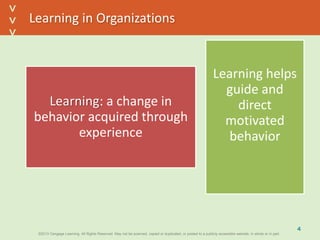
Learning in Organizations
Learning: a change in
behavior acquired through
experience
Learning helps
guide and
direct
motivated
behavior
4
©2013 Cengage Learning. All Rights Reserved. May not be scanned, copied or duplicated, or posted to a publicly accessible website, in whole or in part.©2013 Cengage Learning. All Rights Reserved. May not be scanned, copied or duplicated, or posted to a publicly accessible website, in whole or in part.
^
^
Classical and Operant Conditioning
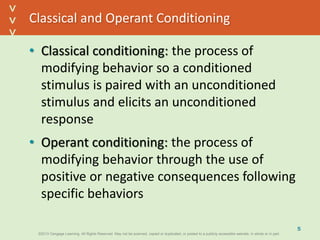
• Classical conditioning: the process of
modifying behavior so a conditioned
stimulus is paired with an unconditioned
stimulus and elicits an unconditioned
response
• Operant conditioning: the process of
modifying behavior through the use of
positive or negative consequences following
specific behaviors
5
©2013 Cengage Learning. All Rights Reserved. May not be scanned, copied or duplicated, or posted to a publicly accessible website, in whole or in part.©2013 Cengage Learning. All Rights Reserved. May not be scanned, copied or duplicated, or posted to a publicly accessible website, in whole or in part.
^
^
Reinforcement, Punishment, and Extinction
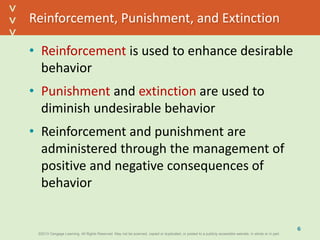
• Reinforcement is used to enhance desirable
behavior
• Punishment and extinction are used to
diminish undesirable behavior
• Reinforcement and punishment are
administered through the management of
positive and negative consequences of
behavior
6
©2013 Cengage Learning. All Rights Reserved. May not be scanned, copied or duplicated, or posted to a publicly accessible website, in whole or in part.©2013 Cengage Learning. All Rights Reserved. May not be scanned, copied or duplicated, or posted to a publicly accessible website, in whole or in part.
^
^
Reinforcement, Punishment, and Extinction
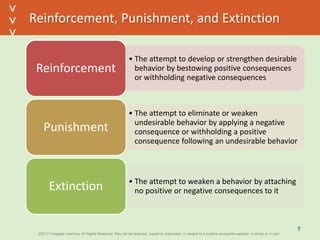
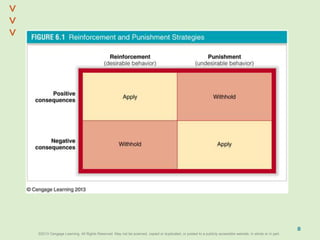
• The attempt to develop or strengthen desirable
behavior by bestowing positive consequences
or withholding negative consequences
Reinforcement
• The attempt to eliminate or weaken
undesirable behavior by applying a negative
consequence or withholding a positive
consequence following an undesirable behavior
Punishment
• The attempt to weaken a behavior by attaching
no positive or negative consequences to itExtinction
7
©2013 Cengage Learning. All Rights Reserved. May not be scanned, copied or duplicated, or posted to a publicly accessible website, in whole or in part.©2013 Cengage Learning. All Rights Reserved. May not be scanned, copied or duplicated, or posted to a publicly accessible website, in whole or in part.
^
^
8
©2013 Cengage Learning. All Rights Reserved. May not be scanned, copied or duplicated, or posted to a publicly accessible website, in whole or in part.©2013 Cengage Learning. All Rights Reserved. May not be scanned, copied or duplicated, or posted to a publicly accessible website, in whole or in part.
^
^
9
©2013 Cengage Learning. All Rights Reserved. May not be scanned, copied or duplicated, or posted to a publicly accessible website, in whole or in part.©2013 Cengage Learning. All Rights Reserved. May not be scanned, copied or duplicated, or posted to a publicly accessible website, in whole or in part.
^
^
Bandura’s Social Learning Theory
• Learning occurs through the observation of
others and the modeling of observing
behavior
• Task-specific self-efficacy: an individual’s
beliefs and expectancies about his or her
ability to perform a specific task effectively
• Believing in one’s own capability to get
something done is an important facilitator of
success
10
©2013 Cengage Learning. All Rights Reserved. May not be scanned, copied or duplicated, or posted to a publicly accessible website, in whole or in part.©2013 Cengage Learning. All Rights Reserved. May not be scanned, copied or duplicated, or posted to a publicly accessible website, in whole or in part.
^
^
Sources of Task-Specific Self-Efficacy
• Prior experiences
• Behavior models (witnessing success)
• Persuasion from other people
• Assessment of current physical and
emotional capabilities
11
©2013 Cengage Learning. All Rights Reserved. May not be scanned, copied or duplicated, or posted to a publicly accessible website, in whole or in part.©2013 Cengage Learning. All Rights Reserved. May not be scanned, copied or duplicated, or posted to a publicly accessible website, in whole or in part.
^
^
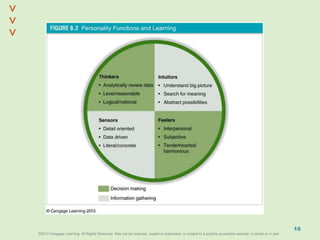
Learning and Personality Differences
Two elements of Jung’s theory have
important implications for learning and
subsequent behavior
• The distinction between introverted and
extraverted people
• The personality functions of intuition, sensing,
thinking, and feeling
12
©2013 Cengage Learning. All Rights Reserved. May not be scanned, copied or duplicated, or posted to a publicly accessible website, in whole or in part.©2013 Cengage Learning. All Rights Reserved. May not be scanned, copied or duplicated, or posted to a publicly accessible website, in whole or in part.
^
^
13
©2013 Cengage Learning. All Rights Reserved. May not be scanned, copied or duplicated, or posted to a publicly accessible website, in whole or in part.©2013 Cengage Learning. All Rights Reserved. May not be scanned, copied or duplicated, or posted to a publicly accessible website, in whole or in part.
^
^
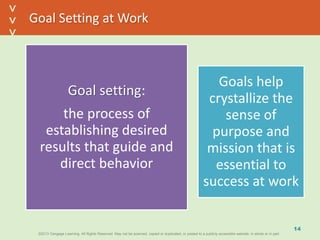
Goal Setting at Work
Goal setting:
the process of
establishing desired
results that guide and
direct behavior
Goals help
crystallize the
sense of
purpose and
mission that is
essential to
success at work
14
©2013 Cengage Learning. All Rights Reserved. May not be scanned, copied or duplicated, or posted to a publicly accessible website, in whole or in part.©2013 Cengage Learning. All Rights Reserved. May not be scanned, copied or duplicated, or posted to a publicly accessible website, in whole or in part.
^
^
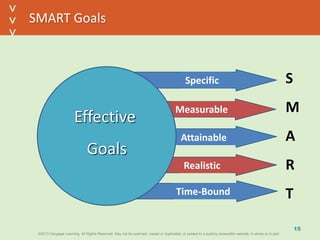
SMART Goals
15
Specific
Measurable
Attainable
Realistic
Time-Bound
S
M
A
R
T
Effective
Goals
©2013 Cengage Learning. All Rights Reserved. May not be scanned, copied or duplicated, or posted to a publicly accessible website, in whole or in part.©2013 Cengage Learning. All Rights Reserved. May not be scanned, copied or duplicated, or posted to a publicly accessible website, in whole or in part.
^
^
16
©2013 Cengage Learning. All Rights Reserved. May not be scanned, copied or duplicated, or posted to a publicly accessible website, in whole or in part.©2013 Cengage Learning. All Rights Reserved. May not be scanned, copied or duplicated, or posted to a publicly accessible website, in whole or in part.
^
^
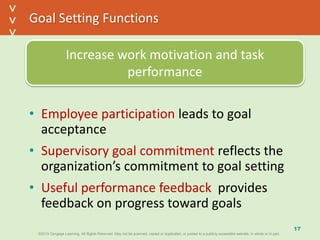
Goal Setting Functions
• Employee participation leads to goal
acceptance
• Supervisory goal commitment reflects the
organization’s commitment to goal setting
• Useful performance feedback provides
feedback on progress toward goals
17
Increase work motivation and task
performance
©2013 Cengage Learning. All Rights Reserved. May not be scanned, copied or duplicated, or posted to a publicly accessible website, in whole or in part.©2013 Cengage Learning. All Rights Reserved. May not be scanned, copied or duplicated, or posted to a publicly accessible website, in whole or in part.
^
^
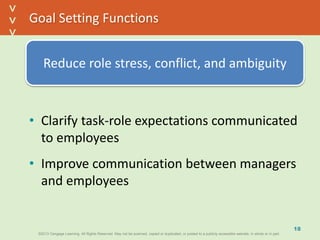
Goal Setting Functions
• Clarify task-role expectations communicated
to employees
• Improve communication between managers
and employees
18
Reduce role stress, conflict, and ambiguity
©2013 Cengage Learning. All Rights Reserved. May not be scanned, copied or duplicated, or posted to a publicly accessible website, in whole or in part.©2013 Cengage Learning. All Rights Reserved. May not be scanned, copied or duplicated, or posted to a publicly accessible website, in whole or in part.
^
^
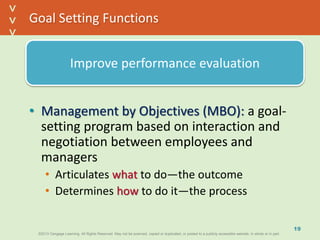
Goal Setting Functions
• Management by Objectives (MBO): a goal-
setting program based on interaction and
negotiation between employees and
managers
• Articulates what to do—the outcome
• Determines how to do it—the process
19
Improve performance evaluation
©2013 Cengage Learning. All Rights Reserved. May not be scanned, copied or duplicated, or posted to a publicly accessible website, in whole or in part.©2013 Cengage Learning. All Rights Reserved. May not be scanned, copied or duplicated, or posted to a publicly accessible website, in whole or in part.
^
^
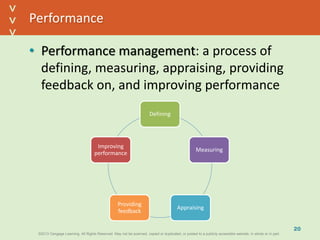
Performance
• Performance management: a process of
defining, measuring, appraising, providing
feedback on, and improving performance
20
Defining
Measuring
Appraising
Providing
feedback
Improving
performance
©2013 Cengage Learning. All Rights Reserved. May not be scanned, copied or duplicated, or posted to a publicly accessible website, in whole or in part.©2013 Cengage Learning. All Rights Reserved. May not be scanned, copied or duplicated, or posted to a publicly accessible website, in whole or in part.
^
^
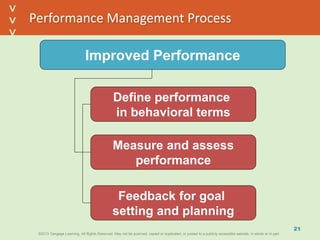
Performance Management Process
21
Improved Performance
Define performance
in behavioral terms
Measure and assess
performance
Feedback for goal
setting and planning
©2013 Cengage Learning. All Rights Reserved. May not be scanned, copied or duplicated, or posted to a publicly accessible website, in whole or in part.©2013 Cengage Learning. All Rights Reserved. May not be scanned, copied or duplicated, or posted to a publicly accessible website, in whole or in part.
^
^
Performance Appraisal
• Performance appraisal: The evaluation of a
person’s actual performance based upon the
defined performance requirements of the
job
• Give employees feedback on performance
• Identify developmental needs
• Make promotion and reward decisions
• Make demotion and termination decisions
• Develop information on selection and
placement decisions
22
©2013 Cengage Learning. All Rights Reserved. May not be scanned, copied or duplicated, or posted to a publicly accessible website, in whole or in part.©2013 Cengage Learning. All Rights Reserved. May not be scanned, copied or duplicated, or posted to a publicly accessible website, in whole or in part.
^
^
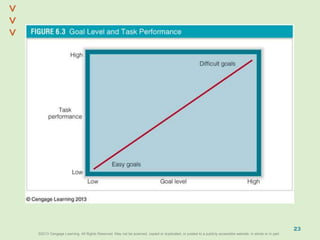
23
©2013 Cengage Learning. All Rights Reserved. May not be scanned, copied or duplicated, or posted to a publicly accessible website, in whole or in part.©2013 Cengage Learning. All Rights Reserved. May not be scanned, copied or duplicated, or posted to a publicly accessible website, in whole or in part.
^
^
Performance Feedback
• Begin with something positive
• Refer to specific, verbatim statements and
specific, observable behaviors
• Focus on changeable behaviors
• Both leader and follower should plan and
organize for the session ahead of time
24
©2013 Cengage Learning. All Rights Reserved. May not be scanned, copied or duplicated, or posted to a publicly accessible website, in whole or in part.©2013 Cengage Learning. All Rights Reserved. May not be scanned, copied or duplicated, or posted to a publicly accessible website, in whole or in part.
^
^
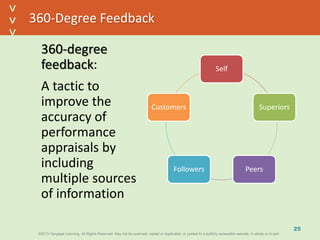
360-Degree Feedback
360-degree
feedback:
A tactic to
improve the
accuracy of
performance
appraisals by
including
multiple sources
of information
25
Self
Superiors
PeersFollowers
Customers
©2013 Cengage Learning. All Rights Reserved. May not be scanned, copied or duplicated, or posted to a publicly accessible website, in whole or in part.©2013 Cengage Learning. All Rights Reserved. May not be scanned, copied or duplicated, or posted to a publicly accessible website, in whole or in part.
^
^
Developing People and Enhancing Careers
• Requires mutual trust between supervisor
and employee
• Supervisor should
• Be vulnerable and open to challenge
• Be an empathetic listener
• Encourage employee to talk about aspirations
• Employee must take responsibility for
development and growth
26
©2013 Cengage Learning. All Rights Reserved. May not be scanned, copied or duplicated, or posted to a publicly accessible website, in whole or in part.©2013 Cengage Learning. All Rights Reserved. May not be scanned, copied or duplicated, or posted to a publicly accessible website, in whole or in part.
^
^
Characteristics of an Effective Appraisal System
27
Validity Reliability
Responsiveness Flexibility
Equitability
©2013 Cengage Learning. All Rights Reserved. May not be scanned, copied or duplicated, or posted to a publicly accessible website, in whole or in part.©2013 Cengage Learning. All Rights Reserved. May not be scanned, copied or duplicated, or posted to a publicly accessible website, in whole or in part.
^
^
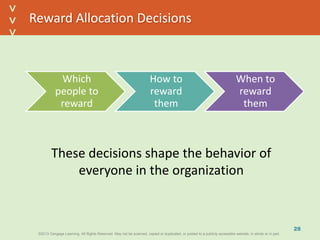
Reward Allocation Decisions
Which
people to
reward
How to
reward
them
When to
reward
them
28
These decisions shape the behavior of
everyone in the organization
©2013 Cengage Learning. All Rights Reserved. May not be scanned, copied or duplicated, or posted to a publicly accessible website, in whole or in part.©2013 Cengage Learning. All Rights Reserved. May not be scanned, copied or duplicated, or posted to a publicly accessible website, in whole or in part.
^
^
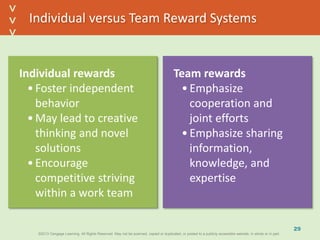
Individual versus Team Reward Systems
29
Individual rewards
•Foster independent
behavior
•May lead to creative
thinking and novel
solutions
•Encourage
competitive striving
within a work team
Team rewards
•Emphasize
cooperation and
joint efforts
•Emphasize sharing
information,
knowledge, and
expertise
©2013 Cengage Learning. All Rights Reserved. May not be scanned, copied or duplicated, or posted to a publicly accessible website, in whole or in part.©2013 Cengage Learning. All Rights Reserved. May not be scanned, copied or duplicated, or posted to a publicly accessible website, in whole or in part.
^
^
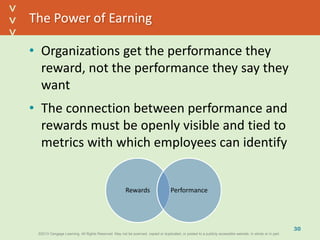
The Power of Earning
• Organizations get the performance they
reward, not the performance they say they
want
• The connection between performance and
rewards must be openly visible and tied to
metrics with which employees can identify
30
Rewards Performance
©2013 Cengage Learning. All Rights Reserved. May not be scanned, copied or duplicated, or posted to a publicly accessible website, in whole or in part.©2013 Cengage Learning. All Rights Reserved. May not be scanned, copied or duplicated, or posted to a publicly accessible website, in whole or in part.
^
^
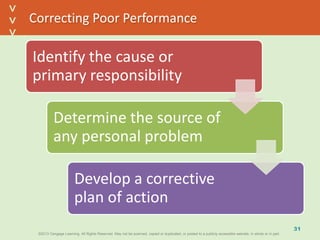
Correcting Poor Performance
Identify the cause or
primary responsibility
Determine the source of
any personal problem
Develop a corrective
plan of action
31
©2013 Cengage Learning. All Rights Reserved. May not be scanned, copied or duplicated, or posted to a publicly accessible website, in whole or in part.©2013 Cengage Learning. All Rights Reserved. May not be scanned, copied or duplicated, or posted to a publicly accessible website, in whole or in part.
^
^
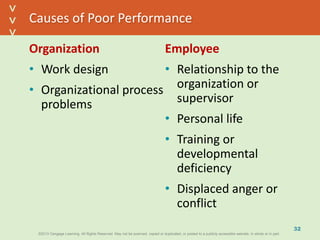
Causes of Poor Performance
Organization
• Work design
• Organizational process
problems
Employee
• Relationship to the
organization or
supervisor
• Personal life
• Training or
developmental
deficiency
• Displaced anger or
conflict
32
©2013 Cengage Learning. All Rights Reserved. May not be scanned, copied or duplicated, or posted to a publicly accessible website, in whole or in part.©2013 Cengage Learning. All Rights Reserved. May not be scanned, copied or duplicated, or posted to a publicly accessible website, in whole or in part.
^
^
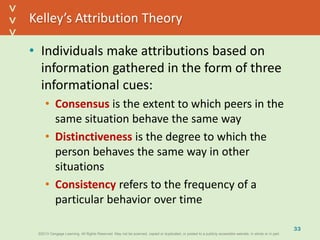
Kelley’s Attribution Theory
• Individuals make attributions based on
information gathered in the form of three
informational cues:
• Consensus is the extent to which peers in the
same situation behave the same way
• Distinctiveness is the degree to which the
person behaves the same way in other
situations
• Consistency refers to the frequency of a
particular behavior over time
33
©2013 Cengage Learning. All Rights Reserved. May not be scanned, copied or duplicated, or posted to a publicly accessible website, in whole or in part.©2013 Cengage Learning. All Rights Reserved. May not be scanned, copied or duplicated, or posted to a publicly accessible website, in whole or in part.
^
^
34
©2013 Cengage Learning. All Rights Reserved. May not be scanned, copied or duplicated, or posted to a publicly accessible website, in whole or in part.©2013 Cengage Learning. All Rights Reserved. May not be scanned, copied or duplicated, or posted to a publicly accessible website, in whole or in part.
^
^
35
©2013 Cengage Learning. All Rights Reserved. May not be scanned, copied or duplicated, or posted to a publicly accessible website, in whole or in part.©2013 Cengage Learning. All Rights Reserved. May not be scanned, copied or duplicated, or posted to a publicly accessible website, in whole or in part.
^
^
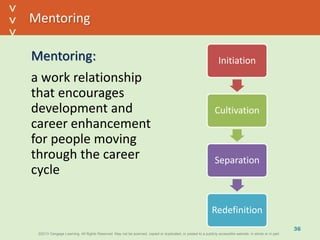
Mentoring
Mentoring:
a work relationship
that encourages
development and
career enhancement
for people moving
through the career
cycle
36
Initiation
Cultivation
Separation
Redefinition
©2013 Cengage Learning. All Rights Reserved. May not be scanned, copied or duplicated, or posted to a publicly accessible website, in whole or in part.©2013 Cengage Learning. All Rights Reserved. May not be scanned, copied or duplicated, or posted to a publicly accessible website, in whole or in part.
^
^
^
Chapter 6: Reflect & Discuss
Take the Lead Video Clip
• Rock and LaRhette are trying to learn the waltz. Which of the two
approaches to learning described earlier in this chapter best
apply to this film sequence? Do you see examples of classical
conditioning or operant conditioning? Why?
• This chapter discussed strategies of reinforcement, punishment,
and extinction. Which of those strategies appear in the film
sequence? Give examples from the film sequence to support your
answer.
• Apply the concepts described in the earlier section of this
chapter, “Performance: A Key Construct,” to the film sequence.
Which performance concepts do you see? Give specific examples
of the concepts from the film sequences.
37

MBA 635 chapter 6

  • 1.
    ©2013 Cengage Learning.All Rights Reserved. May not be scanned, copied or duplicated, or posted to a publicly accessible website, in whole or in part. 6 ©2013 Cengage Learning. All Rights Reserved. May not be scanned, copied or duplicated, or posted to a publicly accessible website, in whole or in part. Learning and Performance Management
  • 2.
    ©2013 Cengage Learning.All Rights Reserved. May not be scanned, copied or duplicated, or posted to a publicly accessible website, in whole or in part. Learning Objectives ©2013 Cengage Learning. All Rights Reserved. May not be scanned, copied or duplicated, or posted to a publicly accessible website, in whole or in part. 1 Define learning. 2 Distinguish between classical and operant conditioning. 3 Explain the use of positive and negative consequences of behavior in strategies of reinforcement and punishment. 4 Define reinforcement, punishment, and extinction. 2
  • 3.
    ©2013 Cengage Learning.All Rights Reserved. May not be scanned, copied or duplicated, or posted to a publicly accessible website, in whole or in part. Learning Objectives continued ©2013 Cengage Learning. All Rights Reserved. May not be scanned, copied or duplicated, or posted to a publicly accessible website, in whole or in part. 5 Define goal setting and identify the purposes of goal setting and five characteristics of effective goals. 6 Describe 360-degree feedback. 7 Compare individual and team-oriented reward systems. 8 Describe strategies for correcting poor performance. 3
  • 4.
    ©2013 Cengage Learning.All Rights Reserved. May not be scanned, copied or duplicated, or posted to a publicly accessible website, in whole or in part.©2013 Cengage Learning. All Rights Reserved. May not be scanned, copied or duplicated, or posted to a publicly accessible website, in whole or in part. ^ ^ Learning in Organizations Learning: a change in behavior acquired through experience Learning helps guide and direct motivated behavior 4
  • 5.
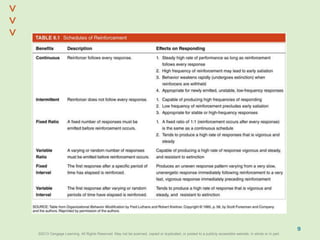
    ©2013 Cengage Learning.All Rights Reserved. May not be scanned, copied or duplicated, or posted to a publicly accessible website, in whole or in part.©2013 Cengage Learning. All Rights Reserved. May not be scanned, copied or duplicated, or posted to a publicly accessible website, in whole or in part. ^ ^ Classical and Operant Conditioning • Classical conditioning: the process of modifying behavior so a conditioned stimulus is paired with an unconditioned stimulus and elicits an unconditioned response • Operant conditioning: the process of modifying behavior through the use of positive or negative consequences following specific behaviors 5
  • 6.
    ©2013 Cengage Learning.All Rights Reserved. May not be scanned, copied or duplicated, or posted to a publicly accessible website, in whole or in part.©2013 Cengage Learning. All Rights Reserved. May not be scanned, copied or duplicated, or posted to a publicly accessible website, in whole or in part. ^ ^ Reinforcement, Punishment, and Extinction • Reinforcement is used to enhance desirable behavior • Punishment and extinction are used to diminish undesirable behavior • Reinforcement and punishment are administered through the management of positive and negative consequences of behavior 6
  • 7.
    ©2013 Cengage Learning.All Rights Reserved. May not be scanned, copied or duplicated, or posted to a publicly accessible website, in whole or in part.©2013 Cengage Learning. All Rights Reserved. May not be scanned, copied or duplicated, or posted to a publicly accessible website, in whole or in part. ^ ^ Reinforcement, Punishment, and Extinction • The attempt to develop or strengthen desirable behavior by bestowing positive consequences or withholding negative consequences Reinforcement • The attempt to eliminate or weaken undesirable behavior by applying a negative consequence or withholding a positive consequence following an undesirable behavior Punishment • The attempt to weaken a behavior by attaching no positive or negative consequences to itExtinction 7
  • 8.
    ©2013 Cengage Learning.All Rights Reserved. May not be scanned, copied or duplicated, or posted to a publicly accessible website, in whole or in part.©2013 Cengage Learning. All Rights Reserved. May not be scanned, copied or duplicated, or posted to a publicly accessible website, in whole or in part. ^ ^ 8
  • 9.
    ©2013 Cengage Learning.All Rights Reserved. May not be scanned, copied or duplicated, or posted to a publicly accessible website, in whole or in part.©2013 Cengage Learning. All Rights Reserved. May not be scanned, copied or duplicated, or posted to a publicly accessible website, in whole or in part. ^ ^ 9
  • 10.
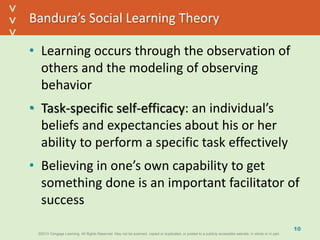
    ©2013 Cengage Learning.All Rights Reserved. May not be scanned, copied or duplicated, or posted to a publicly accessible website, in whole or in part.©2013 Cengage Learning. All Rights Reserved. May not be scanned, copied or duplicated, or posted to a publicly accessible website, in whole or in part. ^ ^ Bandura’s Social Learning Theory • Learning occurs through the observation of others and the modeling of observing behavior • Task-specific self-efficacy: an individual’s beliefs and expectancies about his or her ability to perform a specific task effectively • Believing in one’s own capability to get something done is an important facilitator of success 10
  • 11.
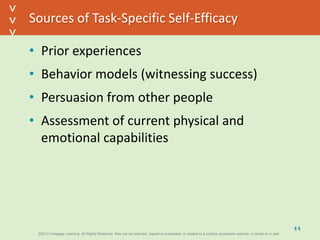
    ©2013 Cengage Learning.All Rights Reserved. May not be scanned, copied or duplicated, or posted to a publicly accessible website, in whole or in part.©2013 Cengage Learning. All Rights Reserved. May not be scanned, copied or duplicated, or posted to a publicly accessible website, in whole or in part. ^ ^ Sources of Task-Specific Self-Efficacy • Prior experiences • Behavior models (witnessing success) • Persuasion from other people • Assessment of current physical and emotional capabilities 11
  • 12.
    ©2013 Cengage Learning.All Rights Reserved. May not be scanned, copied or duplicated, or posted to a publicly accessible website, in whole or in part.©2013 Cengage Learning. All Rights Reserved. May not be scanned, copied or duplicated, or posted to a publicly accessible website, in whole or in part. ^ ^ Learning and Personality Differences Two elements of Jung’s theory have important implications for learning and subsequent behavior • The distinction between introverted and extraverted people • The personality functions of intuition, sensing, thinking, and feeling 12
  • 13.
    ©2013 Cengage Learning.All Rights Reserved. May not be scanned, copied or duplicated, or posted to a publicly accessible website, in whole or in part.©2013 Cengage Learning. All Rights Reserved. May not be scanned, copied or duplicated, or posted to a publicly accessible website, in whole or in part. ^ ^ 13
  • 14.
    ©2013 Cengage Learning.All Rights Reserved. May not be scanned, copied or duplicated, or posted to a publicly accessible website, in whole or in part.©2013 Cengage Learning. All Rights Reserved. May not be scanned, copied or duplicated, or posted to a publicly accessible website, in whole or in part. ^ ^ Goal Setting at Work Goal setting: the process of establishing desired results that guide and direct behavior Goals help crystallize the sense of purpose and mission that is essential to success at work 14
  • 15.
    ©2013 Cengage Learning.All Rights Reserved. May not be scanned, copied or duplicated, or posted to a publicly accessible website, in whole or in part.©2013 Cengage Learning. All Rights Reserved. May not be scanned, copied or duplicated, or posted to a publicly accessible website, in whole or in part. ^ ^ SMART Goals 15 Specific Measurable Attainable Realistic Time-Bound S M A R T Effective Goals
  • 16.
    ©2013 Cengage Learning.All Rights Reserved. May not be scanned, copied or duplicated, or posted to a publicly accessible website, in whole or in part.©2013 Cengage Learning. All Rights Reserved. May not be scanned, copied or duplicated, or posted to a publicly accessible website, in whole or in part. ^ ^ 16
  • 17.
    ©2013 Cengage Learning.All Rights Reserved. May not be scanned, copied or duplicated, or posted to a publicly accessible website, in whole or in part.©2013 Cengage Learning. All Rights Reserved. May not be scanned, copied or duplicated, or posted to a publicly accessible website, in whole or in part. ^ ^ Goal Setting Functions • Employee participation leads to goal acceptance • Supervisory goal commitment reflects the organization’s commitment to goal setting • Useful performance feedback provides feedback on progress toward goals 17 Increase work motivation and task performance
  • 18.
    ©2013 Cengage Learning.All Rights Reserved. May not be scanned, copied or duplicated, or posted to a publicly accessible website, in whole or in part.©2013 Cengage Learning. All Rights Reserved. May not be scanned, copied or duplicated, or posted to a publicly accessible website, in whole or in part. ^ ^ Goal Setting Functions • Clarify task-role expectations communicated to employees • Improve communication between managers and employees 18 Reduce role stress, conflict, and ambiguity
  • 19.
    ©2013 Cengage Learning.All Rights Reserved. May not be scanned, copied or duplicated, or posted to a publicly accessible website, in whole or in part.©2013 Cengage Learning. All Rights Reserved. May not be scanned, copied or duplicated, or posted to a publicly accessible website, in whole or in part. ^ ^ Goal Setting Functions • Management by Objectives (MBO): a goal- setting program based on interaction and negotiation between employees and managers • Articulates what to do—the outcome • Determines how to do it—the process 19 Improve performance evaluation
  • 20.
    ©2013 Cengage Learning.All Rights Reserved. May not be scanned, copied or duplicated, or posted to a publicly accessible website, in whole or in part.©2013 Cengage Learning. All Rights Reserved. May not be scanned, copied or duplicated, or posted to a publicly accessible website, in whole or in part. ^ ^ Performance • Performance management: a process of defining, measuring, appraising, providing feedback on, and improving performance 20 Defining Measuring Appraising Providing feedback Improving performance
  • 21.
    ©2013 Cengage Learning.All Rights Reserved. May not be scanned, copied or duplicated, or posted to a publicly accessible website, in whole or in part.©2013 Cengage Learning. All Rights Reserved. May not be scanned, copied or duplicated, or posted to a publicly accessible website, in whole or in part. ^ ^ Performance Management Process 21 Improved Performance Define performance in behavioral terms Measure and assess performance Feedback for goal setting and planning
  • 22.
    ©2013 Cengage Learning.All Rights Reserved. May not be scanned, copied or duplicated, or posted to a publicly accessible website, in whole or in part.©2013 Cengage Learning. All Rights Reserved. May not be scanned, copied or duplicated, or posted to a publicly accessible website, in whole or in part. ^ ^ Performance Appraisal • Performance appraisal: The evaluation of a person’s actual performance based upon the defined performance requirements of the job • Give employees feedback on performance • Identify developmental needs • Make promotion and reward decisions • Make demotion and termination decisions • Develop information on selection and placement decisions 22
  • 23.
    ©2013 Cengage Learning.All Rights Reserved. May not be scanned, copied or duplicated, or posted to a publicly accessible website, in whole or in part.©2013 Cengage Learning. All Rights Reserved. May not be scanned, copied or duplicated, or posted to a publicly accessible website, in whole or in part. ^ ^ 23
  • 24.
    ©2013 Cengage Learning.All Rights Reserved. May not be scanned, copied or duplicated, or posted to a publicly accessible website, in whole or in part.©2013 Cengage Learning. All Rights Reserved. May not be scanned, copied or duplicated, or posted to a publicly accessible website, in whole or in part. ^ ^ Performance Feedback • Begin with something positive • Refer to specific, verbatim statements and specific, observable behaviors • Focus on changeable behaviors • Both leader and follower should plan and organize for the session ahead of time 24
  • 25.
    ©2013 Cengage Learning.All Rights Reserved. May not be scanned, copied or duplicated, or posted to a publicly accessible website, in whole or in part.©2013 Cengage Learning. All Rights Reserved. May not be scanned, copied or duplicated, or posted to a publicly accessible website, in whole or in part. ^ ^ 360-Degree Feedback 360-degree feedback: A tactic to improve the accuracy of performance appraisals by including multiple sources of information 25 Self Superiors PeersFollowers Customers
  • 26.
    ©2013 Cengage Learning.All Rights Reserved. May not be scanned, copied or duplicated, or posted to a publicly accessible website, in whole or in part.©2013 Cengage Learning. All Rights Reserved. May not be scanned, copied or duplicated, or posted to a publicly accessible website, in whole or in part. ^ ^ Developing People and Enhancing Careers • Requires mutual trust between supervisor and employee • Supervisor should • Be vulnerable and open to challenge • Be an empathetic listener • Encourage employee to talk about aspirations • Employee must take responsibility for development and growth 26
  • 27.
    ©2013 Cengage Learning.All Rights Reserved. May not be scanned, copied or duplicated, or posted to a publicly accessible website, in whole or in part.©2013 Cengage Learning. All Rights Reserved. May not be scanned, copied or duplicated, or posted to a publicly accessible website, in whole or in part. ^ ^ Characteristics of an Effective Appraisal System 27 Validity Reliability Responsiveness Flexibility Equitability
  • 28.
    ©2013 Cengage Learning.All Rights Reserved. May not be scanned, copied or duplicated, or posted to a publicly accessible website, in whole or in part.©2013 Cengage Learning. All Rights Reserved. May not be scanned, copied or duplicated, or posted to a publicly accessible website, in whole or in part. ^ ^ Reward Allocation Decisions Which people to reward How to reward them When to reward them 28 These decisions shape the behavior of everyone in the organization
  • 29.
    ©2013 Cengage Learning.All Rights Reserved. May not be scanned, copied or duplicated, or posted to a publicly accessible website, in whole or in part.©2013 Cengage Learning. All Rights Reserved. May not be scanned, copied or duplicated, or posted to a publicly accessible website, in whole or in part. ^ ^ Individual versus Team Reward Systems 29 Individual rewards •Foster independent behavior •May lead to creative thinking and novel solutions •Encourage competitive striving within a work team Team rewards •Emphasize cooperation and joint efforts •Emphasize sharing information, knowledge, and expertise
  • 30.
    ©2013 Cengage Learning.All Rights Reserved. May not be scanned, copied or duplicated, or posted to a publicly accessible website, in whole or in part.©2013 Cengage Learning. All Rights Reserved. May not be scanned, copied or duplicated, or posted to a publicly accessible website, in whole or in part. ^ ^ The Power of Earning • Organizations get the performance they reward, not the performance they say they want • The connection between performance and rewards must be openly visible and tied to metrics with which employees can identify 30 Rewards Performance
  • 31.
    ©2013 Cengage Learning.All Rights Reserved. May not be scanned, copied or duplicated, or posted to a publicly accessible website, in whole or in part.©2013 Cengage Learning. All Rights Reserved. May not be scanned, copied or duplicated, or posted to a publicly accessible website, in whole or in part. ^ ^ Correcting Poor Performance Identify the cause or primary responsibility Determine the source of any personal problem Develop a corrective plan of action 31
  • 32.
    ©2013 Cengage Learning.All Rights Reserved. May not be scanned, copied or duplicated, or posted to a publicly accessible website, in whole or in part.©2013 Cengage Learning. All Rights Reserved. May not be scanned, copied or duplicated, or posted to a publicly accessible website, in whole or in part. ^ ^ Causes of Poor Performance Organization • Work design • Organizational process problems Employee • Relationship to the organization or supervisor • Personal life • Training or developmental deficiency • Displaced anger or conflict 32
  • 33.
    ©2013 Cengage Learning.All Rights Reserved. May not be scanned, copied or duplicated, or posted to a publicly accessible website, in whole or in part.©2013 Cengage Learning. All Rights Reserved. May not be scanned, copied or duplicated, or posted to a publicly accessible website, in whole or in part. ^ ^ Kelley’s Attribution Theory • Individuals make attributions based on information gathered in the form of three informational cues: • Consensus is the extent to which peers in the same situation behave the same way • Distinctiveness is the degree to which the person behaves the same way in other situations • Consistency refers to the frequency of a particular behavior over time 33
  • 34.
    ©2013 Cengage Learning.All Rights Reserved. May not be scanned, copied or duplicated, or posted to a publicly accessible website, in whole or in part.©2013 Cengage Learning. All Rights Reserved. May not be scanned, copied or duplicated, or posted to a publicly accessible website, in whole or in part. ^ ^ 34
  • 35.
    ©2013 Cengage Learning.All Rights Reserved. May not be scanned, copied or duplicated, or posted to a publicly accessible website, in whole or in part.©2013 Cengage Learning. All Rights Reserved. May not be scanned, copied or duplicated, or posted to a publicly accessible website, in whole or in part. ^ ^ 35
  • 36.
    ©2013 Cengage Learning.All Rights Reserved. May not be scanned, copied or duplicated, or posted to a publicly accessible website, in whole or in part.©2013 Cengage Learning. All Rights Reserved. May not be scanned, copied or duplicated, or posted to a publicly accessible website, in whole or in part. ^ ^ Mentoring Mentoring: a work relationship that encourages development and career enhancement for people moving through the career cycle 36 Initiation Cultivation Separation Redefinition
  • 37.
    ©2013 Cengage Learning.All Rights Reserved. May not be scanned, copied or duplicated, or posted to a publicly accessible website, in whole or in part.©2013 Cengage Learning. All Rights Reserved. May not be scanned, copied or duplicated, or posted to a publicly accessible website, in whole or in part. ^ ^ ^ Chapter 6: Reflect & Discuss Take the Lead Video Clip • Rock and LaRhette are trying to learn the waltz. Which of the two approaches to learning described earlier in this chapter best apply to this film sequence? Do you see examples of classical conditioning or operant conditioning? Why? • This chapter discussed strategies of reinforcement, punishment, and extinction. Which of those strategies appear in the film sequence? Give examples from the film sequence to support your answer. • Apply the concepts described in the earlier section of this chapter, “Performance: A Key Construct,” to the film sequence. Which performance concepts do you see? Give specific examples of the concepts from the film sequences. 37