©2013 Cengage Learning. All Rights Reserved. May not be scanned, copied or duplicated, or posted to a publicly accessible website, in whole or in part.
13
©2013 Cengage Learning. All Rights Reserved.
May not be scanned, copied or duplicated, or posted to a publicly accessible website, in whole or in
part.
Conflict and
Negotiation
©2013 Cengage Learning. All Rights Reserved. May not be scanned, copied or duplicated, or posted to a publicly accessible website, in whole or in part.
Learning Objectives
©2013 Cengage Learning. All Rights Reserved. May not be scanned, copied or duplicated, or posted to a publicly accessible website, in whole or in part.
1 Diagnose functional versus dysfunctional conflict.
2 Identify the causes of conflict in organizations.
3 Identify the different forms of conflict.
4 Understand the defense mechanisms that
individuals exhibit when they engage in
interpersonal conflict.
5 Describe effective and ineffective techniques for
managing conflict.
6 Understand five styles of conflict management, and
diagnose your own preferred style.
2
©2013 Cengage Learning. All Rights Reserved. May not be scanned, copied or duplicated, or posted to a publicly accessible website, in whole or in part.©2013 Cengage Learning. All Rights Reserved. May not be scanned, copied or duplicated, or posted to a publicly accessible website, in whole or in part.
^
^
Defining Conflict
Conflict: any situation in which incompatible
goals, attitudes, emotions, or behaviors lead to
disagreement or opposition for two or more
parties
Functional conflict: a healthy, constructive
disagreement between two or more people
Dysfunctional conflict: an unhealthy,
destructive disagreement between two or
more people
3
©2013 Cengage Learning. All Rights Reserved. May not be scanned, copied or duplicated, or posted to a publicly accessible website, in whole or in part.©2013 Cengage Learning. All Rights Reserved. May not be scanned, copied or duplicated, or posted to a publicly accessible website, in whole or in part.
^
^
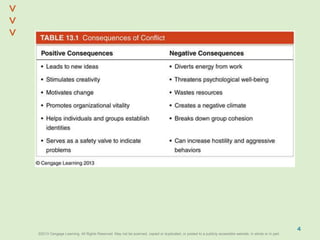
4
©2013 Cengage Learning. All Rights Reserved. May not be scanned, copied or duplicated, or posted to a publicly accessible website, in whole or in part.©2013 Cengage Learning. All Rights Reserved. May not be scanned, copied or duplicated, or posted to a publicly accessible website, in whole or in part.
^
^
Diagnosing Conflict
• Are the parties approaching the conflict from a
hostile standpoint?
• Is the outcome likely to be a negative one for
the organization?
• Do the potential losses of the parties exceed
any potential gains?
• Is energy being diverted from goal
accomplishment?
• If the majority of answers are yes, the conflict is
probably dysfunctional.
5
©2013 Cengage Learning. All Rights Reserved. May not be scanned, copied or duplicated, or posted to a publicly accessible website, in whole or in part.©2013 Cengage Learning. All Rights Reserved. May not be scanned, copied or duplicated, or posted to a publicly accessible website, in whole or in part.
^
^
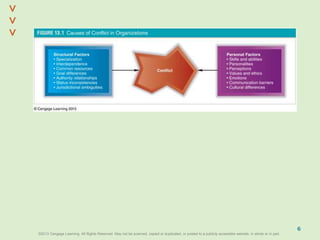
6
©2013 Cengage Learning. All Rights Reserved. May not be scanned, copied or duplicated, or posted to a publicly accessible website, in whole or in part.©2013 Cengage Learning. All Rights Reserved. May not be scanned, copied or duplicated, or posted to a publicly accessible website, in whole or in part.
^
^
Cultural Differences and Conflict
Individualism/
collectivism
Power
distance
Uncertainty
avoidance
Masculinity/
femininity
Long-term/
short-term
orientation
7
©2013 Cengage Learning. All Rights Reserved. May not be scanned, copied or duplicated, or posted to a publicly accessible website, in whole or in part.©2013 Cengage Learning. All Rights Reserved. May not be scanned, copied or duplicated, or posted to a publicly accessible website, in whole or in part.
^
^
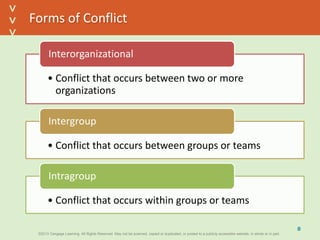
Forms of Conflict
• Conflict that occurs between two or more
organizations
Interorganizational
• Conflict that occurs between groups or teams
Intergroup
• Conflict that occurs within groups or teams
Intragroup
8
©2013 Cengage Learning. All Rights Reserved. May not be scanned, copied or duplicated, or posted to a publicly accessible website, in whole or in part.©2013 Cengage Learning. All Rights Reserved. May not be scanned, copied or duplicated, or posted to a publicly accessible website, in whole or in part.
^
^
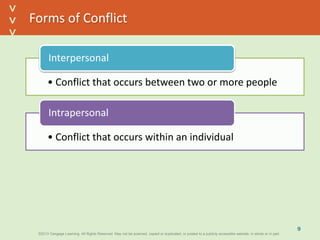
Forms of Conflict
• Conflict that occurs between two or more people
Interpersonal
• Conflict that occurs within an individual
Intrapersonal
9
©2013 Cengage Learning. All Rights Reserved. May not be scanned, copied or duplicated, or posted to a publicly accessible website, in whole or in part.©2013 Cengage Learning. All Rights Reserved. May not be scanned, copied or duplicated, or posted to a publicly accessible website, in whole or in part.
^
^
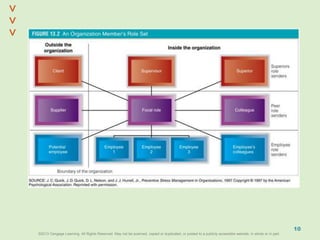
10
©2013 Cengage Learning. All Rights Reserved. May not be scanned, copied or duplicated, or posted to a publicly accessible website, in whole or in part.©2013 Cengage Learning. All Rights Reserved. May not be scanned, copied or duplicated, or posted to a publicly accessible website, in whole or in part.
^
^
Types of Intrapersonal Conflict
Interrole
• Conflict
among the
multiple
roles in an
individual’s
life
Intrarole
• Conflict
within a
single role
Person-role
• Conflict
between a
role and
personal
values
11
©2013 Cengage Learning. All Rights Reserved. May not be scanned, copied or duplicated, or posted to a publicly accessible website, in whole or in part.©2013 Cengage Learning. All Rights Reserved. May not be scanned, copied or duplicated, or posted to a publicly accessible website, in whole or in part.
^
^
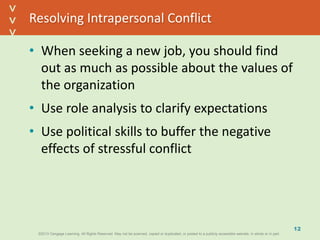
Resolving Intrapersonal Conflict
• When seeking a new job, you should find
out as much as possible about the values of
the organization
• Use role analysis to clarify expectations
• Use political skills to buffer the negative
effects of stressful conflict
12
©2013 Cengage Learning. All Rights Reserved. May not be scanned, copied or duplicated, or posted to a publicly accessible website, in whole or in part.©2013 Cengage Learning. All Rights Reserved. May not be scanned, copied or duplicated, or posted to a publicly accessible website, in whole or in part.
^
^
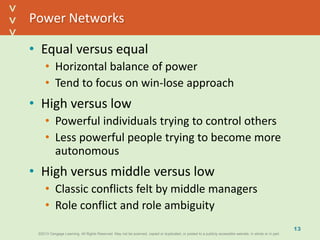
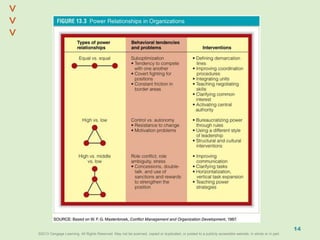
Power Networks
• Equal versus equal
• Horizontal balance of power
• Tend to focus on win-lose approach
• High versus low
• Powerful individuals trying to control others
• Less powerful people trying to become more
autonomous
• High versus middle versus low
• Classic conflicts felt by middle managers
• Role conflict and role ambiguity
13
©2013 Cengage Learning. All Rights Reserved. May not be scanned, copied or duplicated, or posted to a publicly accessible website, in whole or in part.©2013 Cengage Learning. All Rights Reserved. May not be scanned, copied or duplicated, or posted to a publicly accessible website, in whole or in part.
^
^
14
©2013 Cengage Learning. All Rights Reserved. May not be scanned, copied or duplicated, or posted to a publicly accessible website, in whole or in part.©2013 Cengage Learning. All Rights Reserved. May not be scanned, copied or duplicated, or posted to a publicly accessible website, in whole or in part.
^
^
15
©2013 Cengage Learning. All Rights Reserved. May not be scanned, copied or duplicated, or posted to a publicly accessible website, in whole or in part.©2013 Cengage Learning. All Rights Reserved. May not be scanned, copied or duplicated, or posted to a publicly accessible website, in whole or in part.
^
^
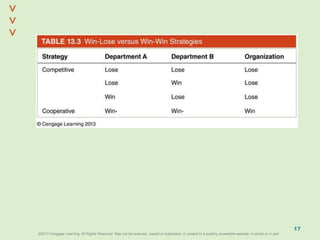
Managing Conflict
• Win-lose
• Dishonest communication
• Mistrust
• Rigid position from both parties
Competitive
strategy
• Win-win
• Honest communication
• Trust
• Openness to risk and vulnerability
• The whole may be greater than the
sum of the parts
Cooperative
strategy
16
©2013 Cengage Learning. All Rights Reserved. May not be scanned, copied or duplicated, or posted to a publicly accessible website, in whole or in part.©2013 Cengage Learning. All Rights Reserved. May not be scanned, copied or duplicated, or posted to a publicly accessible website, in whole or in part.
^
^
17
©2013 Cengage Learning. All Rights Reserved. May not be scanned, copied or duplicated, or posted to a publicly accessible website, in whole or in part.©2013 Cengage Learning. All Rights Reserved. May not be scanned, copied or duplicated, or posted to a publicly accessible website, in whole or in part.
^
^
Ineffective Techniques
• Nonaction—Do nothing
• Secrecy—Try to keep conflict out of view
• Administrative orbiting—Delay action to buy
time
• Due process nonaction—Set up a conflict
procedure too costly and risky to use
• Character assassination—Label or discredit
an opponent
18
©2013 Cengage Learning. All Rights Reserved. May not be scanned, copied or duplicated, or posted to a publicly accessible website, in whole or in part.©2013 Cengage Learning. All Rights Reserved. May not be scanned, copied or duplicated, or posted to a publicly accessible website, in whole or in part.
^
^
Effective Techniques
• Superordinate goals—Appeal to an
organizational goal that is more important to
both parties than individual or group goals
• Expanding resources—Provide more resources
• Changing personnel—Transfer or fire the
individual causing the conflict
• Changing structure—Create an integrator role
or cross-functional team
• Confronting and negotiating—Discuss the
problem openly and work together toward a
mutually beneficial solution
19
©2013 Cengage Learning. All Rights Reserved. May not be scanned, copied or duplicated, or posted to a publicly accessible website, in whole or in part.©2013 Cengage Learning. All Rights Reserved. May not be scanned, copied or duplicated, or posted to a publicly accessible website, in whole or in part.
^
^
Negotiating as a Strategy
Negotiating is a useful strategy when
• There are two or more parties
• There is a conflict of interest
• Each party believes it can use its influence to
obtain a better outcome
• The parties prefer to work together rather
than fight openly, give in, break off contact,
or take the dispute to a higher authority
20
©2013 Cengage Learning. All Rights Reserved. May not be scanned, copied or duplicated, or posted to a publicly accessible website, in whole or in part.©2013 Cengage Learning. All Rights Reserved. May not be scanned, copied or duplicated, or posted to a publicly accessible website, in whole or in part.
^
^
Negotiating Approaches
Distributive
bargaining
• Goals are in direct
conflict
• Win-lose
Integrative
negotiation
• Goals are not
mutually exclusive
• Win-win
21
©2013 Cengage Learning. All Rights Reserved. May not be scanned, copied or duplicated, or posted to a publicly accessible website, in whole or in part.©2013 Cengage Learning. All Rights Reserved. May not be scanned, copied or duplicated, or posted to a publicly accessible website, in whole or in part.
^
^
22
©2013 Cengage Learning. All Rights Reserved. May not be scanned, copied or duplicated, or posted to a publicly accessible website, in whole or in part.©2013 Cengage Learning. All Rights Reserved. May not be scanned, copied or duplicated, or posted to a publicly accessible website, in whole or in part.
^
^
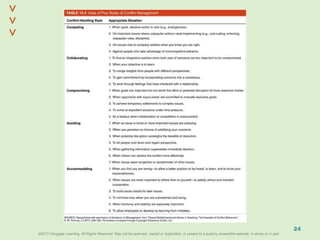
Conflict Management Styles
• Avoiding—Making a deliberate decision to take
no action or stay out of a situation
• Accommodating—Showing more concern for
the other party’s goals than for your own
• Competing—Willing to satisfy your interests at
the other party’s expense
• Compromising—Each party giving up something
to reach a solution
• Collaborating—Discussing the conflict and
arriving at a solution satisfactory to both parties
23
©2013 Cengage Learning. All Rights Reserved. May not be scanned, copied or duplicated, or posted to a publicly accessible website, in whole or in part.©2013 Cengage Learning. All Rights Reserved. May not be scanned, copied or duplicated, or posted to a publicly accessible website, in whole or in part.
^
^
24
©2013 Cengage Learning. All Rights Reserved. May not be scanned, copied or duplicated, or posted to a publicly accessible website, in whole or in part.©2013 Cengage Learning. All Rights Reserved. May not be scanned, copied or duplicated, or posted to a publicly accessible website, in whole or in part.
^
^
25
©2013 Cengage Learning. All Rights Reserved. May not be scanned, copied or duplicated, or posted to a publicly accessible website, in whole or in part.©2013 Cengage Learning. All Rights Reserved. May not be scanned, copied or duplicated, or posted to a publicly accessible website, in whole or in part.
^
^
Creating a Conflict-Positive Organization
Value
diversity and
confront
differences
Seek mutual
benefits and
unite behind
cooperative
goals
Empower
employees
to feel
confident
and skillful
Take stock to
reward
success and
learn from
mistakes
26
©2013 Cengage Learning. All Rights Reserved. May not be scanned, copied or duplicated, or posted to a publicly accessible website, in whole or in part.©2013 Cengage Learning. All Rights Reserved. May not be scanned, copied or duplicated, or posted to a publicly accessible website, in whole or in part.
^
^
^
Chapter 13: Reflect & Discuss
Welcome Home Roscoe Jenkins
Video Clip
 This chapter defined conflict as “any situation in which
incompatible goals, attitudes, emotions, or behaviors lead to
disagreement or opposition between two or more parties.” Does
the interaction in this film sequence show this definition in
action? Give examples from the sequence.
 Does this film sequence show functional or dysfunctional
conflict? Give some examples from the sequence.
 Which conflict management style best fits the behavior shown in
this film sequence? Give some examples from the sequence.
27

MBA 635 chapter 13

  • 1.
    ©2013 Cengage Learning.All Rights Reserved. May not be scanned, copied or duplicated, or posted to a publicly accessible website, in whole or in part. 13 ©2013 Cengage Learning. All Rights Reserved. May not be scanned, copied or duplicated, or posted to a publicly accessible website, in whole or in part. Conflict and Negotiation
  • 2.
    ©2013 Cengage Learning.All Rights Reserved. May not be scanned, copied or duplicated, or posted to a publicly accessible website, in whole or in part. Learning Objectives ©2013 Cengage Learning. All Rights Reserved. May not be scanned, copied or duplicated, or posted to a publicly accessible website, in whole or in part. 1 Diagnose functional versus dysfunctional conflict. 2 Identify the causes of conflict in organizations. 3 Identify the different forms of conflict. 4 Understand the defense mechanisms that individuals exhibit when they engage in interpersonal conflict. 5 Describe effective and ineffective techniques for managing conflict. 6 Understand five styles of conflict management, and diagnose your own preferred style. 2
  • 3.
    ©2013 Cengage Learning.All Rights Reserved. May not be scanned, copied or duplicated, or posted to a publicly accessible website, in whole or in part.©2013 Cengage Learning. All Rights Reserved. May not be scanned, copied or duplicated, or posted to a publicly accessible website, in whole or in part. ^ ^ Defining Conflict Conflict: any situation in which incompatible goals, attitudes, emotions, or behaviors lead to disagreement or opposition for two or more parties Functional conflict: a healthy, constructive disagreement between two or more people Dysfunctional conflict: an unhealthy, destructive disagreement between two or more people 3
  • 4.
    ©2013 Cengage Learning.All Rights Reserved. May not be scanned, copied or duplicated, or posted to a publicly accessible website, in whole or in part.©2013 Cengage Learning. All Rights Reserved. May not be scanned, copied or duplicated, or posted to a publicly accessible website, in whole or in part. ^ ^ 4
  • 5.
    ©2013 Cengage Learning.All Rights Reserved. May not be scanned, copied or duplicated, or posted to a publicly accessible website, in whole or in part.©2013 Cengage Learning. All Rights Reserved. May not be scanned, copied or duplicated, or posted to a publicly accessible website, in whole or in part. ^ ^ Diagnosing Conflict • Are the parties approaching the conflict from a hostile standpoint? • Is the outcome likely to be a negative one for the organization? • Do the potential losses of the parties exceed any potential gains? • Is energy being diverted from goal accomplishment? • If the majority of answers are yes, the conflict is probably dysfunctional. 5
  • 6.
    ©2013 Cengage Learning.All Rights Reserved. May not be scanned, copied or duplicated, or posted to a publicly accessible website, in whole or in part.©2013 Cengage Learning. All Rights Reserved. May not be scanned, copied or duplicated, or posted to a publicly accessible website, in whole or in part. ^ ^ 6
  • 7.
    ©2013 Cengage Learning.All Rights Reserved. May not be scanned, copied or duplicated, or posted to a publicly accessible website, in whole or in part.©2013 Cengage Learning. All Rights Reserved. May not be scanned, copied or duplicated, or posted to a publicly accessible website, in whole or in part. ^ ^ Cultural Differences and Conflict Individualism/ collectivism Power distance Uncertainty avoidance Masculinity/ femininity Long-term/ short-term orientation 7
  • 8.
    ©2013 Cengage Learning.All Rights Reserved. May not be scanned, copied or duplicated, or posted to a publicly accessible website, in whole or in part.©2013 Cengage Learning. All Rights Reserved. May not be scanned, copied or duplicated, or posted to a publicly accessible website, in whole or in part. ^ ^ Forms of Conflict • Conflict that occurs between two or more organizations Interorganizational • Conflict that occurs between groups or teams Intergroup • Conflict that occurs within groups or teams Intragroup 8
  • 9.
    ©2013 Cengage Learning.All Rights Reserved. May not be scanned, copied or duplicated, or posted to a publicly accessible website, in whole or in part.©2013 Cengage Learning. All Rights Reserved. May not be scanned, copied or duplicated, or posted to a publicly accessible website, in whole or in part. ^ ^ Forms of Conflict • Conflict that occurs between two or more people Interpersonal • Conflict that occurs within an individual Intrapersonal 9
  • 10.
    ©2013 Cengage Learning.All Rights Reserved. May not be scanned, copied or duplicated, or posted to a publicly accessible website, in whole or in part.©2013 Cengage Learning. All Rights Reserved. May not be scanned, copied or duplicated, or posted to a publicly accessible website, in whole or in part. ^ ^ 10
  • 11.
    ©2013 Cengage Learning.All Rights Reserved. May not be scanned, copied or duplicated, or posted to a publicly accessible website, in whole or in part.©2013 Cengage Learning. All Rights Reserved. May not be scanned, copied or duplicated, or posted to a publicly accessible website, in whole or in part. ^ ^ Types of Intrapersonal Conflict Interrole • Conflict among the multiple roles in an individual’s life Intrarole • Conflict within a single role Person-role • Conflict between a role and personal values 11
  • 12.
    ©2013 Cengage Learning.All Rights Reserved. May not be scanned, copied or duplicated, or posted to a publicly accessible website, in whole or in part.©2013 Cengage Learning. All Rights Reserved. May not be scanned, copied or duplicated, or posted to a publicly accessible website, in whole or in part. ^ ^ Resolving Intrapersonal Conflict • When seeking a new job, you should find out as much as possible about the values of the organization • Use role analysis to clarify expectations • Use political skills to buffer the negative effects of stressful conflict 12
  • 13.
    ©2013 Cengage Learning.All Rights Reserved. May not be scanned, copied or duplicated, or posted to a publicly accessible website, in whole or in part.©2013 Cengage Learning. All Rights Reserved. May not be scanned, copied or duplicated, or posted to a publicly accessible website, in whole or in part. ^ ^ Power Networks • Equal versus equal • Horizontal balance of power • Tend to focus on win-lose approach • High versus low • Powerful individuals trying to control others • Less powerful people trying to become more autonomous • High versus middle versus low • Classic conflicts felt by middle managers • Role conflict and role ambiguity 13
  • 14.
    ©2013 Cengage Learning.All Rights Reserved. May not be scanned, copied or duplicated, or posted to a publicly accessible website, in whole or in part.©2013 Cengage Learning. All Rights Reserved. May not be scanned, copied or duplicated, or posted to a publicly accessible website, in whole or in part. ^ ^ 14
  • 15.
    ©2013 Cengage Learning.All Rights Reserved. May not be scanned, copied or duplicated, or posted to a publicly accessible website, in whole or in part.©2013 Cengage Learning. All Rights Reserved. May not be scanned, copied or duplicated, or posted to a publicly accessible website, in whole or in part. ^ ^ 15
  • 16.
    ©2013 Cengage Learning.All Rights Reserved. May not be scanned, copied or duplicated, or posted to a publicly accessible website, in whole or in part.©2013 Cengage Learning. All Rights Reserved. May not be scanned, copied or duplicated, or posted to a publicly accessible website, in whole or in part. ^ ^ Managing Conflict • Win-lose • Dishonest communication • Mistrust • Rigid position from both parties Competitive strategy • Win-win • Honest communication • Trust • Openness to risk and vulnerability • The whole may be greater than the sum of the parts Cooperative strategy 16
  • 17.
    ©2013 Cengage Learning.All Rights Reserved. May not be scanned, copied or duplicated, or posted to a publicly accessible website, in whole or in part.©2013 Cengage Learning. All Rights Reserved. May not be scanned, copied or duplicated, or posted to a publicly accessible website, in whole or in part. ^ ^ 17
  • 18.
    ©2013 Cengage Learning.All Rights Reserved. May not be scanned, copied or duplicated, or posted to a publicly accessible website, in whole or in part.©2013 Cengage Learning. All Rights Reserved. May not be scanned, copied or duplicated, or posted to a publicly accessible website, in whole or in part. ^ ^ Ineffective Techniques • Nonaction—Do nothing • Secrecy—Try to keep conflict out of view • Administrative orbiting—Delay action to buy time • Due process nonaction—Set up a conflict procedure too costly and risky to use • Character assassination—Label or discredit an opponent 18
  • 19.
    ©2013 Cengage Learning.All Rights Reserved. May not be scanned, copied or duplicated, or posted to a publicly accessible website, in whole or in part.©2013 Cengage Learning. All Rights Reserved. May not be scanned, copied or duplicated, or posted to a publicly accessible website, in whole or in part. ^ ^ Effective Techniques • Superordinate goals—Appeal to an organizational goal that is more important to both parties than individual or group goals • Expanding resources—Provide more resources • Changing personnel—Transfer or fire the individual causing the conflict • Changing structure—Create an integrator role or cross-functional team • Confronting and negotiating—Discuss the problem openly and work together toward a mutually beneficial solution 19
  • 20.
    ©2013 Cengage Learning.All Rights Reserved. May not be scanned, copied or duplicated, or posted to a publicly accessible website, in whole or in part.©2013 Cengage Learning. All Rights Reserved. May not be scanned, copied or duplicated, or posted to a publicly accessible website, in whole or in part. ^ ^ Negotiating as a Strategy Negotiating is a useful strategy when • There are two or more parties • There is a conflict of interest • Each party believes it can use its influence to obtain a better outcome • The parties prefer to work together rather than fight openly, give in, break off contact, or take the dispute to a higher authority 20
  • 21.
    ©2013 Cengage Learning.All Rights Reserved. May not be scanned, copied or duplicated, or posted to a publicly accessible website, in whole or in part.©2013 Cengage Learning. All Rights Reserved. May not be scanned, copied or duplicated, or posted to a publicly accessible website, in whole or in part. ^ ^ Negotiating Approaches Distributive bargaining • Goals are in direct conflict • Win-lose Integrative negotiation • Goals are not mutually exclusive • Win-win 21
  • 22.
    ©2013 Cengage Learning.All Rights Reserved. May not be scanned, copied or duplicated, or posted to a publicly accessible website, in whole or in part.©2013 Cengage Learning. All Rights Reserved. May not be scanned, copied or duplicated, or posted to a publicly accessible website, in whole or in part. ^ ^ 22
  • 23.
    ©2013 Cengage Learning.All Rights Reserved. May not be scanned, copied or duplicated, or posted to a publicly accessible website, in whole or in part.©2013 Cengage Learning. All Rights Reserved. May not be scanned, copied or duplicated, or posted to a publicly accessible website, in whole or in part. ^ ^ Conflict Management Styles • Avoiding—Making a deliberate decision to take no action or stay out of a situation • Accommodating—Showing more concern for the other party’s goals than for your own • Competing—Willing to satisfy your interests at the other party’s expense • Compromising—Each party giving up something to reach a solution • Collaborating—Discussing the conflict and arriving at a solution satisfactory to both parties 23
  • 24.
    ©2013 Cengage Learning.All Rights Reserved. May not be scanned, copied or duplicated, or posted to a publicly accessible website, in whole or in part.©2013 Cengage Learning. All Rights Reserved. May not be scanned, copied or duplicated, or posted to a publicly accessible website, in whole or in part. ^ ^ 24
  • 25.
    ©2013 Cengage Learning.All Rights Reserved. May not be scanned, copied or duplicated, or posted to a publicly accessible website, in whole or in part.©2013 Cengage Learning. All Rights Reserved. May not be scanned, copied or duplicated, or posted to a publicly accessible website, in whole or in part. ^ ^ 25
  • 26.
    ©2013 Cengage Learning.All Rights Reserved. May not be scanned, copied or duplicated, or posted to a publicly accessible website, in whole or in part.©2013 Cengage Learning. All Rights Reserved. May not be scanned, copied or duplicated, or posted to a publicly accessible website, in whole or in part. ^ ^ Creating a Conflict-Positive Organization Value diversity and confront differences Seek mutual benefits and unite behind cooperative goals Empower employees to feel confident and skillful Take stock to reward success and learn from mistakes 26
  • 27.
    ©2013 Cengage Learning.All Rights Reserved. May not be scanned, copied or duplicated, or posted to a publicly accessible website, in whole or in part.©2013 Cengage Learning. All Rights Reserved. May not be scanned, copied or duplicated, or posted to a publicly accessible website, in whole or in part. ^ ^ ^ Chapter 13: Reflect & Discuss Welcome Home Roscoe Jenkins Video Clip  This chapter defined conflict as “any situation in which incompatible goals, attitudes, emotions, or behaviors lead to disagreement or opposition between two or more parties.” Does the interaction in this film sequence show this definition in action? Give examples from the sequence.  Does this film sequence show functional or dysfunctional conflict? Give some examples from the sequence.  Which conflict management style best fits the behavior shown in this film sequence? Give some examples from the sequence. 27