©2013 Cengage Learning. All Rights Reserved. May not be scanned, copied or duplicated, or posted to a publicly accessible website, in whole or in part.
18
©2013 Cengage Learning. All Rights Reserved.
May not be scanned, copied or duplicated, or posted to a publicly accessible website, in whole or in
part.
Managing Change
©2013 Cengage Learning. All Rights Reserved. May not be scanned, copied or duplicated, or posted to a publicly accessible website, in whole or in part.
Learning Objectives
©2013 Cengage Learning. All Rights Reserved. May not be scanned, copied or duplicated, or posted to a publicly accessible website, in whole or in part.
1 Examine the major external and internal
forces for change in organizations.
2 Understand incremental change, strategic
change, transformational change, and
change agent.
3 Evaluate the reasons for resistance to
change, and discuss methods organizations
can use to manage resistance.
4 Explain Lewin’s organizational change
model.
2
©2013 Cengage Learning. All Rights Reserved. May not be scanned, copied or duplicated, or posted to a publicly accessible website, in whole or in part.
Learning Objectives continued
©2013 Cengage Learning. All Rights Reserved. May not be scanned, copied or duplicated, or posted to a publicly accessible website, in whole or in part.
5 Apply force field analysis to a problem.
6 Discuss the major organization
development interventions.
7 Describe the use of organizational diagnosis
and needs analysis as a first step in
organizational development.
8 Identify the ethical issues that must be
considered in organization development
efforts.
3
©2013 Cengage Learning. All Rights Reserved. May not be scanned, copied or duplicated, or posted to a publicly accessible website, in whole or in part.©2013 Cengage Learning. All Rights Reserved. May not be scanned, copied or duplicated, or posted to a publicly accessible website, in whole or in part.
^
^
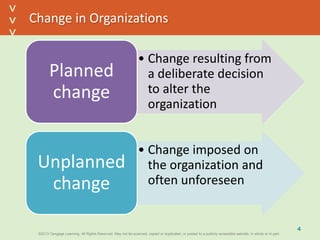
Change in Organizations
• Change resulting from
a deliberate decision
to alter the
organization
Planned
change
• Change imposed on
the organization and
often unforeseen
Unplanned
change
4
©2013 Cengage Learning. All Rights Reserved. May not be scanned, copied or duplicated, or posted to a publicly accessible website, in whole or in part.©2013 Cengage Learning. All Rights Reserved. May not be scanned, copied or duplicated, or posted to a publicly accessible website, in whole or in part.
^
^
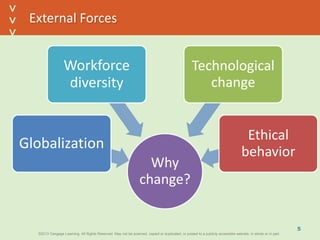
External Forces
5
Why
change?
Globalization
Workforce
diversity
Technological
change
Ethical
behavior
©2013 Cengage Learning. All Rights Reserved. May not be scanned, copied or duplicated, or posted to a publicly accessible website, in whole or in part.©2013 Cengage Learning. All Rights Reserved. May not be scanned, copied or duplicated, or posted to a publicly accessible website, in whole or in part.
^
^
Globalization and Change
• Globalizing an organization means rethinking
the most efficient ways to
• Use resources
• Disseminate and gather information
• Develop people
• It requires structural changes and changes in
the minds of employees
6
©2013 Cengage Learning. All Rights Reserved. May not be scanned, copied or duplicated, or posted to a publicly accessible website, in whole or in part.©2013 Cengage Learning. All Rights Reserved. May not be scanned, copied or duplicated, or posted to a publicly accessible website, in whole or in part.
^
^
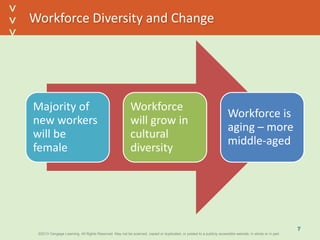
Workforce Diversity and Change
7
Majority of
new workers
will be
female
Workforce
will grow in
cultural
diversity
Workforce is
aging – more
middle-aged
©2013 Cengage Learning. All Rights Reserved. May not be scanned, copied or duplicated, or posted to a publicly accessible website, in whole or in part.©2013 Cengage Learning. All Rights Reserved. May not be scanned, copied or duplicated, or posted to a publicly accessible website, in whole or in part.
^
^
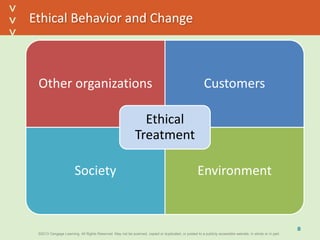
Ethical Behavior and Change
8
Other organizations Customers
Society Environment
Ethical
Treatment
©2013 Cengage Learning. All Rights Reserved. May not be scanned, copied or duplicated, or posted to a publicly accessible website, in whole or in part.©2013 Cengage Learning. All Rights Reserved. May not be scanned, copied or duplicated, or posted to a publicly accessible website, in whole or in part.
^
^
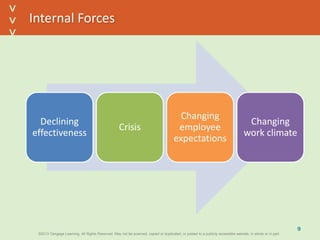
Internal Forces
Declining
effectiveness
Crisis
Changing
employee
expectations
Changing
work climate
9
©2013 Cengage Learning. All Rights Reserved. May not be scanned, copied or duplicated, or posted to a publicly accessible website, in whole or in part.©2013 Cengage Learning. All Rights Reserved. May not be scanned, copied or duplicated, or posted to a publicly accessible website, in whole or in part.
^
^
Scope of Change
• Incremental change: change of a relatively
small scope
• Strategic change: change from an old state
to a known new state during a controlled
period of time
• Transformational change: radical change to a
sometimes unknown future state
10
©2013 Cengage Learning. All Rights Reserved. May not be scanned, copied or duplicated, or posted to a publicly accessible website, in whole or in part.©2013 Cengage Learning. All Rights Reserved. May not be scanned, copied or duplicated, or posted to a publicly accessible website, in whole or in part.
^
^
The Change Agent
Change agent: the individual or group who
undertakes the task of introducing and
managing a change in an organization
Effective change leaders build relationships
• Within the leadership team
• Between the team and organizational
members
• Between the team and key environmental
players
11
©2013 Cengage Learning. All Rights Reserved. May not be scanned, copied or duplicated, or posted to a publicly accessible website, in whole or in part.©2013 Cengage Learning. All Rights Reserved. May not be scanned, copied or duplicated, or posted to a publicly accessible website, in whole or in part.
^
^
A Typical Change Agent
• Young (25-40)
• Female
• Flexible
• People-oriented
• Tough decision maker
• Focuses on performance results
• Energizes people
• Operates in multiple leadership styles
• Comfortable with uncertainty
12
©2013 Cengage Learning. All Rights Reserved. May not be scanned, copied or duplicated, or posted to a publicly accessible website, in whole or in part.©2013 Cengage Learning. All Rights Reserved. May not be scanned, copied or duplicated, or posted to a publicly accessible website, in whole or in part.
^
^
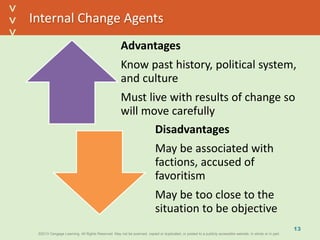
Internal Change Agents
13
Advantages
Know past history, political system,
and culture
Must live with results of change so
will move carefully
Disadvantages
May be associated with
factions, accused of
favoritism
May be too close to the
situation to be objective
©2013 Cengage Learning. All Rights Reserved. May not be scanned, copied or duplicated, or posted to a publicly accessible website, in whole or in part.©2013 Cengage Learning. All Rights Reserved. May not be scanned, copied or duplicated, or posted to a publicly accessible website, in whole or in part.
^
^
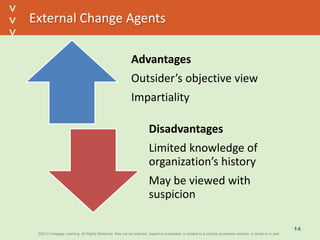
External Change Agents
14
Advantages
Outsider’s objective view
Impartiality
Disadvantages
Limited knowledge of
organization’s history
May be viewed with
suspicion
©2013 Cengage Learning. All Rights Reserved. May not be scanned, copied or duplicated, or posted to a publicly accessible website, in whole or in part.©2013 Cengage Learning. All Rights Reserved. May not be scanned, copied or duplicated, or posted to a publicly accessible website, in whole or in part.
^
^
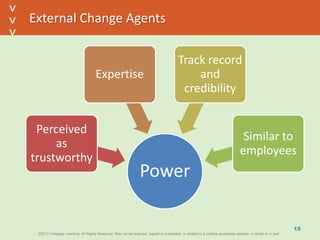
External Change Agents
Power
Perceived
as
trustworthy
Expertise
Track record
and
credibility
Similar to
employees
15
©2013 Cengage Learning. All Rights Reserved. May not be scanned, copied or duplicated, or posted to a publicly accessible website, in whole or in part.©2013 Cengage Learning. All Rights Reserved. May not be scanned, copied or duplicated, or posted to a publicly accessible website, in whole or in part.
^
^
Resistance to Change
• Fear of the unknown
• Fear of loss
• Fear of failure
• Disruption of interpersonal relationships
• Personality conflicts
• Politics
• Cultural assumptions and values
16
©2013 Cengage Learning. All Rights Reserved. May not be scanned, copied or duplicated, or posted to a publicly accessible website, in whole or in part.©2013 Cengage Learning. All Rights Reserved. May not be scanned, copied or duplicated, or posted to a publicly accessible website, in whole or in part.
^
^
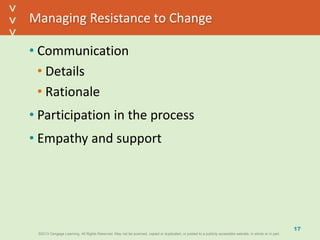
Managing Resistance to Change
• Communication
• Details
• Rationale
• Participation in the process
• Empathy and support
17
©2013 Cengage Learning. All Rights Reserved. May not be scanned, copied or duplicated, or posted to a publicly accessible website, in whole or in part.©2013 Cengage Learning. All Rights Reserved. May not be scanned, copied or duplicated, or posted to a publicly accessible website, in whole or in part.
^
^
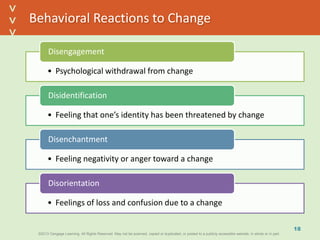
Behavioral Reactions to Change
• Psychological withdrawal from change
Disengagement
• Feeling that one’s identity has been threatened by change
Disidentification
• Feeling negativity or anger toward a change
Disenchantment
• Feelings of loss and confusion due to a change
Disorientation
18
©2013 Cengage Learning. All Rights Reserved. May not be scanned, copied or duplicated, or posted to a publicly accessible website, in whole or in part.©2013 Cengage Learning. All Rights Reserved. May not be scanned, copied or duplicated, or posted to a publicly accessible website, in whole or in part.
^
^
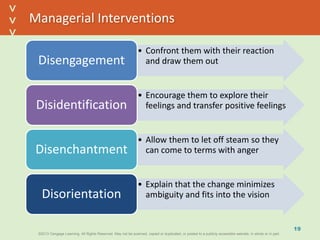
Managerial Interventions
• Confront them with their reaction
and draw them outDisengagement
• Encourage them to explore their
feelings and transfer positive feelingsDisidentification
• Allow them to let off steam so they
can come to terms with angerDisenchantment
• Explain that the change minimizes
ambiguity and fits into the visionDisorientation
19
©2013 Cengage Learning. All Rights Reserved. May not be scanned, copied or duplicated, or posted to a publicly accessible website, in whole or in part.©2013 Cengage Learning. All Rights Reserved. May not be scanned, copied or duplicated, or posted to a publicly accessible website, in whole or in part.
^
^
20
©2013 Cengage Learning. All Rights Reserved. May not be scanned, copied or duplicated, or posted to a publicly accessible website, in whole or in part.©2013 Cengage Learning. All Rights Reserved. May not be scanned, copied or duplicated, or posted to a publicly accessible website, in whole or in part.
^
^
21
©2013 Cengage Learning. All Rights Reserved. May not be scanned, copied or duplicated, or posted to a publicly accessible website, in whole or in part.©2013 Cengage Learning. All Rights Reserved. May not be scanned, copied or duplicated, or posted to a publicly accessible website, in whole or in part.
^
^
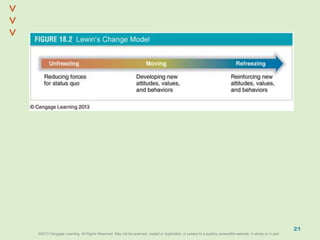
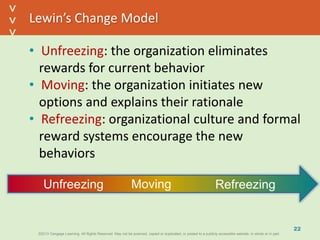
Lewin’s Change Model
• Unfreezing: the organization eliminates
rewards for current behavior
• Moving: the organization initiates new
options and explains their rationale
• Refreezing: organizational culture and formal
reward systems encourage the new
behaviors
22
Unfreezing Moving Refreezing
©2013 Cengage Learning. All Rights Reserved. May not be scanned, copied or duplicated, or posted to a publicly accessible website, in whole or in part.©2013 Cengage Learning. All Rights Reserved. May not be scanned, copied or duplicated, or posted to a publicly accessible website, in whole or in part.
^
^
Organization Development
• Organization development (OD) is a
systematic approach to organizational
improvement
• That applies behavioral science theory and
research
• In order to increase individual and
organizational well-being and effectiveness
23
©2013 Cengage Learning. All Rights Reserved. May not be scanned, copied or duplicated, or posted to a publicly accessible website, in whole or in part.©2013 Cengage Learning. All Rights Reserved. May not be scanned, copied or duplicated, or posted to a publicly accessible website, in whole or in part.
^
^
24
©2013 Cengage Learning. All Rights Reserved. May not be scanned, copied or duplicated, or posted to a publicly accessible website, in whole or in part.©2013 Cengage Learning. All Rights Reserved. May not be scanned, copied or duplicated, or posted to a publicly accessible website, in whole or in part.
^
^
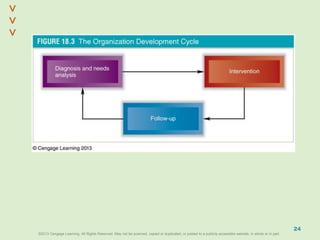
Levinson’s Diagnostic Approach
• Where is the pain in the organization?
• What is it like?
• How long has it been happening?
• What has already been done about it?
25
©2013 Cengage Learning. All Rights Reserved. May not be scanned, copied or duplicated, or posted to a publicly accessible website, in whole or in part.©2013 Cengage Learning. All Rights Reserved. May not be scanned, copied or duplicated, or posted to a publicly accessible website, in whole or in part.
^
^
Levinson’s Diagnostic Approach
Four-part, comprehensive diagnosis:
1. Achieve an understanding of the
organization’s history
2. Obtain data about its structure and
processes
3. Gather interpretive data about attitudes,
relationships, and organizational
functioning
4. Analyze data and draw conclusions
26
©2013 Cengage Learning. All Rights Reserved. May not be scanned, copied or duplicated, or posted to a publicly accessible website, in whole or in part.©2013 Cengage Learning. All Rights Reserved. May not be scanned, copied or duplicated, or posted to a publicly accessible website, in whole or in part.
^
^
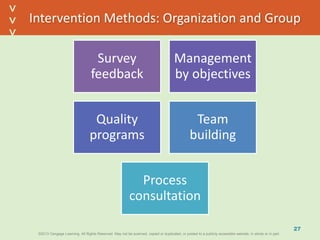
Intervention Methods: Organization and Group
Survey
feedback
Management
by objectives
Quality
programs
Team
building
Process
consultation
27
©2013 Cengage Learning. All Rights Reserved. May not be scanned, copied or duplicated, or posted to a publicly accessible website, in whole or in part.©2013 Cengage Learning. All Rights Reserved. May not be scanned, copied or duplicated, or posted to a publicly accessible website, in whole or in part.
^
^
Intervention Methods: Organization and Group
• Survey feedback: employee attitudes are
solicited via a questionnaire
• Data are fed back to employees to diagnose
problems and plan other interventions
• For effective survey feedback
• Assure confidentiality and anonymity
• Report in a group format
• Assure there will be no negative repercussions
• Inform employees of the purpose
• Follow through on survey results
28
©2013 Cengage Learning. All Rights Reserved. May not be scanned, copied or duplicated, or posted to a publicly accessible website, in whole or in part.©2013 Cengage Learning. All Rights Reserved. May not be scanned, copied or duplicated, or posted to a publicly accessible website, in whole or in part.
^
^
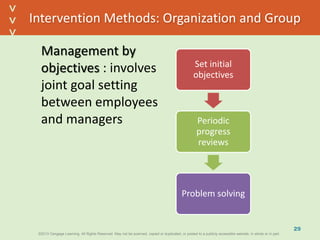
Intervention Methods: Organization and Group
Management by
objectives : involves
joint goal setting
between employees
and managers
29
Set initial
objectives
Periodic
progress
reviews
Problem solving
©2013 Cengage Learning. All Rights Reserved. May not be scanned, copied or duplicated, or posted to a publicly accessible website, in whole or in part.©2013 Cengage Learning. All Rights Reserved. May not be scanned, copied or duplicated, or posted to a publicly accessible website, in whole or in part.
^
^
Intervention Methods: Organization and Group
• Quality programs: programs that embed
product and service quality excellence in the
organizational culture
• Team building: an intervention designed to
improve the effectiveness of a work group
30
©2013 Cengage Learning. All Rights Reserved. May not be scanned, copied or duplicated, or posted to a publicly accessible website, in whole or in part.©2013 Cengage Learning. All Rights Reserved. May not be scanned, copied or duplicated, or posted to a publicly accessible website, in whole or in part.
^
^
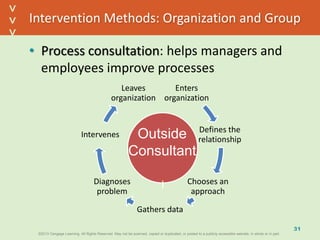
Intervention Methods: Organization and Group
• Process consultation: helps managers and
employees improve processes
31
Enters
organization
Defines the
relationship
Chooses an
approach
Gathers data
Diagnoses
problem
Intervenes
Leaves
organization
Outside
Consultant
©2013 Cengage Learning. All Rights Reserved. May not be scanned, copied or duplicated, or posted to a publicly accessible website, in whole or in part.©2013 Cengage Learning. All Rights Reserved. May not be scanned, copied or duplicated, or posted to a publicly accessible website, in whole or in part.
^
^
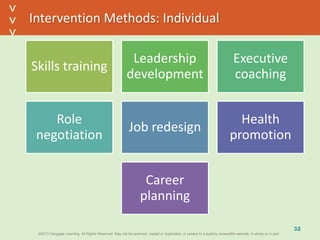
Intervention Methods: Individual
Skills training
Leadership
development
Executive
coaching
Role
negotiation
Job redesign
Health
promotion
Career
planning
32
©2013 Cengage Learning. All Rights Reserved. May not be scanned, copied or duplicated, or posted to a publicly accessible website, in whole or in part.©2013 Cengage Learning. All Rights Reserved. May not be scanned, copied or duplicated, or posted to a publicly accessible website, in whole or in part.
^
^
Intervention Methods: Individual
• Skills training: “What knowledge, skills, and
abilities are necessary to do this job
effectively?”
• Leadership training and development:
techniques designed to enhance individuals’
leadership skills
• Executive coaching: managers or executives
are paired with a coach in a partnership
33
©2013 Cengage Learning. All Rights Reserved. May not be scanned, copied or duplicated, or posted to a publicly accessible website, in whole or in part.©2013 Cengage Learning. All Rights Reserved. May not be scanned, copied or duplicated, or posted to a publicly accessible website, in whole or in part.
^
^
Intervention Methods: Individual
• Role negotiation: individuals meet and clarify
their psychological contract
• Job redesign: emphasizes the fit between
individual skills and the demands of the job
• Health promotion programs: programs that
support employee wellness and psychologically
healthy work environments
• Career planning: matching an individual’s career
aspirations with the opportunities in the
organization
34
©2013 Cengage Learning. All Rights Reserved. May not be scanned, copied or duplicated, or posted to a publicly accessible website, in whole or in part.©2013 Cengage Learning. All Rights Reserved. May not be scanned, copied or duplicated, or posted to a publicly accessible website, in whole or in part.
^
^
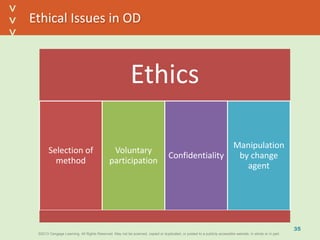
Ethical Issues in OD
35
Ethics
Selection of
method
Voluntary
participation
Confidentiality
Manipulation
by change
agent
©2013 Cengage Learning. All Rights Reserved. May not be scanned, copied or duplicated, or posted to a publicly accessible website, in whole or in part.©2013 Cengage Learning. All Rights Reserved. May not be scanned, copied or duplicated, or posted to a publicly accessible website, in whole or in part.
^
^
Managing Change
• Recognize the forces for change
• Develop shared vision
• Visibly demonstrate support for change
• Conduct comprehensive diagnosis and needs analysis
• Ensure adequate resources to implement change
• Plan for and manage resistance to change
• Select OD technique to meet goals of change
• Manage OD efforts ethically
36
©2013 Cengage Learning. All Rights Reserved. May not be scanned, copied or duplicated, or posted to a publicly accessible website, in whole or in part.©2013 Cengage Learning. All Rights Reserved. May not be scanned, copied or duplicated, or posted to a publicly accessible website, in whole or in part.
^
^
^
Chapter 18: Reflect & Discuss
Field of Dreams Video Clip
• Who is the target of change in this scene?
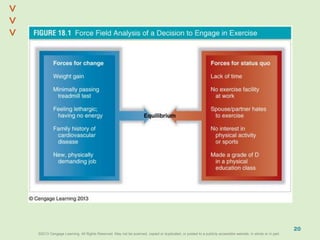
• Apply a force field analysis to this scene.
What are the forces for change? What are
the forces for status quo?
• Is their any evidence of resistance to change
in this scene? Give specific examples of
resistance behavior from the scene.
37

MBA 635 chapter 18

  • 1.
    ©2013 Cengage Learning.All Rights Reserved. May not be scanned, copied or duplicated, or posted to a publicly accessible website, in whole or in part. 18 ©2013 Cengage Learning. All Rights Reserved. May not be scanned, copied or duplicated, or posted to a publicly accessible website, in whole or in part. Managing Change
  • 2.
    ©2013 Cengage Learning.All Rights Reserved. May not be scanned, copied or duplicated, or posted to a publicly accessible website, in whole or in part. Learning Objectives ©2013 Cengage Learning. All Rights Reserved. May not be scanned, copied or duplicated, or posted to a publicly accessible website, in whole or in part. 1 Examine the major external and internal forces for change in organizations. 2 Understand incremental change, strategic change, transformational change, and change agent. 3 Evaluate the reasons for resistance to change, and discuss methods organizations can use to manage resistance. 4 Explain Lewin’s organizational change model. 2
  • 3.
    ©2013 Cengage Learning.All Rights Reserved. May not be scanned, copied or duplicated, or posted to a publicly accessible website, in whole or in part. Learning Objectives continued ©2013 Cengage Learning. All Rights Reserved. May not be scanned, copied or duplicated, or posted to a publicly accessible website, in whole or in part. 5 Apply force field analysis to a problem. 6 Discuss the major organization development interventions. 7 Describe the use of organizational diagnosis and needs analysis as a first step in organizational development. 8 Identify the ethical issues that must be considered in organization development efforts. 3
  • 4.
    ©2013 Cengage Learning.All Rights Reserved. May not be scanned, copied or duplicated, or posted to a publicly accessible website, in whole or in part.©2013 Cengage Learning. All Rights Reserved. May not be scanned, copied or duplicated, or posted to a publicly accessible website, in whole or in part. ^ ^ Change in Organizations • Change resulting from a deliberate decision to alter the organization Planned change • Change imposed on the organization and often unforeseen Unplanned change 4
  • 5.
    ©2013 Cengage Learning.All Rights Reserved. May not be scanned, copied or duplicated, or posted to a publicly accessible website, in whole or in part.©2013 Cengage Learning. All Rights Reserved. May not be scanned, copied or duplicated, or posted to a publicly accessible website, in whole or in part. ^ ^ External Forces 5 Why change? Globalization Workforce diversity Technological change Ethical behavior
  • 6.
    ©2013 Cengage Learning.All Rights Reserved. May not be scanned, copied or duplicated, or posted to a publicly accessible website, in whole or in part.©2013 Cengage Learning. All Rights Reserved. May not be scanned, copied or duplicated, or posted to a publicly accessible website, in whole or in part. ^ ^ Globalization and Change • Globalizing an organization means rethinking the most efficient ways to • Use resources • Disseminate and gather information • Develop people • It requires structural changes and changes in the minds of employees 6
  • 7.
    ©2013 Cengage Learning.All Rights Reserved. May not be scanned, copied or duplicated, or posted to a publicly accessible website, in whole or in part.©2013 Cengage Learning. All Rights Reserved. May not be scanned, copied or duplicated, or posted to a publicly accessible website, in whole or in part. ^ ^ Workforce Diversity and Change 7 Majority of new workers will be female Workforce will grow in cultural diversity Workforce is aging – more middle-aged
  • 8.
    ©2013 Cengage Learning.All Rights Reserved. May not be scanned, copied or duplicated, or posted to a publicly accessible website, in whole or in part.©2013 Cengage Learning. All Rights Reserved. May not be scanned, copied or duplicated, or posted to a publicly accessible website, in whole or in part. ^ ^ Ethical Behavior and Change 8 Other organizations Customers Society Environment Ethical Treatment
  • 9.
    ©2013 Cengage Learning.All Rights Reserved. May not be scanned, copied or duplicated, or posted to a publicly accessible website, in whole or in part.©2013 Cengage Learning. All Rights Reserved. May not be scanned, copied or duplicated, or posted to a publicly accessible website, in whole or in part. ^ ^ Internal Forces Declining effectiveness Crisis Changing employee expectations Changing work climate 9
  • 10.
    ©2013 Cengage Learning.All Rights Reserved. May not be scanned, copied or duplicated, or posted to a publicly accessible website, in whole or in part.©2013 Cengage Learning. All Rights Reserved. May not be scanned, copied or duplicated, or posted to a publicly accessible website, in whole or in part. ^ ^ Scope of Change • Incremental change: change of a relatively small scope • Strategic change: change from an old state to a known new state during a controlled period of time • Transformational change: radical change to a sometimes unknown future state 10
  • 11.
    ©2013 Cengage Learning.All Rights Reserved. May not be scanned, copied or duplicated, or posted to a publicly accessible website, in whole or in part.©2013 Cengage Learning. All Rights Reserved. May not be scanned, copied or duplicated, or posted to a publicly accessible website, in whole or in part. ^ ^ The Change Agent Change agent: the individual or group who undertakes the task of introducing and managing a change in an organization Effective change leaders build relationships • Within the leadership team • Between the team and organizational members • Between the team and key environmental players 11
  • 12.
    ©2013 Cengage Learning.All Rights Reserved. May not be scanned, copied or duplicated, or posted to a publicly accessible website, in whole or in part.©2013 Cengage Learning. All Rights Reserved. May not be scanned, copied or duplicated, or posted to a publicly accessible website, in whole or in part. ^ ^ A Typical Change Agent • Young (25-40) • Female • Flexible • People-oriented • Tough decision maker • Focuses on performance results • Energizes people • Operates in multiple leadership styles • Comfortable with uncertainty 12
  • 13.
    ©2013 Cengage Learning.All Rights Reserved. May not be scanned, copied or duplicated, or posted to a publicly accessible website, in whole or in part.©2013 Cengage Learning. All Rights Reserved. May not be scanned, copied or duplicated, or posted to a publicly accessible website, in whole or in part. ^ ^ Internal Change Agents 13 Advantages Know past history, political system, and culture Must live with results of change so will move carefully Disadvantages May be associated with factions, accused of favoritism May be too close to the situation to be objective
  • 14.
    ©2013 Cengage Learning.All Rights Reserved. May not be scanned, copied or duplicated, or posted to a publicly accessible website, in whole or in part.©2013 Cengage Learning. All Rights Reserved. May not be scanned, copied or duplicated, or posted to a publicly accessible website, in whole or in part. ^ ^ External Change Agents 14 Advantages Outsider’s objective view Impartiality Disadvantages Limited knowledge of organization’s history May be viewed with suspicion
  • 15.
    ©2013 Cengage Learning.All Rights Reserved. May not be scanned, copied or duplicated, or posted to a publicly accessible website, in whole or in part.©2013 Cengage Learning. All Rights Reserved. May not be scanned, copied or duplicated, or posted to a publicly accessible website, in whole or in part. ^ ^ External Change Agents Power Perceived as trustworthy Expertise Track record and credibility Similar to employees 15
  • 16.
    ©2013 Cengage Learning.All Rights Reserved. May not be scanned, copied or duplicated, or posted to a publicly accessible website, in whole or in part.©2013 Cengage Learning. All Rights Reserved. May not be scanned, copied or duplicated, or posted to a publicly accessible website, in whole or in part. ^ ^ Resistance to Change • Fear of the unknown • Fear of loss • Fear of failure • Disruption of interpersonal relationships • Personality conflicts • Politics • Cultural assumptions and values 16
  • 17.
    ©2013 Cengage Learning.All Rights Reserved. May not be scanned, copied or duplicated, or posted to a publicly accessible website, in whole or in part.©2013 Cengage Learning. All Rights Reserved. May not be scanned, copied or duplicated, or posted to a publicly accessible website, in whole or in part. ^ ^ Managing Resistance to Change • Communication • Details • Rationale • Participation in the process • Empathy and support 17
  • 18.
    ©2013 Cengage Learning.All Rights Reserved. May not be scanned, copied or duplicated, or posted to a publicly accessible website, in whole or in part.©2013 Cengage Learning. All Rights Reserved. May not be scanned, copied or duplicated, or posted to a publicly accessible website, in whole or in part. ^ ^ Behavioral Reactions to Change • Psychological withdrawal from change Disengagement • Feeling that one’s identity has been threatened by change Disidentification • Feeling negativity or anger toward a change Disenchantment • Feelings of loss and confusion due to a change Disorientation 18
  • 19.
    ©2013 Cengage Learning.All Rights Reserved. May not be scanned, copied or duplicated, or posted to a publicly accessible website, in whole or in part.©2013 Cengage Learning. All Rights Reserved. May not be scanned, copied or duplicated, or posted to a publicly accessible website, in whole or in part. ^ ^ Managerial Interventions • Confront them with their reaction and draw them outDisengagement • Encourage them to explore their feelings and transfer positive feelingsDisidentification • Allow them to let off steam so they can come to terms with angerDisenchantment • Explain that the change minimizes ambiguity and fits into the visionDisorientation 19
  • 20.
    ©2013 Cengage Learning.All Rights Reserved. May not be scanned, copied or duplicated, or posted to a publicly accessible website, in whole or in part.©2013 Cengage Learning. All Rights Reserved. May not be scanned, copied or duplicated, or posted to a publicly accessible website, in whole or in part. ^ ^ 20
  • 21.
    ©2013 Cengage Learning.All Rights Reserved. May not be scanned, copied or duplicated, or posted to a publicly accessible website, in whole or in part.©2013 Cengage Learning. All Rights Reserved. May not be scanned, copied or duplicated, or posted to a publicly accessible website, in whole or in part. ^ ^ 21
  • 22.
    ©2013 Cengage Learning.All Rights Reserved. May not be scanned, copied or duplicated, or posted to a publicly accessible website, in whole or in part.©2013 Cengage Learning. All Rights Reserved. May not be scanned, copied or duplicated, or posted to a publicly accessible website, in whole or in part. ^ ^ Lewin’s Change Model • Unfreezing: the organization eliminates rewards for current behavior • Moving: the organization initiates new options and explains their rationale • Refreezing: organizational culture and formal reward systems encourage the new behaviors 22 Unfreezing Moving Refreezing
  • 23.
    ©2013 Cengage Learning.All Rights Reserved. May not be scanned, copied or duplicated, or posted to a publicly accessible website, in whole or in part.©2013 Cengage Learning. All Rights Reserved. May not be scanned, copied or duplicated, or posted to a publicly accessible website, in whole or in part. ^ ^ Organization Development • Organization development (OD) is a systematic approach to organizational improvement • That applies behavioral science theory and research • In order to increase individual and organizational well-being and effectiveness 23
  • 24.
    ©2013 Cengage Learning.All Rights Reserved. May not be scanned, copied or duplicated, or posted to a publicly accessible website, in whole or in part.©2013 Cengage Learning. All Rights Reserved. May not be scanned, copied or duplicated, or posted to a publicly accessible website, in whole or in part. ^ ^ 24
  • 25.
    ©2013 Cengage Learning.All Rights Reserved. May not be scanned, copied or duplicated, or posted to a publicly accessible website, in whole or in part.©2013 Cengage Learning. All Rights Reserved. May not be scanned, copied or duplicated, or posted to a publicly accessible website, in whole or in part. ^ ^ Levinson’s Diagnostic Approach • Where is the pain in the organization? • What is it like? • How long has it been happening? • What has already been done about it? 25
  • 26.
    ©2013 Cengage Learning.All Rights Reserved. May not be scanned, copied or duplicated, or posted to a publicly accessible website, in whole or in part.©2013 Cengage Learning. All Rights Reserved. May not be scanned, copied or duplicated, or posted to a publicly accessible website, in whole or in part. ^ ^ Levinson’s Diagnostic Approach Four-part, comprehensive diagnosis: 1. Achieve an understanding of the organization’s history 2. Obtain data about its structure and processes 3. Gather interpretive data about attitudes, relationships, and organizational functioning 4. Analyze data and draw conclusions 26
  • 27.
    ©2013 Cengage Learning.All Rights Reserved. May not be scanned, copied or duplicated, or posted to a publicly accessible website, in whole or in part.©2013 Cengage Learning. All Rights Reserved. May not be scanned, copied or duplicated, or posted to a publicly accessible website, in whole or in part. ^ ^ Intervention Methods: Organization and Group Survey feedback Management by objectives Quality programs Team building Process consultation 27
  • 28.
    ©2013 Cengage Learning.All Rights Reserved. May not be scanned, copied or duplicated, or posted to a publicly accessible website, in whole or in part.©2013 Cengage Learning. All Rights Reserved. May not be scanned, copied or duplicated, or posted to a publicly accessible website, in whole or in part. ^ ^ Intervention Methods: Organization and Group • Survey feedback: employee attitudes are solicited via a questionnaire • Data are fed back to employees to diagnose problems and plan other interventions • For effective survey feedback • Assure confidentiality and anonymity • Report in a group format • Assure there will be no negative repercussions • Inform employees of the purpose • Follow through on survey results 28
  • 29.
    ©2013 Cengage Learning.All Rights Reserved. May not be scanned, copied or duplicated, or posted to a publicly accessible website, in whole or in part.©2013 Cengage Learning. All Rights Reserved. May not be scanned, copied or duplicated, or posted to a publicly accessible website, in whole or in part. ^ ^ Intervention Methods: Organization and Group Management by objectives : involves joint goal setting between employees and managers 29 Set initial objectives Periodic progress reviews Problem solving
  • 30.
    ©2013 Cengage Learning.All Rights Reserved. May not be scanned, copied or duplicated, or posted to a publicly accessible website, in whole or in part.©2013 Cengage Learning. All Rights Reserved. May not be scanned, copied or duplicated, or posted to a publicly accessible website, in whole or in part. ^ ^ Intervention Methods: Organization and Group • Quality programs: programs that embed product and service quality excellence in the organizational culture • Team building: an intervention designed to improve the effectiveness of a work group 30
  • 31.
    ©2013 Cengage Learning.All Rights Reserved. May not be scanned, copied or duplicated, or posted to a publicly accessible website, in whole or in part.©2013 Cengage Learning. All Rights Reserved. May not be scanned, copied or duplicated, or posted to a publicly accessible website, in whole or in part. ^ ^ Intervention Methods: Organization and Group • Process consultation: helps managers and employees improve processes 31 Enters organization Defines the relationship Chooses an approach Gathers data Diagnoses problem Intervenes Leaves organization Outside Consultant
  • 32.
    ©2013 Cengage Learning.All Rights Reserved. May not be scanned, copied or duplicated, or posted to a publicly accessible website, in whole or in part.©2013 Cengage Learning. All Rights Reserved. May not be scanned, copied or duplicated, or posted to a publicly accessible website, in whole or in part. ^ ^ Intervention Methods: Individual Skills training Leadership development Executive coaching Role negotiation Job redesign Health promotion Career planning 32
  • 33.
    ©2013 Cengage Learning.All Rights Reserved. May not be scanned, copied or duplicated, or posted to a publicly accessible website, in whole or in part.©2013 Cengage Learning. All Rights Reserved. May not be scanned, copied or duplicated, or posted to a publicly accessible website, in whole or in part. ^ ^ Intervention Methods: Individual • Skills training: “What knowledge, skills, and abilities are necessary to do this job effectively?” • Leadership training and development: techniques designed to enhance individuals’ leadership skills • Executive coaching: managers or executives are paired with a coach in a partnership 33
  • 34.
    ©2013 Cengage Learning.All Rights Reserved. May not be scanned, copied or duplicated, or posted to a publicly accessible website, in whole or in part.©2013 Cengage Learning. All Rights Reserved. May not be scanned, copied or duplicated, or posted to a publicly accessible website, in whole or in part. ^ ^ Intervention Methods: Individual • Role negotiation: individuals meet and clarify their psychological contract • Job redesign: emphasizes the fit between individual skills and the demands of the job • Health promotion programs: programs that support employee wellness and psychologically healthy work environments • Career planning: matching an individual’s career aspirations with the opportunities in the organization 34
  • 35.
    ©2013 Cengage Learning.All Rights Reserved. May not be scanned, copied or duplicated, or posted to a publicly accessible website, in whole or in part.©2013 Cengage Learning. All Rights Reserved. May not be scanned, copied or duplicated, or posted to a publicly accessible website, in whole or in part. ^ ^ Ethical Issues in OD 35 Ethics Selection of method Voluntary participation Confidentiality Manipulation by change agent
  • 36.
    ©2013 Cengage Learning.All Rights Reserved. May not be scanned, copied or duplicated, or posted to a publicly accessible website, in whole or in part.©2013 Cengage Learning. All Rights Reserved. May not be scanned, copied or duplicated, or posted to a publicly accessible website, in whole or in part. ^ ^ Managing Change • Recognize the forces for change • Develop shared vision • Visibly demonstrate support for change • Conduct comprehensive diagnosis and needs analysis • Ensure adequate resources to implement change • Plan for and manage resistance to change • Select OD technique to meet goals of change • Manage OD efforts ethically 36
  • 37.
    ©2013 Cengage Learning.All Rights Reserved. May not be scanned, copied or duplicated, or posted to a publicly accessible website, in whole or in part.©2013 Cengage Learning. All Rights Reserved. May not be scanned, copied or duplicated, or posted to a publicly accessible website, in whole or in part. ^ ^ ^ Chapter 18: Reflect & Discuss Field of Dreams Video Clip • Who is the target of change in this scene? • Apply a force field analysis to this scene. What are the forces for change? What are the forces for status quo? • Is their any evidence of resistance to change in this scene? Give specific examples of resistance behavior from the scene. 37