©2013 Cengage Learning. All Rights Reserved. May not be scanned, copied or duplicated, or posted to a publicly accessible website, in whole or in part.
11
©2013 Cengage Learning. All Rights Reserved.
May not be scanned, copied or duplicated, or posted to a publicly accessible website, in whole or in
part.
Power and Political
Behavior
©2013 Cengage Learning. All Rights Reserved. May not be scanned, copied or duplicated, or posted to a publicly accessible website, in whole or in part.
Learning Objectives
©2013 Cengage Learning. All Rights Reserved. May not be scanned, copied or duplicated, or posted to a publicly accessible website, in whole or in part.
1 Distinguish among power, influence, and
authority.
2 Compare the interpersonal and functional
sources of power.
3 Understand the ethical use of power.
4 Identify symbols of power and
powerlessness in organizations.
2
©2013 Cengage Learning. All Rights Reserved. May not be scanned, copied or duplicated, or posted to a publicly accessible website, in whole or in part.
Learning Objectives continued
©2013 Cengage Learning. All Rights Reserved. May not be scanned, copied or duplicated, or posted to a publicly accessible website, in whole or in part.
5 Define organizational politics and
understand the role of political skill and
major influence tactics.
6 Develop a plan for managing employee–
boss relationships.
7 Discuss how managers can empower
others.
3
©2013 Cengage Learning. All Rights Reserved. May not be scanned, copied or duplicated, or posted to a publicly accessible website, in whole or in part.©2013 Cengage Learning. All Rights Reserved. May not be scanned, copied or duplicated, or posted to a publicly accessible website, in whole or in part.
^
^
Power Defined
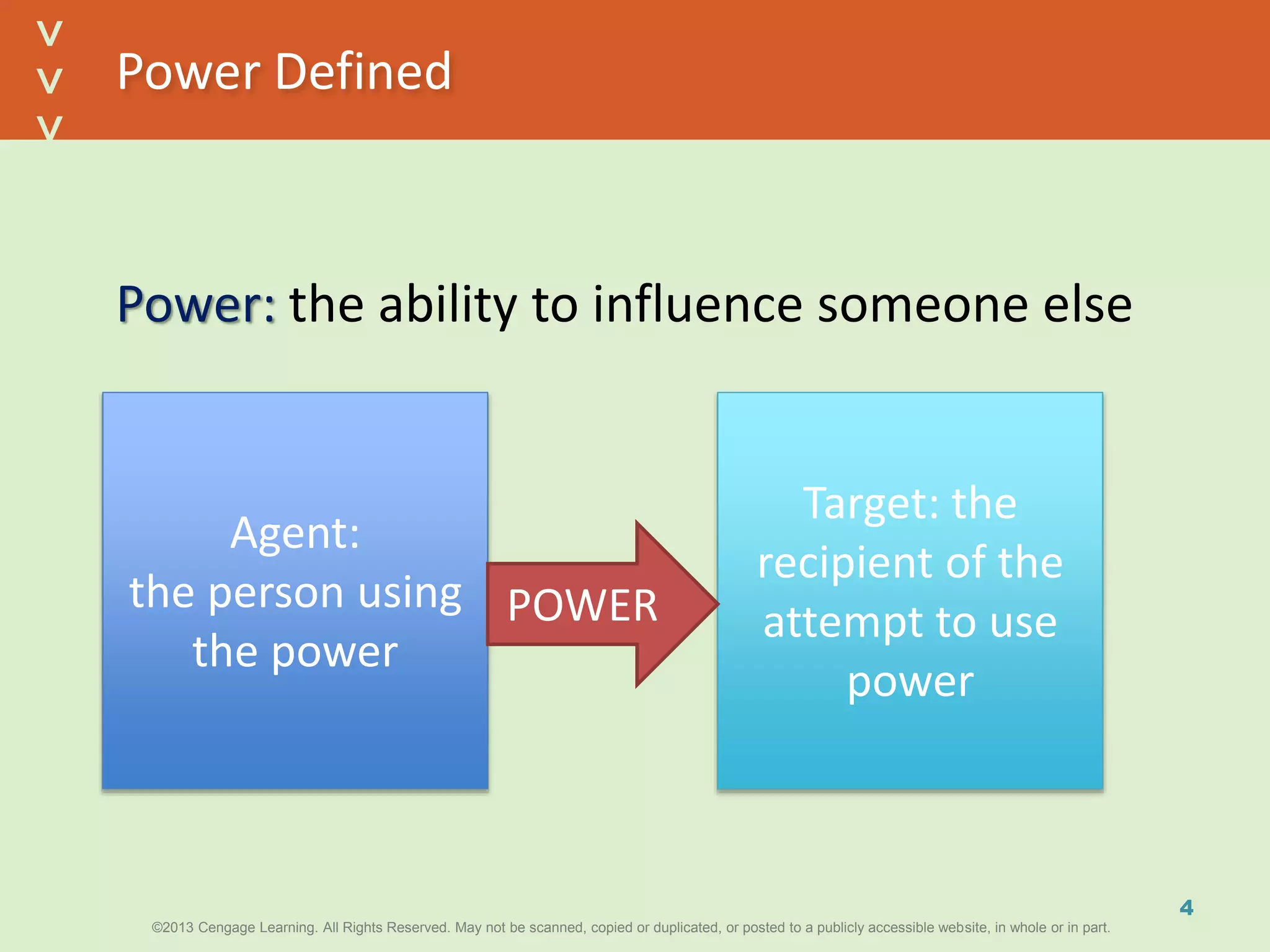
Power: the ability to influence someone else
4
Agent:
the person using
the power
Target: the
recipient of the
attempt to use
power
POWER
©2013 Cengage Learning. All Rights Reserved. May not be scanned, copied or duplicated, or posted to a publicly accessible website, in whole or in part.©2013 Cengage Learning. All Rights Reserved. May not be scanned, copied or duplicated, or posted to a publicly accessible website, in whole or in part.
^
^
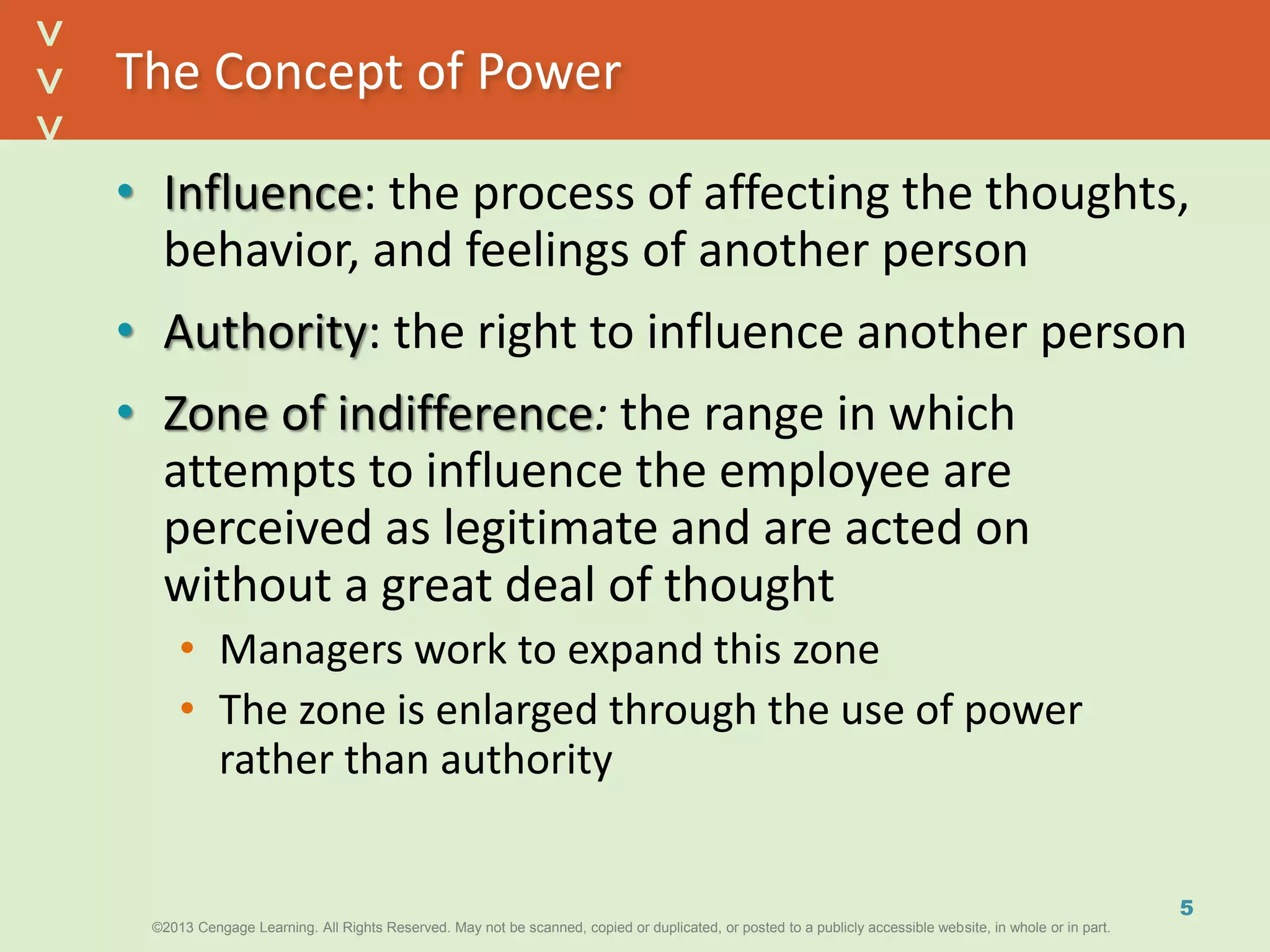
The Concept of Power
• Influence: the process of affecting the thoughts,
behavior, and feelings of another person
• Authority: the right to influence another person
• Zone of indifference: the range in which
attempts to influence the employee are
perceived as legitimate and are acted on
without a great deal of thought
• Managers work to expand this zone
• The zone is enlarged through the use of power
rather than authority
5
©2013 Cengage Learning. All Rights Reserved. May not be scanned, copied or duplicated, or posted to a publicly accessible website, in whole or in part.©2013 Cengage Learning. All Rights Reserved. May not be scanned, copied or duplicated, or posted to a publicly accessible website, in whole or in part.
^
^
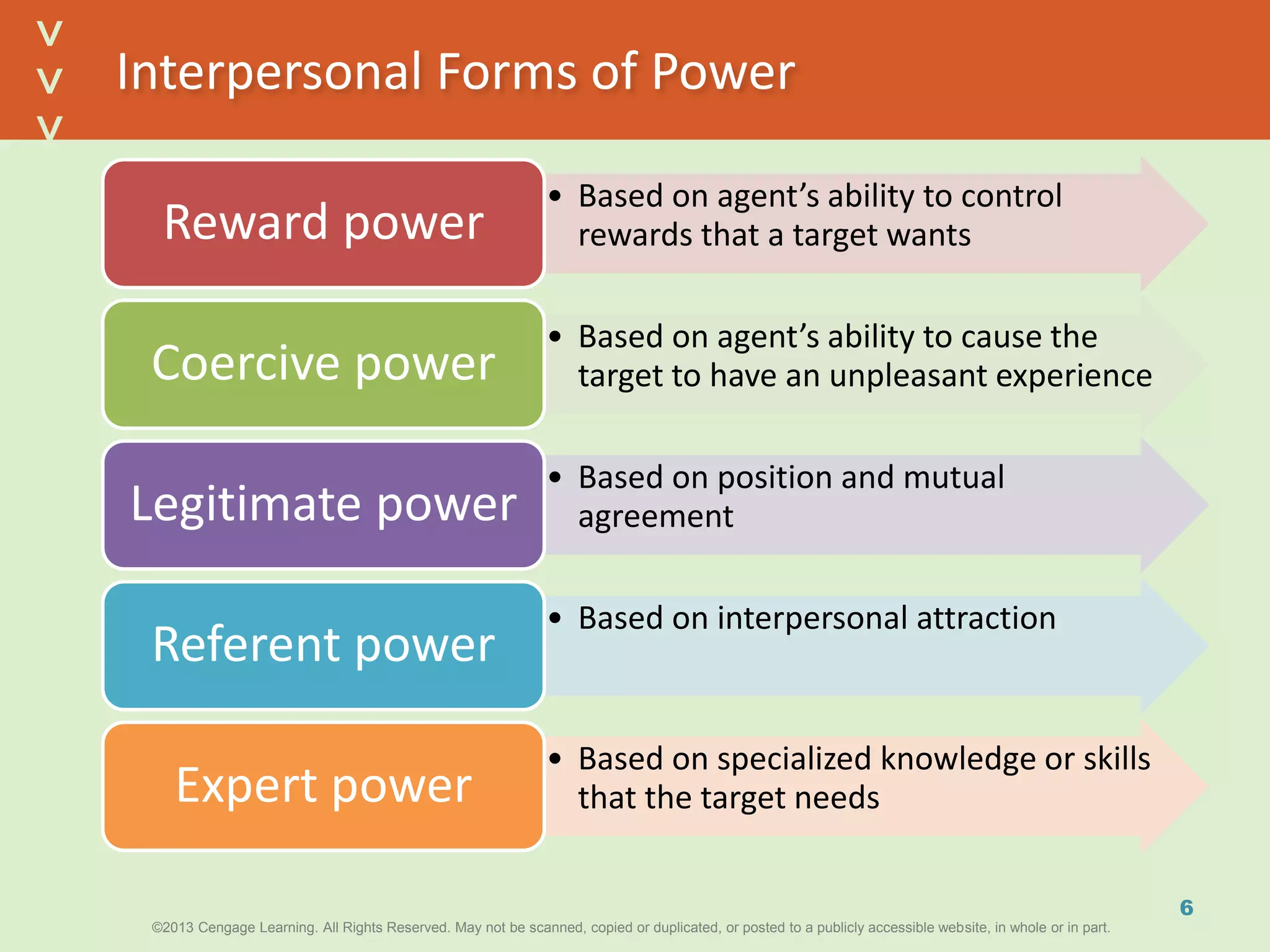
Interpersonal Forms of Power
• Based on agent’s ability to control
rewards that a target wantsReward power
• Based on agent’s ability to cause the
target to have an unpleasant experienceCoercive power
• Based on position and mutual
agreementLegitimate power
• Based on interpersonal attraction
Referent power
• Based on specialized knowledge or skills
that the target needsExpert power
6
©2013 Cengage Learning. All Rights Reserved. May not be scanned, copied or duplicated, or posted to a publicly accessible website, in whole or in part.©2013 Cengage Learning. All Rights Reserved. May not be scanned, copied or duplicated, or posted to a publicly accessible website, in whole or in part.
^
^
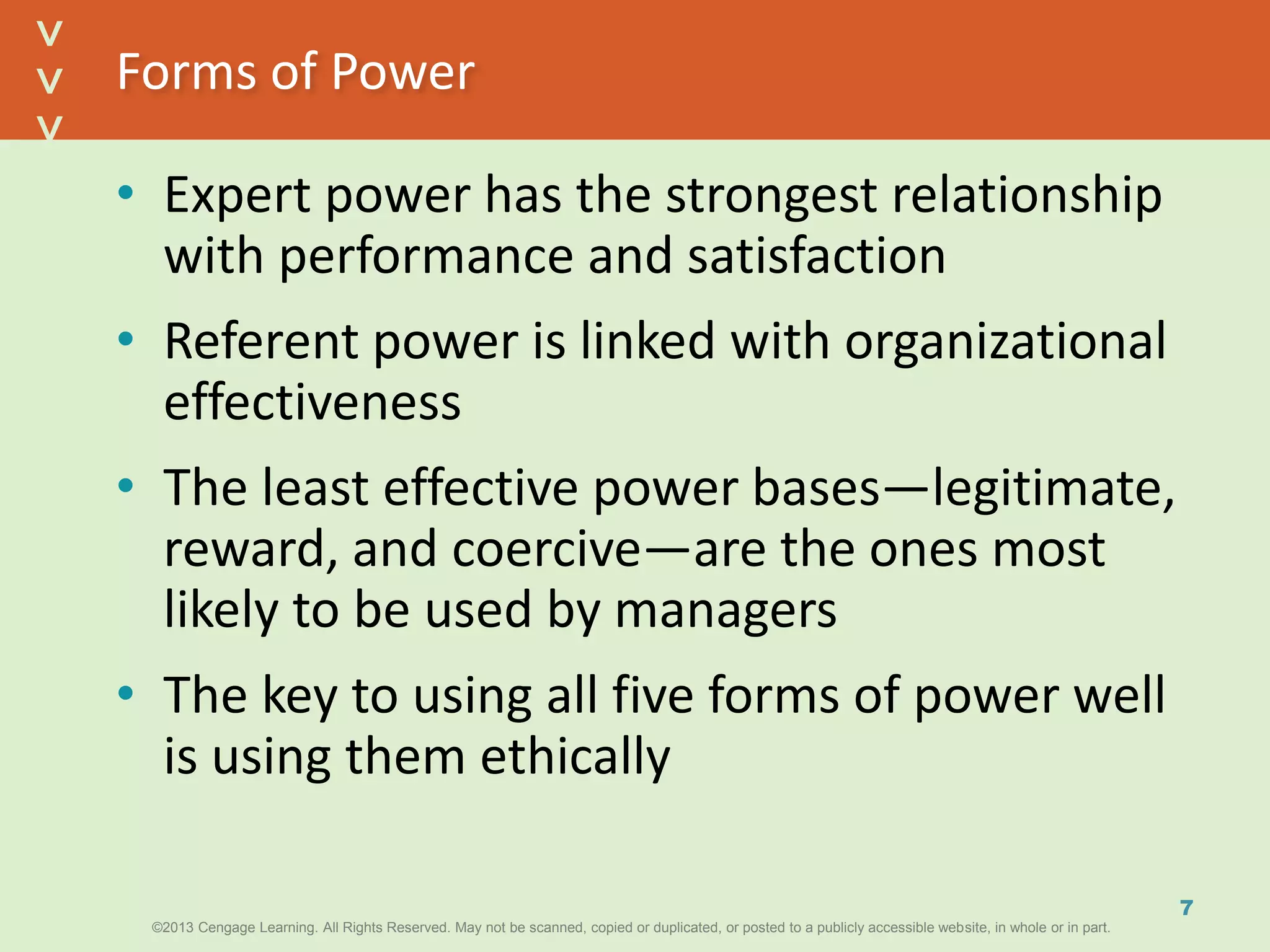
Forms of Power
• Expert power has the strongest relationship
with performance and satisfaction
• Referent power is linked with organizational
effectiveness
• The least effective power bases—legitimate,
reward, and coercive—are the ones most
likely to be used by managers
• The key to using all five forms of power well
is using them ethically
7
©2013 Cengage Learning. All Rights Reserved. May not be scanned, copied or duplicated, or posted to a publicly accessible website, in whole or in part.©2013 Cengage Learning. All Rights Reserved. May not be scanned, copied or duplicated, or posted to a publicly accessible website, in whole or in part.
^
^
8
©2013 Cengage Learning. All Rights Reserved. May not be scanned, copied or duplicated, or posted to a publicly accessible website, in whole or in part.©2013 Cengage Learning. All Rights Reserved. May not be scanned, copied or duplicated, or posted to a publicly accessible website, in whole or in part.
^
^
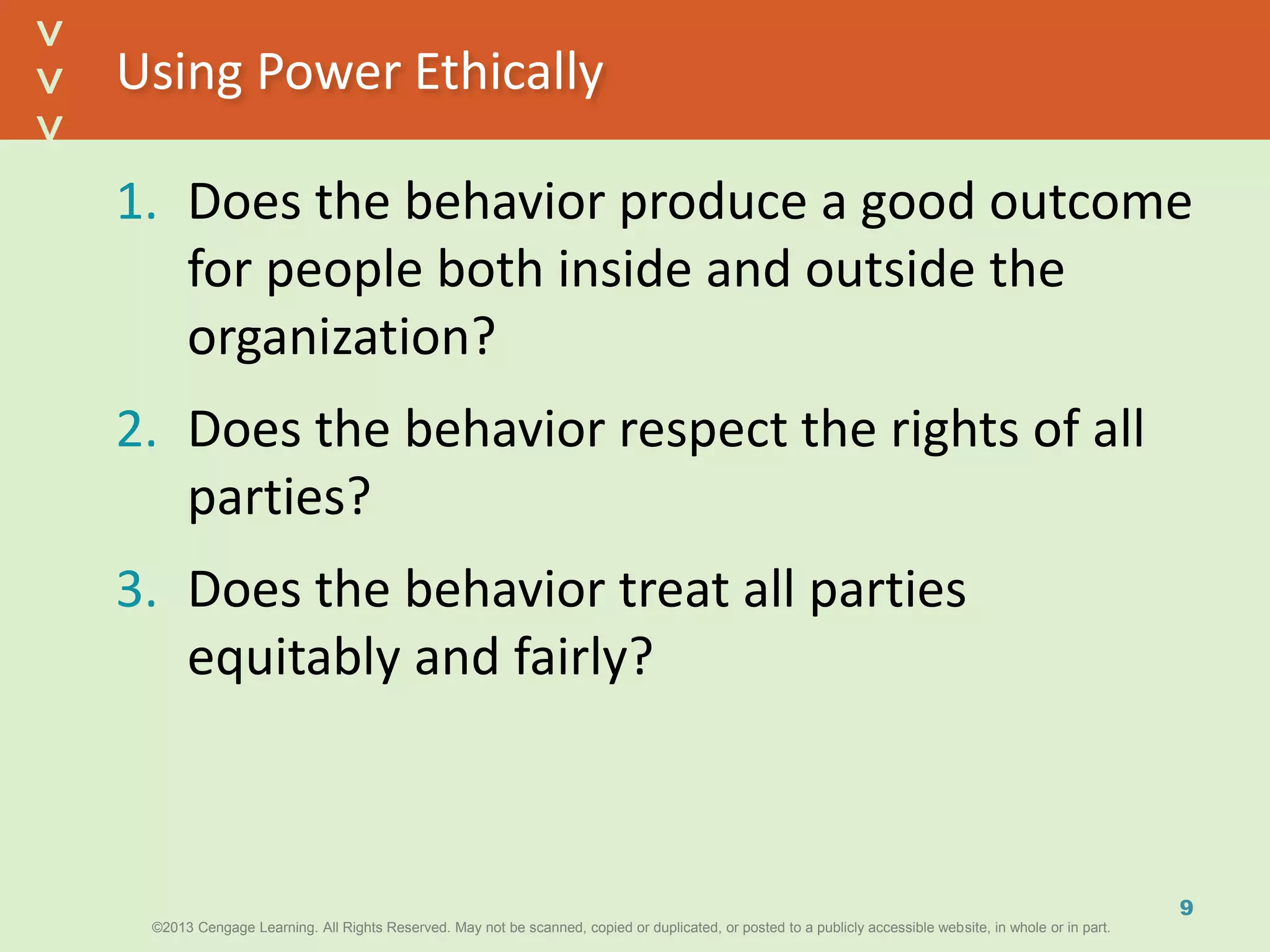
Using Power Ethically
1. Does the behavior produce a good outcome
for people both inside and outside the
organization?
2. Does the behavior respect the rights of all
parties?
3. Does the behavior treat all parties
equitably and fairly?
9
©2013 Cengage Learning. All Rights Reserved. May not be scanned, copied or duplicated, or posted to a publicly accessible website, in whole or in part.©2013 Cengage Learning. All Rights Reserved. May not be scanned, copied or duplicated, or posted to a publicly accessible website, in whole or in part.
^
^
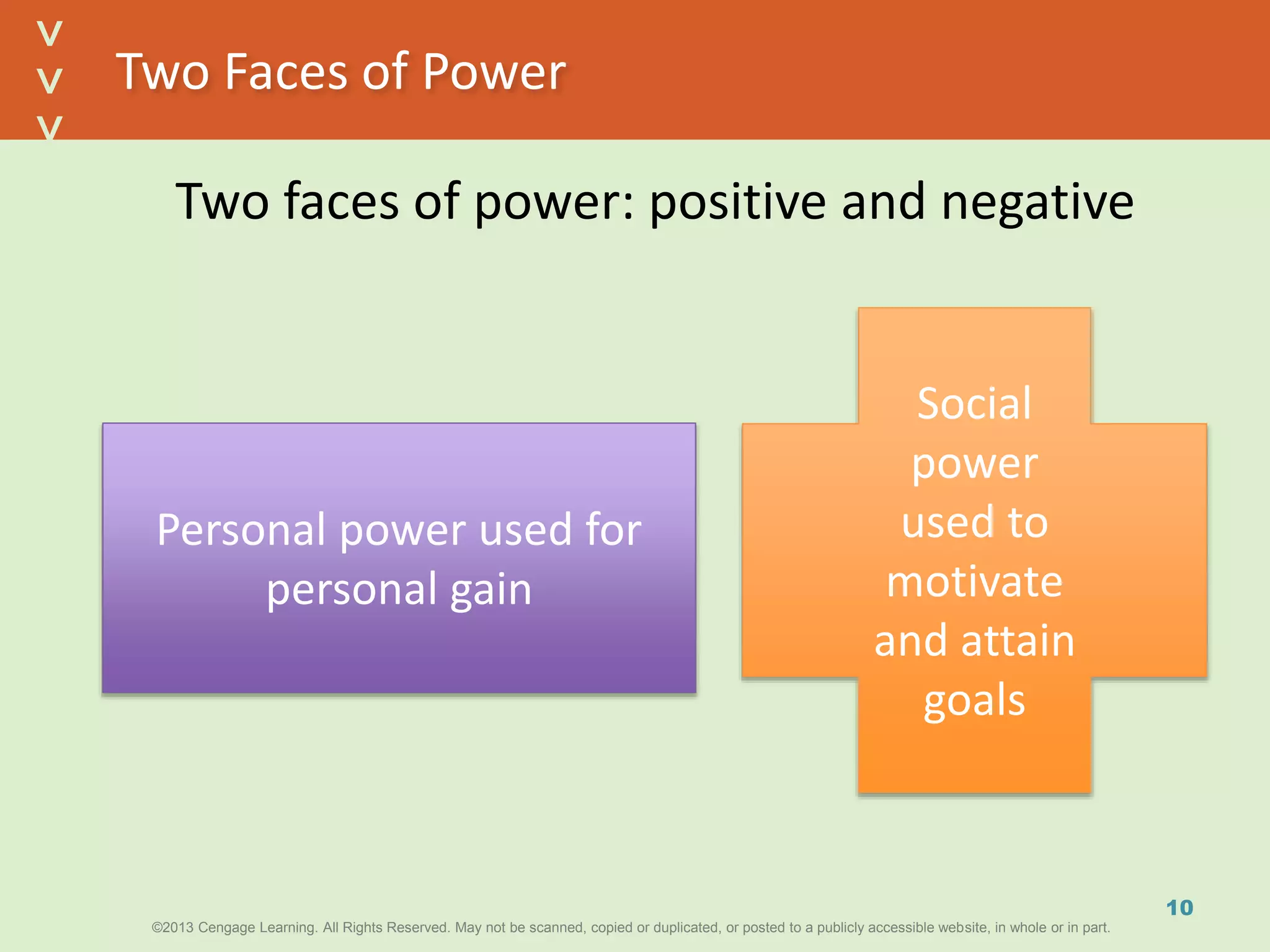
Two Faces of Power
Two faces of power: positive and negative
10
Personal power used for
personal gain
Social
power
used to
motivate
and attain
goals
©2013 Cengage Learning. All Rights Reserved. May not be scanned, copied or duplicated, or posted to a publicly accessible website, in whole or in part.©2013 Cengage Learning. All Rights Reserved. May not be scanned, copied or duplicated, or posted to a publicly accessible website, in whole or in part.
^
^
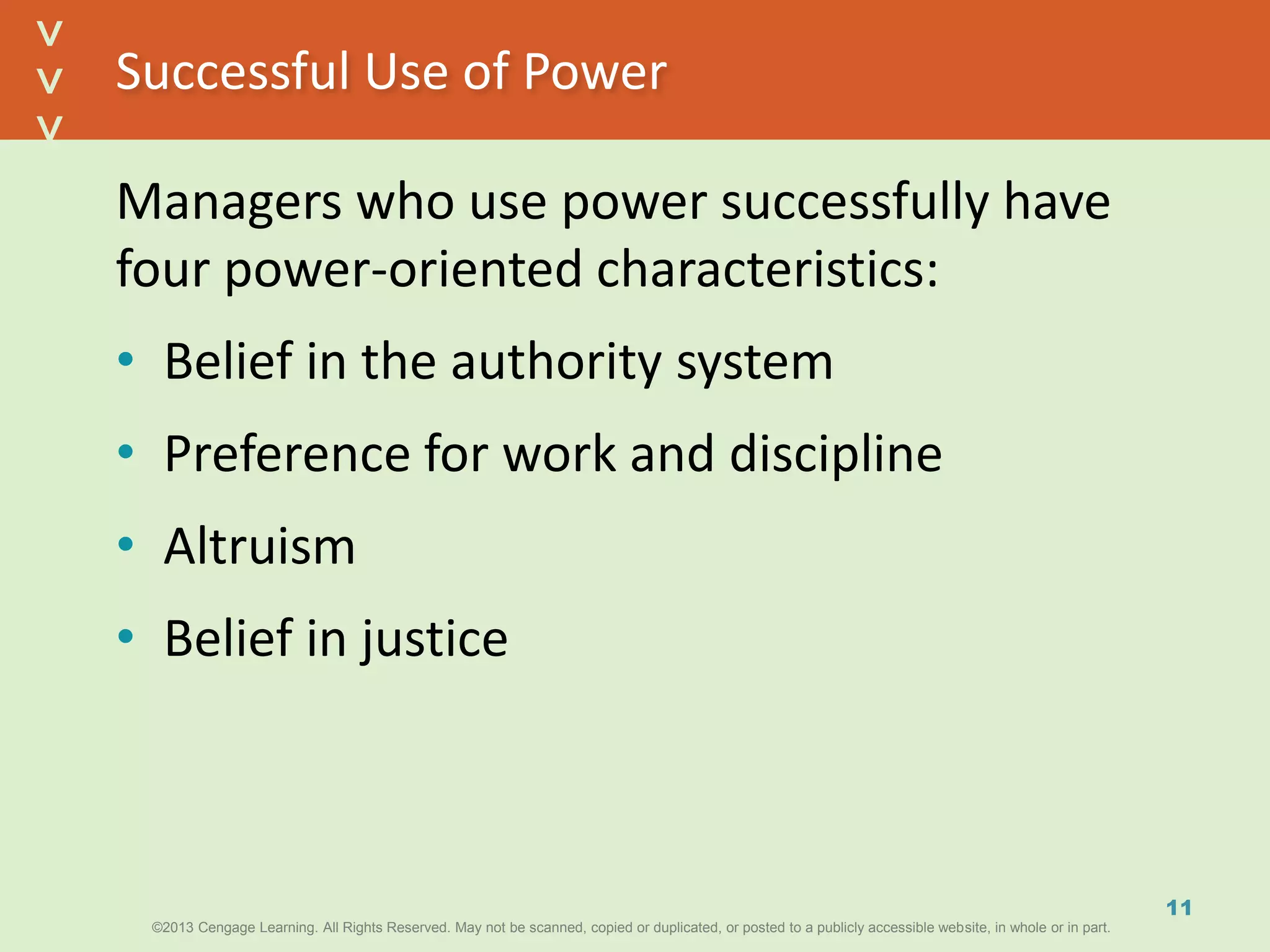
Successful Use of Power
Managers who use power successfully have
four power-oriented characteristics:
• Belief in the authority system
• Preference for work and discipline
• Altruism
• Belief in justice
11
©2013 Cengage Learning. All Rights Reserved. May not be scanned, copied or duplicated, or posted to a publicly accessible website, in whole or in part.©2013 Cengage Learning. All Rights Reserved. May not be scanned, copied or duplicated, or posted to a publicly accessible website, in whole or in part.
^
^
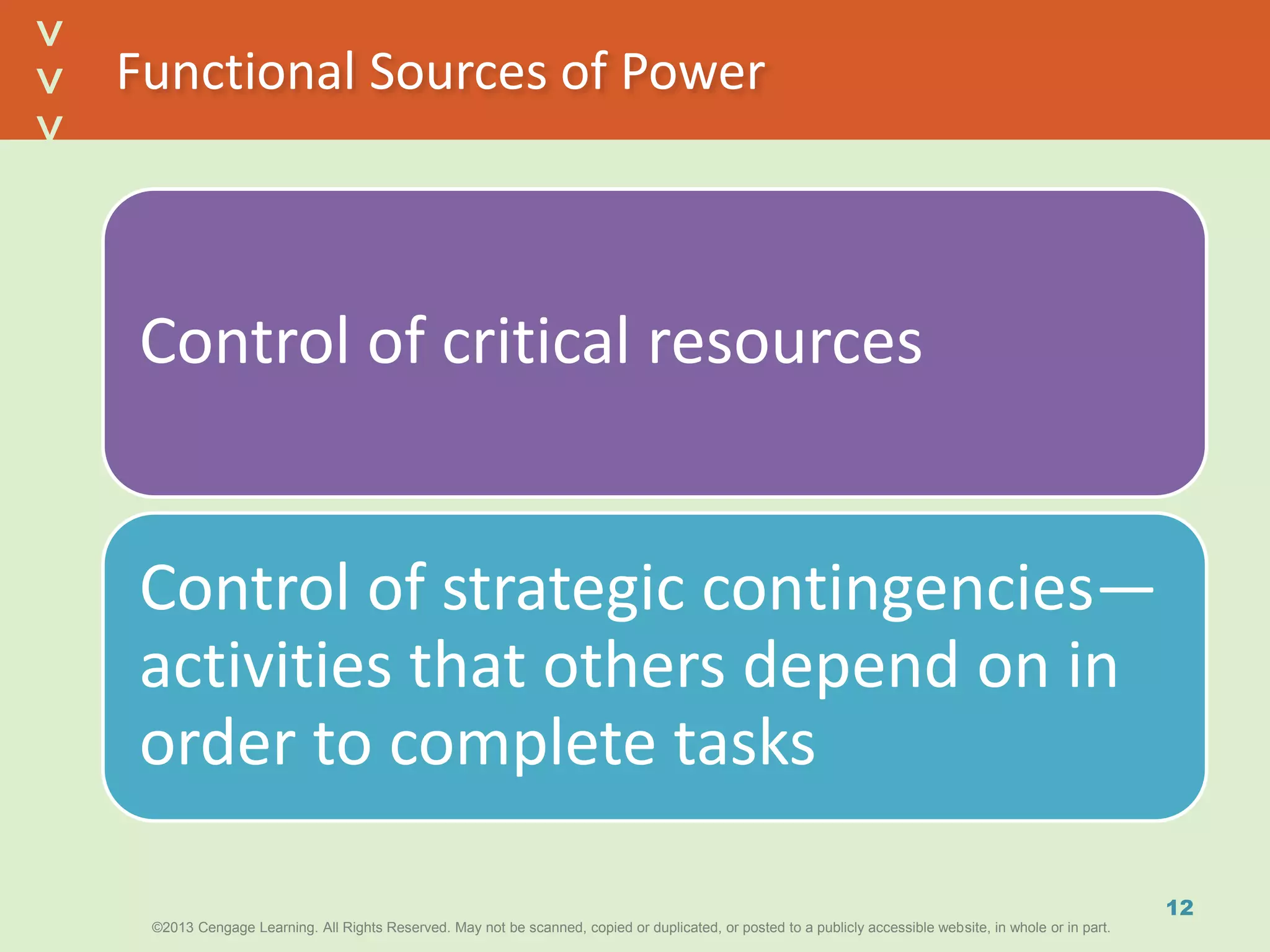
Functional Sources of Power
Control of critical resources
Control of strategic contingencies—
activities that others depend on in
order to complete tasks
12
©2013 Cengage Learning. All Rights Reserved. May not be scanned, copied or duplicated, or posted to a publicly accessible website, in whole or in part.©2013 Cengage Learning. All Rights Reserved. May not be scanned, copied or duplicated, or posted to a publicly accessible website, in whole or in part.
^
^
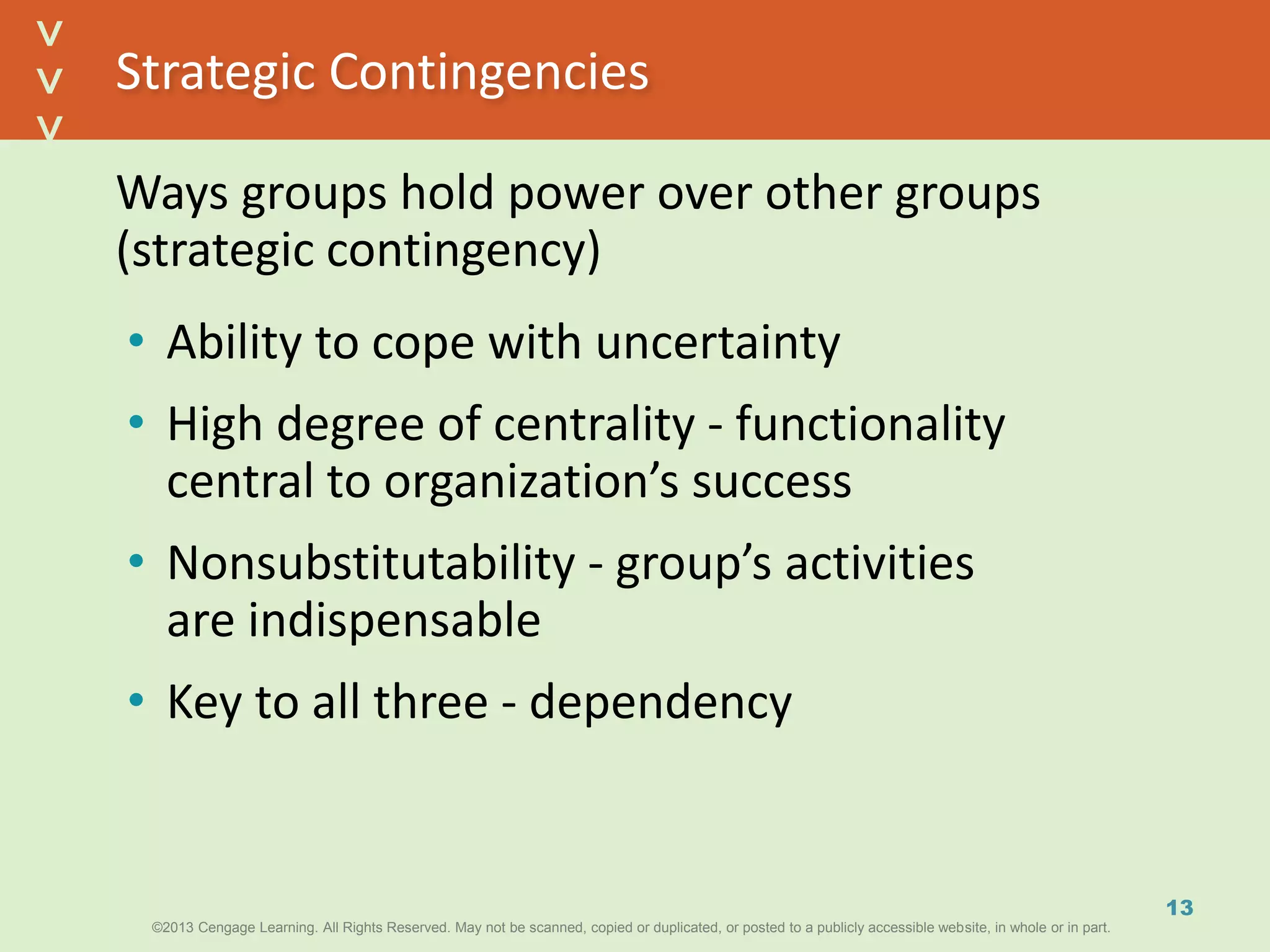
Strategic Contingencies
13
Ways groups hold power over other groups
(strategic contingency)
• Ability to cope with uncertainty
• High degree of centrality - functionality
central to organization’s success
• Nonsubstitutability - group’s activities
are indispensable
• Key to all three - dependency
©2013 Cengage Learning. All Rights Reserved. May not be scanned, copied or duplicated, or posted to a publicly accessible website, in whole or in part.©2013 Cengage Learning. All Rights Reserved. May not be scanned, copied or duplicated, or posted to a publicly accessible website, in whole or in part.
^
^
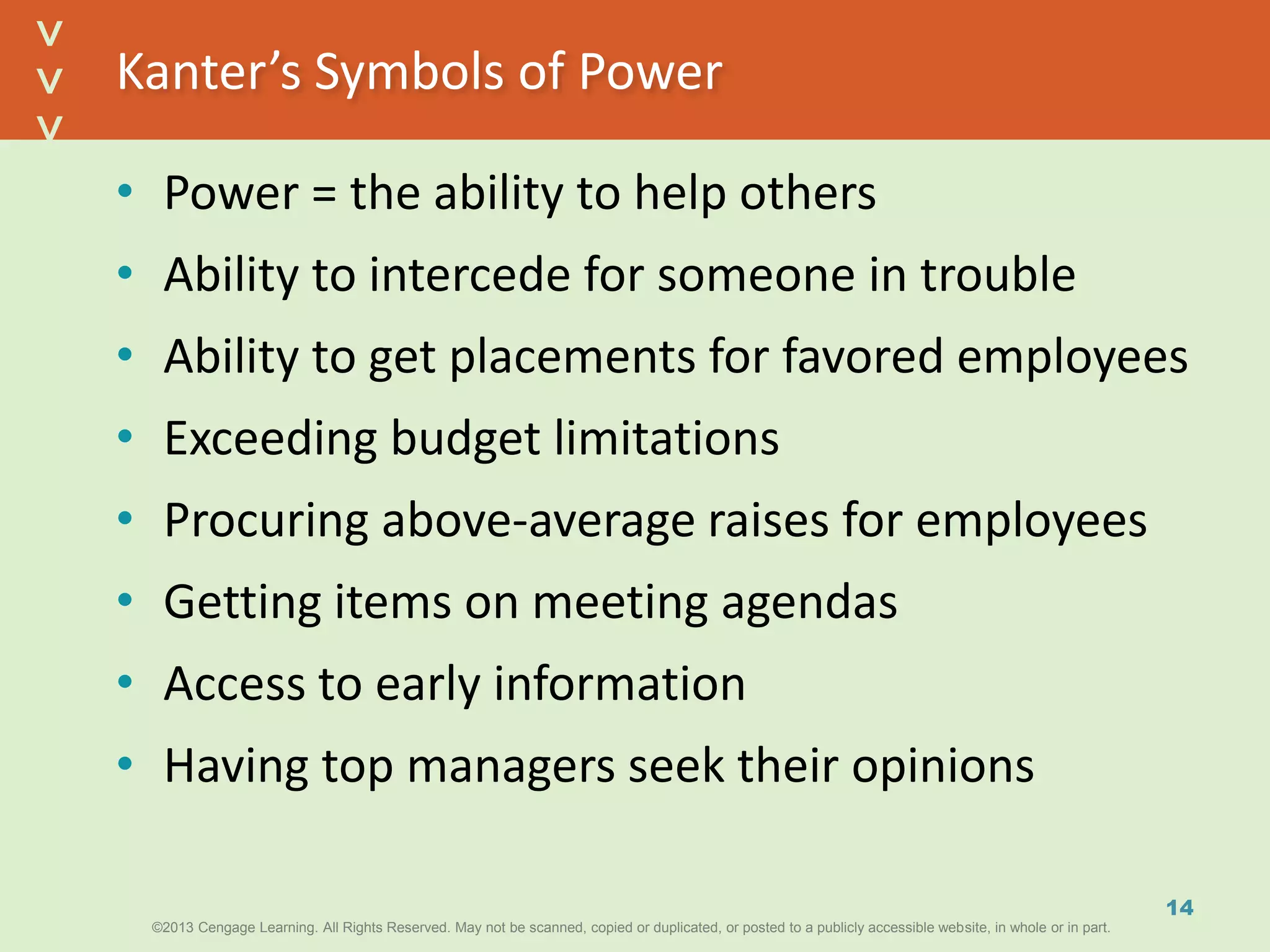
Kanter’s Symbols of Power
• Power = the ability to help others
• Ability to intercede for someone in trouble
• Ability to get placements for favored employees
• Exceeding budget limitations
• Procuring above-average raises for employees
• Getting items on meeting agendas
• Access to early information
• Having top managers seek their opinions
14
©2013 Cengage Learning. All Rights Reserved. May not be scanned, copied or duplicated, or posted to a publicly accessible website, in whole or in part.©2013 Cengage Learning. All Rights Reserved. May not be scanned, copied or duplicated, or posted to a publicly accessible website, in whole or in part.
^
^
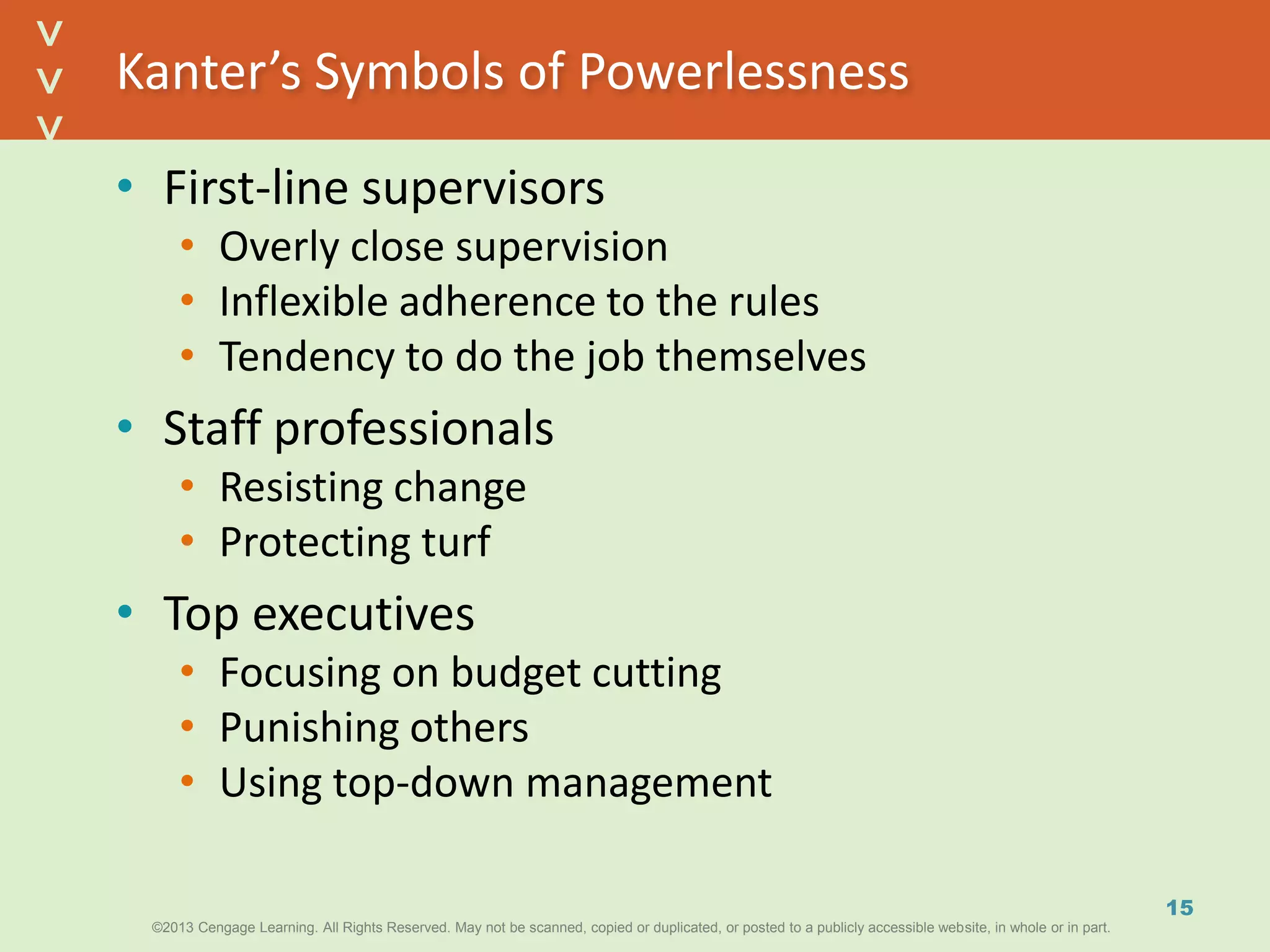
Kanter’s Symbols of Powerlessness
• First-line supervisors
• Overly close supervision
• Inflexible adherence to the rules
• Tendency to do the job themselves
• Staff professionals
• Resisting change
• Protecting turf
• Top executives
• Focusing on budget cutting
• Punishing others
• Using top-down management
15
©2013 Cengage Learning. All Rights Reserved. May not be scanned, copied or duplicated, or posted to a publicly accessible website, in whole or in part.©2013 Cengage Learning. All Rights Reserved. May not be scanned, copied or duplicated, or posted to a publicly accessible website, in whole or in part.
^
^
Korda’s Symbols of Power
• Power = status
• There are more people who inconvenience
themselves on your behalf than there are
people on whose behalf you would
inconvenience yourself
• Furniture
• Time power
• Standing by
16
©2013 Cengage Learning. All Rights Reserved. May not be scanned, copied or duplicated, or posted to a publicly accessible website, in whole or in part.©2013 Cengage Learning. All Rights Reserved. May not be scanned, copied or duplicated, or posted to a publicly accessible website, in whole or in part.
^
^
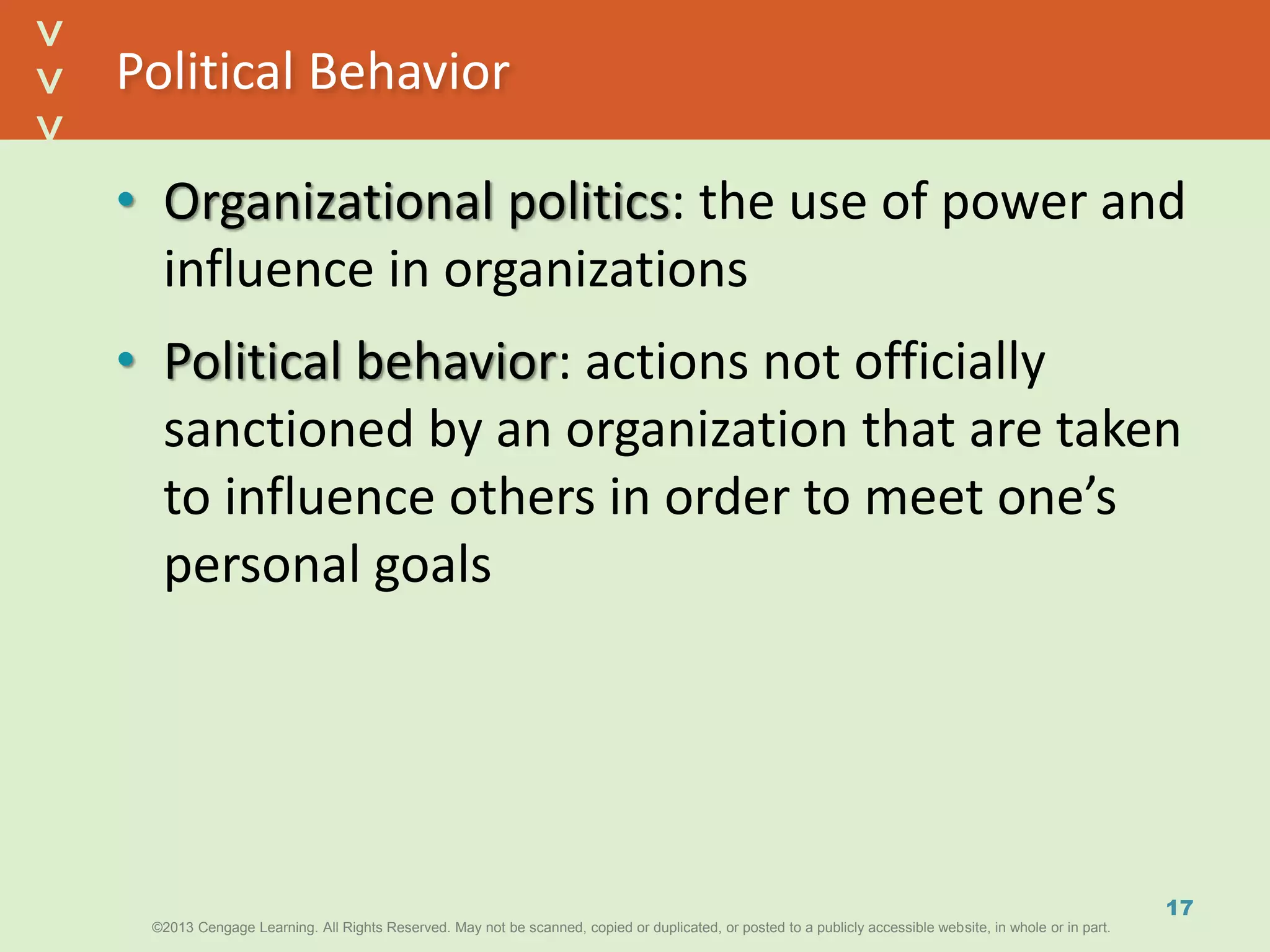
Political Behavior
• Organizational politics: the use of power and
influence in organizations
• Political behavior: actions not officially
sanctioned by an organization that are taken
to influence others in order to meet one’s
personal goals
17
©2013 Cengage Learning. All Rights Reserved. May not be scanned, copied or duplicated, or posted to a publicly accessible website, in whole or in part.©2013 Cengage Learning. All Rights Reserved. May not be scanned, copied or duplicated, or posted to a publicly accessible website, in whole or in part.
^
^
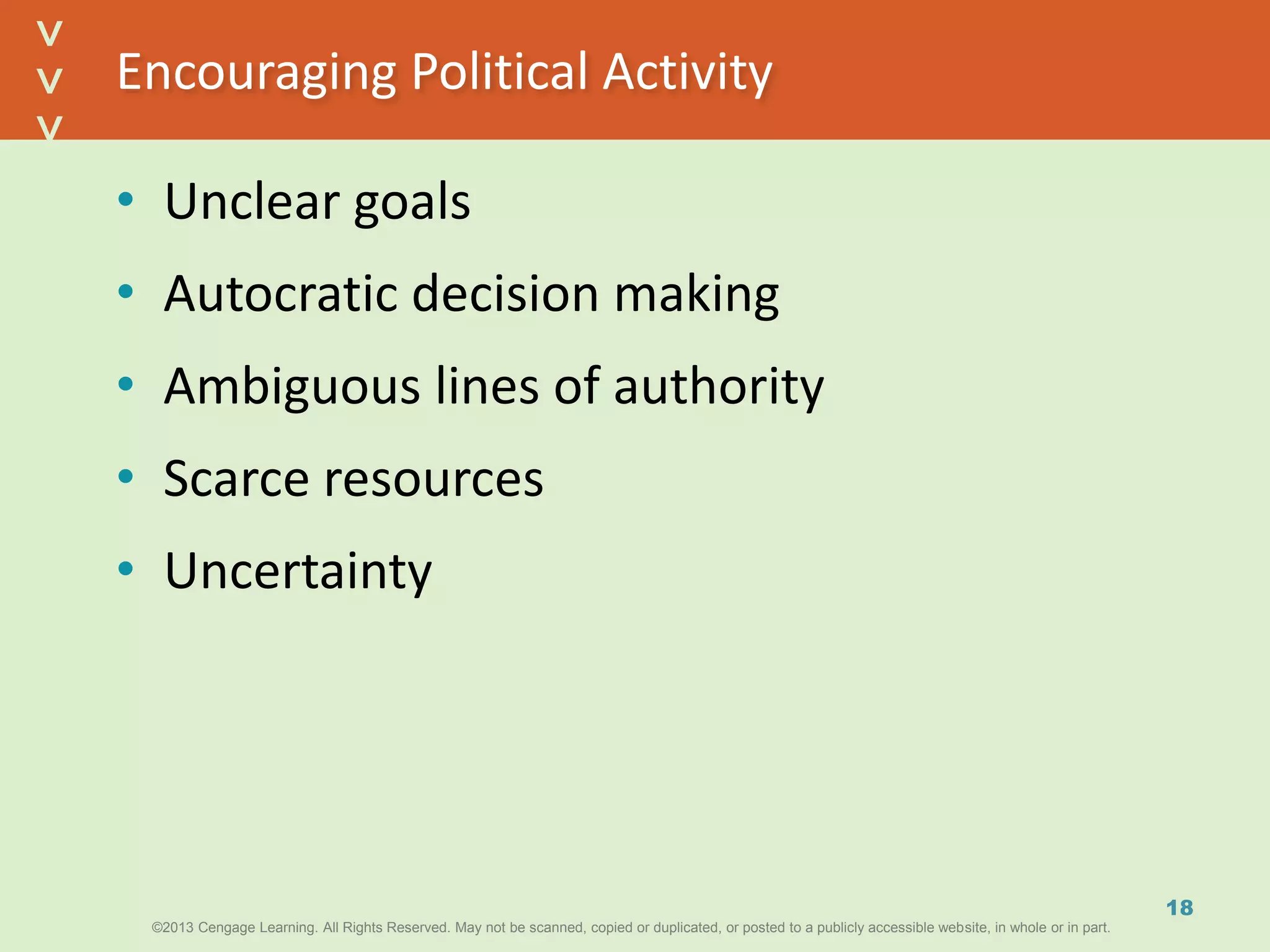
Encouraging Political Activity
• Unclear goals
• Autocratic decision making
• Ambiguous lines of authority
• Scarce resources
• Uncertainty
18
©2013 Cengage Learning. All Rights Reserved. May not be scanned, copied or duplicated, or posted to a publicly accessible website, in whole or in part.©2013 Cengage Learning. All Rights Reserved. May not be scanned, copied or duplicated, or posted to a publicly accessible website, in whole or in part.
^
^
Influence
Upward
influence • Boss
Lateral
influence • Coworker
Downward
influence • Employee
19
Influence: the
process of
affecting the
thoughts,
behavior, or
feelings of
another person
©2013 Cengage Learning. All Rights Reserved. May not be scanned, copied or duplicated, or posted to a publicly accessible website, in whole or in part.©2013 Cengage Learning. All Rights Reserved. May not be scanned, copied or duplicated, or posted to a publicly accessible website, in whole or in part.
^
^
20
©2013 Cengage Learning. All Rights Reserved. May not be scanned, copied or duplicated, or posted to a publicly accessible website, in whole or in part.©2013 Cengage Learning. All Rights Reserved. May not be scanned, copied or duplicated, or posted to a publicly accessible website, in whole or in part.
^
^
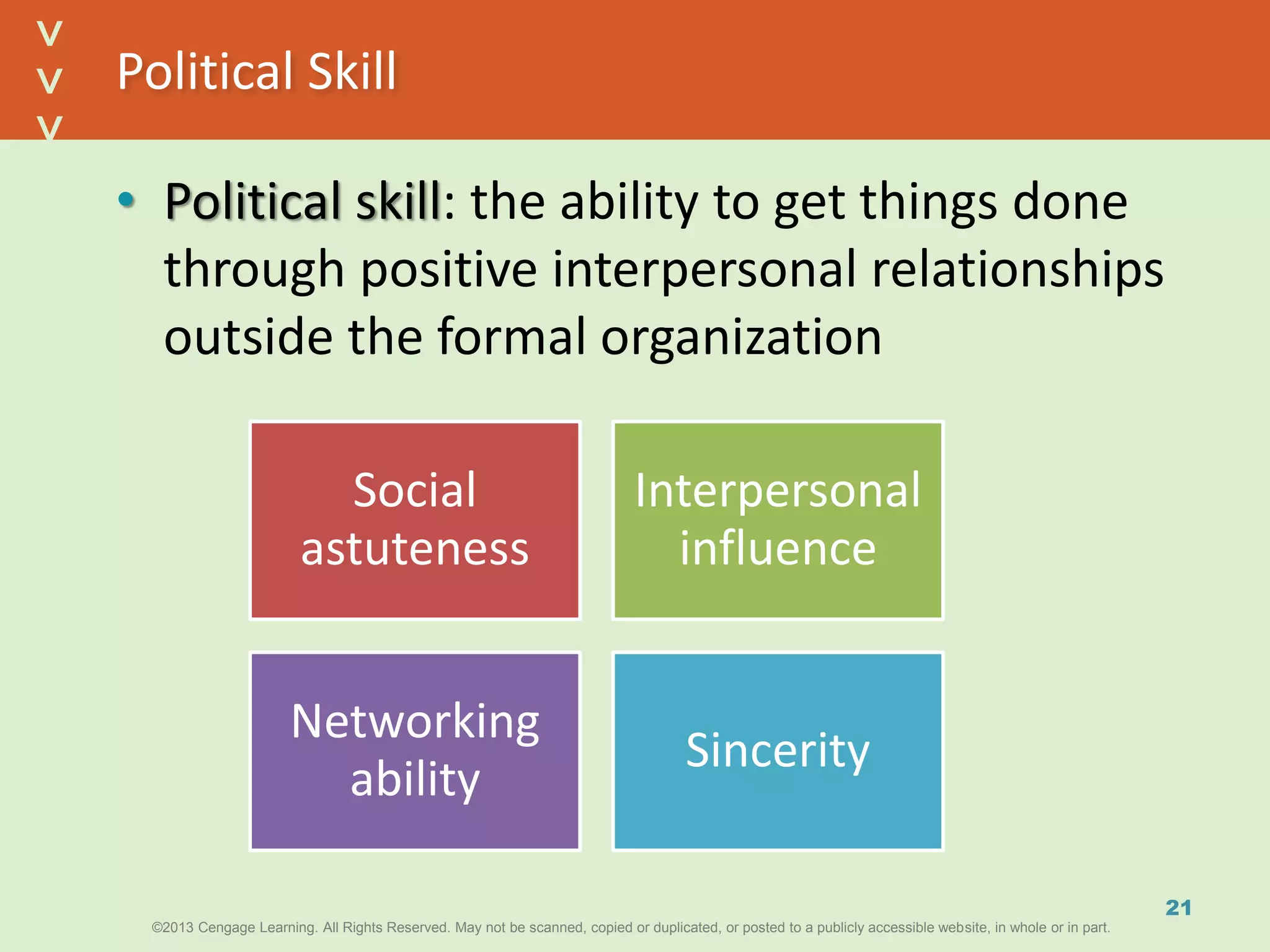
Political Skill
• Political skill: the ability to get things done
through positive interpersonal relationships
outside the formal organization
21
Social
astuteness
Interpersonal
influence
Networking
ability
Sincerity
©2013 Cengage Learning. All Rights Reserved. May not be scanned, copied or duplicated, or posted to a publicly accessible website, in whole or in part.©2013 Cengage Learning. All Rights Reserved. May not be scanned, copied or duplicated, or posted to a publicly accessible website, in whole or in part.
^
^
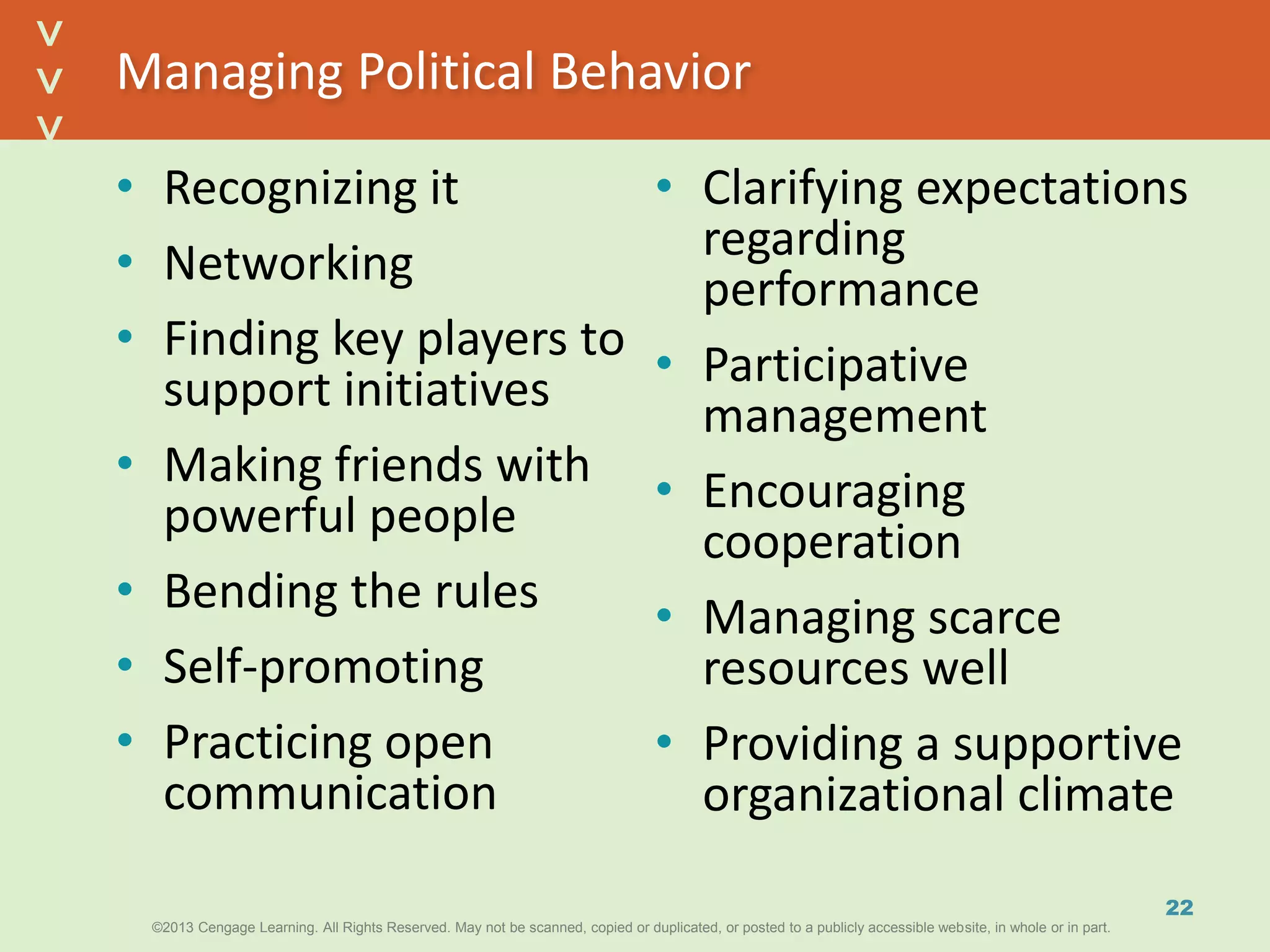
Managing Political Behavior
• Recognizing it
• Networking
• Finding key players to
support initiatives
• Making friends with
powerful people
• Bending the rules
• Self-promoting
• Practicing open
communication
• Clarifying expectations
regarding
performance
• Participative
management
• Encouraging
cooperation
• Managing scarce
resources well
• Providing a supportive
organizational climate
22
©2013 Cengage Learning. All Rights Reserved. May not be scanned, copied or duplicated, or posted to a publicly accessible website, in whole or in part.©2013 Cengage Learning. All Rights Reserved. May not be scanned, copied or duplicated, or posted to a publicly accessible website, in whole or in part.
^
^
Empowerment
• Empowerment: creating conditions for
heightened motivation through the
development of a strong sense of personal
self-efficacy
• Sharing power in such a way that individuals
learn to believe in their ability to do the job
• The individuals closest to the work and to
the customers should make the decisions
23
©2013 Cengage Learning. All Rights Reserved. May not be scanned, copied or duplicated, or posted to a publicly accessible website, in whole or in part.©2013 Cengage Learning. All Rights Reserved. May not be scanned, copied or duplicated, or posted to a publicly accessible website, in whole or in part.
^
^
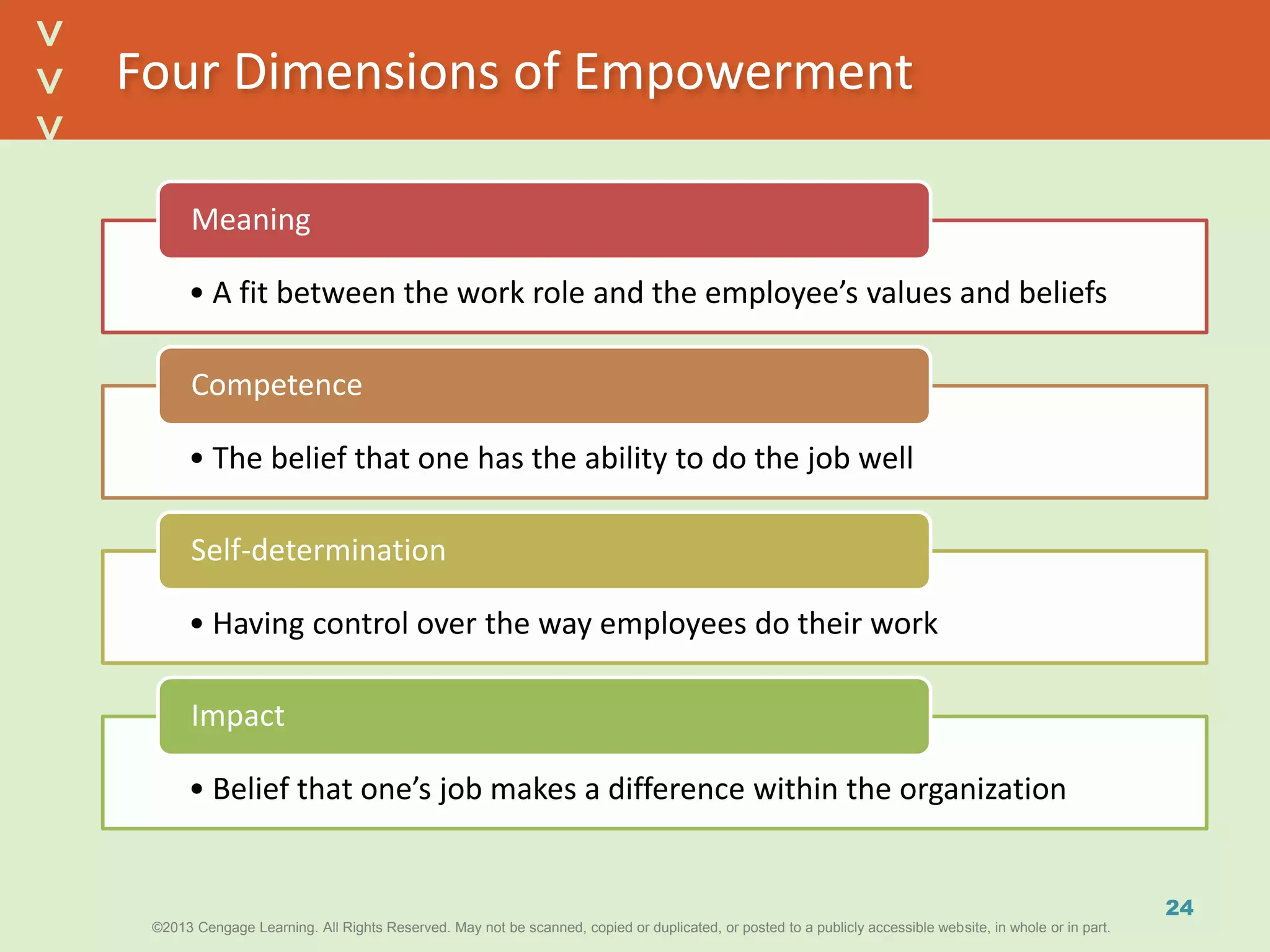
Four Dimensions of Empowerment
• A fit between the work role and the employee’s values and beliefs
Meaning
• The belief that one has the ability to do the job well
Competence
• Having control over the way employees do their work
Self-determination
• Belief that one’s job makes a difference within the organization
Impact
24
©2013 Cengage Learning. All Rights Reserved. May not be scanned, copied or duplicated, or posted to a publicly accessible website, in whole or in part.©2013 Cengage Learning. All Rights Reserved. May not be scanned, copied or duplicated, or posted to a publicly accessible website, in whole or in part.
^
^
Empowering Others
• Express confidence in employees and set
high performance expectations
• Create opportunities for employees to
participate in decision making
• Remove bureaucratic constraints that stifle
autonomy
• Set inspirational or meaningful goals
25
©2013 Cengage Learning. All Rights Reserved. May not be scanned, copied or duplicated, or posted to a publicly accessible website, in whole or in part.©2013 Cengage Learning. All Rights Reserved. May not be scanned, copied or duplicated, or posted to a publicly accessible website, in whole or in part.
^
^
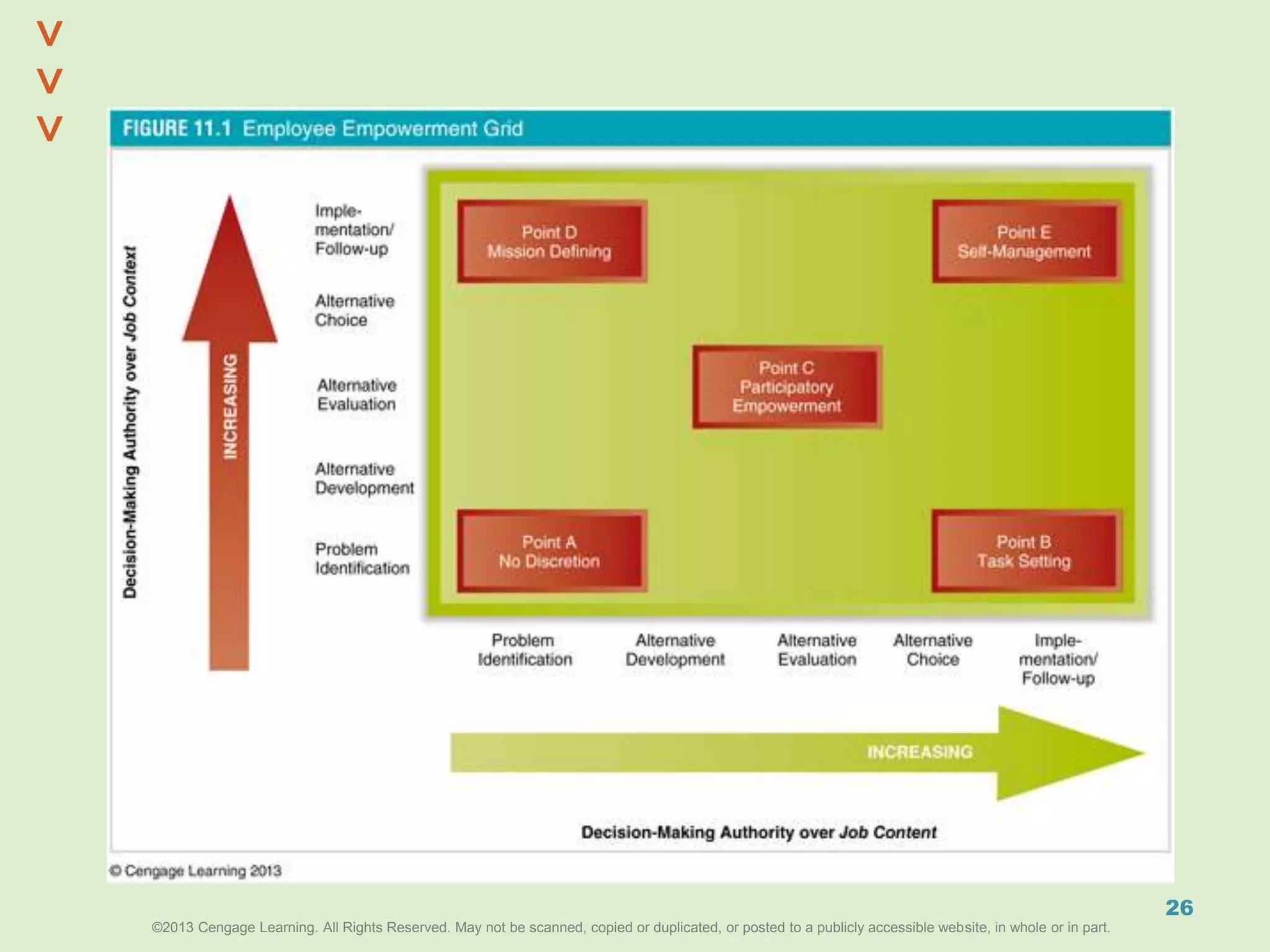
26
©2013 Cengage Learning. All Rights Reserved. May not be scanned, copied or duplicated, or posted to a publicly accessible website, in whole or in part.©2013 Cengage Learning. All Rights Reserved. May not be scanned, copied or duplicated, or posted to a publicly accessible website, in whole or in part.
^
^
Why Executives Fail
• See themselves and their companies as
dominating
• Think they have all the answers
• Eliminate those not 100% behind them
• Rely on what worked for them in the past
• Set no clear boundaries between personal
and corporate interests
27
©2013 Cengage Learning. All Rights Reserved. May not be scanned, copied or duplicated, or posted to a publicly accessible website, in whole or in part.©2013 Cengage Learning. All Rights Reserved. May not be scanned, copied or duplicated, or posted to a publicly accessible website, in whole or in part.
^
^
Using Power Successfully
• Use power in ethical ways
• Understand and use all of the various types of
power and influence
• Seek jobs that allow you to develop your power
skills
• Use power tempered by maturity and self-
control
• Accept that influencing people is an important
part of the management job
28
©2013 Cengage Learning. All Rights Reserved. May not be scanned, copied or duplicated, or posted to a publicly accessible website, in whole or in part.©2013 Cengage Learning. All Rights Reserved. May not be scanned, copied or duplicated, or posted to a publicly accessible website, in whole or in part.
^
^
^
Chapter 11: Reflect & Discuss
Flash of Genius Video Clip
• This chapter defined power as “the ability to
influence someone else.” Who has power in this film
scene?
• The chapter distinguished influence from authority.
What is the example of the use of authority in the
scene?
• Which interpersonal forms of power appear in this
film scene? Draw examples of your choices from the
scene.
29

MBA 635 chapter 11

  • 1.
    ©2013 Cengage Learning.All Rights Reserved. May not be scanned, copied or duplicated, or posted to a publicly accessible website, in whole or in part. 11 ©2013 Cengage Learning. All Rights Reserved. May not be scanned, copied or duplicated, or posted to a publicly accessible website, in whole or in part. Power and Political Behavior
  • 2.
    ©2013 Cengage Learning.All Rights Reserved. May not be scanned, copied or duplicated, or posted to a publicly accessible website, in whole or in part. Learning Objectives ©2013 Cengage Learning. All Rights Reserved. May not be scanned, copied or duplicated, or posted to a publicly accessible website, in whole or in part. 1 Distinguish among power, influence, and authority. 2 Compare the interpersonal and functional sources of power. 3 Understand the ethical use of power. 4 Identify symbols of power and powerlessness in organizations. 2
  • 3.
    ©2013 Cengage Learning.All Rights Reserved. May not be scanned, copied or duplicated, or posted to a publicly accessible website, in whole or in part. Learning Objectives continued ©2013 Cengage Learning. All Rights Reserved. May not be scanned, copied or duplicated, or posted to a publicly accessible website, in whole or in part. 5 Define organizational politics and understand the role of political skill and major influence tactics. 6 Develop a plan for managing employee– boss relationships. 7 Discuss how managers can empower others. 3
  • 4.
    ©2013 Cengage Learning.All Rights Reserved. May not be scanned, copied or duplicated, or posted to a publicly accessible website, in whole or in part.©2013 Cengage Learning. All Rights Reserved. May not be scanned, copied or duplicated, or posted to a publicly accessible website, in whole or in part. ^ ^ Power Defined Power: the ability to influence someone else 4 Agent: the person using the power Target: the recipient of the attempt to use power POWER
  • 5.
    ©2013 Cengage Learning.All Rights Reserved. May not be scanned, copied or duplicated, or posted to a publicly accessible website, in whole or in part.©2013 Cengage Learning. All Rights Reserved. May not be scanned, copied or duplicated, or posted to a publicly accessible website, in whole or in part. ^ ^ The Concept of Power • Influence: the process of affecting the thoughts, behavior, and feelings of another person • Authority: the right to influence another person • Zone of indifference: the range in which attempts to influence the employee are perceived as legitimate and are acted on without a great deal of thought • Managers work to expand this zone • The zone is enlarged through the use of power rather than authority 5
  • 6.
    ©2013 Cengage Learning.All Rights Reserved. May not be scanned, copied or duplicated, or posted to a publicly accessible website, in whole or in part.©2013 Cengage Learning. All Rights Reserved. May not be scanned, copied or duplicated, or posted to a publicly accessible website, in whole or in part. ^ ^ Interpersonal Forms of Power • Based on agent’s ability to control rewards that a target wantsReward power • Based on agent’s ability to cause the target to have an unpleasant experienceCoercive power • Based on position and mutual agreementLegitimate power • Based on interpersonal attraction Referent power • Based on specialized knowledge or skills that the target needsExpert power 6
  • 7.
    ©2013 Cengage Learning.All Rights Reserved. May not be scanned, copied or duplicated, or posted to a publicly accessible website, in whole or in part.©2013 Cengage Learning. All Rights Reserved. May not be scanned, copied or duplicated, or posted to a publicly accessible website, in whole or in part. ^ ^ Forms of Power • Expert power has the strongest relationship with performance and satisfaction • Referent power is linked with organizational effectiveness • The least effective power bases—legitimate, reward, and coercive—are the ones most likely to be used by managers • The key to using all five forms of power well is using them ethically 7
  • 8.
    ©2013 Cengage Learning.All Rights Reserved. May not be scanned, copied or duplicated, or posted to a publicly accessible website, in whole or in part.©2013 Cengage Learning. All Rights Reserved. May not be scanned, copied or duplicated, or posted to a publicly accessible website, in whole or in part. ^ ^ 8
  • 9.
    ©2013 Cengage Learning.All Rights Reserved. May not be scanned, copied or duplicated, or posted to a publicly accessible website, in whole or in part.©2013 Cengage Learning. All Rights Reserved. May not be scanned, copied or duplicated, or posted to a publicly accessible website, in whole or in part. ^ ^ Using Power Ethically 1. Does the behavior produce a good outcome for people both inside and outside the organization? 2. Does the behavior respect the rights of all parties? 3. Does the behavior treat all parties equitably and fairly? 9
  • 10.
    ©2013 Cengage Learning.All Rights Reserved. May not be scanned, copied or duplicated, or posted to a publicly accessible website, in whole or in part.©2013 Cengage Learning. All Rights Reserved. May not be scanned, copied or duplicated, or posted to a publicly accessible website, in whole or in part. ^ ^ Two Faces of Power Two faces of power: positive and negative 10 Personal power used for personal gain Social power used to motivate and attain goals
  • 11.
    ©2013 Cengage Learning.All Rights Reserved. May not be scanned, copied or duplicated, or posted to a publicly accessible website, in whole or in part.©2013 Cengage Learning. All Rights Reserved. May not be scanned, copied or duplicated, or posted to a publicly accessible website, in whole or in part. ^ ^ Successful Use of Power Managers who use power successfully have four power-oriented characteristics: • Belief in the authority system • Preference for work and discipline • Altruism • Belief in justice 11
  • 12.
    ©2013 Cengage Learning.All Rights Reserved. May not be scanned, copied or duplicated, or posted to a publicly accessible website, in whole or in part.©2013 Cengage Learning. All Rights Reserved. May not be scanned, copied or duplicated, or posted to a publicly accessible website, in whole or in part. ^ ^ Functional Sources of Power Control of critical resources Control of strategic contingencies— activities that others depend on in order to complete tasks 12
  • 13.
    ©2013 Cengage Learning.All Rights Reserved. May not be scanned, copied or duplicated, or posted to a publicly accessible website, in whole or in part.©2013 Cengage Learning. All Rights Reserved. May not be scanned, copied or duplicated, or posted to a publicly accessible website, in whole or in part. ^ ^ Strategic Contingencies 13 Ways groups hold power over other groups (strategic contingency) • Ability to cope with uncertainty • High degree of centrality - functionality central to organization’s success • Nonsubstitutability - group’s activities are indispensable • Key to all three - dependency
  • 14.
    ©2013 Cengage Learning.All Rights Reserved. May not be scanned, copied or duplicated, or posted to a publicly accessible website, in whole or in part.©2013 Cengage Learning. All Rights Reserved. May not be scanned, copied or duplicated, or posted to a publicly accessible website, in whole or in part. ^ ^ Kanter’s Symbols of Power • Power = the ability to help others • Ability to intercede for someone in trouble • Ability to get placements for favored employees • Exceeding budget limitations • Procuring above-average raises for employees • Getting items on meeting agendas • Access to early information • Having top managers seek their opinions 14
  • 15.
    ©2013 Cengage Learning.All Rights Reserved. May not be scanned, copied or duplicated, or posted to a publicly accessible website, in whole or in part.©2013 Cengage Learning. All Rights Reserved. May not be scanned, copied or duplicated, or posted to a publicly accessible website, in whole or in part. ^ ^ Kanter’s Symbols of Powerlessness • First-line supervisors • Overly close supervision • Inflexible adherence to the rules • Tendency to do the job themselves • Staff professionals • Resisting change • Protecting turf • Top executives • Focusing on budget cutting • Punishing others • Using top-down management 15
  • 16.
    ©2013 Cengage Learning.All Rights Reserved. May not be scanned, copied or duplicated, or posted to a publicly accessible website, in whole or in part.©2013 Cengage Learning. All Rights Reserved. May not be scanned, copied or duplicated, or posted to a publicly accessible website, in whole or in part. ^ ^ Korda’s Symbols of Power • Power = status • There are more people who inconvenience themselves on your behalf than there are people on whose behalf you would inconvenience yourself • Furniture • Time power • Standing by 16
  • 17.
    ©2013 Cengage Learning.All Rights Reserved. May not be scanned, copied or duplicated, or posted to a publicly accessible website, in whole or in part.©2013 Cengage Learning. All Rights Reserved. May not be scanned, copied or duplicated, or posted to a publicly accessible website, in whole or in part. ^ ^ Political Behavior • Organizational politics: the use of power and influence in organizations • Political behavior: actions not officially sanctioned by an organization that are taken to influence others in order to meet one’s personal goals 17
  • 18.
    ©2013 Cengage Learning.All Rights Reserved. May not be scanned, copied or duplicated, or posted to a publicly accessible website, in whole or in part.©2013 Cengage Learning. All Rights Reserved. May not be scanned, copied or duplicated, or posted to a publicly accessible website, in whole or in part. ^ ^ Encouraging Political Activity • Unclear goals • Autocratic decision making • Ambiguous lines of authority • Scarce resources • Uncertainty 18
  • 19.
    ©2013 Cengage Learning.All Rights Reserved. May not be scanned, copied or duplicated, or posted to a publicly accessible website, in whole or in part.©2013 Cengage Learning. All Rights Reserved. May not be scanned, copied or duplicated, or posted to a publicly accessible website, in whole or in part. ^ ^ Influence Upward influence • Boss Lateral influence • Coworker Downward influence • Employee 19 Influence: the process of affecting the thoughts, behavior, or feelings of another person
  • 20.
    ©2013 Cengage Learning.All Rights Reserved. May not be scanned, copied or duplicated, or posted to a publicly accessible website, in whole or in part.©2013 Cengage Learning. All Rights Reserved. May not be scanned, copied or duplicated, or posted to a publicly accessible website, in whole or in part. ^ ^ 20
  • 21.
    ©2013 Cengage Learning.All Rights Reserved. May not be scanned, copied or duplicated, or posted to a publicly accessible website, in whole or in part.©2013 Cengage Learning. All Rights Reserved. May not be scanned, copied or duplicated, or posted to a publicly accessible website, in whole or in part. ^ ^ Political Skill • Political skill: the ability to get things done through positive interpersonal relationships outside the formal organization 21 Social astuteness Interpersonal influence Networking ability Sincerity
  • 22.
    ©2013 Cengage Learning.All Rights Reserved. May not be scanned, copied or duplicated, or posted to a publicly accessible website, in whole or in part.©2013 Cengage Learning. All Rights Reserved. May not be scanned, copied or duplicated, or posted to a publicly accessible website, in whole or in part. ^ ^ Managing Political Behavior • Recognizing it • Networking • Finding key players to support initiatives • Making friends with powerful people • Bending the rules • Self-promoting • Practicing open communication • Clarifying expectations regarding performance • Participative management • Encouraging cooperation • Managing scarce resources well • Providing a supportive organizational climate 22
  • 23.
    ©2013 Cengage Learning.All Rights Reserved. May not be scanned, copied or duplicated, or posted to a publicly accessible website, in whole or in part.©2013 Cengage Learning. All Rights Reserved. May not be scanned, copied or duplicated, or posted to a publicly accessible website, in whole or in part. ^ ^ Empowerment • Empowerment: creating conditions for heightened motivation through the development of a strong sense of personal self-efficacy • Sharing power in such a way that individuals learn to believe in their ability to do the job • The individuals closest to the work and to the customers should make the decisions 23
  • 24.
    ©2013 Cengage Learning.All Rights Reserved. May not be scanned, copied or duplicated, or posted to a publicly accessible website, in whole or in part.©2013 Cengage Learning. All Rights Reserved. May not be scanned, copied or duplicated, or posted to a publicly accessible website, in whole or in part. ^ ^ Four Dimensions of Empowerment • A fit between the work role and the employee’s values and beliefs Meaning • The belief that one has the ability to do the job well Competence • Having control over the way employees do their work Self-determination • Belief that one’s job makes a difference within the organization Impact 24
  • 25.
    ©2013 Cengage Learning.All Rights Reserved. May not be scanned, copied or duplicated, or posted to a publicly accessible website, in whole or in part.©2013 Cengage Learning. All Rights Reserved. May not be scanned, copied or duplicated, or posted to a publicly accessible website, in whole or in part. ^ ^ Empowering Others • Express confidence in employees and set high performance expectations • Create opportunities for employees to participate in decision making • Remove bureaucratic constraints that stifle autonomy • Set inspirational or meaningful goals 25
  • 26.
    ©2013 Cengage Learning.All Rights Reserved. May not be scanned, copied or duplicated, or posted to a publicly accessible website, in whole or in part.©2013 Cengage Learning. All Rights Reserved. May not be scanned, copied or duplicated, or posted to a publicly accessible website, in whole or in part. ^ ^ 26
  • 27.
    ©2013 Cengage Learning.All Rights Reserved. May not be scanned, copied or duplicated, or posted to a publicly accessible website, in whole or in part.©2013 Cengage Learning. All Rights Reserved. May not be scanned, copied or duplicated, or posted to a publicly accessible website, in whole or in part. ^ ^ Why Executives Fail • See themselves and their companies as dominating • Think they have all the answers • Eliminate those not 100% behind them • Rely on what worked for them in the past • Set no clear boundaries between personal and corporate interests 27
  • 28.
    ©2013 Cengage Learning.All Rights Reserved. May not be scanned, copied or duplicated, or posted to a publicly accessible website, in whole or in part.©2013 Cengage Learning. All Rights Reserved. May not be scanned, copied or duplicated, or posted to a publicly accessible website, in whole or in part. ^ ^ Using Power Successfully • Use power in ethical ways • Understand and use all of the various types of power and influence • Seek jobs that allow you to develop your power skills • Use power tempered by maturity and self- control • Accept that influencing people is an important part of the management job 28
  • 29.
    ©2013 Cengage Learning.All Rights Reserved. May not be scanned, copied or duplicated, or posted to a publicly accessible website, in whole or in part.©2013 Cengage Learning. All Rights Reserved. May not be scanned, copied or duplicated, or posted to a publicly accessible website, in whole or in part. ^ ^ ^ Chapter 11: Reflect & Discuss Flash of Genius Video Clip • This chapter defined power as “the ability to influence someone else.” Who has power in this film scene? • The chapter distinguished influence from authority. What is the example of the use of authority in the scene? • Which interpersonal forms of power appear in this film scene? Draw examples of your choices from the scene. 29