©2013 Cengage Learning. All Rights Reserved. May not be scanned, copied or duplicated, or posted to a publicly accessible website, in whole or in part.
7
©2013 Cengage Learning. All Rights Reserved.
May not be scanned, copied or duplicated, or posted to a publicly accessible website, in whole or in
part.
Stress and
Well-Being at Work
©2013 Cengage Learning. All Rights Reserved. May not be scanned, copied or duplicated, or posted to a publicly accessible website, in whole or in part.
Learning Objectives
©2013 Cengage Learning. All Rights Reserved. May not be scanned, copied or duplicated, or posted to a publicly accessible website, in whole or in part.
1 Define stress and distress.
2 Compare four different approaches to
stress.
3 Explain the stress response.
4 Identify work and nonwork causes of stress.
5 Describe the benefits of eustress and the
costs of distress.
2
©2013 Cengage Learning. All Rights Reserved. May not be scanned, copied or duplicated, or posted to a publicly accessible website, in whole or in part.
Learning Objectives continued
©2013 Cengage Learning. All Rights Reserved. May not be scanned, copied or duplicated, or posted to a publicly accessible website, in whole or in part.
6 Discuss individual differences in the stress-
strain relationship.
7 Distinguish the primary, secondary, and
tertiary stages of preventive stress
management.
8 Discuss organizational and individual
methods of preventive stress management.
3
©2013 Cengage Learning. All Rights Reserved. May not be scanned, copied or duplicated, or posted to a publicly accessible website, in whole or in part.©2013 Cengage Learning. All Rights Reserved. May not be scanned, copied or duplicated, or posted to a publicly accessible website, in whole or in part.
^
^
What Is Stress?
Stress: the unconscious preparation to fight or
flee that a person experiences when faced
with any demand
Stressor: the person or event that triggers the
stress response
Distress or strain: the adverse psychological,
physical, behavioral, and organizational
consequences that may occur as a result of
stressful events
4
©2013 Cengage Learning. All Rights Reserved. May not be scanned, copied or duplicated, or posted to a publicly accessible website, in whole or in part.©2013 Cengage Learning. All Rights Reserved. May not be scanned, copied or duplicated, or posted to a publicly accessible website, in whole or in part.
^
^
Four Approaches to Stress
Homeostatic/
medical
Cognitive
appraisal
Person-
environment fit
Psychoanalytic
Stress
5
©2013 Cengage Learning. All Rights Reserved. May not be scanned, copied or duplicated, or posted to a publicly accessible website, in whole or in part.©2013 Cengage Learning. All Rights Reserved. May not be scanned, copied or duplicated, or posted to a publicly accessible website, in whole or in part.
^
^
Homeostatic/Medical Approach
• The fight or flight response
• Stress results when an external,
environmental demand upsets the natural
steady-state balance
• Homeostasis: a steady state of internal
balance or equilibrium
• The body is designed with natural defense
mechanisms to keep it in homeostasis
6
©2013 Cengage Learning. All Rights Reserved. May not be scanned, copied or duplicated, or posted to a publicly accessible website, in whole or in part.©2013 Cengage Learning. All Rights Reserved. May not be scanned, copied or duplicated, or posted to a publicly accessible website, in whole or in part.
^
^
Cognitive Appraisal Approach
• Emphasizes the psychological and cognitive
aspects of the stress response
• Stress is the result of person-environment
interaction
• Individuals differ in their appraisal of events
and people
• Perception and cognitive appraisal
determine what is stressful
7
©2013 Cengage Learning. All Rights Reserved. May not be scanned, copied or duplicated, or posted to a publicly accessible website, in whole or in part.©2013 Cengage Learning. All Rights Reserved. May not be scanned, copied or duplicated, or posted to a publicly accessible website, in whole or in part.
^
^
Cognitive Appraisal Approach
Problem-
focused coping
•Manage the
stressor
Emotion-
focused coping
•Manage your
response
8
©2013 Cengage Learning. All Rights Reserved. May not be scanned, copied or duplicated, or posted to a publicly accessible website, in whole or in part.©2013 Cengage Learning. All Rights Reserved. May not be scanned, copied or duplicated, or posted to a publicly accessible website, in whole or in part.
^
^
Person-Environment Fit Approach
• Good person-environment fit: a person’s
skills and abilities match a clearly defined,
consistent set of role expectations
• Stress, strain, and depression occur when
• Role expectations are confusing and/or conflicting
• Person’s skills and abilities do not meet the
demands of the social role
9
©2013 Cengage Learning. All Rights Reserved. May not be scanned, copied or duplicated, or posted to a publicly accessible website, in whole or in part.©2013 Cengage Learning. All Rights Reserved. May not be scanned, copied or duplicated, or posted to a publicly accessible website, in whole or in part.
^
^
Psychoanalytic Approach
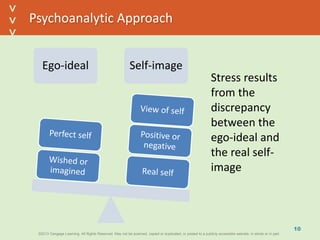
Ego-ideal Self-image
10
Stress results
from the
discrepancy
between the
ego-ideal and
the real self-
image
©2013 Cengage Learning. All Rights Reserved. May not be scanned, copied or duplicated, or posted to a publicly accessible website, in whole or in part.©2013 Cengage Learning. All Rights Reserved. May not be scanned, copied or duplicated, or posted to a publicly accessible website, in whole or in part.
^
^
The Stress Response
11
• Blood redirected from
the skin & internal
organs to brain and
large muscles
• Increased alertness:
improved vision,
hearing, & other sensory
responses
• Release of glucose &
fatty acids for
sustenance
• Depression of immune
system, digestion,
Release of
chemical
messengers,
primarily
adrenaline,
into the
bloodstream
Sympathetic
nervous system
and the
endocrine
(hormone)
system
activated
©2013 Cengage Learning. All Rights Reserved. May not be scanned, copied or duplicated, or posted to a publicly accessible website, in whole or in part.©2013 Cengage Learning. All Rights Reserved. May not be scanned, copied or duplicated, or posted to a publicly accessible website, in whole or in part.
^
^
12
©2013 Cengage Learning. All Rights Reserved. May not be scanned, copied or duplicated, or posted to a publicly accessible website, in whole or in part.©2013 Cengage Learning. All Rights Reserved. May not be scanned, copied or duplicated, or posted to a publicly accessible website, in whole or in part.
^
^
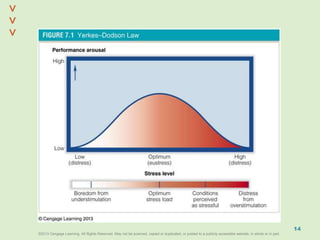
Consequences of Stress
• Eustress: healthy, normal stress
13
The benefits of
eustress must be
balanced against
the cost of
individual and
organizational
distress.
©2013 Cengage Learning. All Rights Reserved. May not be scanned, copied or duplicated, or posted to a publicly accessible website, in whole or in part.©2013 Cengage Learning. All Rights Reserved. May not be scanned, copied or duplicated, or posted to a publicly accessible website, in whole or in part.
^
^
14
©2013 Cengage Learning. All Rights Reserved. May not be scanned, copied or duplicated, or posted to a publicly accessible website, in whole or in part.©2013 Cengage Learning. All Rights Reserved. May not be scanned, copied or duplicated, or posted to a publicly accessible website, in whole or in part.
^
^
15
©2013 Cengage Learning. All Rights Reserved. May not be scanned, copied or duplicated, or posted to a publicly accessible website, in whole or in part.©2013 Cengage Learning. All Rights Reserved. May not be scanned, copied or duplicated, or posted to a publicly accessible website, in whole or in part.
^
^
Individual Distress
16
Work-related psychological disorders
(depression, burnout,
psychosomatic disorders)
©2013 Cengage Learning. All Rights Reserved. May not be scanned, copied or duplicated, or posted to a publicly accessible website, in whole or in part.©2013 Cengage Learning. All Rights Reserved. May not be scanned, copied or duplicated, or posted to a publicly accessible website, in whole or in part.
^
^
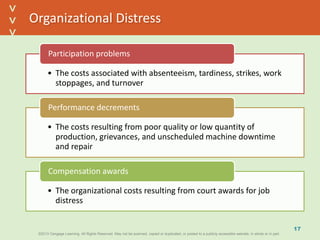
Organizational Distress
17
• The costs associated with absenteeism, tardiness, strikes, work
stoppages, and turnover
Participation problems
• The costs resulting from poor quality or low quantity of
production, grievances, and unscheduled machine downtime
and repair
Performance decrements
• The organizational costs resulting from court awards for job
distress
Compensation awards
©2013 Cengage Learning. All Rights Reserved. May not be scanned, copied or duplicated, or posted to a publicly accessible website, in whole or in part.©2013 Cengage Learning. All Rights Reserved. May not be scanned, copied or duplicated, or posted to a publicly accessible website, in whole or in part.
^
^
Gender-Related Stressors
• Men and women may have differences in
stressors and vulnerabilities, including
• Sexual harassment
• Fatal health problems for men
• Nonfatal, longer-term health problems for
women
18
©2013 Cengage Learning. All Rights Reserved. May not be scanned, copied or duplicated, or posted to a publicly accessible website, in whole or in part.©2013 Cengage Learning. All Rights Reserved. May not be scanned, copied or duplicated, or posted to a publicly accessible website, in whole or in part.
^
^
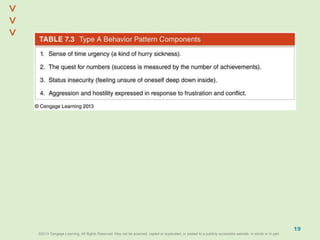
19
©2013 Cengage Learning. All Rights Reserved. May not be scanned, copied or duplicated, or posted to a publicly accessible website, in whole or in part.©2013 Cengage Learning. All Rights Reserved. May not be scanned, copied or duplicated, or posted to a publicly accessible website, in whole or in part.
^
^
Personality Hardiness
• Personality hardiness consists of
• Commitment
• Control
• Challenge
• The hardy personality engages in
transformational coping
• Actively changing an event into something less
subjectively stressful
20
©2013 Cengage Learning. All Rights Reserved. May not be scanned, copied or duplicated, or posted to a publicly accessible website, in whole or in part.©2013 Cengage Learning. All Rights Reserved. May not be scanned, copied or duplicated, or posted to a publicly accessible website, in whole or in part.
^
^
Self-Reliance
• Self-reliance: a personality attribute related
to how people form and maintain supportive
attachments with others
• Three patterns of attachment
• Self-reliance—healthy, secure, interdependent
• Counterdependence—unhealthy, draws inward
• Overdependence –unhealthy, clings to others
21
©2013 Cengage Learning. All Rights Reserved. May not be scanned, copied or duplicated, or posted to a publicly accessible website, in whole or in part.©2013 Cengage Learning. All Rights Reserved. May not be scanned, copied or duplicated, or posted to a publicly accessible website, in whole or in part.
^
^
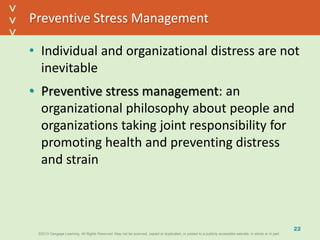
Preventive Stress Management
• Individual and organizational distress are not
inevitable
• Preventive stress management: an
organizational philosophy about people and
organizations taking joint responsibility for
promoting health and preventing distress
and strain
22
©2013 Cengage Learning. All Rights Reserved. May not be scanned, copied or duplicated, or posted to a publicly accessible website, in whole or in part.©2013 Cengage Learning. All Rights Reserved. May not be scanned, copied or duplicated, or posted to a publicly accessible website, in whole or in part.
^
^
Preventive Stress Management
Primary
prevention
• Reduce,
modify, or
eliminate the
source
Secondary
prevention
• Modify the
individual’s or
organization’s
response
Tertiary
prevention
• Heal
symptoms of
distress and
strain
23
©2013 Cengage Learning. All Rights Reserved. May not be scanned, copied or duplicated, or posted to a publicly accessible website, in whole or in part.©2013 Cengage Learning. All Rights Reserved. May not be scanned, copied or duplicated, or posted to a publicly accessible website, in whole or in part.
^
^
24
©2013 Cengage Learning. All Rights Reserved. May not be scanned, copied or duplicated, or posted to a publicly accessible website, in whole or in part.©2013 Cengage Learning. All Rights Reserved. May not be scanned, copied or duplicated, or posted to a publicly accessible website, in whole or in part.
^
^
Organizational Stress Prevention
• Primary prevention
• Job redesign
• Goal setting
• Role negotiation
• Career management
• Secondary prevention
• Team building
• Social support at work
25
©2013 Cengage Learning. All Rights Reserved. May not be scanned, copied or duplicated, or posted to a publicly accessible website, in whole or in part.©2013 Cengage Learning. All Rights Reserved. May not be scanned, copied or duplicated, or posted to a publicly accessible website, in whole or in part.
^
^
26
©2013 Cengage Learning. All Rights Reserved. May not be scanned, copied or duplicated, or posted to a publicly accessible website, in whole or in part.©2013 Cengage Learning. All Rights Reserved. May not be scanned, copied or duplicated, or posted to a publicly accessible website, in whole or in part.
^
^
27
©2013 Cengage Learning. All Rights Reserved. May not be scanned, copied or duplicated, or posted to a publicly accessible website, in whole or in part.©2013 Cengage Learning. All Rights Reserved. May not be scanned, copied or duplicated, or posted to a publicly accessible website, in whole or in part.
^
^
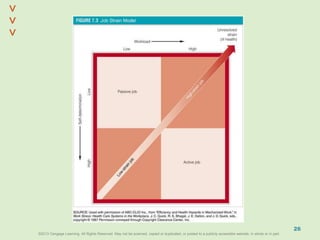
28
©2013 Cengage Learning. All Rights Reserved. May not be scanned, copied or duplicated, or posted to a publicly accessible website, in whole or in part.©2013 Cengage Learning. All Rights Reserved. May not be scanned, copied or duplicated, or posted to a publicly accessible website, in whole or in part.
^
^
Comprehensive Health Promotion
• Programs aimed at establishing a “strong
and resistant host” by building on individual
prevention and lifestyle change
• Physical fitness and exercise
• Organizational wellness
• Social and cognitive processes
29
©2013 Cengage Learning. All Rights Reserved. May not be scanned, copied or duplicated, or posted to a publicly accessible website, in whole or in part.©2013 Cengage Learning. All Rights Reserved. May not be scanned, copied or duplicated, or posted to a publicly accessible website, in whole or in part.
^
^
Managerial Implications
• Create healthy stress
• Adjust workloads
• Avoid ethical dilemmas
• Be sensitive to diversity
• Be sensitive to demands of personal life
• Help adjust to new technologies
• Be sensitive to early signs of distress
• Be aware of gender, personality, and behavioral
differences related to stress
• Use preventive stress management principles
30
©2013 Cengage Learning. All Rights Reserved. May not be scanned, copied or duplicated, or posted to a publicly accessible website, in whole or in part.©2013 Cengage Learning. All Rights Reserved. May not be scanned, copied or duplicated, or posted to a publicly accessible website, in whole or in part.
^
^
^
Chapter 7: Reflect & Discuss
The Upside of Anger Video Clip
• Separately assess the stressors affecting Terry and
Denny. View Part I for Terry and Part II for Denny.
• Are Terry and Denny having a distress or eustress
response? Give examples of behavior in the film
sequences to support your observations.
• Review the earlier section, “The Consequences of
Stress.” What consequences do you observe or
predict for Terry and Denny?
31

MBA 635 chapter 7

  • 1.
    ©2013 Cengage Learning.All Rights Reserved. May not be scanned, copied or duplicated, or posted to a publicly accessible website, in whole or in part. 7 ©2013 Cengage Learning. All Rights Reserved. May not be scanned, copied or duplicated, or posted to a publicly accessible website, in whole or in part. Stress and Well-Being at Work
  • 2.
    ©2013 Cengage Learning.All Rights Reserved. May not be scanned, copied or duplicated, or posted to a publicly accessible website, in whole or in part. Learning Objectives ©2013 Cengage Learning. All Rights Reserved. May not be scanned, copied or duplicated, or posted to a publicly accessible website, in whole or in part. 1 Define stress and distress. 2 Compare four different approaches to stress. 3 Explain the stress response. 4 Identify work and nonwork causes of stress. 5 Describe the benefits of eustress and the costs of distress. 2
  • 3.
    ©2013 Cengage Learning.All Rights Reserved. May not be scanned, copied or duplicated, or posted to a publicly accessible website, in whole or in part. Learning Objectives continued ©2013 Cengage Learning. All Rights Reserved. May not be scanned, copied or duplicated, or posted to a publicly accessible website, in whole or in part. 6 Discuss individual differences in the stress- strain relationship. 7 Distinguish the primary, secondary, and tertiary stages of preventive stress management. 8 Discuss organizational and individual methods of preventive stress management. 3
  • 4.
    ©2013 Cengage Learning.All Rights Reserved. May not be scanned, copied or duplicated, or posted to a publicly accessible website, in whole or in part.©2013 Cengage Learning. All Rights Reserved. May not be scanned, copied or duplicated, or posted to a publicly accessible website, in whole or in part. ^ ^ What Is Stress? Stress: the unconscious preparation to fight or flee that a person experiences when faced with any demand Stressor: the person or event that triggers the stress response Distress or strain: the adverse psychological, physical, behavioral, and organizational consequences that may occur as a result of stressful events 4
  • 5.
    ©2013 Cengage Learning.All Rights Reserved. May not be scanned, copied or duplicated, or posted to a publicly accessible website, in whole or in part.©2013 Cengage Learning. All Rights Reserved. May not be scanned, copied or duplicated, or posted to a publicly accessible website, in whole or in part. ^ ^ Four Approaches to Stress Homeostatic/ medical Cognitive appraisal Person- environment fit Psychoanalytic Stress 5
  • 6.
    ©2013 Cengage Learning.All Rights Reserved. May not be scanned, copied or duplicated, or posted to a publicly accessible website, in whole or in part.©2013 Cengage Learning. All Rights Reserved. May not be scanned, copied or duplicated, or posted to a publicly accessible website, in whole or in part. ^ ^ Homeostatic/Medical Approach • The fight or flight response • Stress results when an external, environmental demand upsets the natural steady-state balance • Homeostasis: a steady state of internal balance or equilibrium • The body is designed with natural defense mechanisms to keep it in homeostasis 6
  • 7.
    ©2013 Cengage Learning.All Rights Reserved. May not be scanned, copied or duplicated, or posted to a publicly accessible website, in whole or in part.©2013 Cengage Learning. All Rights Reserved. May not be scanned, copied or duplicated, or posted to a publicly accessible website, in whole or in part. ^ ^ Cognitive Appraisal Approach • Emphasizes the psychological and cognitive aspects of the stress response • Stress is the result of person-environment interaction • Individuals differ in their appraisal of events and people • Perception and cognitive appraisal determine what is stressful 7
  • 8.
    ©2013 Cengage Learning.All Rights Reserved. May not be scanned, copied or duplicated, or posted to a publicly accessible website, in whole or in part.©2013 Cengage Learning. All Rights Reserved. May not be scanned, copied or duplicated, or posted to a publicly accessible website, in whole or in part. ^ ^ Cognitive Appraisal Approach Problem- focused coping •Manage the stressor Emotion- focused coping •Manage your response 8
  • 9.
    ©2013 Cengage Learning.All Rights Reserved. May not be scanned, copied or duplicated, or posted to a publicly accessible website, in whole or in part.©2013 Cengage Learning. All Rights Reserved. May not be scanned, copied or duplicated, or posted to a publicly accessible website, in whole or in part. ^ ^ Person-Environment Fit Approach • Good person-environment fit: a person’s skills and abilities match a clearly defined, consistent set of role expectations • Stress, strain, and depression occur when • Role expectations are confusing and/or conflicting • Person’s skills and abilities do not meet the demands of the social role 9
  • 10.
    ©2013 Cengage Learning.All Rights Reserved. May not be scanned, copied or duplicated, or posted to a publicly accessible website, in whole or in part.©2013 Cengage Learning. All Rights Reserved. May not be scanned, copied or duplicated, or posted to a publicly accessible website, in whole or in part. ^ ^ Psychoanalytic Approach Ego-ideal Self-image 10 Stress results from the discrepancy between the ego-ideal and the real self- image
  • 11.
    ©2013 Cengage Learning.All Rights Reserved. May not be scanned, copied or duplicated, or posted to a publicly accessible website, in whole or in part.©2013 Cengage Learning. All Rights Reserved. May not be scanned, copied or duplicated, or posted to a publicly accessible website, in whole or in part. ^ ^ The Stress Response 11 • Blood redirected from the skin & internal organs to brain and large muscles • Increased alertness: improved vision, hearing, & other sensory responses • Release of glucose & fatty acids for sustenance • Depression of immune system, digestion, Release of chemical messengers, primarily adrenaline, into the bloodstream Sympathetic nervous system and the endocrine (hormone) system activated
  • 12.
    ©2013 Cengage Learning.All Rights Reserved. May not be scanned, copied or duplicated, or posted to a publicly accessible website, in whole or in part.©2013 Cengage Learning. All Rights Reserved. May not be scanned, copied or duplicated, or posted to a publicly accessible website, in whole or in part. ^ ^ 12
  • 13.
    ©2013 Cengage Learning.All Rights Reserved. May not be scanned, copied or duplicated, or posted to a publicly accessible website, in whole or in part.©2013 Cengage Learning. All Rights Reserved. May not be scanned, copied or duplicated, or posted to a publicly accessible website, in whole or in part. ^ ^ Consequences of Stress • Eustress: healthy, normal stress 13 The benefits of eustress must be balanced against the cost of individual and organizational distress.
  • 14.
    ©2013 Cengage Learning.All Rights Reserved. May not be scanned, copied or duplicated, or posted to a publicly accessible website, in whole or in part.©2013 Cengage Learning. All Rights Reserved. May not be scanned, copied or duplicated, or posted to a publicly accessible website, in whole or in part. ^ ^ 14
  • 15.
    ©2013 Cengage Learning.All Rights Reserved. May not be scanned, copied or duplicated, or posted to a publicly accessible website, in whole or in part.©2013 Cengage Learning. All Rights Reserved. May not be scanned, copied or duplicated, or posted to a publicly accessible website, in whole or in part. ^ ^ 15
  • 16.
    ©2013 Cengage Learning.All Rights Reserved. May not be scanned, copied or duplicated, or posted to a publicly accessible website, in whole or in part.©2013 Cengage Learning. All Rights Reserved. May not be scanned, copied or duplicated, or posted to a publicly accessible website, in whole or in part. ^ ^ Individual Distress 16 Work-related psychological disorders (depression, burnout, psychosomatic disorders)
  • 17.
    ©2013 Cengage Learning.All Rights Reserved. May not be scanned, copied or duplicated, or posted to a publicly accessible website, in whole or in part.©2013 Cengage Learning. All Rights Reserved. May not be scanned, copied or duplicated, or posted to a publicly accessible website, in whole or in part. ^ ^ Organizational Distress 17 • The costs associated with absenteeism, tardiness, strikes, work stoppages, and turnover Participation problems • The costs resulting from poor quality or low quantity of production, grievances, and unscheduled machine downtime and repair Performance decrements • The organizational costs resulting from court awards for job distress Compensation awards
  • 18.
    ©2013 Cengage Learning.All Rights Reserved. May not be scanned, copied or duplicated, or posted to a publicly accessible website, in whole or in part.©2013 Cengage Learning. All Rights Reserved. May not be scanned, copied or duplicated, or posted to a publicly accessible website, in whole or in part. ^ ^ Gender-Related Stressors • Men and women may have differences in stressors and vulnerabilities, including • Sexual harassment • Fatal health problems for men • Nonfatal, longer-term health problems for women 18
  • 19.
    ©2013 Cengage Learning.All Rights Reserved. May not be scanned, copied or duplicated, or posted to a publicly accessible website, in whole or in part.©2013 Cengage Learning. All Rights Reserved. May not be scanned, copied or duplicated, or posted to a publicly accessible website, in whole or in part. ^ ^ 19
  • 20.
    ©2013 Cengage Learning.All Rights Reserved. May not be scanned, copied or duplicated, or posted to a publicly accessible website, in whole or in part.©2013 Cengage Learning. All Rights Reserved. May not be scanned, copied or duplicated, or posted to a publicly accessible website, in whole or in part. ^ ^ Personality Hardiness • Personality hardiness consists of • Commitment • Control • Challenge • The hardy personality engages in transformational coping • Actively changing an event into something less subjectively stressful 20
  • 21.
    ©2013 Cengage Learning.All Rights Reserved. May not be scanned, copied or duplicated, or posted to a publicly accessible website, in whole or in part.©2013 Cengage Learning. All Rights Reserved. May not be scanned, copied or duplicated, or posted to a publicly accessible website, in whole or in part. ^ ^ Self-Reliance • Self-reliance: a personality attribute related to how people form and maintain supportive attachments with others • Three patterns of attachment • Self-reliance—healthy, secure, interdependent • Counterdependence—unhealthy, draws inward • Overdependence –unhealthy, clings to others 21
  • 22.
    ©2013 Cengage Learning.All Rights Reserved. May not be scanned, copied or duplicated, or posted to a publicly accessible website, in whole or in part.©2013 Cengage Learning. All Rights Reserved. May not be scanned, copied or duplicated, or posted to a publicly accessible website, in whole or in part. ^ ^ Preventive Stress Management • Individual and organizational distress are not inevitable • Preventive stress management: an organizational philosophy about people and organizations taking joint responsibility for promoting health and preventing distress and strain 22
  • 23.
    ©2013 Cengage Learning.All Rights Reserved. May not be scanned, copied or duplicated, or posted to a publicly accessible website, in whole or in part.©2013 Cengage Learning. All Rights Reserved. May not be scanned, copied or duplicated, or posted to a publicly accessible website, in whole or in part. ^ ^ Preventive Stress Management Primary prevention • Reduce, modify, or eliminate the source Secondary prevention • Modify the individual’s or organization’s response Tertiary prevention • Heal symptoms of distress and strain 23
  • 24.
    ©2013 Cengage Learning.All Rights Reserved. May not be scanned, copied or duplicated, or posted to a publicly accessible website, in whole or in part.©2013 Cengage Learning. All Rights Reserved. May not be scanned, copied or duplicated, or posted to a publicly accessible website, in whole or in part. ^ ^ 24
  • 25.
    ©2013 Cengage Learning.All Rights Reserved. May not be scanned, copied or duplicated, or posted to a publicly accessible website, in whole or in part.©2013 Cengage Learning. All Rights Reserved. May not be scanned, copied or duplicated, or posted to a publicly accessible website, in whole or in part. ^ ^ Organizational Stress Prevention • Primary prevention • Job redesign • Goal setting • Role negotiation • Career management • Secondary prevention • Team building • Social support at work 25
  • 26.
    ©2013 Cengage Learning.All Rights Reserved. May not be scanned, copied or duplicated, or posted to a publicly accessible website, in whole or in part.©2013 Cengage Learning. All Rights Reserved. May not be scanned, copied or duplicated, or posted to a publicly accessible website, in whole or in part. ^ ^ 26
  • 27.
    ©2013 Cengage Learning.All Rights Reserved. May not be scanned, copied or duplicated, or posted to a publicly accessible website, in whole or in part.©2013 Cengage Learning. All Rights Reserved. May not be scanned, copied or duplicated, or posted to a publicly accessible website, in whole or in part. ^ ^ 27
  • 28.
    ©2013 Cengage Learning.All Rights Reserved. May not be scanned, copied or duplicated, or posted to a publicly accessible website, in whole or in part.©2013 Cengage Learning. All Rights Reserved. May not be scanned, copied or duplicated, or posted to a publicly accessible website, in whole or in part. ^ ^ 28
  • 29.
    ©2013 Cengage Learning.All Rights Reserved. May not be scanned, copied or duplicated, or posted to a publicly accessible website, in whole or in part.©2013 Cengage Learning. All Rights Reserved. May not be scanned, copied or duplicated, or posted to a publicly accessible website, in whole or in part. ^ ^ Comprehensive Health Promotion • Programs aimed at establishing a “strong and resistant host” by building on individual prevention and lifestyle change • Physical fitness and exercise • Organizational wellness • Social and cognitive processes 29
  • 30.
    ©2013 Cengage Learning.All Rights Reserved. May not be scanned, copied or duplicated, or posted to a publicly accessible website, in whole or in part.©2013 Cengage Learning. All Rights Reserved. May not be scanned, copied or duplicated, or posted to a publicly accessible website, in whole or in part. ^ ^ Managerial Implications • Create healthy stress • Adjust workloads • Avoid ethical dilemmas • Be sensitive to diversity • Be sensitive to demands of personal life • Help adjust to new technologies • Be sensitive to early signs of distress • Be aware of gender, personality, and behavioral differences related to stress • Use preventive stress management principles 30
  • 31.
    ©2013 Cengage Learning.All Rights Reserved. May not be scanned, copied or duplicated, or posted to a publicly accessible website, in whole or in part.©2013 Cengage Learning. All Rights Reserved. May not be scanned, copied or duplicated, or posted to a publicly accessible website, in whole or in part. ^ ^ ^ Chapter 7: Reflect & Discuss The Upside of Anger Video Clip • Separately assess the stressors affecting Terry and Denny. View Part I for Terry and Part II for Denny. • Are Terry and Denny having a distress or eustress response? Give examples of behavior in the film sequences to support your observations. • Review the earlier section, “The Consequences of Stress.” What consequences do you observe or predict for Terry and Denny? 31