©2013 Cengage Learning. All Rights Reserved. May not be scanned, copied or duplicated, or posted to a publicly accessible website, in whole or in part.
8
©2013 Cengage Learning. All Rights Reserved.
May not be scanned, copied or duplicated, or posted to a publicly accessible website, in whole or in
part.
Communication
©2013 Cengage Learning. All Rights Reserved. May not be scanned, copied or duplicated, or posted to a publicly accessible website, in whole or in part.
Learning Objectives
©2013 Cengage Learning. All Rights Reserved. May not be scanned, copied or duplicated, or posted to a publicly accessible website, in whole or in part.
1 Understand the roles of the communicator,
the receiver, perceptual screens, and the
message in interpersonal communication.
2 Practice good reflective listening skills.
3 Describe the five communication keys of
effective supervisors.
4 Explain five communication barriers and
gateways through them.
2
©2013 Cengage Learning. All Rights Reserved. May not be scanned, copied or duplicated, or posted to a publicly accessible website, in whole or in part.
Learning Objectives continued
©2013 Cengage Learning. All Rights Reserved. May not be scanned, copied or duplicated, or posted to a publicly accessible website, in whole or in part.
5 Distinguish between civility and incivility,
defensive and nondefensive
communication.
6 Explain positive, healthy communication.
7 Describe Information Communication
Technology (ICT) used by managers.
3
©2013 Cengage Learning. All Rights Reserved. May not be scanned, copied or duplicated, or posted to a publicly accessible website, in whole or in part.©2013 Cengage Learning. All Rights Reserved. May not be scanned, copied or duplicated, or posted to a publicly accessible website, in whole or in part.
^
^
Communication Defined
Communication: the evoking of a shared or
common meaning in another person
Interpersonal communication: communication
between two or more people in an
organization
4
©2013 Cengage Learning. All Rights Reserved. May not be scanned, copied or duplicated, or posted to a publicly accessible website, in whole or in part.©2013 Cengage Learning. All Rights Reserved. May not be scanned, copied or duplicated, or posted to a publicly accessible website, in whole or in part.
^
^
5
©2013 Cengage Learning. All Rights Reserved. May not be scanned, copied or duplicated, or posted to a publicly accessible website, in whole or in part.©2013 Cengage Learning. All Rights Reserved. May not be scanned, copied or duplicated, or posted to a publicly accessible website, in whole or in part.
^
^
Elements of the Communication Model
Communicator – the person originating the
message
Receiver – the person receiving a message
Perceptual Screen – windows through which we
interact with people that influence the quality,
accuracy, and clarity of the communication
Message – the thoughts and feelings that the
communicator is attempting to elicit in the
receiver
6
©2013 Cengage Learning. All Rights Reserved. May not be scanned, copied or duplicated, or posted to a publicly accessible website, in whole or in part.©2013 Cengage Learning. All Rights Reserved. May not be scanned, copied or duplicated, or posted to a publicly accessible website, in whole or in part.
^
^
Elements of the Communication Model
Feedback – information fed back that completes two-
way communication
Language – the words, their pronunciation, and the
methods of combining them used and understood by a
group of people
Data – uninterrupted and unanalyzed facts
Information – data that have been interpreted,
analyzed, and have meaning to some user
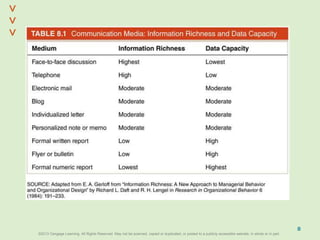
Richness – the ability of a medium or channel to elicit
or evoke meaning in the receiver
7
©2013 Cengage Learning. All Rights Reserved. May not be scanned, copied or duplicated, or posted to a publicly accessible website, in whole or in part.©2013 Cengage Learning. All Rights Reserved. May not be scanned, copied or duplicated, or posted to a publicly accessible website, in whole or in part.
^
^
8
©2013 Cengage Learning. All Rights Reserved. May not be scanned, copied or duplicated, or posted to a publicly accessible website, in whole or in part.©2013 Cengage Learning. All Rights Reserved. May not be scanned, copied or duplicated, or posted to a publicly accessible website, in whole or in part.
^
^
Reflective Listening
• The skill of carefully listening to another
person and repeating back to the speaker
the message heard to correct inaccuracies or
misunderstandings
• Personal
• Feeling-oriented
• Responsive
9
©2013 Cengage Learning. All Rights Reserved. May not be scanned, copied or duplicated, or posted to a publicly accessible website, in whole or in part.©2013 Cengage Learning. All Rights Reserved. May not be scanned, copied or duplicated, or posted to a publicly accessible website, in whole or in part.
^
^
Levels of Verbal Response
Affirming contact
Paraphrasing expressed
thoughts and feelings
Clarifying implicit thoughts and
feelings
Reflecting core feelings not fully
expressed
10
©2013 Cengage Learning. All Rights Reserved. May not be scanned, copied or duplicated, or posted to a publicly accessible website, in whole or in part.©2013 Cengage Learning. All Rights Reserved. May not be scanned, copied or duplicated, or posted to a publicly accessible website, in whole or in part.
^
^
Levels of Verbal Response
11
Affirm contact
• Communicates
attentiveness
• Provides reassurance in
expressing thoughts and
feelings
Paraphrase
• Reflects back to speaker
what has been heard;
assures accuracy
• Builds empathy,
openness, acceptance
Clarify the implicit
• Bring out unspoken (but
evident) thoughts and
feelings
• Builds greater
awareness
Reflect “core” feelings
• Restate important
thoughts and feelings
• Exercise caution; danger
of overreaching
©2013 Cengage Learning. All Rights Reserved. May not be scanned, copied or duplicated, or posted to a publicly accessible website, in whole or in part.©2013 Cengage Learning. All Rights Reserved. May not be scanned, copied or duplicated, or posted to a publicly accessible website, in whole or in part.
^
^
Nonverbal Elements in Reflective Listening
• Silence can help both speaker and listener in
reflective listening
• Eye contact may open up a relationship and
improve communication
12
©2013 Cengage Learning. All Rights Reserved. May not be scanned, copied or duplicated, or posted to a publicly accessible website, in whole or in part.©2013 Cengage Learning. All Rights Reserved. May not be scanned, copied or duplicated, or posted to a publicly accessible website, in whole or in part.
^
^
One-Way versus Two-Way
• Reflective listening encourages two-way
communication
• Two-way communication: an interactive form of
communication in which thoughts, feelings, or both
are exchanged and through which shared meaning
often occurs
• Problem solving
• Decision making
• One-way communication: a communication situation
in which a message is not followed by feedback,
questions, or interaction
• Instructions
• Directions
13
©2013 Cengage Learning. All Rights Reserved. May not be scanned, copied or duplicated, or posted to a publicly accessible website, in whole or in part.©2013 Cengage Learning. All Rights Reserved. May not be scanned, copied or duplicated, or posted to a publicly accessible website, in whole or in part.
^
^
Five Keys to Effective Supervisory Communication
Good supervisors are
• Expressive speakers
• Empathetic listeners
• Persuasive leaders
• Sensitive to employees’ feelings
• Informative managers
14
©2013 Cengage Learning. All Rights Reserved. May not be scanned, copied or duplicated, or posted to a publicly accessible website, in whole or in part.©2013 Cengage Learning. All Rights Reserved. May not be scanned, copied or duplicated, or posted to a publicly accessible website, in whole or in part.
^
^
Barriers to Communication
Barriers to communication—factors that block
or distort successful communication
• Physical separation
• Status differences
• Gender differences
• Cultural diversity
• Language
15
©2013 Cengage Learning. All Rights Reserved. May not be scanned, copied or duplicated, or posted to a publicly accessible website, in whole or in part.©2013 Cengage Learning. All Rights Reserved. May not be scanned, copied or duplicated, or posted to a publicly accessible website, in whole or in part.
^
^
Gateways to Communication
Pathways through communication barriers
16
Physical
separation
Face-to-face
communication
Regular
meetings
Status
differences
Supervisory
skills
Employee
security
Gender
differences
Awareness of
differences
Clarify meaning
Cultural
diversity
Increase
awareness
Cultural
metaphors
©2013 Cengage Learning. All Rights Reserved. May not be scanned, copied or duplicated, or posted to a publicly accessible website, in whole or in part.©2013 Cengage Learning. All Rights Reserved. May not be scanned, copied or duplicated, or posted to a publicly accessible website, in whole or in part.
^
^
Civility and Incivility
• Civility: communication and behavior that
respects the integrity and dignity of the
individual
• Nondefensive communication—assertive,
controlled, informative, realistic, honest
• Incivility: discourteous communication and
rude behavior that is disrespectful, hurtful,
or injurious
• Defensive communication—aggressive,
attacking, angry, passive, withdrawing
17
©2013 Cengage Learning. All Rights Reserved. May not be scanned, copied or duplicated, or posted to a publicly accessible website, in whole or in part.©2013 Cengage Learning. All Rights Reserved. May not be scanned, copied or duplicated, or posted to a publicly accessible website, in whole or in part.
^
^
Steps in Nondefensive Communication
18
Define the situation
Clarify the person’s position
Acknowledge the person’s
feelings
Bring the focus back to the facts
©2013 Cengage Learning. All Rights Reserved. May not be scanned, copied or duplicated, or posted to a publicly accessible website, in whole or in part.©2013 Cengage Learning. All Rights Reserved. May not be scanned, copied or duplicated, or posted to a publicly accessible website, in whole or in part.
^
^
Defensive Communication at Work
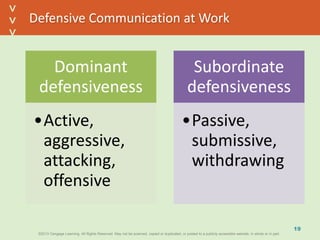
Dominant
defensiveness
•Active,
aggressive,
attacking,
offensive
Subordinate
defensiveness
•Passive,
submissive,
withdrawing
19
©2013 Cengage Learning. All Rights Reserved. May not be scanned, copied or duplicated, or posted to a publicly accessible website, in whole or in part.©2013 Cengage Learning. All Rights Reserved. May not be scanned, copied or duplicated, or posted to a publicly accessible website, in whole or in part.
^
^
20
©2013 Cengage Learning. All Rights Reserved. May not be scanned, copied or duplicated, or posted to a publicly accessible website, in whole or in part.©2013 Cengage Learning. All Rights Reserved. May not be scanned, copied or duplicated, or posted to a publicly accessible website, in whole or in part.
^
^
Nonverbal Communication
Nonverbal communication: all elements of
communication, such as gestures and the use
of space, that do not involve words or
language
21
Nonverbal
Proxemics
Kinesics
Facial and
eye
Paralanguage
©2013 Cengage Learning. All Rights Reserved. May not be scanned, copied or duplicated, or posted to a publicly accessible website, in whole or in part.©2013 Cengage Learning. All Rights Reserved. May not be scanned, copied or duplicated, or posted to a publicly accessible website, in whole or in part.
^
^
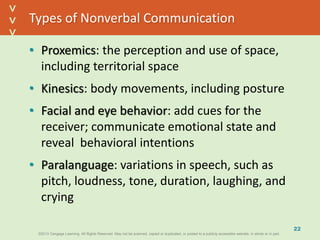
Types of Nonverbal Communication
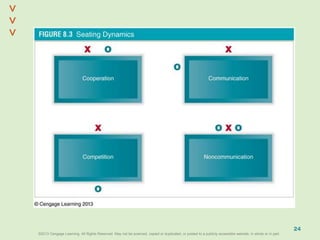
• Proxemics: the perception and use of space,
including territorial space
• Kinesics: body movements, including posture
• Facial and eye behavior: add cues for the
receiver; communicate emotional state and
reveal behavioral intentions
• Paralanguage: variations in speech, such as
pitch, loudness, tone, duration, laughing, and
crying
22
©2013 Cengage Learning. All Rights Reserved. May not be scanned, copied or duplicated, or posted to a publicly accessible website, in whole or in part.©2013 Cengage Learning. All Rights Reserved. May not be scanned, copied or duplicated, or posted to a publicly accessible website, in whole or in part.
^
^
23
©2013 Cengage Learning. All Rights Reserved. May not be scanned, copied or duplicated, or posted to a publicly accessible website, in whole or in part.©2013 Cengage Learning. All Rights Reserved. May not be scanned, copied or duplicated, or posted to a publicly accessible website, in whole or in part.
^
^
24
©2013 Cengage Learning. All Rights Reserved. May not be scanned, copied or duplicated, or posted to a publicly accessible website, in whole or in part.©2013 Cengage Learning. All Rights Reserved. May not be scanned, copied or duplicated, or posted to a publicly accessible website, in whole or in part.
^
^
25
©2013 Cengage Learning. All Rights Reserved. May not be scanned, copied or duplicated, or posted to a publicly accessible website, in whole or in part.©2013 Cengage Learning. All Rights Reserved. May not be scanned, copied or duplicated, or posted to a publicly accessible website, in whole or in part.
^
^
Positive, Healthy Communication
• Communicative disease: the absence of
heartfelt communication in human
relationships, leading to loneliness and
social isolation
• Healthy communication involves
• Positive emotional competence
• Healthy internal dialogue between thoughts,
feelings, ideas, and emotions
• Trust and truthfulness
26
©2013 Cengage Learning. All Rights Reserved. May not be scanned, copied or duplicated, or posted to a publicly accessible website, in whole or in part.©2013 Cengage Learning. All Rights Reserved. May not be scanned, copied or duplicated, or posted to a publicly accessible website, in whole or in part.
^
^
Information Communication Technology
• ICT accelerates the exchange of information across
geographic boundaries and time zones
• Impersonal nature may diminish interpersonal skills
• Absence of nonverbal cues makes it difficult to assess
emotional element
• Equalizes participation in groups
• Increases potential for overload
• Leads to impatience in face-to-face communication
• May result in unmet social needs
27
©2013 Cengage Learning. All Rights Reserved. May not be scanned, copied or duplicated, or posted to a publicly accessible website, in whole or in part.©2013 Cengage Learning. All Rights Reserved. May not be scanned, copied or duplicated, or posted to a publicly accessible website, in whole or in part.
^
^
28
©2013 Cengage Learning. All Rights Reserved. May not be scanned, copied or duplicated, or posted to a publicly accessible website, in whole or in part.©2013 Cengage Learning. All Rights Reserved. May not be scanned, copied or duplicated, or posted to a publicly accessible website, in whole or in part.
^
^
^
Chapter 8: Reflect & Discuss
Friday Night Lights Video Clip
• This chapter defines communication as creating “a
shared or common meaning in another person.” Do
you perceive Coach Gaines as having reached that
communication goal? Why or why not?
• This chapter described an Interpersonal
Communication Model. What are examples from this
film sequence of each part of the model?
• Assess the effectiveness of this communication
event. How do you expect team members and the
assistant coaches to react in the second half of the
game?
29

MBA 635 chapter 8

  • 1.
    ©2013 Cengage Learning.All Rights Reserved. May not be scanned, copied or duplicated, or posted to a publicly accessible website, in whole or in part. 8 ©2013 Cengage Learning. All Rights Reserved. May not be scanned, copied or duplicated, or posted to a publicly accessible website, in whole or in part. Communication
  • 2.
    ©2013 Cengage Learning.All Rights Reserved. May not be scanned, copied or duplicated, or posted to a publicly accessible website, in whole or in part. Learning Objectives ©2013 Cengage Learning. All Rights Reserved. May not be scanned, copied or duplicated, or posted to a publicly accessible website, in whole or in part. 1 Understand the roles of the communicator, the receiver, perceptual screens, and the message in interpersonal communication. 2 Practice good reflective listening skills. 3 Describe the five communication keys of effective supervisors. 4 Explain five communication barriers and gateways through them. 2
  • 3.
    ©2013 Cengage Learning.All Rights Reserved. May not be scanned, copied or duplicated, or posted to a publicly accessible website, in whole or in part. Learning Objectives continued ©2013 Cengage Learning. All Rights Reserved. May not be scanned, copied or duplicated, or posted to a publicly accessible website, in whole or in part. 5 Distinguish between civility and incivility, defensive and nondefensive communication. 6 Explain positive, healthy communication. 7 Describe Information Communication Technology (ICT) used by managers. 3
  • 4.
    ©2013 Cengage Learning.All Rights Reserved. May not be scanned, copied or duplicated, or posted to a publicly accessible website, in whole or in part.©2013 Cengage Learning. All Rights Reserved. May not be scanned, copied or duplicated, or posted to a publicly accessible website, in whole or in part. ^ ^ Communication Defined Communication: the evoking of a shared or common meaning in another person Interpersonal communication: communication between two or more people in an organization 4
  • 5.
    ©2013 Cengage Learning.All Rights Reserved. May not be scanned, copied or duplicated, or posted to a publicly accessible website, in whole or in part.©2013 Cengage Learning. All Rights Reserved. May not be scanned, copied or duplicated, or posted to a publicly accessible website, in whole or in part. ^ ^ 5
  • 6.
    ©2013 Cengage Learning.All Rights Reserved. May not be scanned, copied or duplicated, or posted to a publicly accessible website, in whole or in part.©2013 Cengage Learning. All Rights Reserved. May not be scanned, copied or duplicated, or posted to a publicly accessible website, in whole or in part. ^ ^ Elements of the Communication Model Communicator – the person originating the message Receiver – the person receiving a message Perceptual Screen – windows through which we interact with people that influence the quality, accuracy, and clarity of the communication Message – the thoughts and feelings that the communicator is attempting to elicit in the receiver 6
  • 7.
    ©2013 Cengage Learning.All Rights Reserved. May not be scanned, copied or duplicated, or posted to a publicly accessible website, in whole or in part.©2013 Cengage Learning. All Rights Reserved. May not be scanned, copied or duplicated, or posted to a publicly accessible website, in whole or in part. ^ ^ Elements of the Communication Model Feedback – information fed back that completes two- way communication Language – the words, their pronunciation, and the methods of combining them used and understood by a group of people Data – uninterrupted and unanalyzed facts Information – data that have been interpreted, analyzed, and have meaning to some user Richness – the ability of a medium or channel to elicit or evoke meaning in the receiver 7
  • 8.
    ©2013 Cengage Learning.All Rights Reserved. May not be scanned, copied or duplicated, or posted to a publicly accessible website, in whole or in part.©2013 Cengage Learning. All Rights Reserved. May not be scanned, copied or duplicated, or posted to a publicly accessible website, in whole or in part. ^ ^ 8
  • 9.
    ©2013 Cengage Learning.All Rights Reserved. May not be scanned, copied or duplicated, or posted to a publicly accessible website, in whole or in part.©2013 Cengage Learning. All Rights Reserved. May not be scanned, copied or duplicated, or posted to a publicly accessible website, in whole or in part. ^ ^ Reflective Listening • The skill of carefully listening to another person and repeating back to the speaker the message heard to correct inaccuracies or misunderstandings • Personal • Feeling-oriented • Responsive 9
  • 10.
    ©2013 Cengage Learning.All Rights Reserved. May not be scanned, copied or duplicated, or posted to a publicly accessible website, in whole or in part.©2013 Cengage Learning. All Rights Reserved. May not be scanned, copied or duplicated, or posted to a publicly accessible website, in whole or in part. ^ ^ Levels of Verbal Response Affirming contact Paraphrasing expressed thoughts and feelings Clarifying implicit thoughts and feelings Reflecting core feelings not fully expressed 10
  • 11.
    ©2013 Cengage Learning.All Rights Reserved. May not be scanned, copied or duplicated, or posted to a publicly accessible website, in whole or in part.©2013 Cengage Learning. All Rights Reserved. May not be scanned, copied or duplicated, or posted to a publicly accessible website, in whole or in part. ^ ^ Levels of Verbal Response 11 Affirm contact • Communicates attentiveness • Provides reassurance in expressing thoughts and feelings Paraphrase • Reflects back to speaker what has been heard; assures accuracy • Builds empathy, openness, acceptance Clarify the implicit • Bring out unspoken (but evident) thoughts and feelings • Builds greater awareness Reflect “core” feelings • Restate important thoughts and feelings • Exercise caution; danger of overreaching
  • 12.
    ©2013 Cengage Learning.All Rights Reserved. May not be scanned, copied or duplicated, or posted to a publicly accessible website, in whole or in part.©2013 Cengage Learning. All Rights Reserved. May not be scanned, copied or duplicated, or posted to a publicly accessible website, in whole or in part. ^ ^ Nonverbal Elements in Reflective Listening • Silence can help both speaker and listener in reflective listening • Eye contact may open up a relationship and improve communication 12
  • 13.
    ©2013 Cengage Learning.All Rights Reserved. May not be scanned, copied or duplicated, or posted to a publicly accessible website, in whole or in part.©2013 Cengage Learning. All Rights Reserved. May not be scanned, copied or duplicated, or posted to a publicly accessible website, in whole or in part. ^ ^ One-Way versus Two-Way • Reflective listening encourages two-way communication • Two-way communication: an interactive form of communication in which thoughts, feelings, or both are exchanged and through which shared meaning often occurs • Problem solving • Decision making • One-way communication: a communication situation in which a message is not followed by feedback, questions, or interaction • Instructions • Directions 13
  • 14.
    ©2013 Cengage Learning.All Rights Reserved. May not be scanned, copied or duplicated, or posted to a publicly accessible website, in whole or in part.©2013 Cengage Learning. All Rights Reserved. May not be scanned, copied or duplicated, or posted to a publicly accessible website, in whole or in part. ^ ^ Five Keys to Effective Supervisory Communication Good supervisors are • Expressive speakers • Empathetic listeners • Persuasive leaders • Sensitive to employees’ feelings • Informative managers 14
  • 15.
    ©2013 Cengage Learning.All Rights Reserved. May not be scanned, copied or duplicated, or posted to a publicly accessible website, in whole or in part.©2013 Cengage Learning. All Rights Reserved. May not be scanned, copied or duplicated, or posted to a publicly accessible website, in whole or in part. ^ ^ Barriers to Communication Barriers to communication—factors that block or distort successful communication • Physical separation • Status differences • Gender differences • Cultural diversity • Language 15
  • 16.
    ©2013 Cengage Learning.All Rights Reserved. May not be scanned, copied or duplicated, or posted to a publicly accessible website, in whole or in part.©2013 Cengage Learning. All Rights Reserved. May not be scanned, copied or duplicated, or posted to a publicly accessible website, in whole or in part. ^ ^ Gateways to Communication Pathways through communication barriers 16 Physical separation Face-to-face communication Regular meetings Status differences Supervisory skills Employee security Gender differences Awareness of differences Clarify meaning Cultural diversity Increase awareness Cultural metaphors
  • 17.
    ©2013 Cengage Learning.All Rights Reserved. May not be scanned, copied or duplicated, or posted to a publicly accessible website, in whole or in part.©2013 Cengage Learning. All Rights Reserved. May not be scanned, copied or duplicated, or posted to a publicly accessible website, in whole or in part. ^ ^ Civility and Incivility • Civility: communication and behavior that respects the integrity and dignity of the individual • Nondefensive communication—assertive, controlled, informative, realistic, honest • Incivility: discourteous communication and rude behavior that is disrespectful, hurtful, or injurious • Defensive communication—aggressive, attacking, angry, passive, withdrawing 17
  • 18.
    ©2013 Cengage Learning.All Rights Reserved. May not be scanned, copied or duplicated, or posted to a publicly accessible website, in whole or in part.©2013 Cengage Learning. All Rights Reserved. May not be scanned, copied or duplicated, or posted to a publicly accessible website, in whole or in part. ^ ^ Steps in Nondefensive Communication 18 Define the situation Clarify the person’s position Acknowledge the person’s feelings Bring the focus back to the facts
  • 19.
    ©2013 Cengage Learning.All Rights Reserved. May not be scanned, copied or duplicated, or posted to a publicly accessible website, in whole or in part.©2013 Cengage Learning. All Rights Reserved. May not be scanned, copied or duplicated, or posted to a publicly accessible website, in whole or in part. ^ ^ Defensive Communication at Work Dominant defensiveness •Active, aggressive, attacking, offensive Subordinate defensiveness •Passive, submissive, withdrawing 19
  • 20.
    ©2013 Cengage Learning.All Rights Reserved. May not be scanned, copied or duplicated, or posted to a publicly accessible website, in whole or in part.©2013 Cengage Learning. All Rights Reserved. May not be scanned, copied or duplicated, or posted to a publicly accessible website, in whole or in part. ^ ^ 20
  • 21.
    ©2013 Cengage Learning.All Rights Reserved. May not be scanned, copied or duplicated, or posted to a publicly accessible website, in whole or in part.©2013 Cengage Learning. All Rights Reserved. May not be scanned, copied or duplicated, or posted to a publicly accessible website, in whole or in part. ^ ^ Nonverbal Communication Nonverbal communication: all elements of communication, such as gestures and the use of space, that do not involve words or language 21 Nonverbal Proxemics Kinesics Facial and eye Paralanguage
  • 22.
    ©2013 Cengage Learning.All Rights Reserved. May not be scanned, copied or duplicated, or posted to a publicly accessible website, in whole or in part.©2013 Cengage Learning. All Rights Reserved. May not be scanned, copied or duplicated, or posted to a publicly accessible website, in whole or in part. ^ ^ Types of Nonverbal Communication • Proxemics: the perception and use of space, including territorial space • Kinesics: body movements, including posture • Facial and eye behavior: add cues for the receiver; communicate emotional state and reveal behavioral intentions • Paralanguage: variations in speech, such as pitch, loudness, tone, duration, laughing, and crying 22
  • 23.
    ©2013 Cengage Learning.All Rights Reserved. May not be scanned, copied or duplicated, or posted to a publicly accessible website, in whole or in part.©2013 Cengage Learning. All Rights Reserved. May not be scanned, copied or duplicated, or posted to a publicly accessible website, in whole or in part. ^ ^ 23
  • 24.
    ©2013 Cengage Learning.All Rights Reserved. May not be scanned, copied or duplicated, or posted to a publicly accessible website, in whole or in part.©2013 Cengage Learning. All Rights Reserved. May not be scanned, copied or duplicated, or posted to a publicly accessible website, in whole or in part. ^ ^ 24
  • 25.
    ©2013 Cengage Learning.All Rights Reserved. May not be scanned, copied or duplicated, or posted to a publicly accessible website, in whole or in part.©2013 Cengage Learning. All Rights Reserved. May not be scanned, copied or duplicated, or posted to a publicly accessible website, in whole or in part. ^ ^ 25
  • 26.
    ©2013 Cengage Learning.All Rights Reserved. May not be scanned, copied or duplicated, or posted to a publicly accessible website, in whole or in part.©2013 Cengage Learning. All Rights Reserved. May not be scanned, copied or duplicated, or posted to a publicly accessible website, in whole or in part. ^ ^ Positive, Healthy Communication • Communicative disease: the absence of heartfelt communication in human relationships, leading to loneliness and social isolation • Healthy communication involves • Positive emotional competence • Healthy internal dialogue between thoughts, feelings, ideas, and emotions • Trust and truthfulness 26
  • 27.
    ©2013 Cengage Learning.All Rights Reserved. May not be scanned, copied or duplicated, or posted to a publicly accessible website, in whole or in part.©2013 Cengage Learning. All Rights Reserved. May not be scanned, copied or duplicated, or posted to a publicly accessible website, in whole or in part. ^ ^ Information Communication Technology • ICT accelerates the exchange of information across geographic boundaries and time zones • Impersonal nature may diminish interpersonal skills • Absence of nonverbal cues makes it difficult to assess emotional element • Equalizes participation in groups • Increases potential for overload • Leads to impatience in face-to-face communication • May result in unmet social needs 27
  • 28.
    ©2013 Cengage Learning.All Rights Reserved. May not be scanned, copied or duplicated, or posted to a publicly accessible website, in whole or in part.©2013 Cengage Learning. All Rights Reserved. May not be scanned, copied or duplicated, or posted to a publicly accessible website, in whole or in part. ^ ^ 28
  • 29.
    ©2013 Cengage Learning.All Rights Reserved. May not be scanned, copied or duplicated, or posted to a publicly accessible website, in whole or in part.©2013 Cengage Learning. All Rights Reserved. May not be scanned, copied or duplicated, or posted to a publicly accessible website, in whole or in part. ^ ^ ^ Chapter 8: Reflect & Discuss Friday Night Lights Video Clip • This chapter defines communication as creating “a shared or common meaning in another person.” Do you perceive Coach Gaines as having reached that communication goal? Why or why not? • This chapter described an Interpersonal Communication Model. What are examples from this film sequence of each part of the model? • Assess the effectiveness of this communication event. How do you expect team members and the assistant coaches to react in the second half of the game? 29