©2013 Cengage Learning. All Rights Reserved. May not be scanned, copied or duplicated, or posted to a publicly accessible website, in whole or in part.
15
©2013 Cengage Learning. All Rights Reserved.
May not be scanned, copied or duplicated, or posted to a publicly accessible website, in whole or in
part.
Organizational
Design and
Structure
©2013 Cengage Learning. All Rights Reserved. May not be scanned, copied or duplicated, or posted to a publicly accessible website, in whole or in part.
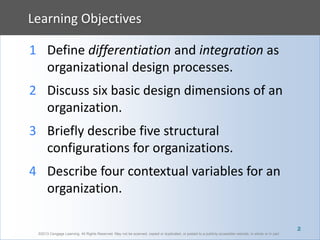
Learning Objectives
©2013 Cengage Learning. All Rights Reserved. May not be scanned, copied or duplicated, or posted to a publicly accessible website, in whole or in part.
1 Define differentiation and integration as
organizational design processes.
2 Discuss six basic design dimensions of an
organization.
3 Briefly describe five structural
configurations for organizations.
4 Describe four contextual variables for an
organization.
2
©2013 Cengage Learning. All Rights Reserved. May not be scanned, copied or duplicated, or posted to a publicly accessible website, in whole or in part.
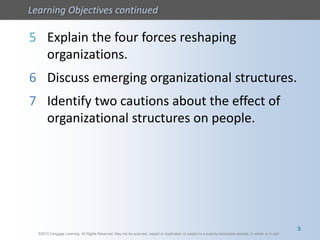
Learning Objectives continued
©2013 Cengage Learning. All Rights Reserved. May not be scanned, copied or duplicated, or posted to a publicly accessible website, in whole or in part.
5 Explain the four forces reshaping
organizations.
6 Discuss emerging organizational structures.
7 Identify two cautions about the effect of
organizational structures on people.
3
©2013 Cengage Learning. All Rights Reserved. May not be scanned, copied or duplicated, or posted to a publicly accessible website, in whole or in part.©2013 Cengage Learning. All Rights Reserved. May not be scanned, copied or duplicated, or posted to a publicly accessible website, in whole or in part.
^
^
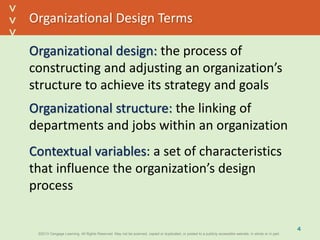
Organizational Design Terms
Organizational design: the process of
constructing and adjusting an organization’s
structure to achieve its strategy and goals
Organizational structure: the linking of
departments and jobs within an organization
Contextual variables: a set of characteristics
that influence the organization’s design
process
4
©2013 Cengage Learning. All Rights Reserved. May not be scanned, copied or duplicated, or posted to a publicly accessible website, in whole or in part.©2013 Cengage Learning. All Rights Reserved. May not be scanned, copied or duplicated, or posted to a publicly accessible website, in whole or in part.
^
^
Differentiation and Integration
Differentiation Integration
Successful
organizational
design
5
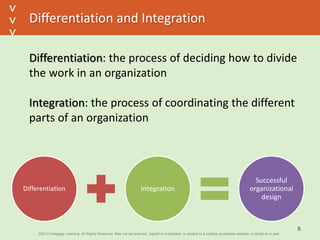
Differentiation: the process of deciding how to divide
the work in an organization
Integration: the process of coordinating the different
parts of an organization
©2013 Cengage Learning. All Rights Reserved. May not be scanned, copied or duplicated, or posted to a publicly accessible website, in whole or in part.©2013 Cengage Learning. All Rights Reserved. May not be scanned, copied or duplicated, or posted to a publicly accessible website, in whole or in part.
^
^
6
©2013 Cengage Learning. All Rights Reserved. May not be scanned, copied or duplicated, or posted to a publicly accessible website, in whole or in part.©2013 Cengage Learning. All Rights Reserved. May not be scanned, copied or duplicated, or posted to a publicly accessible website, in whole or in part.
^
^
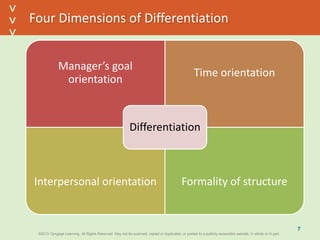
Four Dimensions of Differentiation
Manager’s goal
orientation
Time orientation
Interpersonal orientation Formality of structure
Differentiation
7
©2013 Cengage Learning. All Rights Reserved. May not be scanned, copied or duplicated, or posted to a publicly accessible website, in whole or in part.©2013 Cengage Learning. All Rights Reserved. May not be scanned, copied or duplicated, or posted to a publicly accessible website, in whole or in part.
^
^
8
©2013 Cengage Learning. All Rights Reserved. May not be scanned, copied or duplicated, or posted to a publicly accessible website, in whole or in part.©2013 Cengage Learning. All Rights Reserved. May not be scanned, copied or duplicated, or posted to a publicly accessible website, in whole or in part.
^
^
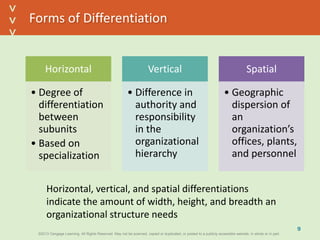
Forms of Differentiation
Horizontal
‱ Degree of
differentiation
between
subunits
‱ Based on
specialization
Vertical
‱ Difference in
authority and
responsibility
in the
organizational
hierarchy
Spatial
‱ Geographic
dispersion of
an
organization’s
offices, plants,
and personnel
9
Horizontal, vertical, and spatial differentiations
indicate the amount of width, height, and breadth an
organizational structure needs
©2013 Cengage Learning. All Rights Reserved. May not be scanned, copied or duplicated, or posted to a publicly accessible website, in whole or in part.©2013 Cengage Learning. All Rights Reserved. May not be scanned, copied or duplicated, or posted to a publicly accessible website, in whole or in part.
^
^
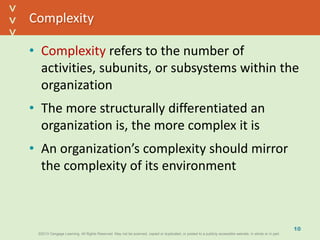
Complexity
‱ Complexity refers to the number of
activities, subunits, or subsystems within the
organization
‱ The more structurally differentiated an
organization is, the more complex it is
‱ An organization’s complexity should mirror
the complexity of its environment
10
©2013 Cengage Learning. All Rights Reserved. May not be scanned, copied or duplicated, or posted to a publicly accessible website, in whole or in part.©2013 Cengage Learning. All Rights Reserved. May not be scanned, copied or duplicated, or posted to a publicly accessible website, in whole or in part.
^
^
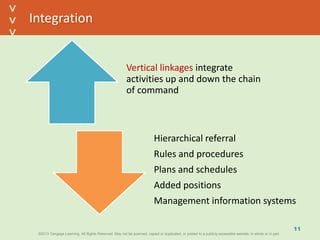
Integration
Vertical linkages integrate
activities up and down the chain
of command
Hierarchical referral
Rules and procedures
Plans and schedules
Added positions
Management information systems
11
©2013 Cengage Learning. All Rights Reserved. May not be scanned, copied or duplicated, or posted to a publicly accessible website, in whole or in part.©2013 Cengage Learning. All Rights Reserved. May not be scanned, copied or duplicated, or posted to a publicly accessible website, in whole or in part.
^
^
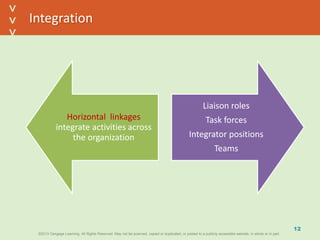
Integration
Horizontal linkages
integrate activities across
the organization
Liaison roles
Task forces
Integrator positions
Teams
12
©2013 Cengage Learning. All Rights Reserved. May not be scanned, copied or duplicated, or posted to a publicly accessible website, in whole or in part.©2013 Cengage Learning. All Rights Reserved. May not be scanned, copied or duplicated, or posted to a publicly accessible website, in whole or in part.
^
^
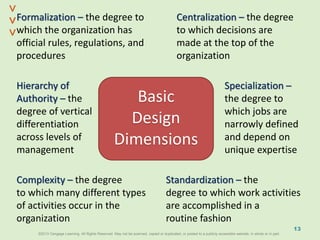
13
Hierarchy of
Authority – the
degree of vertical
differentiation
across levels of
management
Specialization –
the degree to
which jobs are
narrowly defined
and depend on
unique expertise
Basic
Design
Dimensions
Formalization – the degree to
which the organization has
official rules, regulations, and
procedures
Standardization – the
degree to which work activities
are accomplished in a
routine fashion
Complexity – the degree
to which many different types
of activities occur in the
organization
Centralization – the degree
to which decisions are
made at the top of the
organization
©2013 Cengage Learning. All Rights Reserved. May not be scanned, copied or duplicated, or posted to a publicly accessible website, in whole or in part.©2013 Cengage Learning. All Rights Reserved. May not be scanned, copied or duplicated, or posted to a publicly accessible website, in whole or in part.
^
^
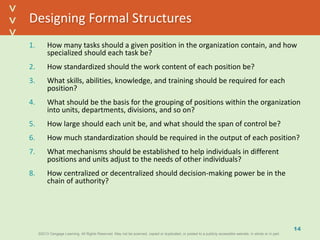
Designing Formal Structures
1. How many tasks should a given position in the organization contain, and how
specialized should each task be?
2. How standardized should the work content of each position be?
3. What skills, abilities, knowledge, and training should be required for each
position?
4. What should be the basis for the grouping of positions within the organization
into units, departments, divisions, and so on?
5. How large should each unit be, and what should the span of control be?
6. How much standardization should be required in the output of each position?
7. What mechanisms should be established to help individuals in different
positions and units adjust to the needs of other individuals?
8. How centralized or decentralized should decision-making power be in the
chain of authority?
14
©2013 Cengage Learning. All Rights Reserved. May not be scanned, copied or duplicated, or posted to a publicly accessible website, in whole or in part.©2013 Cengage Learning. All Rights Reserved. May not be scanned, copied or duplicated, or posted to a publicly accessible website, in whole or in part.
^
^
15
©2013 Cengage Learning. All Rights Reserved. May not be scanned, copied or duplicated, or posted to a publicly accessible website, in whole or in part.©2013 Cengage Learning. All Rights Reserved. May not be scanned, copied or duplicated, or posted to a publicly accessible website, in whole or in part.
^
^
16
©2013 Cengage Learning. All Rights Reserved. May not be scanned, copied or duplicated, or posted to a publicly accessible website, in whole or in part.©2013 Cengage Learning. All Rights Reserved. May not be scanned, copied or duplicated, or posted to a publicly accessible website, in whole or in part.
^
^
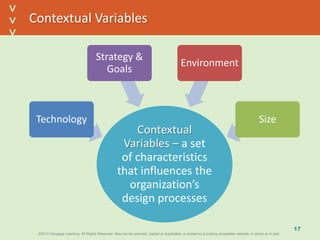
Contextual Variables
17
Contextual
Variables – a set
of characteristics
that influences the
organization’s
design processes
Technology
Strategy &
Goals
Environment
Size
©2013 Cengage Learning. All Rights Reserved. May not be scanned, copied or duplicated, or posted to a publicly accessible website, in whole or in part.©2013 Cengage Learning. All Rights Reserved. May not be scanned, copied or duplicated, or posted to a publicly accessible website, in whole or in part.
^
^
18
©2013 Cengage Learning. All Rights Reserved. May not be scanned, copied or duplicated, or posted to a publicly accessible website, in whole or in part.©2013 Cengage Learning. All Rights Reserved. May not be scanned, copied or duplicated, or posted to a publicly accessible website, in whole or in part.
^
^
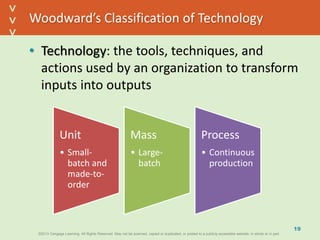
Woodward’s Classification of Technology
‱ Technology: the tools, techniques, and
actions used by an organization to transform
inputs into outputs
19
Unit
‱ Small-
batch and
made-to-
order
Mass
‱ Large-
batch
Process
‱ Continuous
production
©2013 Cengage Learning. All Rights Reserved. May not be scanned, copied or duplicated, or posted to a publicly accessible website, in whole or in part.©2013 Cengage Learning. All Rights Reserved. May not be scanned, copied or duplicated, or posted to a publicly accessible website, in whole or in part.
^
^
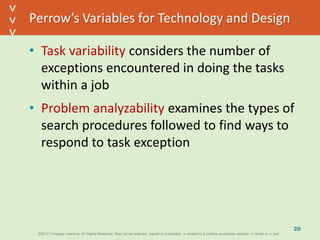
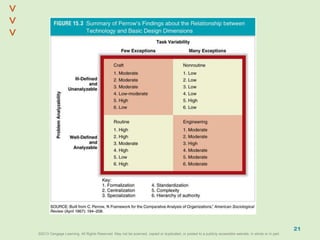
Perrow’s Variables for Technology and Design
‱ Task variability considers the number of
exceptions encountered in doing the tasks
within a job
‱ Problem analyzability examines the types of
search procedures followed to find ways to
respond to task exception
20
©2013 Cengage Learning. All Rights Reserved. May not be scanned, copied or duplicated, or posted to a publicly accessible website, in whole or in part.©2013 Cengage Learning. All Rights Reserved. May not be scanned, copied or duplicated, or posted to a publicly accessible website, in whole or in part.
^
^
21
©2013 Cengage Learning. All Rights Reserved. May not be scanned, copied or duplicated, or posted to a publicly accessible website, in whole or in part.©2013 Cengage Learning. All Rights Reserved. May not be scanned, copied or duplicated, or posted to a publicly accessible website, in whole or in part.
^
^
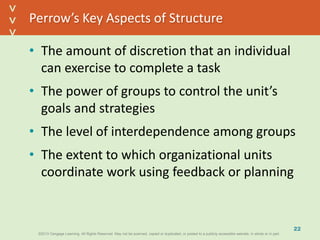
Perrow’s Key Aspects of Structure
‱ The amount of discretion that an individual
can exercise to complete a task
‱ The power of groups to control the unit’s
goals and strategies
‱ The level of interdependence among groups
‱ The extent to which organizational units
coordinate work using feedback or planning
22
©2013 Cengage Learning. All Rights Reserved. May not be scanned, copied or duplicated, or posted to a publicly accessible website, in whole or in part.©2013 Cengage Learning. All Rights Reserved. May not be scanned, copied or duplicated, or posted to a publicly accessible website, in whole or in part.
^
^
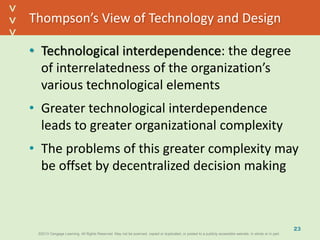
Thompson’s View of Technology and Design
‱ Technological interdependence: the degree
of interrelatedness of the organization’s
various technological elements
‱ Greater technological interdependence
leads to greater organizational complexity
‱ The problems of this greater complexity may
be offset by decentralized decision making
23
©2013 Cengage Learning. All Rights Reserved. May not be scanned, copied or duplicated, or posted to a publicly accessible website, in whole or in part.©2013 Cengage Learning. All Rights Reserved. May not be scanned, copied or duplicated, or posted to a publicly accessible website, in whole or in part.
^
^
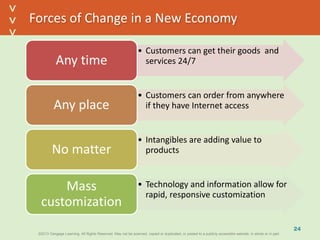
Forces of Change in a New Economy
‱ Customers can get their goods and
services 24/7Any time
‱ Customers can order from anywhere
if they have Internet accessAny place
‱ Intangibles are adding value to
productsNo matter
‱ Technology and information allow for
rapid, responsive customization
Mass
customization
24
©2013 Cengage Learning. All Rights Reserved. May not be scanned, copied or duplicated, or posted to a publicly accessible website, in whole or in part.©2013 Cengage Learning. All Rights Reserved. May not be scanned, copied or duplicated, or posted to a publicly accessible website, in whole or in part.
^
^
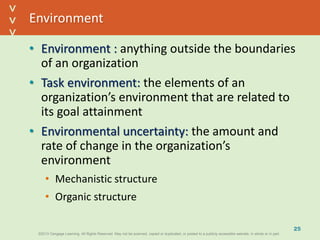
Environment
‱ Environment : anything outside the boundaries
of an organization
‱ Task environment: the elements of an
organization’s environment that are related to
its goal attainment
‱ Environmental uncertainty: the amount and
rate of change in the organization’s
environment
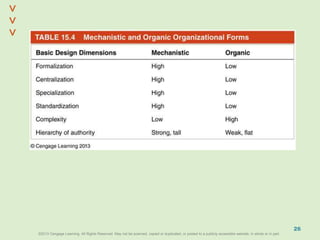
‱ Mechanistic structure
‱ Organic structure
25
©2013 Cengage Learning. All Rights Reserved. May not be scanned, copied or duplicated, or posted to a publicly accessible website, in whole or in part.©2013 Cengage Learning. All Rights Reserved. May not be scanned, copied or duplicated, or posted to a publicly accessible website, in whole or in part.
^
^
26
©2013 Cengage Learning. All Rights Reserved. May not be scanned, copied or duplicated, or posted to a publicly accessible website, in whole or in part.©2013 Cengage Learning. All Rights Reserved. May not be scanned, copied or duplicated, or posted to a publicly accessible website, in whole or in part.
^
^
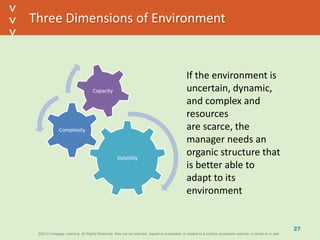
Three Dimensions of Environment
Volatility
Complexity
Capacity
27
If the environment is
uncertain, dynamic,
and complex and
resources
are scarce, the
manager needs an
organic structure that
is better able to
adapt to its
environment
©2013 Cengage Learning. All Rights Reserved. May not be scanned, copied or duplicated, or posted to a publicly accessible website, in whole or in part.©2013 Cengage Learning. All Rights Reserved. May not be scanned, copied or duplicated, or posted to a publicly accessible website, in whole or in part.
^
^
28
©2013 Cengage Learning. All Rights Reserved. May not be scanned, copied or duplicated, or posted to a publicly accessible website, in whole or in part.©2013 Cengage Learning. All Rights Reserved. May not be scanned, copied or duplicated, or posted to a publicly accessible website, in whole or in part.
^
^
29
©2013 Cengage Learning. All Rights Reserved. May not be scanned, copied or duplicated, or posted to a publicly accessible website, in whole or in part.©2013 Cengage Learning. All Rights Reserved. May not be scanned, copied or duplicated, or posted to a publicly accessible website, in whole or in part.
^
^
30
©2013 Cengage Learning. All Rights Reserved. May not be scanned, copied or duplicated, or posted to a publicly accessible website, in whole or in part.©2013 Cengage Learning. All Rights Reserved. May not be scanned, copied or duplicated, or posted to a publicly accessible website, in whole or in part.
^
^
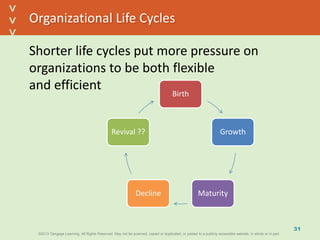
Organizational Life Cycles
31
Shorter life cycles put more pressure on
organizations to be both flexible
and efficient Birth
Growth
MaturityDecline
Revival ??
©2013 Cengage Learning. All Rights Reserved. May not be scanned, copied or duplicated, or posted to a publicly accessible website, in whole or in part.©2013 Cengage Learning. All Rights Reserved. May not be scanned, copied or duplicated, or posted to a publicly accessible website, in whole or in part.
^
^
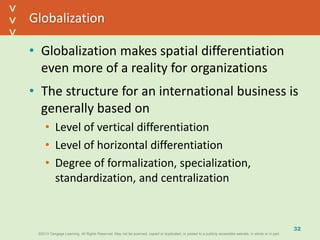
Globalization
‱ Globalization makes spatial differentiation
even more of a reality for organizations
‱ The structure for an international business is
generally based on
‱ Level of vertical differentiation
‱ Level of horizontal differentiation
‱ Degree of formalization, specialization,
standardization, and centralization
32
©2013 Cengage Learning. All Rights Reserved. May not be scanned, copied or duplicated, or posted to a publicly accessible website, in whole or in part.©2013 Cengage Learning. All Rights Reserved. May not be scanned, copied or duplicated, or posted to a publicly accessible website, in whole or in part.
^
^
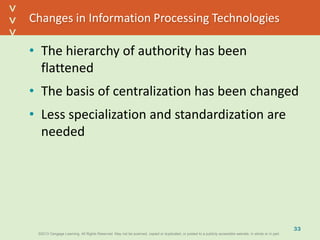
Changes in Information Processing Technologies
‱ The hierarchy of authority has been
flattened
‱ The basis of centralization has been changed
‱ Less specialization and standardization are
needed
33
©2013 Cengage Learning. All Rights Reserved. May not be scanned, copied or duplicated, or posted to a publicly accessible website, in whole or in part.©2013 Cengage Learning. All Rights Reserved. May not be scanned, copied or duplicated, or posted to a publicly accessible website, in whole or in part.
^
^
34
©2013 Cengage Learning. All Rights Reserved. May not be scanned, copied or duplicated, or posted to a publicly accessible website, in whole or in part.©2013 Cengage Learning. All Rights Reserved. May not be scanned, copied or duplicated, or posted to a publicly accessible website, in whole or in part.
^
^
Emerging Organizational Structures
‱ Network organization—weblike structures that
contract operating functions to other
organizations and coordinate these activities at
their headquarters
‱ Virtual organization—temporary network
organizations consisting of independent
enterprises
‱ Circle organization—systemic parts that create
demand, produce product, and provide support
and are linked by leadership and strategy
council
35
©2013 Cengage Learning. All Rights Reserved. May not be scanned, copied or duplicated, or posted to a publicly accessible website, in whole or in part.©2013 Cengage Learning. All Rights Reserved. May not be scanned, copied or duplicated, or posted to a publicly accessible website, in whole or in part.
^
^
Cautionary Notes about Structure
‱ An organizational structure may be weak or deficient
‱ Delayed decision making
‱ Decision making lacks quality
‱ Lacks ability to respond innovatively
‱ Conflict
‱ The personality of the chief executive may adversely
affect the structure
‱ The paranoid
‱ The depressive
‱ The dramatic
‱ The compulsive
‱ The schizoid
36
©2013 Cengage Learning. All Rights Reserved. May not be scanned, copied or duplicated, or posted to a publicly accessible website, in whole or in part.©2013 Cengage Learning. All Rights Reserved. May not be scanned, copied or duplicated, or posted to a publicly accessible website, in whole or in part.
^
^
^
Chapter 15: Reflect & Discuss
Rendition Video Clip
 Review the earlier section, “Basic Design
Dimensions.” Which dimensions does this scene show
or imply?
 Can you sense the division of labor represented by
Senator Hawkins and Alan Smith? Corrine Whitman
does not appear in this scene but is also part of a
division of labor.
 Review the five structural configurations described
earlier in this chapter. Which of those configurations
best describes the likely structure of Senator Hawkins’
office? Which configurations do not apply? Why?
37

MBA 635 chapter 15

  • 1.
    ©2013 Cengage Learning.All Rights Reserved. May not be scanned, copied or duplicated, or posted to a publicly accessible website, in whole or in part. 15 ©2013 Cengage Learning. All Rights Reserved. May not be scanned, copied or duplicated, or posted to a publicly accessible website, in whole or in part. Organizational Design and Structure
  • 2.
    ©2013 Cengage Learning.All Rights Reserved. May not be scanned, copied or duplicated, or posted to a publicly accessible website, in whole or in part. Learning Objectives ©2013 Cengage Learning. All Rights Reserved. May not be scanned, copied or duplicated, or posted to a publicly accessible website, in whole or in part. 1 Define differentiation and integration as organizational design processes. 2 Discuss six basic design dimensions of an organization. 3 Briefly describe five structural configurations for organizations. 4 Describe four contextual variables for an organization. 2
  • 3.
    ©2013 Cengage Learning.All Rights Reserved. May not be scanned, copied or duplicated, or posted to a publicly accessible website, in whole or in part. Learning Objectives continued ©2013 Cengage Learning. All Rights Reserved. May not be scanned, copied or duplicated, or posted to a publicly accessible website, in whole or in part. 5 Explain the four forces reshaping organizations. 6 Discuss emerging organizational structures. 7 Identify two cautions about the effect of organizational structures on people. 3
  • 4.
    ©2013 Cengage Learning.All Rights Reserved. May not be scanned, copied or duplicated, or posted to a publicly accessible website, in whole or in part.©2013 Cengage Learning. All Rights Reserved. May not be scanned, copied or duplicated, or posted to a publicly accessible website, in whole or in part. ^ ^ Organizational Design Terms Organizational design: the process of constructing and adjusting an organization’s structure to achieve its strategy and goals Organizational structure: the linking of departments and jobs within an organization Contextual variables: a set of characteristics that influence the organization’s design process 4
  • 5.
    ©2013 Cengage Learning.All Rights Reserved. May not be scanned, copied or duplicated, or posted to a publicly accessible website, in whole or in part.©2013 Cengage Learning. All Rights Reserved. May not be scanned, copied or duplicated, or posted to a publicly accessible website, in whole or in part. ^ ^ Differentiation and Integration Differentiation Integration Successful organizational design 5 Differentiation: the process of deciding how to divide the work in an organization Integration: the process of coordinating the different parts of an organization
  • 6.
    ©2013 Cengage Learning.All Rights Reserved. May not be scanned, copied or duplicated, or posted to a publicly accessible website, in whole or in part.©2013 Cengage Learning. All Rights Reserved. May not be scanned, copied or duplicated, or posted to a publicly accessible website, in whole or in part. ^ ^ 6
  • 7.
    ©2013 Cengage Learning.All Rights Reserved. May not be scanned, copied or duplicated, or posted to a publicly accessible website, in whole or in part.©2013 Cengage Learning. All Rights Reserved. May not be scanned, copied or duplicated, or posted to a publicly accessible website, in whole or in part. ^ ^ Four Dimensions of Differentiation Manager’s goal orientation Time orientation Interpersonal orientation Formality of structure Differentiation 7
  • 8.
    ©2013 Cengage Learning.All Rights Reserved. May not be scanned, copied or duplicated, or posted to a publicly accessible website, in whole or in part.©2013 Cengage Learning. All Rights Reserved. May not be scanned, copied or duplicated, or posted to a publicly accessible website, in whole or in part. ^ ^ 8
  • 9.
    ©2013 Cengage Learning.All Rights Reserved. May not be scanned, copied or duplicated, or posted to a publicly accessible website, in whole or in part.©2013 Cengage Learning. All Rights Reserved. May not be scanned, copied or duplicated, or posted to a publicly accessible website, in whole or in part. ^ ^ Forms of Differentiation Horizontal ‱ Degree of differentiation between subunits ‱ Based on specialization Vertical ‱ Difference in authority and responsibility in the organizational hierarchy Spatial ‱ Geographic dispersion of an organization’s offices, plants, and personnel 9 Horizontal, vertical, and spatial differentiations indicate the amount of width, height, and breadth an organizational structure needs
  • 10.
    ©2013 Cengage Learning.All Rights Reserved. May not be scanned, copied or duplicated, or posted to a publicly accessible website, in whole or in part.©2013 Cengage Learning. All Rights Reserved. May not be scanned, copied or duplicated, or posted to a publicly accessible website, in whole or in part. ^ ^ Complexity ‱ Complexity refers to the number of activities, subunits, or subsystems within the organization ‱ The more structurally differentiated an organization is, the more complex it is ‱ An organization’s complexity should mirror the complexity of its environment 10
  • 11.
    ©2013 Cengage Learning.All Rights Reserved. May not be scanned, copied or duplicated, or posted to a publicly accessible website, in whole or in part.©2013 Cengage Learning. All Rights Reserved. May not be scanned, copied or duplicated, or posted to a publicly accessible website, in whole or in part. ^ ^ Integration Vertical linkages integrate activities up and down the chain of command Hierarchical referral Rules and procedures Plans and schedules Added positions Management information systems 11
  • 12.
    ©2013 Cengage Learning.All Rights Reserved. May not be scanned, copied or duplicated, or posted to a publicly accessible website, in whole or in part.©2013 Cengage Learning. All Rights Reserved. May not be scanned, copied or duplicated, or posted to a publicly accessible website, in whole or in part. ^ ^ Integration Horizontal linkages integrate activities across the organization Liaison roles Task forces Integrator positions Teams 12
  • 13.
    ©2013 Cengage Learning.All Rights Reserved. May not be scanned, copied or duplicated, or posted to a publicly accessible website, in whole or in part.©2013 Cengage Learning. All Rights Reserved. May not be scanned, copied or duplicated, or posted to a publicly accessible website, in whole or in part. ^ ^ 13 Hierarchy of Authority – the degree of vertical differentiation across levels of management Specialization – the degree to which jobs are narrowly defined and depend on unique expertise Basic Design Dimensions Formalization – the degree to which the organization has official rules, regulations, and procedures Standardization – the degree to which work activities are accomplished in a routine fashion Complexity – the degree to which many different types of activities occur in the organization Centralization – the degree to which decisions are made at the top of the organization
  • 14.
    ©2013 Cengage Learning.All Rights Reserved. May not be scanned, copied or duplicated, or posted to a publicly accessible website, in whole or in part.©2013 Cengage Learning. All Rights Reserved. May not be scanned, copied or duplicated, or posted to a publicly accessible website, in whole or in part. ^ ^ Designing Formal Structures 1. How many tasks should a given position in the organization contain, and how specialized should each task be? 2. How standardized should the work content of each position be? 3. What skills, abilities, knowledge, and training should be required for each position? 4. What should be the basis for the grouping of positions within the organization into units, departments, divisions, and so on? 5. How large should each unit be, and what should the span of control be? 6. How much standardization should be required in the output of each position? 7. What mechanisms should be established to help individuals in different positions and units adjust to the needs of other individuals? 8. How centralized or decentralized should decision-making power be in the chain of authority? 14
  • 15.
    ©2013 Cengage Learning.All Rights Reserved. May not be scanned, copied or duplicated, or posted to a publicly accessible website, in whole or in part.©2013 Cengage Learning. All Rights Reserved. May not be scanned, copied or duplicated, or posted to a publicly accessible website, in whole or in part. ^ ^ 15
  • 16.
    ©2013 Cengage Learning.All Rights Reserved. May not be scanned, copied or duplicated, or posted to a publicly accessible website, in whole or in part.©2013 Cengage Learning. All Rights Reserved. May not be scanned, copied or duplicated, or posted to a publicly accessible website, in whole or in part. ^ ^ 16
  • 17.
    ©2013 Cengage Learning.All Rights Reserved. May not be scanned, copied or duplicated, or posted to a publicly accessible website, in whole or in part.©2013 Cengage Learning. All Rights Reserved. May not be scanned, copied or duplicated, or posted to a publicly accessible website, in whole or in part. ^ ^ Contextual Variables 17 Contextual Variables – a set of characteristics that influences the organization’s design processes Technology Strategy & Goals Environment Size
  • 18.
    ©2013 Cengage Learning.All Rights Reserved. May not be scanned, copied or duplicated, or posted to a publicly accessible website, in whole or in part.©2013 Cengage Learning. All Rights Reserved. May not be scanned, copied or duplicated, or posted to a publicly accessible website, in whole or in part. ^ ^ 18
  • 19.
    ©2013 Cengage Learning.All Rights Reserved. May not be scanned, copied or duplicated, or posted to a publicly accessible website, in whole or in part.©2013 Cengage Learning. All Rights Reserved. May not be scanned, copied or duplicated, or posted to a publicly accessible website, in whole or in part. ^ ^ Woodward’s Classification of Technology ‱ Technology: the tools, techniques, and actions used by an organization to transform inputs into outputs 19 Unit ‱ Small- batch and made-to- order Mass ‱ Large- batch Process ‱ Continuous production
  • 20.
    ©2013 Cengage Learning.All Rights Reserved. May not be scanned, copied or duplicated, or posted to a publicly accessible website, in whole or in part.©2013 Cengage Learning. All Rights Reserved. May not be scanned, copied or duplicated, or posted to a publicly accessible website, in whole or in part. ^ ^ Perrow’s Variables for Technology and Design ‱ Task variability considers the number of exceptions encountered in doing the tasks within a job ‱ Problem analyzability examines the types of search procedures followed to find ways to respond to task exception 20
  • 21.
    ©2013 Cengage Learning.All Rights Reserved. May not be scanned, copied or duplicated, or posted to a publicly accessible website, in whole or in part.©2013 Cengage Learning. All Rights Reserved. May not be scanned, copied or duplicated, or posted to a publicly accessible website, in whole or in part. ^ ^ 21
  • 22.
    ©2013 Cengage Learning.All Rights Reserved. May not be scanned, copied or duplicated, or posted to a publicly accessible website, in whole or in part.©2013 Cengage Learning. All Rights Reserved. May not be scanned, copied or duplicated, or posted to a publicly accessible website, in whole or in part. ^ ^ Perrow’s Key Aspects of Structure ‱ The amount of discretion that an individual can exercise to complete a task ‱ The power of groups to control the unit’s goals and strategies ‱ The level of interdependence among groups ‱ The extent to which organizational units coordinate work using feedback or planning 22
  • 23.
    ©2013 Cengage Learning.All Rights Reserved. May not be scanned, copied or duplicated, or posted to a publicly accessible website, in whole or in part.©2013 Cengage Learning. All Rights Reserved. May not be scanned, copied or duplicated, or posted to a publicly accessible website, in whole or in part. ^ ^ Thompson’s View of Technology and Design ‱ Technological interdependence: the degree of interrelatedness of the organization’s various technological elements ‱ Greater technological interdependence leads to greater organizational complexity ‱ The problems of this greater complexity may be offset by decentralized decision making 23
  • 24.
    ©2013 Cengage Learning.All Rights Reserved. May not be scanned, copied or duplicated, or posted to a publicly accessible website, in whole or in part.©2013 Cengage Learning. All Rights Reserved. May not be scanned, copied or duplicated, or posted to a publicly accessible website, in whole or in part. ^ ^ Forces of Change in a New Economy ‱ Customers can get their goods and services 24/7Any time ‱ Customers can order from anywhere if they have Internet accessAny place ‱ Intangibles are adding value to productsNo matter ‱ Technology and information allow for rapid, responsive customization Mass customization 24
  • 25.
    ©2013 Cengage Learning.All Rights Reserved. May not be scanned, copied or duplicated, or posted to a publicly accessible website, in whole or in part.©2013 Cengage Learning. All Rights Reserved. May not be scanned, copied or duplicated, or posted to a publicly accessible website, in whole or in part. ^ ^ Environment ‱ Environment : anything outside the boundaries of an organization ‱ Task environment: the elements of an organization’s environment that are related to its goal attainment ‱ Environmental uncertainty: the amount and rate of change in the organization’s environment ‱ Mechanistic structure ‱ Organic structure 25
  • 26.
    ©2013 Cengage Learning.All Rights Reserved. May not be scanned, copied or duplicated, or posted to a publicly accessible website, in whole or in part.©2013 Cengage Learning. All Rights Reserved. May not be scanned, copied or duplicated, or posted to a publicly accessible website, in whole or in part. ^ ^ 26
  • 27.
    ©2013 Cengage Learning.All Rights Reserved. May not be scanned, copied or duplicated, or posted to a publicly accessible website, in whole or in part.©2013 Cengage Learning. All Rights Reserved. May not be scanned, copied or duplicated, or posted to a publicly accessible website, in whole or in part. ^ ^ Three Dimensions of Environment Volatility Complexity Capacity 27 If the environment is uncertain, dynamic, and complex and resources are scarce, the manager needs an organic structure that is better able to adapt to its environment
  • 28.
    ©2013 Cengage Learning.All Rights Reserved. May not be scanned, copied or duplicated, or posted to a publicly accessible website, in whole or in part.©2013 Cengage Learning. All Rights Reserved. May not be scanned, copied or duplicated, or posted to a publicly accessible website, in whole or in part. ^ ^ 28
  • 29.
    ©2013 Cengage Learning.All Rights Reserved. May not be scanned, copied or duplicated, or posted to a publicly accessible website, in whole or in part.©2013 Cengage Learning. All Rights Reserved. May not be scanned, copied or duplicated, or posted to a publicly accessible website, in whole or in part. ^ ^ 29
  • 30.
    ©2013 Cengage Learning.All Rights Reserved. May not be scanned, copied or duplicated, or posted to a publicly accessible website, in whole or in part.©2013 Cengage Learning. All Rights Reserved. May not be scanned, copied or duplicated, or posted to a publicly accessible website, in whole or in part. ^ ^ 30
  • 31.
    ©2013 Cengage Learning.All Rights Reserved. May not be scanned, copied or duplicated, or posted to a publicly accessible website, in whole or in part.©2013 Cengage Learning. All Rights Reserved. May not be scanned, copied or duplicated, or posted to a publicly accessible website, in whole or in part. ^ ^ Organizational Life Cycles 31 Shorter life cycles put more pressure on organizations to be both flexible and efficient Birth Growth MaturityDecline Revival ??
  • 32.
    ©2013 Cengage Learning.All Rights Reserved. May not be scanned, copied or duplicated, or posted to a publicly accessible website, in whole or in part.©2013 Cengage Learning. All Rights Reserved. May not be scanned, copied or duplicated, or posted to a publicly accessible website, in whole or in part. ^ ^ Globalization ‱ Globalization makes spatial differentiation even more of a reality for organizations ‱ The structure for an international business is generally based on ‱ Level of vertical differentiation ‱ Level of horizontal differentiation ‱ Degree of formalization, specialization, standardization, and centralization 32
  • 33.
    ©2013 Cengage Learning.All Rights Reserved. May not be scanned, copied or duplicated, or posted to a publicly accessible website, in whole or in part.©2013 Cengage Learning. All Rights Reserved. May not be scanned, copied or duplicated, or posted to a publicly accessible website, in whole or in part. ^ ^ Changes in Information Processing Technologies ‱ The hierarchy of authority has been flattened ‱ The basis of centralization has been changed ‱ Less specialization and standardization are needed 33
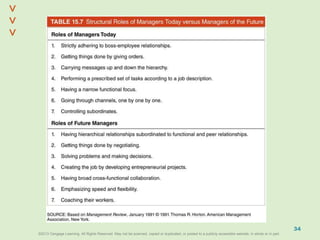
  • 34.
    ©2013 Cengage Learning.All Rights Reserved. May not be scanned, copied or duplicated, or posted to a publicly accessible website, in whole or in part.©2013 Cengage Learning. All Rights Reserved. May not be scanned, copied or duplicated, or posted to a publicly accessible website, in whole or in part. ^ ^ 34
  • 35.
    ©2013 Cengage Learning.All Rights Reserved. May not be scanned, copied or duplicated, or posted to a publicly accessible website, in whole or in part.©2013 Cengage Learning. All Rights Reserved. May not be scanned, copied or duplicated, or posted to a publicly accessible website, in whole or in part. ^ ^ Emerging Organizational Structures ‱ Network organization—weblike structures that contract operating functions to other organizations and coordinate these activities at their headquarters ‱ Virtual organization—temporary network organizations consisting of independent enterprises ‱ Circle organization—systemic parts that create demand, produce product, and provide support and are linked by leadership and strategy council 35
  • 36.
    ©2013 Cengage Learning.All Rights Reserved. May not be scanned, copied or duplicated, or posted to a publicly accessible website, in whole or in part.©2013 Cengage Learning. All Rights Reserved. May not be scanned, copied or duplicated, or posted to a publicly accessible website, in whole or in part. ^ ^ Cautionary Notes about Structure ‱ An organizational structure may be weak or deficient ‱ Delayed decision making ‱ Decision making lacks quality ‱ Lacks ability to respond innovatively ‱ Conflict ‱ The personality of the chief executive may adversely affect the structure ‱ The paranoid ‱ The depressive ‱ The dramatic ‱ The compulsive ‱ The schizoid 36
  • 37.
    ©2013 Cengage Learning.All Rights Reserved. May not be scanned, copied or duplicated, or posted to a publicly accessible website, in whole or in part.©2013 Cengage Learning. All Rights Reserved. May not be scanned, copied or duplicated, or posted to a publicly accessible website, in whole or in part. ^ ^ ^ Chapter 15: Reflect & Discuss Rendition Video Clip  Review the earlier section, “Basic Design Dimensions.” Which dimensions does this scene show or imply?  Can you sense the division of labor represented by Senator Hawkins and Alan Smith? Corrine Whitman does not appear in this scene but is also part of a division of labor.  Review the five structural configurations described earlier in this chapter. Which of those configurations best describes the likely structure of Senator Hawkins’ office? Which configurations do not apply? Why? 37