The K to 10 Instructional
Design Framework
“All kitchens share the same purpose and elements.
Refrigerators are for chilling, counters for chopping,
sinks for cleanup, etc. So are all kitchens the same?
Hardly. Like painters at canvases, kitchen designers
make individual choices in layouts, colors, cabinets,
and such. The best result comes when the design is
tailored to the needs of a particular household.”
Remodeling Ideas for Your Home, Better Homes and Gardens Special Interest Publications, February/March 2005
With so many pieces in the “education puzzle”,
teachers can easily become overwhelmed,
overloaded with information, and fragmented in
their efforts. The solution to this challenge lies in
utilizing an instructional framework.
https://learningfocused.com/instructional-framework-101
As the K to 10 Basic Education Curriculum is
revised, the Instructional Design Framework, being
a systematic and iterative approach to
developing effective and efficient instruction, is
imperatively needed to establish an enabling
structure of ensuring the effective teaching and
learning delivery.
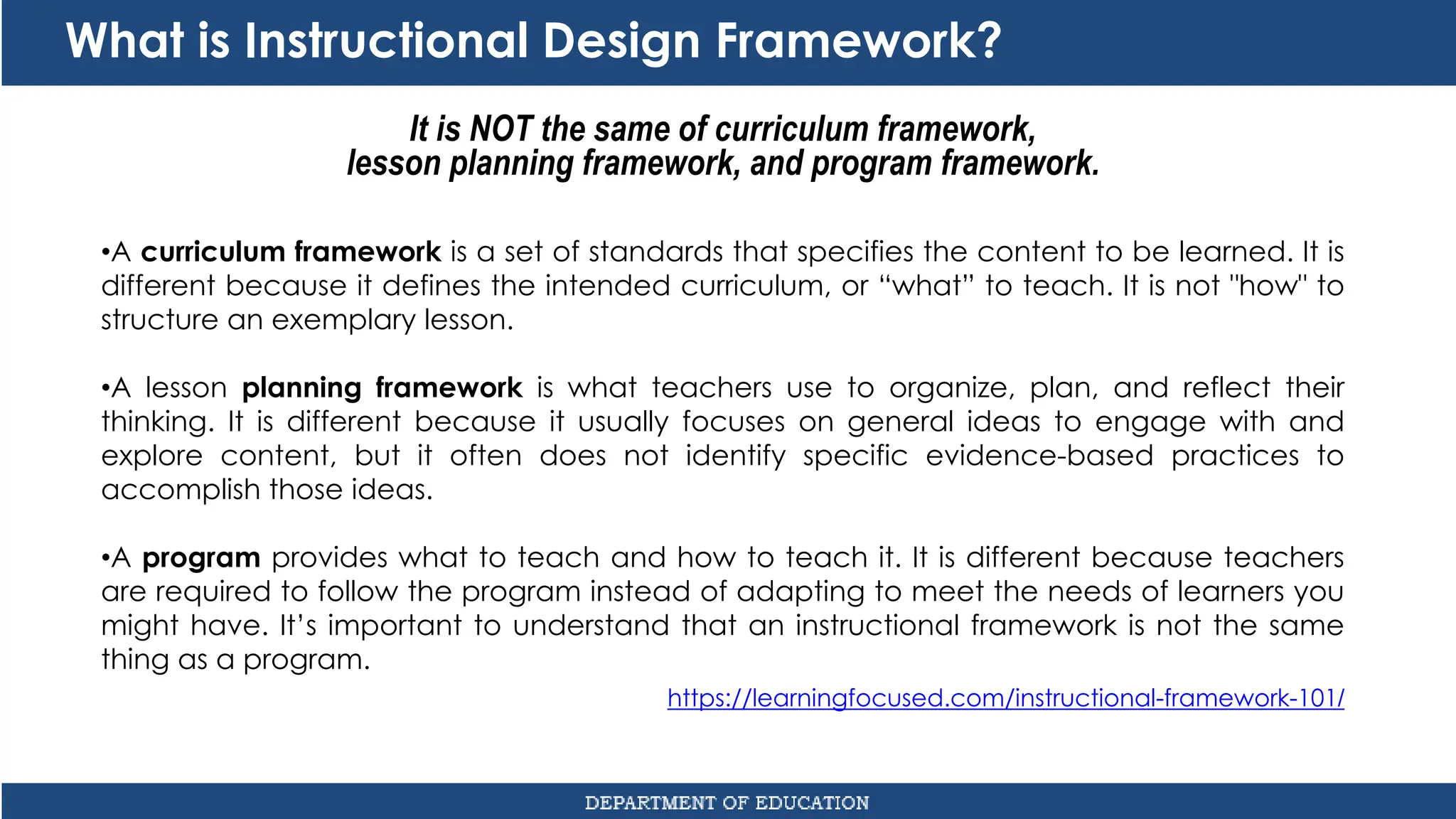
It is NOT the same of curriculum framework,
lesson planning framework, and program framework.
•A curriculum framework is a set of standards that specifies the content to be learned. It is
different because it defines the intended curriculum, or “what” to teach. It is not "how" to
structure an exemplary lesson.
•A lesson planning framework is what teachers use to organize, plan, and reflect their
thinking. It is different because it usually focuses on general ideas to engage with and
explore content, but it often does not identify specific evidence-based practices to
accomplish those ideas.
•A program provides what to teach and how to teach it. It is different because teachers
are required to follow the program instead of adapting to meet the needs of learners you
might have. It’s important to understand that an instructional framework is not the same
thing as a program.
https://learningfocused.com/instructional-framework-101/
What is Instructional Design Framework?
Instructional Design Framework
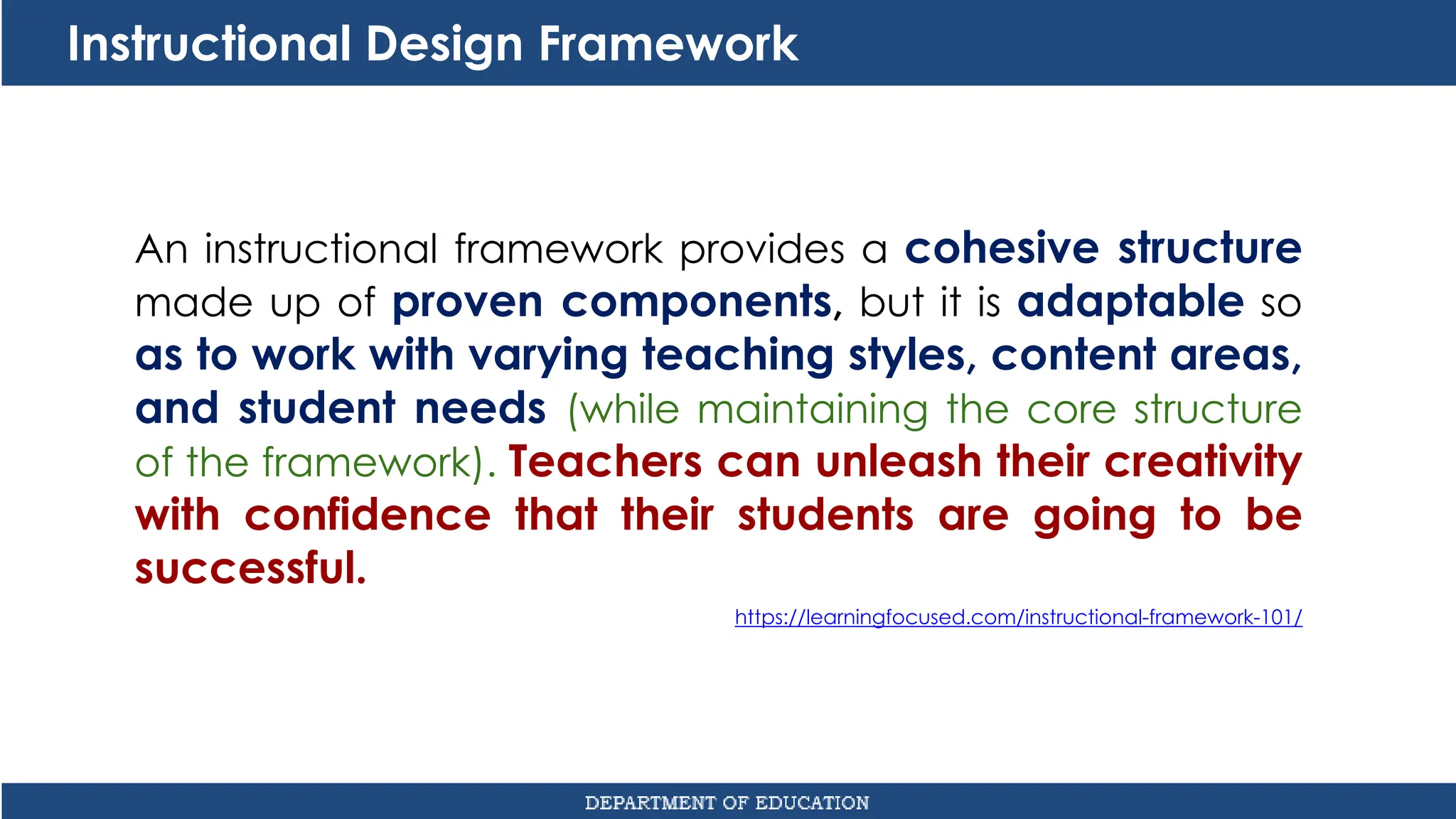
An instructional framework provides a cohesive structure
made up of proven components, but it is adaptable so
as to work with varying teaching styles, content areas,
and student needs (while maintaining the core structure
of the framework). Teachers can unleash their creativity
with confidence that their students are going to be
successful.
https://learningfocused.com/instructional-framework-101/
The K to10 Instructional Design Framework
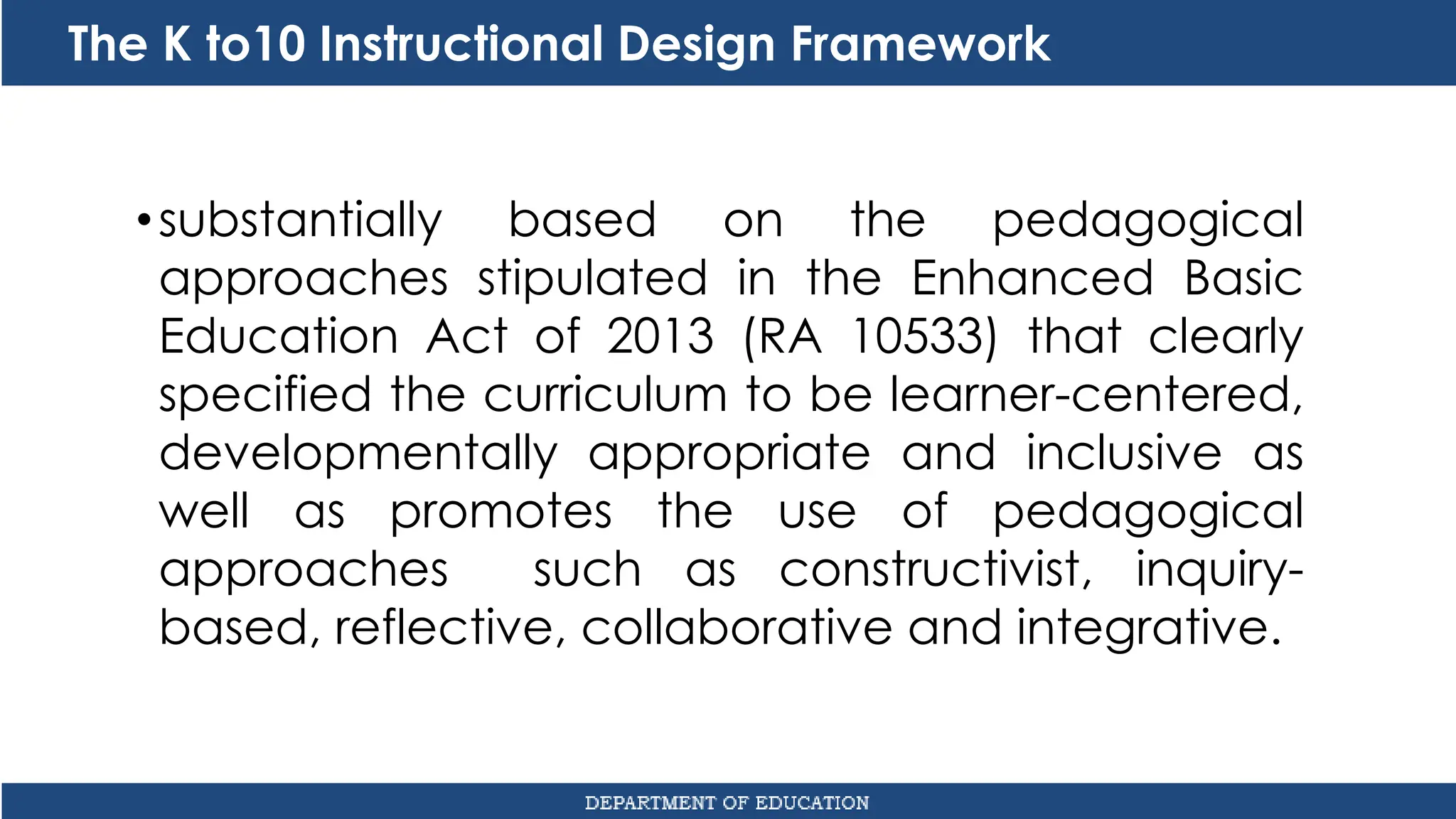
•substantially based on the pedagogical
approaches stipulated in the Enhanced Basic
Education Act of 2013 (RA 10533) that clearly
specified the curriculum to be learner-centered,
developmentally appropriate and inclusive as
well as promotes the use of pedagogical
approaches such as constructivist, inquiry-
based, reflective, collaborative and integrative.
The K to10 Instructional Design Framework
•It is mainly anchored on Constructivism,
Behaviorism, and Cognitivism. These learner-
centered educational philosophies share a
common emphasis on the importance of
personalized instruction, learner engagement, and
a supportive learning environment. By placing the
learner at the center of the learning process, these
philosophies help to promote meaningful and
effective learning experiences for all learners.
The K to10 Instructional Design Framework
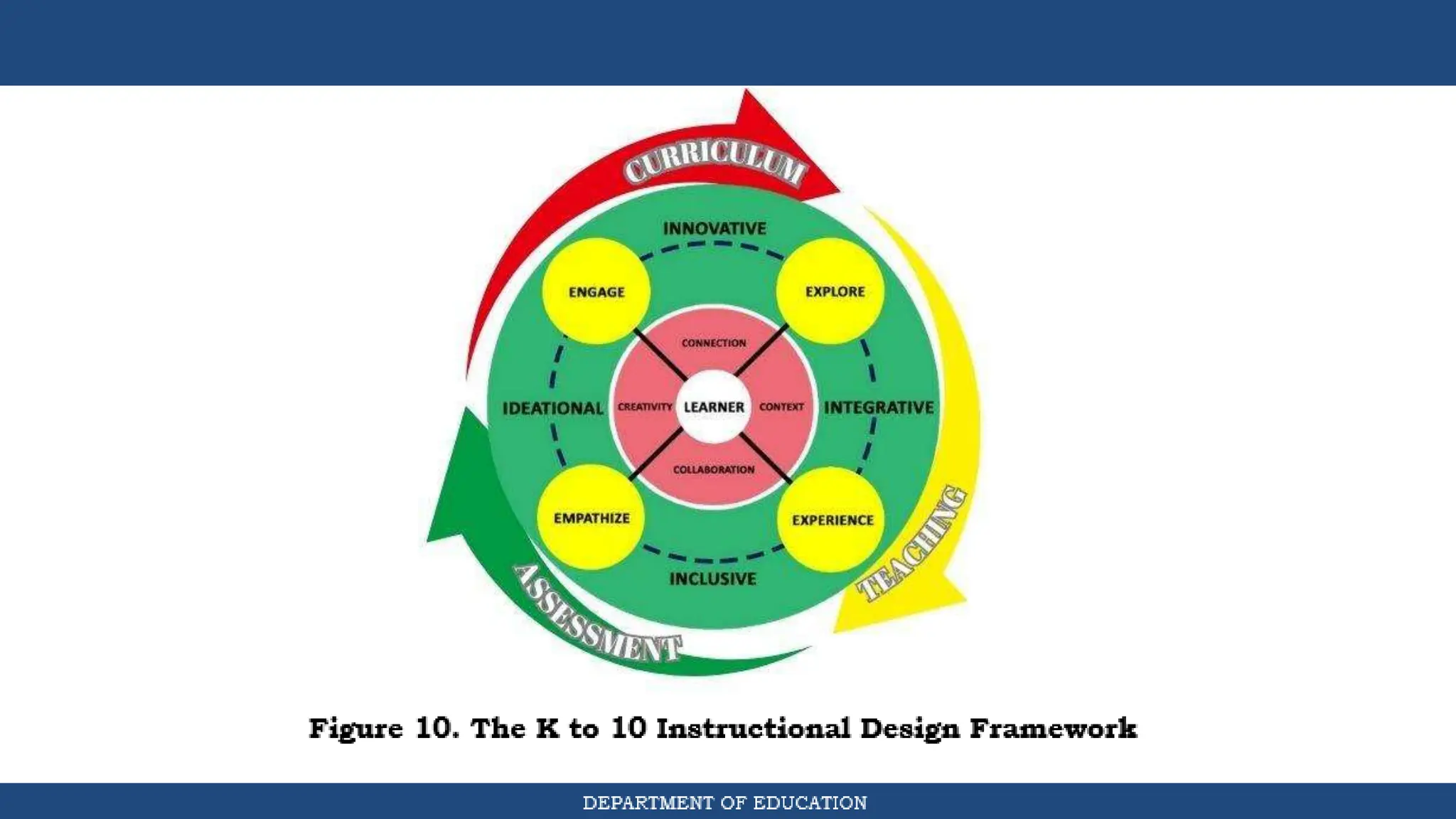
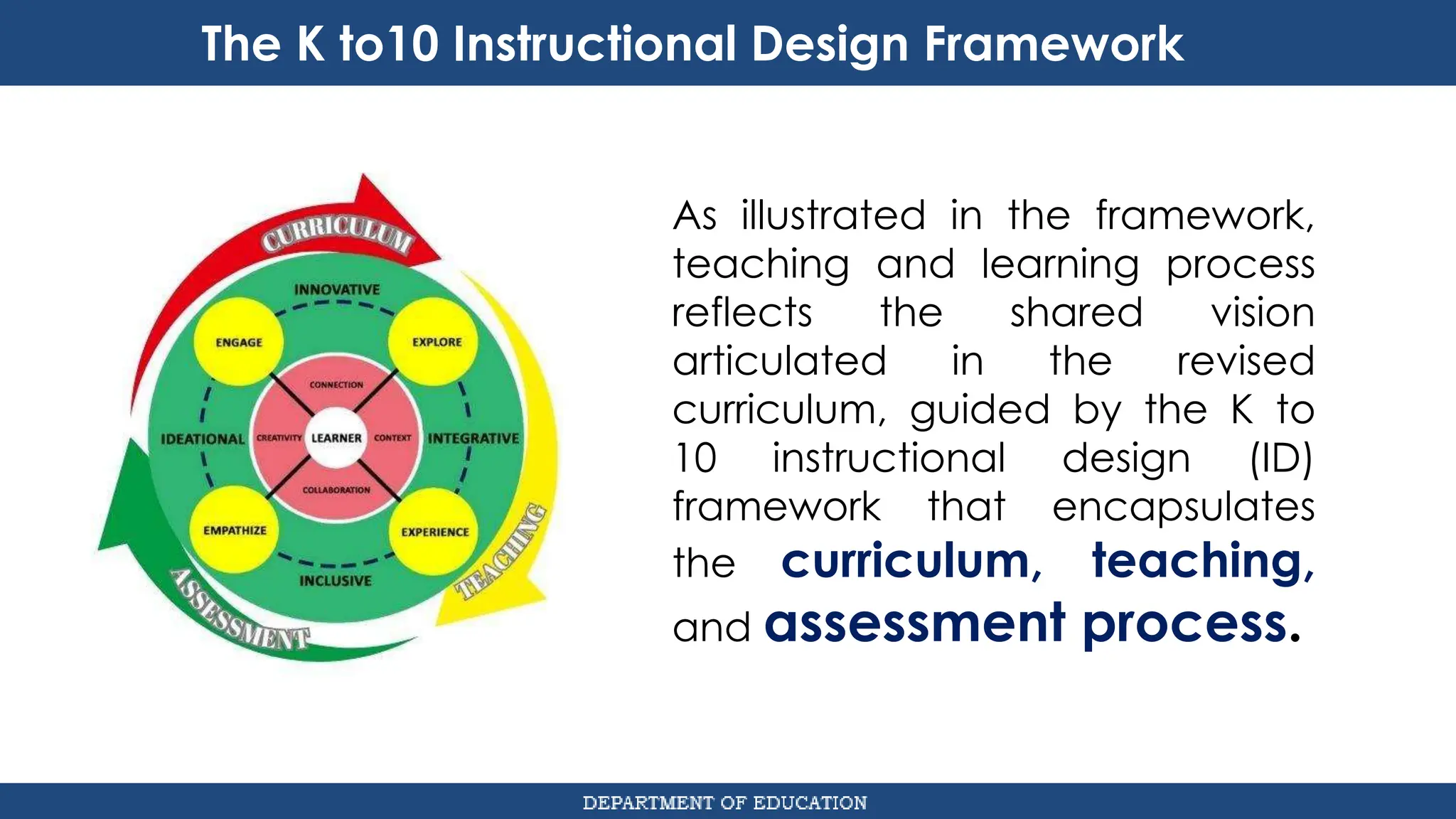
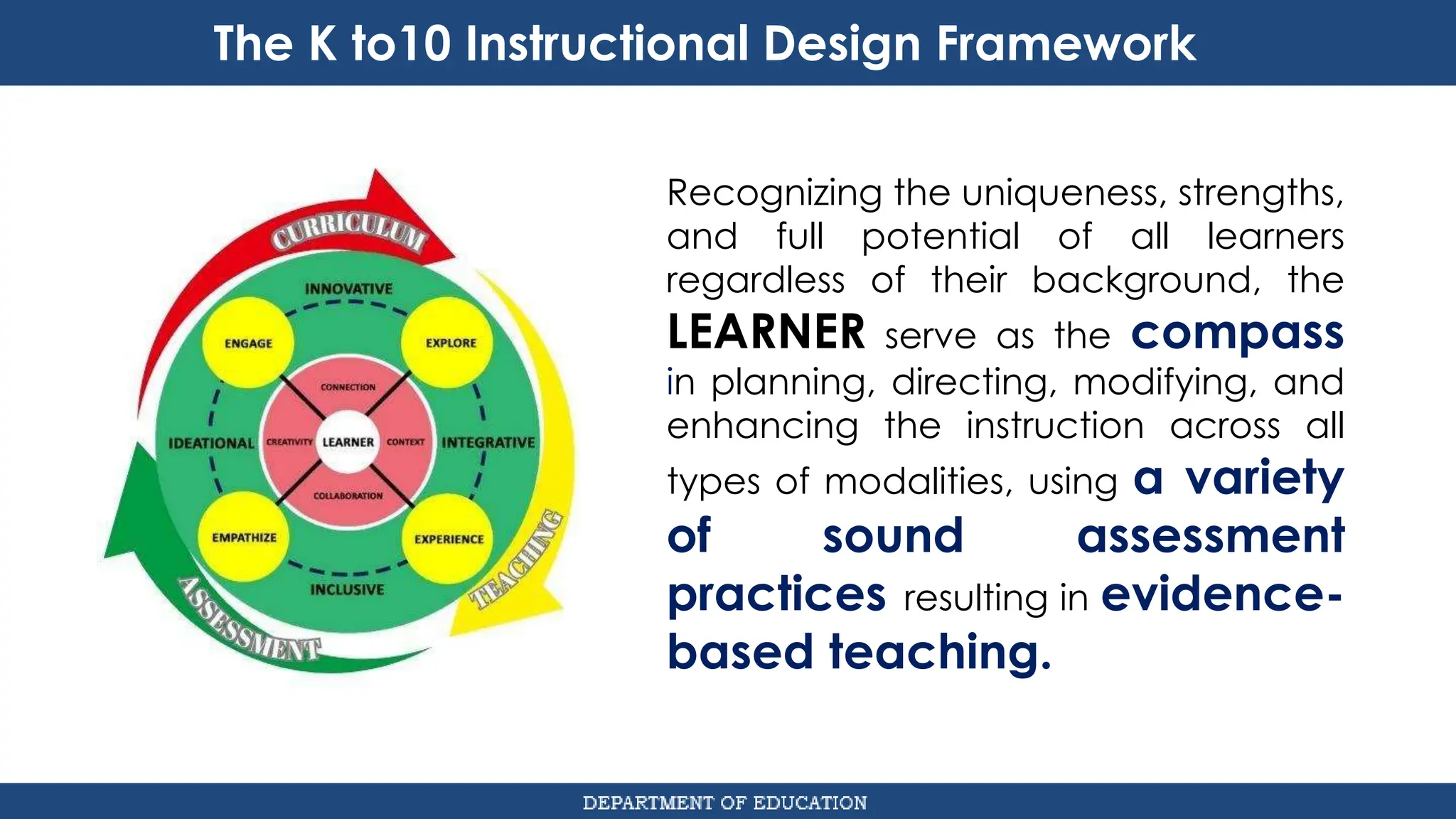
As illustrated in the framework,
teaching and learning process
reflects the shared vision
articulated in the revised
curriculum, guided by the K to
10 instructional design (ID)
framework that encapsulates
the curriculum, teaching,
and assessment process.
The K to10 Instructional Design Framework
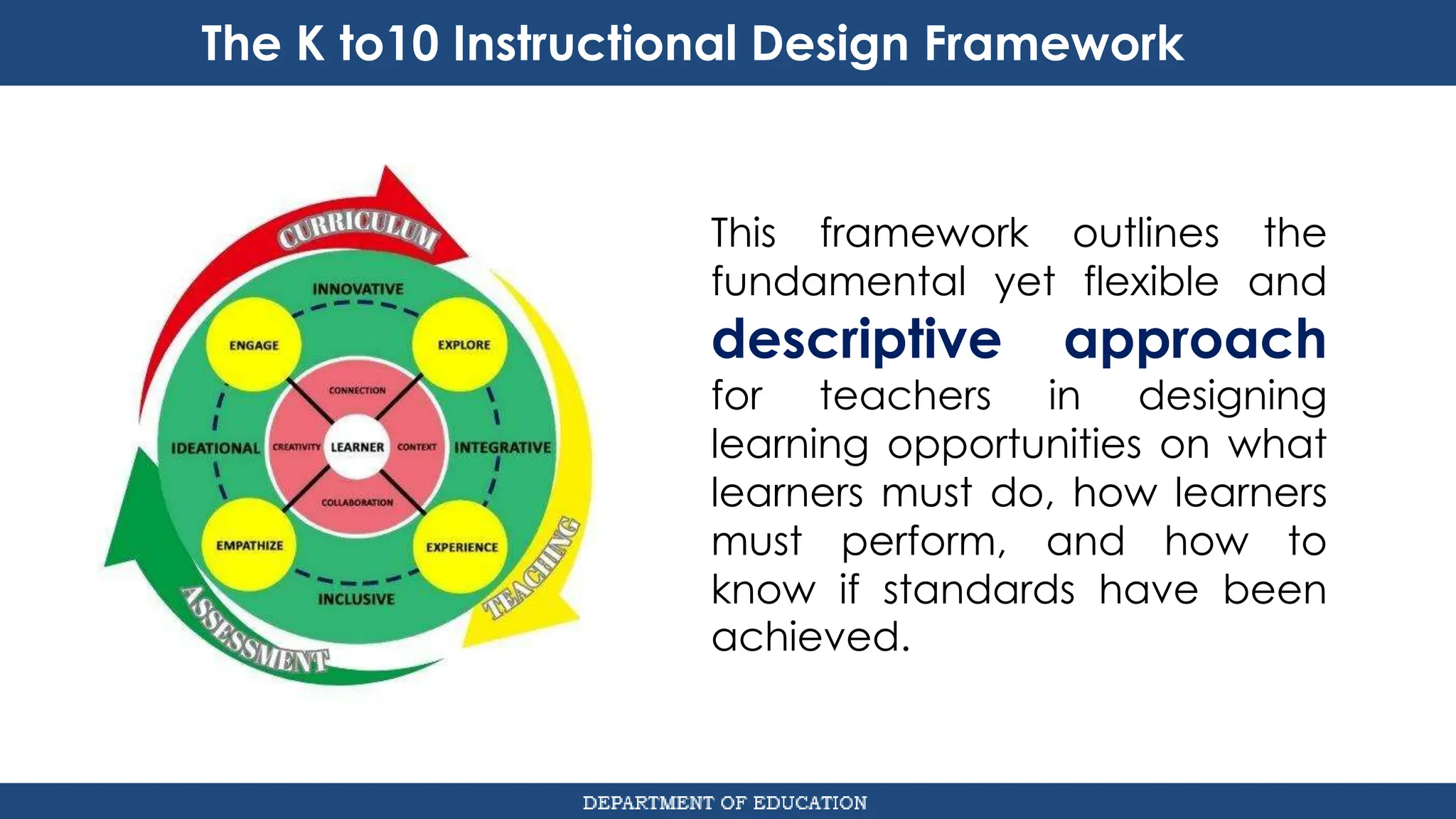
This framework outlines the
fundamental yet flexible and
descriptive approach
for teachers in designing
learning opportunities on what
learners must do, how learners
must perform, and how to
know if standards have been
achieved.
The K to10 Instructional Design Framework
Recognizing the uniqueness, strengths,
and full potential of all learners
regardless of their background, the
LEARNER serve as the compass
in planning, directing, modifying, and
enhancing the instruction across all
types of modalities, using a variety
of sound assessment
practices resulting in evidence-
based teaching.
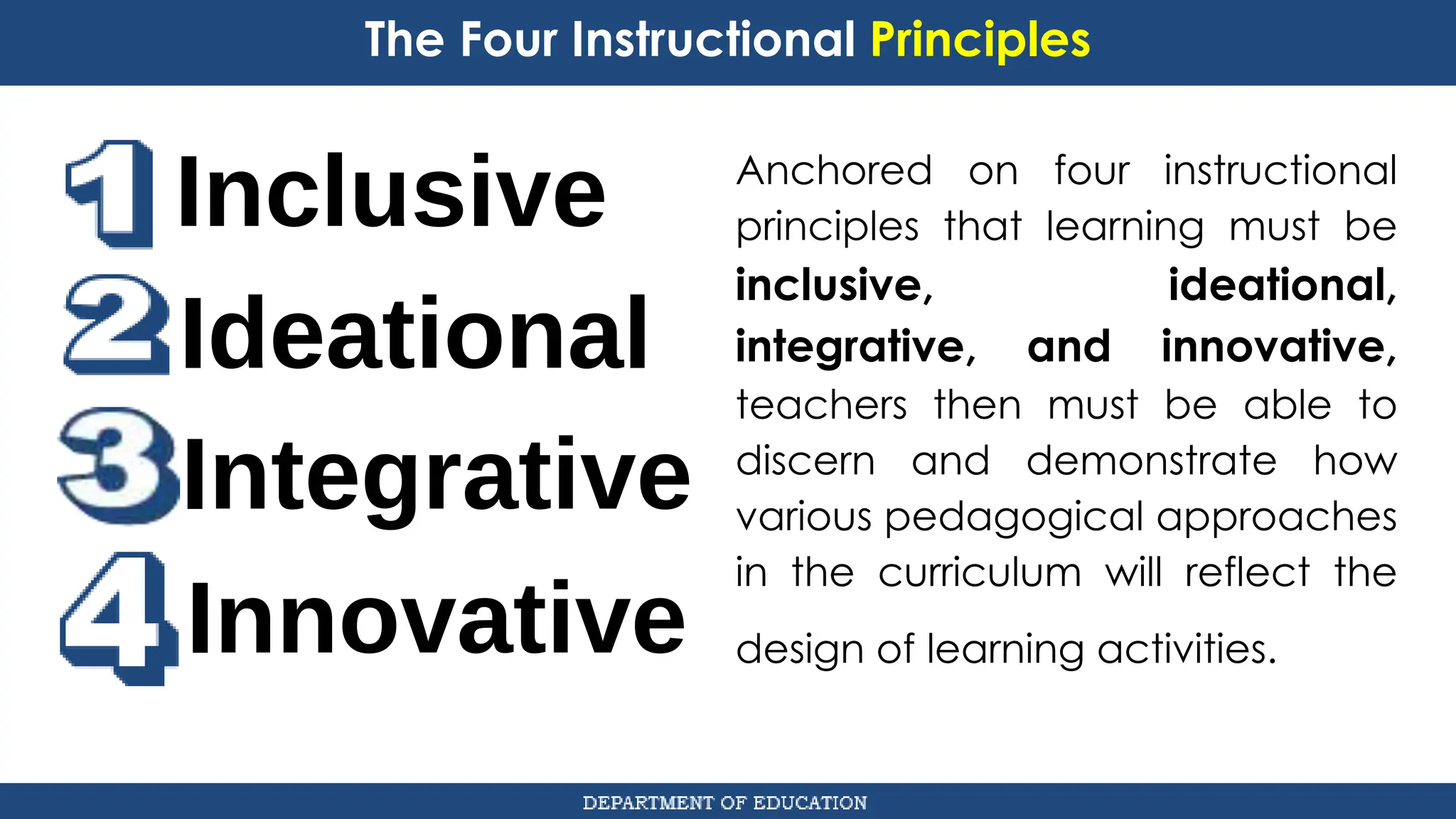
The Four Instructional Principles
Inclusive
Ideational
Integrative
Innovative
Anchored on four instructional
principles that learning must be
inclusive, ideational,
integrative, and innovative,
teachers then must be able to
discern and demonstrate how
various pedagogical approaches
in the curriculum will reflect the
design of learning activities.
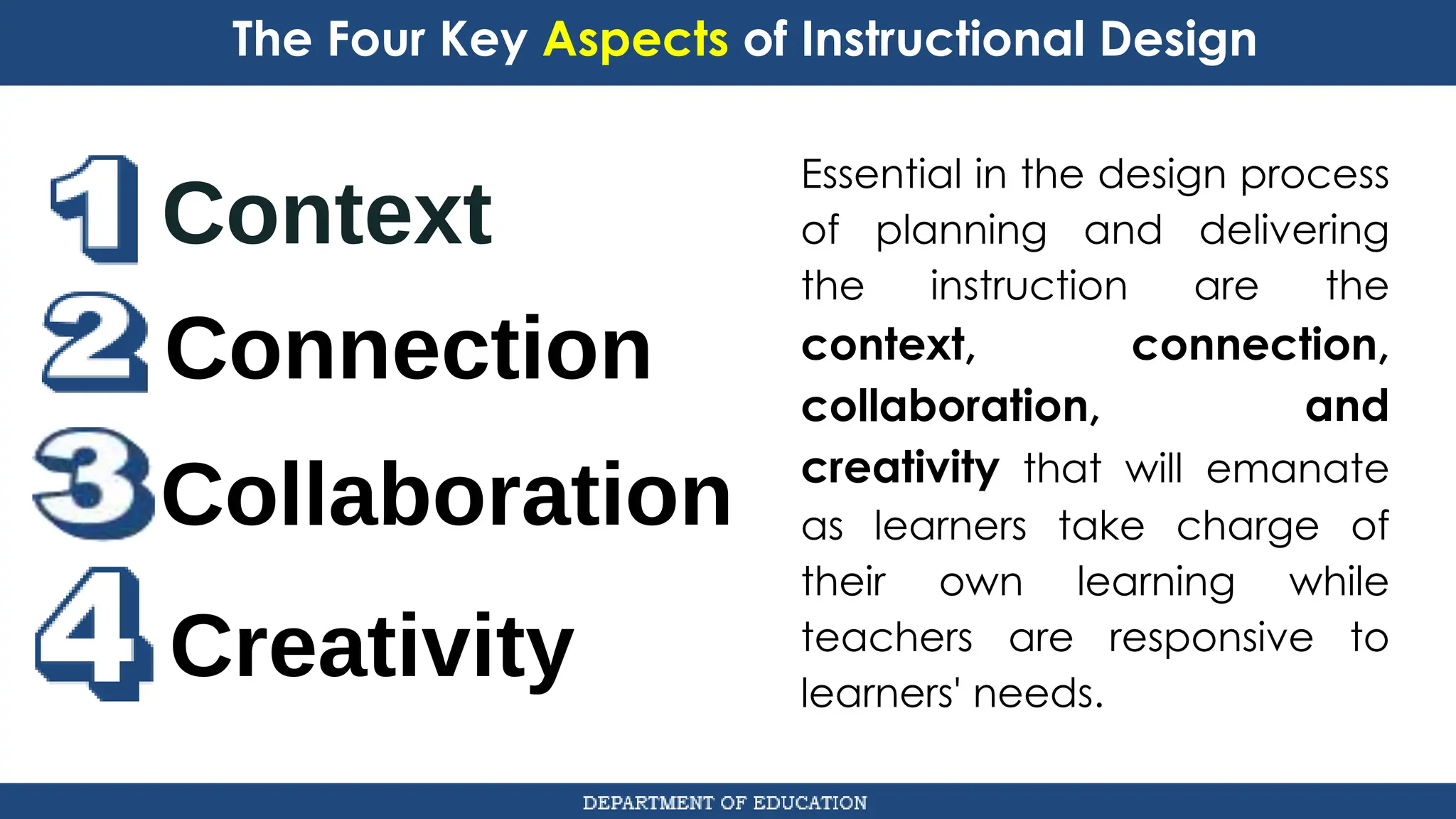
The Four Key Aspects of Instructional Design
s
Context
Connection
Collaboration
Creativity
Essential in the design process
of planning and delivering
the instruction are the
context, connection,
collaboration, and
creativity that will emanate
as learners take charge of
their own learning while
teachers are responsive to
learners' needs.
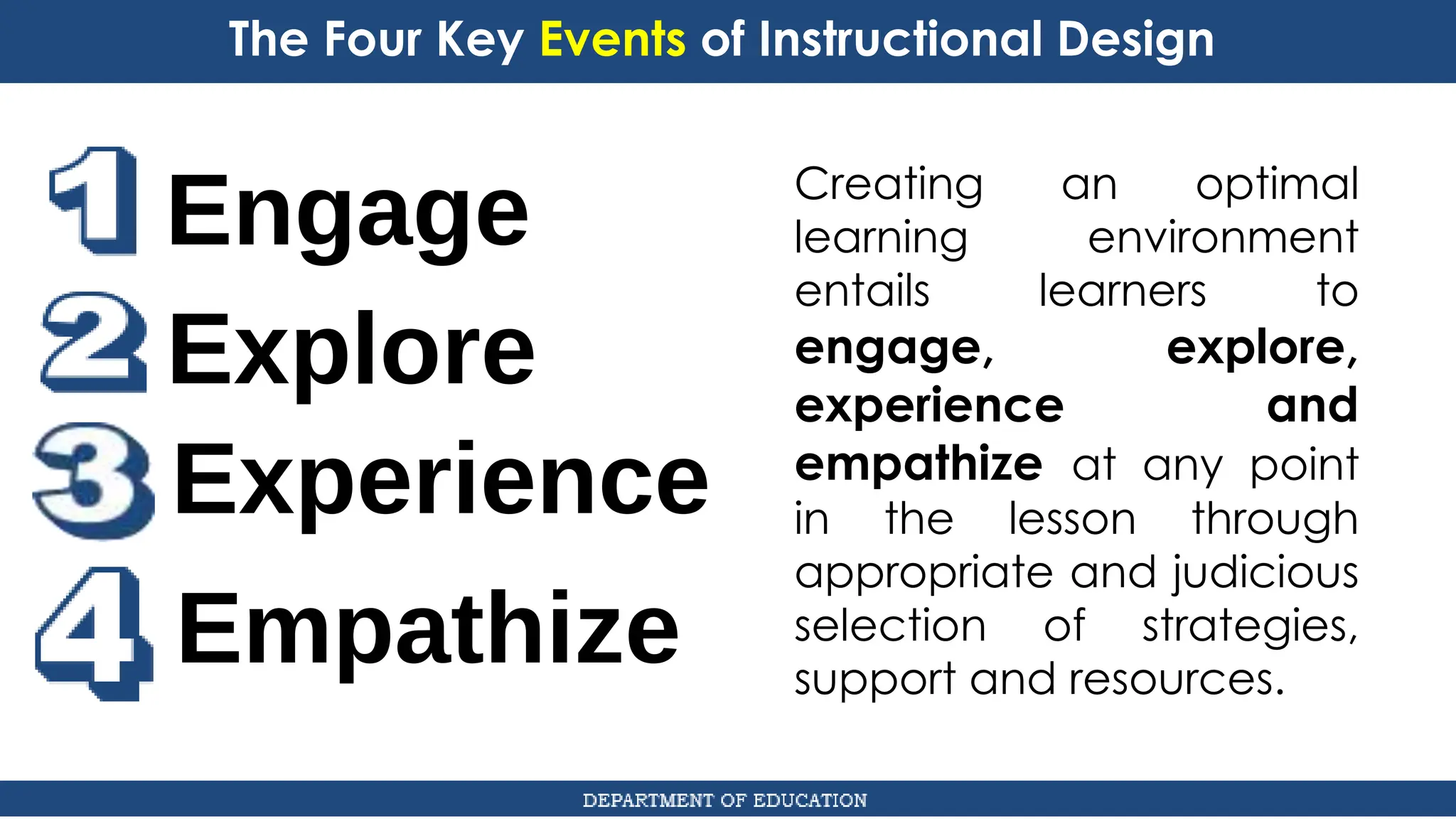
The Four Key Events of Instructional Design
s
Engage
Explore
Experience
Empathize
Creating an optimal
learning environment
entails learners to
engage, explore,
experience and
empathize at any point
in the lesson through
appropriate and judicious
selection of strategies,
support and resources.
Features of the K to 10 Instructional Design Framework
a.It cuts across important learning stages and learning areas.
b.It emphasizes the learners at the center of the process. It
enables learners to take part in making decisions about
creating learning activities.
c.It gives direction and brings together school administrators,
teachers, and learners in a shared understanding of how to
accomplish learning objectives and discuss and enhance
learners' progress.
d.It is flexible to promote creativity and collaboration not only
among learners but also among teachers and instructional
leaders.
Features of the K to 10 Instructional Design Framework
e. It is descriptive rather than prescriptive. It outlines the
key elements and considerations in adopting a
teaching strategy, teaching materials, and
educational approach to achieve learning
standards.
f. It provides the design of instruction and does not
direct its procedures. Thus, the pedagogical
approaches and models to be used in instruction will
provide the methods and procedures.
g. It serves as a guide for implementing uniformity and
consistency in designing and planning the lesson.
s
Experience
Assessment, Feedback,
and Reflection
A vital process of instructional delivery as it measures the extent
of the attainment of mastering the expected competencies and
development of skills based on the learning standards.
Assessment
It is the systematic basis for interpreting the efficiency of instruction
– the approaches, methods, strategies, and techniques applied in
its delivery and the principles by which it was based on.
s
Experience
Assessment
DepEd Order No. 8, s. 2015 defines classroom assessment as
an ongoing process of identifying, gathering, organizing,
and interpreting quantitative and qualitative
information about what learners know and can do.
It is an integral part of the teaching-learning process;
hence the K to 10 Instructional Design Framework provides
that assessment may be given at any point in the lesson.
s
Experience
Feedback
DO 8, s. 2015 provides that formative assessment must provide
learners with immediate feedback on how well they are learning
throughout the teaching-learning process so that teachers can
provide appropriate recommendations on how learners can
improve themselves and make their own decisions to direct
learning.
s
Experience
Feedback
Feedback is information provided to the learners about their
performance as a result of assessment in order to help them grow,
learn, and improve with respect to the learning standards. It can
be specific, descriptive, and factual to enhance the areas of
strength and areas for improvement. It should be presented in a
way that is timely, constructive, respectful, and supportive of the
learner’s efforts.
s
Experience
Reflection
Reflection is the process by which learners determine
which areas of their learning experiences they have
improved, and which ones still require their attention in
order to improve. It enables learners to synthesize the
learning, make connections between theory and practice,
and explore the complexities of their own experiences (Lai
and Law, 2016 p. 143).
s
Experience
The K to 12 Pedagogical Approaches
The K to 10 Revised Curriculum shall
continue to utilize pedagogical
approaches that are constructivist,
inquiry-based, reflective, collaborative,
and integrative as stipulated in RA 10533
and reiterated in DepEd Order No. 21, s.
2019.
s
Experience
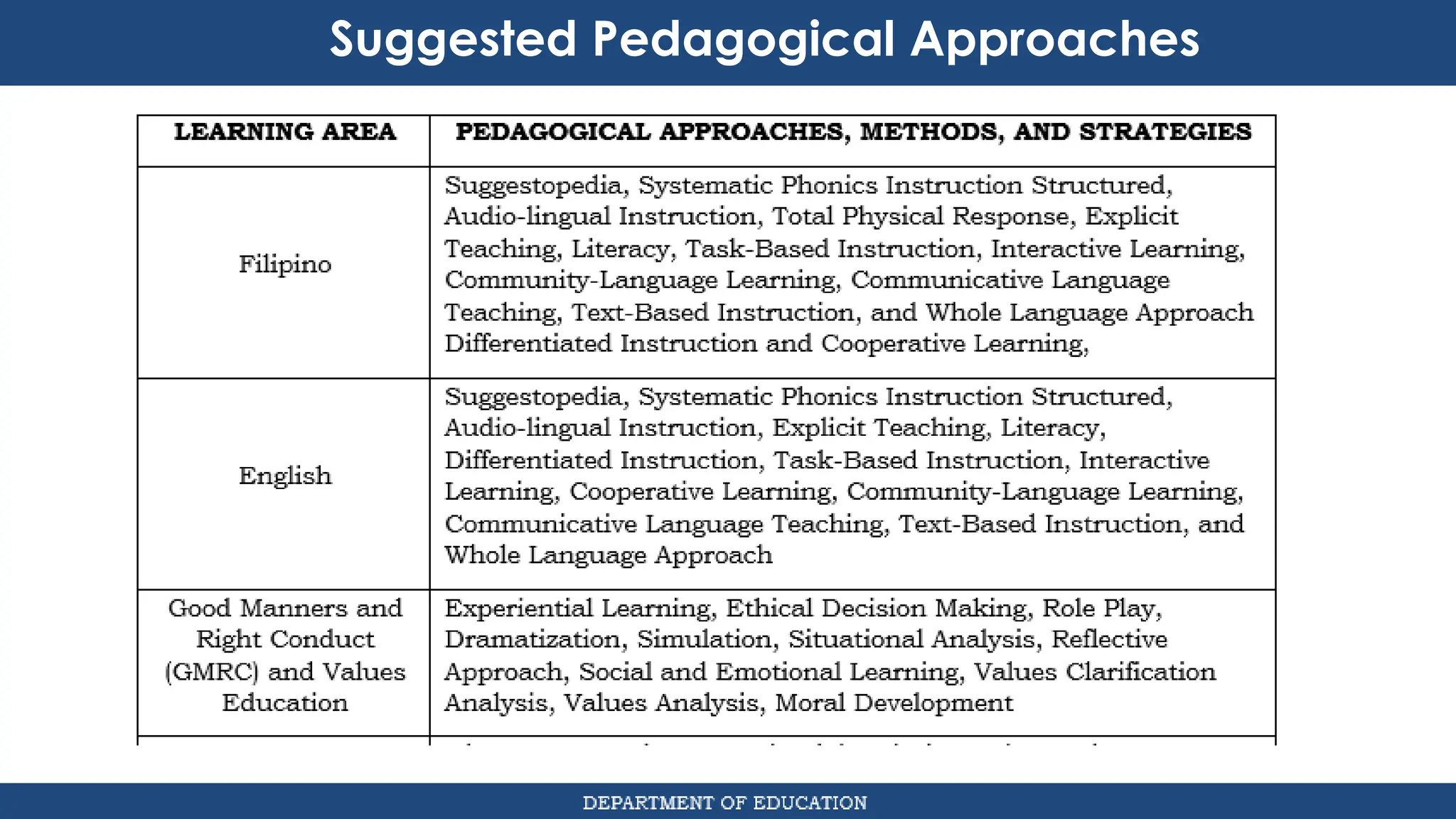
Suggested Pedagogical Approaches
s
Suggested Pedagogical Approaches
s
Experience
Suggested Pedagogical Approaches
s
Elements of Textbooks and Teacher’s Manuals
Textbooks (For Content Area) Teacher’s Manual (For Content Area)
A. Title and Overview of the Chapter
B. Pre-Assessment (per chapter)
C. Title and Overview of the Lesson
D. Learning Competencies/ Objectives
E. Content/Concept Development
E.1. Learning Activities appropriate to the learning area
E.2. Deepening of Core Understanding /Key Concepts
(Processing/Questioning)
E.3. Valuing when appropriate and necessary
E.4. Summary
(Note: The elements under item E may be presented creatively as
long as these are found in the lesson development.)
F. Post-Assessment
(Note: Post-Assessment shall be constructed differently from
the Pre-Assessment)
G. Reflection (Self-Monitoring/Self-Assessment)
H. Remediation / Enrichment Activities when
applicable
A. Title and Overview of the Chapter
(Content and Performance Standard)
B. Pre-Assessment (per chapter)
C. Title and Overview of the Lesson
D. Learning Competencies/ Objectives
E. Pre-Assessment (per lesson)
F. Motivation
G. Content/Concept Development
(Differentiated Instruction)
G. 1. Learning Activities appropriate to the
learning area (Processing/Questioning)
G. 2. Deepening of Core Understanding/
Key Concept (Processing/Questioning)
G. 3. Valuing when appropriate and necessary
(Processing/Questioning)
H. Generalization/s
I. Summative Assessment (per lesson).
J. Reflection (Self-Monitoring/Self-Assessment)
(Processing/Questioning)
K. Remediation or Enrichment Activities
(as applicable)
L. Performance Task (per learning area)
M. Post-Assessment
N. Answer Key
s
*** END ***
Thank you !

May29-Revision_The-K-to-10-Instructional-Design-Framework.pptx

  • 1.
    The K to10 Instructional Design Framework
  • 2.
    “All kitchens sharethe same purpose and elements. Refrigerators are for chilling, counters for chopping, sinks for cleanup, etc. So are all kitchens the same? Hardly. Like painters at canvases, kitchen designers make individual choices in layouts, colors, cabinets, and such. The best result comes when the design is tailored to the needs of a particular household.” Remodeling Ideas for Your Home, Better Homes and Gardens Special Interest Publications, February/March 2005
  • 3.
    With so manypieces in the “education puzzle”, teachers can easily become overwhelmed, overloaded with information, and fragmented in their efforts. The solution to this challenge lies in utilizing an instructional framework. https://learningfocused.com/instructional-framework-101
  • 4.
    As the Kto 10 Basic Education Curriculum is revised, the Instructional Design Framework, being a systematic and iterative approach to developing effective and efficient instruction, is imperatively needed to establish an enabling structure of ensuring the effective teaching and learning delivery.
  • 5.
    It is NOTthe same of curriculum framework, lesson planning framework, and program framework. •A curriculum framework is a set of standards that specifies the content to be learned. It is different because it defines the intended curriculum, or “what” to teach. It is not "how" to structure an exemplary lesson. •A lesson planning framework is what teachers use to organize, plan, and reflect their thinking. It is different because it usually focuses on general ideas to engage with and explore content, but it often does not identify specific evidence-based practices to accomplish those ideas. •A program provides what to teach and how to teach it. It is different because teachers are required to follow the program instead of adapting to meet the needs of learners you might have. It’s important to understand that an instructional framework is not the same thing as a program. https://learningfocused.com/instructional-framework-101/ What is Instructional Design Framework?
  • 6.
    Instructional Design Framework Aninstructional framework provides a cohesive structure made up of proven components, but it is adaptable so as to work with varying teaching styles, content areas, and student needs (while maintaining the core structure of the framework). Teachers can unleash their creativity with confidence that their students are going to be successful. https://learningfocused.com/instructional-framework-101/
  • 7.
    The K to10Instructional Design Framework •substantially based on the pedagogical approaches stipulated in the Enhanced Basic Education Act of 2013 (RA 10533) that clearly specified the curriculum to be learner-centered, developmentally appropriate and inclusive as well as promotes the use of pedagogical approaches such as constructivist, inquiry- based, reflective, collaborative and integrative.
  • 8.
    The K to10Instructional Design Framework •It is mainly anchored on Constructivism, Behaviorism, and Cognitivism. These learner- centered educational philosophies share a common emphasis on the importance of personalized instruction, learner engagement, and a supportive learning environment. By placing the learner at the center of the learning process, these philosophies help to promote meaningful and effective learning experiences for all learners.
  • 10.
    The K to10Instructional Design Framework As illustrated in the framework, teaching and learning process reflects the shared vision articulated in the revised curriculum, guided by the K to 10 instructional design (ID) framework that encapsulates the curriculum, teaching, and assessment process.
  • 11.
    The K to10Instructional Design Framework This framework outlines the fundamental yet flexible and descriptive approach for teachers in designing learning opportunities on what learners must do, how learners must perform, and how to know if standards have been achieved.
  • 12.
    The K to10Instructional Design Framework Recognizing the uniqueness, strengths, and full potential of all learners regardless of their background, the LEARNER serve as the compass in planning, directing, modifying, and enhancing the instruction across all types of modalities, using a variety of sound assessment practices resulting in evidence- based teaching.
  • 13.
    The Four InstructionalPrinciples Inclusive Ideational Integrative Innovative Anchored on four instructional principles that learning must be inclusive, ideational, integrative, and innovative, teachers then must be able to discern and demonstrate how various pedagogical approaches in the curriculum will reflect the design of learning activities.
  • 14.
    The Four KeyAspects of Instructional Design s Context Connection Collaboration Creativity Essential in the design process of planning and delivering the instruction are the context, connection, collaboration, and creativity that will emanate as learners take charge of their own learning while teachers are responsive to learners' needs.
  • 15.
    The Four KeyEvents of Instructional Design s Engage Explore Experience Empathize Creating an optimal learning environment entails learners to engage, explore, experience and empathize at any point in the lesson through appropriate and judicious selection of strategies, support and resources.
  • 16.
    Features of theK to 10 Instructional Design Framework a.It cuts across important learning stages and learning areas. b.It emphasizes the learners at the center of the process. It enables learners to take part in making decisions about creating learning activities. c.It gives direction and brings together school administrators, teachers, and learners in a shared understanding of how to accomplish learning objectives and discuss and enhance learners' progress. d.It is flexible to promote creativity and collaboration not only among learners but also among teachers and instructional leaders.
  • 17.
    Features of theK to 10 Instructional Design Framework e. It is descriptive rather than prescriptive. It outlines the key elements and considerations in adopting a teaching strategy, teaching materials, and educational approach to achieve learning standards. f. It provides the design of instruction and does not direct its procedures. Thus, the pedagogical approaches and models to be used in instruction will provide the methods and procedures. g. It serves as a guide for implementing uniformity and consistency in designing and planning the lesson.
  • 18.
  • 19.
    A vital processof instructional delivery as it measures the extent of the attainment of mastering the expected competencies and development of skills based on the learning standards. Assessment It is the systematic basis for interpreting the efficiency of instruction – the approaches, methods, strategies, and techniques applied in its delivery and the principles by which it was based on.
  • 20.
    s Experience Assessment DepEd Order No.8, s. 2015 defines classroom assessment as an ongoing process of identifying, gathering, organizing, and interpreting quantitative and qualitative information about what learners know and can do. It is an integral part of the teaching-learning process; hence the K to 10 Instructional Design Framework provides that assessment may be given at any point in the lesson.
  • 21.
    s Experience Feedback DO 8, s.2015 provides that formative assessment must provide learners with immediate feedback on how well they are learning throughout the teaching-learning process so that teachers can provide appropriate recommendations on how learners can improve themselves and make their own decisions to direct learning.
  • 22.
    s Experience Feedback Feedback is informationprovided to the learners about their performance as a result of assessment in order to help them grow, learn, and improve with respect to the learning standards. It can be specific, descriptive, and factual to enhance the areas of strength and areas for improvement. It should be presented in a way that is timely, constructive, respectful, and supportive of the learner’s efforts.
  • 23.
    s Experience Reflection Reflection is theprocess by which learners determine which areas of their learning experiences they have improved, and which ones still require their attention in order to improve. It enables learners to synthesize the learning, make connections between theory and practice, and explore the complexities of their own experiences (Lai and Law, 2016 p. 143).
  • 24.
    s Experience The K to12 Pedagogical Approaches The K to 10 Revised Curriculum shall continue to utilize pedagogical approaches that are constructivist, inquiry-based, reflective, collaborative, and integrative as stipulated in RA 10533 and reiterated in DepEd Order No. 21, s. 2019.
  • 25.
  • 26.
  • 27.
  • 28.
    s Elements of Textbooksand Teacher’s Manuals Textbooks (For Content Area) Teacher’s Manual (For Content Area) A. Title and Overview of the Chapter B. Pre-Assessment (per chapter) C. Title and Overview of the Lesson D. Learning Competencies/ Objectives E. Content/Concept Development E.1. Learning Activities appropriate to the learning area E.2. Deepening of Core Understanding /Key Concepts (Processing/Questioning) E.3. Valuing when appropriate and necessary E.4. Summary (Note: The elements under item E may be presented creatively as long as these are found in the lesson development.) F. Post-Assessment (Note: Post-Assessment shall be constructed differently from the Pre-Assessment) G. Reflection (Self-Monitoring/Self-Assessment) H. Remediation / Enrichment Activities when applicable A. Title and Overview of the Chapter (Content and Performance Standard) B. Pre-Assessment (per chapter) C. Title and Overview of the Lesson D. Learning Competencies/ Objectives E. Pre-Assessment (per lesson) F. Motivation G. Content/Concept Development (Differentiated Instruction) G. 1. Learning Activities appropriate to the learning area (Processing/Questioning) G. 2. Deepening of Core Understanding/ Key Concept (Processing/Questioning) G. 3. Valuing when appropriate and necessary (Processing/Questioning) H. Generalization/s I. Summative Assessment (per lesson). J. Reflection (Self-Monitoring/Self-Assessment) (Processing/Questioning) K. Remediation or Enrichment Activities (as applicable) L. Performance Task (per learning area) M. Post-Assessment N. Answer Key
  • 29.