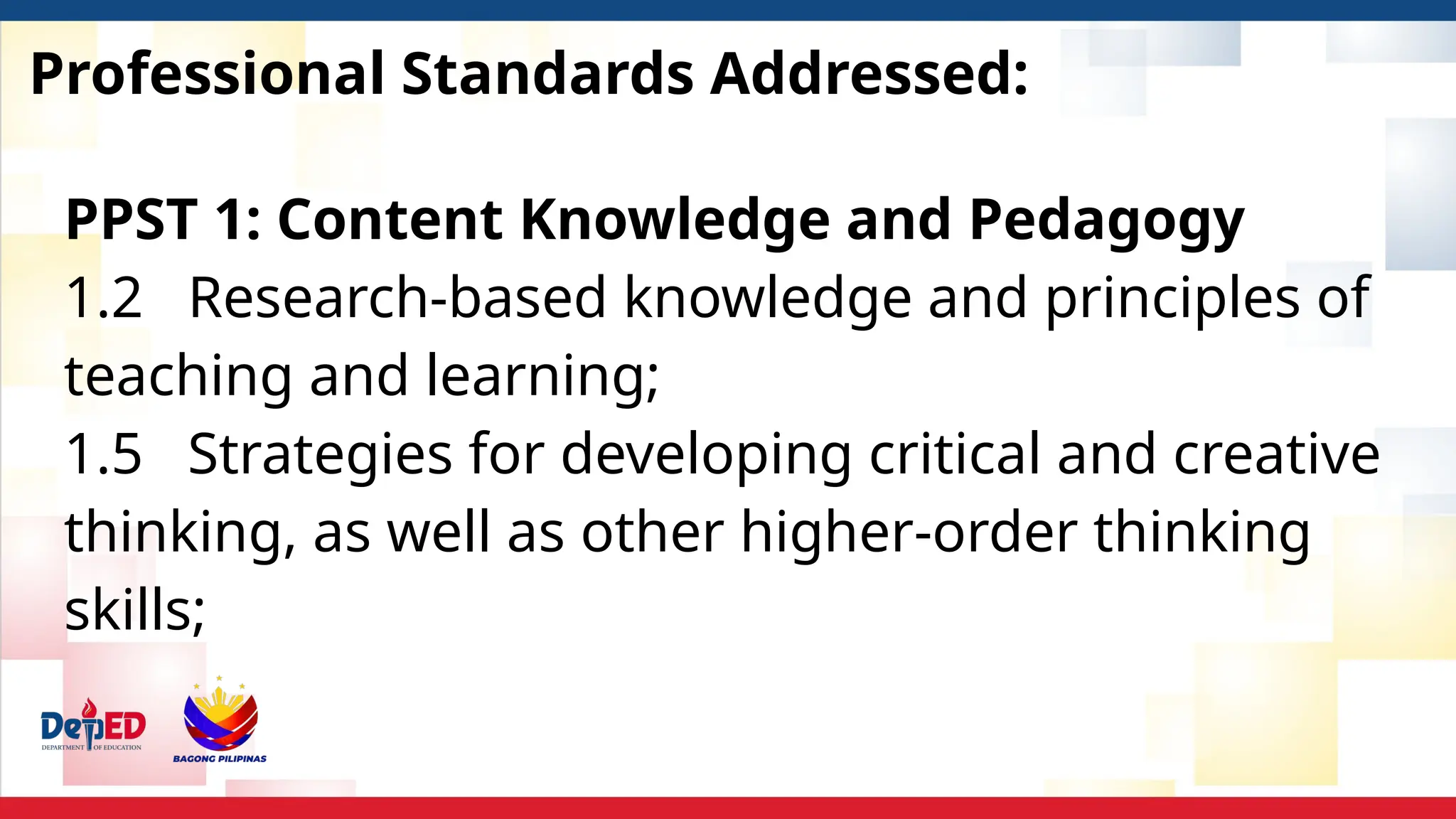
Professional Standards Addressed:
PPST1: Content Knowledge and Pedagogy
1.2 Research-based knowledge and principles of
teaching and learning;
1.5 Strategies for developing critical and creative
thinking, as well as other higher-order thinking
skills;
5.
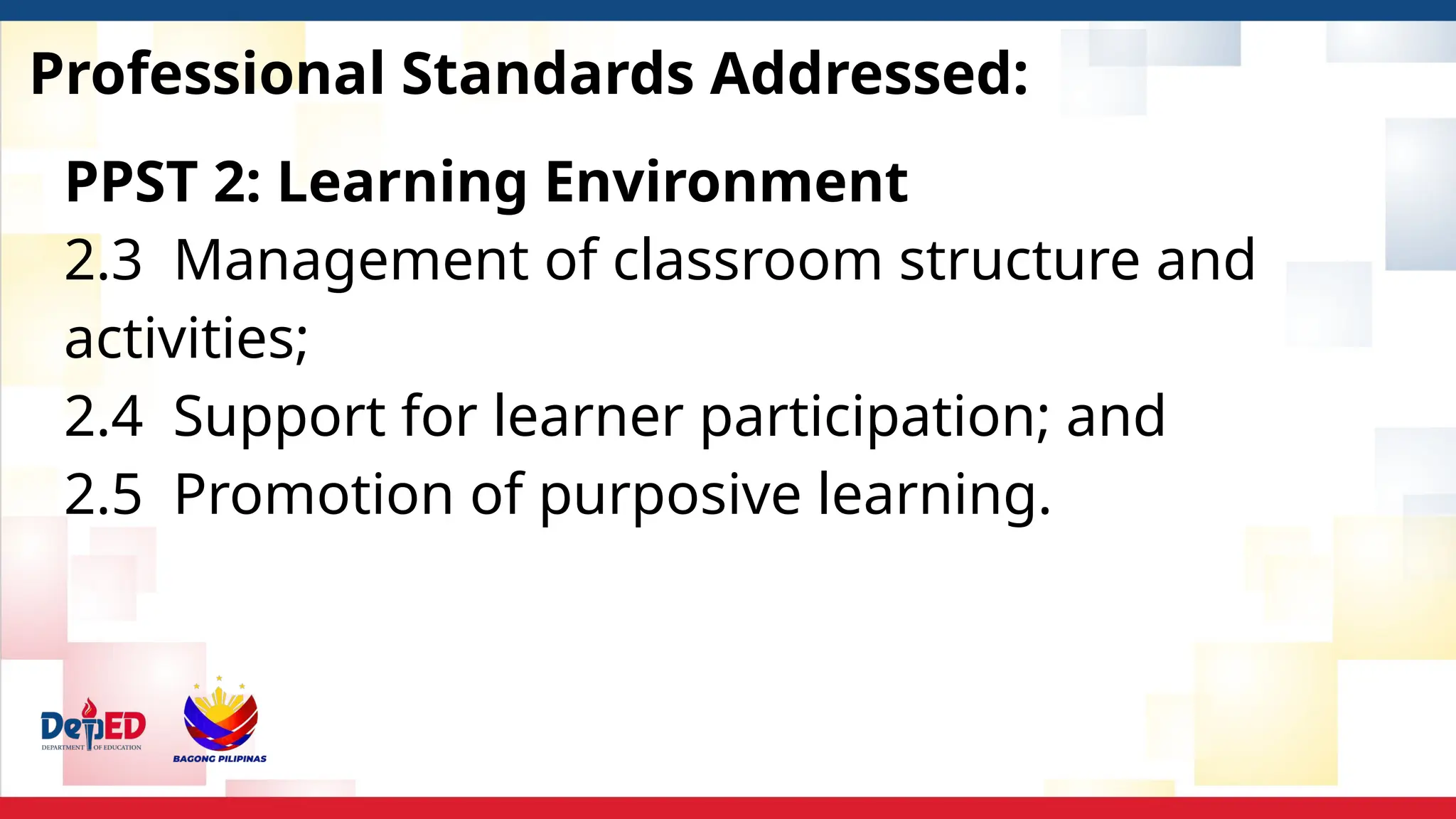
Professional Standards Addressed:
PPST2: Learning Environment
2.3 Management of classroom structure and
activities;
2.4 Support for learner participation; and
2.5 Promotion of purposive learning.
6.
Professional Standards Addressed:
PPST4: Curriculum and Planning
4.1. Planning and management of teaching and
learning process;
4.2 Learning outcomes aligned with learning
competencies.
7.
Session Objectives
At theend of the session, participants will…
1. Compare and contrast pedagogical theories,
approaches, teaching methods/strategies and
activities.
2. Classify different pedagogical approaches that can be
utilized that are aligned in the unpacked learning
competencies.
8.
Session Objectives
At theend of the session, participants will…
3.Articulate 21st
century skills that is aligned to the
pedagogical approaches that can be utilized that is aligned
in the unpacked learning competencies.
4. Classify different assessments whether formative or
summative type of assessment.
9.
Session Objectives
At theend of the session, participants will…
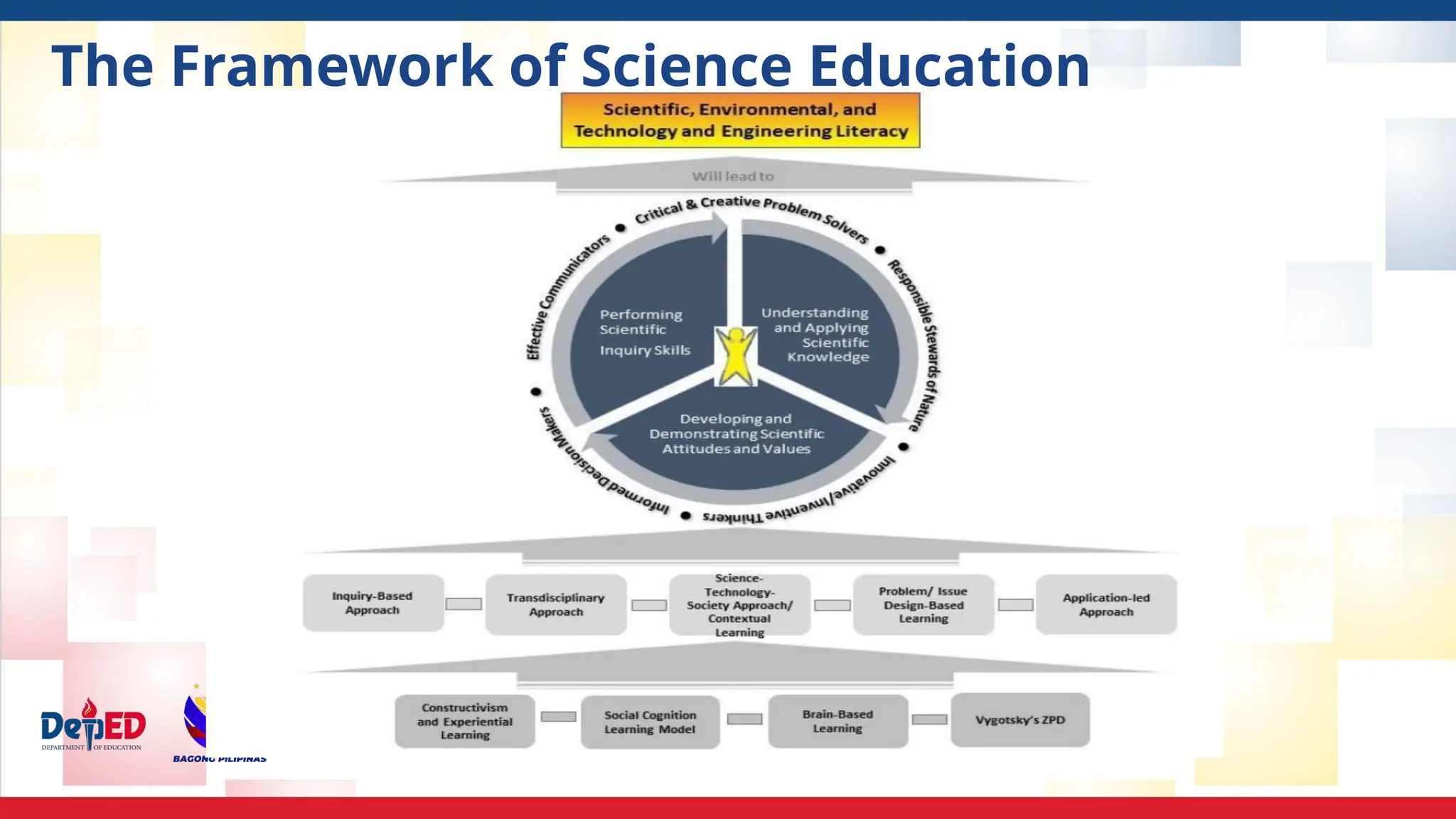
5. Describe the different features of assessment based on DO
8, s. 2015 and DO 31, s. 2020
6. Categorize different assessment activities in relation to the
unpacked competencies, aligned with the pedagogical
approaches and teaching strategies.
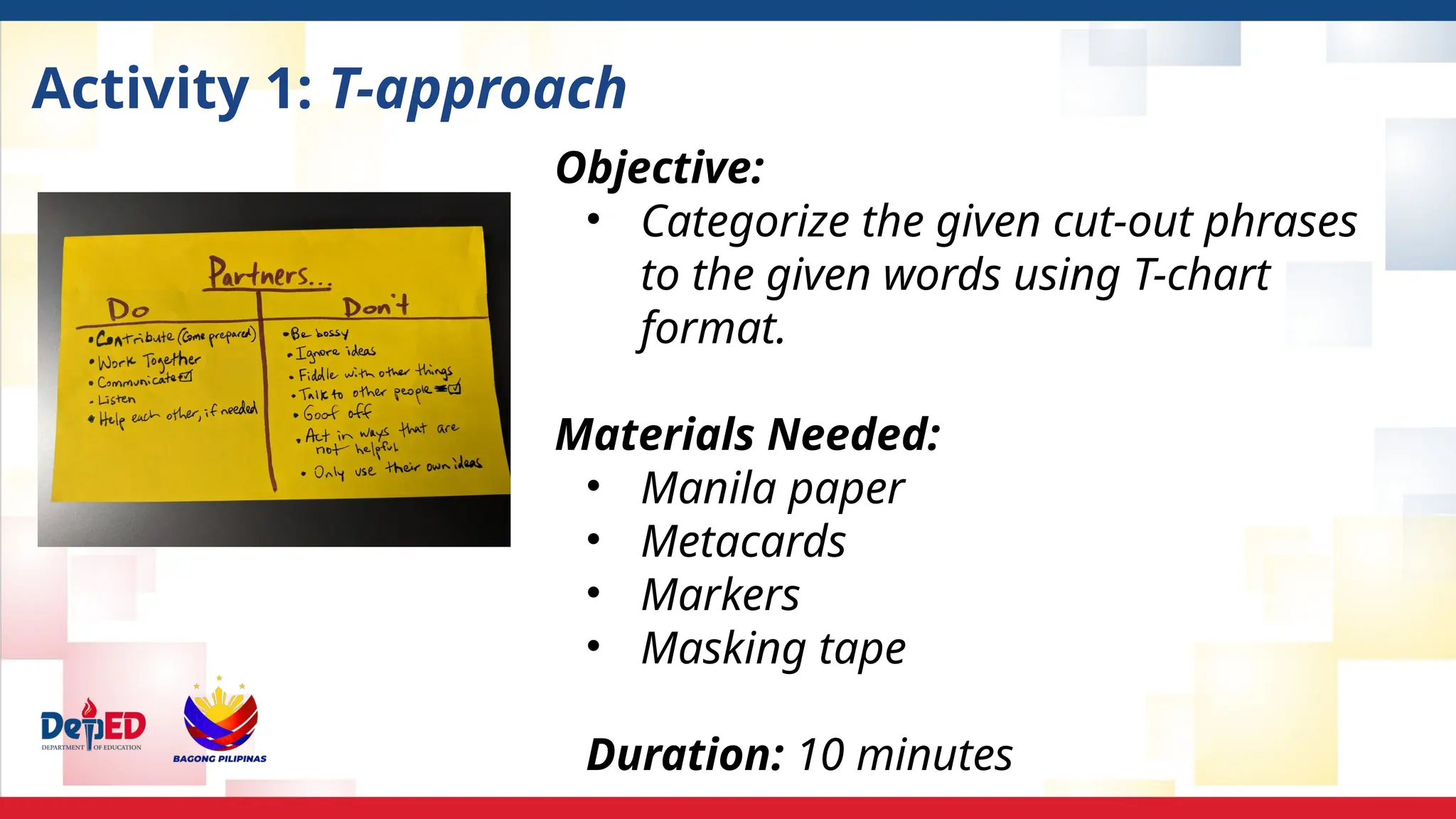
Activity 1: T-approach
Objective:
•Categorize the given cut-out phrases
to the given words using T-chart
format.
Materials Needed:
• Manila paper
• Metacards
• Markers
• Masking tape
Duration: 10 minutes
12.
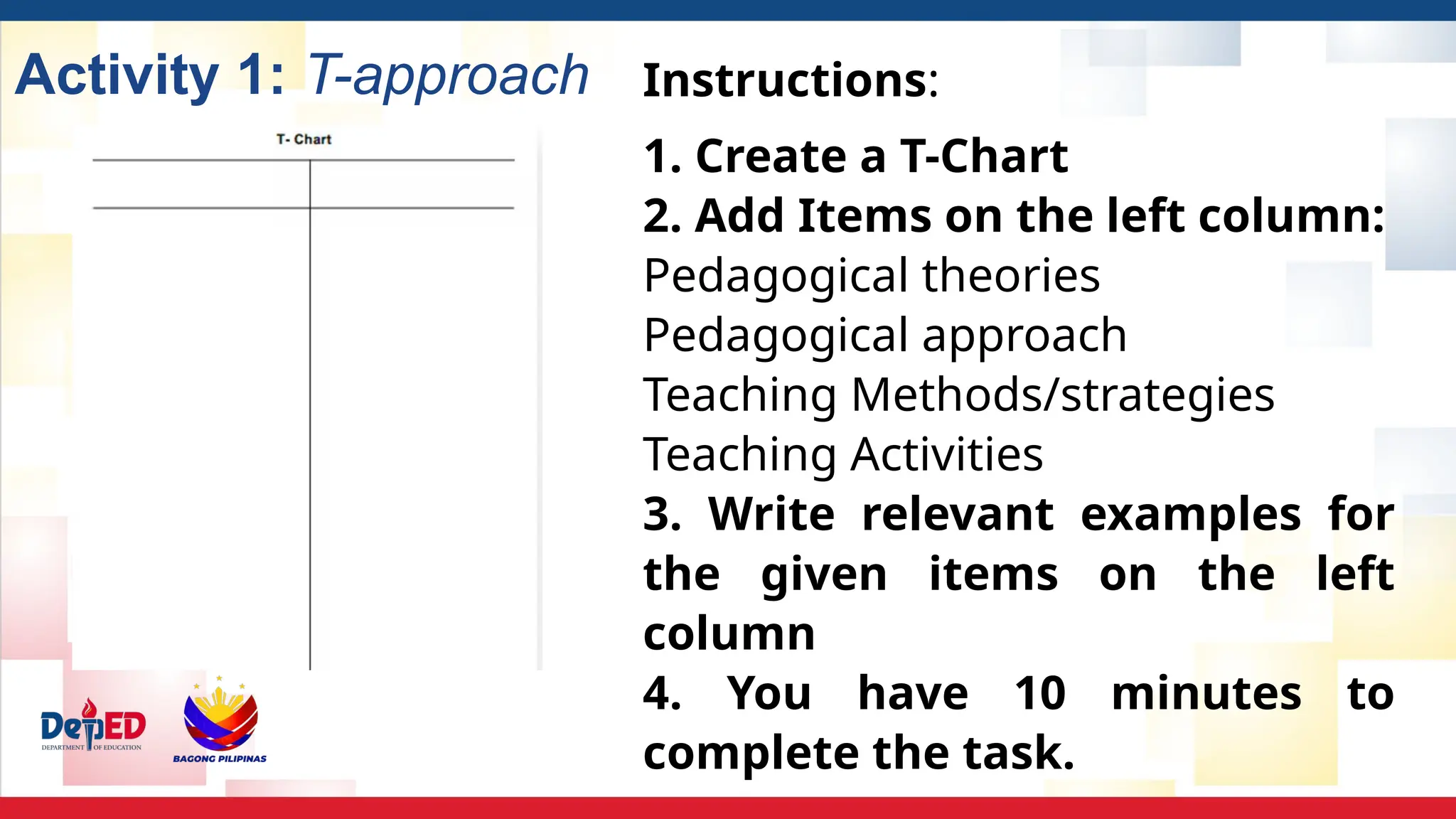
Activity 1: T-approachInstructions:
1. Create a T-Chart
2. Add Items on the left column:
Pedagogical theories
Pedagogical approach
Teaching Methods/strategies
Teaching Activities
3. Write relevant examples for
the given items on the left
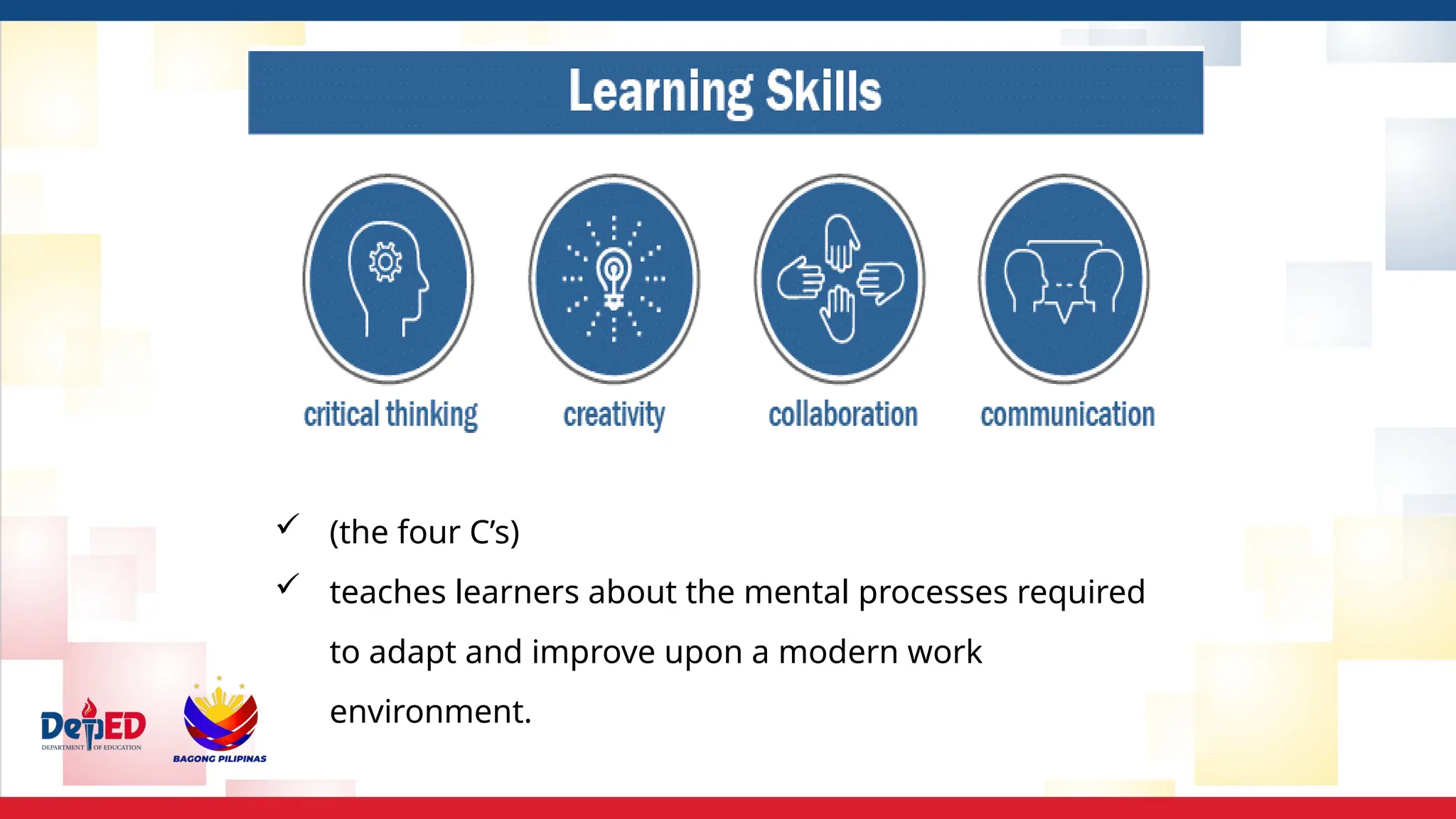
column
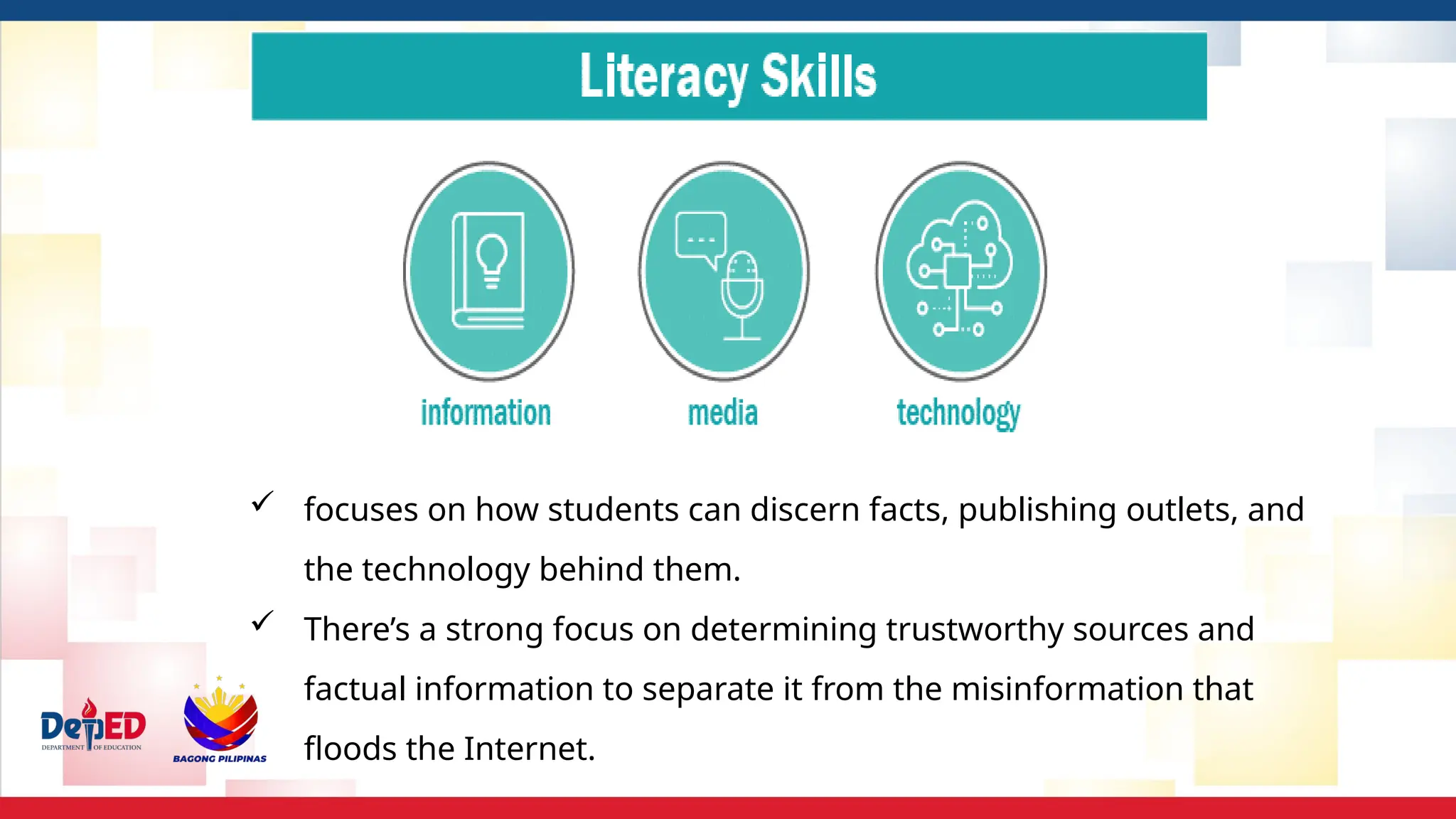
4. You have 10 minutes to
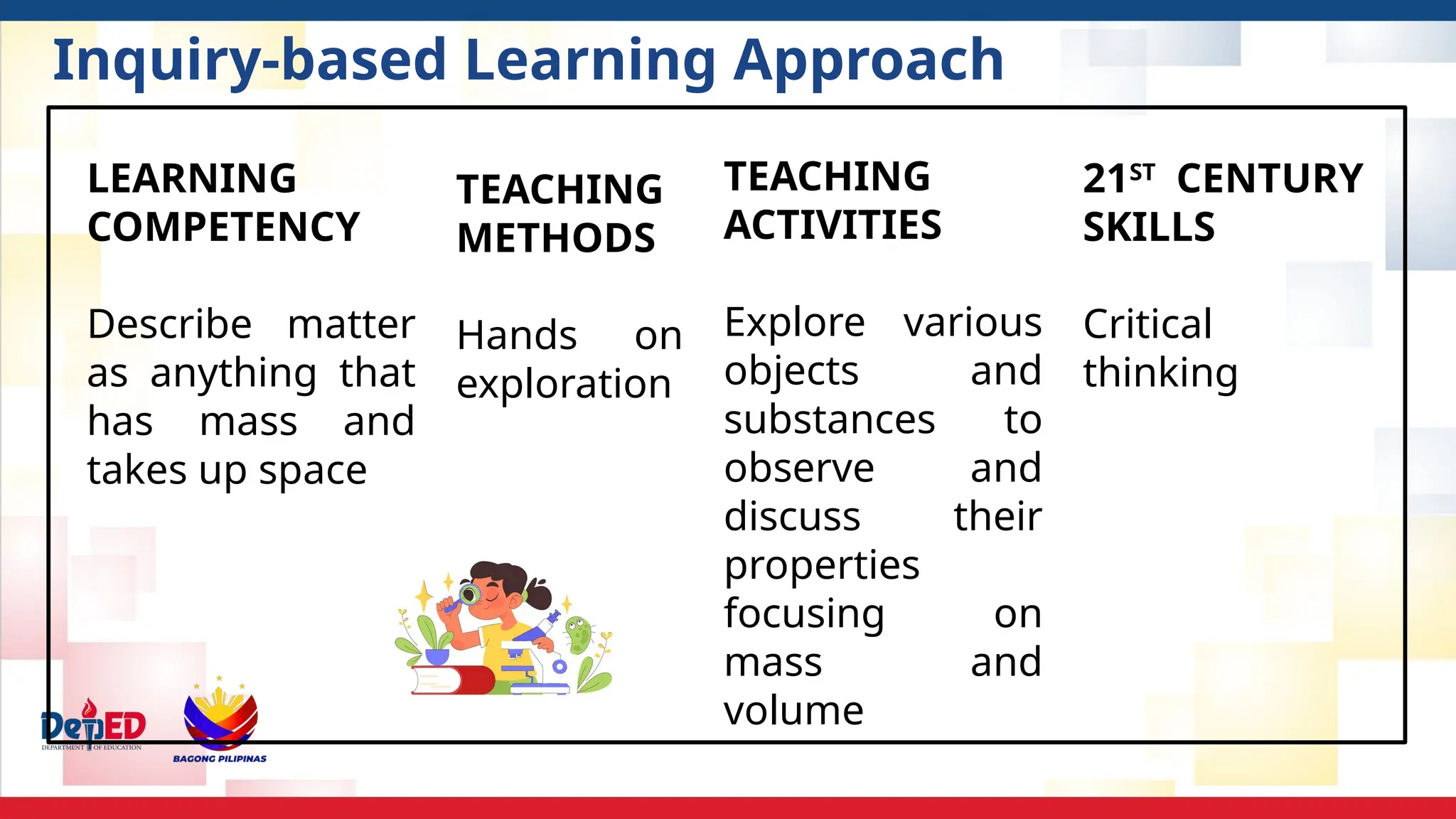
complete the task.
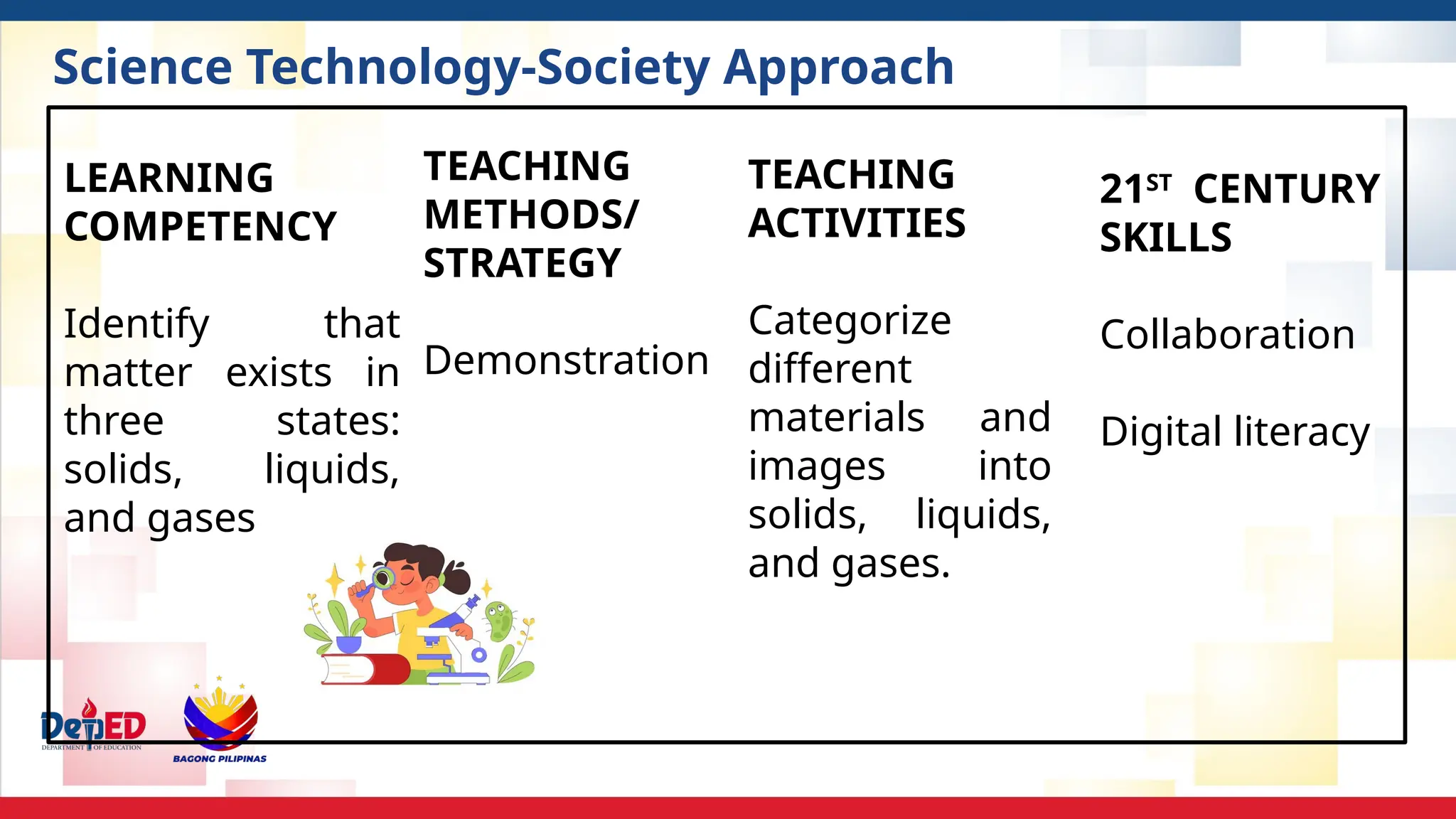
13.
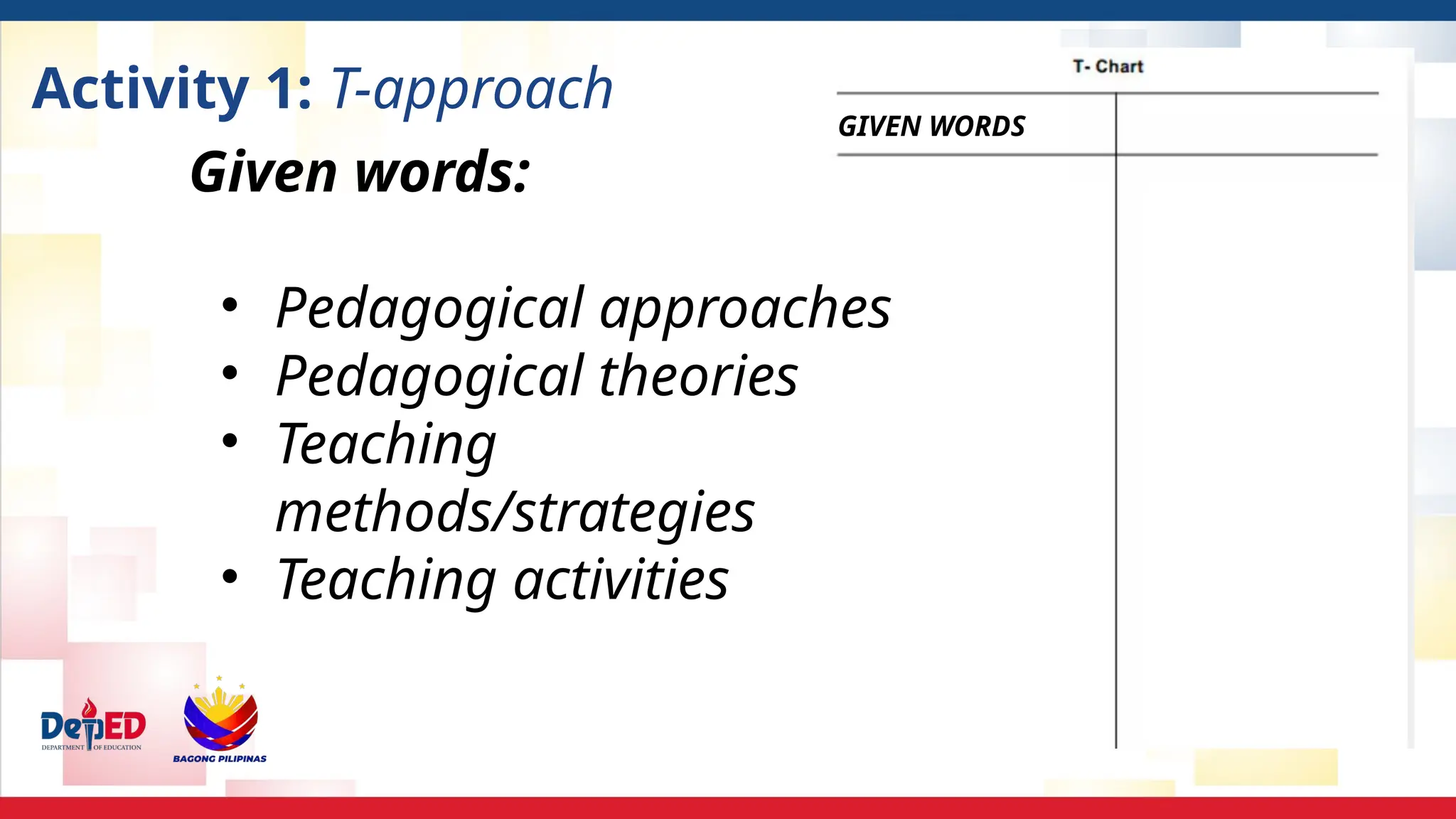
Activity 1: T-approach
Givenwords:
• Pedagogical approaches
• Pedagogical theories
• Teaching
methods/strategies
• Teaching activities
GIVEN WORDS
14.
GUIDE QUESTIONS
1.What arethe key differences between
pedagogical theories, pedagogical
approaches, teaching methods/strategies,
and teaching strategies?
2.In what ways can understanding these
differences enhance your effectiveness in your
own work context?
15.
GUIDE QUESTIONS
3.How canyou apply specific
pedagogical theories, approaches,
methods/strategies, or strategies to
improve your teaching or educational
practice?
Activity 1 -Group Presentation
TWIST & CHALLENGE using Pecha Kucha
style of presentation.
● Presentation Format:
• Use the Pecha Kucha style: Present each
item in the left column with a maximum
of 20 seconds per item.
• Presentation time should not more than
2 minutes per group.
GUIDE QUESTIONS
1.What arethe key differences between
pedagogical theories, pedagogical
approaches, teaching methods/strategies,
and teaching strategies?
2.In what ways can understanding these
differences enhance your effectiveness in your
own work context?
20.
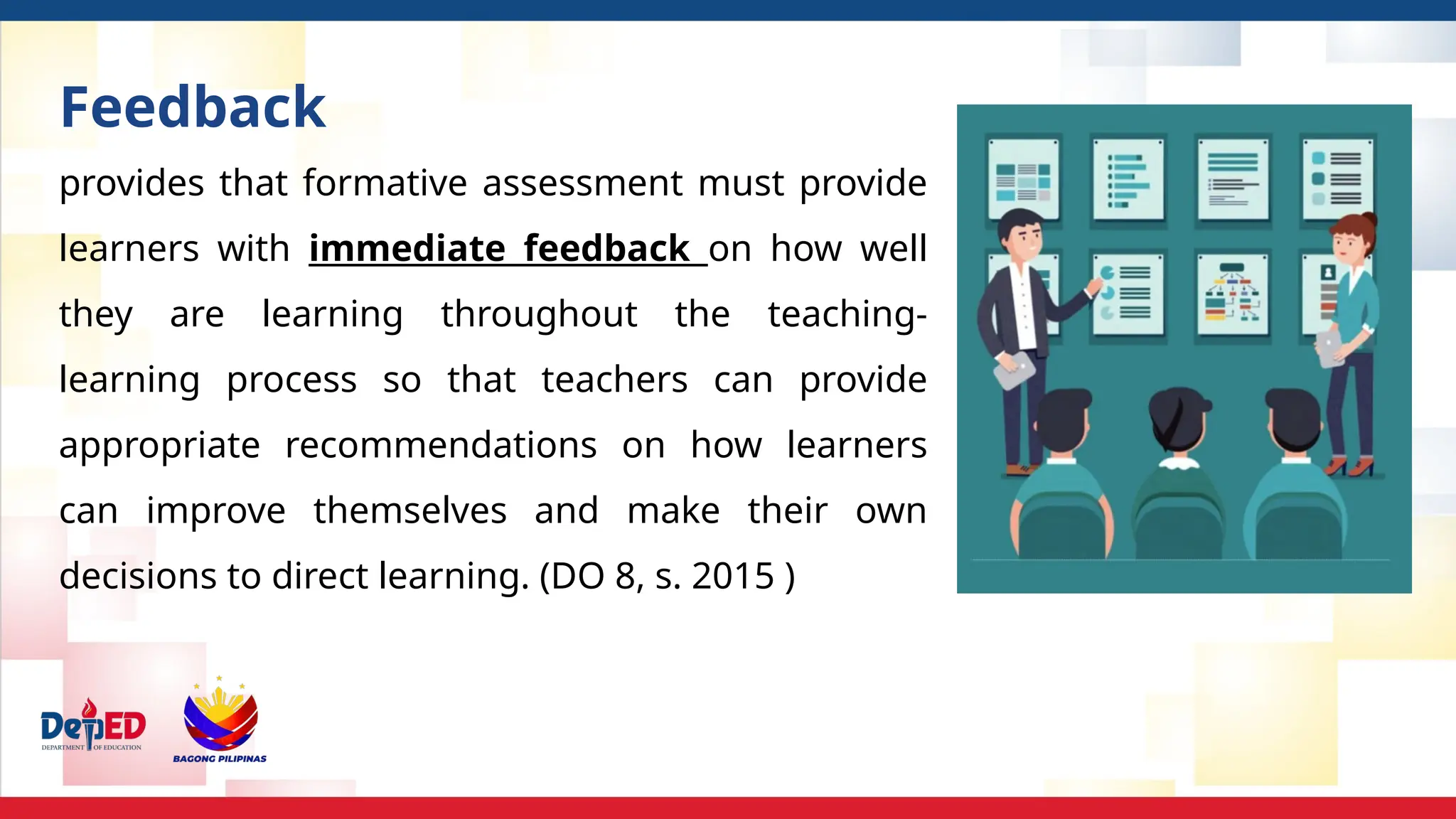
GUIDE QUESTIONS
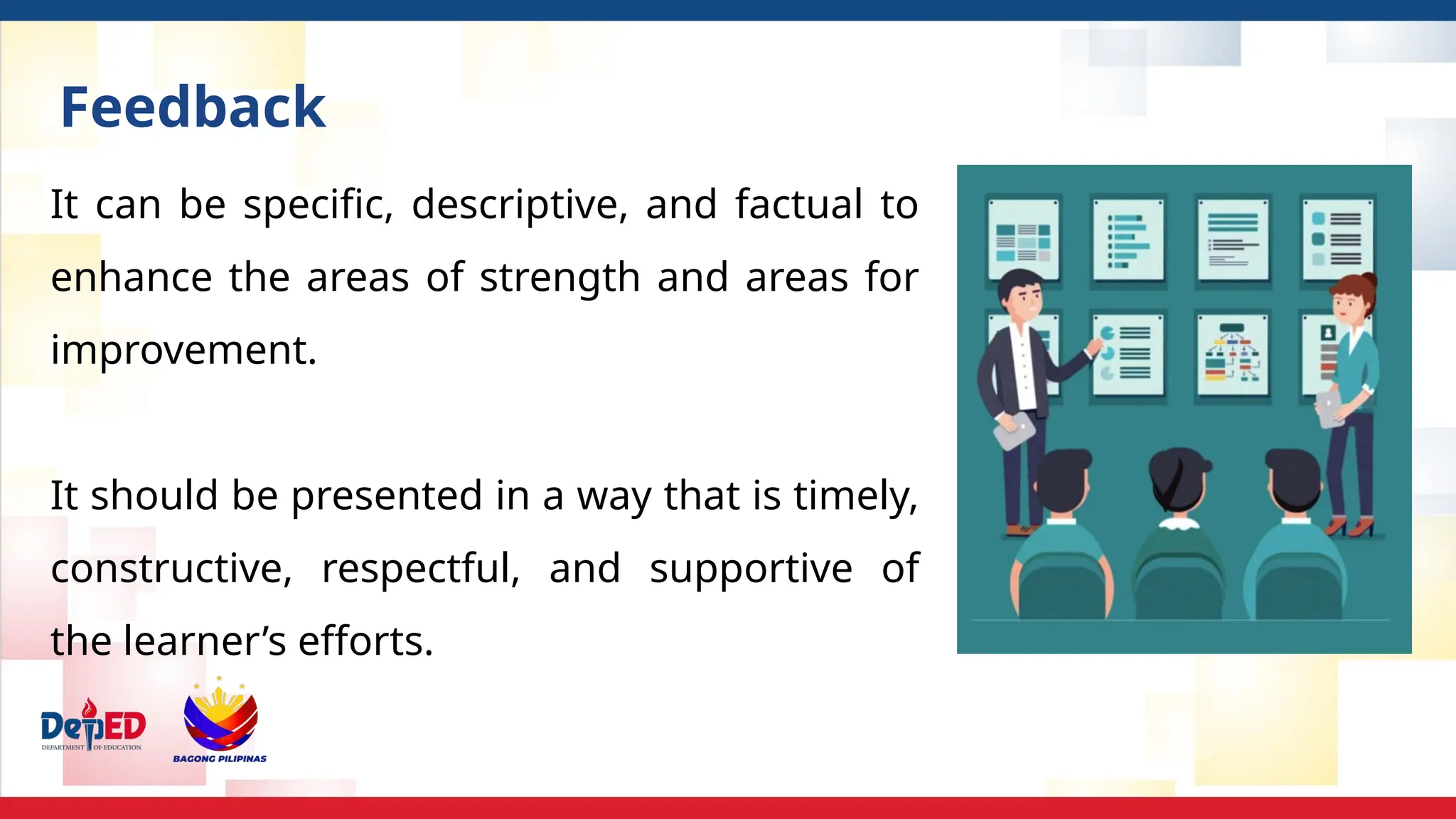
3.How canyou apply specific
pedagogical theories, approaches,
methods/strategies, activities to
improve your teaching or educational
practice?
22.
Let us clearthis up!
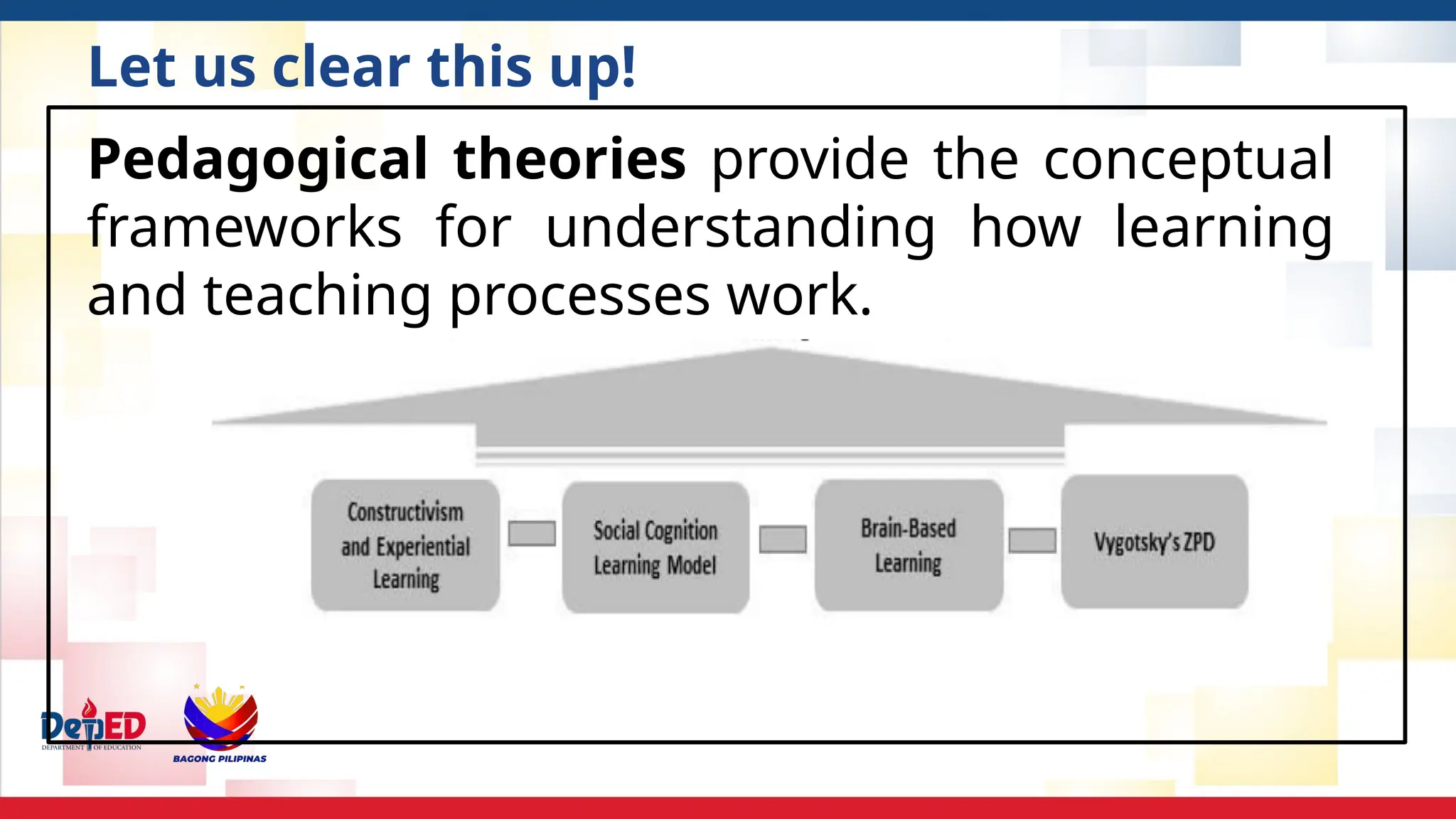
Pedagogical theories provide the conceptual
frameworks for understanding how learning
and teaching processes work.
23.
Let us clearthis up!
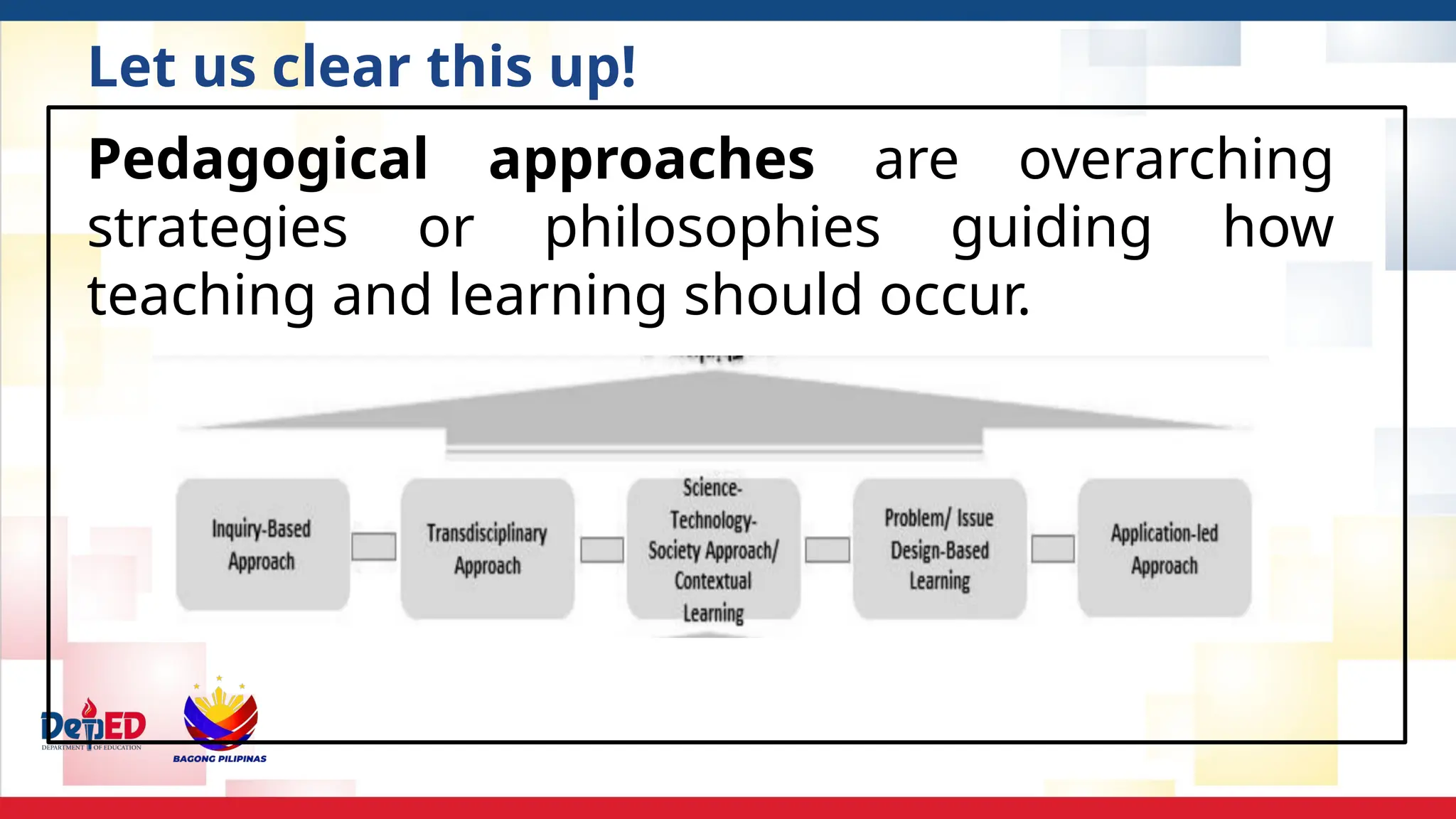
Pedagogical approaches are overarching
strategies or philosophies guiding how
teaching and learning should occur.
24.
Teaching methods/strategies arespecific
techniques employed by educators to facilitate
learning.
Teaching activities are concrete tasks or
exercises used within methods to engage
students and support their learning.
Let us clear this up!
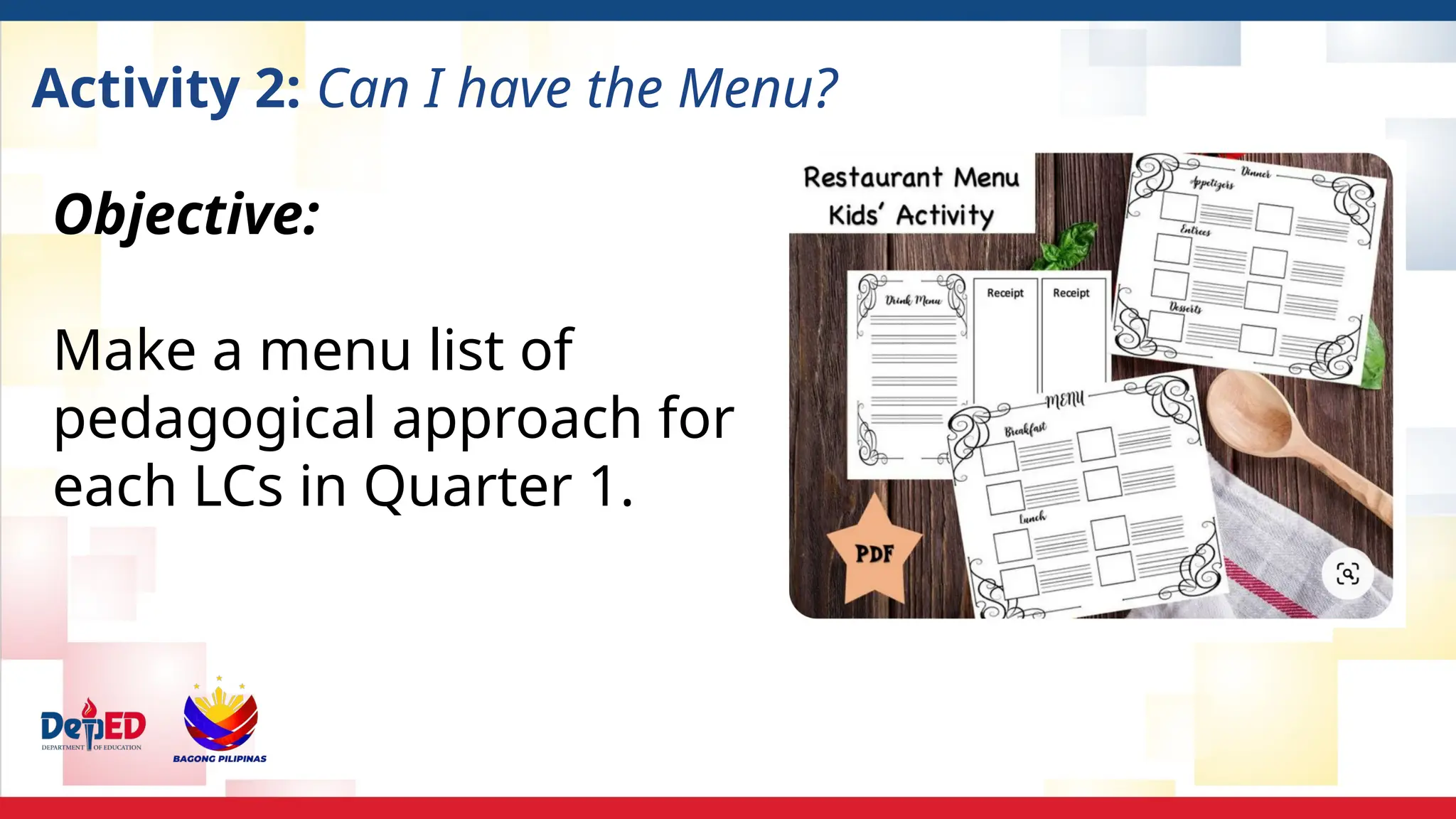
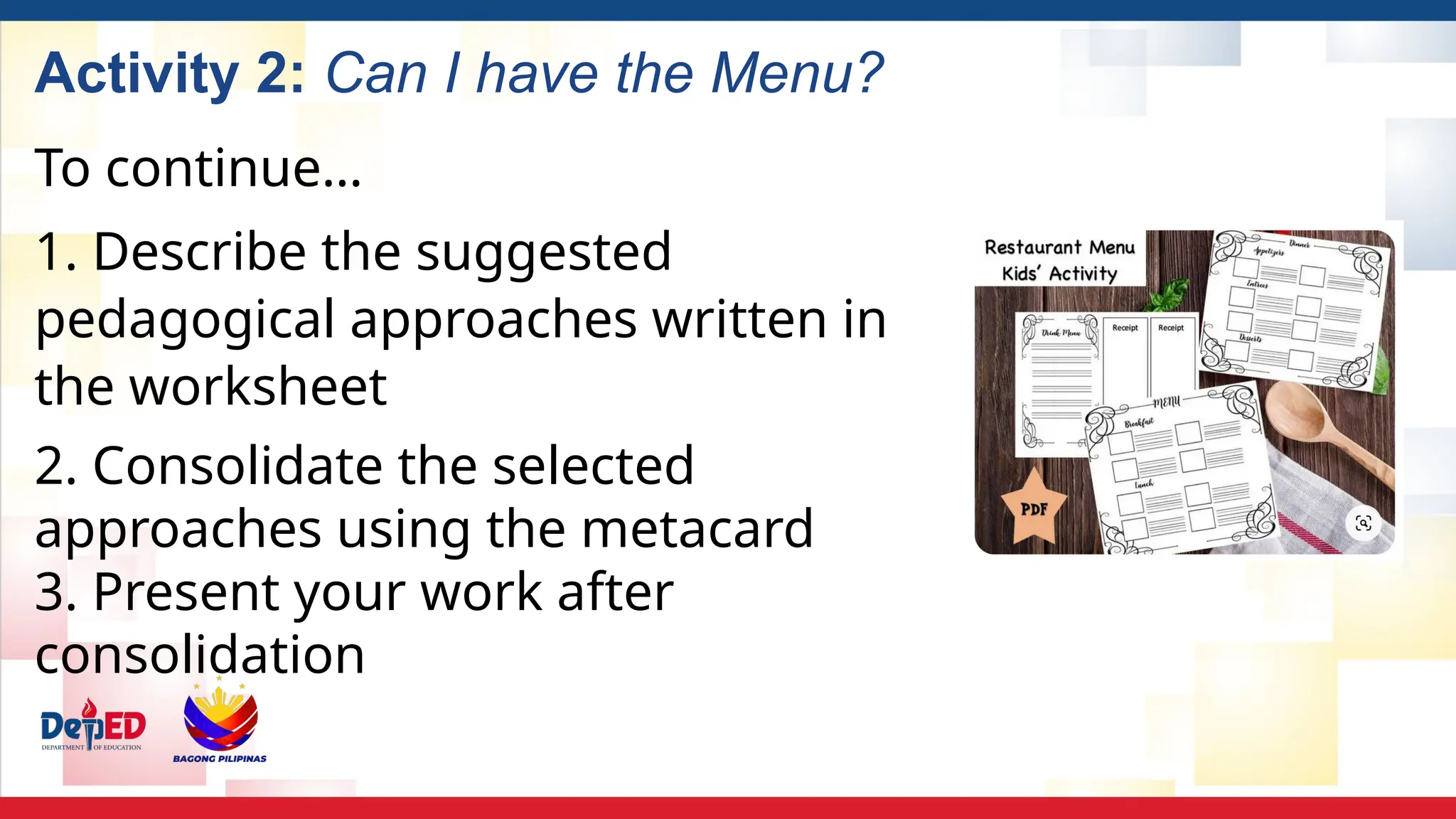
Activity 2: CanI have the Menu?
Objective:
Make a menu list of
pedagogical approach for
each LCs in Quarter 1.
29.
Activity 2: CanI have the Menu?
Instructions:
1. Gather necessary materials from the
facilitator.
2. List down Pedagogical Approaches in
your worksheet
3. You will be given 5 minutes to finish
the task.
Activity 2: CanI have the Menu?
To continue…
1. Describe the suggested
pedagogical approaches written in
the worksheet
2. Consolidate the selected
approaches using the metacard
3. Present your work after
consolidation
32.
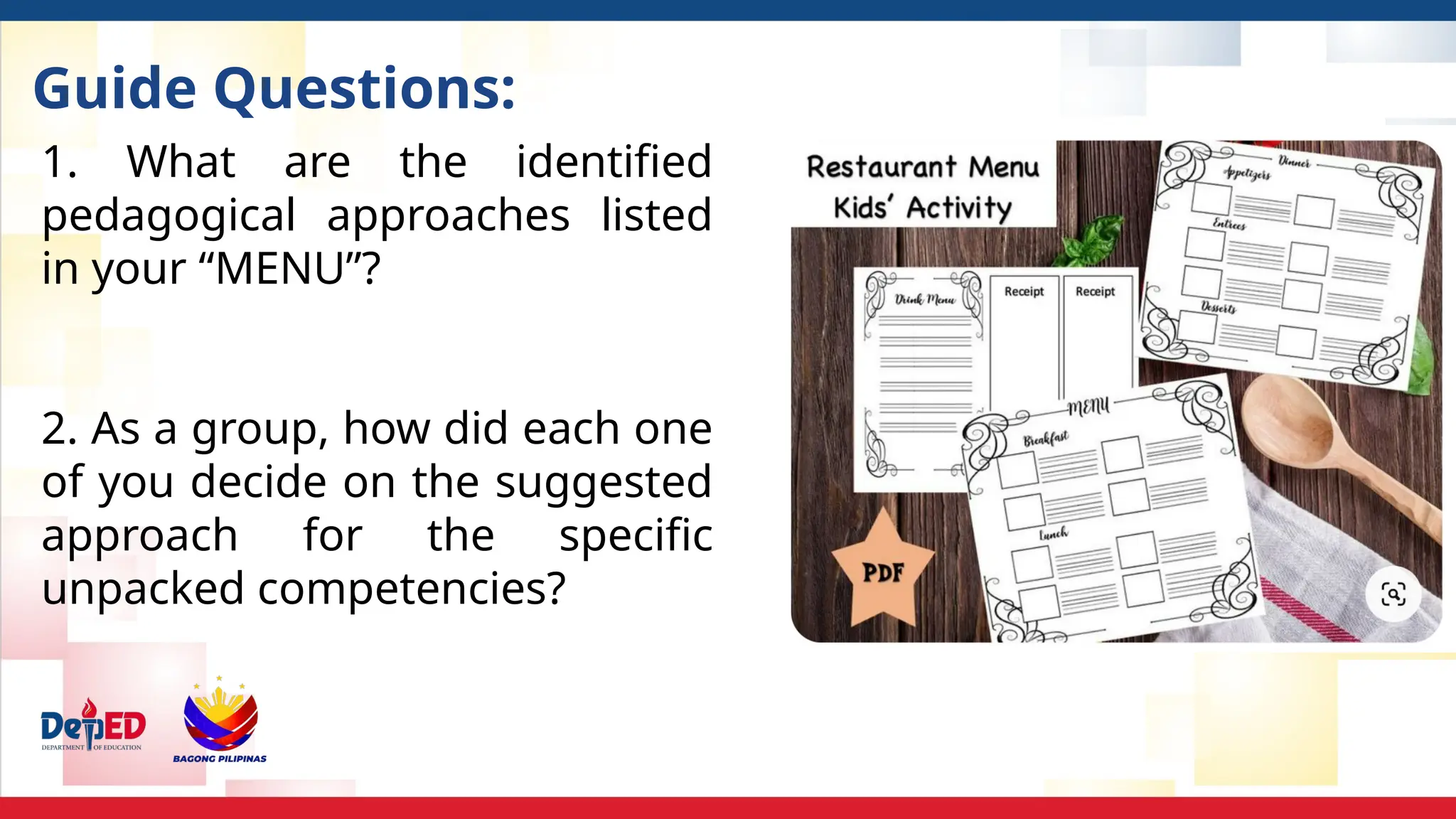
Guide Questions:
1. Whatare the identified
pedagogical approaches listed
in your “MENU”?
2. As a group, how did each one
of you decide on the suggested
approach for the specific
unpacked competencies?
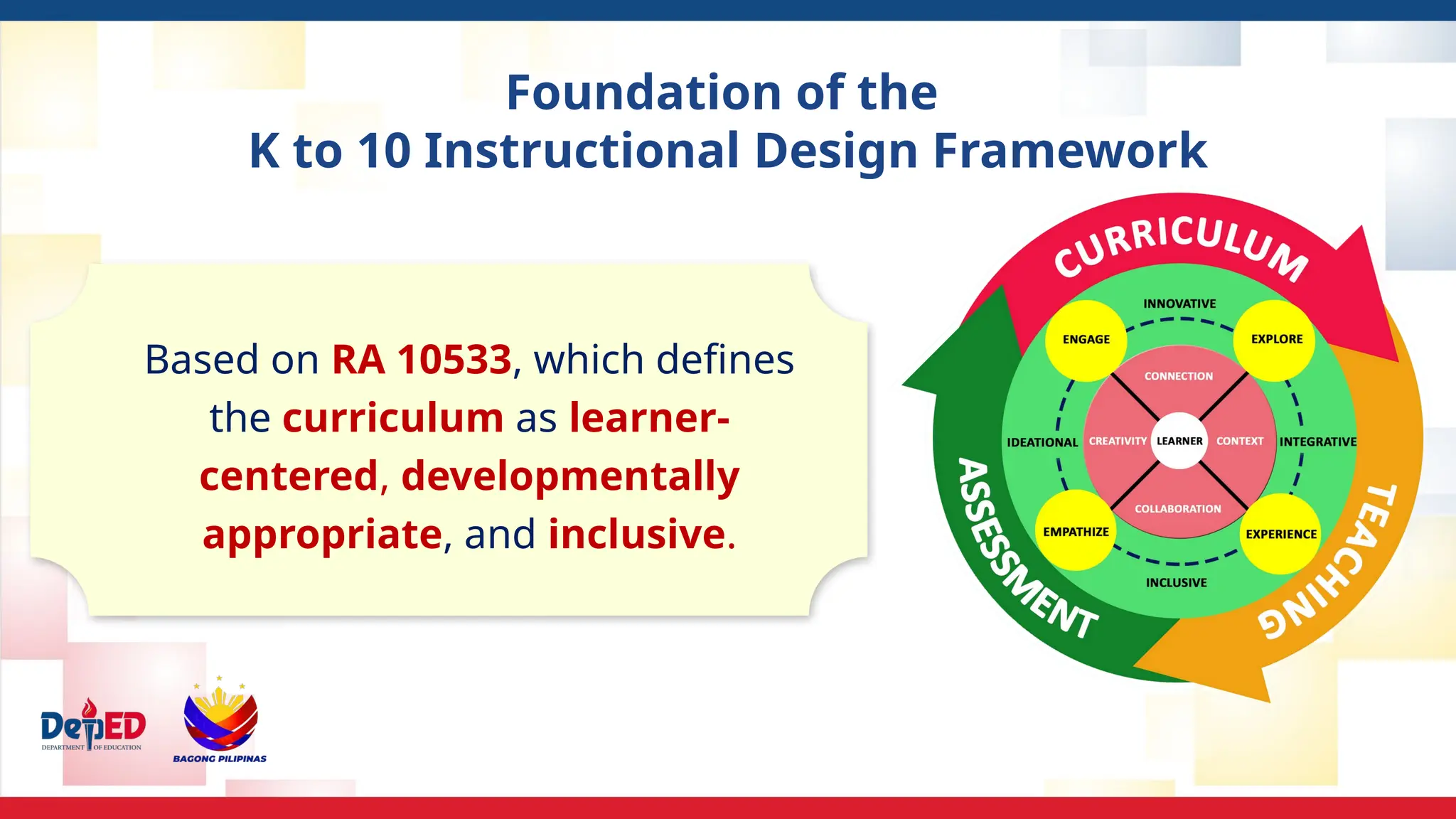
Foundation of the
Kto 10 Instructional Design Framework
Based on RA 10533, which defines
the curriculum as learner-
centered, developmentally
appropriate, and inclusive.
38.
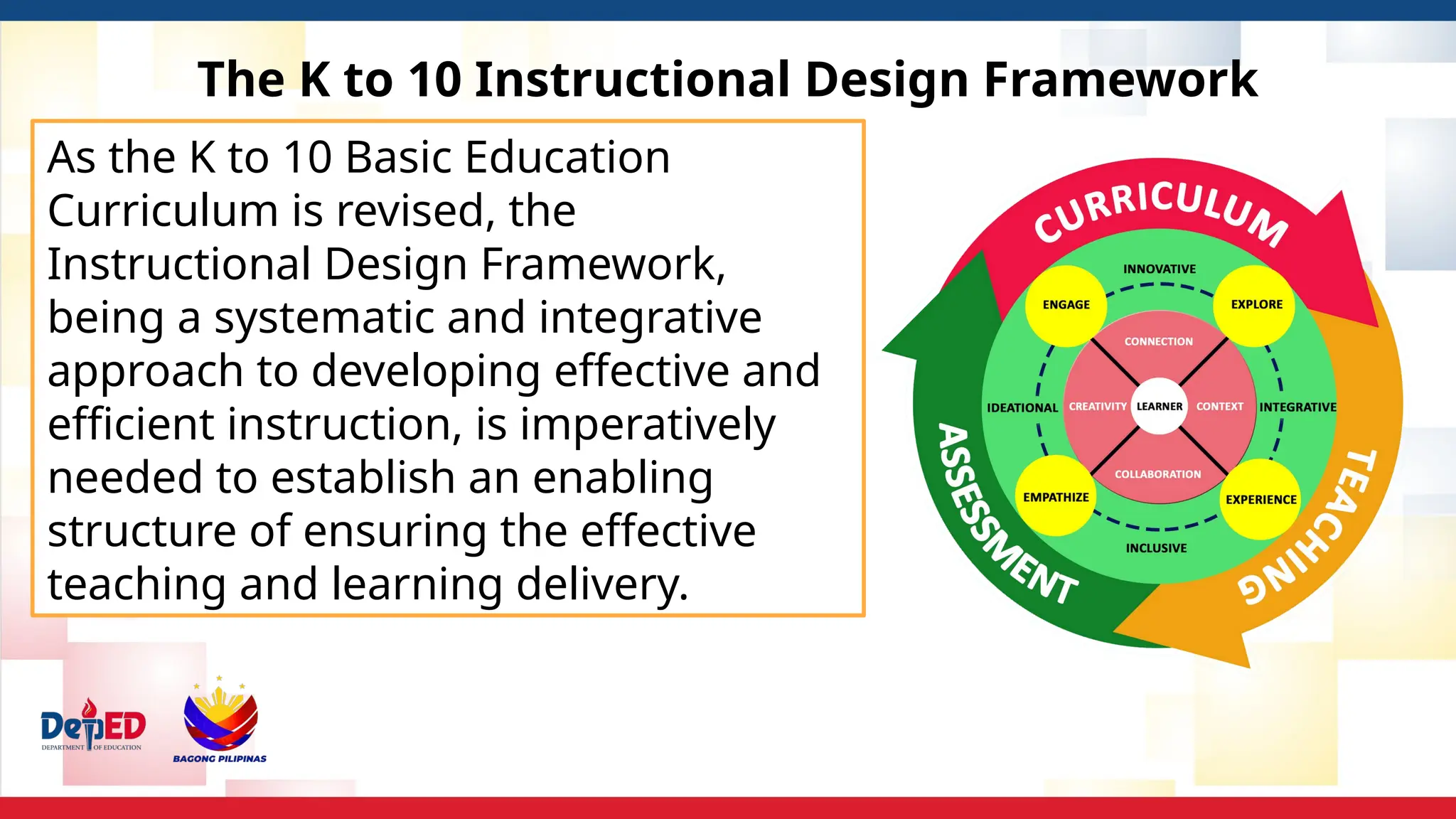
As the Kto 10 Basic Education
Curriculum is revised, the
Instructional Design Framework,
being a systematic and integrative
approach to developing effective and
efficient instruction, is imperatively
needed to establish an enabling
structure of ensuring the effective
teaching and learning delivery.
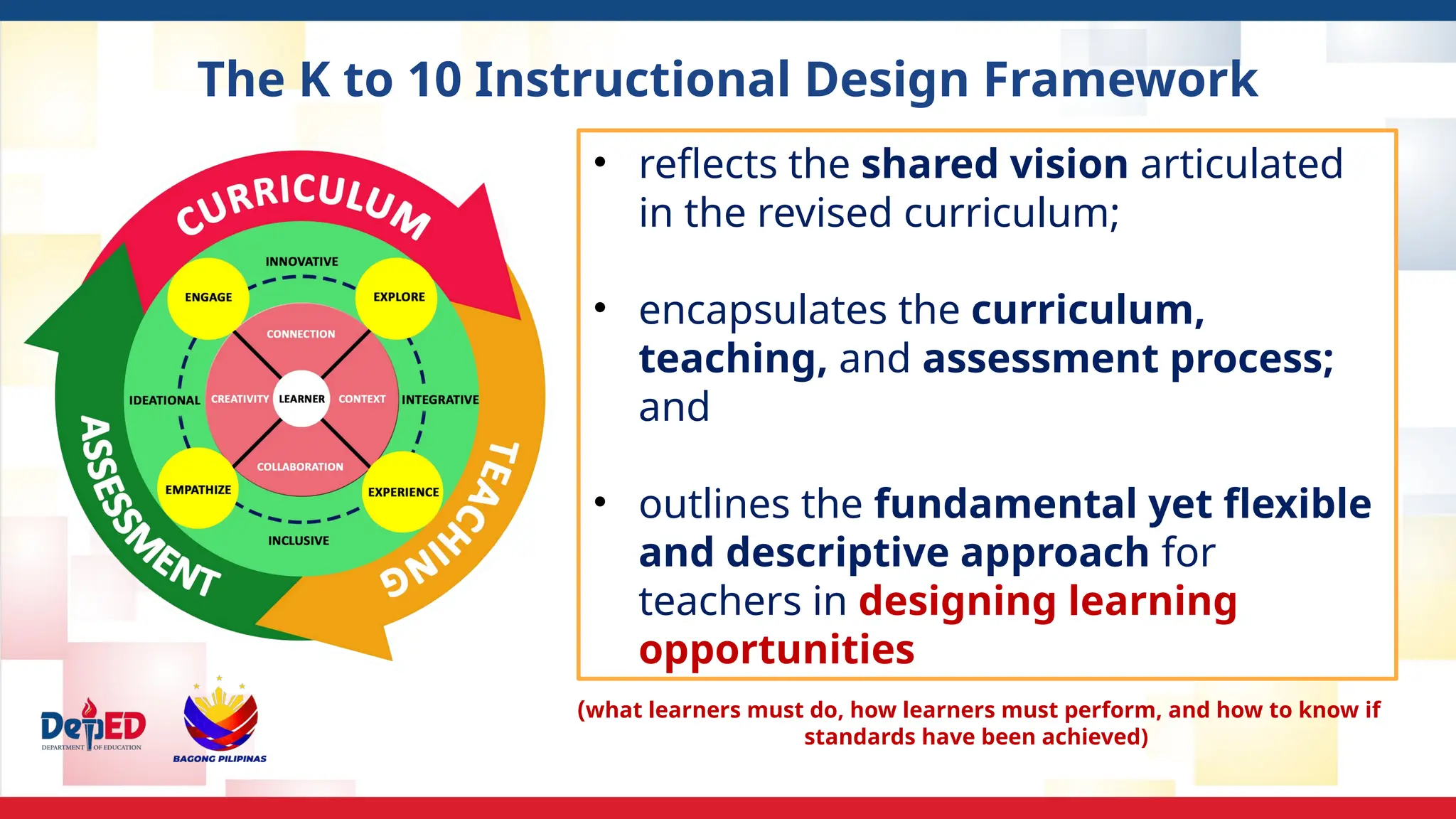
The K to 10 Instructional Design Framework
39.
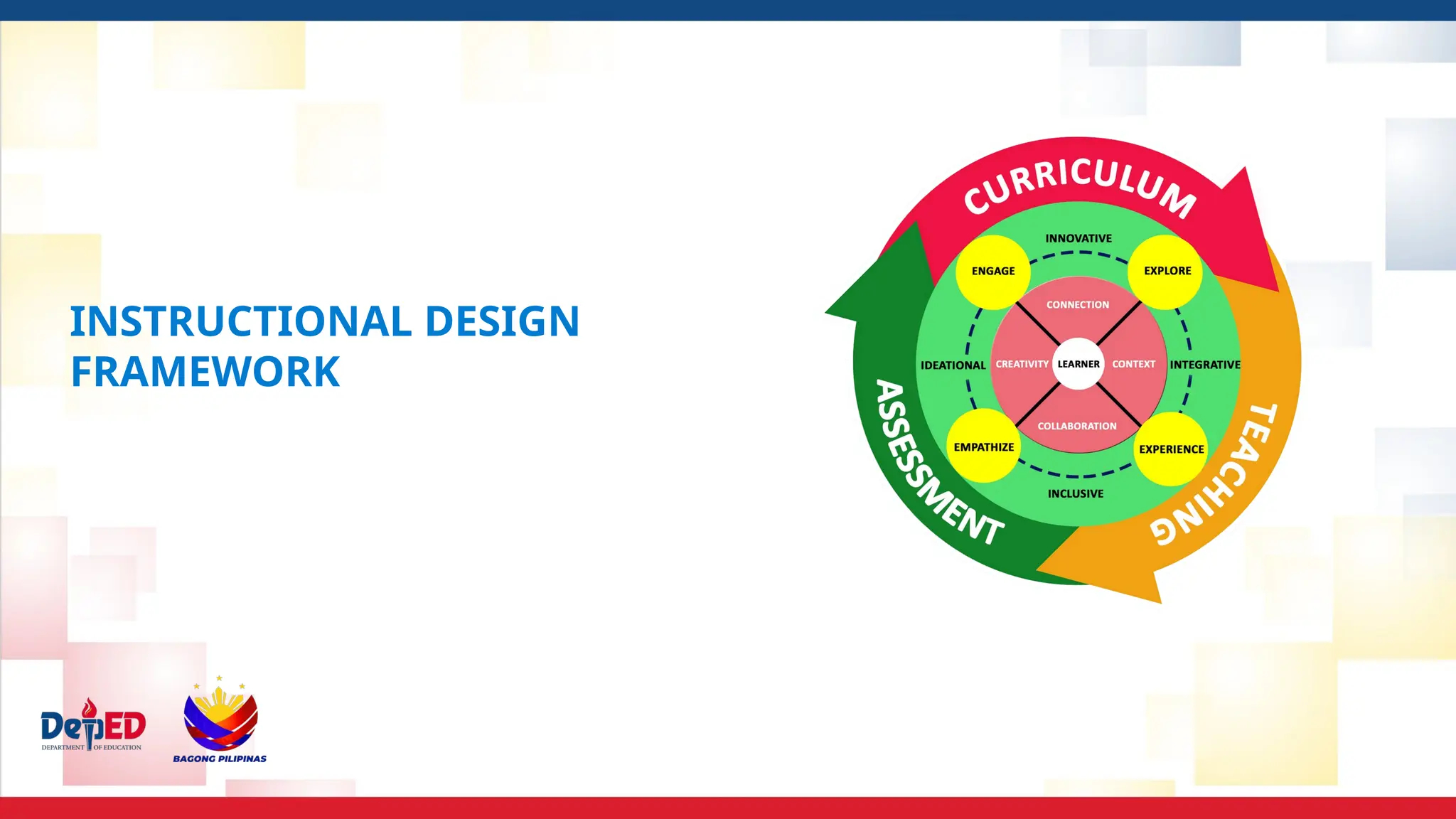
The K to10 Instructional Design Framework
• reflects the shared vision articulated
in the revised curriculum;
• encapsulates the curriculum,
teaching, and assessment process;
and
• outlines the fundamental yet flexible
and descriptive approach for
teachers in designing learning
opportunities
(what learners must do, how learners must perform, and how to know if
standards have been achieved)
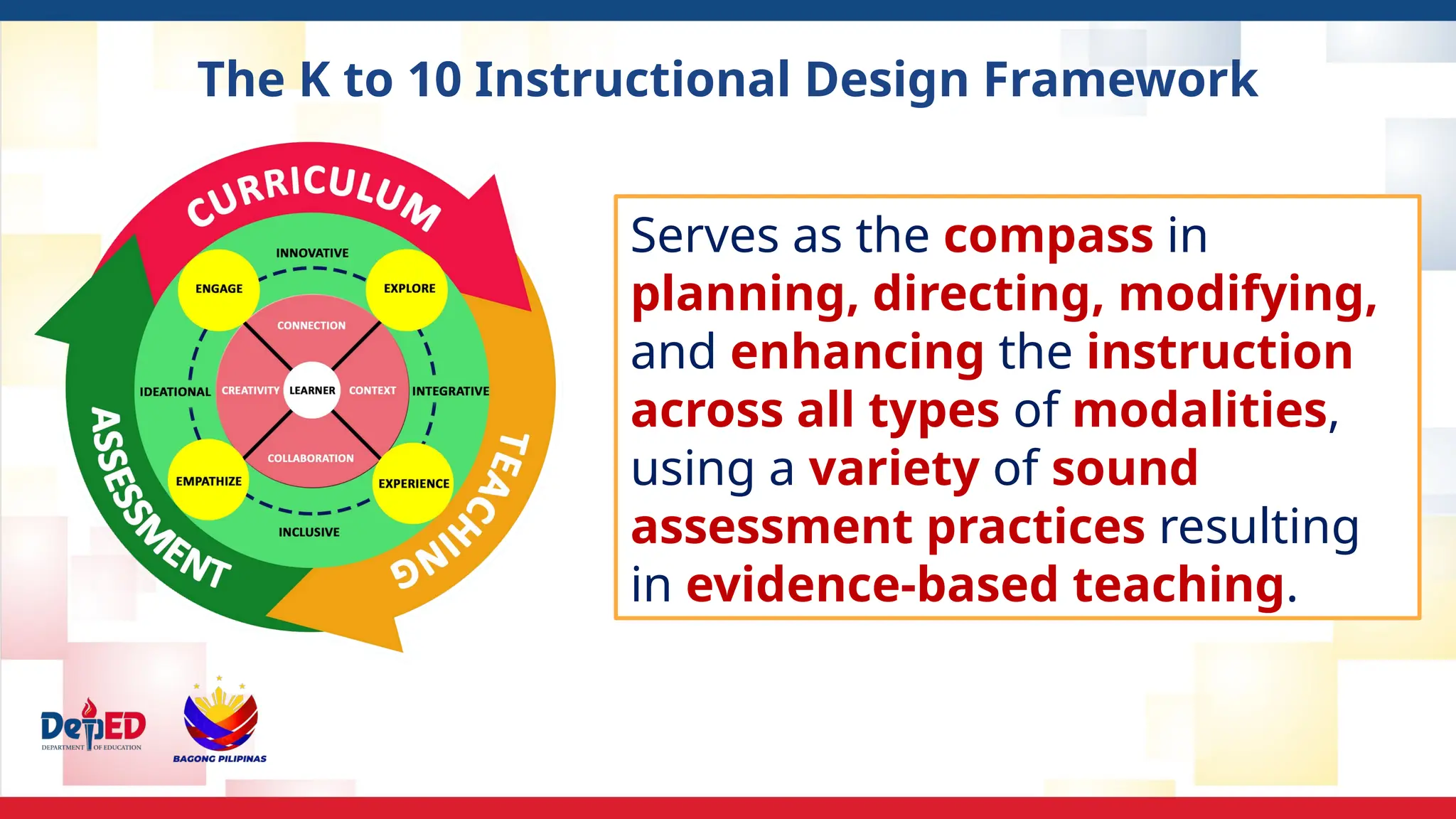
40.
Serves as thecompass in
planning, directing, modifying,
and enhancing the instruction
across all types of modalities,
using a variety of sound
assessment practices resulting
in evidence-based teaching.
The K to 10 Instructional Design Framework
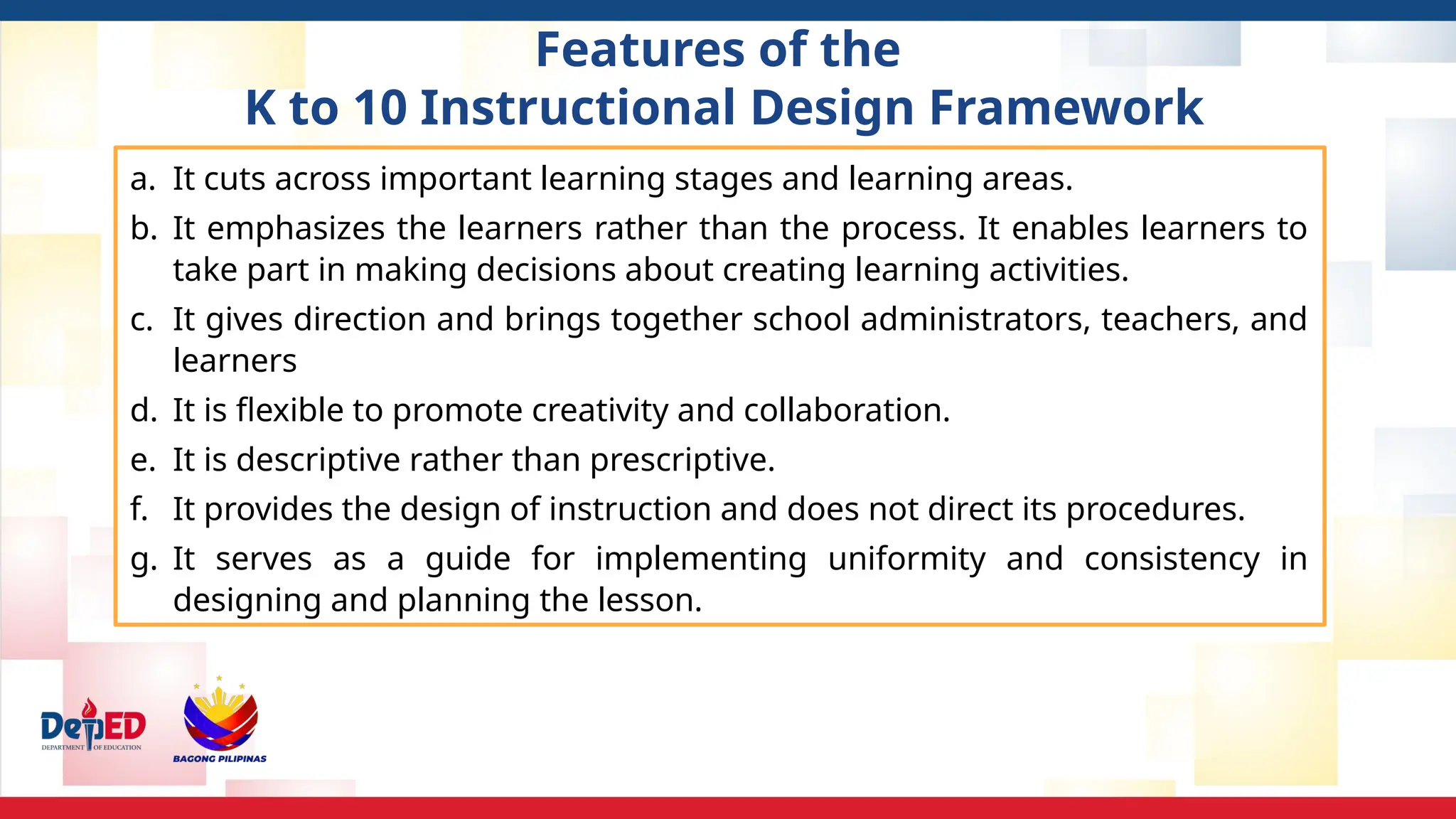
41.
Features of the
Kto 10 Instructional Design Framework
a. It cuts across important learning stages and learning areas.
b. It emphasizes the learners rather than the process. It enables learners to
take part in making decisions about creating learning activities.
c. It gives direction and brings together school administrators, teachers, and
learners
d. It is flexible to promote creativity and collaboration.
e. It is descriptive rather than prescriptive.
f. It provides the design of instruction and does not direct its procedures.
g. It serves as a guide for implementing uniformity and consistency in
designing and planning the lesson.
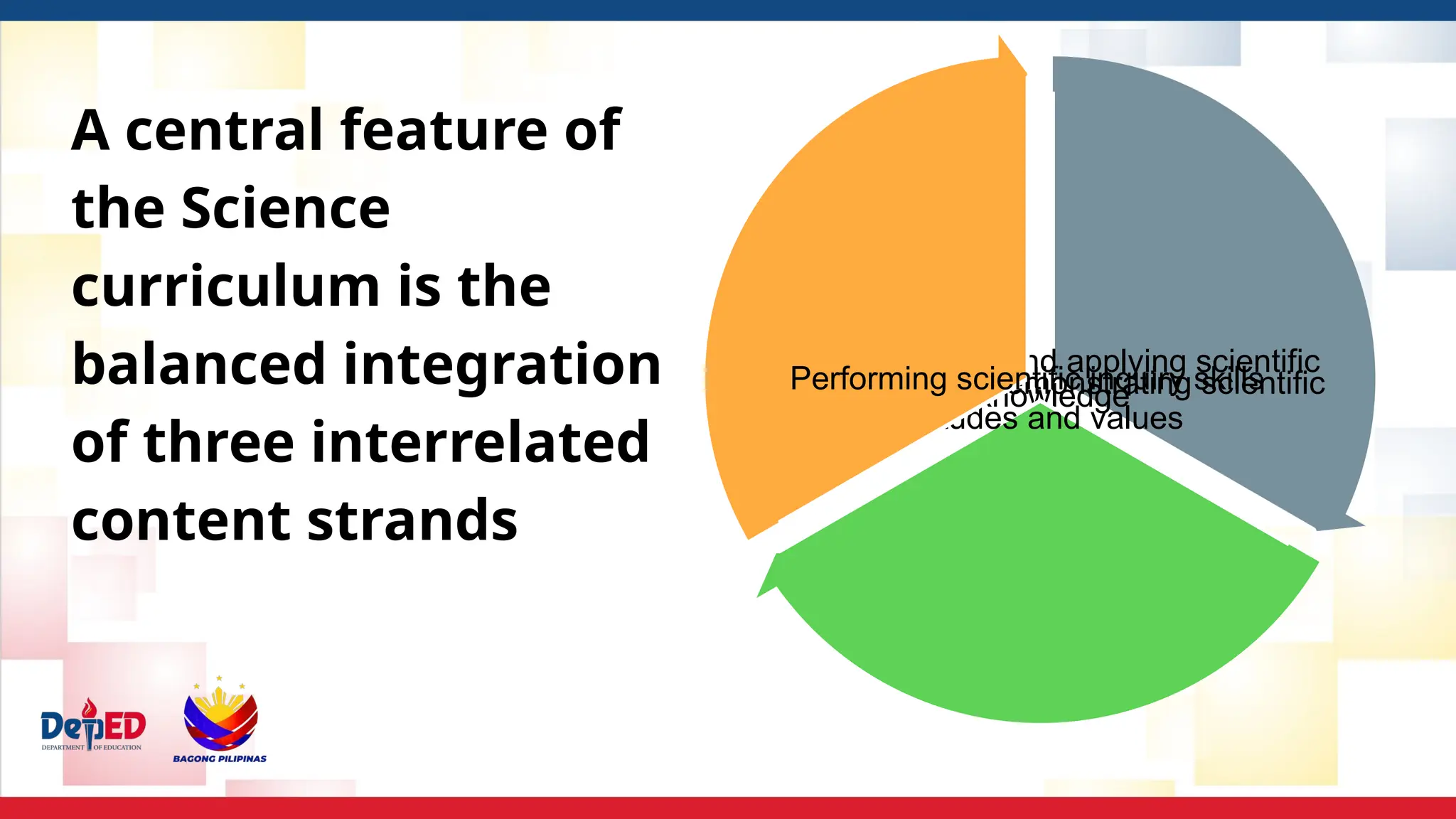
42.
A central featureof
the Science
curriculum is the
balanced integration
of three interrelated
content strands
Understanding and applying scientific
knowledge
Developing and demonstrating scientific
attitudes and values
Performing scientific inquiry skills
Inquiry-based Learning
The approachis characterized in the
classroom by questions and discussions.
Inquiry allows learners to formulate
questions and find solutions through
learning real-life-based investigations and
research projects.
48.
Inquiry-based Learning
In thisapproach learners also
engage in developing process skills,
analyzing and evaluating evidence,
experiencing and discussing, and
talking to their peers about their own
understanding (Suchman, 1964).
49.
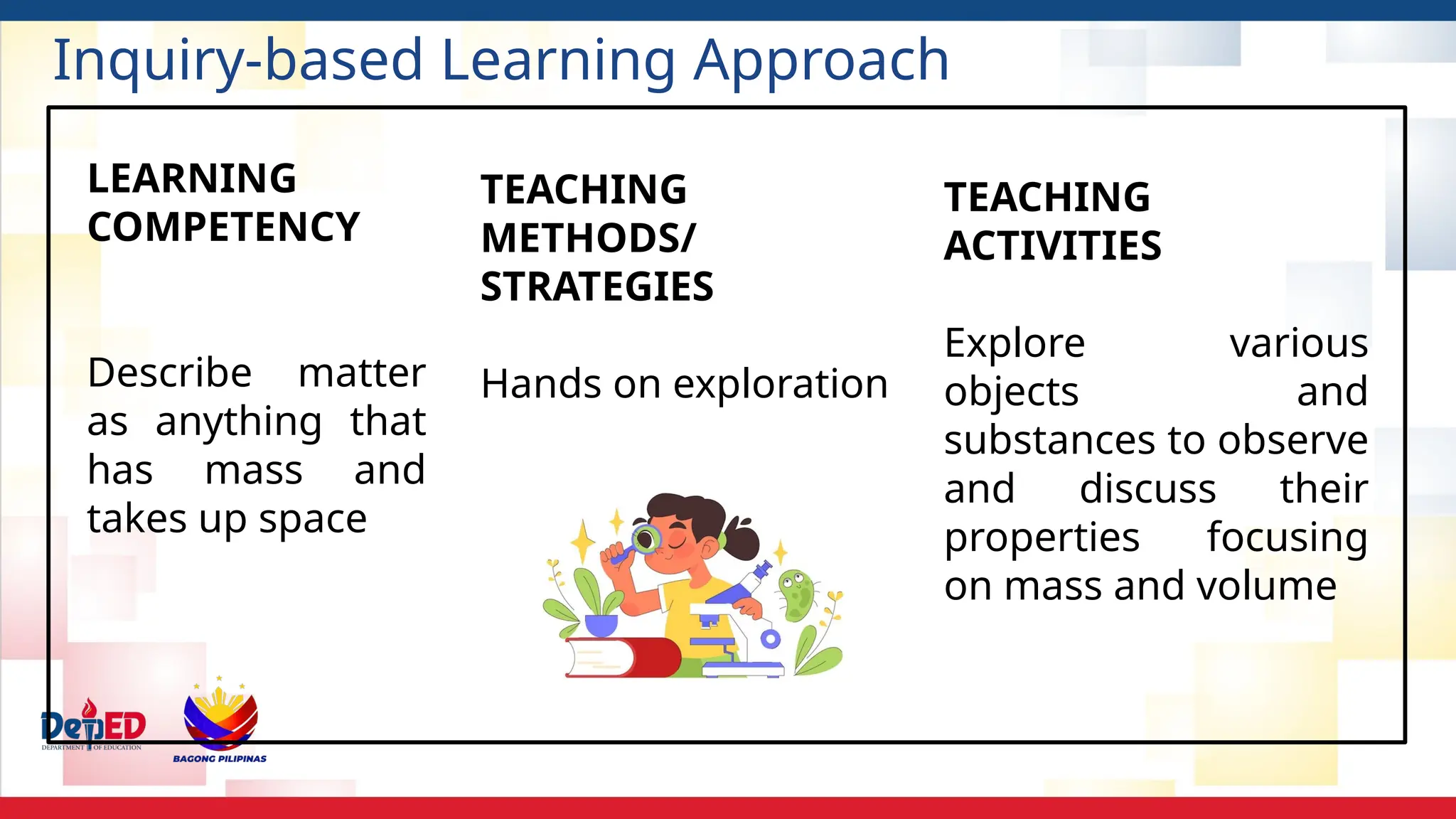
LEARNING
COMPETENCY
Describe matter
as anythingthat
has mass and
takes up space
TEACHING
METHODS/
STRATEGIES
Hands on exploration
TEACHING
ACTIVITIES
Explore various
objects and
substances to observe
and discuss their
properties focusing
on mass and volume
Inquiry-based Learning Approach
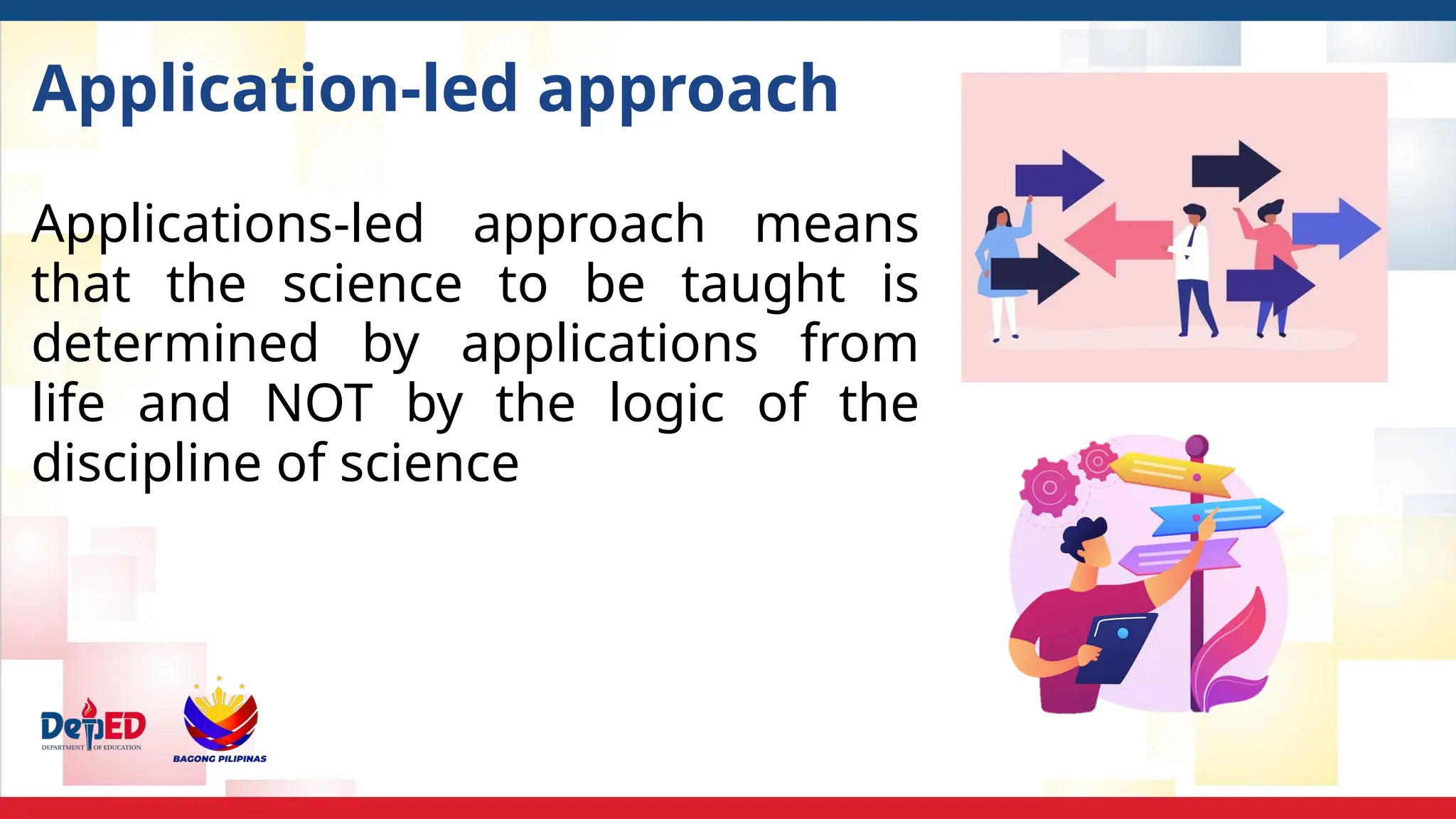
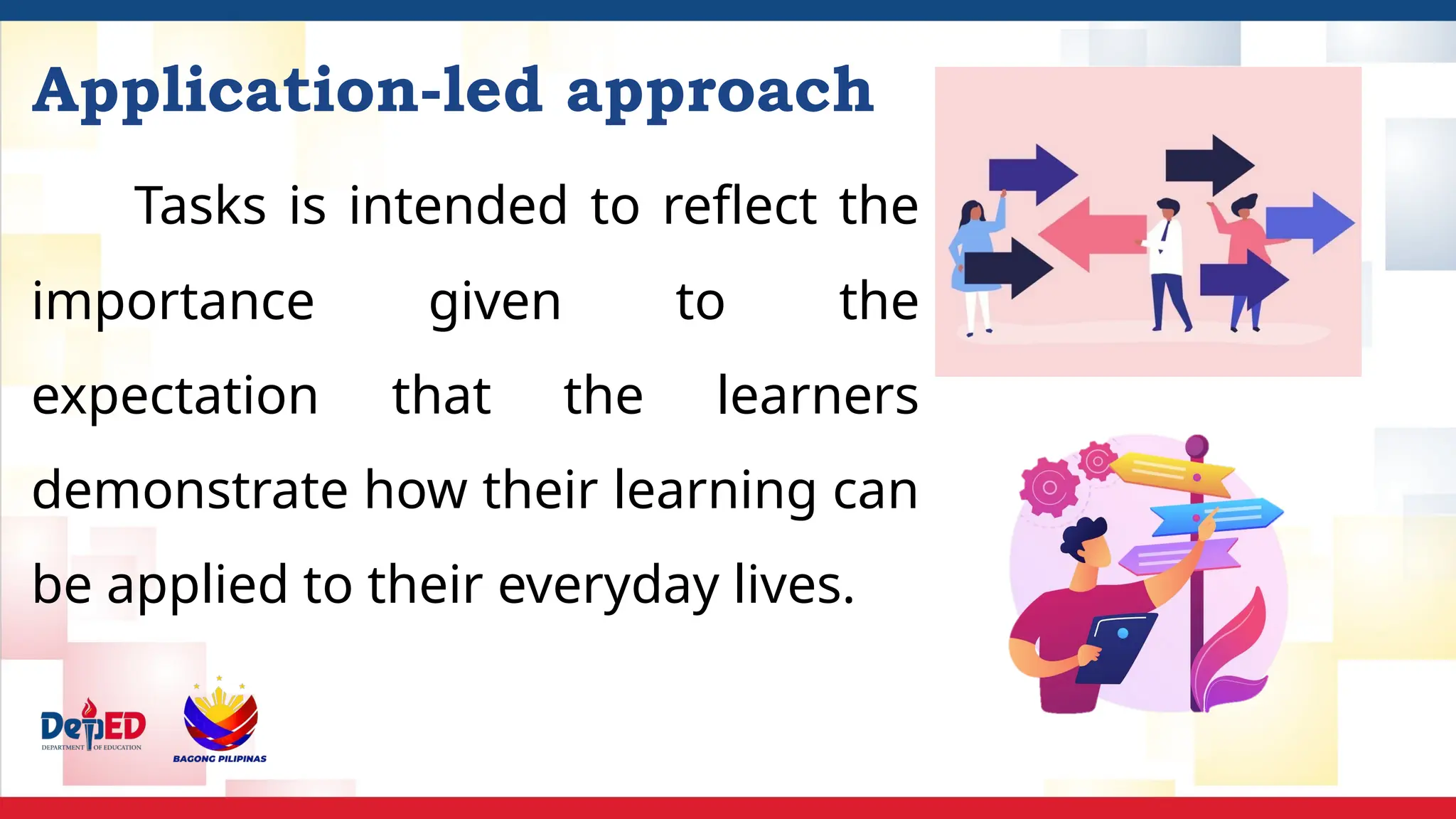
Application-led approach
Tasks isintended to reflect the
importance given to the
expectation that the learners
demonstrate how their learning can
be applied to their everyday lives.
52.
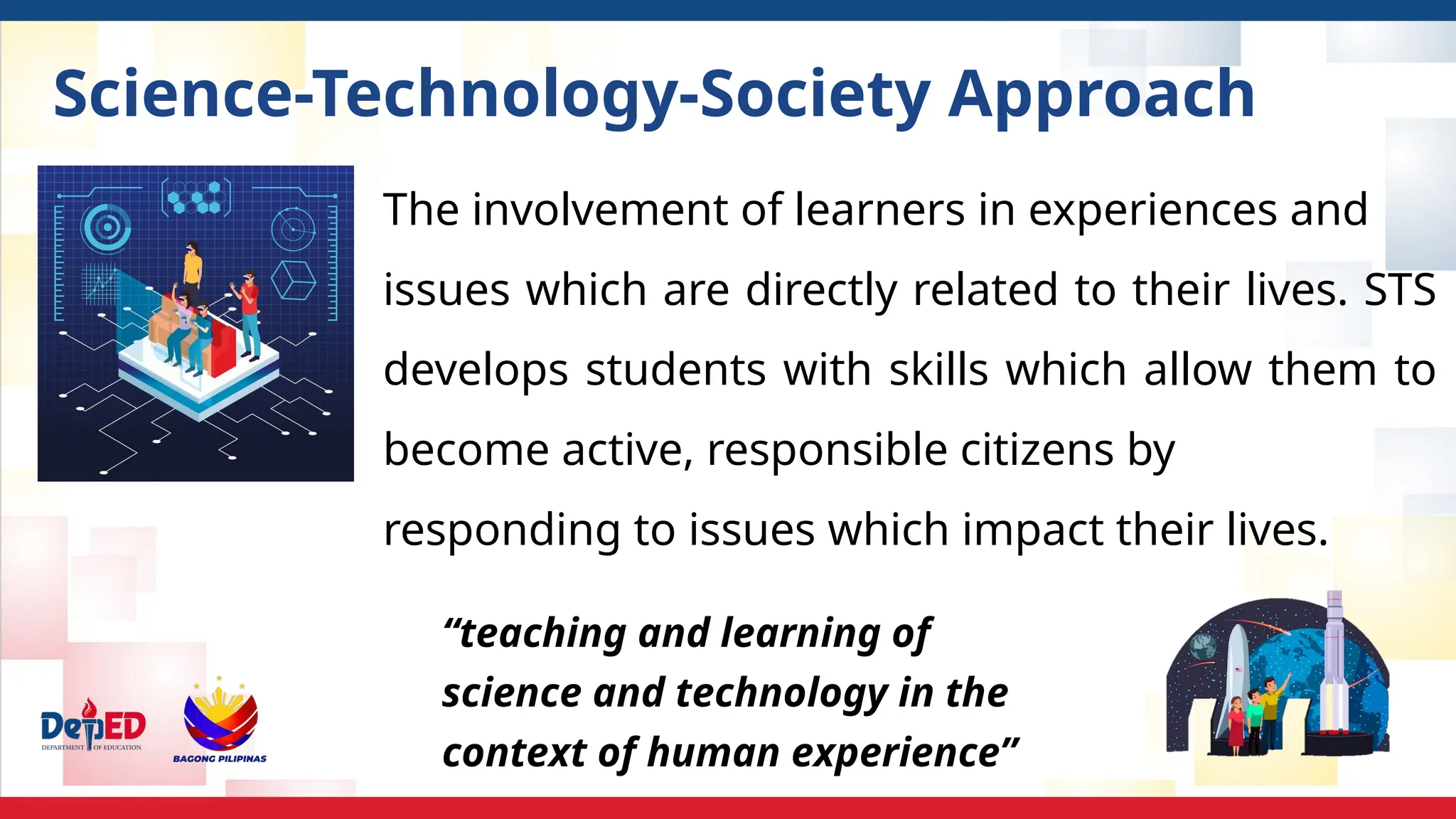
Science-Technology-Society Approach
The involvementof learners in experiences and
issues which are directly related to their lives. STS
develops students with skills which allow them to
become active, responsible citizens by
responding to issues which impact their lives.
“teaching and learning of
science and technology in the
context of human experience”
53.
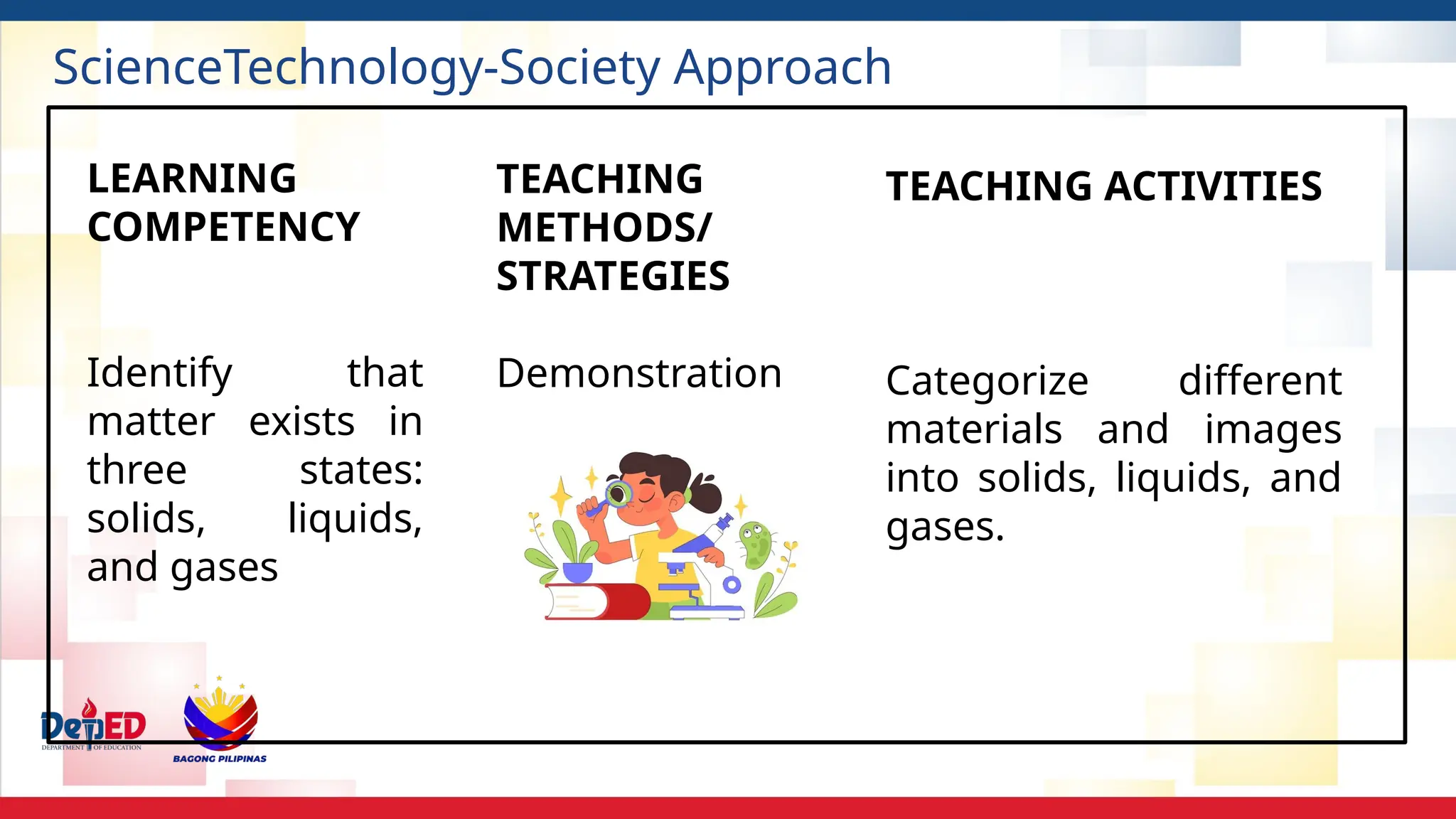
LEARNING
COMPETENCY
Identify that
matter existsin
three states:
solids, liquids,
and gases
TEACHING
METHODS/
STRATEGIES
Demonstration
TEACHING ACTIVITIES
Categorize different
materials and images
into solids, liquids, and
gases.
ScienceTechnology-Society Approach
54.
Problem-Based Learning
a student-centeredapproach in which
learners learn about a subject by working in
groups to solve an open-ended problem.
the aim is for learners to take an active and
problem-solving role in the process, in
accordance with the learner-centered education
approach
55.
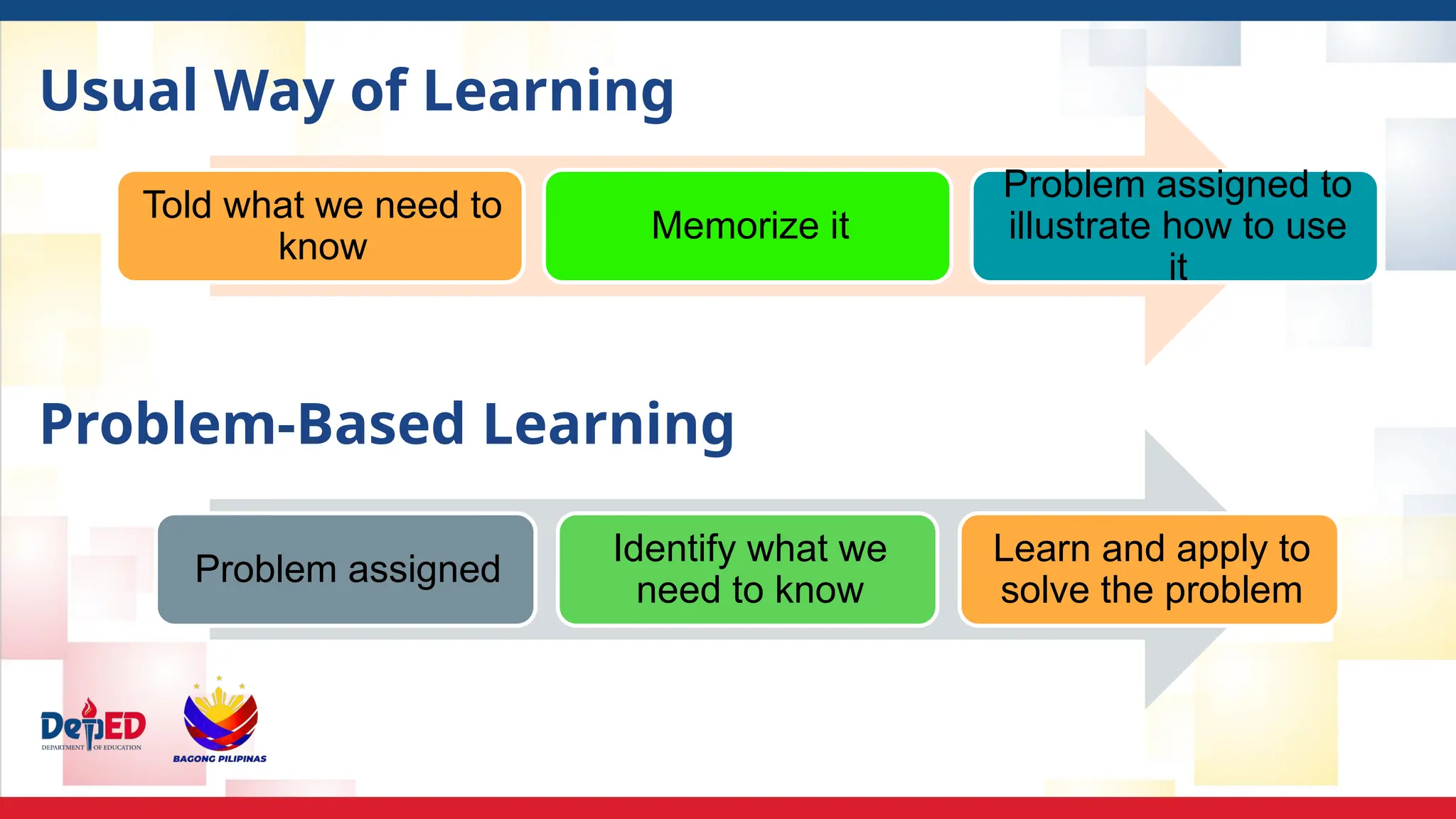
Usual Way ofLearning
Problem-Based Learning
Told what we need to
know
Memorize it
Problem assigned to
illustrate how to use
it
Problem assigned
Identify what we
need to know
Learn and apply to
solve the problem
56.
Samples of Problem-BasedLearning
Discussion & Debate: Environmental Issues and
Concerns
Role Play: Disaster Preparedness
Student Presentations: Mitigation and
Resilience Plans on Climate Change Impacts
Think Pair Share include under Active
Learning: Non-Renewable Energy Sources:
Boom or Bane?
57.
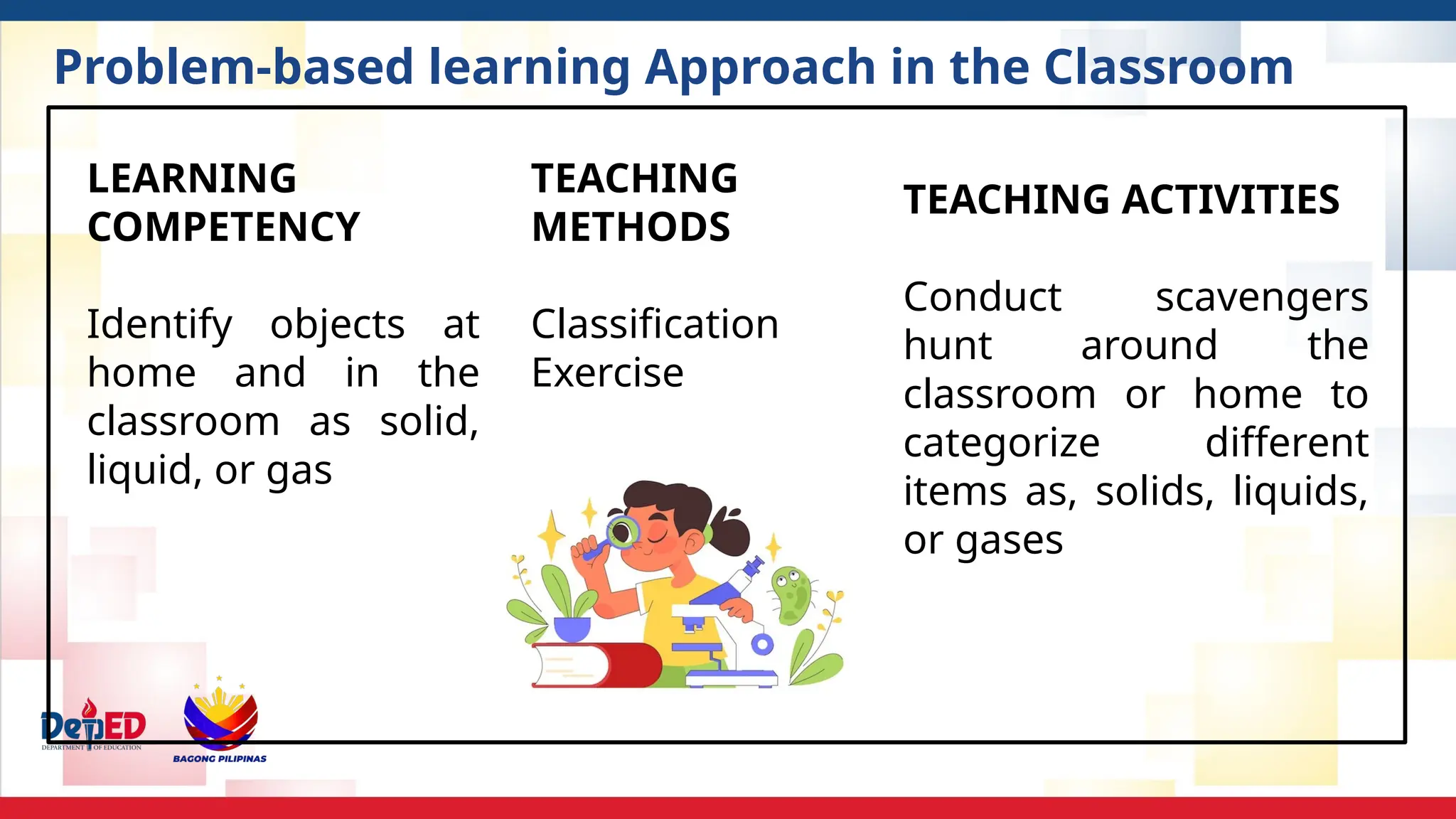
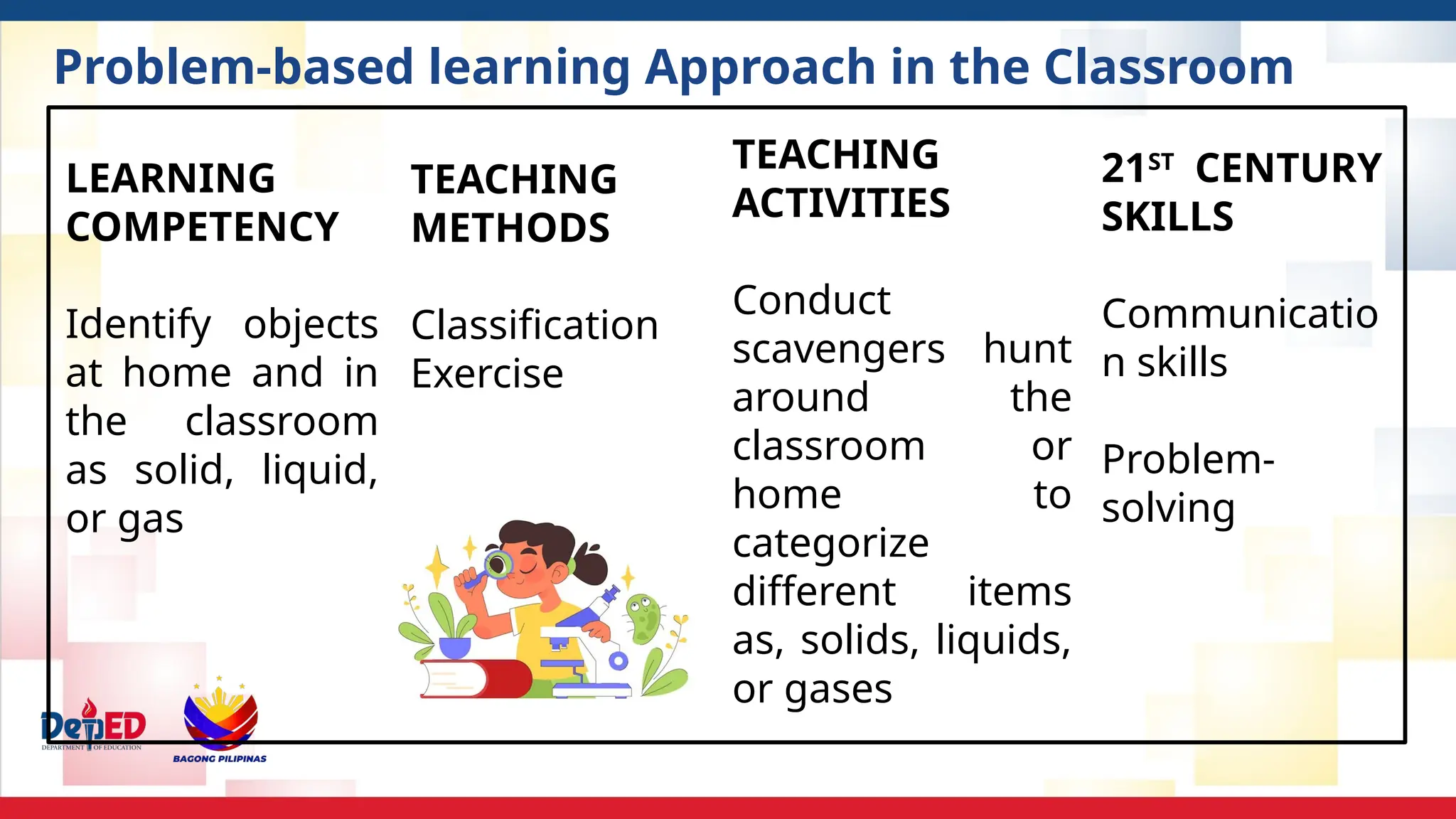
LEARNING
COMPETENCY
Identify objects at
homeand in the
classroom as solid,
liquid, or gas
TEACHING
METHODS
Classification
Exercise
TEACHING ACTIVITIES
Conduct scavengers
hunt around the
classroom or home to
categorize different
items as, solids, liquids,
or gases
Problem-based learning Approach in the Classroom
Approach to curriculumintegration
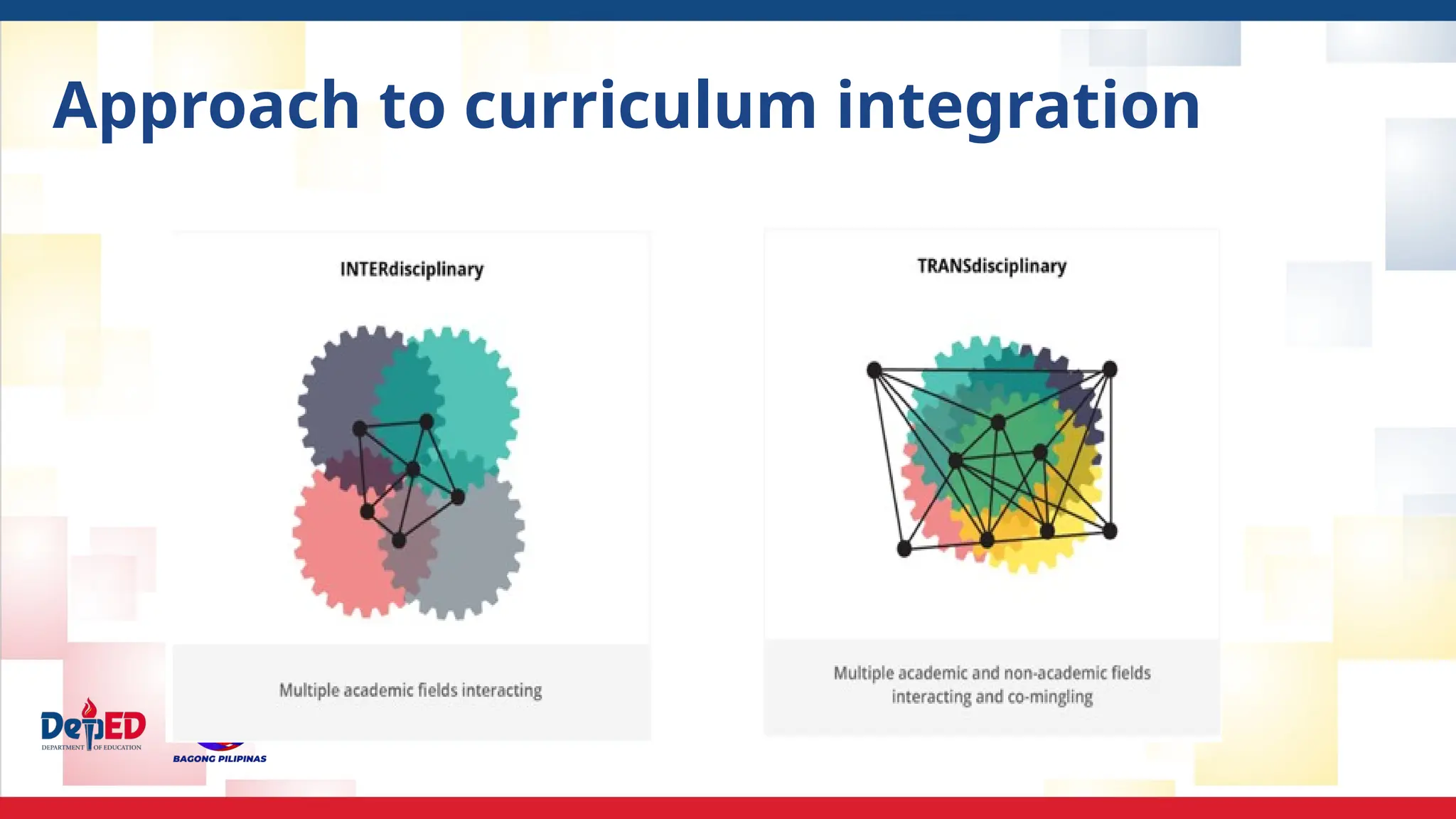
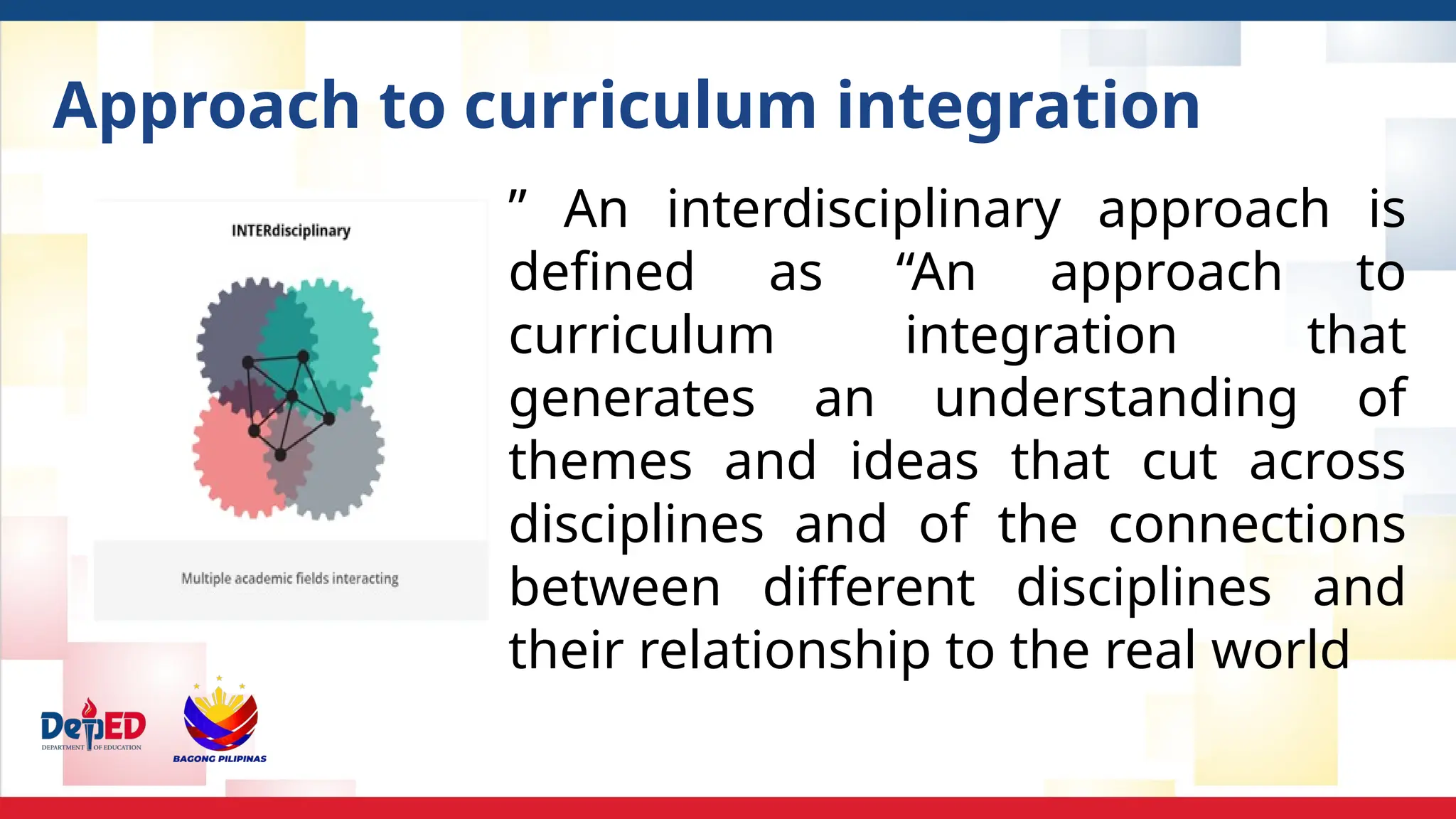
” An interdisciplinary approach is
defined as “An approach to
curriculum integration that
generates an understanding of
themes and ideas that cut across
disciplines and of the connections
between different disciplines and
their relationship to the real world
62.
Approach to curriculumintegration
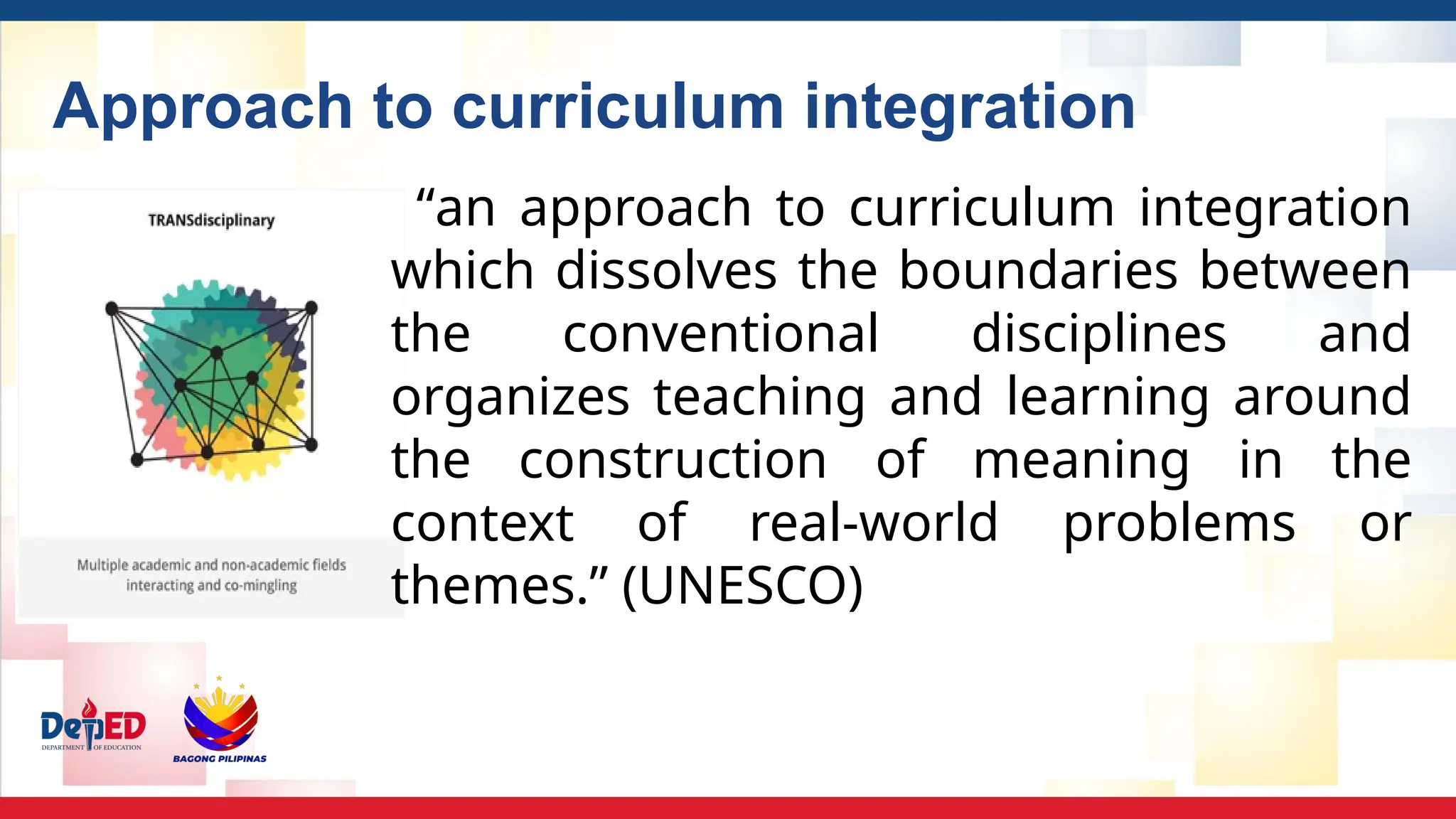
“an approach to curriculum integration
which dissolves the boundaries between
the conventional disciplines and
organizes teaching and learning around
the construction of meaning in the
context of real-world problems or
themes.” (UNESCO)
63.
Additional Approaches inthe NEW NORMAL
Cooperation Learning
Next Generation Science Learning
Nature of Science (NOS) Pedagogy
Sociocultural Practices
Responsive Teaching
Practice-Based Pedagogy
64.
Additional Approaches inthe NEW NORMAL
Sci-vestigative Pedagogical Strategy
(SPS)
Studio-Based Learning (SBL)
STEAM Approach
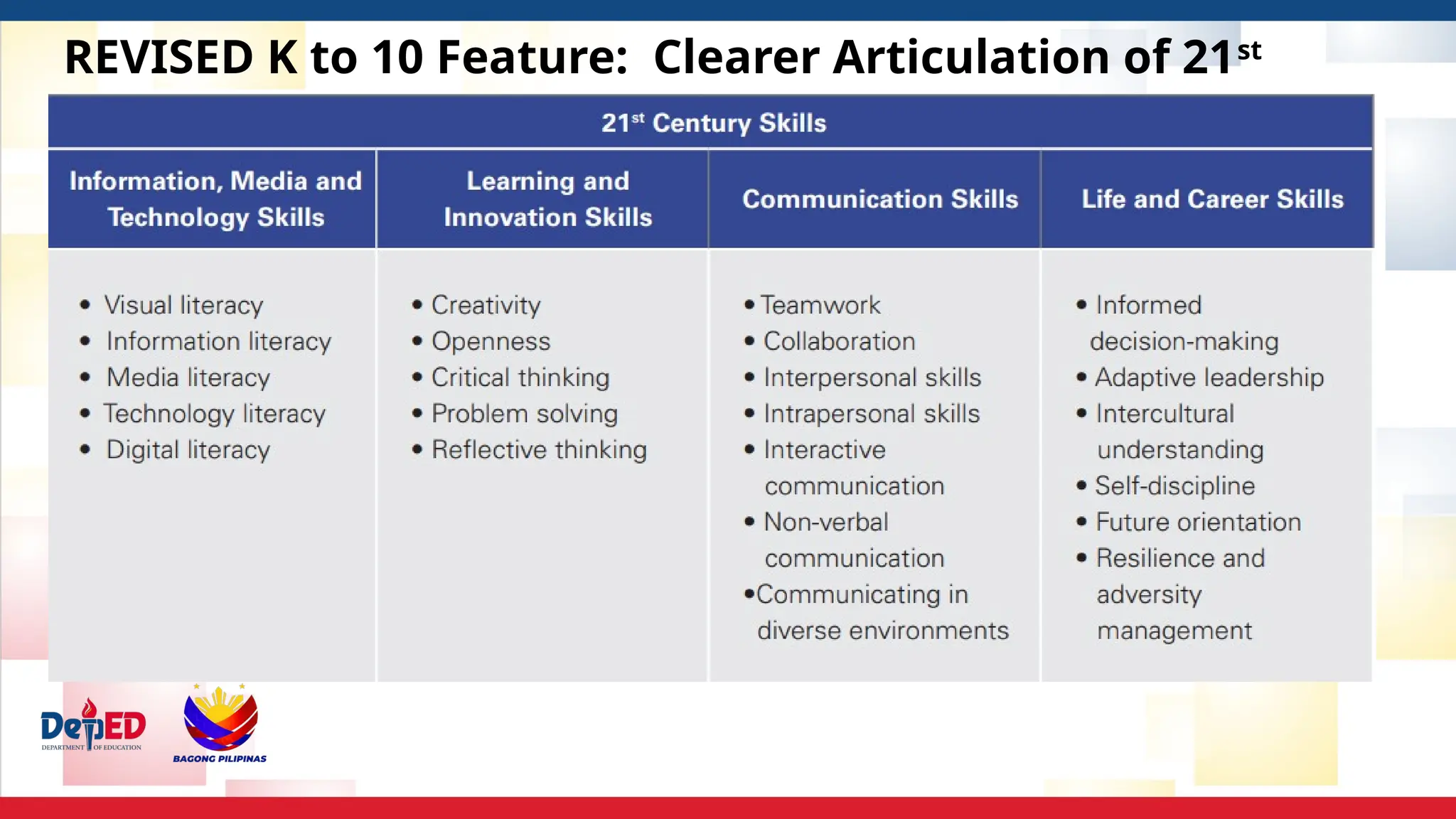
REVISED K to10 Feature: Clearer Articulation of 21st
Century Skills
68.
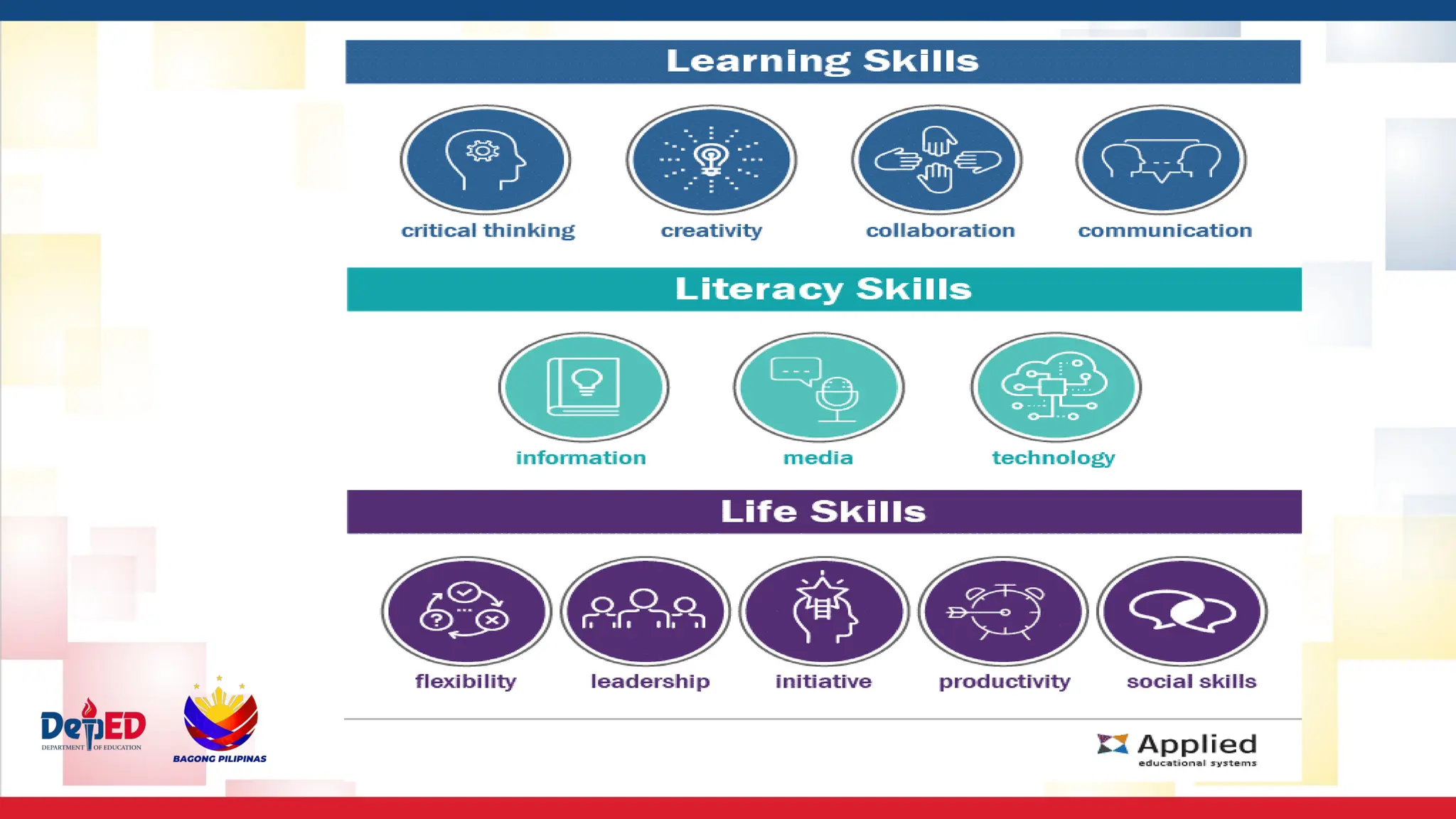
(the fourC’s)
teaches learners about the mental processes required
to adapt and improve upon a modern work
environment.
69.
focuses onhow students can discern facts, publishing outlets, and
the technology behind them.
There’s a strong focus on determining trustworthy sources and
factual information to separate it from the misinformation that
floods the Internet.
70.
LEARNING
COMPETENCY
Describe matter
as anythingthat
has mass and
takes up space
TEACHING
METHODS
Hands on
exploration
TEACHING
ACTIVITIES
Explore various
objects and
substances to
observe and
discuss their
properties
focusing on
mass and
volume
Inquiry-based Learning Approach
21ST
CENTURY
SKILLS
Critical
thinking
71.
LEARNING
COMPETENCY
Identify that
matter existsin
three states:
solids, liquids,
and gases
TEACHING
METHODS/
STRATEGY
Demonstration
TEACHING
ACTIVITIES
Categorize
different
materials and
images into
solids, liquids,
and gases.
Science Technology-Society Approach
21ST
CENTURY
SKILLS
Collaboration
Digital literacy
72.
LEARNING
COMPETENCY
Identify objects
at homeand in
the classroom
as solid, liquid,
or gas
TEACHING
METHODS
Classification
Exercise
TEACHING
ACTIVITIES
Conduct
scavengers hunt
around the
classroom or
home to
categorize
different items
as, solids, liquids,
or gases
Problem-based learning Approach in the Classroom
21ST
CENTURY
SKILLS
Communicatio
n skills
Problem-
solving
Activity 3: ScavengerHunt guide!
Instructions:
1. Each member will complete the session worksheet by listing
applicable pedagogical approaches with appropriate teaching
activities with articulated 21st
century skills
2. After 7 minutes, the worksheet will be shared to the group and work
together to hunt for the most applicable pedagogical approaches
and appropriate teaching activities with articulated 21st
century
skills
Activity 3: ScavengerHunt guide!
1. Summarize your work in a manila paper using metacards
and marker.
2. You will be given 8 minutes to finish the activity
3. Each group will be given 2 minutes to present their work.
The Learning facilitator will choose the specific learning
competency to be presented in the class.
Synthesis
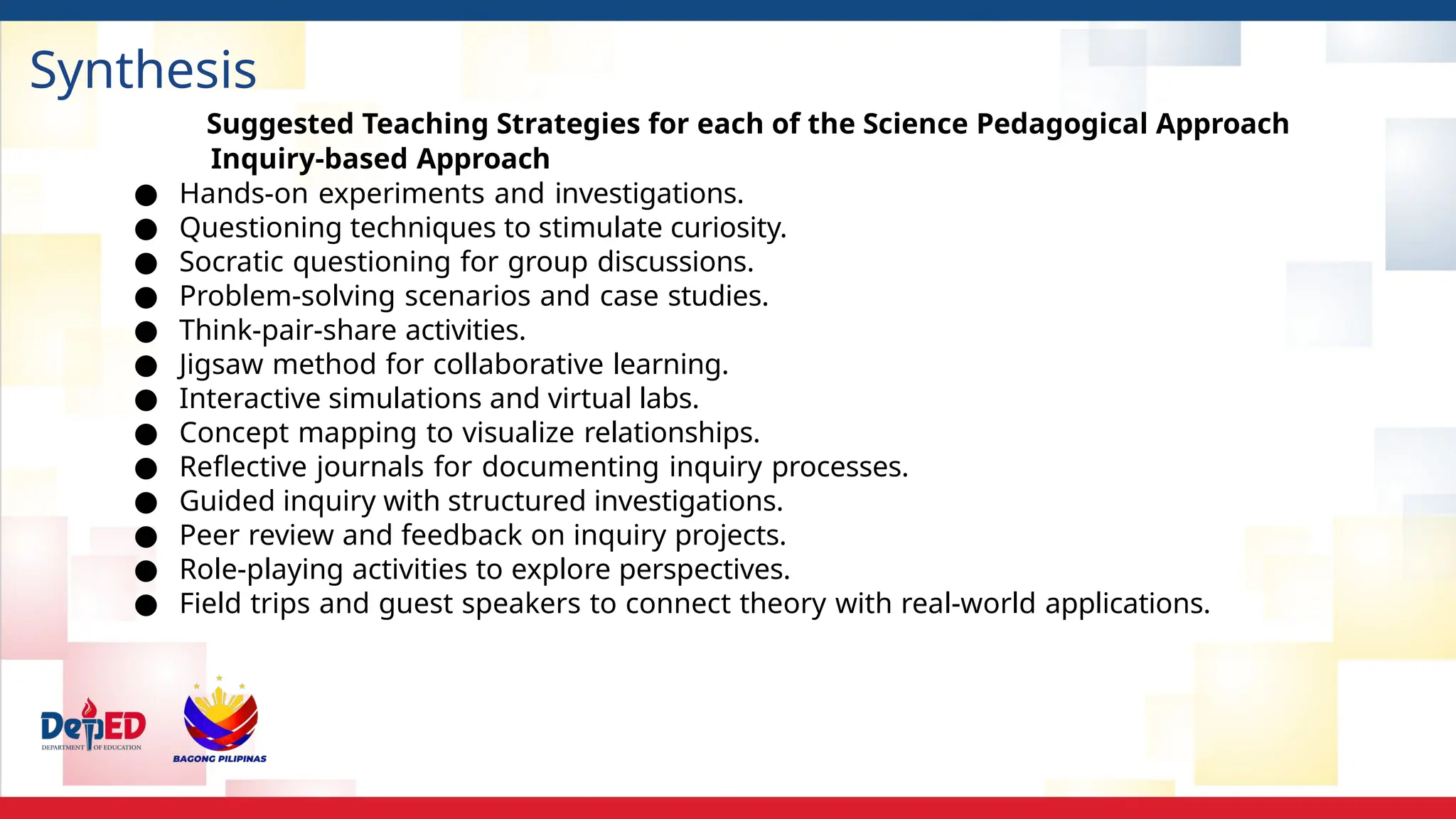
Suggested Teaching Strategiesfor each of the Science Pedagogical Approach
Inquiry-based Approach
● Hands-on experiments and investigations.
● Questioning techniques to stimulate curiosity.
● Socratic questioning for group discussions.
● Problem-solving scenarios and case studies.
● Think-pair-share activities.
● Jigsaw method for collaborative learning.
● Interactive simulations and virtual labs.
● Concept mapping to visualize relationships.
● Reflective journals for documenting inquiry processes.
● Guided inquiry with structured investigations.
● Peer review and feedback on inquiry projects.
● Role-playing activities to explore perspectives.
● Field trips and guest speakers to connect theory with real-world applications.
81.
Synthesis
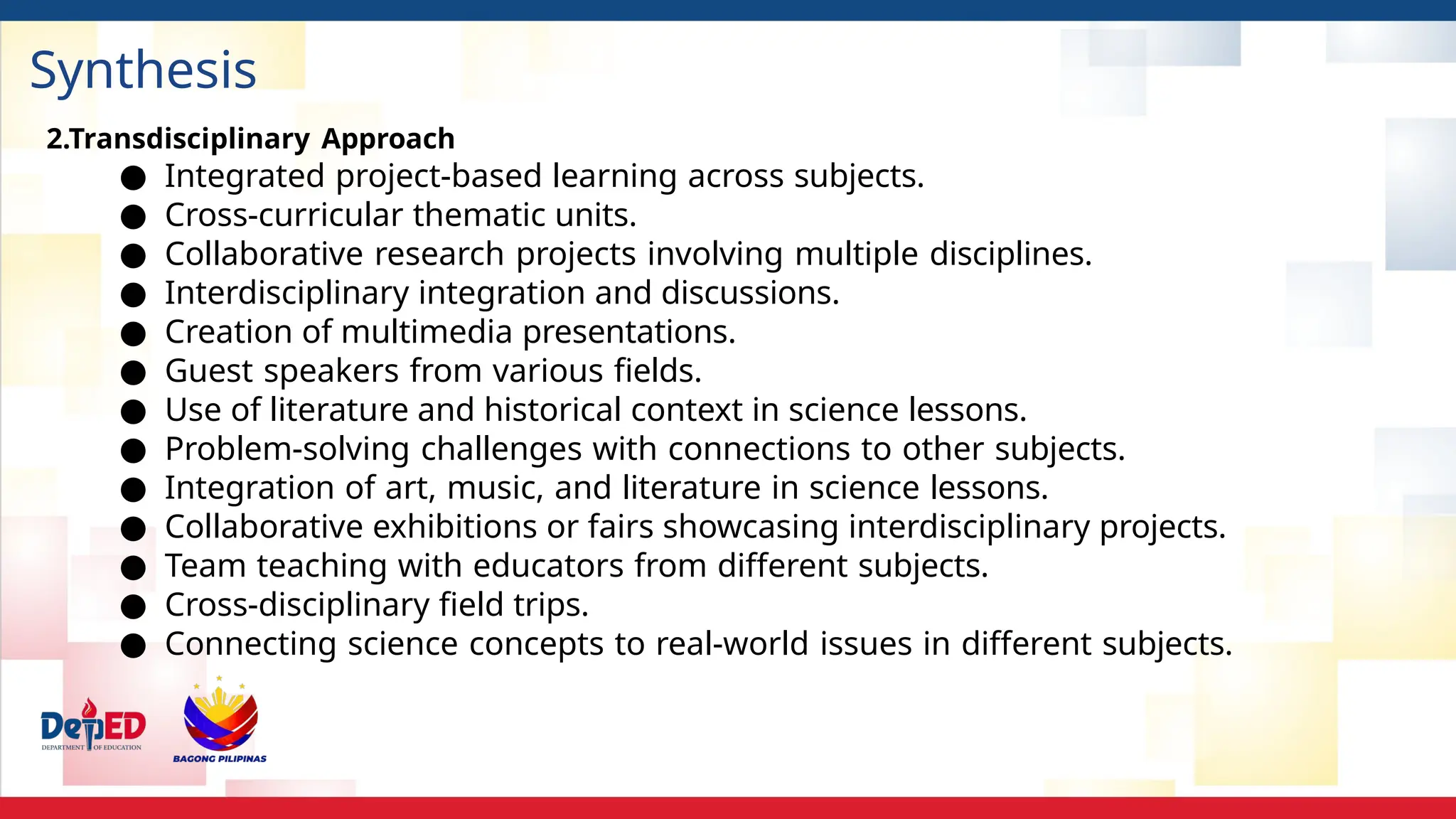
2.Transdisciplinary Approach
● Integratedproject-based learning across subjects.
● Cross-curricular thematic units.
● Collaborative research projects involving multiple disciplines.
● Interdisciplinary integration and discussions.
● Creation of multimedia presentations.
● Guest speakers from various fields.
● Use of literature and historical context in science lessons.
● Problem-solving challenges with connections to other subjects.
● Integration of art, music, and literature in science lessons.
● Collaborative exhibitions or fairs showcasing interdisciplinary projects.
● Team teaching with educators from different subjects.
● Cross-disciplinary field trips.
● Connecting science concepts to real-world issues in different subjects.
82.
Synthesis
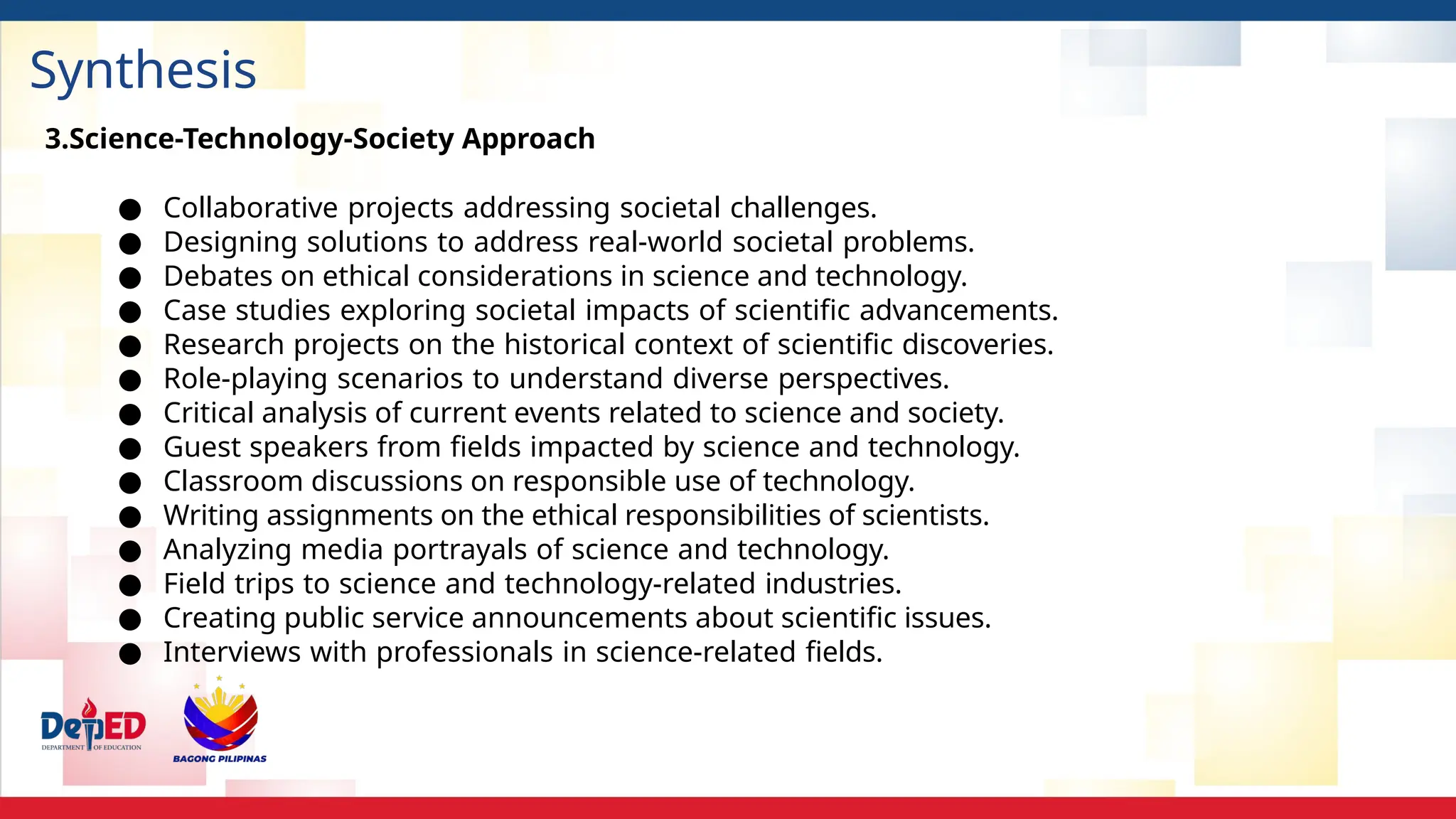
3.Science-Technology-Society Approach
● Collaborativeprojects addressing societal challenges.
● Designing solutions to address real-world societal problems.
● Debates on ethical considerations in science and technology.
● Case studies exploring societal impacts of scientific advancements.
● Research projects on the historical context of scientific discoveries.
● Role-playing scenarios to understand diverse perspectives.
● Critical analysis of current events related to science and society.
● Guest speakers from fields impacted by science and technology.
● Classroom discussions on responsible use of technology.
● Writing assignments on the ethical responsibilities of scientists.
● Analyzing media portrayals of science and technology.
● Field trips to science and technology-related industries.
● Creating public service announcements about scientific issues.
● Interviews with professionals in science-related fields.
83.
Synthesis
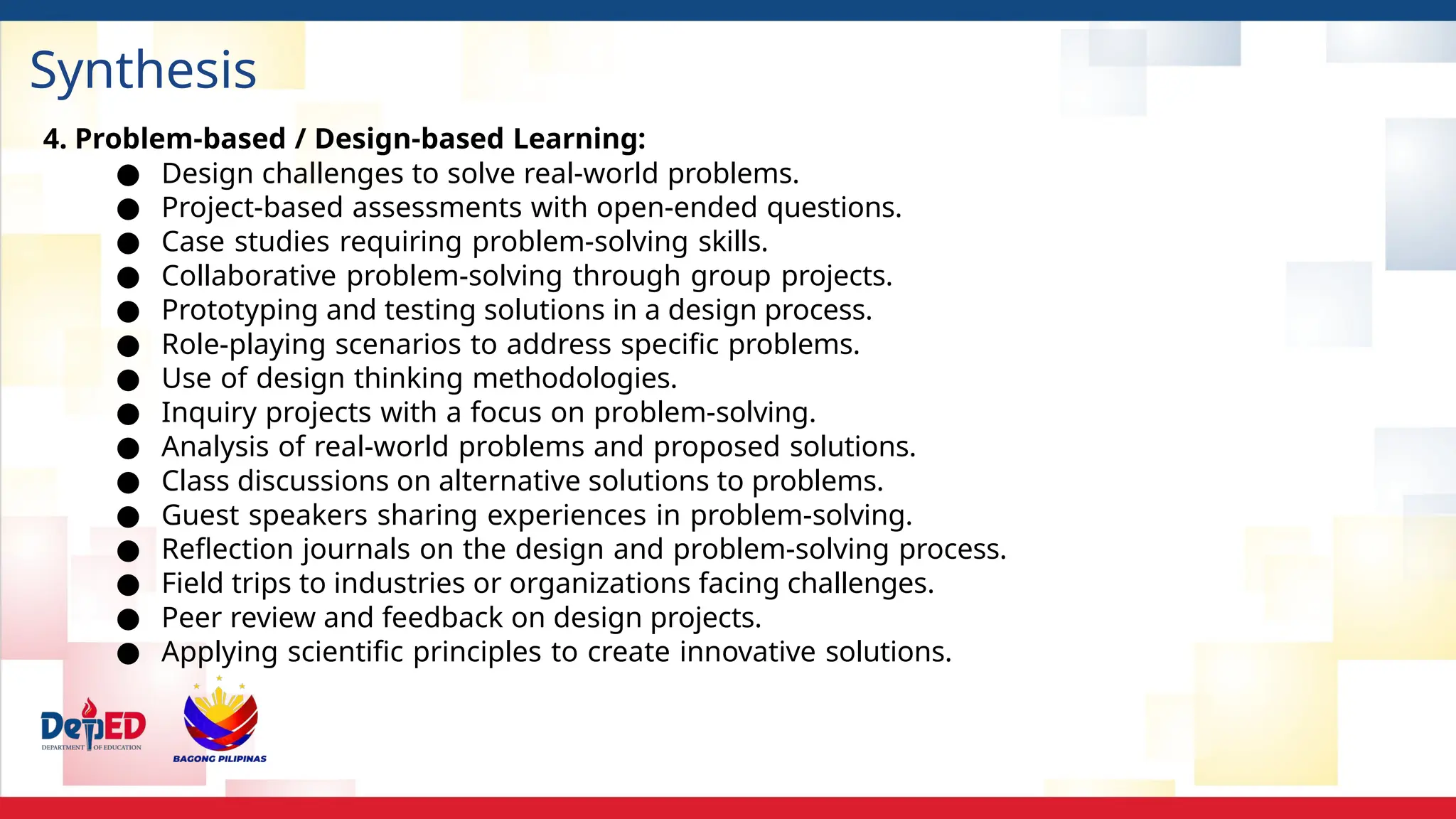
4. Problem-based /Design-based Learning:
● Design challenges to solve real-world problems.
● Project-based assessments with open-ended questions.
● Case studies requiring problem-solving skills.
● Collaborative problem-solving through group projects.
● Prototyping and testing solutions in a design process.
● Role-playing scenarios to address specific problems.
● Use of design thinking methodologies.
● Inquiry projects with a focus on problem-solving.
● Analysis of real-world problems and proposed solutions.
● Class discussions on alternative solutions to problems.
● Guest speakers sharing experiences in problem-solving.
● Reflection journals on the design and problem-solving process.
● Field trips to industries or organizations facing challenges.
● Peer review and feedback on design projects.
● Applying scientific principles to create innovative solutions.
84.
Synthesis
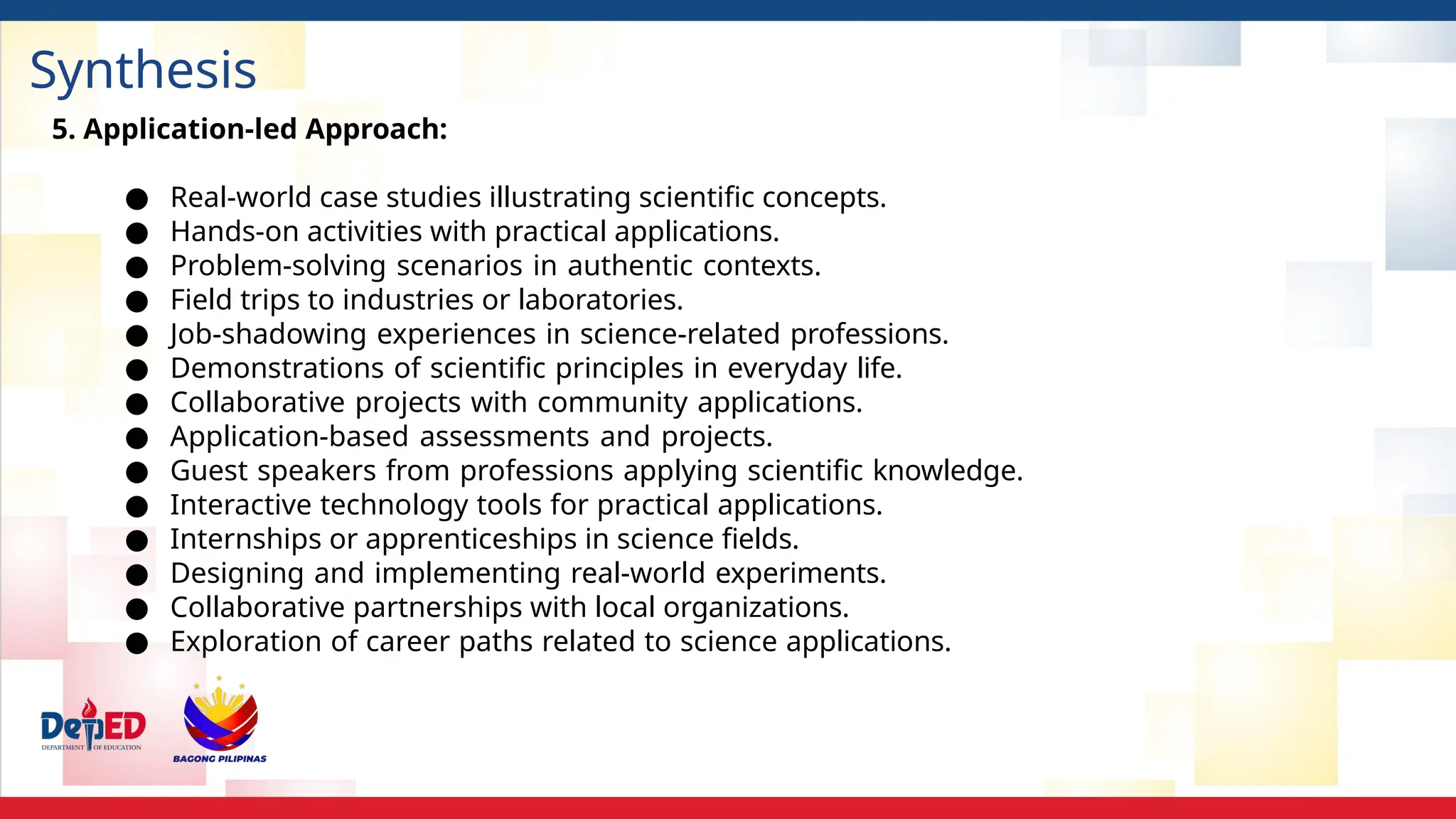
5. Application-led Approach:
●Real-world case studies illustrating scientific concepts.
● Hands-on activities with practical applications.
● Problem-solving scenarios in authentic contexts.
● Field trips to industries or laboratories.
● Job-shadowing experiences in science-related professions.
● Demonstrations of scientific principles in everyday life.
● Collaborative projects with community applications.
● Application-based assessments and projects.
● Guest speakers from professions applying scientific knowledge.
● Interactive technology tools for practical applications.
● Internships or apprenticeships in science fields.
● Designing and implementing real-world experiments.
● Collaborative partnerships with local organizations.
● Exploration of career paths related to science applications.
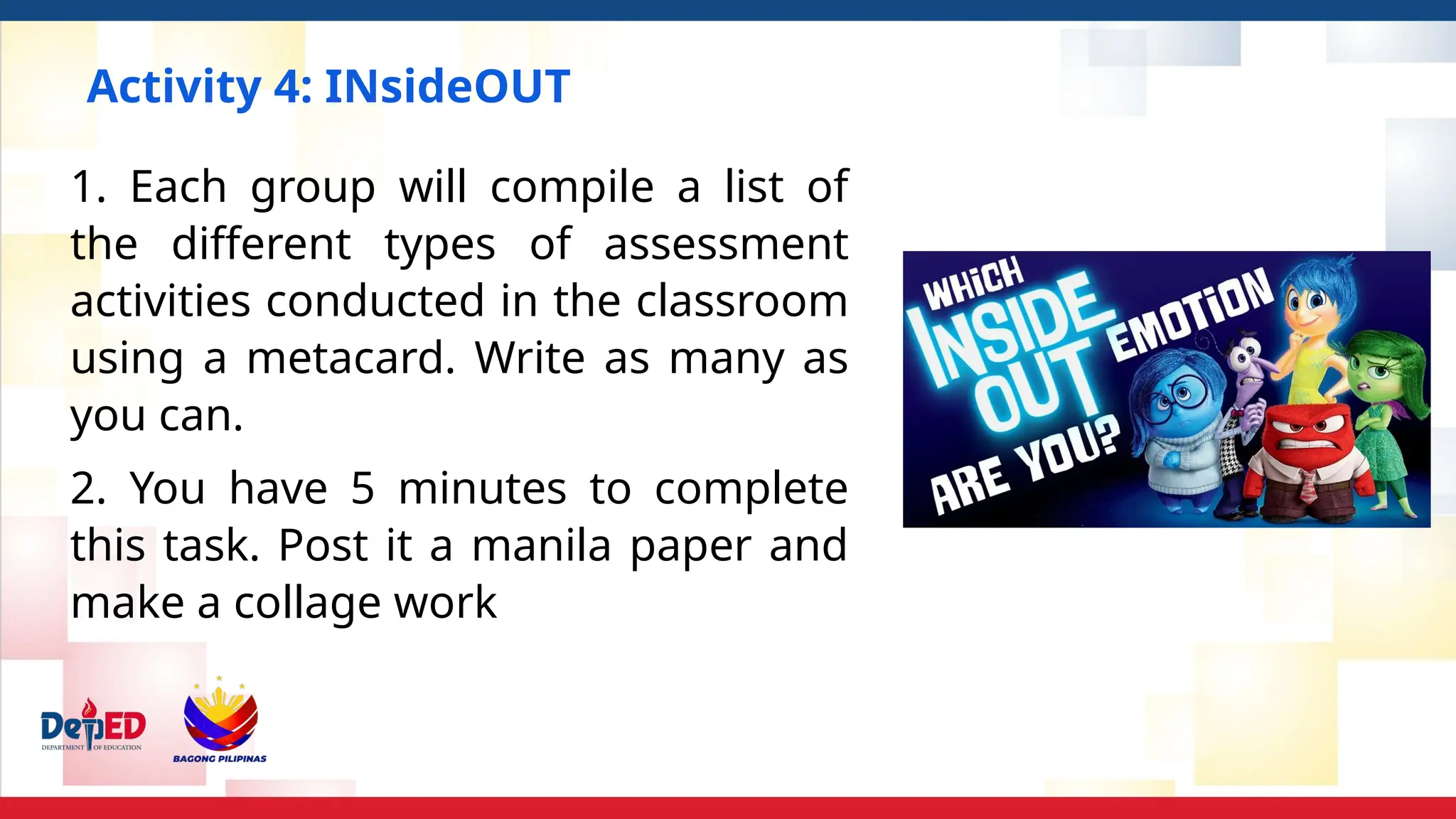
Activity 4: INsideOUT
1.Each group will compile a list of
the different types of assessment
activities conducted in the classroom
using a metacard. Write as many as
you can.
2. You have 5 minutes to complete
this task. Post it a manila paper and
make a collage work
Activity 4: Inor Out
1. After listing the assessment activities, each
group will take turns reciting their list aloud.
2. As each group recites and will ask other
group (IN OR OUT?) if it has same word, other
groups will cross out any matching
assessment activities on their own lists.
3. Continue this process until every group has
had the opportunity to recite, and all possible
matches have been crossed out.
Guide Questions:
1. Whatare the assessment were
crossed out?
2. What are the assessments
retained in your list?
3. explain the remaining
assessment/s in your list being
delivered inside classroom?
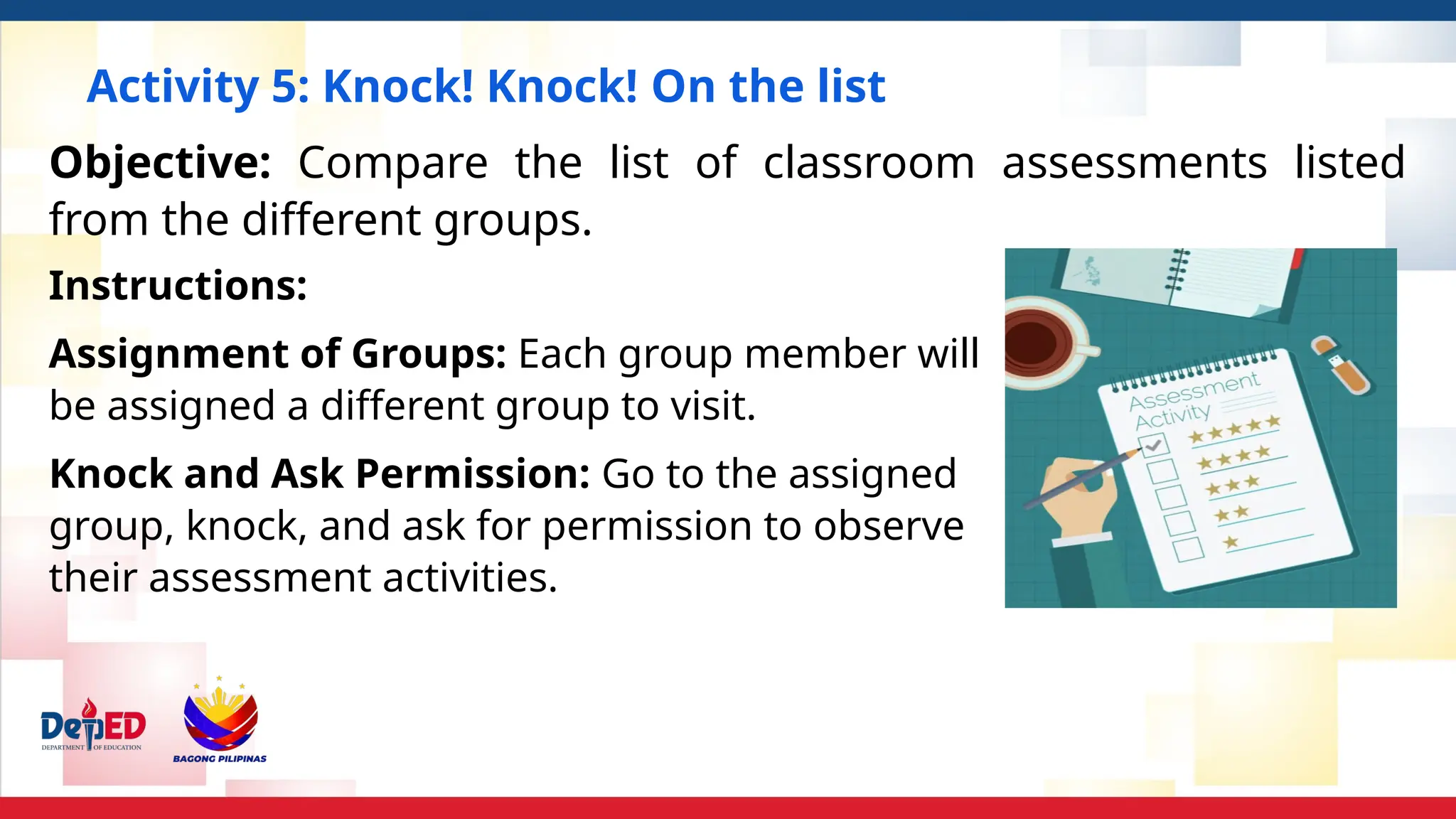
Activity 5: Knock!Knock! On the list
Instructions:
Assignment of Groups: Each group member will
be assigned a different group to visit.
Knock and Ask Permission: Go to the assigned
group, knock, and ask for permission to observe
their assessment activities.
Objective: Compare the list of classroom assessments listed
from the different groups.
94.
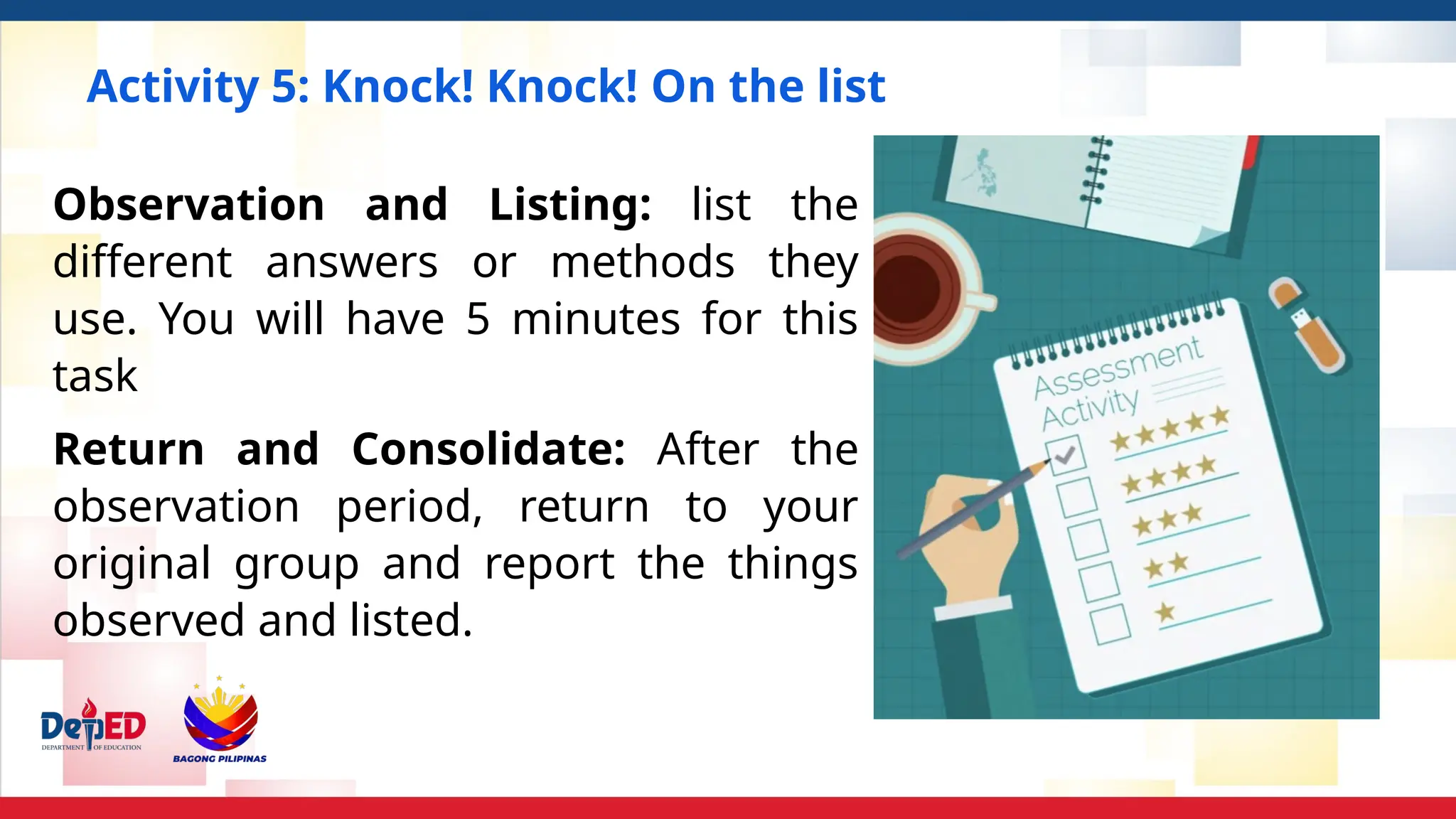
Activity 5: Knock!Knock! On the list
Observation and Listing: list the
different answers or methods they
use. You will have 5 minutes for this
task
Return and Consolidate: After the
observation period, return to your
original group and report the things
observed and listed.
Activity 5: Knock!Knock! On the list
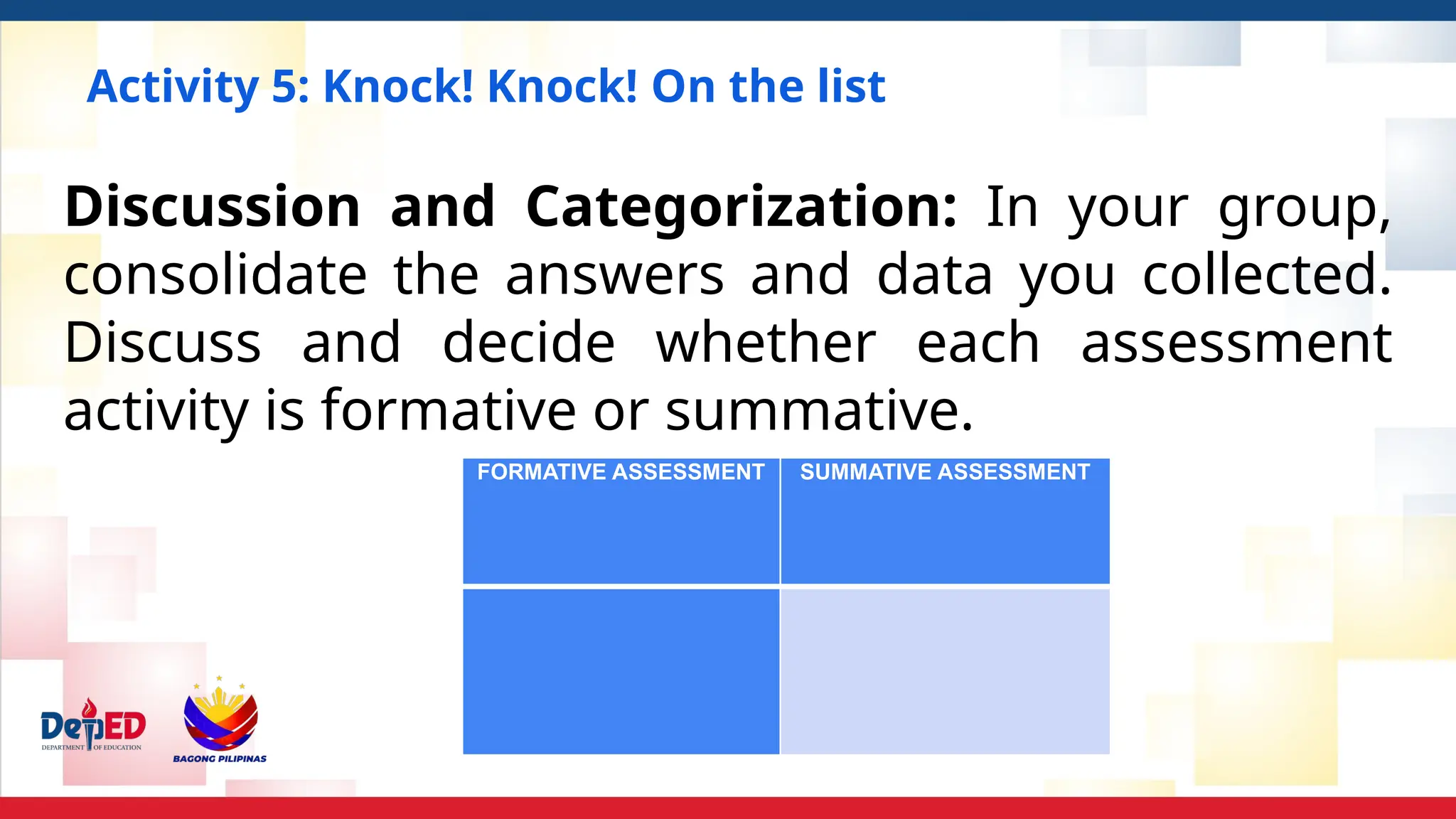
FORMATIVE ASSESSMENT SUMMATIVE ASSESSMENT
Discussion and Categorization: In your group,
consolidate the answers and data you collected.
Discuss and decide whether each assessment
activity is formative or summative.
Activity 5: GuideQuestions
1. How are assessments classified into formative
or summative?
2. What are your observations on the given
sample assessment of the different groups?
3. How is this assessment activity conducted or
implemented inside classroom?
ASSESSMENT
defines classroom assessmentas an
ongoing process of identifying,
gathering, organizing, and
interpreting quantitative and
qualitative information about what
learners know and can do. (DepEd Order
No. 8, s. 2015)
102.
ASSESSMENT
It is anintegral part of the
teaching-learning process;
hence the K to 10 Instructional
Design Framework provides that
assessment may be given at any
point in the lesson.
103.
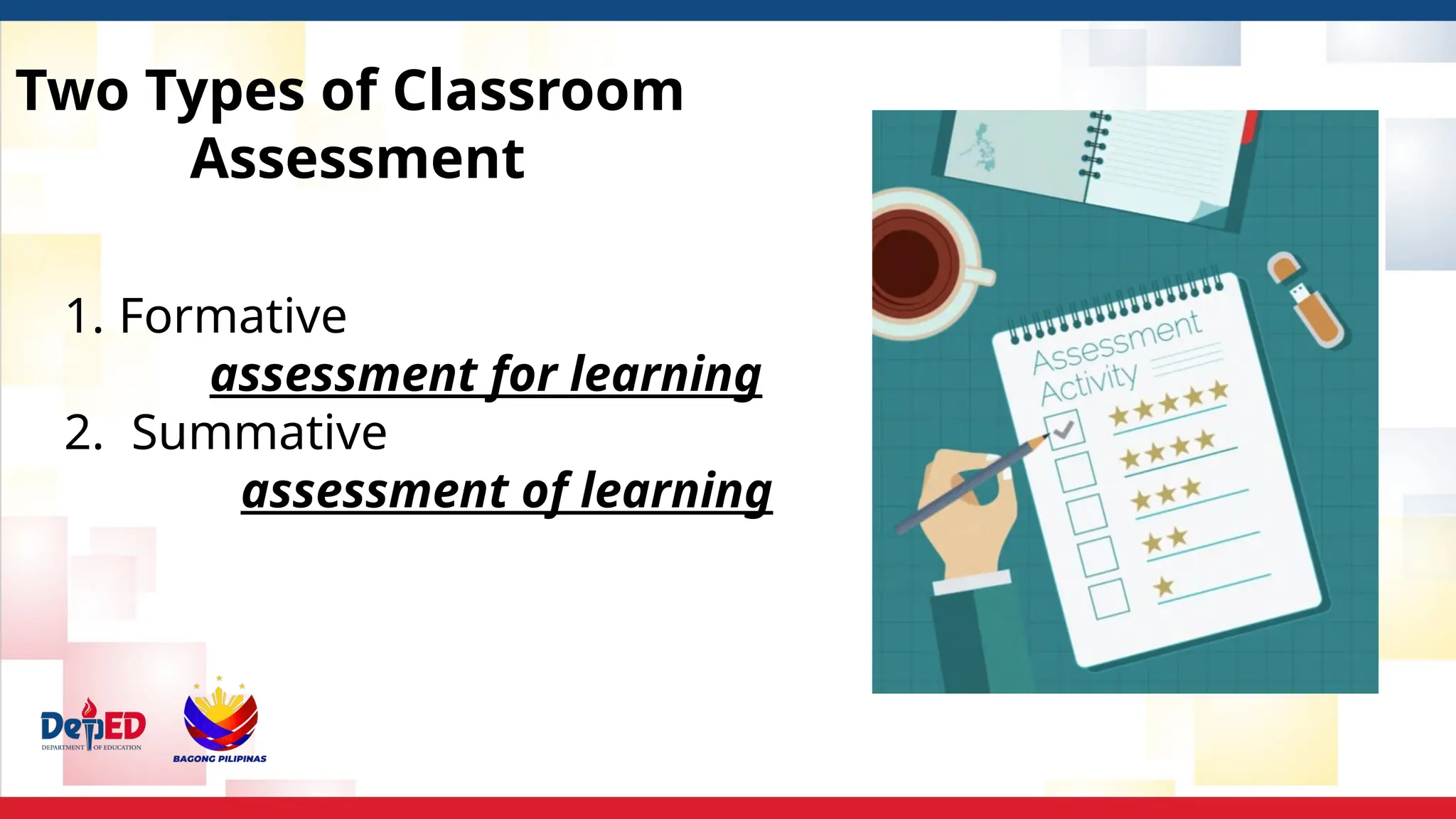
Two Types ofClassroom
Assessment
1. Formative
assessment for learning
2. Summative
assessment of learning
104.
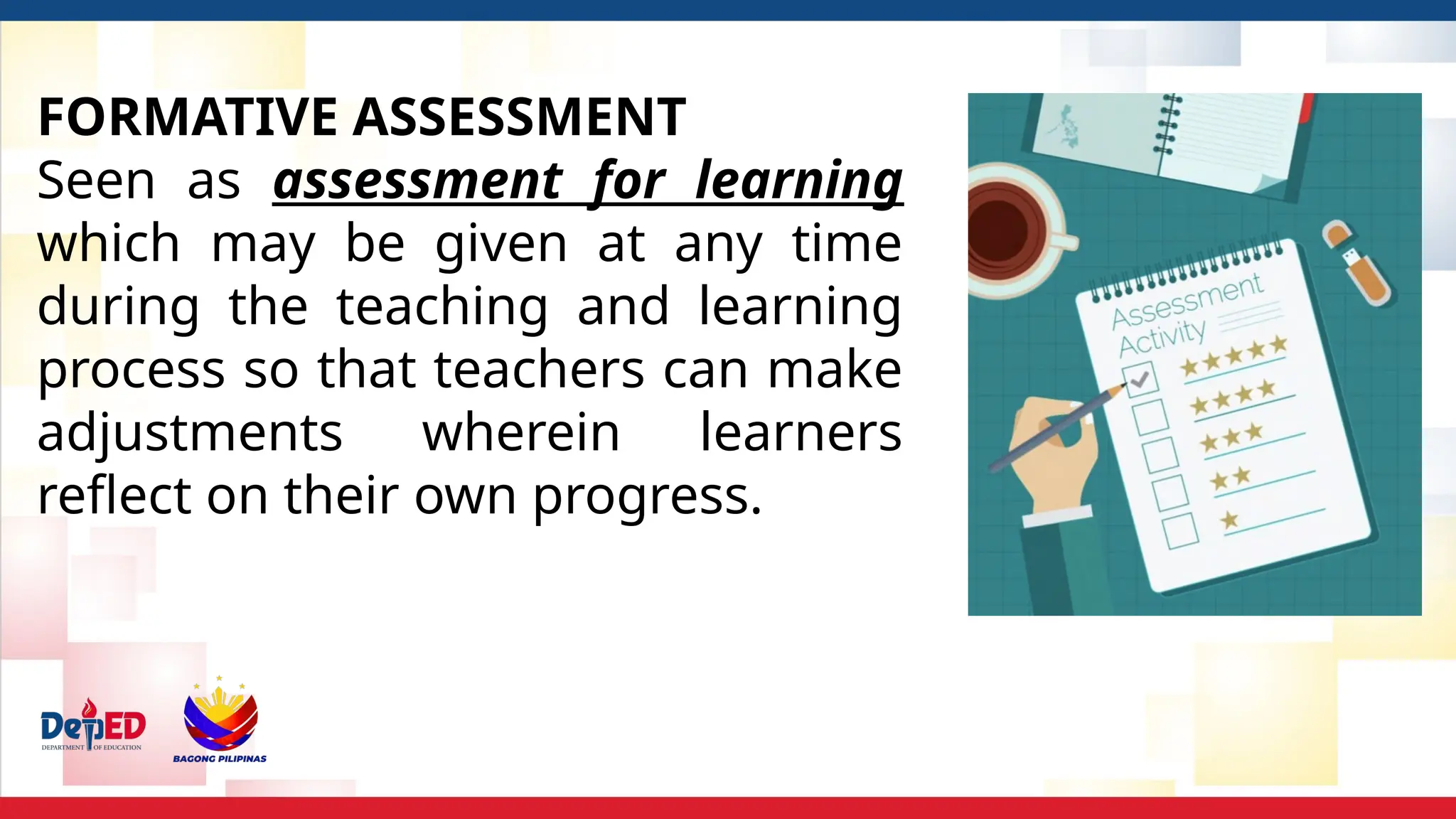
FORMATIVE ASSESSMENT
Seen asassessment for learning
which may be given at any time
during the teaching and learning
process so that teachers can make
adjustments wherein learners
reflect on their own progress.
105.
FORMATIVE ASSESSMENT -Before
Examples of Assessment
Methods
Agree/Disagree Activities
Games
Interviews
Inventories/Checklists
KWL Activities
Open-Ended Questions
Practice Exercises
106.
FORMATIVE ASSESSMENT -During
Examples of Assessment
Methods
Multimedia Presentations
Observations
Other Formative Performance
Tasks
Quizzes (recorded but not
graded)
Recitation
Simulation Activities
107.
FORMATIVE ASSESSMENT -After
Examples of Assessment
Methods
Agree/Disagree Activities
Games
Interviews
Inventories/Checklists
KWL Activities
Open-Ended Questions
Practice Exercises
108.
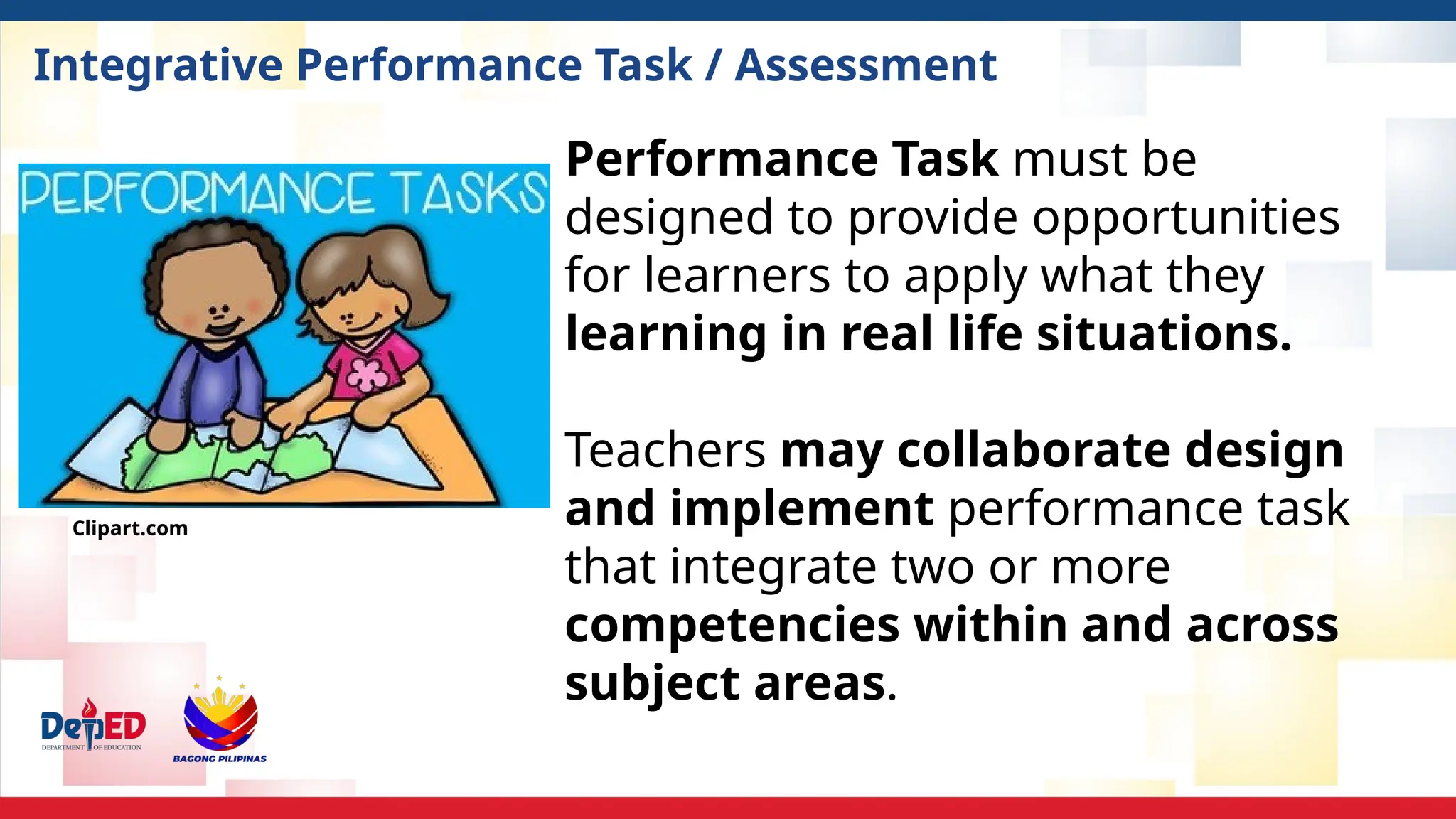
Integrative Performance Task/ Assessment
Performance Task must be
designed to provide opportunities
for learners to apply what they
learning in real life situations.
Teachers may collaborate design
and implement performance task
that integrate two or more
competencies within and across
subject areas.
Clipart.com
109.
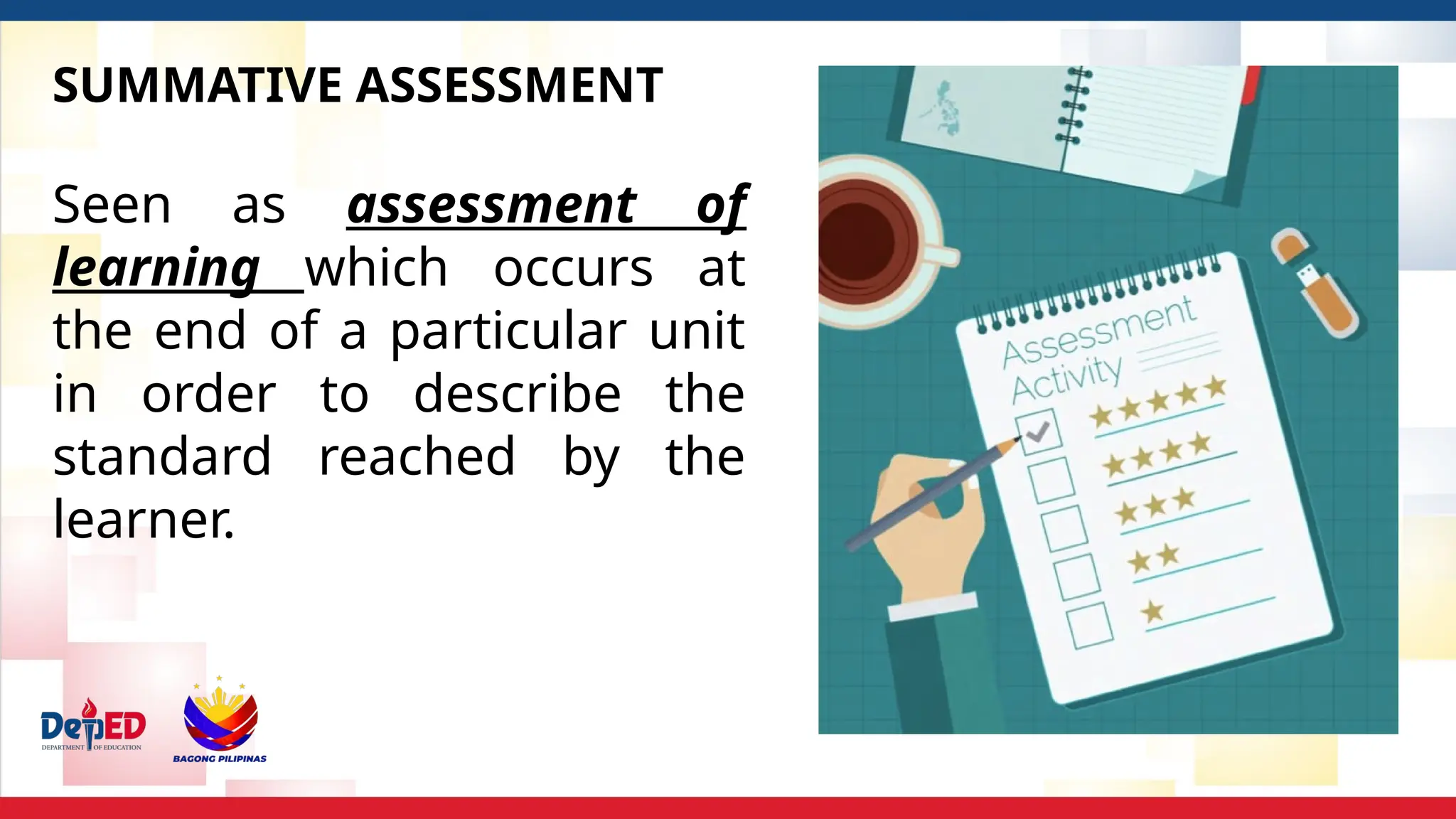
SUMMATIVE ASSESSMENT
Seen asassessment of
learning which occurs at
the end of a particular unit
in order to describe the
standard reached by the
learner.
110.
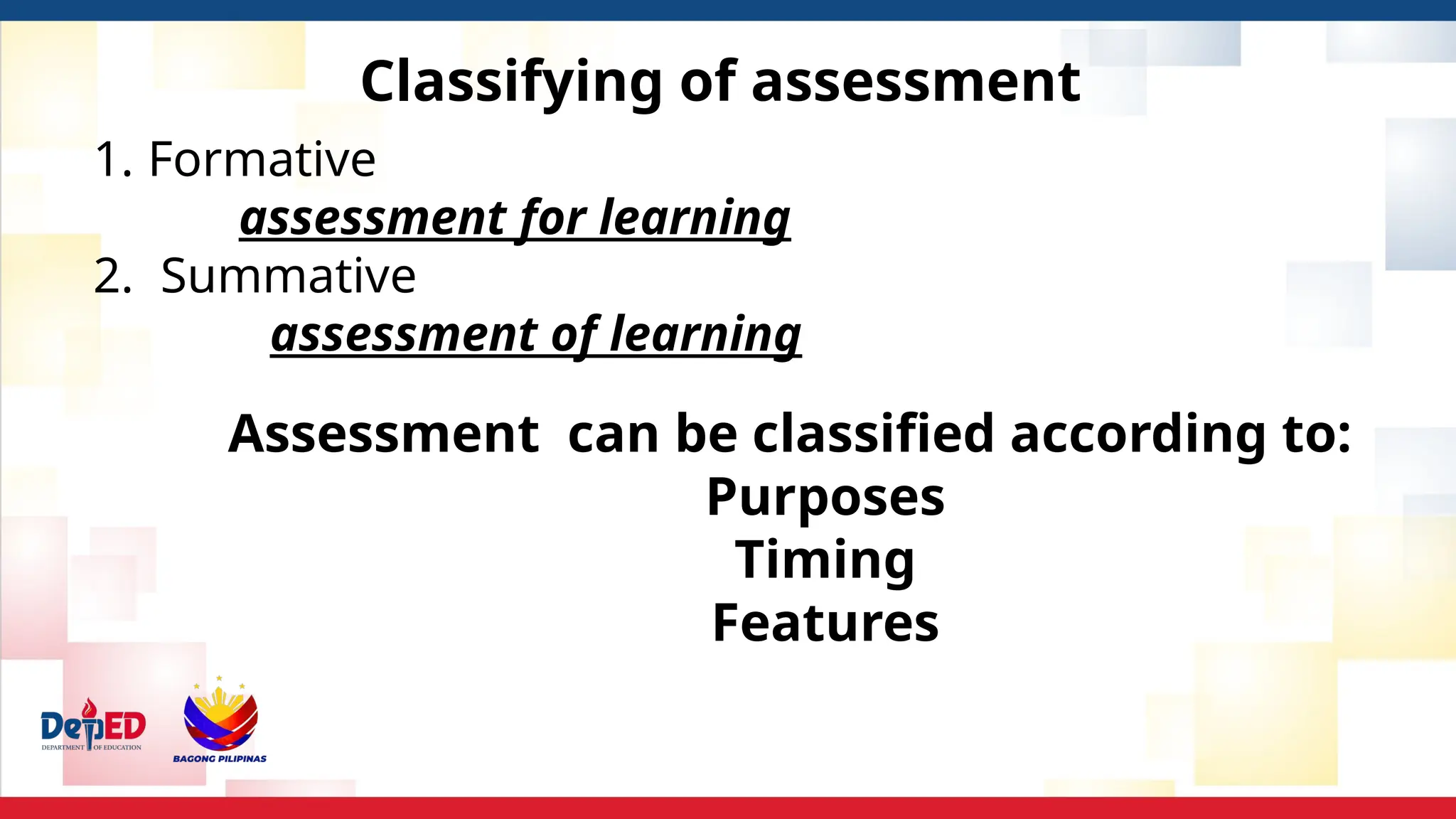
Classifying of assessment
1.Formative
assessment for learning
2. Summative
assessment of learning
Assessment can be classified according to:
Purposes
Timing
Features
111.
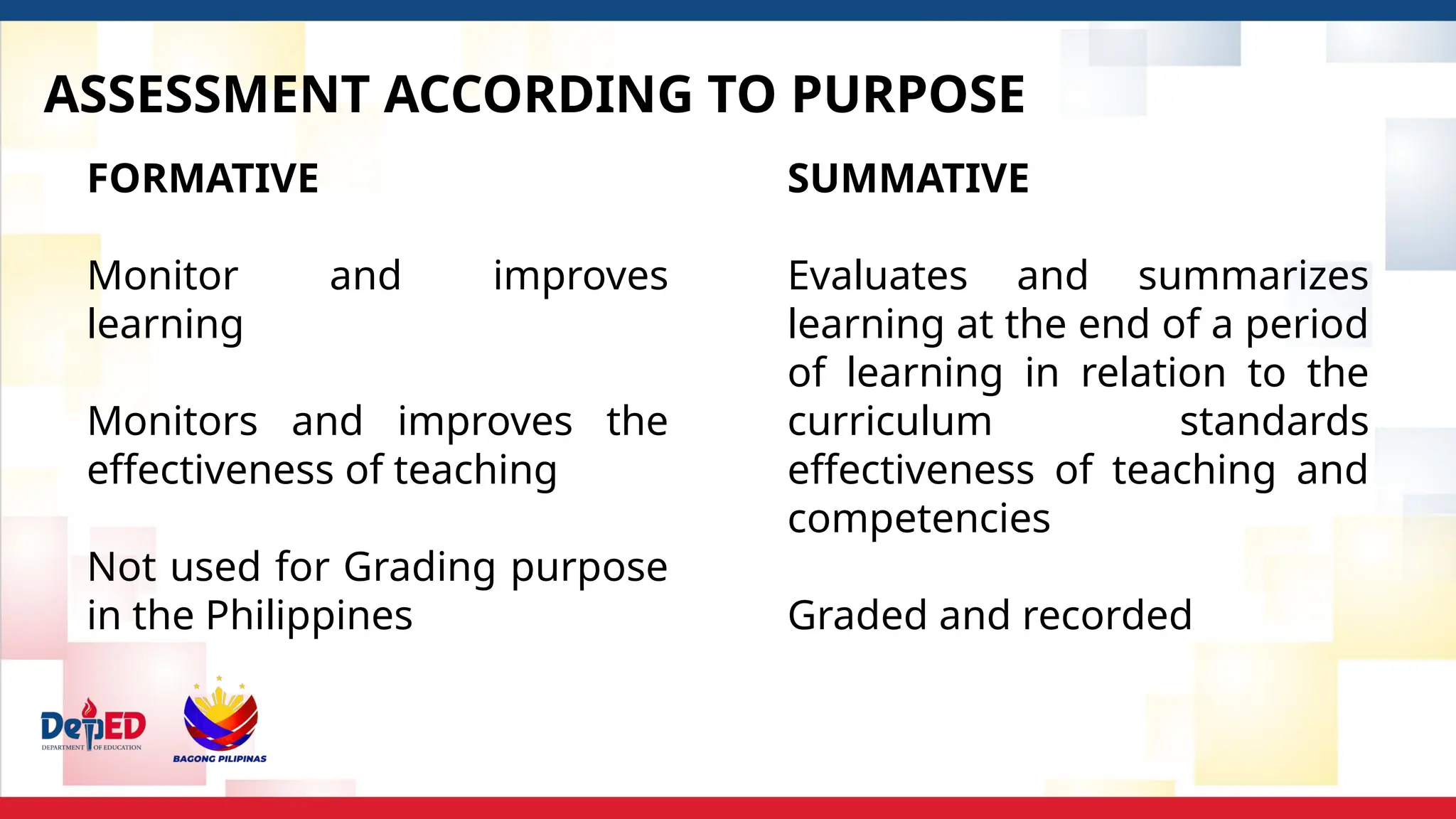
ASSESSMENT ACCORDING TOPURPOSE
FORMATIVE
Monitor and improves
learning
Monitors and improves the
effectiveness of teaching
Not used for Grading purpose
in the Philippines
SUMMATIVE
Evaluates and summarizes
learning at the end of a period
of learning in relation to the
curriculum standards
effectiveness of teaching and
competencies
Graded and recorded
112.
ASSESSMENT ACCORDING TOTIMING
FORMATIVE
May occur before, during or
after the lesson
Occurs at appropriate stages
in the learning process
Occurs while the learners are
learning
SUMMATIVE
It is completed at the end of
period of learning such as at
the end of a topic quarter,
semester, or year
113.
ASSESSMENT ACCORDING TOFEATURES
FORMATIVE
Informs teachers of learners’
progress
Enables teachers to give
constructive feedback
SUMMATIVE
Provides summary of what
has been learned
Provides information about
learner’s progress
114.
provides that formativeassessment must provide
learners with immediate feedback on how well
they are learning throughout the teaching-
learning process so that teachers can provide
appropriate recommendations on how learners
can improve themselves and make their own
decisions to direct learning. (DO 8, s. 2015 )
Feedback
115.
It can bespecific, descriptive, and factual to
enhance the areas of strength and areas for
improvement.
It should be presented in a way that is timely,
constructive, respectful, and supportive of
the learner’s efforts.
Feedback
116.
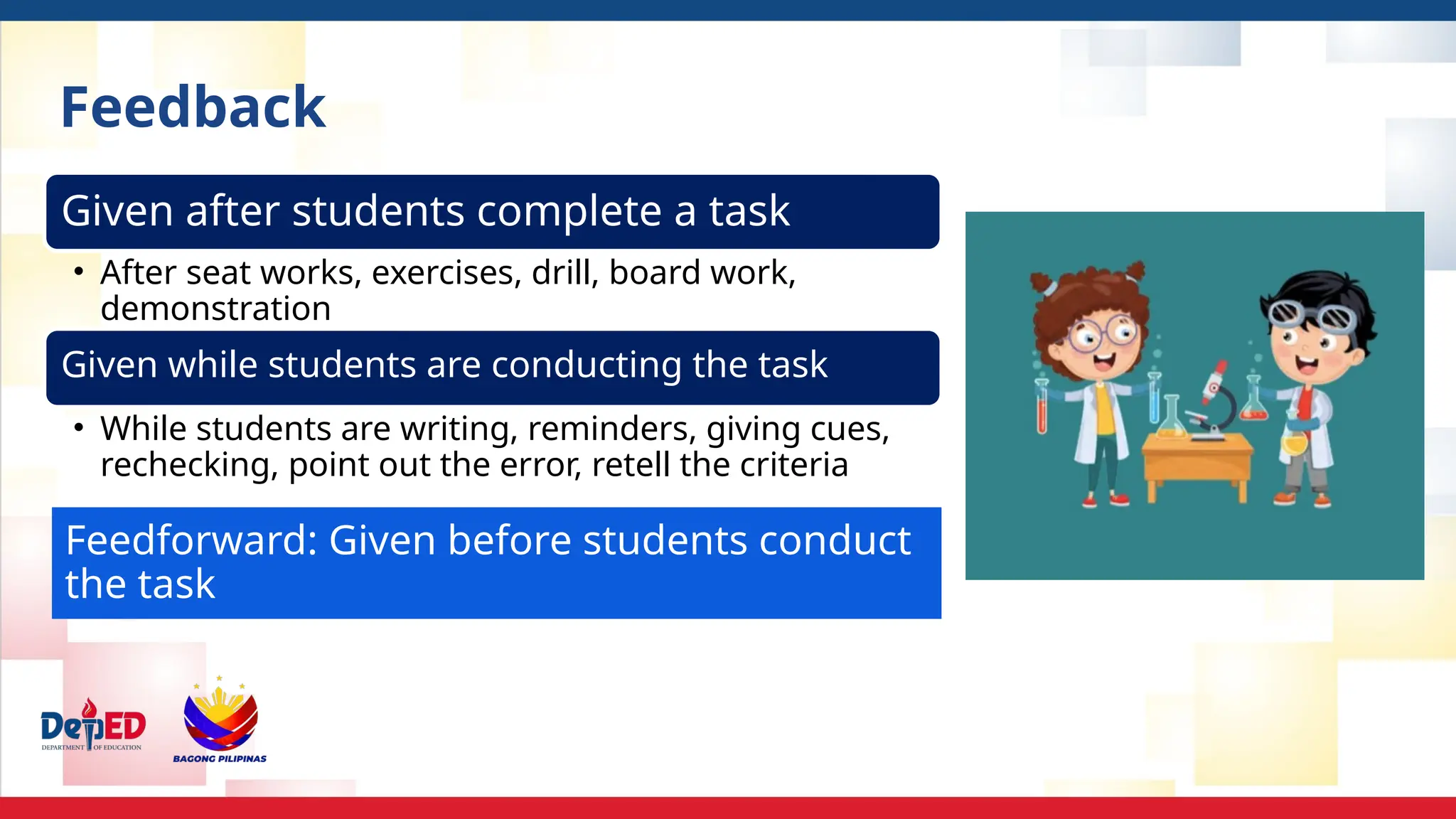
Given after studentscomplete a task
• After seat works, exercises, drill, board work,
demonstration
Given while students are conducting the task
• While students are writing, reminders, giving cues,
rechecking, point out the error, retell the criteria
Feedforward: Given before students conduct
the task
Feedback
117.
Assessment should beInclusive
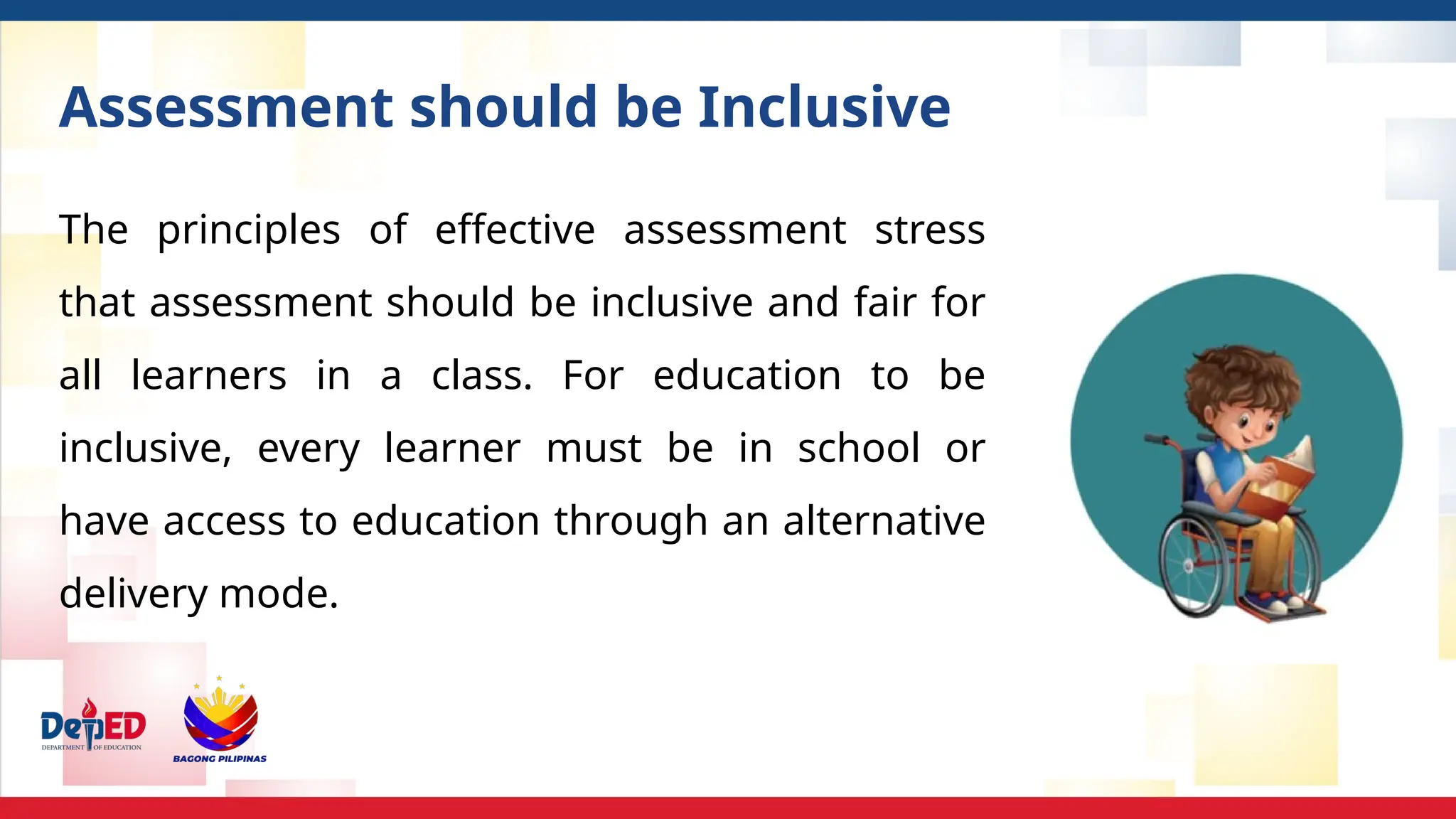
The principles of effective assessment stress
that assessment should be inclusive and fair for
all learners in a class. For education to be
inclusive, every learner must be in school or
have access to education through an alternative
delivery mode.
118.
Tips to makeassessment inclusive of Gender,
Indigenous people, and with Disabilities
GENDER:
Use range of assessment activities and ways for
girls and boys to demonstrate their learning
Vary assessment activities across physical and
socio-emotional dimensions of learning
119.
Tips to makeassessment inclusive of Gender,
Indigenous people, and with Disabilities
INDIGENEOUS PEOPLES:
Ensure that the values of the assessment process are
sensitive to and consistent with communal values.
Check the assessment activities are parallel to
cultural and national content
Avoid examples and questions that are
discriminatory
120.
Tips to makeassessment inclusive of Gender,
Indigenous people, and with special needs
WITH SPECIAL NEEDS:
Modify the way you present assessments to suit your
learners
Allow learners to choose ways to demonstrate their
learning
Prepare the environment: Administer assessments in a
separate place to minimize distraction
Provide enough time
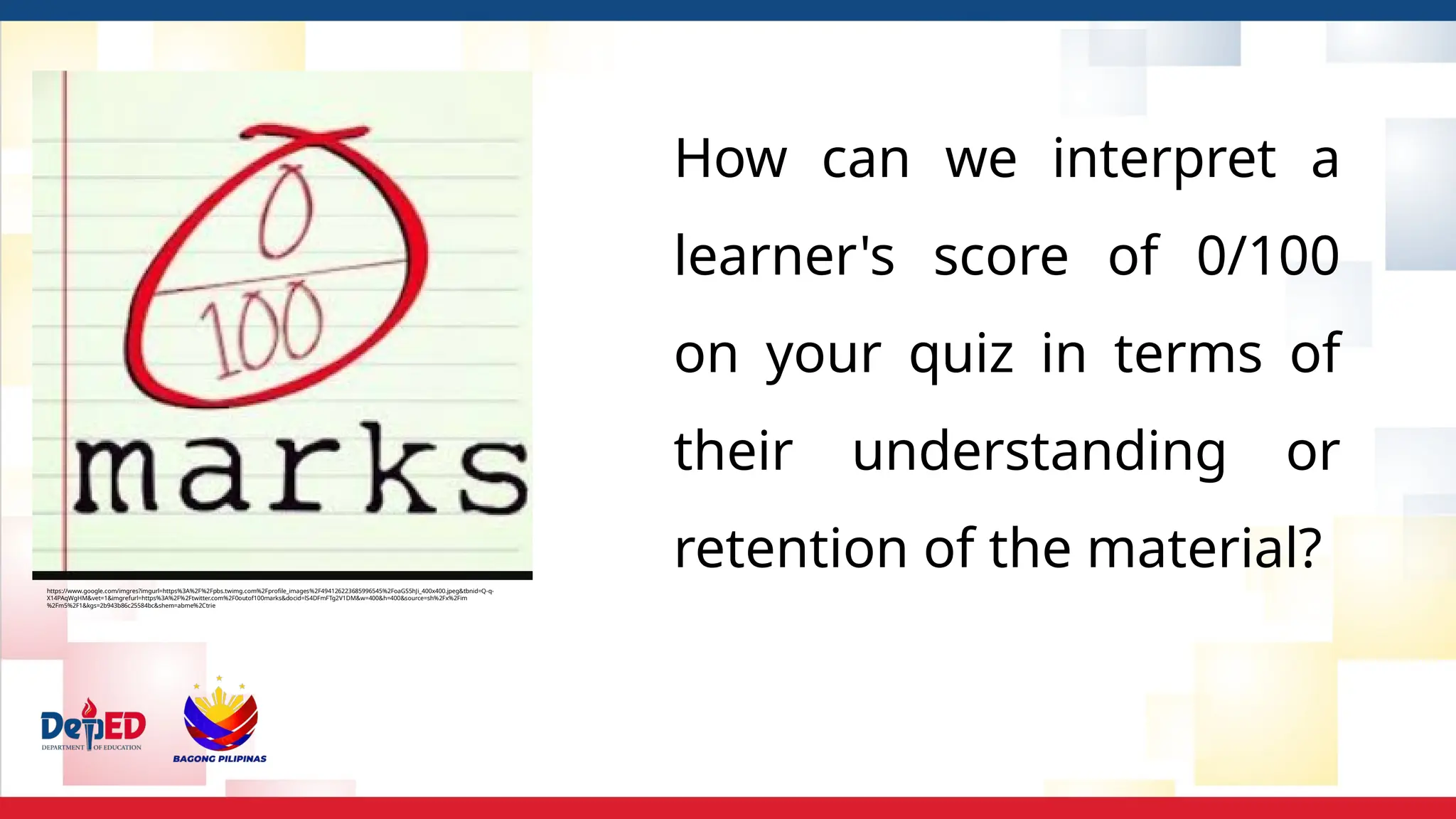
How can weinterpret a
learner's score of 0/100
on your quiz in terms of
their understanding or
retention of the material?
https://www.google.com/imgres?imgurl=https%3A%2F%2Fpbs.twimg.com%2Fprofile_images%2F494126223685996545%2FoaGS5hJi_400x400.jpeg&tbnid=Q-q-
X14PAqWgHM&vet=1&imgrefurl=https%3A%2F%2Ftwitter.com%2F0outof100marks&docid=lS4DFmFTg2V1DM&w=400&h=400&source=sh%2Fx%2Fim
%2Fm5%2F1&kgs=2b943b86c25584bc&shem=abme%2Ctrie
123.
Some issues withBloom’s Taxonomy
The category of a particular question does not usually provide a link
to the level of understanding in a student’s response.
The suggested hierarchy, and choice of words for each level of
Bloom’s Taxonomy makes it difficult to have an exact meaning (or use
the idea) with young students.
There are difficulties with the complexity associated with putting the
ideas of Bloom into a normal classroom setting. Many words used are
relevant to more than one level (e.g., knowledge, understand).
The SOLO Taxonomy addresses
these concerns!
124.
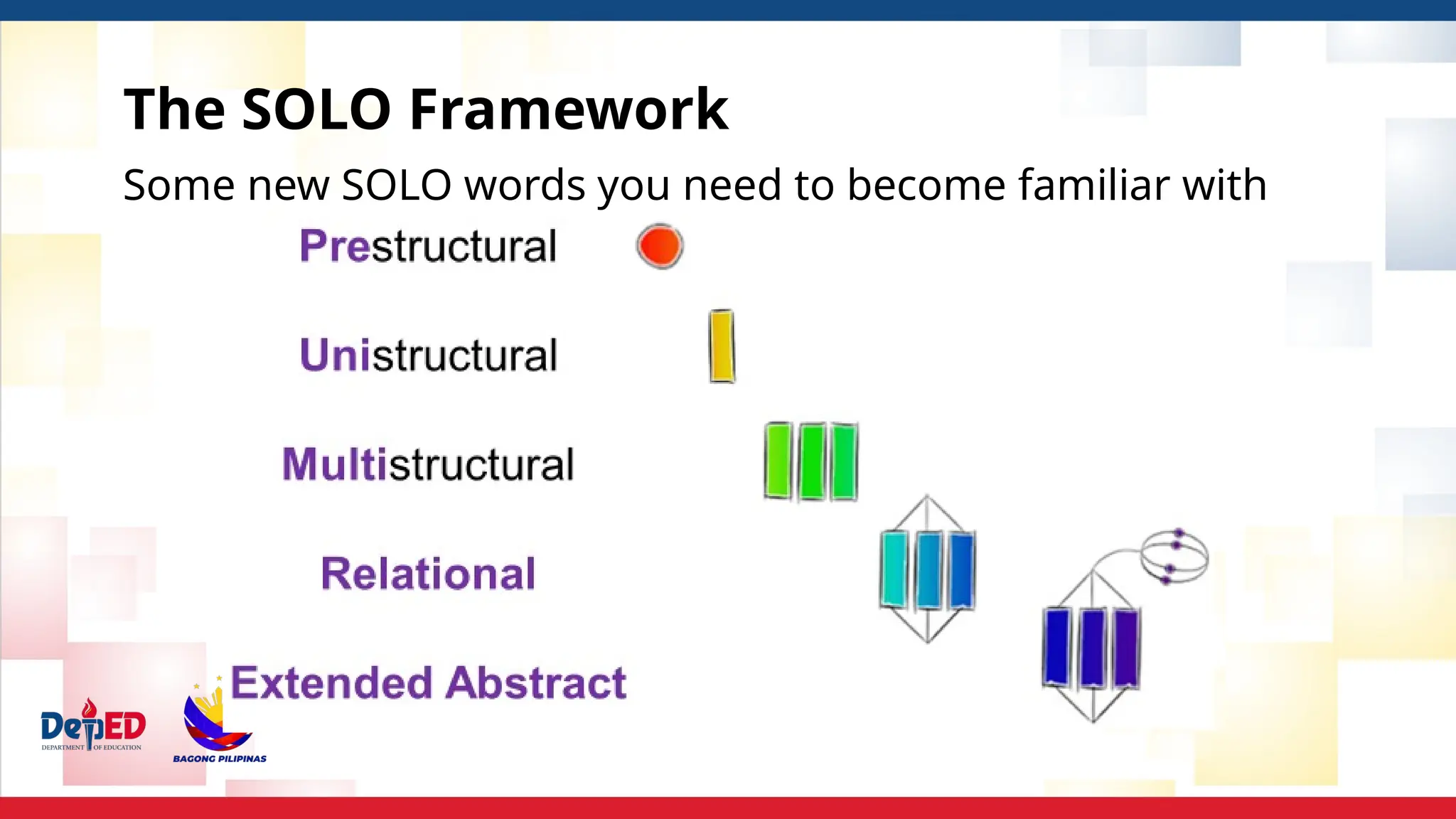
The SOLO Framework
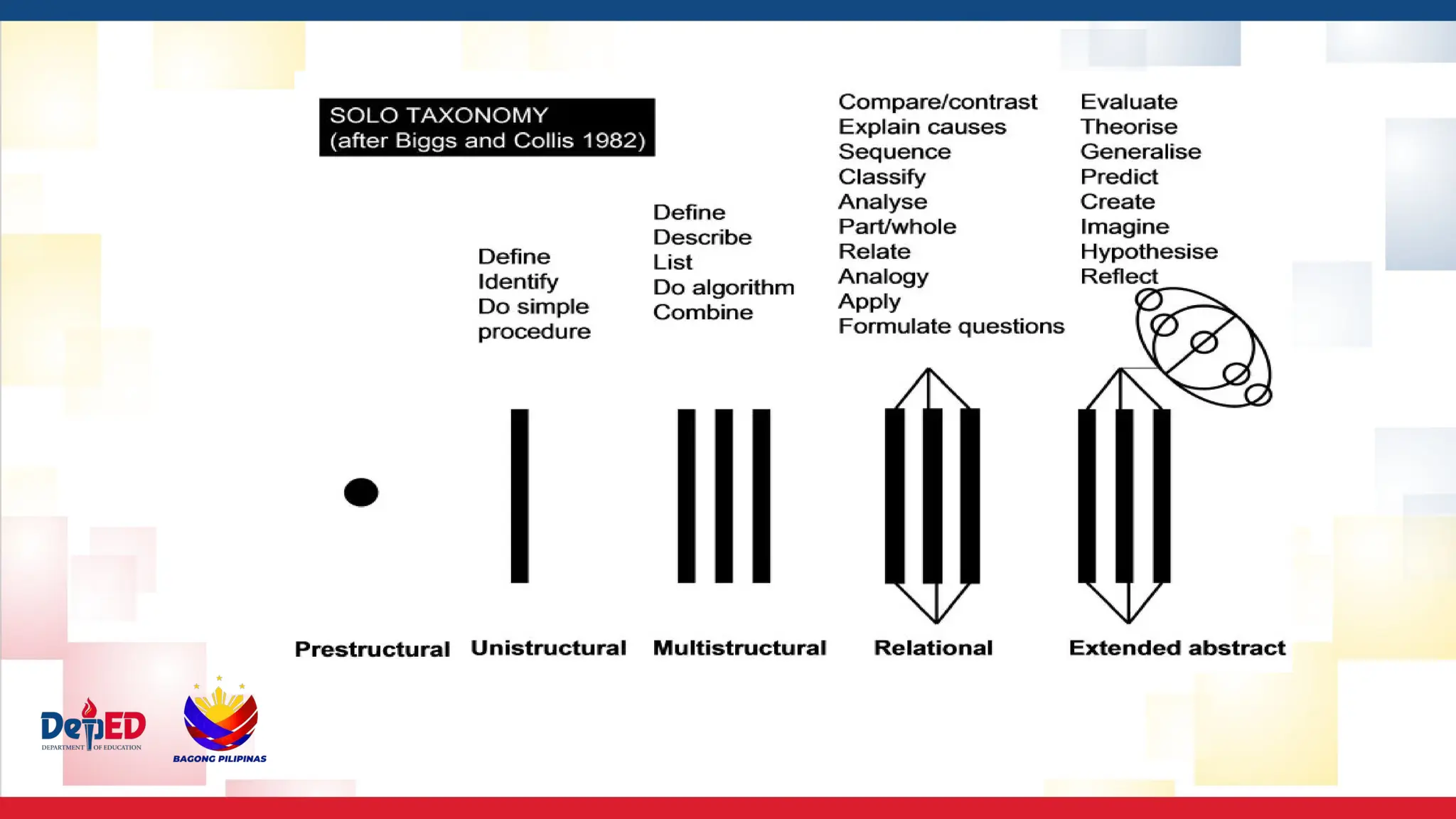
TheStructure of the Observed Learning Outcome (SOLO)
Taxonomy / Model is a system to classify the QUALITY of a
response based on structural complexity.
SOLO was developed by John Biggs and Kevin Collis.
125.
Some issues withBloom’s
Taxonomy
The category of a particular question does not usually provide a link
to the level of understanding in a student’s response.
The suggested hierarchy, and choice of words for each level of
Bloom’s Taxonomy makes it difficult to have an exact meaning (or use
the idea) with young students.
There are difficulties with the complexity associated with putting the
ideas of Bloom into a normal classroom setting. Many words used are
relevant to more than one level (e.g., knowledge, understand).
The SOLO Model:Why is it so useful?
Describe a response to a learned activity or question, as well as
help a teacher decide where students should proceed with
their learning.
Offer practical support in writing questions that can
differentiate higher-order and lower-order ideas.
Understand or help develop teaching programs (learning
progressions) and lessons that mirror how the brain learns.
131.
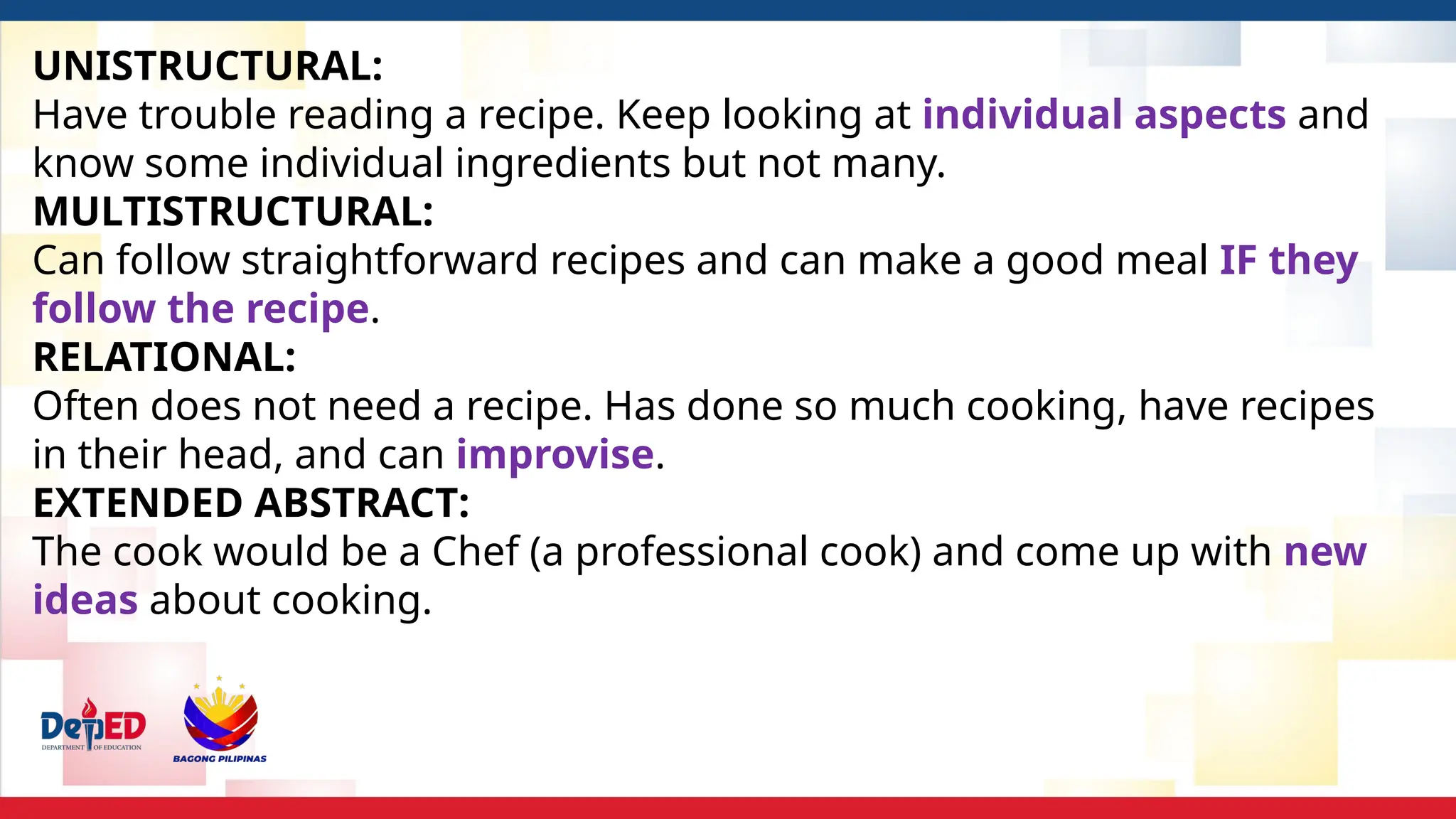
UNISTRUCTURAL:
Have trouble readinga recipe. Keep looking at individual aspects and
know some individual ingredients but not many.
MULTISTRUCTURAL:
Can follow straightforward recipes and can make a good meal IF they
follow the recipe.
RELATIONAL:
Often does not need a recipe. Has done so much cooking, have recipes
in their head, and can improvise.
EXTENDED ABSTRACT:
The cook would be a Chef (a professional cook) and come up with new
ideas about cooking.
132.
Activity 6: WeThink to Decide!
1. Get the metacards presented in a collage
form from the previous activity.
2. Rearrange the metacards where
assessment is applicable to the learning
competency which is aligned in the
pedagogical approach, teaching
methods/strategies and activities in
5mins
Activity 6: WeThink to Decide!
1. Consolidate your answer in the
worksheet for another 5mins
2. Group will present one learning
competency alignment to teaching
approach up to assessment.
Consider the following guide
questions:
Pedagogy shines, abeacon
so bright, Guiding our minds
to the heart of insight.
Assessment's the compass,
keeping us near, As we
navigate life with vision clear.
Doña R. N. (2024)
139.
REFERENCES
Department of Education.2023. K to 10 Instructional Design Framework.
Department of Education. 2023. MATATAG Science Curriculum Framework.
Department of Education. 2015. DepEd Order No. 8, s. 2015: Policy Guidelines on Classroom
Assessment for the K to 12 Basic Education Program.
Department of Education. 2020. DepEd Order No. 31, s. 2020: Interim Guidelines for Assessment and
Grading in Light of the Basic Education Learning Continuity Plan.
Department of Education. 2016. DepEd Order No. 42, s. 2016: Policy Guidelines on Daily Lesson
Preparation for the K to 12 Basic Education Program.
Abrea, Julieven. 2023. Matatag Training Resource Package for Trainers and Facilitators.
Make sure to adjust the formatting (italics, capitalization) according to your specific requirements or
style guide.
140.
REFERENCES
Bransford, J. D.,A. L. Brown, and R. R. Cocking, eds. 2000. How People Learn: Brain, Mind, Experience,
and School. Washington, DC: National Academies Press.
Caine, R. N., and G. Caine. 1991. Making Connections: Teaching and the Human Brain. Alexandria, VA:
ASCD.
Harlen, W., and A. Qualter. 2009. The Teaching of Science in Primary Schools. London: David Fulton
Publishers.
Hattie, J. 2009. Visible Learning: A Synthesis of Over 800 Meta-Analyses Relating to Achievement. New
York: Routledge.
Driver, R., H. Asoko, J. Leach, E. Mortimer, and P. Scott. 1994. "Constructing Scientific Knowledge in the
Classroom." Educational Researcher 23 (7): 5-12.
Make sure to adjust the formatting based on your specific guidelines or preferences.
141.
Program Management Team
Curriculumand Teaching Strand
Bureau of Curriculum Development
Bureau of Learning Delivery
Bureau of Education Assessment
Bureau of Alternative Education
Bureau of Learning Resources
Human Resources and Organizational Development
Strand
National Educators Academy of the Philippines
(NEAP)
Professional Development Division
Quality Assurance Division
Session Guide and Presentation
Deck Developer/s
Ryan Noel A. Doña, SDO Quezon City
REVISED K TO 10 CURRICULUM TRAINING RESOURCE
PACKAGE
141
Editor's Notes
#1 Purpose of the Slide:
Say:
Do:
Note: Change the title to reflect the governance level and target audience. Download this document as a PPT.
Check the session Flow:
1. Describe a clear understanding on the Pedagogical approaches, theories, activities and methods of teaching
2. Create pedagogical menu that can be utilized inside classroom
3. Walkthrough on Pedagogical approaches with articulation of the 21st Century Skills emphasizing the salient features of the Revised K to 10 curriculum
4. Discuss different assessments whether formative or summative type of assessment.
5. Describe the different features of assessment based on DO 8, s. 2015 and DO 31, s. 2020
6. Do an alignment of the unpacked competencies, aligned with the pedagogical approaches and teaching strategies to appropriate assessment activities
#2 Do: The Facilitator will: Display a welcome slide with the session title: Pedagogical approaches in Science Grade 5 Curriculum
Greet the participants and make them feel comfortable.
Introduce himself/herself.
Discuss the Learning Journey, for this session, it is the walkthrough of the Science shaping paper.
Read the session objectives and the Philippine Professional standards.
The facilitator will discuss the session flow.
#4 Say: 1: Content Knowledge and Pedagogy
1.2 Research-based knowledge and principles of teaching and learning;
1.5 Strategies for developing critical and creative thinking, as well as other higher-order thinking skills;
PPST 2: Learning Environment
2.3 Management of classroom structure and activities;
2.4 Support for learner participation; and
2.5 Promotion of purposive learning.
PPST 4: Curriculum and Planning
4.1. Planning and management of teaching and learning process;
4.2 Learning outcomes aligned with learning competencies
#5 Say: 1: Content Knowledge and Pedagogy
1.2 Research-based knowledge and principles of teaching and learning;
1.5 Strategies for developing critical and creative thinking, as well as other higher-order thinking skills;
PPST 2: Learning Environment
2.3 Management of classroom structure and activities;
2.4 Support for learner participation; and
2.5 Promotion of purposive learning.
PPST 4: Curriculum and Planning
4.1. Planning and management of teaching and learning process;
4.2 Learning outcomes aligned with learning competencies
#6 1: Content Knowledge and Pedagogy
1.2 Research-based knowledge and principles of teaching and learning;
1.5 Strategies for developing critical and creative thinking, as well as other higher-order thinking skills;
PPST 2: Learning Environment
2.3 Management of classroom structure and activities;
2.4 Support for learner participation; and
2.5 Promotion of purposive learning.
PPST 4: Curriculum and Planning
4.1. Planning and management of teaching and learning process;
4.2 Learning outcomes aligned with learning competencies
#7 Say:At the end of the session, participants will…
Compare and contrast pedagogical theories, approaches, teaching methods/strategies and activities.
Classify different pedagogical approaches that can be utilized that are aligned in the unpacked learning competencies.
#8 At the end of the session, participants will…
3.Articulate 21st century skills that is aligned to the pedagogical approaches that can be utilized that is aligned in the unpacked learning competencies.
4. Classify different assessments whether formative or summative type of assessment.
#9 Say: 5. Describe the different features of assessment based on DO 8, s. 2015 and DO 31, s. 2020
6. Categorize different assessment activities in relation to the unpacked competencies, aligned with the pedagogical approaches and teaching strategies.
#11 Say: The objective of this activity is to Categorize the given cut-out phrases to the given words using T-chart format.
#12 Instructions:
Draw a T-chart on the manila paper. Label the left column “GIVEN WORDS” and the right column “GIVEN EXAMPLES”.
Write the following items in the left column of the T-chart using metacards.
In the right column, match each item from the left column with relevant examples or categories.
You have 10 minutes to complete the task. Afterward, each group will have 2 minutes to present their T-chart and explain their organization.
#13 Do: The LF will display the screen the sample of T-chart and distribute the Material
Say: Look at the
Do you have your materials already? Any clarification? If none you can start accomplishing your task now.
#17 Note: Presentation time should not be more than 2 minutes.
TWIST & CHALLENGE using Pecha Kucha style of presentation. Presentation Format: Use the Pecha Kucha style: Present each item in the left column with a maximum of 20 seconds per item. Presentation time should not to be more than 2 minutes per group.
#18 TWIST & CHALLENGE using Pecha Kucha style of presentation. Presentation Format: Use the Pecha Kucha style: Present each item in the left column with a maximum of 20 seconds per item. Presentation time should not more than 2 minutes per group.
#23 Purpose: The Facilitator will:
Greet the participants and make them feel comfortable.
Introduce himself/herself.
Discuss the Learning Journey, for this session, it is the walkthrough of the Science shaping paper.
Read the session objectives and the Philippine Professional standards.
The facilitator will discuss the session flow.
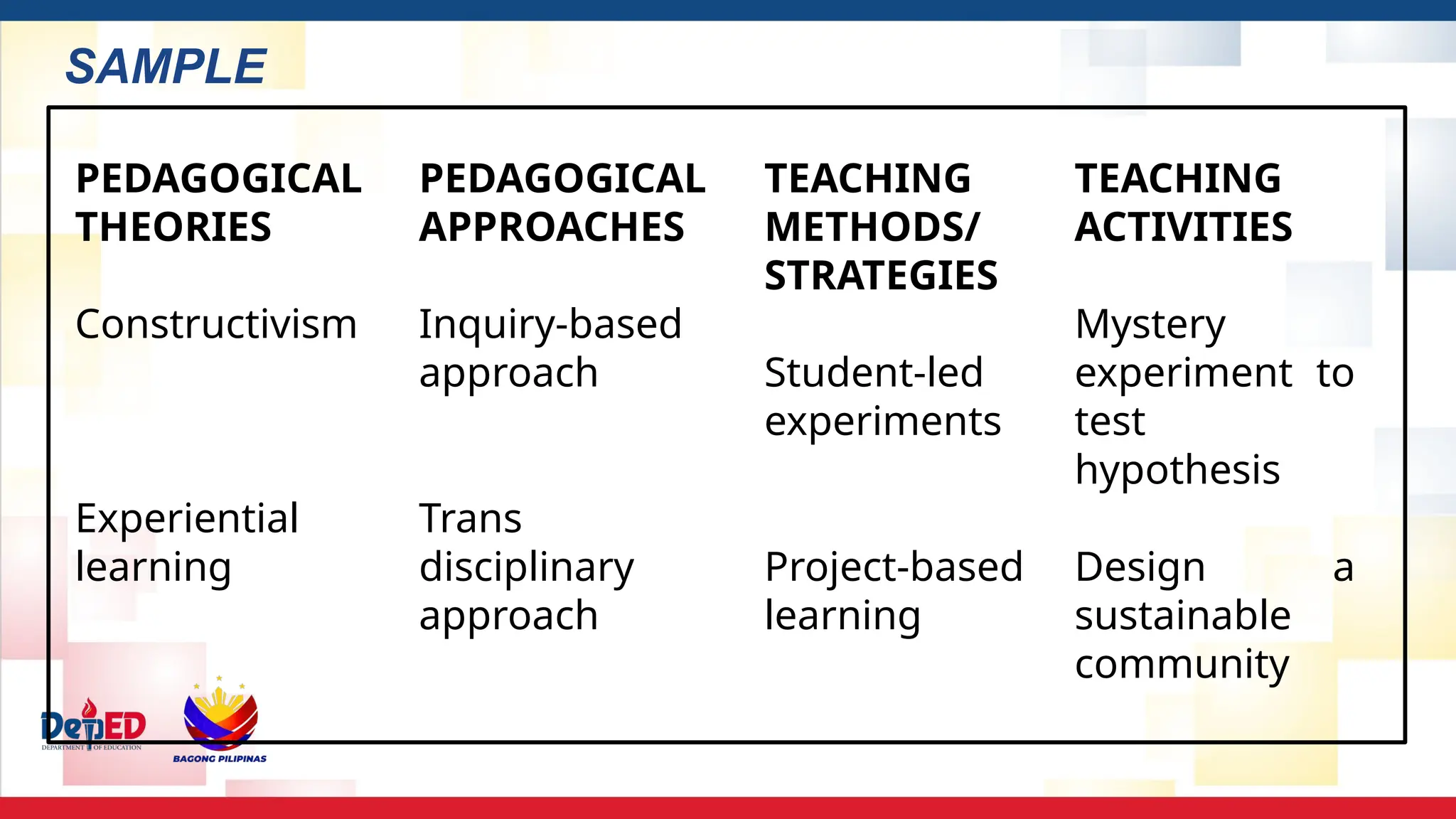
#25 As sample, we have Constructivism as theory, Inquiry-based approach as pedagogical approach , student-led experiments as teaching methods and Mystery experiment to test hypothesis as teaching activity
Another example for us to understand the differences, Experiential learning as theory, Transdisciplinary as an approach, Project-based learning as teaching method, and design sustainable community in teaching activities
#26 For more example of how we understand the differences of theory, approach, method, activity.
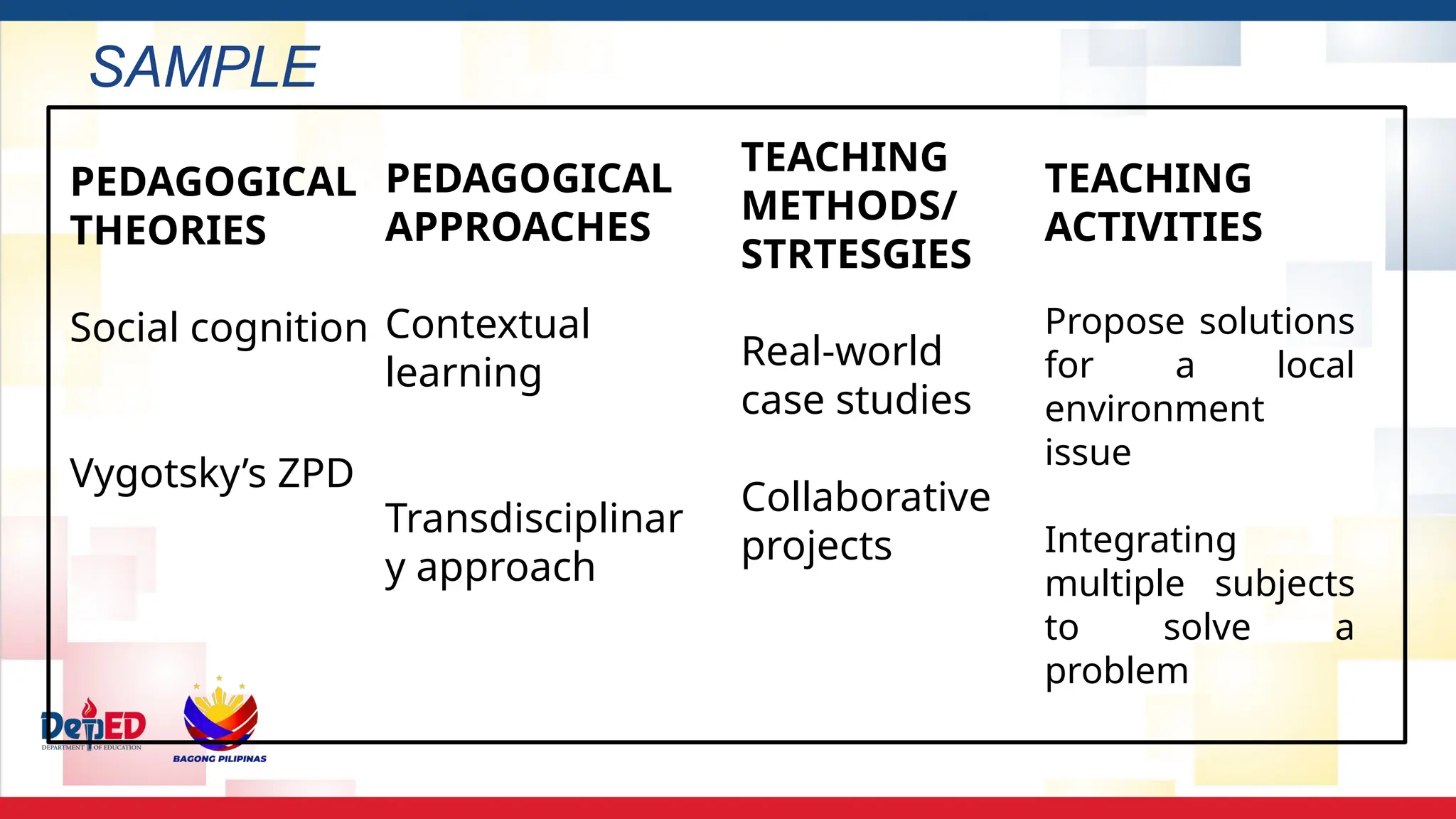
Social cognition as theory, contextual learning as an approach, real-world case study as method, and Proposing a solution for a local environment for the activity
The last one in Theory we have Vygotsky’s ZPD, Transdisciplinary approach, Collaborative projects as method and integrating multiple subjects to solve problem as an activity
#28 Say: For our second activity, we will make a list of pedagogical approaches that we can use inside classroom. Let us do the activity entitled “Can I have the menu?”
Objective: Make a menu list of pedagogical approach for each LCs in quarter 1.
#29 Purpose:
Say: 1. One group member will collect the materials from the envelopes, including metacards, manila paper, and markers.
2. Each member writes different pedagogical approaches used in the classroom on the worksheet number 1. You will be given 5 minutes to finish the task.
#31 Continuation…
Purpose:
Say: 1. As a group, discuss and describe individual answers. Decide on a maximum of two pedagogical approaches for each Learning Competency (LC).
Write the answer on the provided pedagogical menu worksheet.
2. With the answers of the group, write consolidated pedagogical approaches in the metacards.
Post the metacard beside the applicable unpacked learning competencies from the previous activity. You will be given 10 minutes to finish the task
#34 After the group presentation the LF will process their answers using the guide questions. Call participant to answer the question to give insights and have a professional discourse
Welcome slide
Activity 2: “Can I have the menu?”
Say: For our second activity, we will make a list of pedagogical approaches that we can use inside classroom. Let us do the activity entitled “Can I have the menu?”
Objective: Make a menu list of pedagogical approach for each LCs in quarter 1.
Instructions:
Gather Materials: One group member will collect the materials from the envelopes, including metacards, manila paper, and markers.
List Pedagogical Approaches: Each member writes different pedagogical approaches used in the classroom on the worksheet number 1. You will be given 5 mins to finish the task.
5 minute timer
to continue
Describe and Suggest:
As a group, discuss and describe individual answers.
Decide on a maximum of two pedagogical approaches for each Learning Competency (LC).
Write the answer on the provided pedagogical menu worksheet
Consolidate and Select Approaches:
With the answers of the group, write consolidated pedagogical approaches in the metacards.
Post the metacard beside the applicable unpacked learning competencies from the previous activity. You will be given 10 minutes to finish the task
10 minute timer
Presentation proper
LF commend and give recognition to each group for their work
After the group presentation the LF will process their answers using the guide questions. Call participant to answer the question to give insights and have a professional discourse
GUIDE QUESTIONS:
What are the identified pedagogical approaches listed in your menu?
As a group, how did each one of you decide on the suggested approach for the specific unpacked competencies?
To process this activity, we will answer the following questions.
What are the identified pedagogical approaches listed in your “MENU”?
Expected
The learning approaches are:
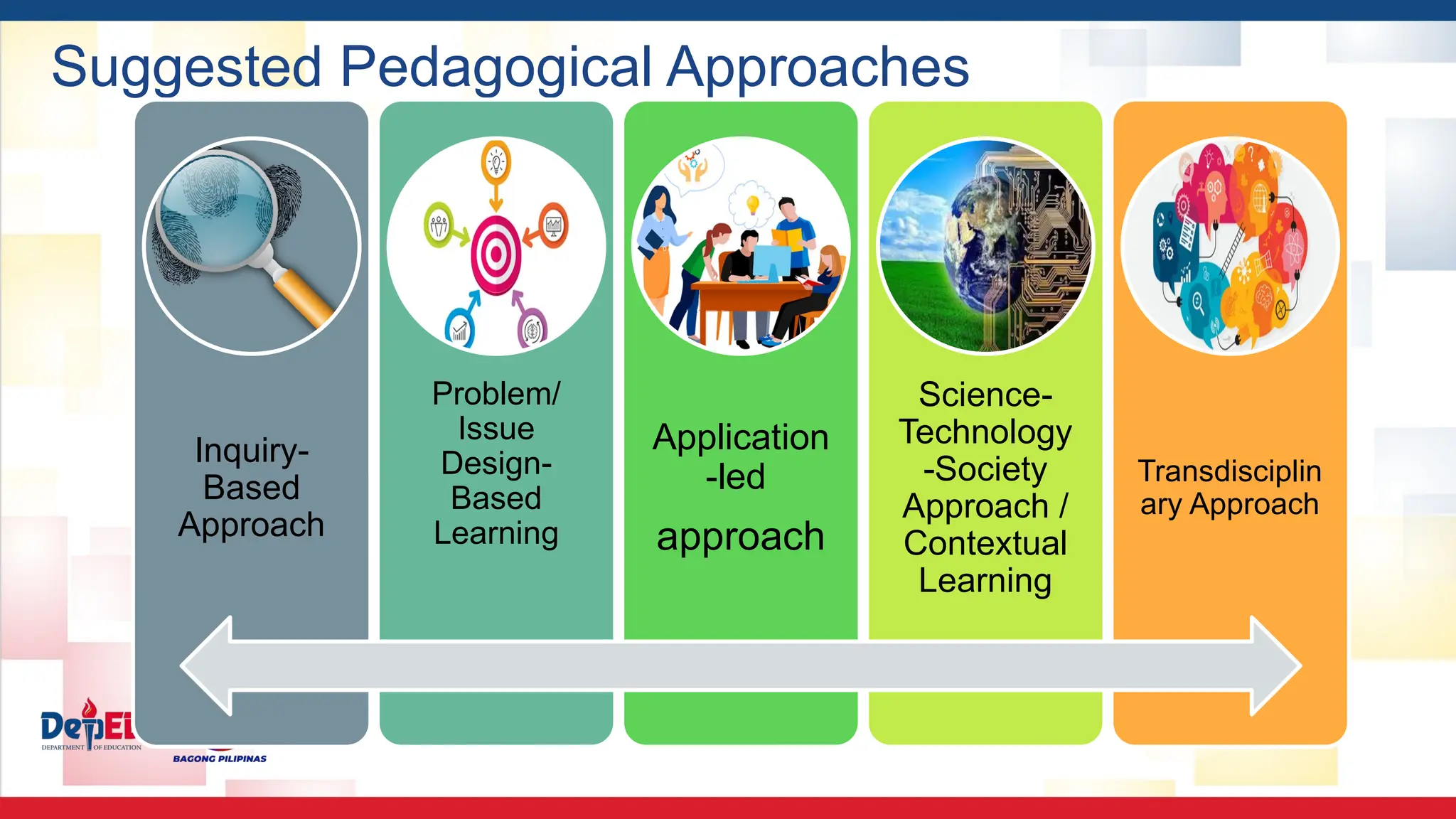
Inquiry-based approach
Transdisciplinary Approach
Science-Technology-Society Approach
Problem-based / Designed-based Learning
Application-led Approach
How the group be able to decide the suggested approach/es to specific unpacked learning competencies?
Expected
Some of the group identified specific teaching methods and categorize it based on pedagogical approach and come up what teaching activities that can be suggested:
Inquiry-based Approach
Hands-on experiments and investigations.
Questioning techniques to stimulate curiosity.
Socratic questioning for group discussions.
Problem-solving scenarios and case studies.
Think-pair-share activities.
Transdisciplinary Approach
Integrated project-based learning across subjects.
Cross-curricular thematic units.
Collaborative research projects involving multiple disciplines.
Science-Technology-Society Approach
Collaborative projects addressing societal challenges.
Designing solutions to address real-world societal problems.
Debates on ethical considerations in science and technology.
Problem-based / Design-based Learning:
Design challenges to solve real-world problems.
Project-based assessments with open-ended questions.
Case studies requiring problem-solving skills.
Application-led Approach:
Real-world case studies illustrating scientific concepts.
Hands-on activities with practical applications.
Problem-solving scenarios in authentic contexts.
The LF will process the answers of the group and observe different approaches that is common, uncommon or can be used as best practice for such unpacked competencies to learning pedagogy.
#37 The Revised K to 10 Curriculum shall continue to utilize pedagogical approaches that are constructivist, inquiry-based, reflective, collaborative, and integrative as stipulated in RA 10533 and reiterated in DepEd Order No. 21, s. 2019.
“The previous session highlights the Instructional Design Framework as discussed in the General Shaping Paper of the REVISED K TO 10 Curriculum. For this session, we will discuss IDF as applied in the context of Science and its appropriate pedagogical approaches and assessment strategies.”
“As presented, the IDF is the guide of every teacher in preparing instructional materials in the delivery of the lesson. pedagogical approaches that are constructivist, inquiry-based, reflective, collaborative, and integrative
#38 The K to 10 Instructional Design Framework
As the K to 10 Basic Education Curriculum is revised, the Instructional Design Framework, being a systematic and integrative approach to developing effective and efficient instruction, is imperatively needed to establish an enabling structure of ensuring the effective teaching and learning delivery.
#39 Say: reflects the shared vision articulated in the revised curriculum;
encapsulates the curriculum, teaching, and assessment process; and
outlines the fundamental yet flexible and descriptive approach for teachers in designing learning opportunities
#40 Recognizes the uniqueness, strengths, and full potential of all learners regardless of their background, the learner serve as the compass in planning, directing, modifying, and enhancing the instruction across all types of modalities, using a variety of sound assessment practices resulting in evidence-based teaching.
#41 Purpose: Relate the Features
Features of the K to 10 Instructional Design Framework
Say: It cuts across important learning stages and learning areas.
It emphasizes the learners rather than the process. It enables learners to take part in making decisions about creating learning activities.
It gives direction and brings together school administrators, teachers, and learners
It is flexible to promote creativity and collaboration.
It is descriptive rather than prescriptive.
It provides the design of instruction and does not direct its procedures.
It serves as a guide for implementing uniformity and consistency in designing and planning the lesson.
#42 “A central feature of the Science curriculum is the balanced integration of three interrelated content strands: performing scientific inquiry skills, understanding and applying scientific knowledge, and developing and demonstrating scientific attitudes and values.”
#44 Within the framework of science education, it is anchored on the following educational pedagogical theories and models: constructivism and experiential learning, social cognition learning model, brain-based learning, and Vygotsky’s Zone of Proximal Development.
With all of the principles, aspects, and facets of the IDF, together with the educational pedagogical theories and models and pedagogical approaches for science, the framework of science education and the k to 10 instructional design framework will highlight our Filipino learners in the field of science education towards active engagement, real-world relevance, critical thinking, student-centered, collaboration, and adaptation.
Background:
The overall goal of the Science Curriculum is the achievement of scientific, environmental and technology and engineering literacy of all learners.
On achieving the outcomes of the curriculum, learners will be ready to actively participate in local, national, and global contexts and make meaningful contributions to a dynamic and culturally diverse and expanding world. By successfully completing the Science Curriculum, Filipino learners will demonstrate capabilities as put forth in the Basic Education Development Plan (BEDP) 2030.
#45 Say: With all of the principles, aspects, and facets of the IDF, together with the educational pedagogical theories and models and pedagogical approaches for science, the framework of science education and the k to 10 instructional design framework will highlight our Filipino learners in the field of science education towards active engagement, real-world relevance, critical thinking, student-centered, collaboration, and adaptation.
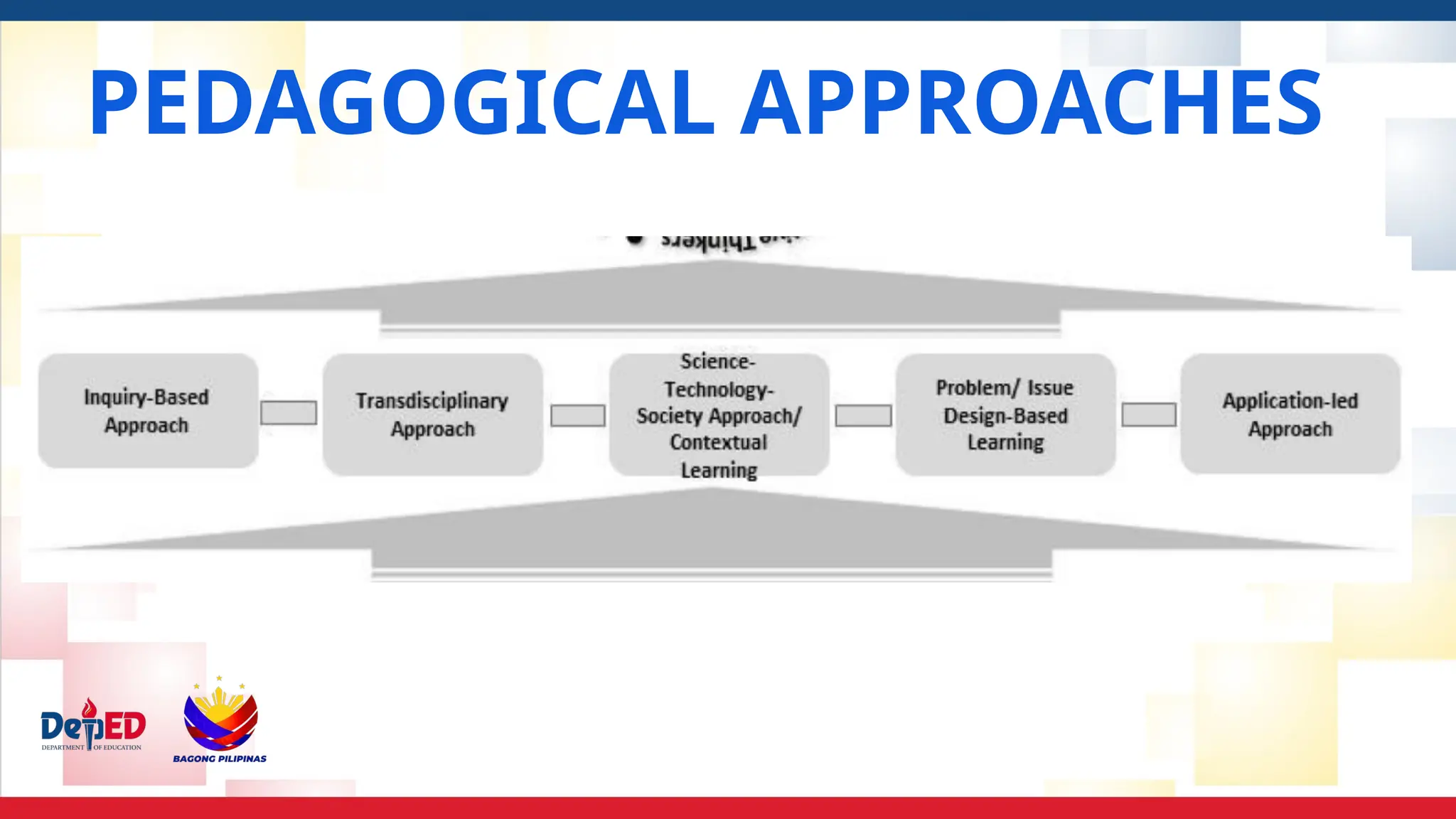
#46 The suggested pedagogical approaches for science includes the following: Inquiry-Based learning, problem-based learning, application-led approach, science-technology-society approach, and integrated Transdisciplinary approach.
#47 Inquiry-based learning approach puts a premium on questioning, investigating, proving, probing, explaining, predicting, and establishing connections of evidence (Calburn, 2020). Instead of a transmissive mode of teaching, this approach involves inquiry and sustained active engagement of learners. The approach is characterized in the classroom by questions and discussions. Inquiry allows learners to formulate questions and find solutions through learning real-life-based investigations and research projects. Concepts and specific scientific terms need to be explained in simple language. Applications and situations need to be explained in relevant contexts and are best explored through science activities. In this approach learners also engage in developing process skills, analyzing and evaluating evidence, experiencing and discussing, and talking to their peers about their own understanding (Suchman, 1964). Learners collaborate with others to make discoveries, solve problems, and plan investigations.
#50 Second, pedagogical approach to science teaching is the differentiated instruction.
Differentiation means tailoring instruction to meet individual needs. In simple terms, teachers tailor their instruction to meet the needs of the learners. With a variety of needs filling our classrooms, it is important to use a variety of instructional techniques.
#51 Second, pedagogical approach to science teaching is the differentiated instruction.
Differentiation means tailoring instruction to meet individual needs. In simple terms, teachers tailor their instruction to meet the needs of the learners. With a variety of needs filling our classrooms, it is important to use a variety of instructional techniques.
#52 Fourth, the science-technology-society approach. It is the involvement of learners in experiences and issues which are directly related to their lives. STS develops students with skills which allow them to become active, responsible citizens by responding to issues which impact their lives. In other sense, it is the teaching and learning of science and technology in the context of human experience.
#54 Third, the pedagogical approach is the problem-based learning. It is a student-centered approach in which learners learn about a subject by working in groups to solve an open-ended problem.
The aim of PBL is for learners to take an active and problem-solving role in the process, in accordance with the learner-centered education approach.
#55 We can identify the unique structure of PBL over the traditional learning from the presented slide.
On the usual way of learning, learners will be told what they need to know, followed by memorization. Then, the problem will be assigned to illustrate as well as how to use it.
In PBL, problem will be assigned, and the learners will identify what they need to know. At the end, learners will learn and apply it to solve the problem.
#56 These are the samples of PBL which could be applied in teaching science education:
Discussion and debate relative to environmental issues and concerns
Role play on disaster preparedness
Student presentations about their mitigation and resilience plans relative to the impacts of climate change.
Think-Pair-Share about the use of non-renewable energy sources: boom or bane
#58 The next pedagogical approach is the interdisciplinary approach which considers different points of view, comparing and contrasting them. It involves drawing appropriately from several disciplines (or separate branches of learning or fields of expertise) to redefine problems outside of normal boundaries and reach solutions based on a new understanding of complex situations.
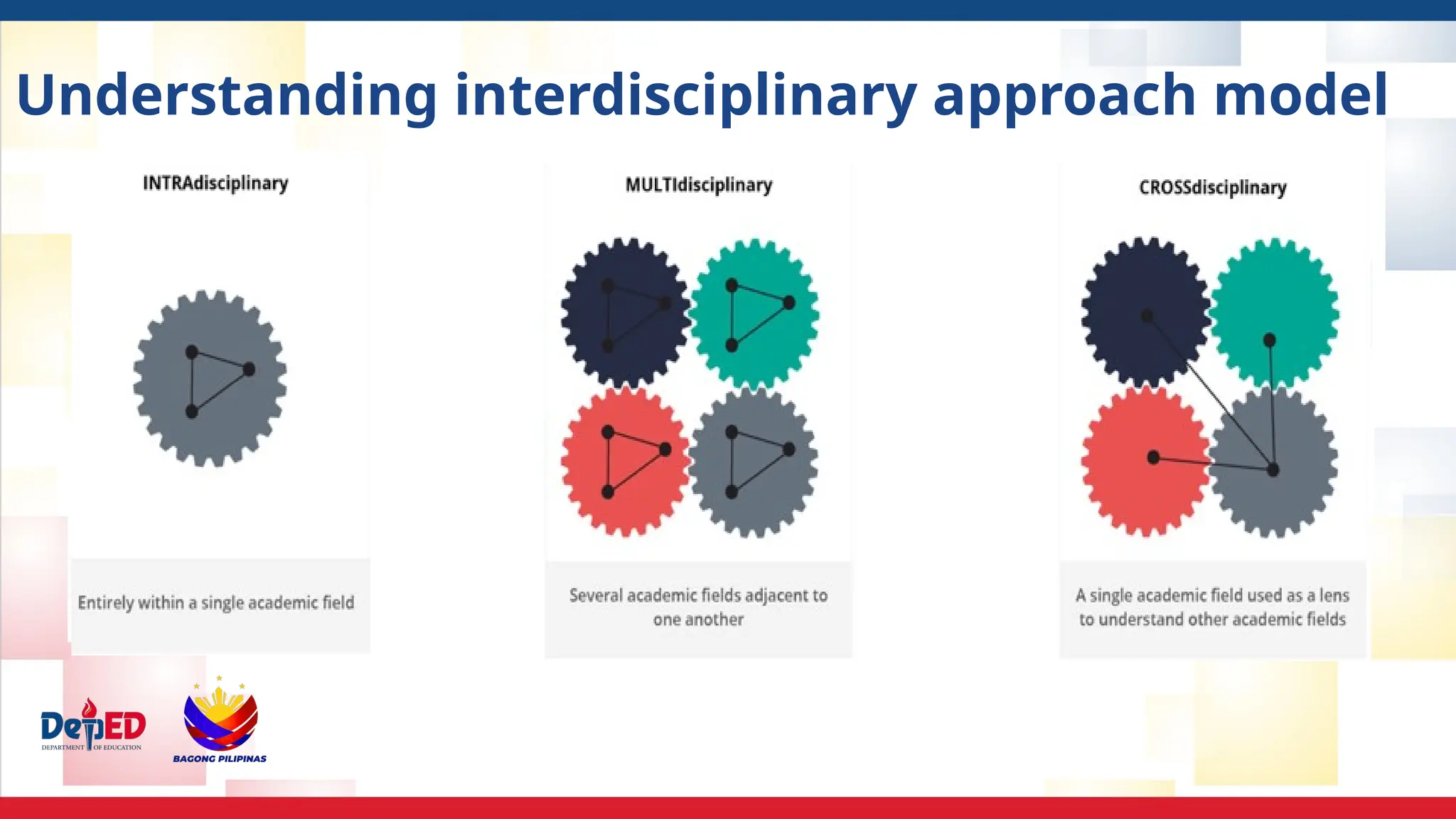
#59 We can simply understand the context of interdisciplinary approach using the following models.
For intradisciplinary, it highlights that the instruction was entirely within a single academic field.
For multidisciplinary, the instruction was from several academic fields adjacent to one another.
For cross disciplinary, a single academic field is used as a lens to understand other academic fields in the instruction.
#60 In contrast to the previous models, interdisciplinary and transdisciplinary models better prepare our learners to find an engaging and rewarding pathway.
For interdisciplinary, the instruction focuses on multiple academic fields interacting
Meanwhile, multiple academic and non-academic fields interacting, and co-mingling was highlighted in the transdisciplinary model.
#61 In contrast to the previous models, interdisciplinary and transdisciplinary models better prepare our learners to find an engaging and rewarding pathway.
For interdisciplinary, the instruction focuses on multiple academic fields interacting
Meanwhile, multiple academic and non-academic fields interacting, and co-mingling was highlighted in the transdisciplinary model.
#62 In contrast to the previous models, interdisciplinary and transdisciplinary models better prepare our learners to find an engaging and rewarding pathway.
For interdisciplinary, the instruction focuses on multiple academic fields interacting
Meanwhile, multiple academic and non-academic fields interacting, and co-mingling was highlighted in the transdisciplinary model.
#63 Cooperation Learning -
Next Generation Science Learning
Nature of Science (NOS) Pedagogy
Sociocultural Practices
Responsive Teaching
Practice-Based Pedagogy
#65 Say: Pedagogical approaches in teaching Science 5 REVISED K TO 10 curriculum will be more efficient if we will integrate these 21st century skills necessary towards the success of education.
#66 Presented in the slide is the clearer articulation of the 21st century skills as featured in our REVISED K TO 10 Curriculum as stipulated in DepEd Order No. 24, s. 2022
21st Century skills are the abilities that today’s students need to succeed in their careers during the Information Age. These skills are intended to help learners keep up with the lightning-pace of today’s modern markets. Each skill is unique in how it helps learners, but they all have one quality in common. They’re essential in the age of the Internet.
#67 Each 21st Century skill is broken into one of three categories:
Learning skills
Literacy skills
Life skills
#68 Learning skills (the four C’s) teaches learners about the mental processes required to adapt and improve upon a modern work environment.
#69 Literacy skills (IMT) focuses on how students can discern facts, publishing outlets, and the technology behind them. There’s a strong focus on determining trustworthy sources and factual information to separate it from the misinformation that floods the Internet.
#74 Say: Objective: Create a guide chart of the aligned learning competency to applicable pedagogical approach, teaching activities with articulated 21st century skills.
#75 Individual Activity – Participants must list down different approaches they use in their school context
Collaborative approach – summarizing the listed approaches through hunting from other members from different members and come up with summarize answer in a manila paper
Summarize and put into manila paper -
#80 Purpose: To have a checklist to use as guide (
#85 Purpose:
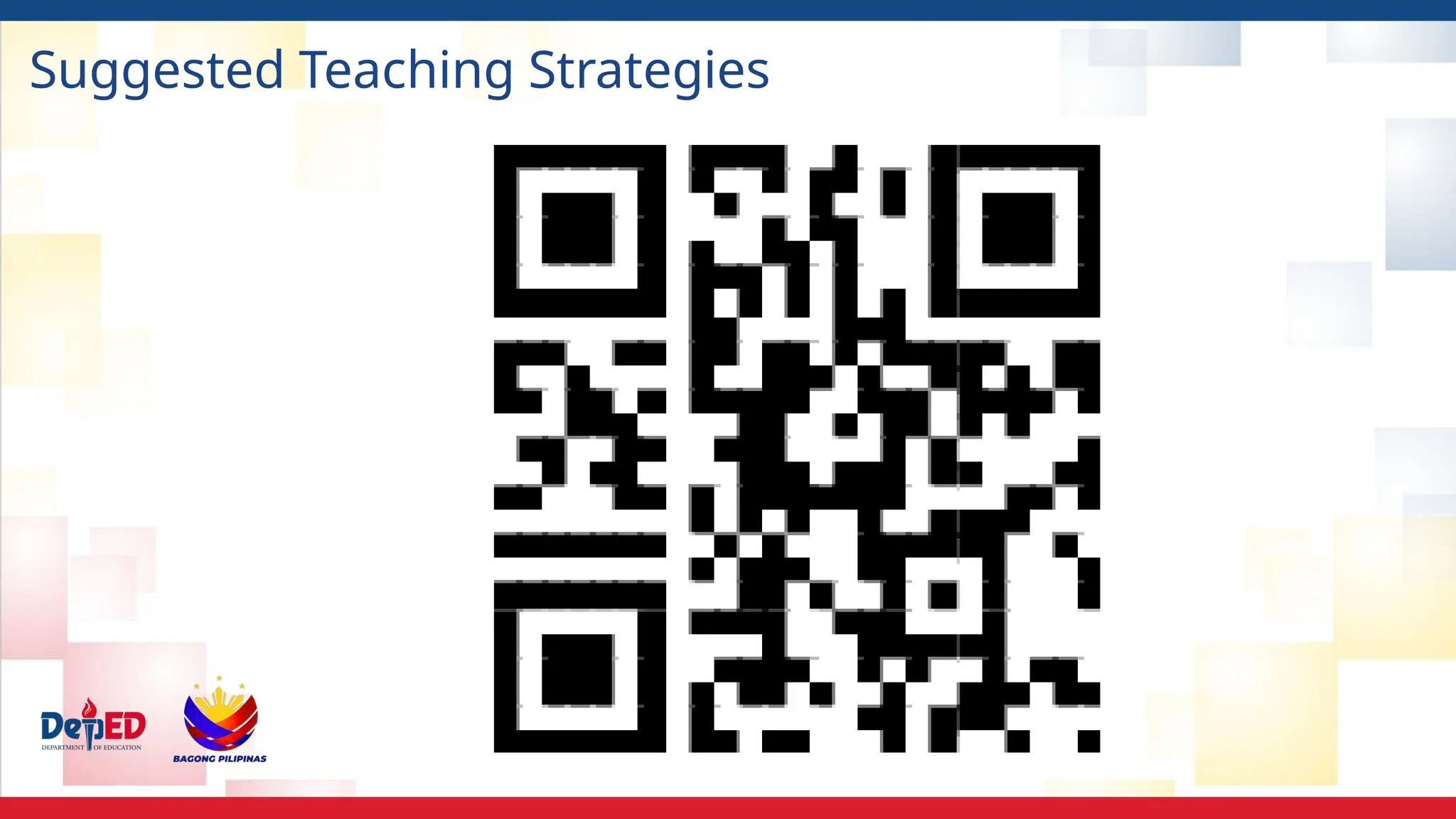
Say: To access the list of the suggested strategies you can scan the QR code
#86 Say: Let us continue our session on Pedagogical approaches and Assessment Methods in Science. We have a mix of presentations, discussions, and hands-on activities planned to keep things dynamic and interactive.
#87 Say: We will have our 4th activity for session 2. You're going to play “ARE U INsideOUT”.
Instructions:
1. Each group will compile a list of the different types of assessment activities conducted in the classroom using a metacard. Write as many as you can.
2. You have 5 minutes to complete this task. Post it in a manila paper and make a collage work.
#89 After listing the assessment activities, each group will take turns reciting their list aloud.
2. As each group recites and will ask other group (IN OR OUT?) if it has same word, other groups will cross out any matching assessment activities on their own lists.
3. Continue this process until every group has had the opportunity to recite, and all possible matches have been crossed out.
Note to LF: At the end of the recitation, the facilitator will review and remaining metacard/s that have not been cross-out
#91 What are the assessment were crossed out?
What are the assessments retained in your list?
explain the remaining assessment/s in your list being delivered inside classroom?
#99 How are assessment activities classified into formative or summative?
What are your observations on the given sample assessment of the different groups?
How is this assessment activity conducted or implemented inside the classroom?
#101 As per DepEd Order No. 8, s. 2015 defines classroom assessment as an ongoing process of identifying, gathering, organizing, and interpreting quantitative and qualitative information about what learners know and can do.
#102 It is an integral part of the teaching-learning process; hence the K to 10 Instructional Design Framework provides that assessment may be given at any point in the lesson.
#103 We are much familiar that there are two types of classroom assessment as stipulated in DO 8, s. 2015. The two types of classroom assessment are formative and summative assessment.
Formative assessment is known as assessment for learning because it helps to improve the learning of all learners while they learn. Learners also develop an understanding of what is involved in their learning and how to take responsibility for improving it.
Summative assessment is known as assessment of learning as it summarizes learning that has occurred over a period for all learners. It is administered at the end of a block of learning to measure the extent learners have mastered the content and performance standards; the results of summative assessment are used as the basis for computing grades.
#104 Formative assessment is seen as assessment for learning which may be given at any time during the teaching and learning process so that teachers can make adjustments wherein learners reflect on their own progress.
#106 Meanwhile, here are some examples of assessment methods during the lesson:
Multimedia Presentations
Observations
Other Formative Performance Tasks
Quizzes (recorded but not graded)
Recitation
Simulation Activities
#107 On the other hand, here are the examples of assessment methods after the lesson:
Checklists
Discussions
Games
Performance Tasks that emanate from the lesson objectives
Practice Exercises
Short Quizzes
Written Work
#108 Purpose of the Slide: To recall/ introduce Integrative PT/Assessment
Say: DO 31, s. 2020 provide guidance in implementing Integrative Performance Task
Other Notes: May ask the pax of their experiences/practices in doing the Summative Assessment.
#109 Summative assessment is seen as assessment of learning which occurs at the end of a particular unit in order to describe the standard reached by the learner.
#110 To maximize its effectiveness, it is essential to consider three core elements when designing and implementing assessments: purpose, timing, and features. Understanding these elements helps educators tailor assessments to meet specific objectives, align them with learning goals, and ensure they provide meaningful feedback. This careful consideration ensures that assessments not only gauge students' knowledge and skills but also enhance their learning experience.
#111 According to Purpose:
Formative:
Monitors and enhances learning.
Improves teaching effectiveness.
Not used for grading in the Philippines.
Summative:
Evaluates and summarizes learning at the end of a period.
Assesses curriculum standards, teaching effectiveness, and competencies.
Used for grading and recording.
#112 According to Timing:
Formative:
Takes place before, during, or after the lesson.
Occurs at various stages in the learning process.
Happens while learning is ongoing.
Summative:
Administered at the end of a learning period (e.g., topic, quarter, semester, or year).
#113 According to Features:
Formative:
Provides insight into learners' progress.
Enables constructive feedback from teachers.
Summative:
Summarizes what has been learned.
Offers a final overview of learner’s progress.
#114 As stipulated in DO 8, s. 2015, formative assessment must provide learners with immediate feedback on how well they are learning throughout the teaching-learning process so that teachers can provide appropriate recommendations on how learners can improve themselves and make their own decisions to direct learning.
#115 Feedback:
Specific, descriptive, and factual.
Timely, constructive, respectful, and supportive of learner’s efforts.
#116 Feedbacking can be given before, during, and after the learners complete a task.
#117 Inclusivity in Education
Definition and Importance:
Inclusivity refers to ensuring that all learners, regardless of their background, abilities, or circumstances, have equal access to educational opportunities. This means that education should cater to diverse needs and ensure that no learner is excluded based on factors like disability, socio-economic status, gender, ethnicity, or learning style.
Accessibility:
For education to be truly inclusive, every learner must be able to attend school physically or have access to education through alternative methods. This could include special accommodations within traditional classrooms, online learning platforms, or community-based educational programs. The goal is to remove barriers that might prevent any learner from participating fully.
Implementation:
Schools and educational systems must implement practices and provide resources that support inclusivity. This might involve differentiated instruction, which tailors teaching methods to meet varied needs, or providing assistive technologies and resources to support learners with disabilities.
#122 Say: How can we interpret a learner's score of 0/100 on your quiz in terms of their understanding or retention of the material?
#123 Some issues of the bloom’s taxonomy includes:
The category of a particular question does not usually provide a link to the level of understanding in a student’s response.
The suggested hierarchy, and choice of words for each level of Bloom’s Taxonomy makes it difficult to have an exact meaning (or use the idea) with young students.
There are difficulties with the complexity associated with putting the ideas of Bloom into a normal classroom setting. Many words used are relevant to more than one level (e.g., knowledge, understand).
With these, the SOLO Taxonomy addresses these concerns.
#124 SOLO aims to provide this framework, unlike the word ‘knowledge’ where it could mean a lot of things or cater to different thinking levels.
SOLO has been used many times already in the Philippines. SOLO offers a framework that was used in the development of the three professional standards: the Philippine Professional Standards for Teachers (PPST), for School Heads (PPSSH), and for Supervisors (PPSS). Moreover, SOLO was used as a framework in developing test items for the 2021 National Qualifying Examination for School Heads (NQESH).
#125 Some issues of the bloom’s taxonomy includes:
The category of a particular question does not usually provide a link to the level of understanding in a student’s response.
The suggested hierarchy, and choice of words for each level of Bloom’s Taxonomy makes it difficult to have an exact meaning (or use the idea) with young students.
There are difficulties with the complexity associated with putting the ideas of Bloom into a normal classroom setting. Many words used are relevant to more than one level (e.g., knowledge, understand).
With these, the SOLO Taxonomy addresses these concerns.
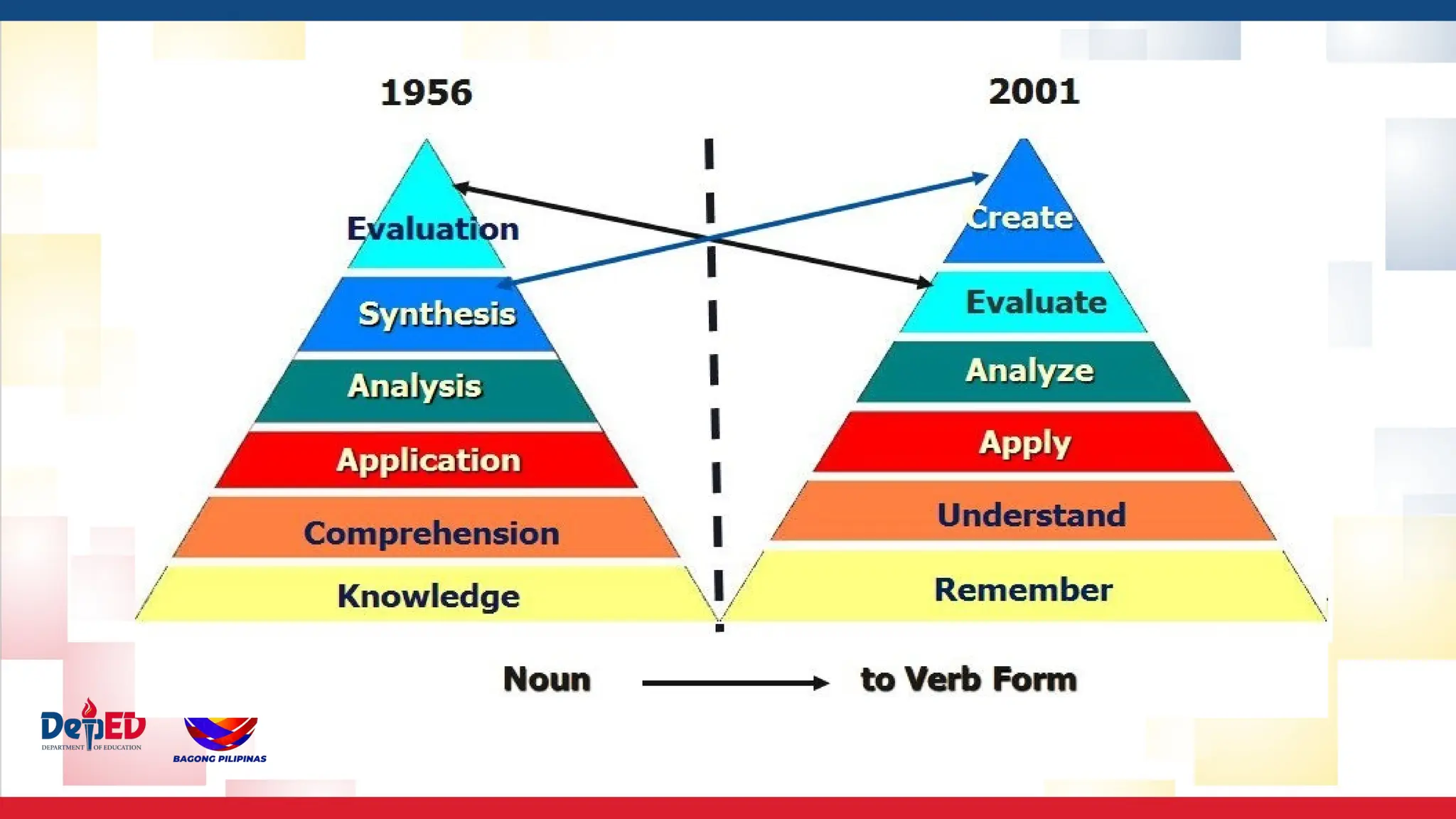
#126 Let’s explore the variations of 1956 and 2001 versions of the Bloom’s Taxonomy.
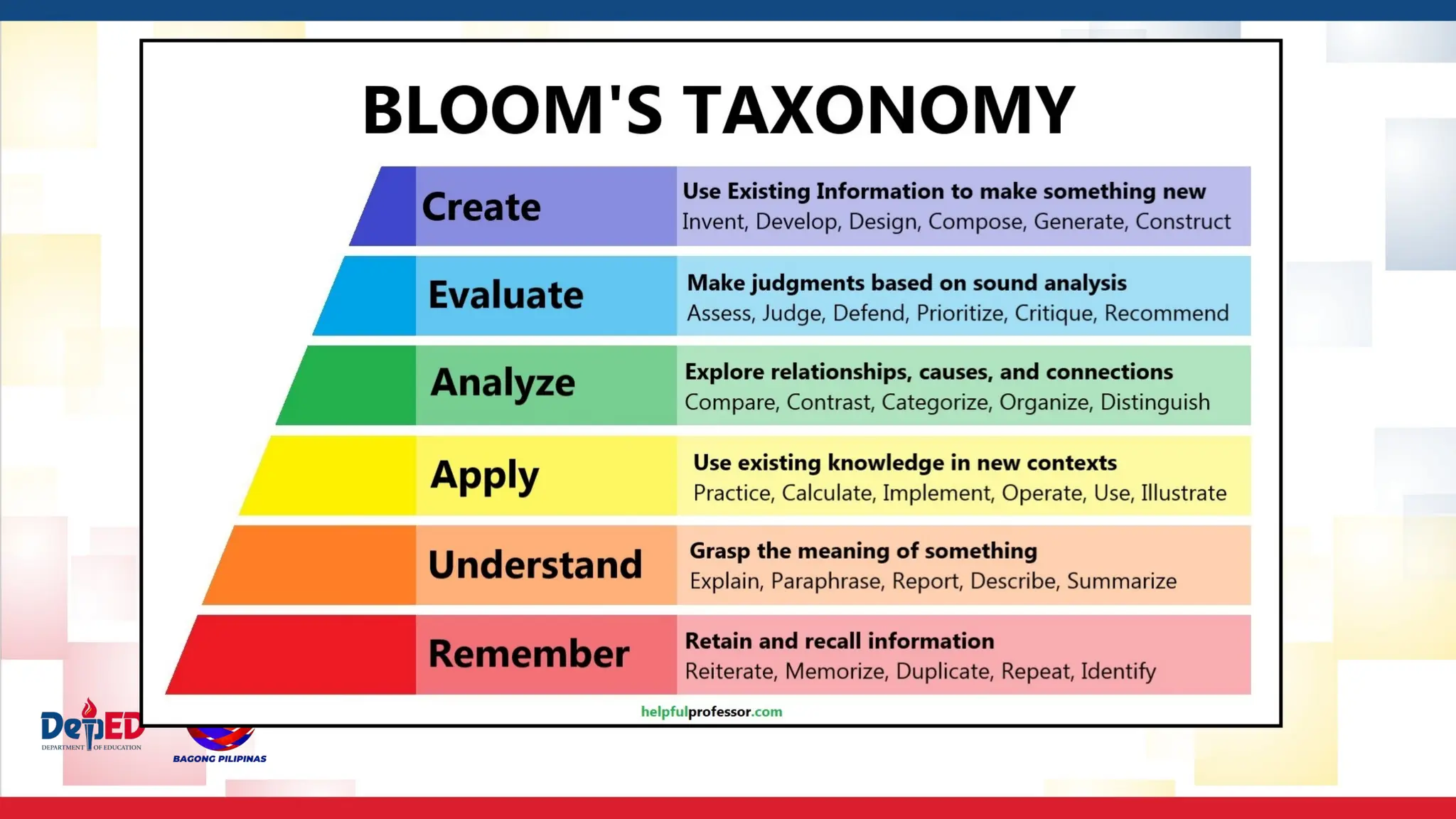
#127 There are six levels of cognitive learning according to the revised version of Bloom's Taxonomy. Each level is conceptually different. The six levels are remembering, understanding, applying, analyzing, evaluating, and creating. These levels can be helpful in developing learning outcomes because certain verbs are particularly appropriate at each level and not appropriate at other levels
#128 Some new SOLO words you need to become familiar with are: Prestructural, Unistructural, Multistructural, Relational, and Extended Abstract
#132 Say: Get the metacards presented in a collage form from the previous activity.
Rearrange the metacards where assessment is applicable to the learning competency which is aligned in the pedagogical approach, teaching methods/strategies and activities in 5mins
#134 Say: Consolidate your answer in the worksheet for another 5mins
Group will present one learning competency alignment to teaching approach up to assessment. Consider the following guide questions:
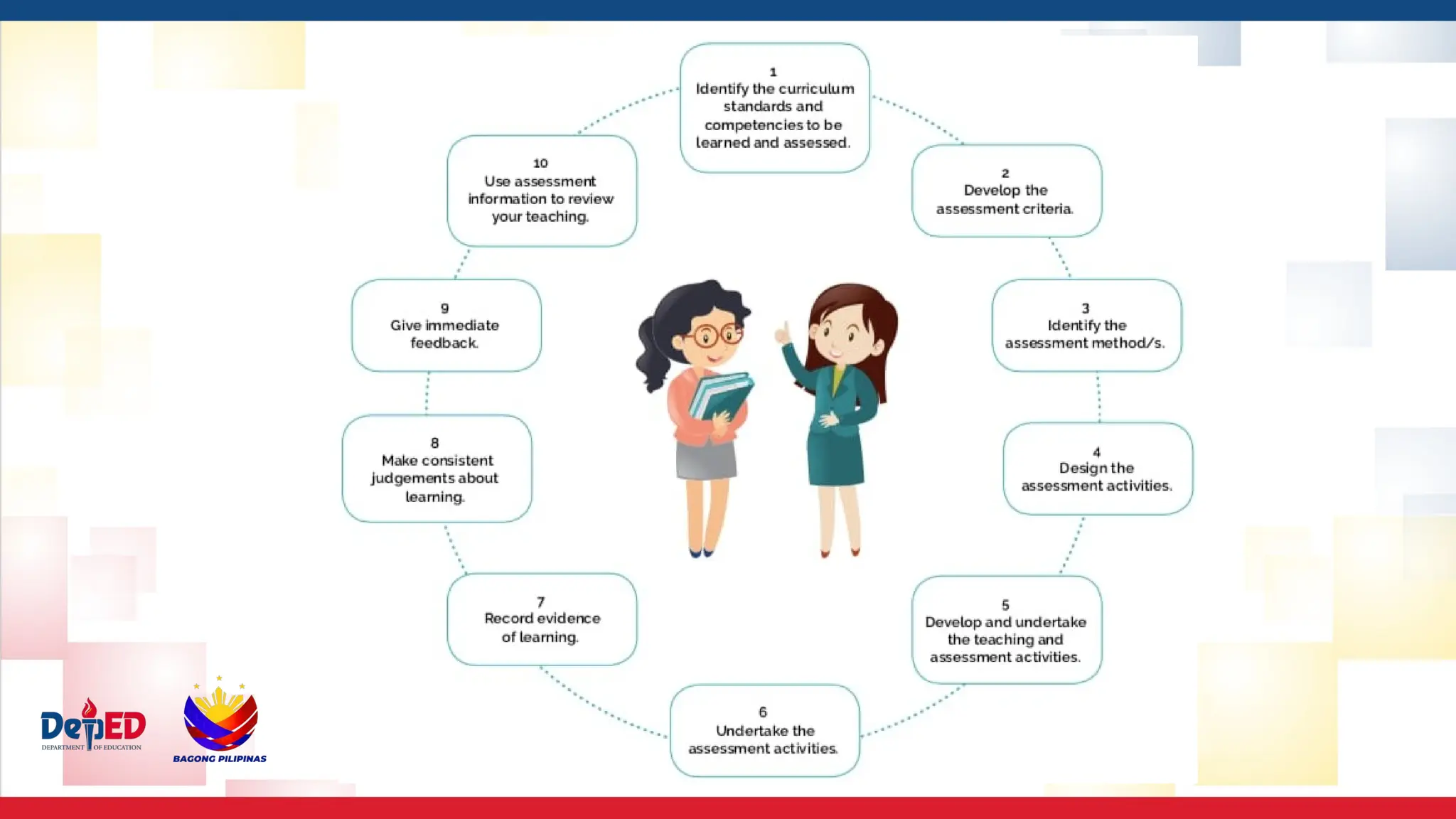
#136 The assessment cycle begins with identifying the curriculum, which sets the foundation for developing assessment criteria tailored to measure specific learning outcomes. Once the criteria are established, appropriate assessment methods are selected to ensure they effectively evaluate students' understanding. Designing assessment activities follows, ensuring they align with both the curriculum and assessment criteria. After implementing the teaching and conducting the assessments, it's crucial to record evidence of learning meticulously. This evidence is used to make consistent judgments about students' performance. Immediate feedback is then provided to support ongoing learning, while assessment information is reviewed to refine and enhance teaching strategies. This cycle ensures a dynamic and responsive approach to education, continuously improving both teaching and learning.
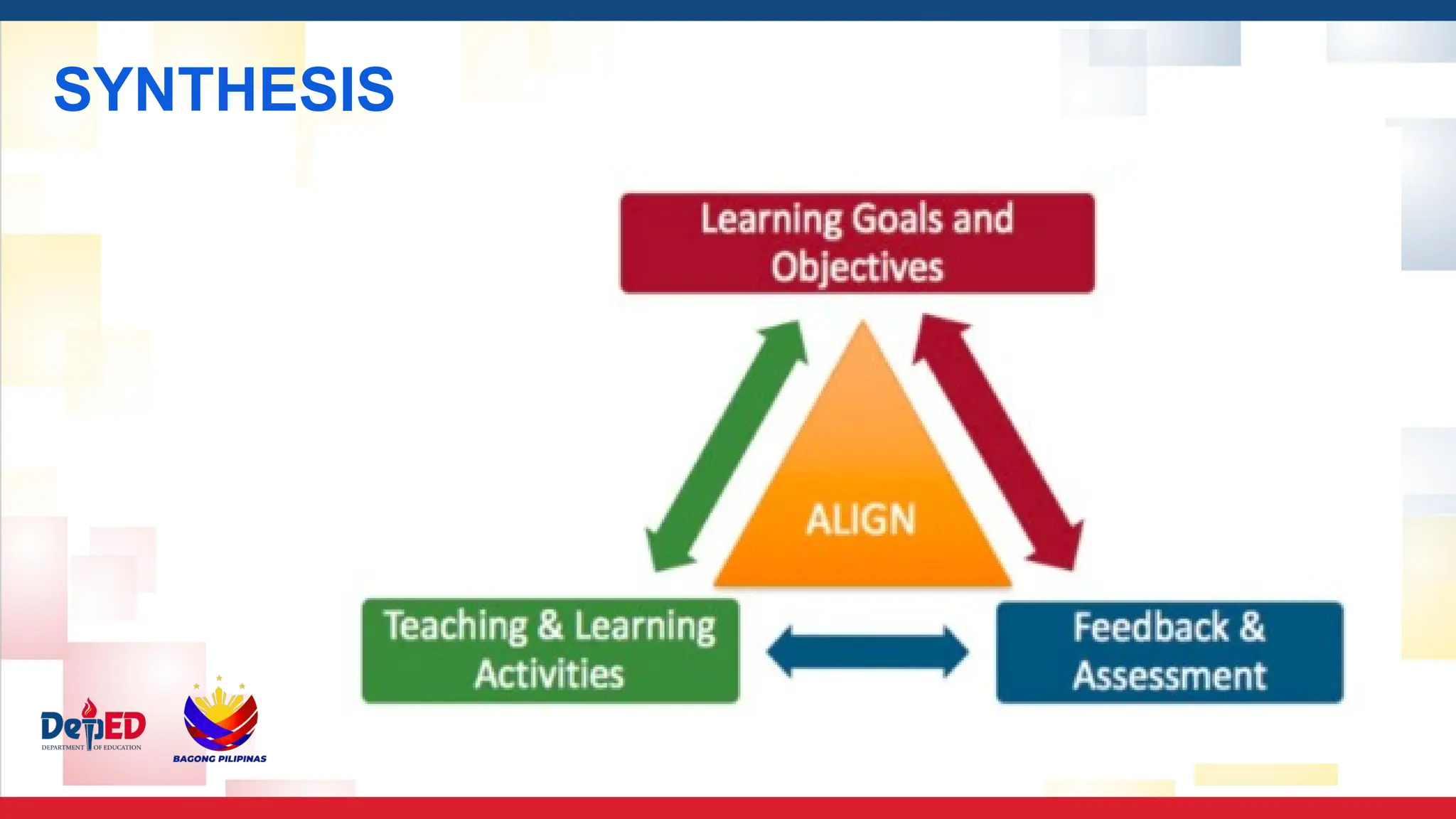
#137 The concept of aligning learning goals, teaching strategies, and assessments is often attributed to educational theorists such as Robert M. Gagné, who emphasized systematic approaches to instruction and evaluation. However, the specific diagram commonly used to represent this alignment is known as "The Assessment Triangle" proposed by Edward H. Haertel, which includes three key components: learning goals, instruction, and assessment. This framework underscores the importance of ensuring these elements are interconnected to effectively support student learning.
#138 Say: I would like to end my session by sharing the quote by Doña R. N. (2024) which state that Pedagogy shines, a beacon so bright, Guiding our minds to the heart of insight. Assessment's the compass, keeping us near, As we navigate life with vision clear. Once again a great afternoon!
#139 Say: These are the references of this session.
#140 The concept of aligning learning goals, teaching strategies, and assessments is often attributed to educational theorists such as Robert M. Gagné, who emphasized systematic approaches to instruction and evaluation. However, the specific diagram commonly used to represent this alignment is known as "The Assessment Triangle" proposed by Edward H. Haertel, which includes three key components: learning goals, instruction, and assessment. This framework underscores the importance of ensuring these elements are interconnected to effectively support student learning.