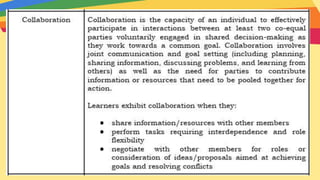
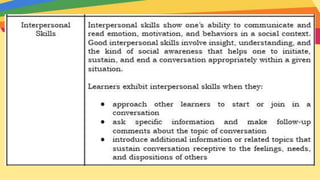
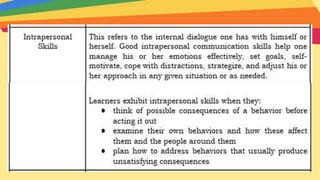
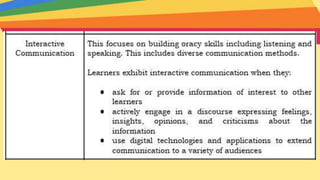
General Shaping
Paper DepEd
Matatag
EDGAR M. TINAPAY
ESP-4
Rationale
The Enhanced Basic Education Program or K to 12 Basic Education Program is a
response to local and global community needs and demands through its mission to
strengthen the values of the Filipino people; develop a strong sense of nationalism;
develop productive citizens who contribute to the building of a progressive, just, and
humane society; ensure environmental sustainability; and cultivate global partnerships
for development. The implementation of the K to 12 Basic Education Curriculum is
considered one of the most significant educational reforms in the country, introducing
several programs and projects that all aim to expand and improve the delivery of the
Philippine basic education. Its primary goal is to equip Filipino learners with the
necessary skills and competence to prepare them to take on the challenges of the 21st
century. It also endeavors to make the basic education system in the Philippines on a
par with international standards by ensuring that it is appropriate, responsive, and
relevant to the learners and to national and global realities (DepEd, 2019).
Rationale
As with any curricular reform, however, the K to 12 Program is not without challenges.
Results of both national and international standardized assessments reveal no improvement
in the academic performance of Filipino learners (Schleicher, 2018; Mullis, Martin, Foy, Kelly,
& Fishbein, 2020; UNICEF & SEAMEO, 2020). Moreover, the emergence of copious
compelling research on the nature of learners and the process of learning emphasizes the
need for basic education institutions to keep abreast of global future trends while addressing
the changing needs and learning challenges of children (Jorgenson, 2006). These, in turn,
prompted a re examination and enhancement of the K to 12 curricula in order to identify
points for improvement to ultimately lift the quality of basic education. The Department of
Education, with the Assessment Curriculum and Technology Research Centre (ACTRC), has
undertaken the process of reviewing the intended curriculum in order to verify claims about
and solve existing gaps in the document. As a result, the Shape of the MATATAG Curriculum
is therefore crafted to communicate the process behind the curriculum review and revision,
and more importantly, set the future direction and provide a basis for developing the shaping
papers for each learning area.
BACKGROUND
In pursuing any form of change in the basic education
curriculum, it is imperative to understand the current
context and setting. Doing so will allow the Department to
recognize the existing and expected realities and,
consequently, adopt appropriate measures to realize its
vision, hence making the MATATAG Curriculum
responsive and attuned to the dynamic changes that
come into play in the society.
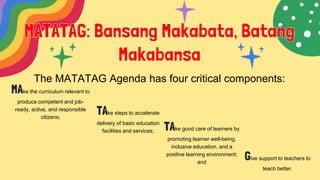
MAke the curriculum relevant to
produce competent and job-
ready, active, and responsible
citizens;
TAke steps to accelerate
delivery of basic education
facilities and services; TAke good care of learners by
promoting learner well-being,
inclusive education, and a
positive learning environment;
and
The MATATAG Agenda has four critical components:
Give support to teachers to
teach better.
The MATATAG agenda in improving
access, equity, resiliency, and well-
being can be attained through the
support of the various education
stakeholders. This is why education
partners penned their commitments and
support for the new basic education
agenda.
The Demands of the Future in an
Ever-Changing World
Living in the 21st century means constant adjustment to rapidly changing environments,
which is necessary to navigate multifaceted challenges. In such a context, learners grapple
with a deluge of information resulting from technological progress and digitization. This
information overload necessitates the development of strong information literacy skills to
discern what is crucial, credible, and useful. Additionally, although the surge in digital
technology presents an array of opportunities for innovative and personalized learning
experiences, these changes also impose a constant requirement for learners to update their
digital skills, address issues such as online privacy and cyberbullying, and balance digital
engagement with other life facets.
On the Quality of Student Learning:
Indicators and Result
System assessments are given at the end of each key stage. Learners at the end of Grade 3 take the Early
Language, Literacy, and Numeracy Assessment (ELLNA), which measures early language literacy and
numeracy. Exit assessments in the form of National Assessment Test (NAT) are given at the end of
Grades 6, 10, and 12. Both the ELLNA and NAT are designed to determine if the learners meet the
learning standards at the end of each key stage and to provide empirical data in the crafting and designing
of policies and programs. Results of the ELLNA given in S.Y. 2016 2017 showed many issues and
concerns that the Department needs to address in English, Filipino, Mother Tongue, and Math. The results
imply the need for more improvements in curriculum and delivery. In particular, strategic interventions
should come into play since literacy is an accurate predictor of academic success. Furthermore, the NAT
results for English and Math in the last four academic years given to Grades 6 and 9 students affirm the
need to have a collective and deliberate effort to address systemic issues that affect the learners’ mastery
of competencies.
On the Quality of Student Learning:
Indicators and Result
In light of these assessment data and along with the idea that
the success of the curriculum lies in the quality of student
learning, the Department expresses its intensified focus on
the role of assessment as a source of important feedback on
the implemented curriculum and the intended curriculum.
Curriculum Review as Basis for the
K to 10 Curriculum
Guided by the goals and standards of the K to 12 Program and recognizing the
need to ensure that these are attained by the learners, the Department of
Education initiated the curriculum review. The review is a quality control
mechanism that primarily examines the curriculum in its various phases, i.e.,
intended, implemented, assessed, and achieved. It is not simply meant to fulfill one
of the provisions of Republic Act (RA) 105333 or the Enhanced Basic Education
Act to review the curriculum, but is also part of the Department's commitment to
ensure quality, relevant, and liberating basic education for all through continuous
curriculum refinement.
THE MATATAG
CURRICULUM GOALS
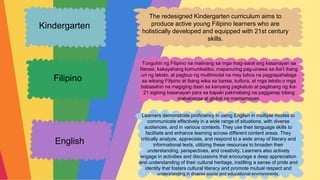
Filipino
English
Tunguhin ng Filipino na malinang sa mga mag-aaral ang kasanayan sa
literasi, kakayahang komunikatibo, mapanuring pag-unawa sa iba’t ibang
uri ng teksto, at pagbuo ng multimodal na may lubos na pagpapahalaga
sa wikang Filipino at ibang wika sa bansa, kultura, at mga teksto o mga
babasahin na magiging daan sa kanyang pagkatuto at paglinang ng ika-
21 siglong kasanayan para sa kapaki pakinabang na pagganap bilang
makabansa at global na mamamayan.
Learners demonstrate proficiency in using English in multiple modes to
communicate effectively in a wide range of situations, with diverse
audiences, and in various contexts. They use their language skills to
facilitate and enhance learning across different content areas. They
critically analyze, appreciate, and respond to a wide array of literary and
informational texts, utilizing these resources to broaden their
understanding, perspectives, and creativity. Learners also actively
engage in activities and discussions that encourage a deep appreciation
and understanding of their cultural heritage, instilling a sense of pride and
identity that fosters cultural literacy and promote mutual respect and
understanding in diverse social and educational environments.
The redesigned Kindergarten curriculum aims to
produce active young Filipino learners who are
holistically developed and equipped with 21st century
skills.
Kindergarten
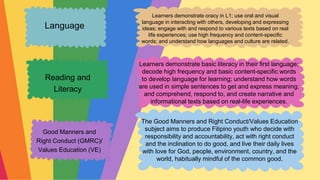
Reading and
Literacy
Good Manners and
Right Conduct (GMRC)/
Values Education (VE)
Learners demonstrate basic literacy in their first language;
decode high frequency and basic content-specific words
to develop language for learning; understand how words
are used in simple sentences to get and express meaning;
and comprehend, respond to, and create narrative and
informational texts based on real-life experiences.
The Good Manners and Right Conduct/Values Education
subject aims to produce Filipino youth who decide with
responsibility and accountability, act with right conduct
and the inclination to do good, and live their daily lives
with love for God, people, environment, country, and the
world, habitually mindful of the common good.
Learners demonstrate oracy in L1; use oral and visual
language in interacting with others, developing and expressing
ideas; engage with and respond to various texts based on real
life experiences; use high frequency and content-specific
words; and understand how languages and culture are related.
Language
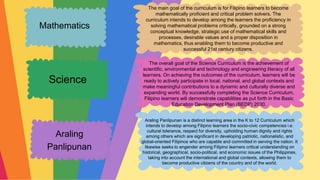
Science
Araling
Panlipunan
The overall goal of the Science Curriculum is the achievement of
scientific, environmental and technology and engineering literacy of all
learners. On achieving the outcomes of the curriculum, learners will be
ready to actively participate in local, national, and global contexts and
make meaningful contributions to a dynamic and culturally diverse and
expanding world. By successfully completing the Science Curriculum,
Filipino learners will demonstrate capabilities as put forth in the Basic
Education Development Plan (BEDP) 2030.
Araling Panlipunan is a distinct learning area in the K to 12 Curriculum which
intends to develop among Filipino learners the socio-civic competencies i.e.
cultural tolerance, respect for diversity, upholding human dignity and rights
among others which are significant in developing patriotic, nationalistic, and
global-oriented Filipinos who are capable and committed in serving the nation. It
likewise seeks to engender among Filipino learners critical understanding on
historical, geographical, socio-political, and economic issues of the Philippines,
taking into account the international and global contexts, allowing them to
become productive citizens of the country and of the world.
The main goal of the curriculum is for Filipino learners to become
mathematically proficient and critical problem solvers. The
curriculum intends to develop among the learners the proficiency in
solving mathematical problems critically, grounded on a strong
conceptual knowledge, strategic use of mathematical skills and
processes, desirable values and a proper disposition in
mathematics, thus enabling them to become productive and
successful 21st century citizens.
Mathematics
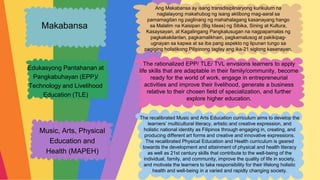
Edukasyong Pantahanan at
Pangkabuhayan (EPP)/
Technology and Livelihood
Education (TLE)
Music, Arts, Physical
Education and
Health (MAPEH)
The rationalized EPP/ TLE/ TVL envisions learners to apply
life skills that are adaptable in their family/community, become
ready for the world of work, engage in entrepreneurial
activities and improve their livelihood, generate a business
relative to their chosen field of specialization, and further
explore higher education.
The recalibrated Music and Arts Education curriculum aims to develop the
learners’ multicultural literacy, artistic and creative expression, and
holistic national identity as Filipinos through engaging in, creating, and
producing different art forms and creative and innovative expressions.
The recalibrated Physical Education and Health curriculum is geared
towards the development and attainment of physical and health literacy
as well as 21st century skills that contribute to the well-being of the
individual, family, and community, improve the quality of life in society,
and motivate the learners to take responsibility for their lifelong holistic
health and well-being in a varied and rapidly changing society.
Ang Makabansa ay isang transdisiplinaryong kurikulum na
naglalayong makahubog ng isang aktibong mag-aaral sa
pamamagitan ng paglinang ng mahahalagang kasanayang hango
sa Malalim na Kaisipan (Big Ideas) ng Sibika, Sining at Kultura,
Kasaysayan, at Kagalingang Pangkalusugan na nagpapamalas ng
pagkakakilanlan, pagkamalikhain, pagkamalusog at pakikipag-
ugnayan sa kapwa at sa iba pang aspekto ng lipunan tungo sa
pagiging holistikong Pilipinong taglay ang ika-21 siglong kasanayan.
Makabansa
These curriculum goals will be unpacked
through the learning area shaping papers and
subsequent curriculum guides. It is expected
that these documents will detail the standards
for learners and the learning competencies
they will develop. These will include the
specification of knowledge, understandings,
skills, and attitudes.
THE FEATURES OF
THE MATATAG
CURRICULUM
Focus on Foundational Skills
The major concern was the congestion of the curriculum, which
necessitated streamlining its intent and content. The MATATAG
curriculum for Grade 1 has shifted from offering seven learning
areas to only five that focus on strengthening literacy and
numeracy. New learning areas—Language, Reading and
Literacy, and Makabansa—are introduced. These learning
areas have been deliberately crafted, rather than simply
merging or integrating the existing learning areas.
Language
The Language learning area is a new addition to the existing learning areas for Grade
1 in the MATATAG Curriculum. The creation of the Language curriculum gives more
emphasis to the development of oral language skills for communication in the
learner’s first language, which is essential in developing foundational skills for literacy
and learning other content areas. The development of the Languages curricula
recognizes the role of the first language (L1) as the language and literacy resource
that the child can use most effectively to establish a strong foundation for literacy
development and further knowledge. It recognizes the status of the more than 180
languages in the country, including sign and visual languages and languages of
indigenous groups and communities.
Reading and Literacy
The Reading and Literacy learning area aims to develop foundational
reading skills essential for early literacy. These goals include building
phonemic awareness, decoding skills, and recognizing sight words to
facilitate fluent reading in the first language. Comprehension strategies
are introduced to help students understand and engage with texts,
identify main ideas, and draw simple inferences. Concurrently, the
curriculum aims to foster a positive reading attitude, nurturing a love for
reading through exposure to age-appropriate and engaging texts.
Makabansa
The introduction of a new learning area called Makabansa in Key Stage 1 (Grades 1
3) intends to provide learners with essential knowledge, skills, and attitudes enabling
them to develop personal and cultural consciousness in becoming active, healthy and
creative members of their respective communities. It employs a transdisciplinary
approach in actualizing the learning intent and content relative to civics, history, art
and culture, and health and wellness optimizing integrative learning frameworks,
pedagogies, and approaches. Ultimately, Makabansa prepares learners to better
understand and appreciate the more disciplinal approach of Music and Arts, Physical
Education and Health, and Araling Panlipunan as learners go through the succeeding
key stages.
Makabansa
The introduction of a new learning area called Makabansa in Key Stage 1 (Grades 1
3) intends to provide learners with essential knowledge, skills, and attitudes enabling
them to develop personal and cultural consciousness in becoming active, healthy and
creative members of their respective communities. It employs a transdisciplinary
approach in actualizing the learning intent and content relative to civics, history, art
and culture, and health and wellness optimizing integrative learning frameworks,
pedagogies, and approaches. Ultimately, Makabansa prepares learners to better
understand and appreciate the more disciplinal approach of Music and Arts, Physical
Education and Health, and Araling Panlipunan as learners go through the succeeding
key stages.
STRENGTHENED LITERACY AND
NUMERACY IN THE FIRST KEY
STAGE THROUGH THE NATIONAL
READING PROGRAM AND THE
NATIONAL MATHEMATICS PROGRAM
Reading literacy and numeracy are essential for success in both academic and
professional settings. Sadly, Filipino learners do not exhibit the proficiency
expected from their respective grade levels as evidenced by both national and
international large-scale assessments. In the most recent PISA assessment
conducted in 2018, the Philippines ranked 78th out of 79 participating countries
and economies in reading and 77th in mathematics. The results showed that the
average reading scores of Filipino learners were significantly lower than the
average scores of learners from other countries. Similarly, in the 2019 SEA-PLM
assessment, the Philippines ranked 7th out of 7 participating countries in both
mathematics and reading, with a mean score of 312 in reading. The low
performance of Filipino learners in these large-scale assessments suggests that
many learners are not developing the necessary literacy and numeracy skills to
succeed in school and in their future careers and that there is a need for the
country, through the Department of Education, to improve the quality of the
reading and numeracy curriculum and its delivery.
In the first key stage, the curriculum was designed to ensure that literacy and
numeracy are at the center of the teaching and learning experience. Literacy
abilities are developed through standards that give prime attention to
phonological awareness, phonics and word study, vocabulary and word
knowledge, grammar awareness and grammatical structures, comprehension,
and fluency. On the other hand, children become numerate as they explore
mathematical ideas and engage in problem-solving. Children develop confidence
as their parents, careers, families and friends help them to mathematically
investigate space, structures and patterns, number, measurement, and different
kinds of data and connections (South Australia Department for Education, 2021).
In their foundational years, it is imperative that children achieve mastery of the
foundational competencies required for reading literacy and numeracy, which, in
turn, serve as the fundamental skills for success in life.
In addition to the development of a curriculum that centers
on reading literacy and numeracy formation, national
programs on different literacies shall be implemented in the
same school year.
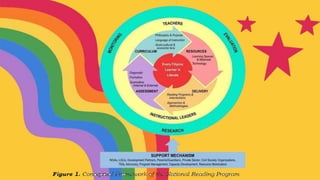
The National Reading Program
The National Reading Program (NRP) is a comprehensive
program that aims to make every Filipino learner literate.
Achieving this goal calls for a relevant curriculum, adequate
resources, appropriate delivery, and through assessment, and
well-trained teachers, instructional leaders with well-in-place
support mechanisms. To determine whether goals are realized,
monitoring, evaluation, and research must be in place.
The National Reading Program
The NRP is grounded on the Science of Reading and evidence-based
instruction. It stresses the importance of addressing the learners’ needs
through the implementation of responsive reading programs,
interventions, approaches, methodologies, and techniques, which, in
turn, aided by developmentally and grade level-appropriate learning
resources and technology. Thus, the conduct of assessment for learning
must provide data for instructional leaders and teachers for informed
decision-making.
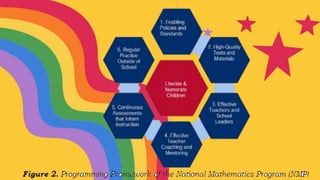
The National Mathematics Program
Planning for the design, implementation and evaluation of
the National Mathematics Program shall be guided by the
MOSAIC Framework (Evans et al., 2019), an evidence-
based tool of six interrelated pedagogy and learning-
focused components that support large-scale and
comprehensive literacy and numeracy initiatives.
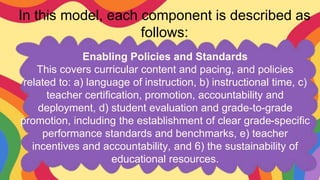
In this model, each component is described as
follows:
Enabling Policies and Standards
This covers curricular content and pacing, and policies
related to: a) language of instruction, b) instructional time, c)
teacher certification, promotion, accountability and
deployment, d) student evaluation and grade-to-grade
promotion, including the establishment of clear grade-specific
performance standards and benchmarks, e) teacher
incentives and accountability, and 6) the sustainability of
educational resources.
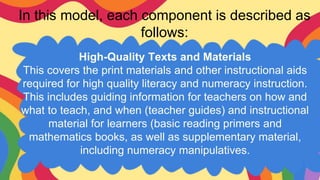
In this model, each component is described as
follows:
High-Quality Texts and Materials
This covers the print materials and other instructional aids
required for high quality literacy and numeracy instruction.
This includes guiding information for teachers on how and
what to teach, and when (teacher guides) and instructional
material for learners (basic reading primers and
mathematics books, as well as supplementary material,
including numeracy manipulatives.
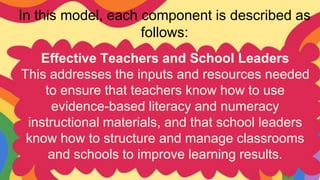
In this model, each component is described as
follows:
Effective Teachers and School Leaders
This addresses the inputs and resources needed
to ensure that teachers know how to use
evidence-based literacy and numeracy
instructional materials, and that school leaders
know how to structure and manage classrooms
and schools to improve learning results.
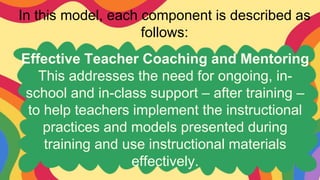
In this model, each component is described as
follows:
Effective Teacher Coaching and Mentoring
This addresses the need for ongoing, in-
school and in-class support – after training –
to help teachers implement the instructional
practices and models presented during
training and use instructional materials
effectively.
In this model, each component is described as
follows:
Continuous Assessments to Inform Instruction
This addresses the need for teachers to have the ability to
gather informal and formal data on learner progress and
performance, within the context of the classroom, on a
regular basis. This type of assessment should be used
primarily for immediate response to student learning
needs, including whole group reteaching of concepts and
skills, small group remediation, and individual intervention
for learners with the greatest needs.
In this model, each component is described as
follows:
Regular Practice Outside of School
This addresses the need to extend learning
beyond the confines of the school day. The
more time children engage in rich and
cognitively challenging literacy and numeracy
activities, the greater their learning gains.
Redefining the Interplay
among Languages in the
MTB-MLE Program
The Mother Tongue-Based Multilingual Education (MTB-
MLE) is an integral feature of the K to 12 Basic Education
Program, which emphasizes the role of a child's first
language as a critical resource for effective learning and
foundational literacy development. The program
acknowledges that a learner's language, societal and cultural
experiences, prior education, media exposure, and home
environment form a collective schema facilitating the
understanding of new concepts. MTB-MLE advocates the use
of the mother tongue as the initial language and literacy
resource before transitioning to the learning of other
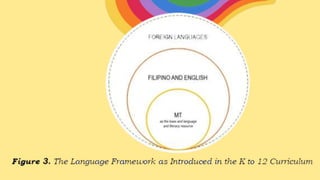
languages. This is made apparent in the revised language
curricula through the Language Framework below:
Medium of Teaching and Learning
Mother Tongue as Medium of Teaching and Learning (MOTL) refers to the use of the learner’s
first language in the teaching and learning process. In Key Stage 1, while learners are still
developing both oral and written proficiency in the second language(s) (i.e., Filipino and/or
English), MT is used as MOTL to support the acquisition of those languages. The first language
refers to the language that learners could understand primarily through listening (listening
capacity) and/or active use in daily oral communications; hence, it is considered as a primary tool
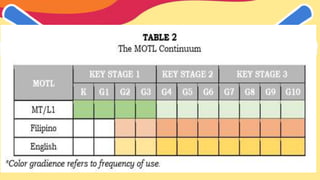
or language and literacy resource in the teaching and learning process. The current policy is to
use the Mother Tongue as the primary MOTL for the first four years of education (Kindergarten to
Grade 3); Filipino and English are then adopted as the primary MOTL from Grade 4 onwards.
However, the Mother Tongue is not terminated at the end of Grade 3 and instead assumes the
role of auxiliary MOTL in the second and third key stages.
Presentations are communication tools that can be used as demonstrations, lectures,
speeches, reports, and more. It is mstly presented before an audience.
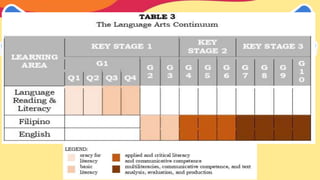
Language Learning Areas
The revised language curricula also present a reorganization of
the continuum for the Language Arts. All language learning
areas – Language, Reading and Literacy, Filipino, and English –
shall develop first the learners’ oracy, which shall then serve as
the foundation for literacy development in the target languages.
Decongested
Curriculum
One of the salient findings of the review is the congestion of the curricula, which has
been found to be overcrowded with content, thus disallowing learners to fully grasp and
understand various concepts. To address this issue, the current curriculum is
decongested by 70% while still ensuring that the heavier weight of the learning areas
would be on English, Filipino, Science, Mathematics, and EPP/TLE or Technical
Livelihood Education. The act of decongesting the curriculum, reducing overcrowding,
and focusing on the essential elements of learning has profound implications for
learners’ educational experiences. First, this approach now provides learners with the
time needed to truly understand and assimilate the foundational elements of learning,
rather than simply dabbling in a vast array of topics. Second, a less crowded curriculum
allows learners to focus more intently on each learning area, leading to a deeper
comprehension and retention of knowledge. Ultimately, the net effect of this
transformation is a more targeted, effective, and meaningful learning experience.
Clearer Articulation of the
DepEd’s 21st Century Skills
Framework: Embodying the
Vision for the Filipino
Learner
The vision of the DepEd remains the same: to produce holistically developed
Filipino learners with 21st century skills or the knowledge, skills, attitudes, and
competencies that learners need to develop so that they can prepare for and
succeed in work and life in the 21st century (DepEd Order No. 21, s. 2019). The
improved 21st century skills framework integrates skill sets culled from various
international and local competency frameworks that redefine the future of
education, skills development, and training in light of the evolving society and
economy. The development of such skills coupled with the Department’s core
values (i.e., Maka-Diyos, Makatao, Makakalikasan, Makabansa) will allow learners
to realize aspirations that represent their ideals and ambitions, and ultimately
contribute to building a progressive and cohesive nation that enjoys economic
prosperity, socio-political stability, unity in diversity, and sustainability.
The detailed 21st century skills framework comprises
the same four domains as originally set out in DepEd
Order No. 21, s. 2019. These are: ● Information, Media,
and Technology Skills ● Learning and Innovation Skills
● Communication Skills ● Life and Career Skills
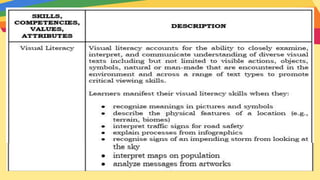
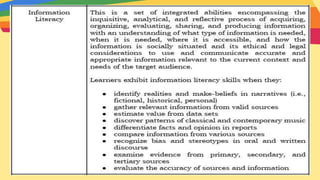
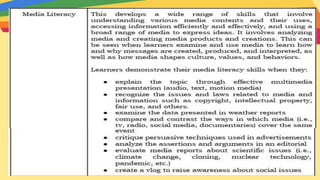
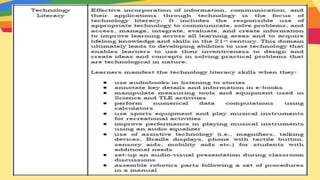
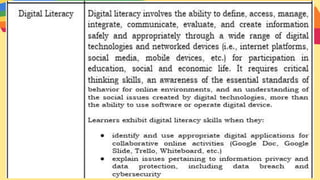
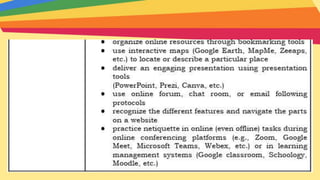
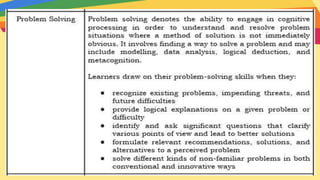
Information, Media, and Technology Skills
This multifaceted domain manifests the 21st century skills referring to the ability to
gather, manage, use, synthesize, evaluate, and create information through media and
technology.
These skills allow learners to navigate the fluid and dynamic environment of today’s
technologically and information-driven society and empower them to use plurality of
information sources (i.e., private, government, community) and plurality of voices (i.e.,
from people of all levels of society) for problem-solving, decision-making, and ideation
in personal, social, economic, and political life.
The following are the descriptions of
each skill, competency, value, or
attribute included under this domain:
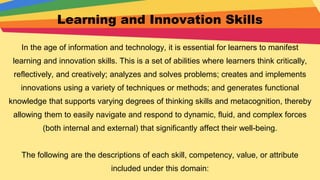
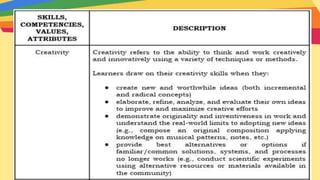
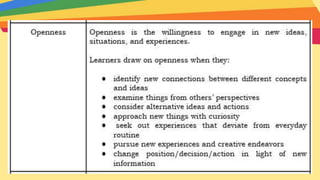
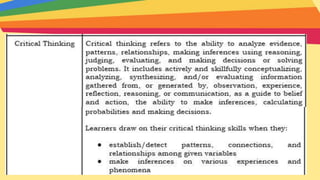
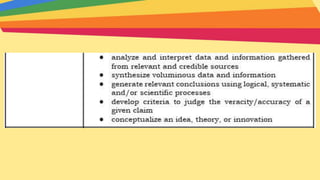
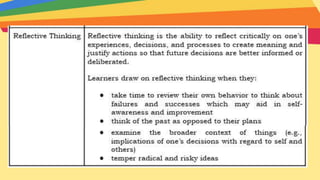
Learning and Innovation Skills
In the age of information and technology, it is essential for learners to manifest
learning and innovation skills. This is a set of abilities where learners think critically,
reflectively, and creatively; analyzes and solves problems; creates and implements
innovations using a variety of techniques or methods; and generates functional
knowledge that supports varying degrees of thinking skills and metacognition, thereby
allowing them to easily navigate and respond to dynamic, fluid, and complex forces
(both internal and external) that significantly affect their well-being.
The following are the descriptions of each skill, competency, value, or attribute
included under this domain:
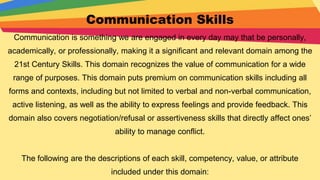
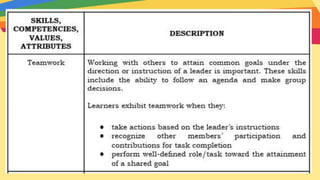
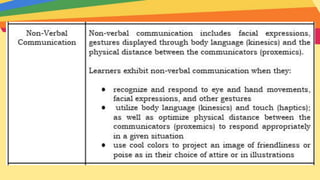
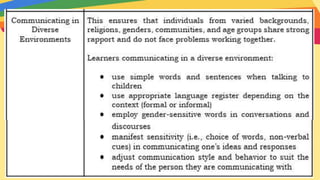
Communication Skills
Communication is something we are engaged in every day may that be personally,
academically, or professionally, making it a significant and relevant domain among the
21st Century Skills. This domain recognizes the value of communication for a wide
range of purposes. This domain puts premium on communication skills including all
forms and contexts, including but not limited to verbal and non-verbal communication,
active listening, as well as the ability to express feelings and provide feedback. This
domain also covers negotiation/refusal or assertiveness skills that directly affect ones’
ability to manage conflict.
The following are the descriptions of each skill, competency, value, or attribute
included under this domain:
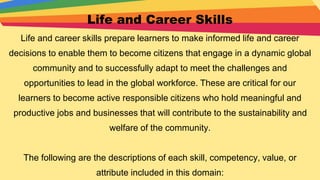
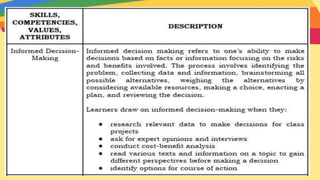
Life and Career Skills
Life and career skills prepare learners to make informed life and career
decisions to enable them to become citizens that engage in a dynamic global
community and to successfully adapt to meet the challenges and
opportunities to lead in the global workforce. These are critical for our
learners to become active responsible citizens who hold meaningful and
productive jobs and businesses that will contribute to the sustainability and
welfare of the community.
The following are the descriptions of each skill, competency, value, or
attribute included in this domain:
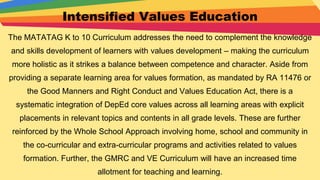
Intensified Values Education
The MATATAG K to 10 Curriculum addresses the need to complement the knowledge
and skills development of learners with values development – making the curriculum
more holistic as it strikes a balance between competence and character. Aside from
providing a separate learning area for values formation, as mandated by RA 11476 or
the Good Manners and Right Conduct and Values Education Act, there is a
systematic integration of DepEd core values across all learning areas with explicit
placements in relevant topics and contents in all grade levels. These are further
reinforced by the Whole School Approach involving home, school and community in
the co-curricular and extra-curricular programs and activities related to values
formation. Further, the GMRC and VE Curriculum will have an increased time
allotment for teaching and learning.
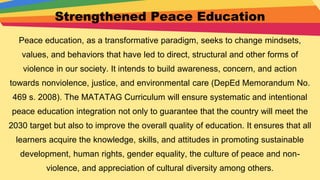
Strengthened Peace Education
Peace education, as a transformative paradigm, seeks to change mindsets,
values, and behaviors that have led to direct, structural and other forms of
violence in our society. It intends to build awareness, concern, and action
towards nonviolence, justice, and environmental care (DepEd Memorandum No.
469 s. 2008). The MATATAG Curriculum will ensure systematic and intentional
peace education integration not only to guarantee that the country will meet the
2030 target but also to improve the overall quality of education. It ensures that all
learners acquire the knowledge, skills, and attitudes in promoting sustainable
development, human rights, gender equality, the culture of peace and non-
violence, and appreciation of cultural diversity among others.
Other features of
the MATATAG
Curriculum
Redesigned Kindergarten Curriculum
The redesigned Kindergarten Education espouses a
learner-centered, learning centered, integrated,
developmentally appropriate, play-based and
nationalistic curriculum that aims to develop holistic
learners equipped with foundational skills, imbued with
physical, social, emotional, cognitive, and values
development.
Redesigned Kindergarten Curriculum
The Kindergarten curriculum presents curricular themes such as
Knowing Who We Are and Our Families, exploring our
Community, Appreciating Our Country, and Caring for Our
World, each having an effect on a child’s holistic development.
In addition, the domains of development in the redesigned
Kindergarten curriculum are socio-emotional, values, physical
health and motor, aesthetic/creative, cognitive and language,
literacy, and communication.
Redesigned Kindergarten Curriculum
Moreover, Kindergarten learners are assessed in the class through
regular and continuous observation of their works and
performances that showcase their knowledge, skills, and abilities
exhibited during the actual conduct of blocks of time. Learners are
evaluated at the start of the school year using the Philippine Early
Childhood Development (ECD) Checklist, a developmental
screening tool that provides information about the learners’ stage of
development and aids the teacher in identifying any delays.
Redesigned Kindergarten Curriculum
The Progress Report contains components that
are aligned with the learning competencies from
the Kindergarten Curriculum Guide. This will
serve as a checklist to evaluate the overall
performance of the learner in every quarter.
Emphasis on the Engineering Design Process
The Science, Technology, Engineering and Mathematics
(STEM) are four interconnected disciplines which offer cross-
disciplinary instruction on real-world applications. Though
Science, Mathematics and Technology and Livelihood Education
(TLE) are distinct and separate learning areas, the skills and
competencies are interrelated and cut across subject areas.
These learning areas draw on each other while being taught
separately.
Emphasis on the Engineering Design Process
The Engineering Design Process (EDP) adopted by the Department
includes the following steps: Empathize, Define, Generate Ideas, Create,
and Evaluate. It is iterative and the process may revert to the previous
step at any stage. This design process is used to come up with solutions
to real-world problems and teaches the learners to innovate. The possible
solutions may take many forms such as a product, a process, a strategy,
a response, or a model. The possible solution is evaluated to see if it
works or whether the end-users find it useful and relevant.
Emphasis on the Engineering Design Process
The use of EDP develops several skills such as critical and creative
thinking, problem solving, decision-making, communication skills, ICT
literacy, growth mindset, grit, and self-management. The EDP is also
appropriate for learners of all ages. Young learners can apply EDP on
problems within their interest, while older learners can design solutions for
problems in school, at home, and in the community. Many of the
performance standards in the science curriculum employ the engineering
design process to design and build to provide possible solution to real-
world problems.
Merging the Concepts of MAPEH in Key Stages 2 and 3
The Matatag MAPEH Curriculum merges Music & Arts and Physical Education &
Health as two distinct components. The curriculum framework focuses on
developing 21st century Filipino lifelong learners, who are at the center of the
educational approach. The integration of Music & Arts and Physical Education &
Health aims to enhance the skills and competencies of learners in these
components. It emphasizes the importance of music and arts in shaping cultural
identity, creative communication, and multicultural literacy. Additionally, the
framework for physical education and health components promotes the
development of healthy habits and active lifestyles, contributing to the well-being
of individuals and society.
Rationalization of Technical-Vocational-Livelihood Specialization
The learners in Grades 4 to 6 will explore the fundamental home skills (one
skill per component) of the four components of EPP/TLE (Information and
Communications Technology [ICT], Agriculture and Fishery Arts [AFA],
Family and Consumer Science [FCS], and Industrial Arts [IA]). The basic and
common competencies of the four TLE components will be introduced in
Grades 7 to 8. In Grades 9 and 10, selected core competencies will be taken
in every sector with intensified entrepreneurial skills (exploratory by sector).
The specializations will no longer be offered in JHS and will be taken instead
in Senior High School.
Redesigned Araling Panlipunan 7 Curriculum
Significant change has been introduced in Araling
Panlipunan 7 where vital content and competencies
cater on the Philippine Contemporary History
highlighting its complex relationship in with Southeast
Asian societies. The departure from Asian Studies Ang
Pilipinas at Timog Silangang Asya intends to
strengthen our Southeast Asian identity.
Redesigned Araling Panlipunan 7 Curriculum
By acquainting Filipino learners with their Southeast Asian counterparts
while discussing their history and culture among others. This is a
necessary part of the ASEAN Integration thereby advancing the global
citizenship competencies of the Filipino learners an essential component
of the Southeast Asia Primary Learning Metrics (SEA-PLM). History
lessons, beyond the parochial paradigm, aims to reinforce the overall goal
of the Araling Panlipunan curriculum, that is, to develop among learners a
critical understanding of historical, geographical, socio-political, and
economic issues of the Philippines.
Pedagogy and
Assessment
Curriculum, pedagogy, and assessment are the three equally important
aspects of the teaching and learning process. These educational terms
broadly describe the content of instruction, the processes involved in
teaching-learning, and the assessment of the acquired knowledge and skills
of learners, respectively. Teachers’ understanding of how these three
concepts interplay in educational practice predicts the success of both
teaching and learning in the classroom. Consequently, the Department is
equitably putting curriculum, pedagogy, and assessment as important
considerations in designing the educational landscape for Filipino teachers
and learners.
The Changing Role of
Schools: Students,
Teachers, Administrators,
Parents, Community
Pedagogical modifications have proved to be critical as conventional in-
person classroom instruction does not translate well to a remote learning
environment. Teachers are therefore expected to modify their practices and
provide innovative opportunities for their students to stay motivated and
engaged regardless of the type of learning delivery used (modular, online,
TV, radio, blended distance learning, etc.). Teachers are likewise encouraged
to use various strategies to monitor student learning remotely. Faced with the
challenges of remote teaching, they may utilize high-tech and low-tech
approaches to reach out to parents/guardians and their children and better
support their learning progress.
Section 5.E of the Enhanced Basic Education Act of 2013 (RA 10533)
necessitates the use of pedagogical approaches that are constructivist,
inquiry-based, reflective, collaborative, and integrative. Other important
pedagogical approaches utilized in most learning areas across grade
levels are differentiated instruction, explicit teaching (direct instruction)
approach, experiential learning approach, culture-based instruction, and
technology-enhanced instruction. These pedagogies or their combination
with other teaching approaches shall be used by the teachers to ensure
the development of the 21st century skills of learners.
Pedagogical
Approaches for the
Different Learning
Areas
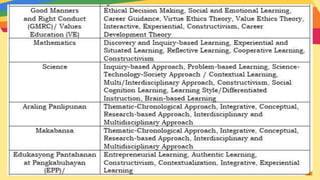
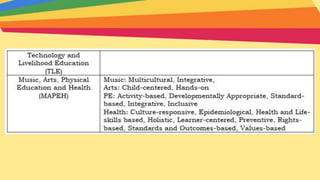
The MATATAG Curriculum shall maintain constructivist, inquiry-based,
reflective, collaborative, and integrative pedagogical approaches as
outlined in RA 10533 and DepEd Order No. 21, s. 2019. The
pedagogical approaches discussed in the Shaping Papers of the
different learning areas are rooted in various learning theories and
principles; however, teachers are given the prerogative to employ
other methods and strategies deemed suitable to the lessons and
learners' diverse needs, contexts, interests, and styles.
Choosing and utilizing the appropriate pedagogical approach is
vital for successful learning. Therefore, teachers must be
cautious in selecting their approaches, considering learning
goals, styles, subject matter, available materials, learners'
diversity, classroom situation, and context. The chosen
pedagogical approaches should allow learners to develop 21st
century skills, embody core values, and meet curriculum
standards.
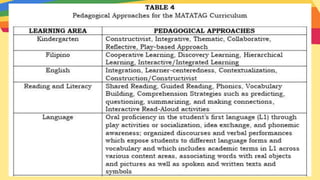
The pedagogical approaches best suited to the acquisition
of learning and development of skills enshrined in the
respective curriculum content of each of the earning areas
are anchored on various learning theories and principles.
These pedagogical approaches, as enumerated below, are
explicitly reflected in the Curriculum Framework of each
learning area.
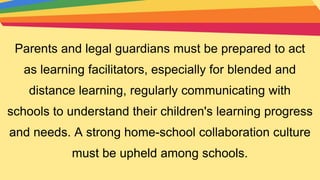
Parents and legal guardians must be prepared to act
as learning facilitators, especially for blended and
distance learning, regularly communicating with
schools to understand their children's learning progress
and needs. A strong home-school collaboration culture
must be upheld among schools.
The Instructional
Design Framework for
Kindergarten to Grade
10
RA 10533, which clearly defines the curriculum as
learner-centered, developmentally appropriate,
inclusive, hence promoting the use of constructivist,
inquiry-based, reflective, collaborative, and integrative
pedagogical approaches, forms the foundation for the
K to10 Instructional Design Framework.
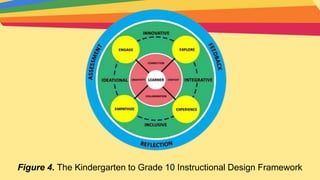
Figure 4. The Kindergarten to Grade 10 Instructional Design Framework
The following are the key features of the K to 10 Instructional Design
Framework:
• It cuts across all learning stages and key stages.
• It emphasizes the learners rather than the process. It enables learners
to take part in making decisions about creating learning activities.
• It gives directions and brings together school administrators, teachers,
and learners in a shared understanding of how to accomplish learning
objectives and discuss and enhance learners' progress.
• It provides flexibility in promoting creativity and collaboration not only
among learners but also among teachers and instructional leaders.
• It is descriptive rather than prescriptive. It outlines the key elements and
considerations in adopting teaching strategies, teaching materials, and
the educational approach required to achieve learning standards.
• It provides the design of instruction and does not direct its procedures.
Thus, the pedagogical approaches and models to be used in instruction
will provide the methods and procedures.
• It serves as a guide for implementing uniformity and consistency in
designing and planning the lesson.
The Four Instructional Principles
The four instructional principles (4Is) for basic
education are inclusive, ideational, integrative,
and innovative. These principles aim to promote
holistic learning, lifelong learning pursuit, and
equip learners to become informed decision-
makers and productive workforce members.
The Four Instructional Principles
• "Inclusive" emphasizes creating accessible and meaningful learning
experiences for all learners, regardless of their backgrounds or abilities. It
entails developing culturally responsive materials, providing various
modalities for content access, accommodating learners with special
needs, and adjusting the learning environment to allow multiple learning
pathways.
• "Ideational" involves fostering a creative thought process and idea
generation without judgment or criticism. It aims to expose learners to a
variety of potential solutions and discover unexpected idea connections.
The Four Instructional Principles
• "Integrative" involves combining different elements into a unified whole,
building on learners' prior knowledge, utilizing real-life situations, and
encouraging connections between different concepts and ideas. This
principle aids learners in relating the content to their lives and deepening
their topic understanding.
• "Innovative" explores creative ways of designing and delivering
instruction. It includes the use of emerging technologies, varied teaching
methods, and innovative assessment strategies to ensure a motivating
and engaging learning experience for learners.
The Four Key Aspects of Instructional Design
The 4Cs: context, connection, collaboration, and
creativity represent key aspects of instructional
design, impacting the planning, delivery, and
assessment of the teaching and learning
process.
The Four Key Aspects of Instructional Design
• "Context" refers to the background or setting that impacts how
learners understand information. By relating teaching materials
to learners' daily life experiences, context enhances learners'
motivation to participate actively in learning activities.
• "Connection" involves fostering understanding and the
development of transferable knowledge. It aims for students to
build robust, flexible knowledge that can be applied to new
problems and contexts.
The Four Key Aspects of Instructional Design
• "Collaboration" is the cooperative process where students work
together to achieve a common goal. It recognizes students' individual
skills and holds them equally accountable for outcomes or knowledge
sharing, preparing them for lifelong interaction with others.
• "Creativity" encourages learners to use their imagination and critical
thinking to create meaningful expressions of their learning. It promotes
the generation of new ideas and the transformation of existing
solutions into more innovative and sustainable ones.
The Four Essential Facets of Learning
The 4 Es (Engage, Explore, Experience, and
Empathize) are crucial elements for creating
effective, engaging learning experiences that
aren't strictly procedural and can occur at any
point during a lesson, based on a teacher's
judgment and learner centric focus.
The Four Essential Facets of Learning
• "Engage" aims to capture learners' attention and stimulate
interest by using various strategies and techniques that promote
active participation. By creating an emotional connection, it
enhances learners' motivation and willingness to learn.
• "Explore" encourages learners to independently discover new
concepts and ideas. It includes opportunities for learners to
experiment, solve problems, or pose questions, fostering active
learning and problem-solving skills.
The Four Essential Facets of Learning
• "Experience" allows learners to apply their acquired knowledge,
skills, abilities, and attitudes in real-world contexts. Simulations,
case studies, and other practical activities facilitate the transfer of
learning to real-life situations.
• "Empathize" encourages learners to understand and connect
with the material they are learning, and to identify their own needs.
This component supports socio emotional learning and helps
learners form bonds, improve communication, and resolve conflicts.
Assessment,
Feedback and
Reflection
Assessment in the instructional delivery process is crucial as it gauges the
level of mastery of expected competencies and development of skills
according to learning standards. As outlined in DepEd Order No. 8, s. 2015 or
the “Policy Guidelines on Classroom Assessment for the K to 12 Basic
Education Program”, classroom assessment is an ongoing process, carried
out at any point in a lesson, to gather and interpret data about learners'
knowledge and skills. Teachers should holistically measure learners' abilities,
recognizing the diversity of learners and the need for various ways to
measure their potential, and enabling learners to take part in the assessment
process.
Formative assessment, involving real-time feedback for learning adjustment
and self reflection, is crucial, and learner-to-learner feedback is highly
encouraged to enhance learning experiences and growth areas identification.
This formative assessment helps learners become independent, and capable
of managing and assessing their own learning progress. On the other hand,
summative assessment is conducted at the end of a learning duration or
episode to measure the attainment of learning standards and learners'
application of their knowledge in various situations. The results communicate
learners' achievements to them, their parents or guardians, school heads,
succeeding grade teachers, and guidance counselors.
Feedback is essential information about learners'
performance from assessments, aimed at facilitating their
growth and improvement. Feedback can be either positive
or negative but should always be presented in a supportive,
respectful, and constructive manner. It can also come from
learners to teachers, informing them about the
effectiveness of their teaching strategies.
Reflection, a critical part of assessment, involves learners
identifying areas of improvement and progress in their learning
experiences. It aids learners in making connections between
theory and practice, exploring their experiences' complexities,
and developing higher-order thinking skills. Thus, instruction
under the Kindergarten to Grade 10 Instructional Design
Framework effectively helps learners by utilizing assessment,
feedback, and reflection.
It is envisioned that instruction shall utilize all
these variables under the Kindergarten to Grade
10 Instructional Design Framework. All other
provisions stipulated in DO 8, s. 2015 relative to
classroom assessment shall remain in force and
in effect.
THANK YOU!
KAYA?

general shaping paper General Shaping .pptx

  • 1.
  • 2.
  • 3.
    Rationale The Enhanced BasicEducation Program or K to 12 Basic Education Program is a response to local and global community needs and demands through its mission to strengthen the values of the Filipino people; develop a strong sense of nationalism; develop productive citizens who contribute to the building of a progressive, just, and humane society; ensure environmental sustainability; and cultivate global partnerships for development. The implementation of the K to 12 Basic Education Curriculum is considered one of the most significant educational reforms in the country, introducing several programs and projects that all aim to expand and improve the delivery of the Philippine basic education. Its primary goal is to equip Filipino learners with the necessary skills and competence to prepare them to take on the challenges of the 21st century. It also endeavors to make the basic education system in the Philippines on a par with international standards by ensuring that it is appropriate, responsive, and relevant to the learners and to national and global realities (DepEd, 2019).
  • 4.
    Rationale As with anycurricular reform, however, the K to 12 Program is not without challenges. Results of both national and international standardized assessments reveal no improvement in the academic performance of Filipino learners (Schleicher, 2018; Mullis, Martin, Foy, Kelly, & Fishbein, 2020; UNICEF & SEAMEO, 2020). Moreover, the emergence of copious compelling research on the nature of learners and the process of learning emphasizes the need for basic education institutions to keep abreast of global future trends while addressing the changing needs and learning challenges of children (Jorgenson, 2006). These, in turn, prompted a re examination and enhancement of the K to 12 curricula in order to identify points for improvement to ultimately lift the quality of basic education. The Department of Education, with the Assessment Curriculum and Technology Research Centre (ACTRC), has undertaken the process of reviewing the intended curriculum in order to verify claims about and solve existing gaps in the document. As a result, the Shape of the MATATAG Curriculum is therefore crafted to communicate the process behind the curriculum review and revision, and more importantly, set the future direction and provide a basis for developing the shaping papers for each learning area.
  • 5.
    BACKGROUND In pursuing anyform of change in the basic education curriculum, it is imperative to understand the current context and setting. Doing so will allow the Department to recognize the existing and expected realities and, consequently, adopt appropriate measures to realize its vision, hence making the MATATAG Curriculum responsive and attuned to the dynamic changes that come into play in the society.
  • 6.
    MAke the curriculumrelevant to produce competent and job- ready, active, and responsible citizens; TAke steps to accelerate delivery of basic education facilities and services; TAke good care of learners by promoting learner well-being, inclusive education, and a positive learning environment; and The MATATAG Agenda has four critical components: Give support to teachers to teach better.
  • 7.
    The MATATAG agendain improving access, equity, resiliency, and well- being can be attained through the support of the various education stakeholders. This is why education partners penned their commitments and support for the new basic education agenda.
  • 8.
    The Demands ofthe Future in an Ever-Changing World Living in the 21st century means constant adjustment to rapidly changing environments, which is necessary to navigate multifaceted challenges. In such a context, learners grapple with a deluge of information resulting from technological progress and digitization. This information overload necessitates the development of strong information literacy skills to discern what is crucial, credible, and useful. Additionally, although the surge in digital technology presents an array of opportunities for innovative and personalized learning experiences, these changes also impose a constant requirement for learners to update their digital skills, address issues such as online privacy and cyberbullying, and balance digital engagement with other life facets.
  • 9.
    On the Qualityof Student Learning: Indicators and Result System assessments are given at the end of each key stage. Learners at the end of Grade 3 take the Early Language, Literacy, and Numeracy Assessment (ELLNA), which measures early language literacy and numeracy. Exit assessments in the form of National Assessment Test (NAT) are given at the end of Grades 6, 10, and 12. Both the ELLNA and NAT are designed to determine if the learners meet the learning standards at the end of each key stage and to provide empirical data in the crafting and designing of policies and programs. Results of the ELLNA given in S.Y. 2016 2017 showed many issues and concerns that the Department needs to address in English, Filipino, Mother Tongue, and Math. The results imply the need for more improvements in curriculum and delivery. In particular, strategic interventions should come into play since literacy is an accurate predictor of academic success. Furthermore, the NAT results for English and Math in the last four academic years given to Grades 6 and 9 students affirm the need to have a collective and deliberate effort to address systemic issues that affect the learners’ mastery of competencies.
  • 10.
    On the Qualityof Student Learning: Indicators and Result In light of these assessment data and along with the idea that the success of the curriculum lies in the quality of student learning, the Department expresses its intensified focus on the role of assessment as a source of important feedback on the implemented curriculum and the intended curriculum.
  • 11.
    Curriculum Review asBasis for the K to 10 Curriculum Guided by the goals and standards of the K to 12 Program and recognizing the need to ensure that these are attained by the learners, the Department of Education initiated the curriculum review. The review is a quality control mechanism that primarily examines the curriculum in its various phases, i.e., intended, implemented, assessed, and achieved. It is not simply meant to fulfill one of the provisions of Republic Act (RA) 105333 or the Enhanced Basic Education Act to review the curriculum, but is also part of the Department's commitment to ensure quality, relevant, and liberating basic education for all through continuous curriculum refinement.
  • 12.
  • 13.
    Filipino English Tunguhin ng Filipinona malinang sa mga mag-aaral ang kasanayan sa literasi, kakayahang komunikatibo, mapanuring pag-unawa sa iba’t ibang uri ng teksto, at pagbuo ng multimodal na may lubos na pagpapahalaga sa wikang Filipino at ibang wika sa bansa, kultura, at mga teksto o mga babasahin na magiging daan sa kanyang pagkatuto at paglinang ng ika- 21 siglong kasanayan para sa kapaki pakinabang na pagganap bilang makabansa at global na mamamayan. Learners demonstrate proficiency in using English in multiple modes to communicate effectively in a wide range of situations, with diverse audiences, and in various contexts. They use their language skills to facilitate and enhance learning across different content areas. They critically analyze, appreciate, and respond to a wide array of literary and informational texts, utilizing these resources to broaden their understanding, perspectives, and creativity. Learners also actively engage in activities and discussions that encourage a deep appreciation and understanding of their cultural heritage, instilling a sense of pride and identity that fosters cultural literacy and promote mutual respect and understanding in diverse social and educational environments. The redesigned Kindergarten curriculum aims to produce active young Filipino learners who are holistically developed and equipped with 21st century skills. Kindergarten
  • 14.
    Reading and Literacy Good Mannersand Right Conduct (GMRC)/ Values Education (VE) Learners demonstrate basic literacy in their first language; decode high frequency and basic content-specific words to develop language for learning; understand how words are used in simple sentences to get and express meaning; and comprehend, respond to, and create narrative and informational texts based on real-life experiences. The Good Manners and Right Conduct/Values Education subject aims to produce Filipino youth who decide with responsibility and accountability, act with right conduct and the inclination to do good, and live their daily lives with love for God, people, environment, country, and the world, habitually mindful of the common good. Learners demonstrate oracy in L1; use oral and visual language in interacting with others, developing and expressing ideas; engage with and respond to various texts based on real life experiences; use high frequency and content-specific words; and understand how languages and culture are related. Language
  • 15.
    Science Araling Panlipunan The overall goalof the Science Curriculum is the achievement of scientific, environmental and technology and engineering literacy of all learners. On achieving the outcomes of the curriculum, learners will be ready to actively participate in local, national, and global contexts and make meaningful contributions to a dynamic and culturally diverse and expanding world. By successfully completing the Science Curriculum, Filipino learners will demonstrate capabilities as put forth in the Basic Education Development Plan (BEDP) 2030. Araling Panlipunan is a distinct learning area in the K to 12 Curriculum which intends to develop among Filipino learners the socio-civic competencies i.e. cultural tolerance, respect for diversity, upholding human dignity and rights among others which are significant in developing patriotic, nationalistic, and global-oriented Filipinos who are capable and committed in serving the nation. It likewise seeks to engender among Filipino learners critical understanding on historical, geographical, socio-political, and economic issues of the Philippines, taking into account the international and global contexts, allowing them to become productive citizens of the country and of the world. The main goal of the curriculum is for Filipino learners to become mathematically proficient and critical problem solvers. The curriculum intends to develop among the learners the proficiency in solving mathematical problems critically, grounded on a strong conceptual knowledge, strategic use of mathematical skills and processes, desirable values and a proper disposition in mathematics, thus enabling them to become productive and successful 21st century citizens. Mathematics
  • 16.
    Edukasyong Pantahanan at Pangkabuhayan(EPP)/ Technology and Livelihood Education (TLE) Music, Arts, Physical Education and Health (MAPEH) The rationalized EPP/ TLE/ TVL envisions learners to apply life skills that are adaptable in their family/community, become ready for the world of work, engage in entrepreneurial activities and improve their livelihood, generate a business relative to their chosen field of specialization, and further explore higher education. The recalibrated Music and Arts Education curriculum aims to develop the learners’ multicultural literacy, artistic and creative expression, and holistic national identity as Filipinos through engaging in, creating, and producing different art forms and creative and innovative expressions. The recalibrated Physical Education and Health curriculum is geared towards the development and attainment of physical and health literacy as well as 21st century skills that contribute to the well-being of the individual, family, and community, improve the quality of life in society, and motivate the learners to take responsibility for their lifelong holistic health and well-being in a varied and rapidly changing society. Ang Makabansa ay isang transdisiplinaryong kurikulum na naglalayong makahubog ng isang aktibong mag-aaral sa pamamagitan ng paglinang ng mahahalagang kasanayang hango sa Malalim na Kaisipan (Big Ideas) ng Sibika, Sining at Kultura, Kasaysayan, at Kagalingang Pangkalusugan na nagpapamalas ng pagkakakilanlan, pagkamalikhain, pagkamalusog at pakikipag- ugnayan sa kapwa at sa iba pang aspekto ng lipunan tungo sa pagiging holistikong Pilipinong taglay ang ika-21 siglong kasanayan. Makabansa
  • 17.
    These curriculum goalswill be unpacked through the learning area shaping papers and subsequent curriculum guides. It is expected that these documents will detail the standards for learners and the learning competencies they will develop. These will include the specification of knowledge, understandings, skills, and attitudes.
  • 18.
    THE FEATURES OF THEMATATAG CURRICULUM
  • 19.
    Focus on FoundationalSkills The major concern was the congestion of the curriculum, which necessitated streamlining its intent and content. The MATATAG curriculum for Grade 1 has shifted from offering seven learning areas to only five that focus on strengthening literacy and numeracy. New learning areas—Language, Reading and Literacy, and Makabansa—are introduced. These learning areas have been deliberately crafted, rather than simply merging or integrating the existing learning areas.
  • 20.
    Language The Language learningarea is a new addition to the existing learning areas for Grade 1 in the MATATAG Curriculum. The creation of the Language curriculum gives more emphasis to the development of oral language skills for communication in the learner’s first language, which is essential in developing foundational skills for literacy and learning other content areas. The development of the Languages curricula recognizes the role of the first language (L1) as the language and literacy resource that the child can use most effectively to establish a strong foundation for literacy development and further knowledge. It recognizes the status of the more than 180 languages in the country, including sign and visual languages and languages of indigenous groups and communities.
  • 21.
    Reading and Literacy TheReading and Literacy learning area aims to develop foundational reading skills essential for early literacy. These goals include building phonemic awareness, decoding skills, and recognizing sight words to facilitate fluent reading in the first language. Comprehension strategies are introduced to help students understand and engage with texts, identify main ideas, and draw simple inferences. Concurrently, the curriculum aims to foster a positive reading attitude, nurturing a love for reading through exposure to age-appropriate and engaging texts.
  • 22.
    Makabansa The introduction ofa new learning area called Makabansa in Key Stage 1 (Grades 1 3) intends to provide learners with essential knowledge, skills, and attitudes enabling them to develop personal and cultural consciousness in becoming active, healthy and creative members of their respective communities. It employs a transdisciplinary approach in actualizing the learning intent and content relative to civics, history, art and culture, and health and wellness optimizing integrative learning frameworks, pedagogies, and approaches. Ultimately, Makabansa prepares learners to better understand and appreciate the more disciplinal approach of Music and Arts, Physical Education and Health, and Araling Panlipunan as learners go through the succeeding key stages.
  • 23.
    Makabansa The introduction ofa new learning area called Makabansa in Key Stage 1 (Grades 1 3) intends to provide learners with essential knowledge, skills, and attitudes enabling them to develop personal and cultural consciousness in becoming active, healthy and creative members of their respective communities. It employs a transdisciplinary approach in actualizing the learning intent and content relative to civics, history, art and culture, and health and wellness optimizing integrative learning frameworks, pedagogies, and approaches. Ultimately, Makabansa prepares learners to better understand and appreciate the more disciplinal approach of Music and Arts, Physical Education and Health, and Araling Panlipunan as learners go through the succeeding key stages.
  • 24.
    STRENGTHENED LITERACY AND NUMERACYIN THE FIRST KEY STAGE THROUGH THE NATIONAL READING PROGRAM AND THE NATIONAL MATHEMATICS PROGRAM
  • 25.
    Reading literacy andnumeracy are essential for success in both academic and professional settings. Sadly, Filipino learners do not exhibit the proficiency expected from their respective grade levels as evidenced by both national and international large-scale assessments. In the most recent PISA assessment conducted in 2018, the Philippines ranked 78th out of 79 participating countries and economies in reading and 77th in mathematics. The results showed that the average reading scores of Filipino learners were significantly lower than the average scores of learners from other countries. Similarly, in the 2019 SEA-PLM assessment, the Philippines ranked 7th out of 7 participating countries in both mathematics and reading, with a mean score of 312 in reading. The low performance of Filipino learners in these large-scale assessments suggests that many learners are not developing the necessary literacy and numeracy skills to succeed in school and in their future careers and that there is a need for the country, through the Department of Education, to improve the quality of the reading and numeracy curriculum and its delivery.
  • 26.
    In the firstkey stage, the curriculum was designed to ensure that literacy and numeracy are at the center of the teaching and learning experience. Literacy abilities are developed through standards that give prime attention to phonological awareness, phonics and word study, vocabulary and word knowledge, grammar awareness and grammatical structures, comprehension, and fluency. On the other hand, children become numerate as they explore mathematical ideas and engage in problem-solving. Children develop confidence as their parents, careers, families and friends help them to mathematically investigate space, structures and patterns, number, measurement, and different kinds of data and connections (South Australia Department for Education, 2021). In their foundational years, it is imperative that children achieve mastery of the foundational competencies required for reading literacy and numeracy, which, in turn, serve as the fundamental skills for success in life.
  • 27.
    In addition tothe development of a curriculum that centers on reading literacy and numeracy formation, national programs on different literacies shall be implemented in the same school year.
  • 28.
    The National ReadingProgram The National Reading Program (NRP) is a comprehensive program that aims to make every Filipino learner literate. Achieving this goal calls for a relevant curriculum, adequate resources, appropriate delivery, and through assessment, and well-trained teachers, instructional leaders with well-in-place support mechanisms. To determine whether goals are realized, monitoring, evaluation, and research must be in place.
  • 30.
    The National ReadingProgram The NRP is grounded on the Science of Reading and evidence-based instruction. It stresses the importance of addressing the learners’ needs through the implementation of responsive reading programs, interventions, approaches, methodologies, and techniques, which, in turn, aided by developmentally and grade level-appropriate learning resources and technology. Thus, the conduct of assessment for learning must provide data for instructional leaders and teachers for informed decision-making.
  • 31.
    The National MathematicsProgram Planning for the design, implementation and evaluation of the National Mathematics Program shall be guided by the MOSAIC Framework (Evans et al., 2019), an evidence- based tool of six interrelated pedagogy and learning- focused components that support large-scale and comprehensive literacy and numeracy initiatives.
  • 33.
    In this model,each component is described as follows: Enabling Policies and Standards This covers curricular content and pacing, and policies related to: a) language of instruction, b) instructional time, c) teacher certification, promotion, accountability and deployment, d) student evaluation and grade-to-grade promotion, including the establishment of clear grade-specific performance standards and benchmarks, e) teacher incentives and accountability, and 6) the sustainability of educational resources.
  • 34.
    In this model,each component is described as follows: High-Quality Texts and Materials This covers the print materials and other instructional aids required for high quality literacy and numeracy instruction. This includes guiding information for teachers on how and what to teach, and when (teacher guides) and instructional material for learners (basic reading primers and mathematics books, as well as supplementary material, including numeracy manipulatives.
  • 35.
    In this model,each component is described as follows: Effective Teachers and School Leaders This addresses the inputs and resources needed to ensure that teachers know how to use evidence-based literacy and numeracy instructional materials, and that school leaders know how to structure and manage classrooms and schools to improve learning results.
  • 36.
    In this model,each component is described as follows: Effective Teacher Coaching and Mentoring This addresses the need for ongoing, in- school and in-class support – after training – to help teachers implement the instructional practices and models presented during training and use instructional materials effectively.
  • 37.
    In this model,each component is described as follows: Continuous Assessments to Inform Instruction This addresses the need for teachers to have the ability to gather informal and formal data on learner progress and performance, within the context of the classroom, on a regular basis. This type of assessment should be used primarily for immediate response to student learning needs, including whole group reteaching of concepts and skills, small group remediation, and individual intervention for learners with the greatest needs.
  • 38.
    In this model,each component is described as follows: Regular Practice Outside of School This addresses the need to extend learning beyond the confines of the school day. The more time children engage in rich and cognitively challenging literacy and numeracy activities, the greater their learning gains.
  • 39.
    Redefining the Interplay amongLanguages in the MTB-MLE Program
  • 40.
    The Mother Tongue-BasedMultilingual Education (MTB- MLE) is an integral feature of the K to 12 Basic Education Program, which emphasizes the role of a child's first language as a critical resource for effective learning and foundational literacy development. The program acknowledges that a learner's language, societal and cultural experiences, prior education, media exposure, and home environment form a collective schema facilitating the understanding of new concepts. MTB-MLE advocates the use of the mother tongue as the initial language and literacy resource before transitioning to the learning of other languages. This is made apparent in the revised language curricula through the Language Framework below:
  • 42.
    Medium of Teachingand Learning Mother Tongue as Medium of Teaching and Learning (MOTL) refers to the use of the learner’s first language in the teaching and learning process. In Key Stage 1, while learners are still developing both oral and written proficiency in the second language(s) (i.e., Filipino and/or English), MT is used as MOTL to support the acquisition of those languages. The first language refers to the language that learners could understand primarily through listening (listening capacity) and/or active use in daily oral communications; hence, it is considered as a primary tool or language and literacy resource in the teaching and learning process. The current policy is to use the Mother Tongue as the primary MOTL for the first four years of education (Kindergarten to Grade 3); Filipino and English are then adopted as the primary MOTL from Grade 4 onwards. However, the Mother Tongue is not terminated at the end of Grade 3 and instead assumes the role of auxiliary MOTL in the second and third key stages.
  • 43.
    Presentations are communicationtools that can be used as demonstrations, lectures, speeches, reports, and more. It is mstly presented before an audience.
  • 44.
    Language Learning Areas Therevised language curricula also present a reorganization of the continuum for the Language Arts. All language learning areas – Language, Reading and Literacy, Filipino, and English – shall develop first the learners’ oracy, which shall then serve as the foundation for literacy development in the target languages.
  • 46.
  • 47.
    One of thesalient findings of the review is the congestion of the curricula, which has been found to be overcrowded with content, thus disallowing learners to fully grasp and understand various concepts. To address this issue, the current curriculum is decongested by 70% while still ensuring that the heavier weight of the learning areas would be on English, Filipino, Science, Mathematics, and EPP/TLE or Technical Livelihood Education. The act of decongesting the curriculum, reducing overcrowding, and focusing on the essential elements of learning has profound implications for learners’ educational experiences. First, this approach now provides learners with the time needed to truly understand and assimilate the foundational elements of learning, rather than simply dabbling in a vast array of topics. Second, a less crowded curriculum allows learners to focus more intently on each learning area, leading to a deeper comprehension and retention of knowledge. Ultimately, the net effect of this transformation is a more targeted, effective, and meaningful learning experience.
  • 48.
    Clearer Articulation ofthe DepEd’s 21st Century Skills Framework: Embodying the Vision for the Filipino Learner
  • 49.
    The vision ofthe DepEd remains the same: to produce holistically developed Filipino learners with 21st century skills or the knowledge, skills, attitudes, and competencies that learners need to develop so that they can prepare for and succeed in work and life in the 21st century (DepEd Order No. 21, s. 2019). The improved 21st century skills framework integrates skill sets culled from various international and local competency frameworks that redefine the future of education, skills development, and training in light of the evolving society and economy. The development of such skills coupled with the Department’s core values (i.e., Maka-Diyos, Makatao, Makakalikasan, Makabansa) will allow learners to realize aspirations that represent their ideals and ambitions, and ultimately contribute to building a progressive and cohesive nation that enjoys economic prosperity, socio-political stability, unity in diversity, and sustainability.
  • 50.
    The detailed 21stcentury skills framework comprises the same four domains as originally set out in DepEd Order No. 21, s. 2019. These are: ● Information, Media, and Technology Skills ● Learning and Innovation Skills ● Communication Skills ● Life and Career Skills
  • 51.
    Information, Media, andTechnology Skills This multifaceted domain manifests the 21st century skills referring to the ability to gather, manage, use, synthesize, evaluate, and create information through media and technology. These skills allow learners to navigate the fluid and dynamic environment of today’s technologically and information-driven society and empower them to use plurality of information sources (i.e., private, government, community) and plurality of voices (i.e., from people of all levels of society) for problem-solving, decision-making, and ideation in personal, social, economic, and political life.
  • 52.
    The following arethe descriptions of each skill, competency, value, or attribute included under this domain:
  • 59.
    Learning and InnovationSkills In the age of information and technology, it is essential for learners to manifest learning and innovation skills. This is a set of abilities where learners think critically, reflectively, and creatively; analyzes and solves problems; creates and implements innovations using a variety of techniques or methods; and generates functional knowledge that supports varying degrees of thinking skills and metacognition, thereby allowing them to easily navigate and respond to dynamic, fluid, and complex forces (both internal and external) that significantly affect their well-being. The following are the descriptions of each skill, competency, value, or attribute included under this domain:
  • 66.
    Communication Skills Communication issomething we are engaged in every day may that be personally, academically, or professionally, making it a significant and relevant domain among the 21st Century Skills. This domain recognizes the value of communication for a wide range of purposes. This domain puts premium on communication skills including all forms and contexts, including but not limited to verbal and non-verbal communication, active listening, as well as the ability to express feelings and provide feedback. This domain also covers negotiation/refusal or assertiveness skills that directly affect ones’ ability to manage conflict. The following are the descriptions of each skill, competency, value, or attribute included under this domain:
  • 74.
    Life and CareerSkills Life and career skills prepare learners to make informed life and career decisions to enable them to become citizens that engage in a dynamic global community and to successfully adapt to meet the challenges and opportunities to lead in the global workforce. These are critical for our learners to become active responsible citizens who hold meaningful and productive jobs and businesses that will contribute to the sustainability and welfare of the community. The following are the descriptions of each skill, competency, value, or attribute included in this domain:
  • 81.
    Intensified Values Education TheMATATAG K to 10 Curriculum addresses the need to complement the knowledge and skills development of learners with values development – making the curriculum more holistic as it strikes a balance between competence and character. Aside from providing a separate learning area for values formation, as mandated by RA 11476 or the Good Manners and Right Conduct and Values Education Act, there is a systematic integration of DepEd core values across all learning areas with explicit placements in relevant topics and contents in all grade levels. These are further reinforced by the Whole School Approach involving home, school and community in the co-curricular and extra-curricular programs and activities related to values formation. Further, the GMRC and VE Curriculum will have an increased time allotment for teaching and learning.
  • 82.
    Strengthened Peace Education Peaceeducation, as a transformative paradigm, seeks to change mindsets, values, and behaviors that have led to direct, structural and other forms of violence in our society. It intends to build awareness, concern, and action towards nonviolence, justice, and environmental care (DepEd Memorandum No. 469 s. 2008). The MATATAG Curriculum will ensure systematic and intentional peace education integration not only to guarantee that the country will meet the 2030 target but also to improve the overall quality of education. It ensures that all learners acquire the knowledge, skills, and attitudes in promoting sustainable development, human rights, gender equality, the culture of peace and non- violence, and appreciation of cultural diversity among others.
  • 83.
    Other features of theMATATAG Curriculum
  • 84.
    Redesigned Kindergarten Curriculum Theredesigned Kindergarten Education espouses a learner-centered, learning centered, integrated, developmentally appropriate, play-based and nationalistic curriculum that aims to develop holistic learners equipped with foundational skills, imbued with physical, social, emotional, cognitive, and values development.
  • 85.
    Redesigned Kindergarten Curriculum TheKindergarten curriculum presents curricular themes such as Knowing Who We Are and Our Families, exploring our Community, Appreciating Our Country, and Caring for Our World, each having an effect on a child’s holistic development. In addition, the domains of development in the redesigned Kindergarten curriculum are socio-emotional, values, physical health and motor, aesthetic/creative, cognitive and language, literacy, and communication.
  • 86.
    Redesigned Kindergarten Curriculum Moreover,Kindergarten learners are assessed in the class through regular and continuous observation of their works and performances that showcase their knowledge, skills, and abilities exhibited during the actual conduct of blocks of time. Learners are evaluated at the start of the school year using the Philippine Early Childhood Development (ECD) Checklist, a developmental screening tool that provides information about the learners’ stage of development and aids the teacher in identifying any delays.
  • 87.
    Redesigned Kindergarten Curriculum TheProgress Report contains components that are aligned with the learning competencies from the Kindergarten Curriculum Guide. This will serve as a checklist to evaluate the overall performance of the learner in every quarter.
  • 88.
    Emphasis on theEngineering Design Process The Science, Technology, Engineering and Mathematics (STEM) are four interconnected disciplines which offer cross- disciplinary instruction on real-world applications. Though Science, Mathematics and Technology and Livelihood Education (TLE) are distinct and separate learning areas, the skills and competencies are interrelated and cut across subject areas. These learning areas draw on each other while being taught separately.
  • 89.
    Emphasis on theEngineering Design Process The Engineering Design Process (EDP) adopted by the Department includes the following steps: Empathize, Define, Generate Ideas, Create, and Evaluate. It is iterative and the process may revert to the previous step at any stage. This design process is used to come up with solutions to real-world problems and teaches the learners to innovate. The possible solutions may take many forms such as a product, a process, a strategy, a response, or a model. The possible solution is evaluated to see if it works or whether the end-users find it useful and relevant.
  • 90.
    Emphasis on theEngineering Design Process The use of EDP develops several skills such as critical and creative thinking, problem solving, decision-making, communication skills, ICT literacy, growth mindset, grit, and self-management. The EDP is also appropriate for learners of all ages. Young learners can apply EDP on problems within their interest, while older learners can design solutions for problems in school, at home, and in the community. Many of the performance standards in the science curriculum employ the engineering design process to design and build to provide possible solution to real- world problems.
  • 91.
    Merging the Conceptsof MAPEH in Key Stages 2 and 3 The Matatag MAPEH Curriculum merges Music & Arts and Physical Education & Health as two distinct components. The curriculum framework focuses on developing 21st century Filipino lifelong learners, who are at the center of the educational approach. The integration of Music & Arts and Physical Education & Health aims to enhance the skills and competencies of learners in these components. It emphasizes the importance of music and arts in shaping cultural identity, creative communication, and multicultural literacy. Additionally, the framework for physical education and health components promotes the development of healthy habits and active lifestyles, contributing to the well-being of individuals and society.
  • 92.
    Rationalization of Technical-Vocational-LivelihoodSpecialization The learners in Grades 4 to 6 will explore the fundamental home skills (one skill per component) of the four components of EPP/TLE (Information and Communications Technology [ICT], Agriculture and Fishery Arts [AFA], Family and Consumer Science [FCS], and Industrial Arts [IA]). The basic and common competencies of the four TLE components will be introduced in Grades 7 to 8. In Grades 9 and 10, selected core competencies will be taken in every sector with intensified entrepreneurial skills (exploratory by sector). The specializations will no longer be offered in JHS and will be taken instead in Senior High School.
  • 93.
    Redesigned Araling Panlipunan7 Curriculum Significant change has been introduced in Araling Panlipunan 7 where vital content and competencies cater on the Philippine Contemporary History highlighting its complex relationship in with Southeast Asian societies. The departure from Asian Studies Ang Pilipinas at Timog Silangang Asya intends to strengthen our Southeast Asian identity.
  • 94.
    Redesigned Araling Panlipunan7 Curriculum By acquainting Filipino learners with their Southeast Asian counterparts while discussing their history and culture among others. This is a necessary part of the ASEAN Integration thereby advancing the global citizenship competencies of the Filipino learners an essential component of the Southeast Asia Primary Learning Metrics (SEA-PLM). History lessons, beyond the parochial paradigm, aims to reinforce the overall goal of the Araling Panlipunan curriculum, that is, to develop among learners a critical understanding of historical, geographical, socio-political, and economic issues of the Philippines.
  • 95.
  • 96.
    Curriculum, pedagogy, andassessment are the three equally important aspects of the teaching and learning process. These educational terms broadly describe the content of instruction, the processes involved in teaching-learning, and the assessment of the acquired knowledge and skills of learners, respectively. Teachers’ understanding of how these three concepts interplay in educational practice predicts the success of both teaching and learning in the classroom. Consequently, the Department is equitably putting curriculum, pedagogy, and assessment as important considerations in designing the educational landscape for Filipino teachers and learners.
  • 97.
    The Changing Roleof Schools: Students, Teachers, Administrators, Parents, Community
  • 98.
    Pedagogical modifications haveproved to be critical as conventional in- person classroom instruction does not translate well to a remote learning environment. Teachers are therefore expected to modify their practices and provide innovative opportunities for their students to stay motivated and engaged regardless of the type of learning delivery used (modular, online, TV, radio, blended distance learning, etc.). Teachers are likewise encouraged to use various strategies to monitor student learning remotely. Faced with the challenges of remote teaching, they may utilize high-tech and low-tech approaches to reach out to parents/guardians and their children and better support their learning progress.
  • 99.
    Section 5.E ofthe Enhanced Basic Education Act of 2013 (RA 10533) necessitates the use of pedagogical approaches that are constructivist, inquiry-based, reflective, collaborative, and integrative. Other important pedagogical approaches utilized in most learning areas across grade levels are differentiated instruction, explicit teaching (direct instruction) approach, experiential learning approach, culture-based instruction, and technology-enhanced instruction. These pedagogies or their combination with other teaching approaches shall be used by the teachers to ensure the development of the 21st century skills of learners.
  • 100.
  • 101.
    The MATATAG Curriculumshall maintain constructivist, inquiry-based, reflective, collaborative, and integrative pedagogical approaches as outlined in RA 10533 and DepEd Order No. 21, s. 2019. The pedagogical approaches discussed in the Shaping Papers of the different learning areas are rooted in various learning theories and principles; however, teachers are given the prerogative to employ other methods and strategies deemed suitable to the lessons and learners' diverse needs, contexts, interests, and styles.
  • 102.
    Choosing and utilizingthe appropriate pedagogical approach is vital for successful learning. Therefore, teachers must be cautious in selecting their approaches, considering learning goals, styles, subject matter, available materials, learners' diversity, classroom situation, and context. The chosen pedagogical approaches should allow learners to develop 21st century skills, embody core values, and meet curriculum standards.
  • 103.
    The pedagogical approachesbest suited to the acquisition of learning and development of skills enshrined in the respective curriculum content of each of the earning areas are anchored on various learning theories and principles. These pedagogical approaches, as enumerated below, are explicitly reflected in the Curriculum Framework of each learning area.
  • 107.
    Parents and legalguardians must be prepared to act as learning facilitators, especially for blended and distance learning, regularly communicating with schools to understand their children's learning progress and needs. A strong home-school collaboration culture must be upheld among schools.
  • 108.
    The Instructional Design Frameworkfor Kindergarten to Grade 10
  • 109.
    RA 10533, whichclearly defines the curriculum as learner-centered, developmentally appropriate, inclusive, hence promoting the use of constructivist, inquiry-based, reflective, collaborative, and integrative pedagogical approaches, forms the foundation for the K to10 Instructional Design Framework.
  • 110.
    Figure 4. TheKindergarten to Grade 10 Instructional Design Framework
  • 111.
    The following arethe key features of the K to 10 Instructional Design Framework: • It cuts across all learning stages and key stages. • It emphasizes the learners rather than the process. It enables learners to take part in making decisions about creating learning activities. • It gives directions and brings together school administrators, teachers, and learners in a shared understanding of how to accomplish learning objectives and discuss and enhance learners' progress. • It provides flexibility in promoting creativity and collaboration not only among learners but also among teachers and instructional leaders.
  • 112.
    • It isdescriptive rather than prescriptive. It outlines the key elements and considerations in adopting teaching strategies, teaching materials, and the educational approach required to achieve learning standards. • It provides the design of instruction and does not direct its procedures. Thus, the pedagogical approaches and models to be used in instruction will provide the methods and procedures. • It serves as a guide for implementing uniformity and consistency in designing and planning the lesson.
  • 113.
    The Four InstructionalPrinciples The four instructional principles (4Is) for basic education are inclusive, ideational, integrative, and innovative. These principles aim to promote holistic learning, lifelong learning pursuit, and equip learners to become informed decision- makers and productive workforce members.
  • 114.
    The Four InstructionalPrinciples • "Inclusive" emphasizes creating accessible and meaningful learning experiences for all learners, regardless of their backgrounds or abilities. It entails developing culturally responsive materials, providing various modalities for content access, accommodating learners with special needs, and adjusting the learning environment to allow multiple learning pathways. • "Ideational" involves fostering a creative thought process and idea generation without judgment or criticism. It aims to expose learners to a variety of potential solutions and discover unexpected idea connections.
  • 115.
    The Four InstructionalPrinciples • "Integrative" involves combining different elements into a unified whole, building on learners' prior knowledge, utilizing real-life situations, and encouraging connections between different concepts and ideas. This principle aids learners in relating the content to their lives and deepening their topic understanding. • "Innovative" explores creative ways of designing and delivering instruction. It includes the use of emerging technologies, varied teaching methods, and innovative assessment strategies to ensure a motivating and engaging learning experience for learners.
  • 116.
    The Four KeyAspects of Instructional Design The 4Cs: context, connection, collaboration, and creativity represent key aspects of instructional design, impacting the planning, delivery, and assessment of the teaching and learning process.
  • 117.
    The Four KeyAspects of Instructional Design • "Context" refers to the background or setting that impacts how learners understand information. By relating teaching materials to learners' daily life experiences, context enhances learners' motivation to participate actively in learning activities. • "Connection" involves fostering understanding and the development of transferable knowledge. It aims for students to build robust, flexible knowledge that can be applied to new problems and contexts.
  • 118.
    The Four KeyAspects of Instructional Design • "Collaboration" is the cooperative process where students work together to achieve a common goal. It recognizes students' individual skills and holds them equally accountable for outcomes or knowledge sharing, preparing them for lifelong interaction with others. • "Creativity" encourages learners to use their imagination and critical thinking to create meaningful expressions of their learning. It promotes the generation of new ideas and the transformation of existing solutions into more innovative and sustainable ones.
  • 119.
    The Four EssentialFacets of Learning The 4 Es (Engage, Explore, Experience, and Empathize) are crucial elements for creating effective, engaging learning experiences that aren't strictly procedural and can occur at any point during a lesson, based on a teacher's judgment and learner centric focus.
  • 120.
    The Four EssentialFacets of Learning • "Engage" aims to capture learners' attention and stimulate interest by using various strategies and techniques that promote active participation. By creating an emotional connection, it enhances learners' motivation and willingness to learn. • "Explore" encourages learners to independently discover new concepts and ideas. It includes opportunities for learners to experiment, solve problems, or pose questions, fostering active learning and problem-solving skills.
  • 121.
    The Four EssentialFacets of Learning • "Experience" allows learners to apply their acquired knowledge, skills, abilities, and attitudes in real-world contexts. Simulations, case studies, and other practical activities facilitate the transfer of learning to real-life situations. • "Empathize" encourages learners to understand and connect with the material they are learning, and to identify their own needs. This component supports socio emotional learning and helps learners form bonds, improve communication, and resolve conflicts.
  • 122.
  • 123.
    Assessment in theinstructional delivery process is crucial as it gauges the level of mastery of expected competencies and development of skills according to learning standards. As outlined in DepEd Order No. 8, s. 2015 or the “Policy Guidelines on Classroom Assessment for the K to 12 Basic Education Program”, classroom assessment is an ongoing process, carried out at any point in a lesson, to gather and interpret data about learners' knowledge and skills. Teachers should holistically measure learners' abilities, recognizing the diversity of learners and the need for various ways to measure their potential, and enabling learners to take part in the assessment process.
  • 124.
    Formative assessment, involvingreal-time feedback for learning adjustment and self reflection, is crucial, and learner-to-learner feedback is highly encouraged to enhance learning experiences and growth areas identification. This formative assessment helps learners become independent, and capable of managing and assessing their own learning progress. On the other hand, summative assessment is conducted at the end of a learning duration or episode to measure the attainment of learning standards and learners' application of their knowledge in various situations. The results communicate learners' achievements to them, their parents or guardians, school heads, succeeding grade teachers, and guidance counselors.
  • 125.
    Feedback is essentialinformation about learners' performance from assessments, aimed at facilitating their growth and improvement. Feedback can be either positive or negative but should always be presented in a supportive, respectful, and constructive manner. It can also come from learners to teachers, informing them about the effectiveness of their teaching strategies.
  • 126.
    Reflection, a criticalpart of assessment, involves learners identifying areas of improvement and progress in their learning experiences. It aids learners in making connections between theory and practice, exploring their experiences' complexities, and developing higher-order thinking skills. Thus, instruction under the Kindergarten to Grade 10 Instructional Design Framework effectively helps learners by utilizing assessment, feedback, and reflection.
  • 127.
    It is envisionedthat instruction shall utilize all these variables under the Kindergarten to Grade 10 Instructional Design Framework. All other provisions stipulated in DO 8, s. 2015 relative to classroom assessment shall remain in force and in effect.
  • 128.
  • 129.