TRAINING ON THE
MATATAG CURRICULUM
1
TRAINING ON THE
MATATAG CURRICULUM
2
K, G1, G4, G7 Teachers, and School Leaders
MATATAG Curriculum Training | 2024
Session 11/12
CLASSROOM OBSERVATION
3
MATATAG Curriculum Training | 2024
Session Objectives:
During the session, the participants will:
• revisit the nature of classroom observation, its protocols,
tools and key players;
• review some of the classroom observable indicators relative
to the implementation of MATATAG Curriculum; and
• refine the prepared lesson plan based on the indicators
presented leading to demonstration teaching.
4
MATATAG Curriculum Training | 2024
PPST (For Teachers)
Domain 1: Content Knowledge and Pedagogy
1.1 Content knowledge and its application within and across
curriculum areas
1.4 Strategies for promoting literacy and numeracy
1.5 Strategies for developing critical and creative thinking, as
well as other higher order thinking skills
1.6 Mother Tongue, Filipino and English in teaching and
learning
5
MATATAG Curriculum Training | 2024
PPST (For Teachers) con’t…
Domain 4: Curriculum and Planning
4.1 Planning and management of teaching and learning
process
4.5 Teaching and learning resources including ICT
Domain 5: Assessment and Reporting
5.1 Design, selection, organization and utilization of
assessment strategies
6
MATATAG Curriculum Training | 2024 7
PPSSH (For School Heads and Head Teachers):
Domain 3 Focusing on Teaching and Learning
3.2 Teaching Standards and Pedagogies
3.2.2 Provide technical assistance to teachers on teaching
standards and pedagogies within and across learning areas
to improve their teaching practice.
3.2.3 Engage school personnel such as master teachers,
head teachers, department heads in providing technical
assistance to teachers on teaching standards and
pedagogies within and across learning areas to improve
their teaching practice.
MATATAG Curriculum Training | 2024 8
PPSS (For Supervisors, EPSs, PSDSs, and Chiefs)
Domain 3: Fostering a Culture of Continuous Improvement
3.1. Support for instructional leadership
3.1.2.Apply appropriate instructional leadership support
strategies to help divisions/districts/schools and/or learning
centers with the continuous improvement of the teaching-
learning process
3.1.3. Mentor and coach colleagues in adapting relevant
instructional leadership support strategies to address the
harmonized needs of clusters of divisions/ districts/schools
and/or learning centers
MATATAG Curriculum Training | 2024
Session Flow:
Solicit from the group experiences on managing and conducting
Classroom Observation
Reflect on the challenges and opportunities brought about by
Classroom Observation
Classroom Observation, Criteria for Effective Teaching Evaluation,
CO Protocols, CO Tools, CO Observers, CO Indicators, PMCF
Refine the prepared lesson plan/ exemplars based on the
indicators presented and execute it through Demonstration
Teaching
9
MATATAG Curriculum Training | 2024
SHARE IT!
10
1. In 2 minutes, share among the members of your group (as
seated by table) your experiences in managing and conducting
classroom observations.
2. Summarize your group findings by writing a hashtag on a
metacard (i.e., #fulfilling, #empowered).
3. Be ready to share your hashtag with the group. Each chosen
sharer will be given 2 minutes to present their findings relative
to the hashtag.
MATATAG Curriculum Training | 2024
WHAT IS CLASSROOM OBSERVATION?
11
• Educators observing each other’s practice, providing feedback
and learning from each other to improve their impact on students’
learning
• Focused on improving teacher practice in alignment with learner
needs and school and region/state level priorities
• Aims to make classroom practice more visible and encourage
colleagues to collaborate to improve teacher practice and
student learning
-Australian Institute for Teaching and School Leadership (AITSL)
MATATAG Curriculum Training | 2024
WHAT IS CLASSROOM OBSERVATION?
12
• One gauge in ensuring quality teaching
• A process of providing feedback to a teacher’s classroom practice
• Encourages teachers to reflect and develop self-awareness about
their own practice
• Provides evidence of actual teacher performance, their strengths
and areas of improvement
- RPMS Manual (2018)
MATATAG Curriculum Training | 2024
CRITERIA FOR AN EFFECTIVE TEACHING
EVALUATION
13
“Teachers evaluation should be based on professional
teaching standards and should be sophisticated enough to
assess teaching quality across the continuum of
development from novice to expert teacher.”
(Darling-Hammond, 2012)
MATATAG Curriculum Training | 2024
Can you recall our
Classroom Observation
Protocols?
14
MATATAG Curriculum Training | 2024
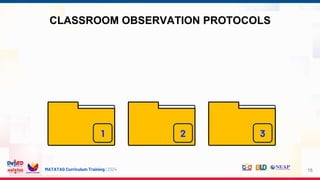
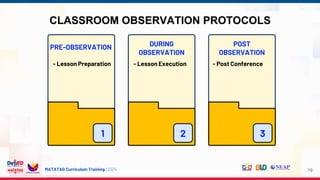
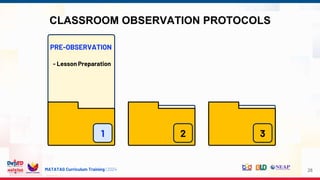
CLASSROOM OBSERVATION PROTOCOLS
15
1 2 3
MATATAG Curriculum Training | 2024
CLASSROOM OBSERVATION PROTOCOLS
16
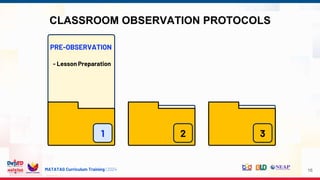
1 2 3
PRE-OBSERVATION
- Lesson Preparation
MATATAG Curriculum Training | 2024
CLASSROOM OBSERVATION PROTOCOLS
17
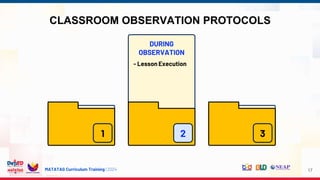
DURING
OBSERVATION
1 2 3
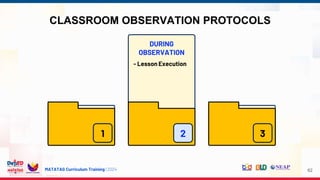
- Lesson Execution
MATATAG Curriculum Training | 2024
CLASSROOM OBSERVATION PROTOCOLS
18
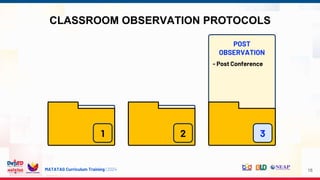
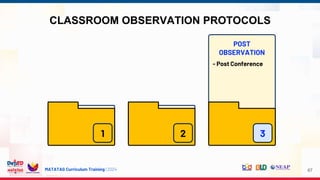
1 2 3
POST
OBSERVATION
- Post Conference
MATATAG Curriculum Training | 2024
CLASSROOM OBSERVATION PROTOCOLS
19
3
POST
OBSERVATION
DURING
OBSERVATION
2
1
PRE-OBSERVATION
- Lesson Preparation - Lesson Execution - Post Conference
MATATAG Curriculum Training | 2024
How about the classroom
observation tools?
20
MATATAG Curriculum Training | 2024 21
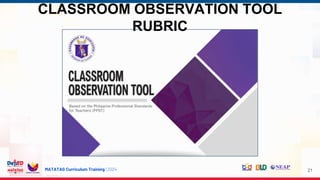
CLASSROOM OBSERVATION TOOL
RUBRIC
MATATAG Curriculum Training | 2024
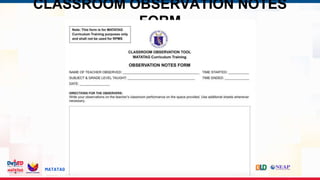
CLASSROOM OBSERVATION NOTES
FORM
MATATAG Curriculum Training | 2024
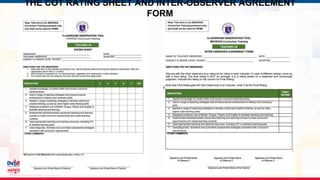
THE COT RATING SHEET AND INTER-OBSERVER AGREEMENT
FORM
MATATAG Curriculum Training | 2024
Who are our classroom
observers?
24
MATATAG Curriculum Training | 2024
CLASSROOM
OBSERVERS
25
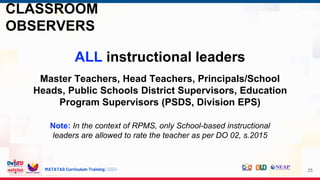
ALL instructional leaders
Master Teachers, Head Teachers, Principals/School
Heads, Public Schools District Supervisors, Education
Program Supervisors (PSDS, Division EPS)
Note: In the context of RPMS, only School-based instructional
leaders are allowed to rate the teacher as per DO 02, s.2015
MATATAG Curriculum Training | 2024
CLASSROOM
OBSERVERS
26
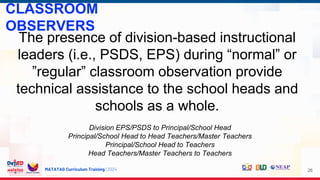
The presence of division-based instructional
leaders (i.e., PSDS, EPS) during “normal” or
”regular” classroom observation provide
technical assistance to the school heads and
schools as a whole.
Division EPS/PSDS to Principal/School Head
Principal/School Head to Head Teachers/Master Teachers
Principal/School Head to Teachers
Head Teachers/Master Teachers to Teachers
MATATAG Curriculum Training | 2024
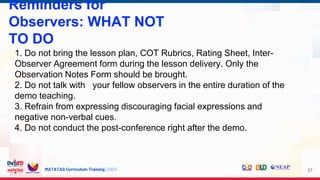
Reminders for
Observers: WHAT NOT
TO DO
27
1. Do not bring the lesson plan, COT Rubrics, Rating Sheet, Inter-
Observer Agreement form during the lesson delivery. Only the
Observation Notes Form should be brought.
2. Do not talk with your fellow observers in the entire duration of the
demo teaching.
3. Refrain from expressing discouraging facial expressions and
negative non-verbal cues.
4. Do not conduct the post-conference right after the demo.
MATATAG Curriculum Training | 2024
CLASSROOM OBSERVATION PROTOCOLS
28
1 2 3
PRE-OBSERVATION
- Lesson Preparation
MATATAG Curriculum Training | 2024
Classroom Observable Indicators (COI)
in the context of MATATAG Curriculum
Implementation for Kindergarten, Grades 1, 4 and 7
29
MATATAG Curriculum Training | 2024
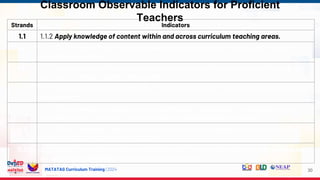
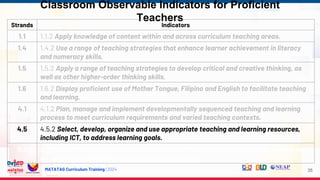
Classroom Observable Indicators for Proficient
Teachers
30
Strands Indicators
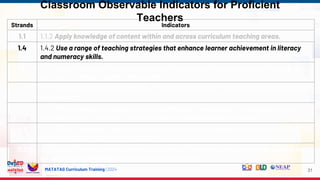
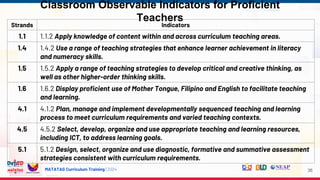
1.1 1.1.2 Apply knowledge of content within and across curriculum teaching areas.
1.4 1.4.2 Use a range of teaching strategies that enhance learner achievement in literacy
and numeracy skills.
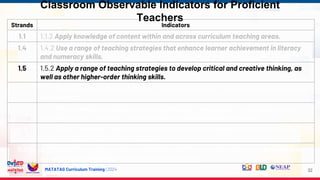
1.5 1.5.2 Apply a range of teaching strategies to develop critical and creative thinking, as
well as other higher-order thinking skills.
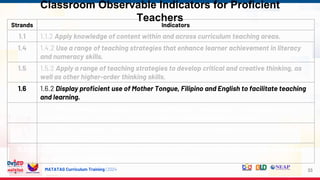
1.6 1.6.2 Display proficient use of Mother Tongue, Filipino and English to facilitate teaching
and learning.
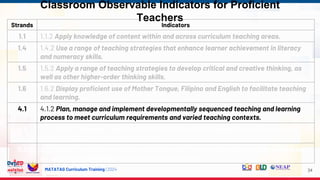
4.1 4.1.2 Plan, manage and implement developmentally sequenced teaching and learning
process to meet curriculum requirements and varied teaching contexts.
4.5 4.5.2 Select, develop, organize and use appropriate teaching and learning resources,
including ICT, to address learning goals.
5.1 5.1.2 Design, select, organize and use diagnostic, formative and summative assessment
strategies consistent with curriculum requirements.
MATATAG Curriculum Training | 2024
Classroom Observable Indicators for Proficient
Teachers
31
Strands Indicators
1.1 1.1.2 Apply knowledge of content within and across curriculum teaching areas.
1.4 1.4.2 Use a range of teaching strategies that enhance learner achievement in literacy
and numeracy skills.
1.5 1.5.2 Apply a range of teaching strategies to develop critical and creative thinking, as
well as other higher-order thinking skills.
1.6 1.6.2 Display proficient use of Mother Tongue, Filipino and English to facilitate teaching
and learning.
4.1 4.1.2 Plan, manage and implement developmentally sequenced teaching and learning
process to meet curriculum requirements and varied teaching contexts.
4.5 4.5.2 Select, develop, organize and use appropriate teaching and learning resources,
including ICT, to address learning goals.
5.1 5.1.2 Design, select, organize and use diagnostic, formative and summative assessment
strategies consistent with curriculum requirements.
MATATAG Curriculum Training | 2024
Classroom Observable Indicators for Proficient
Teachers
32
Strands Indicators
1.1 1.1.2 Apply knowledge of content within and across curriculum teaching areas.
1.4 1.4.2 Use a range of teaching strategies that enhance learner achievement in literacy
and numeracy skills.
1.5 1.5.2 Apply a range of teaching strategies to develop critical and creative thinking, as
well as other higher-order thinking skills.
1.6 1.6.2 Display proficient use of Mother Tongue, Filipino and English to facilitate teaching
and learning.
4.1 4.1.2 Plan, manage and implement developmentally sequenced teaching and learning
process to meet curriculum requirements and varied teaching contexts.
4.5 4.5.2 Select, develop, organize and use appropriate teaching and learning resources,
including ICT, to address learning goals.
5.1 5.1.2 Design, select, organize and use diagnostic, formative and summative assessment
strategies consistent with curriculum requirements.
MATATAG Curriculum Training | 2024
Classroom Observable Indicators for Proficient
Teachers
33
Strands Indicators
1.1 1.1.2 Apply knowledge of content within and across curriculum teaching areas.
1.4 1.4.2 Use a range of teaching strategies that enhance learner achievement in literacy
and numeracy skills.
1.5 1.5.2 Apply a range of teaching strategies to develop critical and creative thinking, as
well as other higher-order thinking skills.
1.6 1.6.2 Display proficient use of Mother Tongue, Filipino and English to facilitate teaching
and learning.
4.1 4.1.2 Plan, manage and implement developmentally sequenced teaching and learning
process to meet curriculum requirements and varied teaching contexts.
4.5 4.5.2 Select, develop, organize and use appropriate teaching and learning resources,
including ICT, to address learning goals.
5.1 5.1.2 Design, select, organize and use diagnostic, formative and summative assessment
strategies consistent with curriculum requirements.
MATATAG Curriculum Training | 2024
Classroom Observable Indicators for Proficient
Teachers
34
Strands Indicators
1.1 1.1.2 Apply knowledge of content within and across curriculum teaching areas.
1.4 1.4.2 Use a range of teaching strategies that enhance learner achievement in literacy
and numeracy skills.
1.5 1.5.2 Apply a range of teaching strategies to develop critical and creative thinking, as
well as other higher-order thinking skills.
1.6 1.6.2 Display proficient use of Mother Tongue, Filipino and English to facilitate teaching
and learning.
4.1 4.1.2 Plan, manage and implement developmentally sequenced teaching and learning
process to meet curriculum requirements and varied teaching contexts.
4.5 4.5.2 Select, develop, organize and use appropriate teaching and learning resources,
including ICT, to address learning goals.
5.1 5.1.2 Design, select, organize and use diagnostic, formative and summative assessment
strategies consistent with curriculum requirements.
MATATAG Curriculum Training | 2024
Classroom Observable Indicators for Proficient
Teachers
35
Strands Indicators
1.1 1.1.2 Apply knowledge of content within and across curriculum teaching areas.
1.4 1.4.2 Use a range of teaching strategies that enhance learner achievement in literacy
and numeracy skills.
1.5 1.5.2 Apply a range of teaching strategies to develop critical and creative thinking, as
well as other higher-order thinking skills.
1.6 1.6.2 Display proficient use of Mother Tongue, Filipino and English to facilitate teaching
and learning.
4.1 4.1.2 Plan, manage and implement developmentally sequenced teaching and learning
process to meet curriculum requirements and varied teaching contexts.
4.5 4.5.2 Select, develop, organize and use appropriate teaching and learning resources,
including ICT, to address learning goals.
5.1 5.1.2 Design, select, organize and use diagnostic, formative and summative assessment
strategies consistent with curriculum requirements.
MATATAG Curriculum Training | 2024
Classroom Observable Indicators for Proficient
Teachers
36
Strands Indicators
1.1 1.1.2 Apply knowledge of content within and across curriculum teaching areas.
1.4 1.4.2 Use a range of teaching strategies that enhance learner achievement in literacy
and numeracy skills.
1.5 1.5.2 Apply a range of teaching strategies to develop critical and creative thinking, as
well as other higher-order thinking skills.
1.6 1.6.2 Display proficient use of Mother Tongue, Filipino and English to facilitate teaching
and learning.
4.1 4.1.2 Plan, manage and implement developmentally sequenced teaching and learning
process to meet curriculum requirements and varied teaching contexts.
4.5 4.5.2 Select, develop, organize and use appropriate teaching and learning resources,
including ICT, to address learning goals.
5.1 5.1.2 Design, select, organize and use diagnostic, formative and summative assessment
strategies consistent with curriculum requirements.
MATATAG Curriculum Training | 2024
Can you identify or situate
the presented indicators in
your prepared lesson plans
or exemplars ?
37
MATATAG Curriculum Training | 2024
Let’s proceed…
39
MATATAG Curriculum Training | 2024 40
MATATAG Curriculum Training | 2024
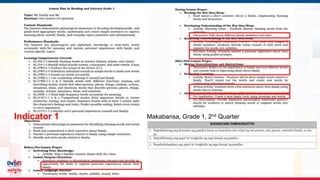
Makabansa, Grade 1, 2nd Quarter
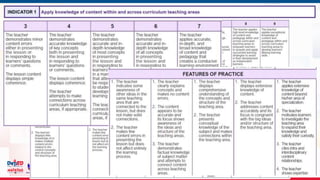
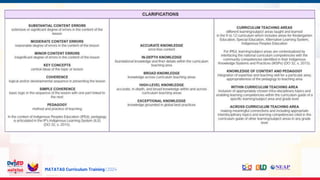
Indicator 1
MATATAG Curriculum Training | 2024
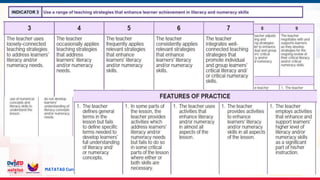
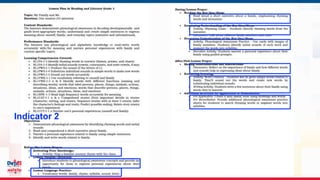
Indicator 2
MATATAG Curriculum Training | 2024
Indicator 3
MATATAG Curriculum Training | 2024
Indicator 4
MATATAG Curriculum Training | 2024
MATATAG Curriculum Training | 2024 54
MATATAG Curriculum Training | 2024
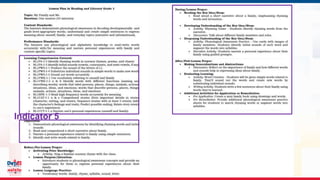
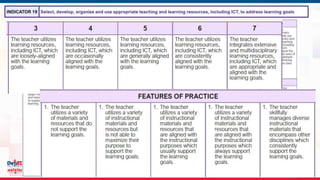
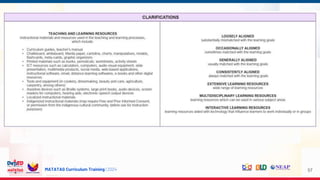
Indicator 5
MATATAG Curriculum Training | 2024 56
MATATAG Curriculum Training | 2024 57
MATATAG Curriculum Training | 2024
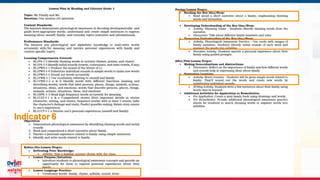
Indicator 6
MATATAG Curriculum Training | 2024 59
MATATAG Curriculum Training | 2024 60
MATATAG Curriculum Training | 2024
Indicator 7
MATATAG Curriculum Training | 2024
CLASSROOM OBSERVATION PROTOCOLS
62
DURING
OBSERVATION
1 2 3
- Lesson Execution
MATATAG Curriculum Training | 2024
Upgrading classroom observation towards a
more reflective and collaborative practice
In the findings of the study of Rosero (2022), he found out that a
shift in perspective in classroom observation can help teachers
and observers rethink classroom observation from teacher-
oriented to student-centered.
The study further elaborated the ‘potential tools’ for upgrading
classroom observation practices, all of which to improve teacher
practice and increase learner engagement and performance.
63
MATATAG Curriculum Training | 2024
Classroom Observation should be…
● frequent and informal
○ should be done as frequently as possible
○ should also be informal and allow teachers
to observe one another, regardless of
position or rank
64
MATATAG Curriculum Training | 2024
Classroom Observation should…
● focus on students and their learning
○ appreciate the process of teaching and
learning, the flow of the lesson, the
interaction between teachers and
learners, and their impact on learners
65
MATATAG Curriculum Training | 2024
Classroom Observation should…
● make use of the classroom observation
notes form (ONF)and upgrade/enhance it
○ structure and content
○ use of picture as evidence
○ writing chronological notes with time
stamps
66
MATATAG Curriculum Training | 2024
CLASSROOM OBSERVATION PROTOCOLS
67
1 2 3
POST
OBSERVATION
- Post Conference
MATATAG Curriculum Training | 2024
In the provision of feedback…
It is essential that teachers feel safe when
giving them feedback or advice about their
practice. It can also improve your observation
practices if you ask the teachers what to
focus on in your observation (Rosero, 2022).
68
MATATAG Curriculum Training | 2024
Finally, the role of observation (1)
Classroom observation should be done to help teachers
and the students to read and follow the flow of the
class. Observers should also learn from the students and
their interactions to help them improve the class
dynamics. In addition, the feedback from classroom
observation should aid teachers' continuous reflection
and redesign of the curriculum.
69
MATATAG Curriculum Training | 2024
Finally, the role of observation (1)
Observers should not just observe; they should also
assist teachers in building better relationships with
each other and with their students (Rosero, 2022).
70
MATATAG Curriculum Training | 2024
Finally, the role of observation (2)
Classroom observation should also facilitate building relationships
among educators and building networks with other schools. By
opening the class and inviting outsiders to observe the class, the
teacher can gain valuable perspectives that could help improve
the lesson. It also opens up a free flow of knowledge and
information, connecting teachers and schools, establishing
professional networks, and creating a learning ecosystem (Rosero,
2022).
71
MATATAG Curriculum Training | 2024
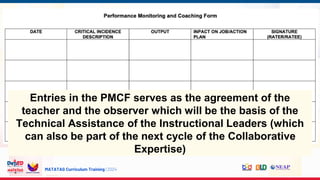
Entries in the PMCF serves as the agreement of the
teacher and the observer which will be the basis of the
Technical Assistance of the Instructional Leaders (which
can also be part of the next cycle of the Collaborative
Expertise)
MATATAG Curriculum Training | 2024
Any Questions?
73
MATATAG Curriculum Training | 2024
Activity
74
Instructions:
1. In the next 15 minutes, revisit and refine
your lesson plan for the last time.
2. After refining, be ready for your
demonstration teaching.
MATATAG Curriculum Training | 2024
Reminder:
75
1. There will only be ONE demonstrator per class.
2. There are THREE instructional leaders who will serve as Class
Observers. (School Head/Public Schools District
Supervisor/Division Education Program Supervisor)
3. The Class Facilitators (Specialists) will be the Process
Observers.
4. The rest of the members of the class will serve as the learners.
MATATAG Curriculum Training | 2024
Demonstration Mechanics
76
MATATAG Curriculum Training | 2024
Demonstration Mechanics
77
1. The demonstration teaching will run for 45 minutes.
2. The respective Class Managers have chosen the group of
participants who will play the role of learners and
observers.
3. It is encouraged that the participants play the role of the
grade level learners in the entire demonstration
teaching.
MATATAG Curriculum Training | 2024
Demonstration Mechanics
78
4. Facilitator 1 will be the Specialists from BLD who will be
co-facilitated by the Specialists from BCD.
5. Observers are discouraged to talk with their fellow
observers during the entire proceedings.
6. To follow protocols in Classroom Observation, observers
shall be given copies of lesson plan before the delivery.
During delivery, lesson plans shall then be kept and may
be reviewed after the demo teaching.
MATATAG Curriculum Training | 2024
Demonstration Mechanics
79
7. After demonstration teaching, observers will be deliberating ratings
from within themselves and shall conduct quick Post-
Demonstration Teaching Conference with the teacher.
8. For the interest of time, observer who will be delivering the post-
conference is encouraged to focus on the indicators.
9. Finally, facilitators who served as process observers in the entire
duration of the demo teaching will give their feedback on their
observations toward the teacher-demonstrator, the learners, and
the observers.
MATATAG Curriculum Training | 2024
References:
DepEd Order No. 02, s. 2015, Guidelines on the Establishment & Implementation of the Results-based
Performance Management Systems (RPMS) in the Department of Education.
DepEd Order No. 42, s. 2017, National Adoption and Implementation of the Philippine Professional Standards
for Teachers
DepEd Order No. 24, s. 2020, National Adoption and Implementation of the Philippine Professional Standards
for School Heads
DepEd Order No. 25, s. 2020, National Adoption and Implementation of the Philippine Professional Standards
for Supervisors
Department of Education. 2017. Manual for RPMS for Teachers and School Heads
Rosero, Michael Wilson I.,2022. Upgrading Classroom Observation towards a More Reflective and
Collaborative Practice, Excerpts from “Starting from Where the Learners Are: Cultivating Inquiries in the
Classroom, School and Professional Learning Ecosystem” United Professional Graduate School of
Professional Development of Teachers. University of Fukui.
81
MATATAG Curriculum Training | 2024
Program Management Team
Curriculum and Teaching Strand
Bureau of Curriculum Development
Bureau of Learning Delivery
Bureau of Education Assessment
Bureau of Alternative Education
Bureau of Learning Resources
Human Resources and Organizational Development
Strand
National Educators Academy of the Philippines
(NEAP)
Professional Development Division
Quality Assurance Division
Session Guide and Presentation
Deck Developer/s
SDO Laguna/Region IV-A CALABARZON
MARK ANTHONY P. IDANG
MATATAG CURRICULUM TRAINING RESOURCE PACKAGE
82
MARAMING SALAMAT!
83

Class Observation on Matatag Curri..pptx

  • 1.
  • 2.
    TRAINING ON THE MATATAGCURRICULUM 2 K, G1, G4, G7 Teachers, and School Leaders
  • 3.
    MATATAG Curriculum Training| 2024 Session 11/12 CLASSROOM OBSERVATION 3
  • 4.
    MATATAG Curriculum Training| 2024 Session Objectives: During the session, the participants will: • revisit the nature of classroom observation, its protocols, tools and key players; • review some of the classroom observable indicators relative to the implementation of MATATAG Curriculum; and • refine the prepared lesson plan based on the indicators presented leading to demonstration teaching. 4
  • 5.
    MATATAG Curriculum Training| 2024 PPST (For Teachers) Domain 1: Content Knowledge and Pedagogy 1.1 Content knowledge and its application within and across curriculum areas 1.4 Strategies for promoting literacy and numeracy 1.5 Strategies for developing critical and creative thinking, as well as other higher order thinking skills 1.6 Mother Tongue, Filipino and English in teaching and learning 5
  • 6.
    MATATAG Curriculum Training| 2024 PPST (For Teachers) con’t… Domain 4: Curriculum and Planning 4.1 Planning and management of teaching and learning process 4.5 Teaching and learning resources including ICT Domain 5: Assessment and Reporting 5.1 Design, selection, organization and utilization of assessment strategies 6
  • 7.
    MATATAG Curriculum Training| 2024 7 PPSSH (For School Heads and Head Teachers): Domain 3 Focusing on Teaching and Learning 3.2 Teaching Standards and Pedagogies 3.2.2 Provide technical assistance to teachers on teaching standards and pedagogies within and across learning areas to improve their teaching practice. 3.2.3 Engage school personnel such as master teachers, head teachers, department heads in providing technical assistance to teachers on teaching standards and pedagogies within and across learning areas to improve their teaching practice.
  • 8.
    MATATAG Curriculum Training| 2024 8 PPSS (For Supervisors, EPSs, PSDSs, and Chiefs) Domain 3: Fostering a Culture of Continuous Improvement 3.1. Support for instructional leadership 3.1.2.Apply appropriate instructional leadership support strategies to help divisions/districts/schools and/or learning centers with the continuous improvement of the teaching- learning process 3.1.3. Mentor and coach colleagues in adapting relevant instructional leadership support strategies to address the harmonized needs of clusters of divisions/ districts/schools and/or learning centers
  • 9.
    MATATAG Curriculum Training| 2024 Session Flow: Solicit from the group experiences on managing and conducting Classroom Observation Reflect on the challenges and opportunities brought about by Classroom Observation Classroom Observation, Criteria for Effective Teaching Evaluation, CO Protocols, CO Tools, CO Observers, CO Indicators, PMCF Refine the prepared lesson plan/ exemplars based on the indicators presented and execute it through Demonstration Teaching 9
  • 10.
    MATATAG Curriculum Training| 2024 SHARE IT! 10 1. In 2 minutes, share among the members of your group (as seated by table) your experiences in managing and conducting classroom observations. 2. Summarize your group findings by writing a hashtag on a metacard (i.e., #fulfilling, #empowered). 3. Be ready to share your hashtag with the group. Each chosen sharer will be given 2 minutes to present their findings relative to the hashtag.
  • 11.
    MATATAG Curriculum Training| 2024 WHAT IS CLASSROOM OBSERVATION? 11 • Educators observing each other’s practice, providing feedback and learning from each other to improve their impact on students’ learning • Focused on improving teacher practice in alignment with learner needs and school and region/state level priorities • Aims to make classroom practice more visible and encourage colleagues to collaborate to improve teacher practice and student learning -Australian Institute for Teaching and School Leadership (AITSL)
  • 12.
    MATATAG Curriculum Training| 2024 WHAT IS CLASSROOM OBSERVATION? 12 • One gauge in ensuring quality teaching • A process of providing feedback to a teacher’s classroom practice • Encourages teachers to reflect and develop self-awareness about their own practice • Provides evidence of actual teacher performance, their strengths and areas of improvement - RPMS Manual (2018)
  • 13.
    MATATAG Curriculum Training| 2024 CRITERIA FOR AN EFFECTIVE TEACHING EVALUATION 13 “Teachers evaluation should be based on professional teaching standards and should be sophisticated enough to assess teaching quality across the continuum of development from novice to expert teacher.” (Darling-Hammond, 2012)
  • 14.
    MATATAG Curriculum Training| 2024 Can you recall our Classroom Observation Protocols? 14
  • 15.
    MATATAG Curriculum Training| 2024 CLASSROOM OBSERVATION PROTOCOLS 15 1 2 3
  • 16.
    MATATAG Curriculum Training| 2024 CLASSROOM OBSERVATION PROTOCOLS 16 1 2 3 PRE-OBSERVATION - Lesson Preparation
  • 17.
    MATATAG Curriculum Training| 2024 CLASSROOM OBSERVATION PROTOCOLS 17 DURING OBSERVATION 1 2 3 - Lesson Execution
  • 18.
    MATATAG Curriculum Training| 2024 CLASSROOM OBSERVATION PROTOCOLS 18 1 2 3 POST OBSERVATION - Post Conference
  • 19.
    MATATAG Curriculum Training| 2024 CLASSROOM OBSERVATION PROTOCOLS 19 3 POST OBSERVATION DURING OBSERVATION 2 1 PRE-OBSERVATION - Lesson Preparation - Lesson Execution - Post Conference
  • 20.
    MATATAG Curriculum Training| 2024 How about the classroom observation tools? 20
  • 21.
    MATATAG Curriculum Training| 2024 21 CLASSROOM OBSERVATION TOOL RUBRIC
  • 22.
    MATATAG Curriculum Training| 2024 CLASSROOM OBSERVATION NOTES FORM
  • 23.
    MATATAG Curriculum Training| 2024 THE COT RATING SHEET AND INTER-OBSERVER AGREEMENT FORM
  • 24.
    MATATAG Curriculum Training| 2024 Who are our classroom observers? 24
  • 25.
    MATATAG Curriculum Training| 2024 CLASSROOM OBSERVERS 25 ALL instructional leaders Master Teachers, Head Teachers, Principals/School Heads, Public Schools District Supervisors, Education Program Supervisors (PSDS, Division EPS) Note: In the context of RPMS, only School-based instructional leaders are allowed to rate the teacher as per DO 02, s.2015
  • 26.
    MATATAG Curriculum Training| 2024 CLASSROOM OBSERVERS 26 The presence of division-based instructional leaders (i.e., PSDS, EPS) during “normal” or ”regular” classroom observation provide technical assistance to the school heads and schools as a whole. Division EPS/PSDS to Principal/School Head Principal/School Head to Head Teachers/Master Teachers Principal/School Head to Teachers Head Teachers/Master Teachers to Teachers
  • 27.
    MATATAG Curriculum Training| 2024 Reminders for Observers: WHAT NOT TO DO 27 1. Do not bring the lesson plan, COT Rubrics, Rating Sheet, Inter- Observer Agreement form during the lesson delivery. Only the Observation Notes Form should be brought. 2. Do not talk with your fellow observers in the entire duration of the demo teaching. 3. Refrain from expressing discouraging facial expressions and negative non-verbal cues. 4. Do not conduct the post-conference right after the demo.
  • 28.
    MATATAG Curriculum Training| 2024 CLASSROOM OBSERVATION PROTOCOLS 28 1 2 3 PRE-OBSERVATION - Lesson Preparation
  • 29.
    MATATAG Curriculum Training| 2024 Classroom Observable Indicators (COI) in the context of MATATAG Curriculum Implementation for Kindergarten, Grades 1, 4 and 7 29
  • 30.
    MATATAG Curriculum Training| 2024 Classroom Observable Indicators for Proficient Teachers 30 Strands Indicators 1.1 1.1.2 Apply knowledge of content within and across curriculum teaching areas. 1.4 1.4.2 Use a range of teaching strategies that enhance learner achievement in literacy and numeracy skills. 1.5 1.5.2 Apply a range of teaching strategies to develop critical and creative thinking, as well as other higher-order thinking skills. 1.6 1.6.2 Display proficient use of Mother Tongue, Filipino and English to facilitate teaching and learning. 4.1 4.1.2 Plan, manage and implement developmentally sequenced teaching and learning process to meet curriculum requirements and varied teaching contexts. 4.5 4.5.2 Select, develop, organize and use appropriate teaching and learning resources, including ICT, to address learning goals. 5.1 5.1.2 Design, select, organize and use diagnostic, formative and summative assessment strategies consistent with curriculum requirements.
  • 31.
    MATATAG Curriculum Training| 2024 Classroom Observable Indicators for Proficient Teachers 31 Strands Indicators 1.1 1.1.2 Apply knowledge of content within and across curriculum teaching areas. 1.4 1.4.2 Use a range of teaching strategies that enhance learner achievement in literacy and numeracy skills. 1.5 1.5.2 Apply a range of teaching strategies to develop critical and creative thinking, as well as other higher-order thinking skills. 1.6 1.6.2 Display proficient use of Mother Tongue, Filipino and English to facilitate teaching and learning. 4.1 4.1.2 Plan, manage and implement developmentally sequenced teaching and learning process to meet curriculum requirements and varied teaching contexts. 4.5 4.5.2 Select, develop, organize and use appropriate teaching and learning resources, including ICT, to address learning goals. 5.1 5.1.2 Design, select, organize and use diagnostic, formative and summative assessment strategies consistent with curriculum requirements.
  • 32.
    MATATAG Curriculum Training| 2024 Classroom Observable Indicators for Proficient Teachers 32 Strands Indicators 1.1 1.1.2 Apply knowledge of content within and across curriculum teaching areas. 1.4 1.4.2 Use a range of teaching strategies that enhance learner achievement in literacy and numeracy skills. 1.5 1.5.2 Apply a range of teaching strategies to develop critical and creative thinking, as well as other higher-order thinking skills. 1.6 1.6.2 Display proficient use of Mother Tongue, Filipino and English to facilitate teaching and learning. 4.1 4.1.2 Plan, manage and implement developmentally sequenced teaching and learning process to meet curriculum requirements and varied teaching contexts. 4.5 4.5.2 Select, develop, organize and use appropriate teaching and learning resources, including ICT, to address learning goals. 5.1 5.1.2 Design, select, organize and use diagnostic, formative and summative assessment strategies consistent with curriculum requirements.
  • 33.
    MATATAG Curriculum Training| 2024 Classroom Observable Indicators for Proficient Teachers 33 Strands Indicators 1.1 1.1.2 Apply knowledge of content within and across curriculum teaching areas. 1.4 1.4.2 Use a range of teaching strategies that enhance learner achievement in literacy and numeracy skills. 1.5 1.5.2 Apply a range of teaching strategies to develop critical and creative thinking, as well as other higher-order thinking skills. 1.6 1.6.2 Display proficient use of Mother Tongue, Filipino and English to facilitate teaching and learning. 4.1 4.1.2 Plan, manage and implement developmentally sequenced teaching and learning process to meet curriculum requirements and varied teaching contexts. 4.5 4.5.2 Select, develop, organize and use appropriate teaching and learning resources, including ICT, to address learning goals. 5.1 5.1.2 Design, select, organize and use diagnostic, formative and summative assessment strategies consistent with curriculum requirements.
  • 34.
    MATATAG Curriculum Training| 2024 Classroom Observable Indicators for Proficient Teachers 34 Strands Indicators 1.1 1.1.2 Apply knowledge of content within and across curriculum teaching areas. 1.4 1.4.2 Use a range of teaching strategies that enhance learner achievement in literacy and numeracy skills. 1.5 1.5.2 Apply a range of teaching strategies to develop critical and creative thinking, as well as other higher-order thinking skills. 1.6 1.6.2 Display proficient use of Mother Tongue, Filipino and English to facilitate teaching and learning. 4.1 4.1.2 Plan, manage and implement developmentally sequenced teaching and learning process to meet curriculum requirements and varied teaching contexts. 4.5 4.5.2 Select, develop, organize and use appropriate teaching and learning resources, including ICT, to address learning goals. 5.1 5.1.2 Design, select, organize and use diagnostic, formative and summative assessment strategies consistent with curriculum requirements.
  • 35.
    MATATAG Curriculum Training| 2024 Classroom Observable Indicators for Proficient Teachers 35 Strands Indicators 1.1 1.1.2 Apply knowledge of content within and across curriculum teaching areas. 1.4 1.4.2 Use a range of teaching strategies that enhance learner achievement in literacy and numeracy skills. 1.5 1.5.2 Apply a range of teaching strategies to develop critical and creative thinking, as well as other higher-order thinking skills. 1.6 1.6.2 Display proficient use of Mother Tongue, Filipino and English to facilitate teaching and learning. 4.1 4.1.2 Plan, manage and implement developmentally sequenced teaching and learning process to meet curriculum requirements and varied teaching contexts. 4.5 4.5.2 Select, develop, organize and use appropriate teaching and learning resources, including ICT, to address learning goals. 5.1 5.1.2 Design, select, organize and use diagnostic, formative and summative assessment strategies consistent with curriculum requirements.
  • 36.
    MATATAG Curriculum Training| 2024 Classroom Observable Indicators for Proficient Teachers 36 Strands Indicators 1.1 1.1.2 Apply knowledge of content within and across curriculum teaching areas. 1.4 1.4.2 Use a range of teaching strategies that enhance learner achievement in literacy and numeracy skills. 1.5 1.5.2 Apply a range of teaching strategies to develop critical and creative thinking, as well as other higher-order thinking skills. 1.6 1.6.2 Display proficient use of Mother Tongue, Filipino and English to facilitate teaching and learning. 4.1 4.1.2 Plan, manage and implement developmentally sequenced teaching and learning process to meet curriculum requirements and varied teaching contexts. 4.5 4.5.2 Select, develop, organize and use appropriate teaching and learning resources, including ICT, to address learning goals. 5.1 5.1.2 Design, select, organize and use diagnostic, formative and summative assessment strategies consistent with curriculum requirements.
  • 37.
    MATATAG Curriculum Training| 2024 Can you identify or situate the presented indicators in your prepared lesson plans or exemplars ? 37
  • 38.
  • 39.
    MATATAG Curriculum Training| 2024 Let’s proceed… 39
  • 40.
  • 41.
  • 42.
  • 43.
    MATATAG Curriculum Training| 2024 Makabansa, Grade 1, 2nd Quarter Indicator 1
  • 44.
  • 45.
  • 46.
    MATATAG Curriculum Training| 2024 Indicator 2
  • 47.
  • 48.
  • 49.
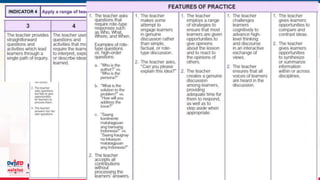
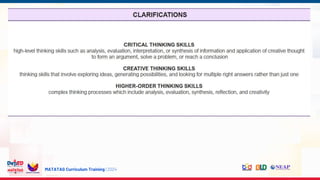
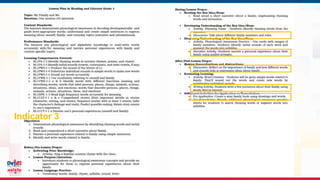
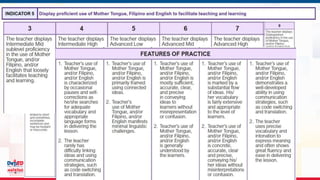
    MATATAG Curriculum Training| 2024 Indicator 3
  • 50.
  • 51.
  • 52.
    MATATAG Curriculum Training| 2024 Indicator 4
  • 53.
  • 54.
  • 55.
    MATATAG Curriculum Training| 2024 Indicator 5
  • 56.
  • 57.
  • 58.
    MATATAG Curriculum Training| 2024 Indicator 6
  • 59.
  • 60.
  • 61.
    MATATAG Curriculum Training| 2024 Indicator 7
  • 62.
    MATATAG Curriculum Training| 2024 CLASSROOM OBSERVATION PROTOCOLS 62 DURING OBSERVATION 1 2 3 - Lesson Execution
  • 63.
    MATATAG Curriculum Training| 2024 Upgrading classroom observation towards a more reflective and collaborative practice In the findings of the study of Rosero (2022), he found out that a shift in perspective in classroom observation can help teachers and observers rethink classroom observation from teacher- oriented to student-centered. The study further elaborated the ‘potential tools’ for upgrading classroom observation practices, all of which to improve teacher practice and increase learner engagement and performance. 63
  • 64.
    MATATAG Curriculum Training| 2024 Classroom Observation should be… ● frequent and informal ○ should be done as frequently as possible ○ should also be informal and allow teachers to observe one another, regardless of position or rank 64
  • 65.
    MATATAG Curriculum Training| 2024 Classroom Observation should… ● focus on students and their learning ○ appreciate the process of teaching and learning, the flow of the lesson, the interaction between teachers and learners, and their impact on learners 65
  • 66.
    MATATAG Curriculum Training| 2024 Classroom Observation should… ● make use of the classroom observation notes form (ONF)and upgrade/enhance it ○ structure and content ○ use of picture as evidence ○ writing chronological notes with time stamps 66
  • 67.
    MATATAG Curriculum Training| 2024 CLASSROOM OBSERVATION PROTOCOLS 67 1 2 3 POST OBSERVATION - Post Conference
  • 68.
    MATATAG Curriculum Training| 2024 In the provision of feedback… It is essential that teachers feel safe when giving them feedback or advice about their practice. It can also improve your observation practices if you ask the teachers what to focus on in your observation (Rosero, 2022). 68
  • 69.
    MATATAG Curriculum Training| 2024 Finally, the role of observation (1) Classroom observation should be done to help teachers and the students to read and follow the flow of the class. Observers should also learn from the students and their interactions to help them improve the class dynamics. In addition, the feedback from classroom observation should aid teachers' continuous reflection and redesign of the curriculum. 69
  • 70.
    MATATAG Curriculum Training| 2024 Finally, the role of observation (1) Observers should not just observe; they should also assist teachers in building better relationships with each other and with their students (Rosero, 2022). 70
  • 71.
    MATATAG Curriculum Training| 2024 Finally, the role of observation (2) Classroom observation should also facilitate building relationships among educators and building networks with other schools. By opening the class and inviting outsiders to observe the class, the teacher can gain valuable perspectives that could help improve the lesson. It also opens up a free flow of knowledge and information, connecting teachers and schools, establishing professional networks, and creating a learning ecosystem (Rosero, 2022). 71
  • 72.
    MATATAG Curriculum Training| 2024 Entries in the PMCF serves as the agreement of the teacher and the observer which will be the basis of the Technical Assistance of the Instructional Leaders (which can also be part of the next cycle of the Collaborative Expertise)
  • 73.
    MATATAG Curriculum Training| 2024 Any Questions? 73
  • 74.
    MATATAG Curriculum Training| 2024 Activity 74 Instructions: 1. In the next 15 minutes, revisit and refine your lesson plan for the last time. 2. After refining, be ready for your demonstration teaching.
  • 75.
    MATATAG Curriculum Training| 2024 Reminder: 75 1. There will only be ONE demonstrator per class. 2. There are THREE instructional leaders who will serve as Class Observers. (School Head/Public Schools District Supervisor/Division Education Program Supervisor) 3. The Class Facilitators (Specialists) will be the Process Observers. 4. The rest of the members of the class will serve as the learners.
  • 76.
    MATATAG Curriculum Training| 2024 Demonstration Mechanics 76
  • 77.
    MATATAG Curriculum Training| 2024 Demonstration Mechanics 77 1. The demonstration teaching will run for 45 minutes. 2. The respective Class Managers have chosen the group of participants who will play the role of learners and observers. 3. It is encouraged that the participants play the role of the grade level learners in the entire demonstration teaching.
  • 78.
    MATATAG Curriculum Training| 2024 Demonstration Mechanics 78 4. Facilitator 1 will be the Specialists from BLD who will be co-facilitated by the Specialists from BCD. 5. Observers are discouraged to talk with their fellow observers during the entire proceedings. 6. To follow protocols in Classroom Observation, observers shall be given copies of lesson plan before the delivery. During delivery, lesson plans shall then be kept and may be reviewed after the demo teaching.
  • 79.
    MATATAG Curriculum Training| 2024 Demonstration Mechanics 79 7. After demonstration teaching, observers will be deliberating ratings from within themselves and shall conduct quick Post- Demonstration Teaching Conference with the teacher. 8. For the interest of time, observer who will be delivering the post- conference is encouraged to focus on the indicators. 9. Finally, facilitators who served as process observers in the entire duration of the demo teaching will give their feedback on their observations toward the teacher-demonstrator, the learners, and the observers.
  • 80.
  • 81.
    MATATAG Curriculum Training| 2024 References: DepEd Order No. 02, s. 2015, Guidelines on the Establishment & Implementation of the Results-based Performance Management Systems (RPMS) in the Department of Education. DepEd Order No. 42, s. 2017, National Adoption and Implementation of the Philippine Professional Standards for Teachers DepEd Order No. 24, s. 2020, National Adoption and Implementation of the Philippine Professional Standards for School Heads DepEd Order No. 25, s. 2020, National Adoption and Implementation of the Philippine Professional Standards for Supervisors Department of Education. 2017. Manual for RPMS for Teachers and School Heads Rosero, Michael Wilson I.,2022. Upgrading Classroom Observation towards a More Reflective and Collaborative Practice, Excerpts from “Starting from Where the Learners Are: Cultivating Inquiries in the Classroom, School and Professional Learning Ecosystem” United Professional Graduate School of Professional Development of Teachers. University of Fukui. 81
  • 82.
    MATATAG Curriculum Training| 2024 Program Management Team Curriculum and Teaching Strand Bureau of Curriculum Development Bureau of Learning Delivery Bureau of Education Assessment Bureau of Alternative Education Bureau of Learning Resources Human Resources and Organizational Development Strand National Educators Academy of the Philippines (NEAP) Professional Development Division Quality Assurance Division Session Guide and Presentation Deck Developer/s SDO Laguna/Region IV-A CALABARZON MARK ANTHONY P. IDANG MATATAG CURRICULUM TRAINING RESOURCE PACKAGE 82
  • 83.

Editor's Notes

  • #2 Introduction: Welcome the participants and set the tone for the training. Say: Good morning/afternoon, dear fellow school leaders/teachers!
  • #3 Show: COLLABORATIVE EXPERTISE   Do: Ask the participants if they are familiar with the concept of collaborative expertise? Where do we commonly use this concept? Affirm their responses and mention that this concept is done aligned with the Learning Action Cells (LAC)
  • #4 Purpose of the Slide: to give the title of the session and name of the RP/LF Say: I am _____________ and I will be facilitating the session titled ______. Other Notes: Faci may add more ad libs.
  • #5 Purpose of the Slide: To give the objective/aim of the session Say: In this session, you will be ___________. At the end of the session, you will also be ____________. Below are the strands of the professional standards that this PD addresses. Other Notes:
  • #6 Purpose of the Slide: To present the domain, strand and indicators of the Philippine Professional Standards for Teachers
  • #7 Purpose of the Slide: To present the domain, strand and indicators of the Philippine Professional Standards for Teachers
  • #8 Purpose of the Slide: To present the domain, strand and indicators of the Philippine Professional Standards for School Heads
  • #9 Purpose of the Slide: To present the domain, strand and indicators of the Philippine Professional Standards for Supervisors
  • #10 Purpose of the Slide: To present the Session Flow Say: In this session, we will solicit from your group the experiences on managing and conducting classroom observation, including your reflection on the challenges and opportunities in conducting classroom observation, the foreign and local literature on classroom observation and the criteria for effective teaching evaluation, and the related tools and forms on classroom observation. As we go through this, our expectation is that we will be able to refine the prepared lesson plan/exemplars based on the indicators to be presented which one of your group will then be executing through a demonstration teaching later. Note to Facilitator: You may initially invite the attention of the participants that there will only be one demonstration teacher per learning area and the lesson that they will be using is the refined lesson plan/exemplar used in the earlier session on Collaborative Expertise, drawn form the Session on Instructional Plan Framework.
  • #11 Purpose of the Slide: To provide instructions on the priming activity. Say: Before we proceed to our sharing of classroom observation and how will it help the initial implementation of the MATATAG Curriculum for Kindergarten, Grade 1, 4 and 7, may I ask that we first do this activity. Do: Read the instructions on the slide Ask the following processing questions: How was the activity? What commonalities have we gathered? What unique strategies or observation lessons have we picked-up? What are the challenges that we conquered and opportunities that were opened through demonstration teaching? After going through the sharing and process, connect the synthesis of this activity to the discussion of the literature on Classroom Observation:
  • #12 Purpose of the Slide: To refresh participants on the nature of classroom observation. Do: Read what is on the slide giving emphasis on the highlighted blue texts, moving towards the synthesis by saying the following: Say: With these definitions, we are clearly reminded that classroom observation should be improving the teaching and learning processes to improve student learning.
  • #13 Purpose of the Slide: To refresh participants on the nature of classroom observation in Philippine Educational Context Do: Read what is on the slide giving emphasis on the highlighted blue texts, moving towards the synthesis by saying the following: Say: Relative to the literature I shared earlier, classroom observation, should be the basis of providing technical assistance to our teachers in the field and should translate classroom observation as avenue to showcase teacher’s best practice. The call to us as instructional leaders is that we are enjoined to advocate classroom observation as a mechanism to improve teaching practice. We should provide the mindset and notion that classroom observation is not just conducted to see the flaws of the teachers but should be seen as tool to develop our teachers even more.
  • #14 Purpose of the Slide: To present the criteria for an effective teaching evaluation Do: Read what is on the slide giving emphasis on the highlighted blue texts, moving towards the next processes in classroom observation.
  • #15 Say: Let's take a moment to revisit our observation protocols. Today, we'll review the essential steps for conducting classroom observations, particularly focusing on how these observations contribute to our ratings in the RPMS. Say: However, it's crucial to understand that these protocols are designed specifically for formal classroom observations. It's worth noting that various types of classroom observations can occur outside of these parameters when assessing teacher performance through IPCR. Say: By refreshing our understanding of these protocols, we not only ensure compliance but also reinforce the broader context of observation practices within our professional development.
  • #16 Purpose of the Slide: To show the classroom observation protocols Do: proceed to the next slide
  • #17 Purpose of the Slide: To show the classroom observation protocols Do: Read what is in the first folder and activities related to it
  • #18 Purpose of the Slide: To show the classroom observation protocols Do: Read what is in the second folder and activities related to it
  • #19 Purpose of the Slide: To show the classroom observation protocols Do: Read what is in the third folder and activities related to it
  • #20 Purpose of the Slide: To show the classroom observation protocols as synthesis Do: proceed to the next slide.
  • #21 Say: After reviewing our protocols, can we identify or recall what are our classroom observation tools?
  • #22 Purpose of the Slide: To show the classroom observation tools Do: Read what is in the slide
  • #23 Purpose of the Slide: To show the classroom observation tools Do: Read what is in the slide
  • #24 Purpose of the Slide: To show the classroom observation tools Do: Read what is in the slide
  • #25 Say: Now, how about our classroom observers? With the following slides, maybe some of our questions and clouds pertaining whose who, will be clarified.
  • #26 Purpose of the Slide: To present the classroom observers Do: Read what is in the slide
  • #27 Purpose of the Slide: To present the classroom observers Do: Read what is in the slide
  • #28 Purpose of the Slide: To present the reminders for classroom observation Do: Read what is in the slide
  • #29 Purpose of the Slide: To walk the participants through the preparation of the lesson Do: Read what is in the first folder and activities related to it
  • #30 Purpose of the Slide: To present some of the classroom observable indicators which can be seen and observed during monitoring of the curriculum implementation Say: The following indicators are just some of the indicators which can be seen and observed during classroom observation in monitoring the curriculum implementation. We are being reminded that we are not doing the classroom observation out of RPMS only. As instructional leaders we can do classroom observation as basis of our technical assistance and not just for performance rating only.
  • #31 Purpose of the Slide: To present some of the classroom observable indicators which can be seen and observed during monitoring of the curriculum implementation Do: Read what is in the slide
  • #32 Purpose of the Slide: To present some of the classroom observable indicators which can be seen and observed during monitoring of the curriculum implementation Do: Read what is in the slide
  • #33 Purpose of the Slide: To present some of the classroom observable indicators which can be seen and observed during monitoring of the curriculum implementation Do: Read what is in the slide
  • #34 Purpose of the Slide: To present some of the classroom observable indicators which can be seen and observed during monitoring of the curriculum implementation Do: Read what is in the slide
  • #35 Purpose of the Slide: To present some of the classroom observable indicators which can be seen and observed during monitoring of the curriculum implementation Do: Read what is in the slide
  • #36 Purpose of the Slide: To present some of the classroom observable indicators which can be seen and observed during monitoring of the curriculum implementation Do: Read what is in the slide
  • #37 Purpose of the Slide: To present some of the classroom observable indicators which can be seen and observed during monitoring of the curriculum implementation Do: Read what is in the slide
  • #38 Say: Can you identify or situate the presented indicators on your prepared lesson plans or exemplars? Let us one-by-one do it with your lesson plans or exemplars that you prepared or used in your last session.
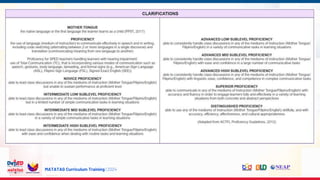
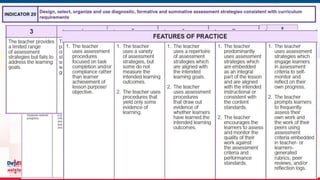
  • #42 Purpose of the Slide: To quickly present the indicator, the description and features of practice Do: Synthesize what the indicator is about.
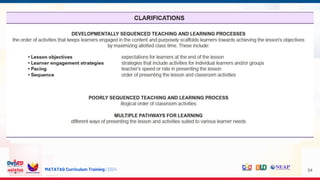
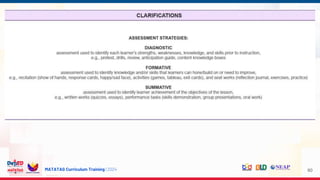
  • #43 Purpose of the Slide: To quickly present the indicator, the clarifications of the indicator Do: Synthesize what the indicator is about.
  • #44 Say: With that being said, let’s see how indicator 1 is captured in this lesson. Do: Present the identified parts of the lesson relative to indicator 1. Say: Now, let’s try it on your lesson plan. Can you identify or locate where is indicator 1? Workshop of about 5 mins.
  • #45 Purpose of the Slide: To quickly present the indicator, the description and features of practice Do: Synthesize what the indicator is about.
  • #47 Say: With that being said, let’s see how indicator 1 is captured in this lesson. Do: Present the identified parts of the lesson relative to indicator 2. Say: Now, let’s try it on your lesson plan. Can you identify or locate where is indicator 2? Workshop of about 5 mins.
  • #48 Purpose of the Slide: To quickly present the indicator, the description and features of practice Do: Synthesize what the indicator is about.
  • #50 Say: With that being said, let’s see how in this lesson indicator three is plotted. Do: Present the identified parts of the lesson relative to indicator 3. Say: Now, let’s try it on your lesson plan. Can you identify or locate where is indicator 3? Workshop of about 5 mins.
  • #51 Purpose of the Slide: To quickly present the indicator, the description and features of practice Do: Synthesize what the indicator is about.
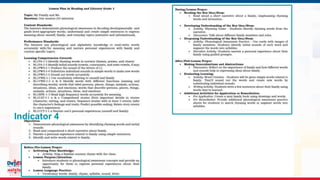
  • #53 Say: With that being said, let’s see how in this lesson indicator four is plotted. Do: Present the identified parts of the lesson relative to indicator 4. Say: Now, let’s try it on your lesson plan. Can you identify or locate where is indicator 4? Workshop of about 5 mins.
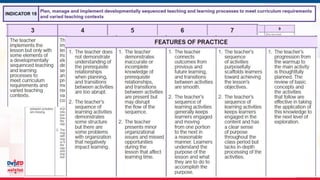
  • #54 Purpose of the Slide: To quickly present the indicator, the description and features of practice Do: Synthesize what the indicator is about.
  • #56 Say: With that being said, let’s see how in this lesson indicator five is plotted. Do: Present the identified parts of the lesson relative to indicator 5. Say: Now, let’s try it on your lesson plan. Can you identify or locate where indicator 5 is? Workshop of about 5 mins.
  • #57 Purpose of the Slide: To quickly present the indicator, the description and features of practice Do: Synthesize what the indicator is about.
  • #59 Say: With that being said, let’s see how in this lesson indicator six is plotted. Do: Present the identified parts of the lesson relative to indicator 6. Say: Now, let’s try it on your lesson plan. Can you identify or locate where is indicator 6? Workshop of about 5 mins.
  • #60 Purpose of the Slide: To quickly present the indicator, the description and features of practice Do: Synthesize what the indicator is about.
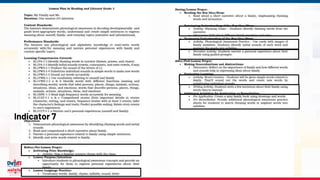
  • #62 Say: With that being said, let’s see how in this lesson indicator seven is plotted. Do: Present the identified parts of the lesson relative to indicator 7. Say: Now, let’s try it on your lesson plan. Can you identify or locate where indicator 7 is? Workshop of about 5 mins.
  • #63 Purpose of the Slide: To show the classroom observation protocols Say: After locating or identifying our indicators, we say that when we observe, the only thing that observers do is to observe while the teacher is executing the lesson. What we have at hand is the Classroom Observation Notes Form. To help us strategize ‘during observation’ activity. I will be sharing with you some research-based classroom observation strategies which can help us improve our teacher’s teaching-learning processes.
  • #65 Say: Classroom observations, aside from assessing teachers to obtain evidence as required by the RPMS, should be done as frequently as possible. It should be done to help teachers reflect on their strengths and areas for improvement. It should be the main purpose for conducting classroom observation. It should also be informal and allow teachers to observe one another, regardless of position or rank.  According to the study’s findings, observations should not be limited to a one-hour lesson. As much as possible, observers should follow the teacher as frequently as the time allows. To fully understand teacher’s practice, at the very least, observers should follow the two consecutive lessons in a week or a quarter. 
  • #66 Say: Classroom observation should encourage observers to appreciate the process of teaching and learning, the flow of the lesson, the interaction between teachers and learners, and their impact on learners. Observers may be helped through writing the observations on the Observation Notes Form.
  • #67 make use of the classroom observation notes form and upgrade it Say: To make the ONF matters, the notes should be easy to follow and to understand. To enhance observation notes, observers can use different colors to signify different roles. For instance, you can use black for teachers’ actions, blue for students’ actions, red for significant events, or reflection, e.g., good points or room for improvement.  structure and content Say: They can also divide the paper into columns. They can divide them into three columns: the first column for activity, the second for student reaction/responses, and the third for reflection, observer’s notes, or other notes that could guide the teacher. Observers’ notes should also capture students’ thoughts, their conversations while listening to the discussion or during group activities. It should not only reflect the flow of the lesson and what the teacher is doing but also the details of students’ work, e.g., their notes, worksheets.   use of picture as evidence Say: You can also take pictures of the class, the blackboard, and students’ worksheets and attach or include them in your observation notes. It is not only helpful as a piece of evidence, but it can also help facilitate reflection. It enables you to track the things that happened on a particular day. It can be beneficial when a lot is going on, and you cannot possibly remember all of them. writing chronological notes with time stamps Say: Writing notes chronologically and indicating timestamps helps both the observers and teachers understand the lesson and the time allotment for each activity. In some of the sessions, the teacher may realize that they spent too much time in the warm-up exercise, which considerably reduced the presentation time. 
  • #69 Say: In the communication of the classroom observation feedback, observers/Raters should focus on the good points of the lesson and what went well in the class. You can say, “I like how you ask the question to start the inquiry,” “I like how to acknowledge the student’s question and ask the next one,” “I like how you demonstrated how to do the Google search.”    Raters can also use, I think… in giving points for improvement. “I think it would be better if you write the key phrases on the board,” “I think it is also a good idea if you let the students call each other during the discussion.” You can also use “I will try…”  in some instances. 
  • #70 Do: Read the slide, giving emphasis on the highlighted texts
  • #71 Do: Read the slide, giving emphasis on the highlighted texts
  • #72 Do: Read the slide, giving emphasis on the highlighted texts
  • #73 Be cleared on the assignment after the Define the roles of the observers Who will do the demo teach: Who will be the Observers: Who will be the Process Observers: BLD BCD Provide TOR