
Maxillofacial Prosthetics 
عميد كلية طب الاسنان : 
د.محمد الدبيس 
1 
2014 
RITESH SHIWAKOTI
History 
 Artificial facial parts found on Egyptian mummies long 
time ago. 
 Ancient Chinese known to have made facial 
restorations. 
 1953 -- American Academy of Maxillofacial Prosthetics 
founded. 
2
Overview 
 Maxillofacial prosthetics is a branch of 
prosthodontics in dentistry. 
 Main aim is to restore the function and 
esthetics of an individual. 
 Its also approve a psychological state of a 
patient after a trauma or surgery. 
3
Maxillofacial Prosthetics 
 The art and science of anatomic, functional, or 
4 
cosmetic reconstruction by means of nonliving 
substitutes of those regions in the maxilla, mandible, 
and face that are missing or defective because of 
surgical intervention, trauma, pathology, or 
developmental or congenital malformations.
Type of M.F.P 
 Intra-Oral 
 Extra-Oral 
5
Indications of MFP 
 After surgical intervention. 
 After trauma. 
 Congenital defects. 
 Acquired defects. 
6
Prosthetic vs. Surgical Rehabilitation 
 Individualized decision between patient and 
doctor. 
 Removable prosthesis allows for cancer 
surveillance. 
 Destruction amount. 
 Malignancy recurrence. 
7
Intraoral vs. Extraoral 
 Intraoral -- mostly functional 
 Mandible 
 Maxilla 
 Extraoral -- cosmetic 
 Ear 
 Nose 
 Orbit 
8
Management of patient for MFP. 
 Personal history of a patient should be obtained. 
9 
 Dental and medical history also should be obtained. 
 Intra and external examination of a patient by a 
maxillofacial surgeon and prosthodontics should be done.
Management of patient for 
MFP. 
 Patients risk assessment should be done. 
 A surgeon should consulate with a 
dentist about a surgery so that there 
should be a team work. 
 All surgical alterations should be 
demonstrated for a dentist on a cast and 
obturator should be made for a day of a 
surgery. 
10
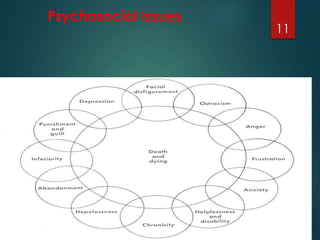
Psychosocial Issues 
11
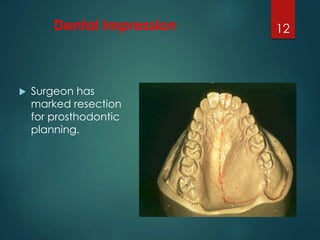
Dental Impression 
 Surgeon has 
marked resection 
for prosthodontic 
planning. 
12
Post surgical management. 
After a surgery and even before it’s a team work for a 
rehabilitation of a patient that includes: 
1. Maxillofacial surgeon. 
2. Prosthodontist 
3. Orthodontist. 
4. Phyciastrist. 
5. Speech rehabilitation specialist. 
6. Oncologist. 
7. Plastic surgeon specialist 
13
Congenital defects 
Lip and palate development: 
14 
 Upper lip develop by coalescence of the premaxilla and 
maxillary growth centers on either sides to produce the 
complete lip. 
 Fusion of the of the lip developing from growth centers 
commences around each nostril floor and spreads 
downwards towards the lower border of the lip uniting the 
premaxilla and maxillary process in each side.
Congenital defects 
15 
 Failure of this union will result in a cleft lip that varies from a 
notch on one side to complete bilateral cleft of the lip 
that may extend up to into each nostril.
Congenital defects 
The palate: 
16 
 Palate develops from the max. and premix. growth 
centers, union of the three segments commencing at 
the region of the nasal floor presented in full 
development by the nasal foramen. 
 Union from this point proceeds backwards until both the 
hard and soft palates and uvula have united, and 
forwards along the of the future maxillary and 
premaxillary structures eventually.
Congenital defects 17 
• Lack of fusion of the palatal shelves either completely or 
partially occurs during embryonic growth side. 
• Failure of union of palatine processes at any stage will 
result in a cleft palate which may be pre-alveolar ( cleft 
lip ) or post alveolar ( cleft palate ) . 
• Cleft palate between 6th – 9th wk. of the embryonic life.
Congenital defects 18 
Classification of cleft palate 
 Pre-alveolar e.g. cleft lip 
 Post alveolar any cleft from uvula up to incisive 
foramen. 
 Alveolar cleft extending from uvula to alveolar ridge 
and lip either unilateral or bilateral.
Congenital defects 
Effects of cleft palate and lip 
1. Speech – lack of valvopharyngeal closure leads to 
escape of air through the nose (nasal speech) 
2. Deglutition – greatly impede the feeding, regurgitation 
and escape of fluids through the nose takes place . 
3. Mastication – impaired due to escape of food through 
the nasal cavity and due to missing teeth and 
malocclusion . 
19
Congenital defects 
20 
4. Esthetics – is effected seriously especially in cleft palate 
and / or lip. 
5. Deterioration of the general health 
6. Psychological trauma . 
7. Recurrent infection of the air ways and middle ear .
Congenital defects 
Management of cleft lip and palate Include the following: 
A. Surgical closure 
 It is the treatment of choice for palatal cleft closure. It 
superior to prosthetic closure by obturator. 
 If cleft involves the lip, it is advisable to repair it as early as 
possible (6 wks. after birth) to facilitate feeding and 
improve appearance. 
 Surgical closure of palatal cleft is better to be done 
before the end of the second year of age. 
21
Congenital defects 
B. Prosthetic restoration 
o Feeding appliances. 
o Simple palatal plate to close cleft. 
o Speech aid obturator. 
o Over denture. 
C. Orthodontic 
o To correct the malaligned teeth or expand the 
maxillary arch. 
22
Congenital defects 23 
 Reason for early closure of cleft palate 
1. To produce longer and more mobile soft palate 
with better muscular development and 
2. velopharyngeal closure. 
3. To habilitate the patient for normal speech. 
4. To allow undisturbed growth of maxilla.
ACQUIRED PALATAL DEFECTS 
 DEFINITION: 
 Lack of continuity of originally intact palatal structures 
through the whole or part of its length. 
 Etiology: 
 Surgical e.g. tumor removal. 
 Traumatic fracture of maxilla. 
 Pathological conditions e.g. osteomyelitis, T. B., and 
syphilis . 
24
ACQUIRED PALATAL DEFECTS 
Prosthetic rehabilitation of acquired maxillary defect: 
 The main priority for the patient with traumatic injury and 
traumatic surgery is to stabilize the patient and control 
immediate damage and/or defect. 
Three phases of prosthodontic treatment includes: 
 Surgical procedures + Immediate obturator. 
 Transitional obturator. 
 Definitive obturator. 
25
IMMEDIATE OBTURATOR 
IMMEDIATE OBTURATOR 
1. It is a prosthesis inserted immediately after operation 
2. Lasts 10-14 days after surgery 
3. Material used, mostly acrylic 
ADVANTAGES: 
1. Maintain function (feeding, speech) 
2. Promote healing 
3. Restore esthetic 
4. Act as stint (keep surgical pack and medication close to 
the wound) 
5. Improve psychology of the patient 
6. Prevent contamination of the wound 
26
IMMEDIATE OBTURATOR 
Construction: 
o Impression/construction of the cast models. 
27 
o With the help of the surgeon determine the area to be 
removed on the cast . 
o The appliance is constructed as a plate to close the 
operation site. 
o Prepared cast is waxed, processed using either heat or 
cold curing resin and wire clasps to retain the obturator.
IMMEDIATE OBTURATOR 
o During operation eradication of the involved 
area, and surgical cavity is filled with surgical 
pack. 
o We can say, it is simple plate with no teeth and 
constructed before surgery to be inserted 
immediately after surgery . 
28
Temporary Obturators 
29 
 Temporary/Transitional Obturator: 
Constructed few days after operation to help in restoring 
oro-nasal function. Carries teeth and stays 3-6 months. 
Making impression is complicated by presence of the 
wound and presence of the defect.
Temporary Obturators 
 The defect is packed with gauze dipped in Vaseline 
to the level of the remaining tissue, then impression 
is taken with modified stock tray using elastic 
impression material. 
 The steps of construction are the same as in 
immediate obturator. 
30
Temporary Obturators 
 Function: helps in restoring 
1. Speech. 
2. Feeding. 
3. Esthetics. 
4. Prevent wound contamination. 
31
Definitive Obturators 
 Definitive Obturator: 
 It is a final prosthetic management construction after 
complete healing of the operation site . 
32
Definitive Obturators 
 Preparation of the mouth for obturator: 
I. Extract hopeless teeth. 
II. Periodontal therapy. 
III. Restore carious teeth. 
33
Definitive Obturators 
 Types of obturators: 
1. Hollow bulb (Closed). 
2. Roofless (Open bulb). 
34
Definitive Obturators 
 Construction: 
1. Select stock tray, modified with wax according to the 
size and shape of the defect. 
2. Partially, pack the defect with Vaseline gauze, then 
do primary impression using alginate. 
35
Definitive Obturators 
3. Under cuts are lift to help in retention. Gauze can 
36 
prevent broken pieces of alginate from escaping into 
the defect. 
4. Construct sp. Trays and do final impression using alginate 
or rubber base impression material. 
5. Outline the master cast to mark the bearing area, 
blocking severe undercut, leaving small undercut area 
for obturator retention.
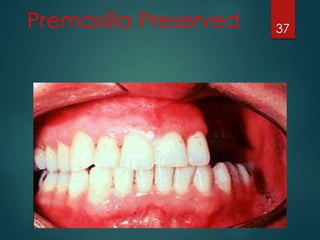
Premaxilla Preserved 37
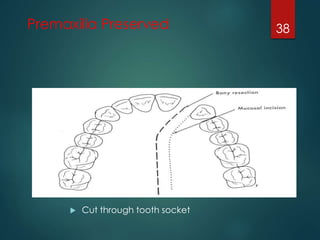
Premaxilla Preserved 
 Cut through tooth socket 
38
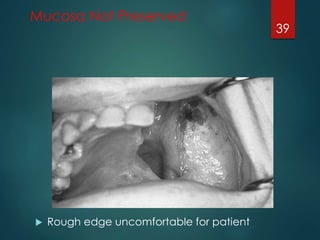
Mucosa Not Preserved 
 Rough edge uncomfortable for patient 
39
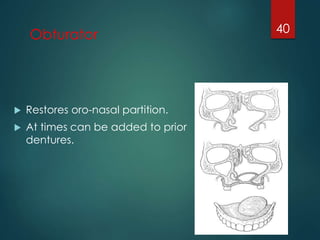
Obturator 
 Restores oro-nasal partition. 
 At times can be added to prior 
dentures. 
40
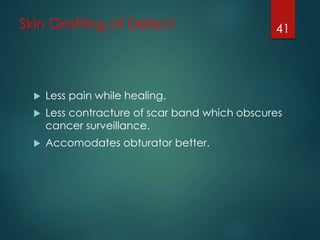
Skin Grafting of Defect 
 Less pain while healing. 
 Less contracture of scar band which obscures 
cancer surveillance. 
 Accomodates obturator better. 
41
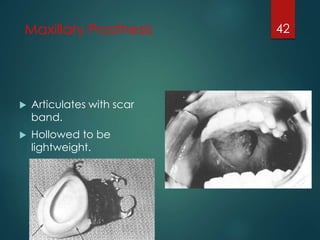
Maxillary Prosthesis 
 Articulates with scar 
band. 
 Hollowed to be 
lightweight. 
42
Timing 
 Immediate (Intraoperative) 
 hold in packs 
 provide early function 
 Interim 
 Definitive 
 3 to 6 months 
43
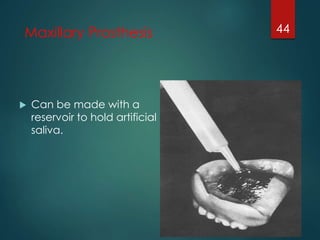
Maxillary Prosthesis 
 Can be made with a 
reservoir to hold artificial 
saliva. 
44
Prosthetic Materials 
 Acrylics 
 Polyurethanes 
 Silicone Elastomers 
 Room-temperature vulcanizing 
 High-temperature vulcanizing 
45
Mandible 
 Mandibular reconstruction revolutionized by 
microvascular and plating techniques. 
46 
 Prosthetics mainly restore occlusion and occlusal 
surface. 
 Implants able to restore high degree of function.
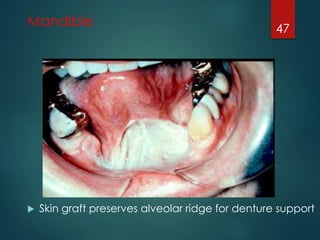
Mandible 
47 
 Skin graft preserves alveolar ridge for denture support
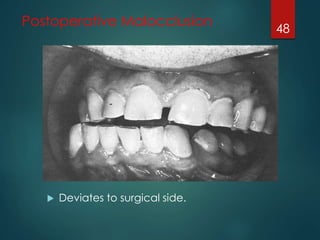
Postoperative Malocclusion 
 Deviates to surgical side. 
48
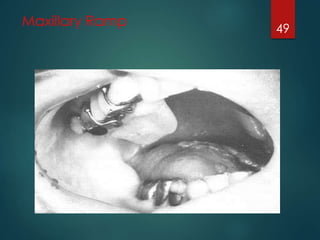
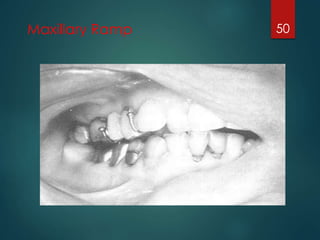
Maxillary Ramp 
49
Maxillary Ramp 50
Adjunctive Preprosthetic Measures 
 Vestibuloplasty. 
 Lowering of Floor of Mouth. 
 Implants. 
51
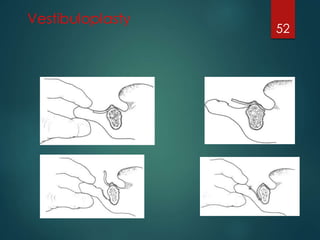
Vestibuloplasty 
52
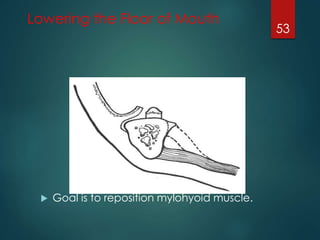
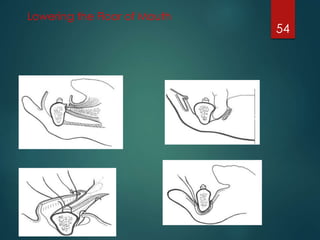
Lowering the Floor of Mouth 
 Goal is to reposition mylohyoid muscle. 
53
Lowering the Floor of Mouth 
54
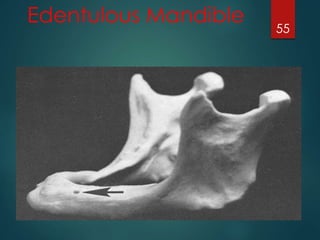
Edentulous Mandible 
55
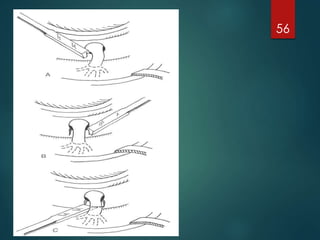
Mental 
Foramen 
56
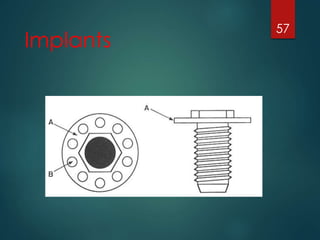
Implants 
57
Extraoral 
Prostheses 
58
Extraoral Prostheses 
General Principles: 
 Goal is cosmetic. 
 Retained with : 
 Adhesives. 
 Implants. 
 Skin grafting may help. 
 Smooth edges. 
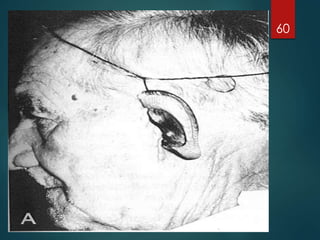
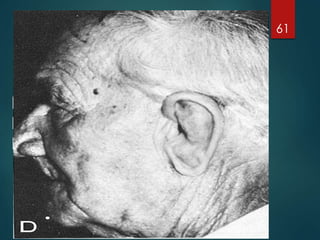
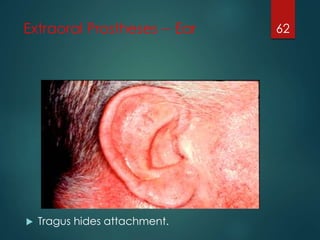
 Extraoral Prostheses Ear: 
 Retain tragus if possible to camouflage anterior 
border. 
59
Extraoral 
Prostheses -- 
Ear 
60
Extraoral 
Prostheses -- 
Ear 
61
Extraoral Prostheses -- Ear 
 Tragus hides attachment. 
62
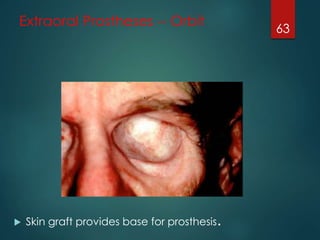
Extraoral Prostheses -- Orbit 
 Skin graft provides base for prosthesis. 
63
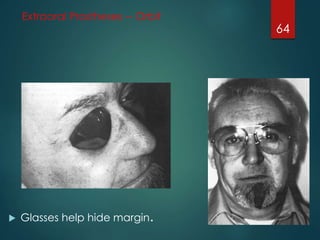
Extraoral Prostheses -- Orbit 
 Glasses help hide margin. 
64
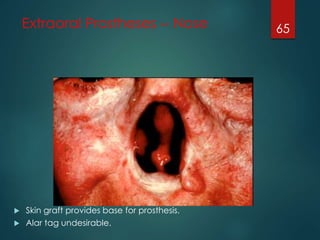
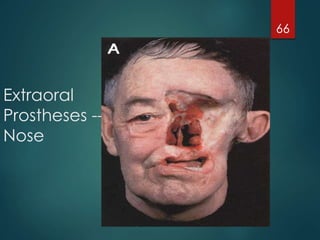
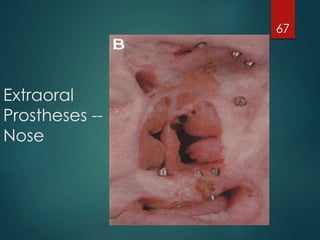
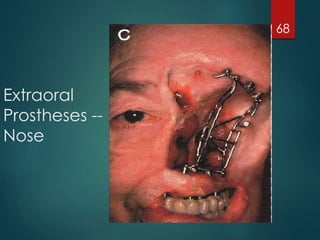
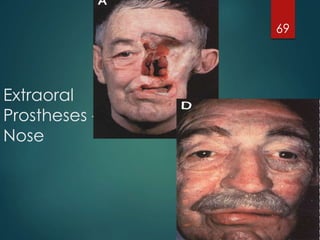
Extraoral Prostheses -- Nose 
 Skin graft provides base for prosthesis. 
 Alar tag undesirable. 
65
Extraoral 
Prostheses -- 
Nose 
66
Extraoral 
Prostheses -- 
Nose 
67
Extraoral 
Prostheses -- 
Nose 
68
Extraoral 
Prostheses -- 
Nose 
69
Conclusion 
 Restore function and cosmesis. 
 Use techniques during surgery to aid prosthetic 
management. 
 Consultation with maxillofacial prosthodontist for 
optimal rehabilitation. 
70

Maxillo facial prosthesis

  • 1.
    Maxillofacial Prosthetics عميدكلية طب الاسنان : د.محمد الدبيس 1 2014 RITESH SHIWAKOTI
  • 2.
    History  Artificialfacial parts found on Egyptian mummies long time ago.  Ancient Chinese known to have made facial restorations.  1953 -- American Academy of Maxillofacial Prosthetics founded. 2
  • 3.
    Overview  Maxillofacialprosthetics is a branch of prosthodontics in dentistry.  Main aim is to restore the function and esthetics of an individual.  Its also approve a psychological state of a patient after a trauma or surgery. 3
  • 4.
    Maxillofacial Prosthetics The art and science of anatomic, functional, or 4 cosmetic reconstruction by means of nonliving substitutes of those regions in the maxilla, mandible, and face that are missing or defective because of surgical intervention, trauma, pathology, or developmental or congenital malformations.
  • 5.
    Type of M.F.P  Intra-Oral  Extra-Oral 5
  • 6.
    Indications of MFP  After surgical intervention.  After trauma.  Congenital defects.  Acquired defects. 6
  • 7.
    Prosthetic vs. SurgicalRehabilitation  Individualized decision between patient and doctor.  Removable prosthesis allows for cancer surveillance.  Destruction amount.  Malignancy recurrence. 7
  • 8.
    Intraoral vs. Extraoral  Intraoral -- mostly functional  Mandible  Maxilla  Extraoral -- cosmetic  Ear  Nose  Orbit 8
  • 9.
    Management of patientfor MFP.  Personal history of a patient should be obtained. 9  Dental and medical history also should be obtained.  Intra and external examination of a patient by a maxillofacial surgeon and prosthodontics should be done.
  • 10.
    Management of patientfor MFP.  Patients risk assessment should be done.  A surgeon should consulate with a dentist about a surgery so that there should be a team work.  All surgical alterations should be demonstrated for a dentist on a cast and obturator should be made for a day of a surgery. 10
  • 11.
  • 12.
    Dental Impression Surgeon has marked resection for prosthodontic planning. 12
  • 13.
    Post surgical management. After a surgery and even before it’s a team work for a rehabilitation of a patient that includes: 1. Maxillofacial surgeon. 2. Prosthodontist 3. Orthodontist. 4. Phyciastrist. 5. Speech rehabilitation specialist. 6. Oncologist. 7. Plastic surgeon specialist 13
  • 14.
    Congenital defects Lipand palate development: 14  Upper lip develop by coalescence of the premaxilla and maxillary growth centers on either sides to produce the complete lip.  Fusion of the of the lip developing from growth centers commences around each nostril floor and spreads downwards towards the lower border of the lip uniting the premaxilla and maxillary process in each side.
  • 15.
    Congenital defects 15  Failure of this union will result in a cleft lip that varies from a notch on one side to complete bilateral cleft of the lip that may extend up to into each nostril.
  • 16.
    Congenital defects Thepalate: 16  Palate develops from the max. and premix. growth centers, union of the three segments commencing at the region of the nasal floor presented in full development by the nasal foramen.  Union from this point proceeds backwards until both the hard and soft palates and uvula have united, and forwards along the of the future maxillary and premaxillary structures eventually.
  • 17.
    Congenital defects 17 • Lack of fusion of the palatal shelves either completely or partially occurs during embryonic growth side. • Failure of union of palatine processes at any stage will result in a cleft palate which may be pre-alveolar ( cleft lip ) or post alveolar ( cleft palate ) . • Cleft palate between 6th – 9th wk. of the embryonic life.
  • 18.
    Congenital defects 18 Classification of cleft palate  Pre-alveolar e.g. cleft lip  Post alveolar any cleft from uvula up to incisive foramen.  Alveolar cleft extending from uvula to alveolar ridge and lip either unilateral or bilateral.
  • 19.
    Congenital defects Effectsof cleft palate and lip 1. Speech – lack of valvopharyngeal closure leads to escape of air through the nose (nasal speech) 2. Deglutition – greatly impede the feeding, regurgitation and escape of fluids through the nose takes place . 3. Mastication – impaired due to escape of food through the nasal cavity and due to missing teeth and malocclusion . 19
  • 20.
    Congenital defects 20 4. Esthetics – is effected seriously especially in cleft palate and / or lip. 5. Deterioration of the general health 6. Psychological trauma . 7. Recurrent infection of the air ways and middle ear .
  • 21.
    Congenital defects Managementof cleft lip and palate Include the following: A. Surgical closure  It is the treatment of choice for palatal cleft closure. It superior to prosthetic closure by obturator.  If cleft involves the lip, it is advisable to repair it as early as possible (6 wks. after birth) to facilitate feeding and improve appearance.  Surgical closure of palatal cleft is better to be done before the end of the second year of age. 21
  • 22.
    Congenital defects B.Prosthetic restoration o Feeding appliances. o Simple palatal plate to close cleft. o Speech aid obturator. o Over denture. C. Orthodontic o To correct the malaligned teeth or expand the maxillary arch. 22
  • 23.
    Congenital defects 23  Reason for early closure of cleft palate 1. To produce longer and more mobile soft palate with better muscular development and 2. velopharyngeal closure. 3. To habilitate the patient for normal speech. 4. To allow undisturbed growth of maxilla.
  • 24.
    ACQUIRED PALATAL DEFECTS  DEFINITION:  Lack of continuity of originally intact palatal structures through the whole or part of its length.  Etiology:  Surgical e.g. tumor removal.  Traumatic fracture of maxilla.  Pathological conditions e.g. osteomyelitis, T. B., and syphilis . 24
  • 25.
    ACQUIRED PALATAL DEFECTS Prosthetic rehabilitation of acquired maxillary defect:  The main priority for the patient with traumatic injury and traumatic surgery is to stabilize the patient and control immediate damage and/or defect. Three phases of prosthodontic treatment includes:  Surgical procedures + Immediate obturator.  Transitional obturator.  Definitive obturator. 25
  • 26.
    IMMEDIATE OBTURATOR IMMEDIATEOBTURATOR 1. It is a prosthesis inserted immediately after operation 2. Lasts 10-14 days after surgery 3. Material used, mostly acrylic ADVANTAGES: 1. Maintain function (feeding, speech) 2. Promote healing 3. Restore esthetic 4. Act as stint (keep surgical pack and medication close to the wound) 5. Improve psychology of the patient 6. Prevent contamination of the wound 26
  • 27.
    IMMEDIATE OBTURATOR Construction: o Impression/construction of the cast models. 27 o With the help of the surgeon determine the area to be removed on the cast . o The appliance is constructed as a plate to close the operation site. o Prepared cast is waxed, processed using either heat or cold curing resin and wire clasps to retain the obturator.
  • 28.
    IMMEDIATE OBTURATOR oDuring operation eradication of the involved area, and surgical cavity is filled with surgical pack. o We can say, it is simple plate with no teeth and constructed before surgery to be inserted immediately after surgery . 28
  • 29.
    Temporary Obturators 29  Temporary/Transitional Obturator: Constructed few days after operation to help in restoring oro-nasal function. Carries teeth and stays 3-6 months. Making impression is complicated by presence of the wound and presence of the defect.
  • 30.
    Temporary Obturators The defect is packed with gauze dipped in Vaseline to the level of the remaining tissue, then impression is taken with modified stock tray using elastic impression material.  The steps of construction are the same as in immediate obturator. 30
  • 31.
    Temporary Obturators Function: helps in restoring 1. Speech. 2. Feeding. 3. Esthetics. 4. Prevent wound contamination. 31
  • 32.
    Definitive Obturators Definitive Obturator:  It is a final prosthetic management construction after complete healing of the operation site . 32
  • 33.
    Definitive Obturators Preparation of the mouth for obturator: I. Extract hopeless teeth. II. Periodontal therapy. III. Restore carious teeth. 33
  • 34.
    Definitive Obturators Types of obturators: 1. Hollow bulb (Closed). 2. Roofless (Open bulb). 34
  • 35.
    Definitive Obturators Construction: 1. Select stock tray, modified with wax according to the size and shape of the defect. 2. Partially, pack the defect with Vaseline gauze, then do primary impression using alginate. 35
  • 36.
    Definitive Obturators 3.Under cuts are lift to help in retention. Gauze can 36 prevent broken pieces of alginate from escaping into the defect. 4. Construct sp. Trays and do final impression using alginate or rubber base impression material. 5. Outline the master cast to mark the bearing area, blocking severe undercut, leaving small undercut area for obturator retention.
  • 37.
  • 38.
    Premaxilla Preserved Cut through tooth socket 38
  • 39.
    Mucosa Not Preserved  Rough edge uncomfortable for patient 39
  • 40.
    Obturator  Restoresoro-nasal partition.  At times can be added to prior dentures. 40
  • 41.
    Skin Grafting ofDefect  Less pain while healing.  Less contracture of scar band which obscures cancer surveillance.  Accomodates obturator better. 41
  • 42.
    Maxillary Prosthesis Articulates with scar band.  Hollowed to be lightweight. 42
  • 43.
    Timing  Immediate(Intraoperative)  hold in packs  provide early function  Interim  Definitive  3 to 6 months 43
  • 44.
    Maxillary Prosthesis Can be made with a reservoir to hold artificial saliva. 44
  • 45.
    Prosthetic Materials Acrylics  Polyurethanes  Silicone Elastomers  Room-temperature vulcanizing  High-temperature vulcanizing 45
  • 46.
    Mandible  Mandibularreconstruction revolutionized by microvascular and plating techniques. 46  Prosthetics mainly restore occlusion and occlusal surface.  Implants able to restore high degree of function.
  • 47.
    Mandible 47 Skin graft preserves alveolar ridge for denture support
  • 48.
    Postoperative Malocclusion Deviates to surgical side. 48
  • 49.
  • 50.
  • 51.
    Adjunctive Preprosthetic Measures  Vestibuloplasty.  Lowering of Floor of Mouth.  Implants. 51
  • 52.
  • 53.
    Lowering the Floorof Mouth  Goal is to reposition mylohyoid muscle. 53
  • 54.
    Lowering the Floorof Mouth 54
  • 55.
  • 56.
  • 57.
  • 58.
  • 59.
    Extraoral Prostheses GeneralPrinciples:  Goal is cosmetic.  Retained with :  Adhesives.  Implants.  Skin grafting may help.  Smooth edges.  Extraoral Prostheses Ear:  Retain tragus if possible to camouflage anterior border. 59
  • 60.
  • 61.
  • 62.
    Extraoral Prostheses --Ear  Tragus hides attachment. 62
  • 63.
    Extraoral Prostheses --Orbit  Skin graft provides base for prosthesis. 63
  • 64.
    Extraoral Prostheses --Orbit  Glasses help hide margin. 64
  • 65.
    Extraoral Prostheses --Nose  Skin graft provides base for prosthesis.  Alar tag undesirable. 65
  • 66.
  • 67.
  • 68.
  • 69.
  • 70.
    Conclusion  Restorefunction and cosmesis.  Use techniques during surgery to aid prosthetic management.  Consultation with maxillofacial prosthodontist for optimal rehabilitation. 70