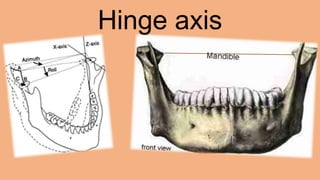
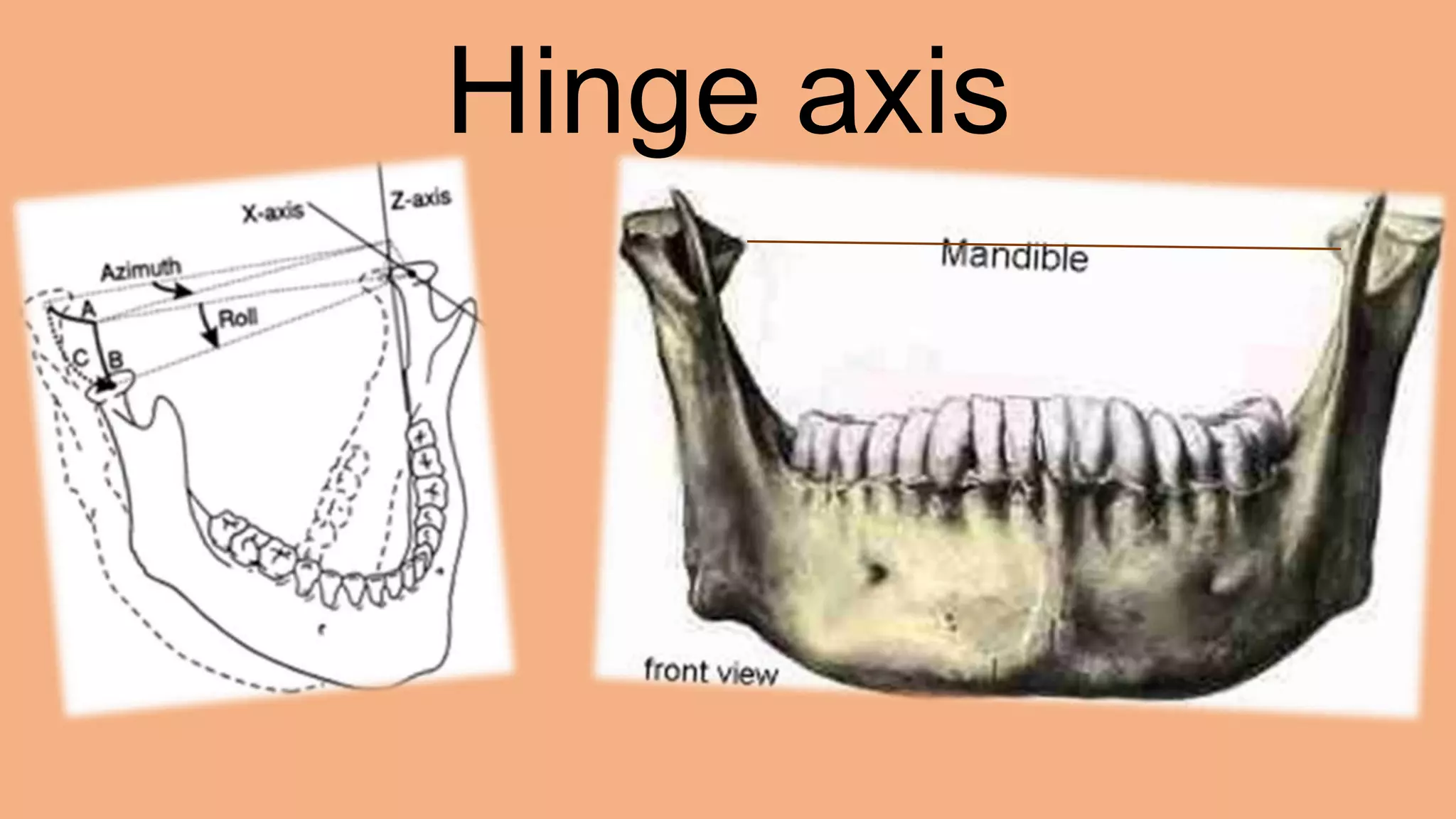
Hinge axis
Contents
1) Introduction
2) Definitions
3) Mandibular movements
4) History
5) Theories of hinge axis
6) Method of locating hinge axis
7) Clinical value of hinge axis
8) Summary
9) Reference
Definition
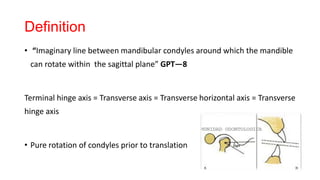
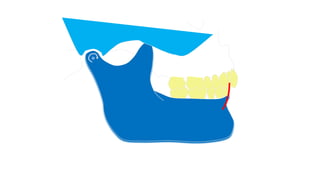
• “Imaginary line between mandibular condyles around which the mandible
can rotate within the sagittal plane” GPT—8
Terminal hinge axis = Transverse axis = Transverse horizontal axis = Transverse
hinge axis
• Pure rotation of condyles prior to translation
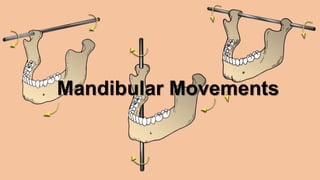
Mandibular Movements
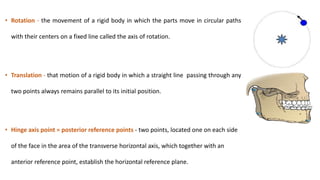
• Rotation - the movement of a rigid body in which the parts move in circular paths
with their centers on a fixed line called the axis of rotation.
• Translation - that motion of a rigid body in which a straight line passing through any
two points always remains parallel to its initial position.
• Hinge axis point = posterior reference points - two points, located one on each side
of the face in the area of the transverse horizontal axis, which together with an
anterior reference point, establish the horizontal reference plane.
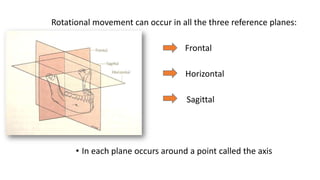
Rotational movement can occur in all the three reference planes:
Frontal
Horizontal
Sagittal
• In each plane occurs around a point called the axis
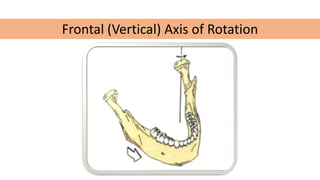
Frontal (Vertical) Axis of Rotation
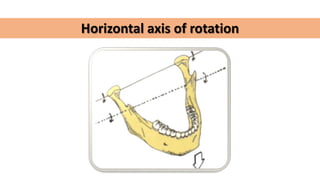
Horizontal axis of rotation
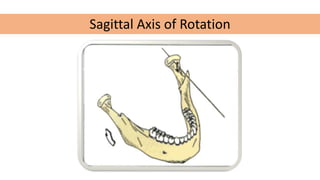
Sagittal Axis of Rotation
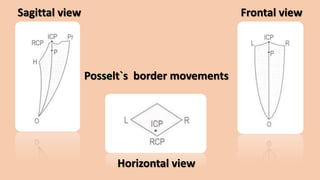
Sagittal view Frontal view
Horizontal view
Posselt`s border movements
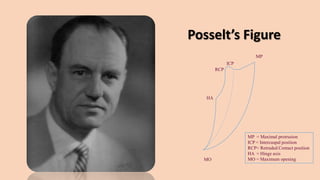
Posselt’s Figure
MP
MO
ICP
RCP
HA
MP = Maximal protrusion
ICP = Intercuspal position
RCP= Retruded Contact position
HA = Hinge axis
MO = Maximum opening
History
• Campion ( 1902-1905 ) – No axis, but movement is complex one.
Consisting first of rotation and secondly of a forward and downward movement
• Bennett ( 1908 ) - no single fixed rotation, since center of rotation constantly shifted for
movements in sagittal plane,
mandible was capable of two independent movements
1. Angular rotation
2. Translation movement
• Gysi ( 1920 ) – Natural condyles are not considered as true rotation points, but
as fixed guides of the mandible
"The mandible opens/closes and rotates on another
rotational center which has no influence in the setting up of the teeth on
articulators. Therefore, need not be considered in the construction of an
articulator.”
• Needles ( 1923 ) - agrees with Bennett: Hinge Joint + Sliding Joint.
No center of rotation in temporomandibular joint itself.
Instant and constantly shifting centers
• Wadsworth (1925) –
Anatomist's conclusion
1st movement around transverse axis passing through condyles which remain
seated in fossae.
2nd movement on articular eminence
• Hall ( 1929 ) – concluded that “condyle is not center of rotation”
`
McCollum ( 1939 )
• Leading advocate of the hinge-axis theory
• Definite opening and closing axis by using facebow
• External landmarks are of little use.
• Rotation occurs during 0.5 inch at incisors for most people, some can
open 1 inch.
Stuart ( 1939 )
• Completed work of McCollum
• Pioneers of gnathology
• Movements were reproduced on articulator to duplicate the jaw movements
McLean ( 1944 )
" The diagnosis of pathological occlusion depended on the fact that the final
phase of jaw closure was pure hinge movement.“
Lauritzen ( 1951 )
• He thought articulation would be understood more easily if the joint
were regarded as two separate joints
• The only movement which could take place in the 'menisco-condylar'
part of the joint while opening and closing - a purely rotational
movement.
• In all patients, the anterior teeth could be separated by at least 12
mm in the rotational hinge relation.
Posselt (1952)
• Hinge opening is obtained if patient is in passive, or trained active motion.
• He could not prove this movement was habitual.
• Hinge-axis opening = 19.2mm 1.9mm.
Kornfield & Granger ( 1955 )
• The only position at which it was possible to locate & reproduce the hinge axis
was at centric relation
Trapozzano ( 1955 )
• Hinge-axis represented a border movement that could be recorded
repeatedly with unfailing accuracy
• It was essential to use trained
mandibular hinge movement
• Recording was static starting point
• Much of concept was based on
asymmetry of condyles
• Off-Centre opening and closing
movements were perpendicular to
hinge axis
• Movement in one direction in the plane
could have only one axis of rotation
Weinberg
( 1959 )
Theories Of Hinge axis
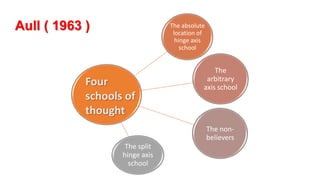
The absolute
location of
hinge axis
school
The
arbitrary
axis school
The non-
believers
The split
hinge axis
school
Aull ( 1963 )
Four
schools of
thought
•The hinge axis is a component of every masticatory movement and can not
be disregarded.
•If the hinge axis of the articulator is not the same as the hinge axis of the
patient then the mechanical reproduction of jaw motions are impossible.
•Believe that there is a definitive transvers axis and should be located
Absolute location of the axis
•The value of actually locating the exact hinge axis is not
worth the effort. This group fails to recognize that if the
hinge axis of the articulator does not coincide with the
hinge axis of the patient, the paths of closure will not be the
same.
Arbitrary location of axis
• This group does not believe the hinge axis can be accurately
located or believes other movements are involved and can not be
reproduced by an articulator simulating one axis
Non-Believers in the transverse axis location
• This group believes there are two axis of rotation ( one in each condyle) and they parallel
each other.
1. The horizontal axis is a hypothetical line connecting the two horizontal rotation centers of
the two condyles of the mandible.
2. There is one hinge location!
Split axis theory
METHOODS OF LOCATING HINGE AXIS
Arbitrary methods
Kinematic methods
Modified methods
1. loma-linda hinge axis device and method
2. Buhnergraph intraoral method
3. Technique using geometric principle to locate hinge axis
4. Abdal-Hadi’s method for locating arbitrary hinge axis
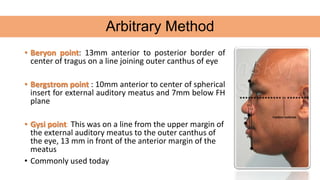
• Beryon point: 13mm anterior to posterior border of
center of tragus on a line joining outer canthus of eye
• Bergstrom point : 10mm anterior to center of spherical
insert for external auditory meatus and 7mm below FH
plane
• Gysi point: This was on a line from the upper margin of
the external auditory meatus to the outer canthus of
the eye, 13 mm in front of the anterior margin of the
meatus
• Commonly used today
Arbitrary Method
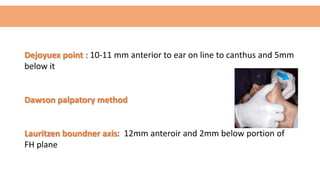
Dejoyuex point : 10-11 mm anterior to ear on line to canthus and 5mm
below it
Dawson palpatory method
Lauritzen boundner axis: 12mm anteroir and 2mm below portion of
FH plane
Two theorems of geometry are used in this technique
• 1. A line drawn through the center of a circle perpendicular to chord
meets it at its midpoint
• 2. The line joining the center of a circle to the mid point of a chord is
perpendicular to the chord.
Kinematic methods
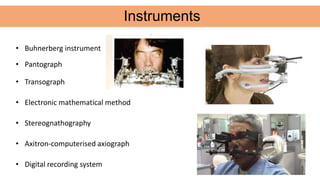
Instruments
• Buhnerberg instrument
• Pantograph
• Transograph
• Electronic mathematical method
• Stereognathography
• Axitron-computerised axiograph
• Digital recording system
Step wise method of recording
1. Recording hinge axis points
2. Transfer to the articulator
3. Mounting of upper casts and
4. Mounting of lower casts with centric record
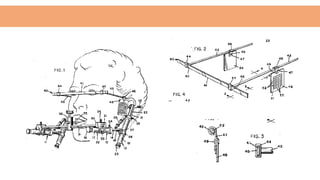
• T.M.J instrument
• Hinge axis locator
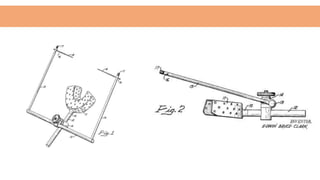
Hinge axis bow
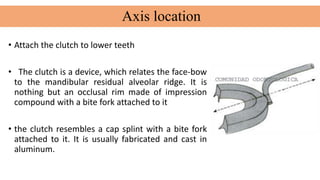
• Attach the clutch to lower teeth
• The clutch is a device, which relates the face-bow
to the mandibular residual alveolar ridge. It is
nothing but an occlusal rim made of impression
compound with a bite fork attached to it
• the clutch resembles a cap splint with a bite fork
attached to it. It is usually fabricated and cast in
aluminum.
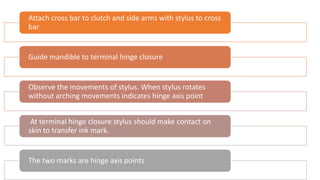
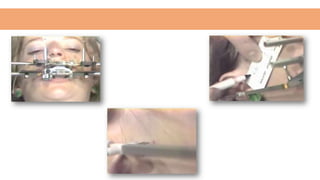
Axis location
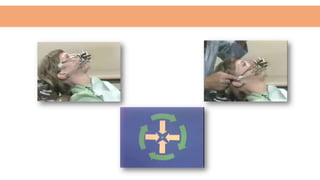
Attach cross bar to clutch and side arms with stylus to cross
bar
Guide mandible to terminal hinge closure
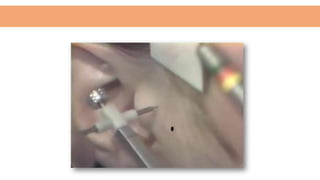
Observe the movements of stylus. When stylus rotates
without arching movements indicates hinge axis point
At terminal hinge closure stylus should make contact on
skin to transfer ink mark.
The two marks are hinge axis points
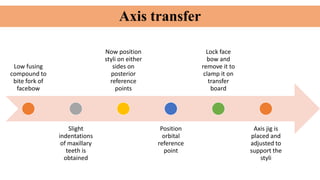
Low fusing
compound to
bite fork of
facebow
Slight
indentations
of maxillary
teeth is
obtained
Now position
styli on either
sides on
posterior
reference
points
Position
orbital
reference
point
Lock face
bow and
remove it to
clamp it on
transfer
board
Axis jig is
placed and
adjusted to
support the
styli
Axis transfer
Loma-linda hinge axis recording device and method
• The opponents of use of a kinematic hinge-axis location for
edentulous patients point to its unreliability because of the resiliency
of the oral mucosa.
• the added weight of the recording clutch which tends to shift the
denture base
Modified method
• Dentist called Buhnergraph
• Buhnergraph instrument consists of a U-shaped piece of aluminum
• Attached to the underside of the lower member of a Whip Mix
articulator. On each side is attached an adjustable arm containing a
pointed shaft which moves in and out.
Buhnergraph intraoral method
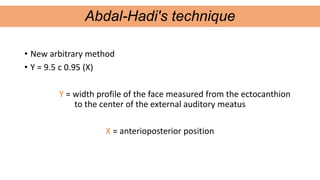
• New arbitrary method
• Y = 9.5 c 0.95 (X)
Y = width profile of the face measured from the ectocanthion
to the center of the external auditory meatus
X = anterioposterior position
Abdal-Hadi's technique
Clinical value of Hinge Axis
• Allows for correct recording of centric relation and its transfer to the
articulator
• Starting point of lateral movements
• Permits a change in vertical dimension
• If transferred to articulator—teeth contact each other in the articulator
exactly as they do in the mouth
• Helps in diagnosis and treatment planning
Variables affecting hinge axis location
Patient variables affecting the T.H.A.
• locations Condyle
• Asymmetry
• Inability to locate a true hinge axis
• Myospasm or joint pathosis
• Emotional conditions of patient
Factors of the recording system affecting THA
• Right angle non-right angle system of the bow
• Length of stylus arms and sharpness of styli
• A minimal error of 5 mm can be expected no matter what arbitrary
position might be chosen.
• Placement of the tragus-canthus line at the superior border of the
tragus of the ear will contribute to greater inaccuracy in most
patients.
• The largest percentage of true axis locations will be inferior to the
tragus-canthus line at the superior border of the tragus of the ear
summary
•In the final analysis, the true value of our
individual work can be measured only by the
degree of fineness with which we practice the
art of dentistry rather than by the particular
school of thought to which we adhere.
conclusion
• Jeffery P. Okeson. Management of temporomandibular disorders and
occlusion, 5th edition
• Zarb bolender-prosthodontic treatment for edentulous patients-12th
edition
• Shillingberg
• Heartwell
• Terminal hinge movement of the mandible J Prosthet Dent
1957;7:787-97.
• Winstanley, R. B. The hinge-axis: A review of the literature. J Oral
Rehabil 12:135-159, 1985.
• Hinge axis overview ; ashu sharma int journal of clinical dentistry
• Vol 5, no, 3 : 2012
reference
Thank you

hinge axis

  • 1.
  • 2.
    Contents 1) Introduction 2) Definitions 3)Mandibular movements 4) History 5) Theories of hinge axis 6) Method of locating hinge axis 7) Clinical value of hinge axis 8) Summary 9) Reference
  • 3.
    Definition • “Imaginary linebetween mandibular condyles around which the mandible can rotate within the sagittal plane” GPT—8 Terminal hinge axis = Transverse axis = Transverse horizontal axis = Transverse hinge axis • Pure rotation of condyles prior to translation
  • 6.
  • 7.
    • Rotation -the movement of a rigid body in which the parts move in circular paths with their centers on a fixed line called the axis of rotation. • Translation - that motion of a rigid body in which a straight line passing through any two points always remains parallel to its initial position. • Hinge axis point = posterior reference points - two points, located one on each side of the face in the area of the transverse horizontal axis, which together with an anterior reference point, establish the horizontal reference plane.
  • 8.
    Rotational movement canoccur in all the three reference planes: Frontal Horizontal Sagittal • In each plane occurs around a point called the axis
  • 9.
  • 10.
  • 11.
  • 12.
    Sagittal view Frontalview Horizontal view Posselt`s border movements
  • 13.
    Posselt’s Figure MP MO ICP RCP HA MP =Maximal protrusion ICP = Intercuspal position RCP= Retruded Contact position HA = Hinge axis MO = Maximum opening
  • 14.
    History • Campion (1902-1905 ) – No axis, but movement is complex one. Consisting first of rotation and secondly of a forward and downward movement • Bennett ( 1908 ) - no single fixed rotation, since center of rotation constantly shifted for movements in sagittal plane, mandible was capable of two independent movements 1. Angular rotation 2. Translation movement
  • 15.
    • Gysi (1920 ) – Natural condyles are not considered as true rotation points, but as fixed guides of the mandible "The mandible opens/closes and rotates on another rotational center which has no influence in the setting up of the teeth on articulators. Therefore, need not be considered in the construction of an articulator.” • Needles ( 1923 ) - agrees with Bennett: Hinge Joint + Sliding Joint. No center of rotation in temporomandibular joint itself. Instant and constantly shifting centers
  • 16.
    • Wadsworth (1925)– Anatomist's conclusion 1st movement around transverse axis passing through condyles which remain seated in fossae. 2nd movement on articular eminence • Hall ( 1929 ) – concluded that “condyle is not center of rotation” `
  • 17.
    McCollum ( 1939) • Leading advocate of the hinge-axis theory • Definite opening and closing axis by using facebow • External landmarks are of little use. • Rotation occurs during 0.5 inch at incisors for most people, some can open 1 inch.
  • 18.
    Stuart ( 1939) • Completed work of McCollum • Pioneers of gnathology • Movements were reproduced on articulator to duplicate the jaw movements McLean ( 1944 ) " The diagnosis of pathological occlusion depended on the fact that the final phase of jaw closure was pure hinge movement.“
  • 19.
    Lauritzen ( 1951) • He thought articulation would be understood more easily if the joint were regarded as two separate joints • The only movement which could take place in the 'menisco-condylar' part of the joint while opening and closing - a purely rotational movement. • In all patients, the anterior teeth could be separated by at least 12 mm in the rotational hinge relation.
  • 20.
    Posselt (1952) • Hingeopening is obtained if patient is in passive, or trained active motion. • He could not prove this movement was habitual. • Hinge-axis opening = 19.2mm 1.9mm. Kornfield & Granger ( 1955 ) • The only position at which it was possible to locate & reproduce the hinge axis was at centric relation
  • 21.
    Trapozzano ( 1955) • Hinge-axis represented a border movement that could be recorded repeatedly with unfailing accuracy
  • 22.
    • It wasessential to use trained mandibular hinge movement • Recording was static starting point • Much of concept was based on asymmetry of condyles • Off-Centre opening and closing movements were perpendicular to hinge axis • Movement in one direction in the plane could have only one axis of rotation Weinberg ( 1959 )
  • 23.
  • 24.
    The absolute location of hingeaxis school The arbitrary axis school The non- believers The split hinge axis school Aull ( 1963 ) Four schools of thought
  • 25.
    •The hinge axisis a component of every masticatory movement and can not be disregarded. •If the hinge axis of the articulator is not the same as the hinge axis of the patient then the mechanical reproduction of jaw motions are impossible. •Believe that there is a definitive transvers axis and should be located Absolute location of the axis
  • 26.
    •The value ofactually locating the exact hinge axis is not worth the effort. This group fails to recognize that if the hinge axis of the articulator does not coincide with the hinge axis of the patient, the paths of closure will not be the same. Arbitrary location of axis
  • 27.
    • This groupdoes not believe the hinge axis can be accurately located or believes other movements are involved and can not be reproduced by an articulator simulating one axis Non-Believers in the transverse axis location
  • 28.
    • This groupbelieves there are two axis of rotation ( one in each condyle) and they parallel each other. 1. The horizontal axis is a hypothetical line connecting the two horizontal rotation centers of the two condyles of the mandible. 2. There is one hinge location! Split axis theory
  • 29.
  • 30.
    Arbitrary methods Kinematic methods Modifiedmethods 1. loma-linda hinge axis device and method 2. Buhnergraph intraoral method 3. Technique using geometric principle to locate hinge axis 4. Abdal-Hadi’s method for locating arbitrary hinge axis
  • 31.
    • Beryon point:13mm anterior to posterior border of center of tragus on a line joining outer canthus of eye • Bergstrom point : 10mm anterior to center of spherical insert for external auditory meatus and 7mm below FH plane • Gysi point: This was on a line from the upper margin of the external auditory meatus to the outer canthus of the eye, 13 mm in front of the anterior margin of the meatus • Commonly used today Arbitrary Method
  • 32.
    Dejoyuex point :10-11 mm anterior to ear on line to canthus and 5mm below it Dawson palpatory method Lauritzen boundner axis: 12mm anteroir and 2mm below portion of FH plane
  • 33.
    Two theorems ofgeometry are used in this technique • 1. A line drawn through the center of a circle perpendicular to chord meets it at its midpoint • 2. The line joining the center of a circle to the mid point of a chord is perpendicular to the chord. Kinematic methods
  • 34.
    Instruments • Buhnerberg instrument •Pantograph • Transograph • Electronic mathematical method • Stereognathography • Axitron-computerised axiograph • Digital recording system
  • 35.
    Step wise methodof recording 1. Recording hinge axis points 2. Transfer to the articulator 3. Mounting of upper casts and 4. Mounting of lower casts with centric record
  • 36.
    • T.M.J instrument •Hinge axis locator Hinge axis bow
  • 37.
    • Attach theclutch to lower teeth • The clutch is a device, which relates the face-bow to the mandibular residual alveolar ridge. It is nothing but an occlusal rim made of impression compound with a bite fork attached to it • the clutch resembles a cap splint with a bite fork attached to it. It is usually fabricated and cast in aluminum. Axis location
  • 40.
    Attach cross barto clutch and side arms with stylus to cross bar Guide mandible to terminal hinge closure Observe the movements of stylus. When stylus rotates without arching movements indicates hinge axis point At terminal hinge closure stylus should make contact on skin to transfer ink mark. The two marks are hinge axis points
  • 44.
    Low fusing compound to bitefork of facebow Slight indentations of maxillary teeth is obtained Now position styli on either sides on posterior reference points Position orbital reference point Lock face bow and remove it to clamp it on transfer board Axis jig is placed and adjusted to support the styli Axis transfer
  • 45.
    Loma-linda hinge axisrecording device and method • The opponents of use of a kinematic hinge-axis location for edentulous patients point to its unreliability because of the resiliency of the oral mucosa. • the added weight of the recording clutch which tends to shift the denture base Modified method
  • 46.
    • Dentist calledBuhnergraph • Buhnergraph instrument consists of a U-shaped piece of aluminum • Attached to the underside of the lower member of a Whip Mix articulator. On each side is attached an adjustable arm containing a pointed shaft which moves in and out. Buhnergraph intraoral method
  • 47.
    • New arbitrarymethod • Y = 9.5 c 0.95 (X) Y = width profile of the face measured from the ectocanthion to the center of the external auditory meatus X = anterioposterior position Abdal-Hadi's technique
  • 48.
  • 49.
    • Allows forcorrect recording of centric relation and its transfer to the articulator • Starting point of lateral movements • Permits a change in vertical dimension • If transferred to articulator—teeth contact each other in the articulator exactly as they do in the mouth • Helps in diagnosis and treatment planning
  • 50.
  • 51.
    Patient variables affectingthe T.H.A. • locations Condyle • Asymmetry • Inability to locate a true hinge axis • Myospasm or joint pathosis • Emotional conditions of patient Factors of the recording system affecting THA • Right angle non-right angle system of the bow • Length of stylus arms and sharpness of styli
  • 52.
    • A minimalerror of 5 mm can be expected no matter what arbitrary position might be chosen. • Placement of the tragus-canthus line at the superior border of the tragus of the ear will contribute to greater inaccuracy in most patients. • The largest percentage of true axis locations will be inferior to the tragus-canthus line at the superior border of the tragus of the ear summary
  • 53.
    •In the finalanalysis, the true value of our individual work can be measured only by the degree of fineness with which we practice the art of dentistry rather than by the particular school of thought to which we adhere. conclusion
  • 54.
    • Jeffery P.Okeson. Management of temporomandibular disorders and occlusion, 5th edition • Zarb bolender-prosthodontic treatment for edentulous patients-12th edition • Shillingberg • Heartwell • Terminal hinge movement of the mandible J Prosthet Dent 1957;7:787-97. • Winstanley, R. B. The hinge-axis: A review of the literature. J Oral Rehabil 12:135-159, 1985. • Hinge axis overview ; ashu sharma int journal of clinical dentistry • Vol 5, no, 3 : 2012 reference
  • 55.

Editor's Notes

  • #5 In centric relation the mandible can be rotated around the horizontal axis to a distance of only 20 to 25mm
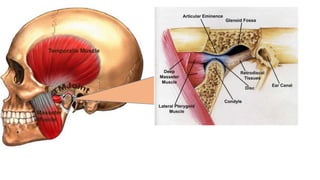
  • #6 GINGLYMO DIARTHRODIAL JOINT.TMJ consists of 4 main structures:- Condyle Temporal bone (Squamous part) Articular discLigaments
  • #7 Occurs as complex serious of interreleated 3d rotational and translation activitiesDetermined by combined and simoultaniouslyaccivitie of both tmj joints
  • #8 Ie is teeth can be separated and den occluded with noo positional change 2 teeth condyle and rami all move in same direction and to the same degree
  • #10 The vertical axis run through the condyle and posterior border of ramus of mandible. mandibular lateral movements
  • #11 Mandibular movement around the horizontal axis is an opening and closing motion. it is referred as a hinge movement
  • #12 Sagittal axis runs through mid sagittal planeOccurs in lateral movementsBalancing Condyle moves downward and medially following the slope of glenoid fossa.working condyle moves laterally and upward
  • #15 Produced 1st graphic record using pantograph which is produced by sucession pf dots 2 in classical paper on mandmov
  • #16 Ie:Functional joints
  • #17  is sliding movement were condyles glide forward in to
  • #18 Proposed a series of articles concerning restorative remidiesExistance rigidly attached to lower teeth 3 for location of axis
  • #19 This movement requires reharasal or guidance from da hand ofoperator on chin
  • #23 Attempted to clear up misunderstanding concerning da hinge axis in fallowing way
  • #26 Lucia1953 , mccollom1939 granger 1952 - 54
  • #27 Carddock & symmons
  • #28 Beck
  • #29 Group 4. Split-axis rotation. They believe in the transograph theory. That each condyle has its own center of rotation. i.e. two axes that parallel each other.Aull's study disproved the transograph theory
  • #34 Using these theorems, it should be possible to locate a rotation point by drafting perpendicular lines at right angels to the chords of areas produced by a rotating mandible. Lines drawn from the mid point of the chordMost accurate of all methods of locating hing axisMovement of stylus in unision with mandibular movements in the proceedureThe recording is made on the flag placed in the condylar region of a axis bowPoint Is accepted when stylus no longer translates I,e it rotatesVarious designs of recording medium eg—multiple styli or recording on radiographic mediums, and at right angels to them, will inter act at the center of the circle represented by the arcs. This center is the true axis point
  • #35 1.Accuracy is abt two degrees of jaw opening and plotting the position of axis2.Two face bows. One maxilla holding writer devices and other to mandible with recording tables…six stylus3.1952…A hinge axis face bow modified lated to serve as an articulatorA writing jaw movement carried over to an articulator—transographBy mc collum,page and albinsonBased on split axis theory,,all three planes do no intersect and hence no one axis
  • #37 Hinge axis bows—record both hinge axis and transfer hinge to articulator
  • #38 A record base is fabricated over the mandibular cast.An occlusal rim made of impression compound is built upon the record base.The bite fork is attached to this occlusal rim.Extending outside from the bite fork is its horizontal stem, which lies parallel to the sagittal (midline) plane