Presented by :
Dr. Avinash Kumar
IInd year P.G
K.V.G Dental College &
hospital, sullia
BALANCED OCCLUSION
AND ITS IMPORTANCE IN
COMPLETE DENTURE FABRICATION
Contents
• Introduction
• Definitions
• Requirements of complete denture occlusion
• Theories of occlusion
• Balanced occlusion: Definition
Pre-Requisites
• Parameters to success of occlusal balance
• Types
• Pro and Cons
• Concepts of Balanced occlusion
• Factors that affect the occlusal balance
• Characteristics of balanced occlusion in complete dentures
• Steps
• Selective grinding(correcting occlusal errors in balanced
articulation)
• The retrognathic mandible
• Lingualised articulation
• Summary & conclusion
• References
Introduction
However, there are rational ways to study occlusion, and
studying occlusion in complete dentures is a good starting
point, because of the need to place an entire dentition within a
system so that the edentulous patient can once again function
with the minimum of discomfort and the maximum possible
efficiency.
Occlusion in complete denture must be developed to function
efficiently and with the least amount of trauma to the
supporting tissues.
Features of natural occlusion
Intercuspal position is used during chewing, swallowing & deliberate
clenching.
In function -
Presence of unworn cusps results in separation of teeth on
one side(most obviously during lateral movements & also in protrusive
movements)
Artificial occlusion
Complete dentures remain static only when jaws remains static. All
dentures move in function.
Prime aim- to ensure minimum movement & can be controlled by the
patient to allow for optimal function.
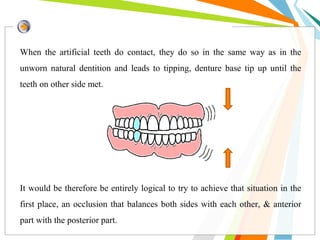
When the artificial teeth do contact, they do so in the same way as in the
unworn natural dentition and leads to tipping, denture base tip up until the
teeth on other side met.
It would be therefore be entirely logical to try to achieve that situation in the
first place, an occlusion that balances both sides with each other, & anterior
part with the posterior part.
Definitions
Occlusion
 Is defined as the static relationship between the incising or
masticating surfaces of the maxillary and mandibular teeth or tooth
analogue. (GPT)
 According to Heartwell this is a static position and the jaws can be
in either centric or eccentric relation. Every time the teeth contact
there is a resultant force which may vary in magnitude and direction.
Articulation
The contact relationship between the occlusal surfaces of the teeth during
function.(GPT)
Excursive movement
Movement occuring when mandible moves away from maximum
intercuspation.
Balancing side/non-working side
The side of mandible which moves towards median line in lateral excursion.
Balanced occlusion
The bilateral, simultaneous, anterior, and posterior occlusal contact of teeth in
centric and eccentric positions.
Centric occlusion
The occlusion of opposing teeth when the mandible is in centric relation. This
may or may not coincide with the maximal intercuspal position.(GPT 8) .Centric
occlusion is the tooth-to-tooth relation whereas centric relation is a static
position and a bone-to-bone relation.
Centric relation
The maxillomandibular relationship in which the condyles articulate with the thinnest
avascular portion of their respective discs with the complex in the anterior- superior
position against the slopes of the articular eminences. This position is independent of
tooth contact. This position is clinically discernible when the mandible is directed
superior and anteriorly. It is restricted to purely rotary movement about the transverse
horizontal axis.(GPT)
Transverse horizontal axis
An imaginary line around which the mandible may rotate within the sagittal plane.
(GPT)
Maximum intercuspation
The complete intercuspation of the opposing teeth, independent of condylar
position.
Eccentric occlusion
Eccentric occlusion refers to contact of teeth that occurs during movement of
the mandible.
It is of two types:-
1.Functional occlusion
2.Non functional occlusion
1.Functional occlusion
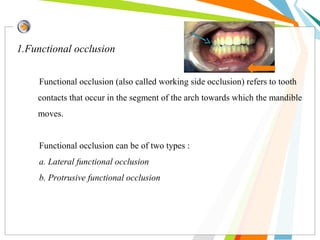
Functional occlusion (also called working side occlusion) refers to tooth
contacts that occur in the segment of the arch towards which the mandible
moves.
Functional occlusion can be of two types :
a. Lateral functional occlusion
b. Protrusive functional occlusion
a) Lateral functional occlusion:
It includes tooth contacts that occur on canines and posterior teeth on the side
towards which the mandible moves.
o The lateral functional occlusion can be of two types :
1. Canine guided occlusion:
2. Grouped lateral occlusion
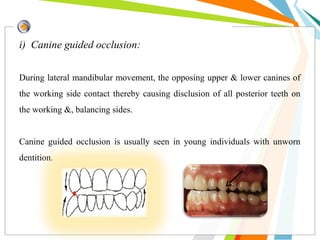
i) Canine guided occlusion:
During lateral mandibular movement, the opposing upper & lower canines of
the working side contact thereby causing disclusion of all posterior teeth on
the working &, balancing sides.
Canine guided occlusion is usually seen in young individuals with unworn
dentition.
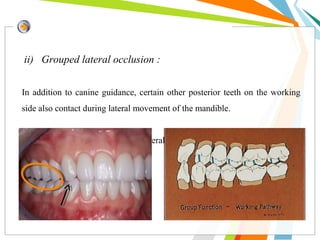
ii) Grouped lateral occlusion :
In addition to canine guidance, certain other posterior teeth on the working
side also contact during lateral movement of the mandible.
Such a type of contact during lateral movement is called grouped lateral
occlusion.
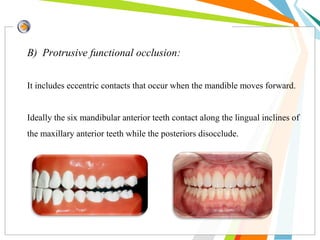
B) Protrusive functional occlusion:
It includes eccentric contacts that occur when the mandible moves forward.
Ideally the six mandibular anterior teeth contact along the lingual inclines of
the maxillary anterior teeth while the posteriors disocclude.
Requirement of Complete Denture Occlusion
(Winkler)
1. Stability of occlusion in centric relation and in areas forward
and lateral to it.
2. Balanced for all eccentric contacts bilaterally for all eccentric
mandibular movements.
3. Unlocking the cusp mesiodistally to allow for gradual but
inevitable settling of the bases due to tissue deformation and
bone resorption.
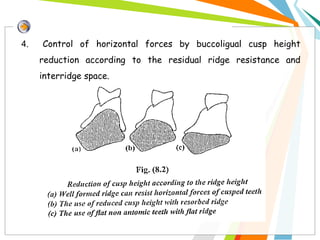
4. Control of horizontal forces by buccoligual cusp height
reduction according to the residual ridge resistance and
interridge space.
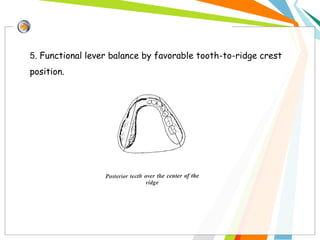
5. Functional lever balance by favorable tooth-to-ridge crest
position.
Theories of occlusion
• Spherical theory
• Equilateral triangle theory
• Conical theory
Spherical theory of occlusion
 Edgar et al 2002 The history of articulators: A clinical history of
articulators based on geometric theories of mandibular movement
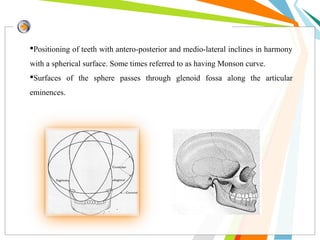
 This was given by Monson and the concept was derived from an idea
by Von spee.
 Lower teeth moves over the surface of upper teeth as over the surface
of sphere with a diameter of 8inches(20cm).
 Centre of sphere is in gabella.
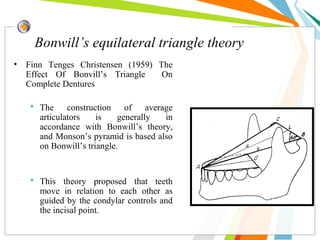
Positioning of teeth with antero-posterior and medio-lateral inclines in harmony
with a spherical surface. Some times referred to as having Monson curve.
Surfaces of the sphere passes through glenoid fossa along the articular
eminences.
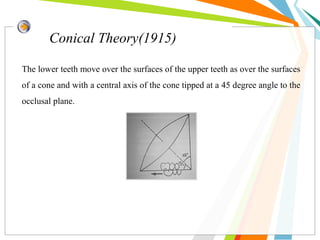
Bonwill’s equilateral triangle theory
• Finn Tenges Christensen (1959) The
Effect Of Bonvill’s Triangle On
Complete Dentures
 The construction of average
articulators is generally in
accordance with Bonwill’s theory,
and Monson’s pyramid is based also
on Bonwill’s triangle.
 This theory proposed that teeth
move in relation to each other as
guided by the condylar controls and
the incisal point.
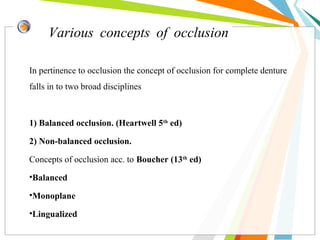
Conical Theory(1915)
The lower teeth move over the surfaces of the upper teeth as over the surfaces
of a cone and with a central axis of the cone tipped at a 45 degree angle to the
occlusal plane.
Various concepts of occlusion
In pertinence to occlusion the concept of occlusion for complete denture
falls in to two broad disciplines
1) Balanced occlusion. (Heartwell 5th
ed)
2) Non-balanced occlusion.
Concepts of occlusion acc. to Boucher (13th
ed)
•Balanced
•Monoplane
•Lingualized
Balanced Occlusion:
• Reported by Brewer.
• “ The simultaneous contacting of maxillary and mandibular teeth on right and
left and in the posterior and anterior occlusal areas in centric and eccentric
positions.”- Heartwell
• Balanced occlusion involves a definite arrangement of tooth contacts in
harmony with mandibular movement.- Stansbery
(TRAPOZZA V R.LAWS OF ARTICULATION. J. Pros. Den.Jan.-Feb., 1963;VOL-13 NO. 1)
• “The simultaneous contacting of the maxillary and the mandibular
teeth on the right and left side and in the posterior and anterior
occlusal areas in centric and eccentric positions, developed to lessen
or limit the tipping or rotating of the denture base in relation to the
supporting structures.-GPT
• “Stable simultaneous contact of the opposing upper and lower teeth
in centric relation position and a continuous smooth bilateral gliding
from this position to any eccentric position within normal range of
mandibular function.”- Winkler
Need for balanced occlusion
 Improved stability of denture
 No interference of cusp during mastication
 Preservation of ridges by better distribution of forces
Goals of balanced occlusion
 Simultaneous contact in centric relation
 Working side contact
 Balancing contact in protrusion
 Balancing contact in lateral excursion
Following axioms should be considered:
1. The wider and larger the ridge and closure the teeth are to the ridge,
the greater the lever balance.
2. Conversely, the smaller and narrower the ridge and the farther the
teeth are placed from the ridge the poorer the lever balance.
3. The wider the ridge and the narrower the teeth, the greater the balance.
4. Conversely, the narrower the ridge and wider the teeth the poorer the
balance.
5. The more lingual the teeth are placed in relation to the ridge the better the
balance.
6. The more buccal the teeth are placed to the ridge crest, the poorer the
balance.
7. The more centered the force of occlusion anterior-posteriorly, the greater
the stability of the base.
Types of Balanced Occlusion:
Balance may be -
•Unilateral,
•Bilateral, or
•Protrusive.
Unilateral lever balance:
This is present when there is equilibrium of base on its supporting structures
when a bolus of food is interposed between teeth on one side and space exists
between teeth on the opposite side.
• This state of equilibrium is encouraged by :
a) Placing the teeth so that the resultant direction of force on the functioning side
is over the ridge or slighty lingual to it.
b) Having the denture base cover as wide an area on ridge as possible.
c) Placing the teeth as close to the ridge as possible.
d) Using a narrow buccolingaul width occlusal food table as practical.
Unilateral occlusal balance:
This is present when occlusal surfaces of the teeth on one side articulate
simultaneously with smooth uninterrupted glide.
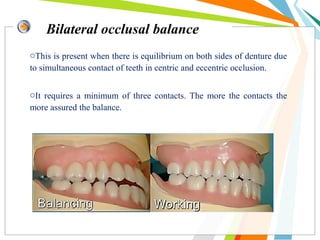
oThis is present when there is equilibrium on both sides of denture due
to simultaneous contact of teeth in centric and eccentric occlusion.
oIt requires a minimum of three contacts. The more the contacts the
more assured the balance.
Bilateral occlusal balance
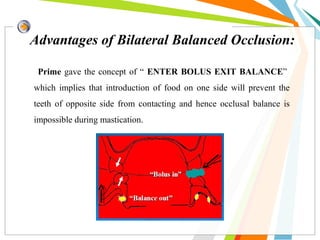
Advantages of Bilateral Balanced Occlusion:
Prime gave the concept of “ ENTER BOLUS EXIT BALANCE”
which implies that introduction of food on one side will prevent the
teeth of opposite side from contacting and hence occlusal balance is
impossible during mastication.
However Sheppard (1964) later gave the concept of ENTER BOLUS
ENTER BALANCE according to which even while chewing, the teeth cut
through the bolus and come in contact with each other, for few fractions of
a second. Hence the stability of the denture is maintained during various
movements of mandible during chewing.
Brewer and hudson (1963) found in a 24 hour test that:
Normal individual makes masticatory tooth contact only for 10 mins in one
day compared to 4hrs of total tooth contact during other functions. So, for
these 4hrs of tooth contact, balanced occlusion is important to maintain
denture stability.
It improves the stability of denture, reduce resorption of the residual ridge
and soreness and improve oral comfort & well-being of the patient.
Pros & cons (Winkler)
 The contact varies in frequency with different foods and different
persons. If this contact is interruptive and deflective; and not bilateral,
the denture base will not be stable. Hence, bilateral balanced contacts
during the terminal arc of closure help to seat the denture in a stable
position.
 Also bilateral balanced occlusion is important during activities such as
swallowing saliva, closing to reseat the dentures, and the bruxing of the
teeth during times of stress.
Pros:
Patient with a balanced design do not upset the normal static, stable and
retentive qualities of their dentures.
In bilateral balance the bases are stable during bruxing activity and they are
tight when the patient separate the teeth.
There are some possible disadvantages of bilateral balanced articulation:
It may tend to encourage lateral and protrusive grinding, although this
habit may be confined to those people who are subjected to irrelevant
muscle activity.
It is difficult to achieve in mouth where an increased vertical incisor
overlap is indicated, and is better to retain the vertical overlap, than to
sacrifice it in order to achieve articular balance.
A semi-adjustable or fully adjustable articulator is required.
Cons:
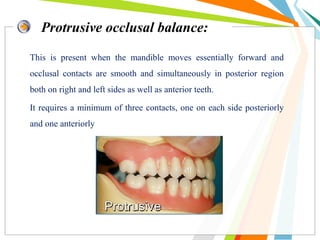
This is present when the mandible moves essentially forward and
occlusal contacts are smooth and simultaneously in posterior region
both on right and left sides as well as anterior teeth.
It requires a minimum of three contacts, one on each side posteriorly
and one anteriorly
Protrusive occlusal balance:
CONCEPTS OF
BALANCED OCCLUSION
o Gysi’s concept
o Sears’s concept
o French’s concept
o Pleasure’s concept
o Frush’s concept
o Hanau’s quint
o Trapazzano’s concept
o Lott’s concept
o Boucher’s concept
o Levin’s concept
GYSI’S CONCEPT
• He proposed the 1st
concept towards balanced occlusion in
1914.
• He suggested arranging 330
anatomic teeth could be used
under various movements of the articulator to enhance the
stability of the denture.
• Truebyte
• In 1927 designed a modified Cross-bite posteriors.
Sears’s concept
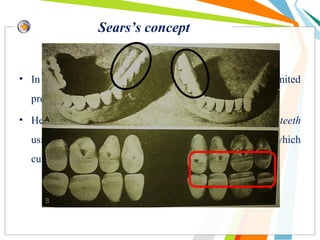
• In 1922 & 1927, “Channel” tooth. To permit unlimited
protrusive glide .
• He proposed the balanced occlusion for non-anatomic teeth
using posterior balancing ramps or an occlusal plane which
curves anteroposteriorly & laterally.
French’s concept
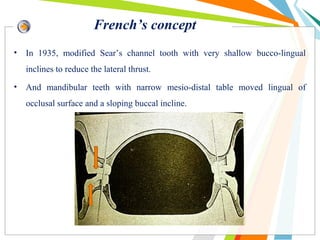
• In 1935, modified Sear’s channel tooth with very shallow bucco-lingual
inclines to reduce the lateral thrust.
• And mandibular teeth with narrow mesio-distal table moved lingual of
occlusal surface and a sloping buccal incline.
Pleasure’s concept
• In 1937, Dr. Max Pleasure described a reverse occlusal scheme in which
the posterior teeth are set with buccal tilt providing total lever balance
during function.
• Buccal tilt (reverse curve) is given at the premolars , no tilt or flat occlusal
surface at first molars and a lingual tilt (Monson curve) to second molars.
• This scheme is especially beneficial for patients with class II jaw relation.
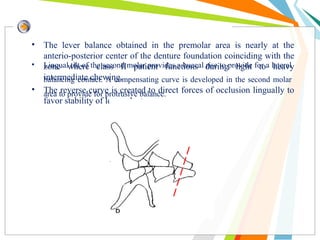
• The lever balance obtained in the premolar area is nearly at the
anterio-posterior center of the denture foundation coinciding with the
zone where class II patient functions during light to heavy
intermediate chewing.
• The reverse curve is created to direct forces of occlusion lingually to
favor stability of lower denture.
• Lingual tilt of the second molar provides a buccal rise to provide for a lateral
balancing contact. A compensating curve is developed in the second molar
area to provide for protrusive balance.
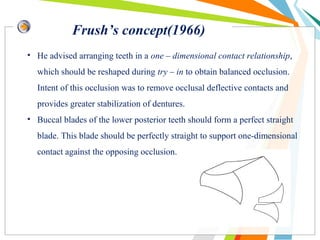
Frush’s concept(1966)
• He advised arranging teeth in a one – dimensional contact relationship,
which should be reshaped during try – in to obtain balanced occlusion.
Intent of this occlusion was to remove occlusal deflective contacts and
provides greater stabilization of dentures.
• Buccal blades of the lower posterior teeth should form a perfect straight
blade. This blade should be perfectly straight to support one-dimensional
contact against the opposing occlusion.
“ Hanau’s laws of articulation ”
RUDOLPH L. Hanau
 Nine factors governing the articulation are-
• Horizontal condylar guidance
• Compensating curve
• Protrusive incisal guidance
• Plane of orientation
• Buccolingual inclination of the tooth axis
• Sagittal condylar pathway
• Sagittal incisal guidance
• Tooth alignment
• Relative cusp height
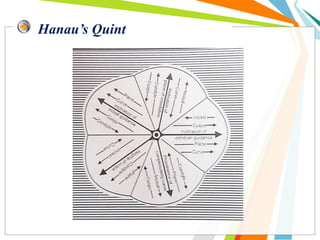
Hanau’s Quint
Trapozzano’s Concept:
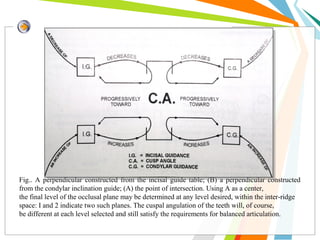
According to him – only 3 factors necessary for determining plane of
occlusion
1.Condylar guidance
2.Incisal guidance
3.Cuspal angle
-He stated occlusal plane could be located at various heights to favour
weaker ridge.
-He also stated that by arranging cusped teeth-these curves are produced
automatically
Fig.. A perpendicular constructed from the incisal guide table; (B) a perpendicular constructed
from the condylar inclination guide; (A) the point of intersection. Using A as a center,
the final level of the occlusal plane may be determined at any level desired, within the inter-ridge
space: I and 2 indicate two such planes. The cuspal angulation of the teeth will, of course,
be different at each level selected and still satisfy the requirements for balanced articulation.
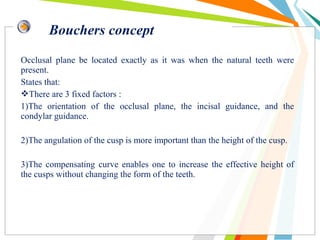
Occlusal plane be located exactly as it was when the natural teeth were
present.
States that:
There are 3 fixed factors :
1)The orientation of the occlusal plane, the incisal guidance, and the
condylar guidance.
2)The angulation of the cusp is more important than the height of the cusp.
3)The compensating curve enables one to increase the effective height of
the cusps without changing the form of the teeth.
Bouchers concept
Boucher felt that the compensatory curve is important since it helps in
increasing the effective height of the cusps without changing the form.
Boucher’s disagreed with Trapazzano that the occlusal plane could be
located at various heights to favour a weaker ridge and recommended
that the plane be orientated exactly as when natural teeth were present.
The lott’s Concept
He related the laws as follows
• The greater the angle of the condylar path, the greater is
the separation
• The greater the angle of the of the overbite, the greater is
the separation in the anterior region and the posterior
region.
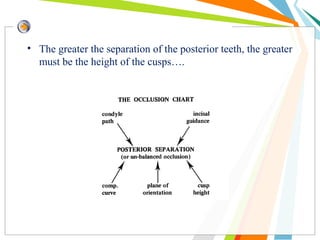
• The greater is separation of the posterior teeth, greater is
the compensating curve.
• Posterior separartion beyond the ability of compensating
curve to balance the occlusion requires the plane of
orientation.
• The greater the separation of the posterior teeth, the greater
must be the height of the cusps….
Bernard Levin Concept
• Eliminated plane of orientation.
• Levin has put forth the four factors in the form of a Quad.
The essentials of a Quad are:-
 The condylar guidance is fixed & is recorded from the patient.
 The incisal guidance is usually obtained from patient’s esthetic & phonetic
requirements. However it can be modified for special requirements.
E.g., the incisal guidance is decreased for flat ridges.
 The compensating curve is the most important factor in obtaining
occlusal balance. Monoplane or low cusp teeth must employ the
use of compensating curve.
 Cusp teeth have the inclines necessary for balanced occlusion but
nearly always are used with a compensating curve.
FACTORS THAT AFFECT THE
OCCLUSAL BALANCE
Condylar guidance
• Determined purely by the biomechanics of the joint itself, i.e. on bone
contour of T.M.J., muscle of mastication, ligament of T.M.J. and
neuromuscular control of the patient.
• This is the net result of the condyle-disc assembly passing forwards and
downwards, under the influence of the anterior slope of the glenoid fossa.
• Obtained by protrusive registration record.
• It should be recorded and transferred to articulator as closely as possible as
given by the patient.
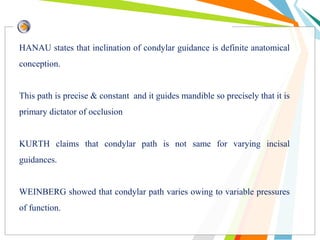
• Average condylar guidance is about 25-30 degree.
HANAU states that inclination of condylar guidance is definite anatomical
conception.
This path is precise & constant and it guides mandible so precisely that it is
primary dictator of occlusion
KURTH claims that condylar path is not same for varying incisal
guidances.
WEINBERG showed that condylar path varies owing to variable pressures
of function.
Significance
 Increase in condylar guidance will increase jaw separation during
protrusion.
 In patients with steep condylar guidance, incisal guidance should be
decreased to reduce amount of jaw separation produced during
protrusion
 As this factor cannot be modified, all other 4 factors should be modified
to compensate effects of this factor
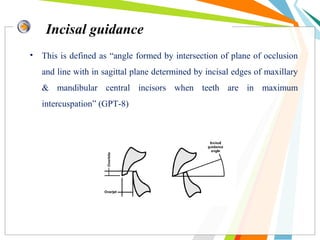
Incisal guidance
• This is defined as “angle formed by intersection of plane of occlusion
and line with in sagittal plane determined by incisal edges of maxillary
& mandibular central incisors when teeth are in maximum
intercuspation” (GPT-8)
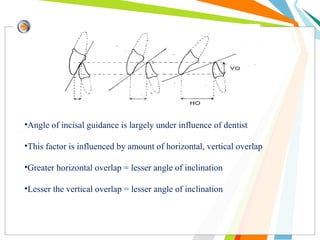
•Angle of incisal guidance is largely under influence of dentist
•This factor is influenced by amount of horizontal, vertical overlap
•Greater horizontal overlap = lesser angle of inclination
•Lesser the vertical overlap = lesser angle of inclination
 In complete dentures the incisal guidance should be as flat as possible as
the esthetics and phonetics permits.
 If the incisal guidance is steep, it requires steep cusps, a steep occlusal
plane, or a steep compensating curve to affect an occlusal plane
 It depends upon following factors:
 Phonetic
 Esthetic
 Shape of residual ridges
 Ridge relation
 Inter-alveolar distance
 On average it is about 10-20 degree.
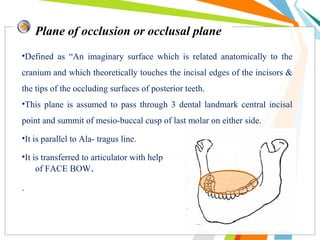
•Defined as “An imaginary surface which is related anatomically to the
cranium and which theoretically touches the incisal edges of the incisors &
the tips of the occluding surfaces of posterior teeth.
•This plane is assumed to pass through 3 dental landmark central incisal
point and summit of mesio-buccal cusp of last molar on either side.
•It is parallel to Ala- tragus line.
•It is transferred to articulator with help
of FACE BOW.
.
Plane of occlusion or occlusal plane
• The plane of occlusion can be altered to a maximum of 10°.
• Steep increase in inclination of occlusal plane will result in movement of
upper denture backward and lower denture forward during function.
• It represents the mean curvature of the surface. Established anteriorly by
height of lower canine and posteriorly by height of retromolar pad.
(winkler)
Compensating curve
o“The anterioposterior and lateral curvatures in the alignment of the
occluding surfaces and incisal edges of artificial teeth which are used to
develop balanced occlusion”(GPT -8)
oDetermined by inclination of posterior teeth and their vertical relationship
to occlusal plane.
oThe primary function thus of compensating curve is to provide balancing
contacts for protrusive mandibular movements. Without this curve it would
be necessary to incline the entire occlusal plane at an angle.
oSteep condylar path requires steep compensating curve to produce
balanced occlusion.
Lesser compensating curve for the same condylar guidance
steeper incisal guidance (anterior interference) causing loss of
molar balancing contact.
• With compensating curve it is possible to produce eccentric balance in
monoplane occlusal scheme, which is otherwise said to be deficient in
this.
• The compensating curve incorporated in a properly oriented plane of
occlusion starts with the first replacement tooth by raising it at distal
and continuing this initiated curve with further rise in the 2nd molar
with distal surface located at or above the top of retromolar pad.
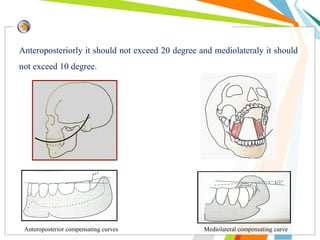
Anteroposteriorly it should not exceed 20 degree and mediolateraly it should
not exceed 10 degree.
Anteroposterior compensating curves Mediolateral compensating curve
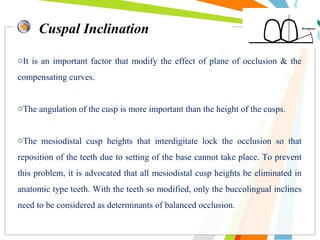
Cuspal Inclination
oIt is an important factor that modify the effect of plane of occlusion & the
compensating curves.
oThe angulation of the cusp is more important than the height of the cusps.
oThe mesiodistal cusp heights that interdigitate lock the occlusion so that
reposition of the teeth due to setting of the base cannot take place. To prevent
this problem, it is advocated that all mesiodistal cusp heights be eliminated in
anatomic type teeth. With the teeth so modified, only the buccolingual inclines
need to be considered as determinants of balanced occlusion.
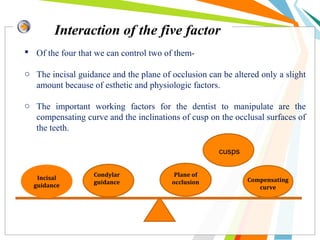
Interaction of the five factor
 Of the four that we can control two of them-
o The incisal guidance and the plane of occlusion can be altered only a slight
amount because of esthetic and physiologic factors.
o The important working factors for the dentist to manipulate are the
compensating curve and the inclinations of cusp on the occlusal surfaces of
the teeth.
Incisal
guidance
Condylar
guidance
Plane of
occlusion
cusps
Compensating
curve
Characteristics of balanced occlusion in
complete dentures
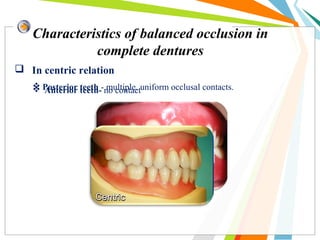
 In centric relation
 Anterior teeth- no contact Posterior teeth - multiple, uniform occlusal contacts.
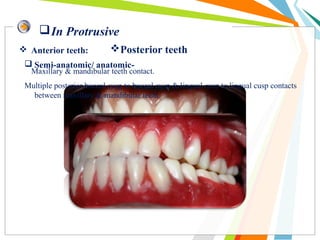
In Protrusive
 Anterior teeth:
Maxillary & mandibular teeth contact.
Posterior teeth
 Semi-anatomic/ anatomic-
Multiple posterior buccal cusp to buccal cusp & lingual cusp to lingual cusp contacts
between maxillary & mandibular teeth.
 Posterior teeth
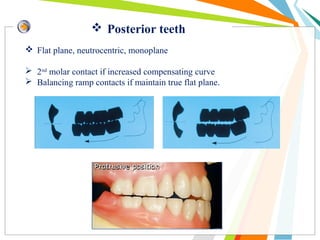
 Flat plane, neutrocentric, monoplane
 2nd
molar contact if increased compensating curve
 Balancing ramp contacts if maintain true flat plane.
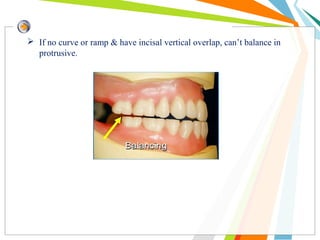
 If no curve or ramp & have incisal vertical overlap, can’t balance in
protrusive.
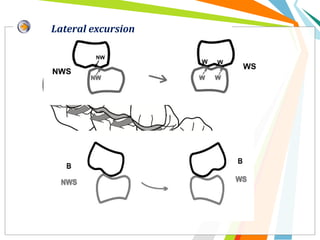
In lateral excursion
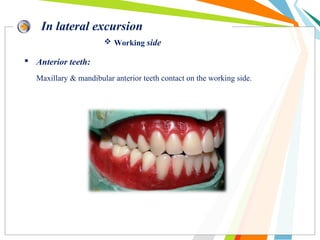
 Working side
 Anterior teeth:
Maxillary & mandibular anterior teeth contact on the working side.
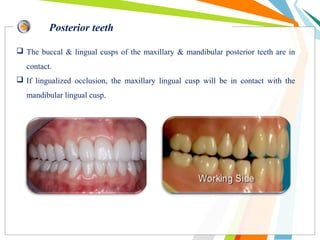
 The buccal & lingual cusps of the maxillary & mandibular posterior teeth are in
contact.
 If lingualized occlusion, the maxillary lingual cusp will be in contact with the
mandibular lingual cusp.
Posterior teeth
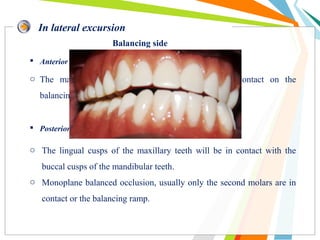
In lateral excursion
Balancing side
 Anterior teeth
o The maxillary & mandibular anterior teeth may contact on the
balancing side.
 Posterior teeth
o The lingual cusps of the maxillary teeth will be in contact with the
buccal cusps of the mandibular teeth.
o Monoplane balanced occlusion, usually only the second molars are in
contact or the balancing ramp.
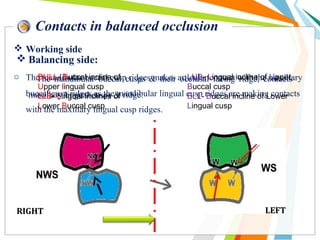
Contacts in balanced occlusion
 Working side
o The mandibular buccal cusp ridges makes articular contact with the maxillary
buccal cusp ridges as the mandibular lingual cusp ridges are making contacts
with the maxillary lingual cusp ridges.
 Balancing side:
The mandibular buccal cusps & their occlusal facing ridge, contacts
maxillary lingual cusps & ridge.
LUB- Lingual incline of Upper
Buccal cusp
BLL- Buccal incline of Lower
Lingual cusp
BULL- Buccal incline of
Upper lingual cusp
LLB- Lingual inclines of
Lower Buccal cusp
RIGHT LEFT
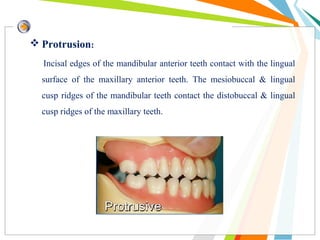
 Protrusion:
Incisal edges of the mandibular anterior teeth contact with the lingual
surface of the maxillary anterior teeth. The mesiobuccal & lingual
cusp ridges of the mandibular teeth contact the distobuccal & lingual
cusp ridges of the maxillary teeth.
Steps
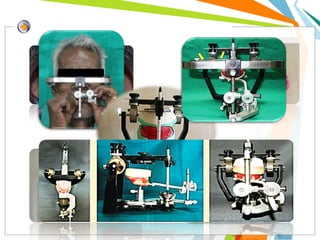
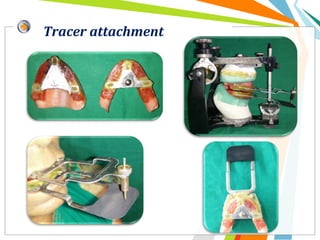
Tracer attachment
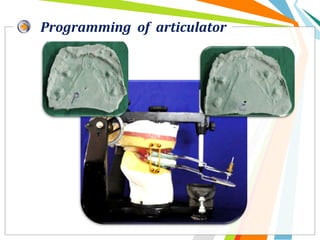
Programming of articulator
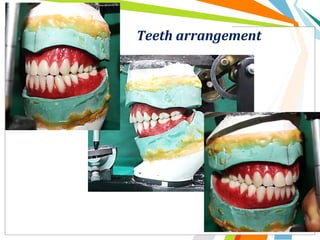
Teeth arrangement
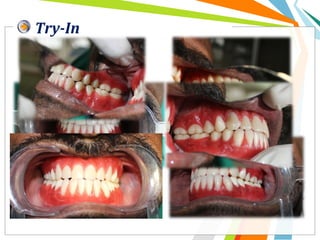
Try-In
Selective grinding
Selective grinding is defined as the, “intentional alteration of the occlusal
surfaces of the teeth to change their form’’ – GPT 8
Rational :
oEliminate occlusal interferences
oAchieve balanced occlusion
oContacts in harmony with TMJ and neuromuscular system
Avoiding remounting the dentures on articulator and selective grinding leads
to,
1) A deformation of underlying soft tissues,
2) Discomfort, and
3) Destruction of the underlying supporting bone. Later occlusal errors may
be concealed and impossible to locate and correct because of distorted and
swollen tissues.
Eliminate interlocking transverse ridges
Functional cusp not subjected to selective grinding
Lower buccal cusp inclines can be reduced but not the cusp
Maxillary buccal cusp out of contact during centric occlusion and
eccentric positions.
“BULL’s Principle”
If interferences exists in the working side reduce either the
upper buccal cusps or the lower lingual cusps.
In anterior teeth, lingual of upper and labial surface of lower teeth is
grinded to eliminate any interference.
Final result should be smooth gliding lateral excursion with working and
balancing contacts.
The multiple contacts should be smooth, uniform and in harmony with
the TMJ’s and the neuro-muscular activity.
Principles :
Steps at which grinding is performed:
1) At the time of teeth arrangement
2) Lab remount procedures
3) Clinical remount procedures
 Methods of detecting errors
 Articulating paper
 Carbon paper
 Wax template
Selective grinding for centric contacts
Correcting for maximum intercuspation
Discrepancies in static relationship due to minor processing errors.
Four types:
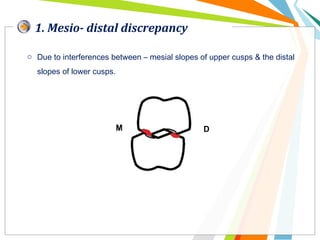
1) Mesio- distal discrepancy
2) Bucco- lingual discrepancy-
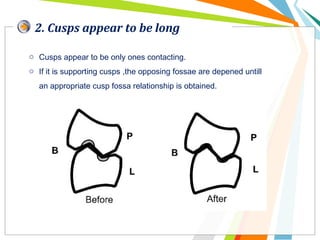
a) Cusps appear to be too long
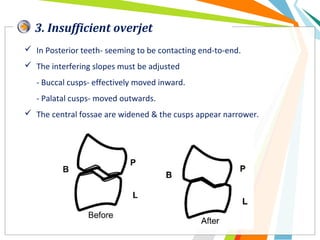
b) Insufficient overjet
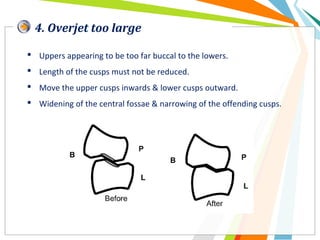
c) Overbite too long.
1. Mesio- distal discrepancy
o Due to interferences between – mesial slopes of upper cusps & the distal
slopes of lower cusps.
2. Cusps appear to be long
o Cusps appear to be only ones contacting.
o If it is supporting cusps ,the opposing fossae are depened untill
an appropriate cusp fossa relationship is obtained.
3. Insufficient overjet
 In Posterior teeth- seeming to be contacting end-to-end.
 The interfering slopes must be adjusted
- Buccal cusps- effectively moved inward.
- Palatal cusps- moved outwards.
 The central fossae are widened & the cusps appear narrower.
4. Overjet too large
 Uppers appearing to be too far buccal to the lowers.
 Length of the cusps must not be reduced.
 Move the upper cusps inwards & lower cusps outward.
 Widening of the central fossae & narrowing of the offending cusps.
Correction for lateral excursive
movements
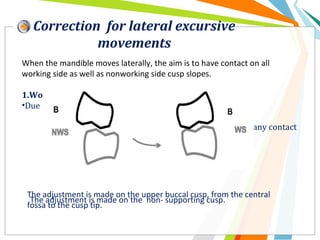
When the mandible moves laterally, the aim is to have contact on all
working side as well as nonworking side cusp slopes.
1.Working side interferences:
•Due to either:
• Buccal cusp or
• Lingual & palatal cusp contacting preventing any contact
on nonworking side.
The adjustment is made on the upper buccal cusp, from the central
fossa to the cusp tip.
The adjustment is made on the non- supporting cusp.
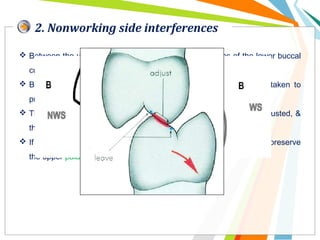
2. Nonworking side interferences
 Between the upper palatal cusp inclines and the inclines of the lower buccal
cusps.
 Both these cusps are supporting cusps, so great care must be taken to
preserve as much of the cusp as possible.
 Therefore only the parts of inclines causing the interference are adjusted, &
their relationship in maximum intercuspation constantly checked.
 If it appears that cusp height must be changed, it is preferable to preserve
the upper palatal cusp.
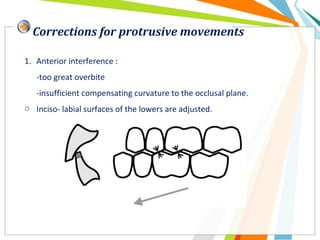
Corrections for protrusive movements
1. Anterior interference :
-too great overbite
-insufficient compensating curvature to the occlusal plane.
o Inciso- labial surfaces of the lowers are adjusted.
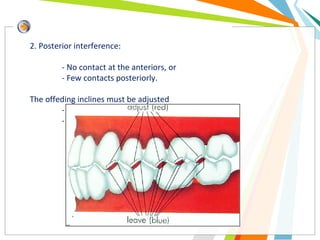
2. Posterior interference:
- No contact at the anteriors, or
- Few contacts posteriorly.
The offeding inclines must be adjusted
- the distal inclines of upper cusps.
- the mesial inclines of the lower cusps.
The Retrognathic
Mandible
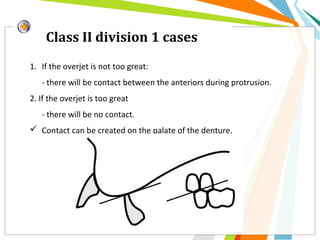
Class II division 1 cases
1. If the overjet is not too great:
- there will be contact between the anteriors during protrusion.
2. If the overjet is too great
- there will be no contact.
 Contact can be created on the palate of the denture.
Lingualised articulation
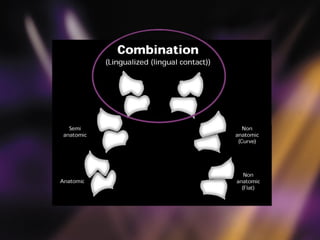
LINGUALISED ARTICULATION
• GYSI in 1927 introduced this type of concept.
• POUND used it for non balanced articulation.
• PAYNE in 1941 used it for balance articulation.
• Lingualised occlusion can be used in most denture combinations.
• It is particularly helpful when the patient places high priority on esthetics but
non-anatomic occlusal scheme is indicated by oral conditions such as severe
alveolar resorption, a Class II jaw relationship, or displaceable supporting
tissue.
• If the non-anatomic occlusal scheme is used, esthetics in the premolar region
are compromised.
• With Lingualised occlusion, the esthetic result is greatly improved while still
maintaining the advantages of a non-anatomic system.
• Lingualised occlusion also can be used effectively when a complete denture
opposes a removable partial denture.
Indications
• Anatomic posterior (30 or 33°) teeth are used for the maxillary denture. Tooth
forms with prominent lingual cusps are helpful.
• Non-anatomic or semi-anatomic (20 or 0 degree) teeth are used for the
mandibular denture. Either a shallow or flat cusp form is used. A narrow
occlusal table is preferred wherever resorption of the residual ridges has
occurred.
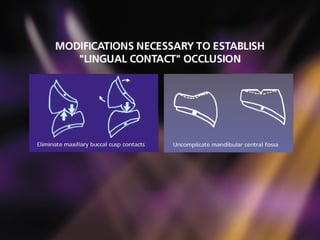
• Modification of the mandibular posterior teeth is accomplished by selective
grinding which is always necessary regardless of specific tooth or material.
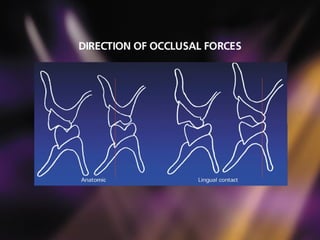
Principles of Lingualised articulation
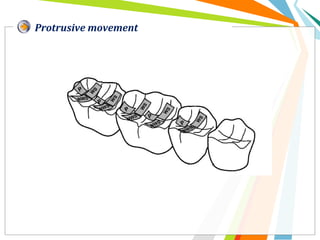
• Maxillary lingual cusps should contact mandibular teeth in centric occlusion.
• Balancing and working contacts should occur only on the maxillary lingual
cusps.
• Protrusive balancing contacts should occur only between the maxillary lingual
cusps and the lower teeth.
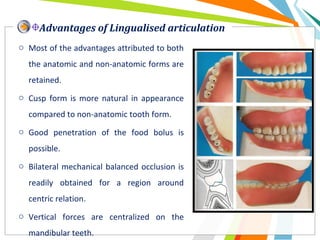
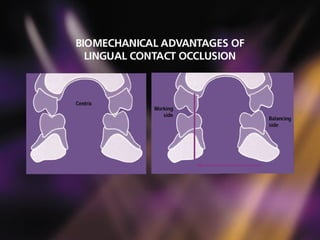
o Most of the advantages attributed to both
the anatomic and non-anatomic forms are
retained.
o Cusp form is more natural in appearance
compared to non-anatomic tooth form.
o Good penetration of the food bolus is
possible.
o Bilateral mechanical balanced occlusion is
readily obtained for a region around
centric relation.
o Vertical forces are centralized on the
mandibular teeth.
Advantages of Lingualised articulation
L/O/G/O
www.themegallery.com
L/O/G/O
www.themegallery.com
L/O/G/O
www.themegallery.com
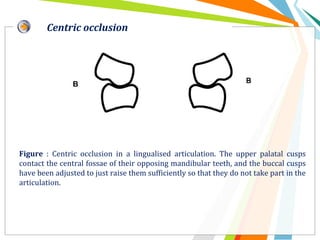
Figure : Centric occlusion in a lingualised articulation. The upper palatal cusps
contact the central fossae of their opposing mandibular teeth, and the buccal cusps
have been adjusted to just raise them sufficiently so that they do not take part in the
articulation.
Centric occlusion
Lateral excursion
Protrusive movement
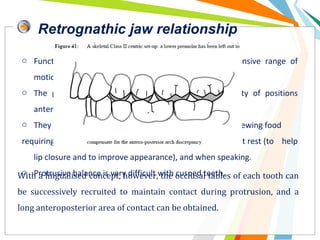
Retrognathic jaw relationship
o Functionally, skeletal Class II individuals have an extensive range of
motion of the mandible.
o The problem is that the patient functions in a variety of positions
anterior to centric relation position,
o They function closest to centric relation position when chewing food
requiring more force, but function forwards of this position at rest (to help
lip closure and to improve appearance), and when speaking.
o Protrusive balance is very difficult with cusped teeth.With a lingualised concept, however, the occlusal tables of each tooth can
be successively recruited to maintain contact during protrusion, and a
long anteroposterior area of contact can be obtained.
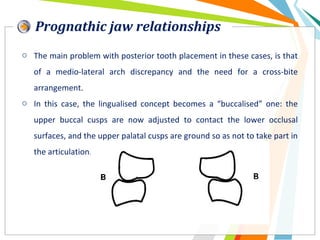
Prognathic jaw relationships
o The main problem with posterior tooth placement in these cases, is that
of a medio-lateral arch discrepancy and the need for a cross-bite
arrangement.
o In this case, the lingualised concept becomes a “buccalised” one: the
upper buccal cusps are now adjusted to contact the lower occlusal
surfaces, and the upper palatal cusps are ground so as not to take part in
the articulation.
Practical considerations
A study comparing patient responses to a lingualised scheme
using 30 upper posteriors to a monoplane scheme.
A statistically significant no. of patients (67%) preferred the
lingualised scheme, because they “chewed better”.
It would seem that 30 or 33 cusp angle teeth enhanced the
effective “pestle” effect of the scheme.
Summary
The nature of the supporting structures for the complete
dentures and the forces directed to them by the occlusion creates
a special biomechanical problem.
Balanced occlusion is one of the most important factors which
will favor the stability of the base; and help in preservation of the
supporting structures by reducing the lateral forces.
“ Thereby signifying its importance in complete denture
fabrication.”
References:
ESSENTIALS OF COMPLETE DENTURE PROSTHODOTICS , SECOND EDITION, by Sheldon
Winkler
BOUCHER’S PROSTHODONTIC TREATMENT FOR EDENTULOUS PATIENTS, ELEVENTH
EDITION, by hickey , zarb and bolender
Trappozano V.R.: An experimental study of the testing of occlusal patterns on the same
denture bases. JPD.;1952; 440-457.
Arthur N.: Balancing ramps in non-anatomic complete denture occlusion.
JPD,1985;53:431-433.
Beck H.O.: Occlusion as related to complete removable prosthodontics.
JPD,1972;27:246-256.
Becker C.M., Swoop P.C.: Lingualised occlusion for removable
prosthodontics.JPD,1977;38:601-608.
Bernard Levin: Reevaluation of Hanaus Laws of Articulation and the Hanaus Quint.
JPD,1978;39:254-258.
Heartwell Charles M.: Sylabbus of complete dentures.
Kydd W.L.: Comlete denture base deformation with varied occlusal tooth form. JPD.,
1959;6:714-718.
Kurth L.E.: Balanced Occlusion. JPD’1954’4:150-167.
Trappozano V.R.: An experimental study of the testing of occlusal patterns on the same
denture bases. JPD.;1952; 440-457.
Owen C P. Occlusion in complete denture.
Thank you

Balanced occlusion and its importance

  • 1.
    Presented by : Dr.Avinash Kumar IInd year P.G K.V.G Dental College & hospital, sullia BALANCED OCCLUSION AND ITS IMPORTANCE IN COMPLETE DENTURE FABRICATION
  • 2.
    Contents • Introduction • Definitions •Requirements of complete denture occlusion • Theories of occlusion • Balanced occlusion: Definition Pre-Requisites • Parameters to success of occlusal balance • Types • Pro and Cons • Concepts of Balanced occlusion
  • 3.
    • Factors thataffect the occlusal balance • Characteristics of balanced occlusion in complete dentures • Steps • Selective grinding(correcting occlusal errors in balanced articulation) • The retrognathic mandible • Lingualised articulation • Summary & conclusion • References
  • 4.
    Introduction However, there arerational ways to study occlusion, and studying occlusion in complete dentures is a good starting point, because of the need to place an entire dentition within a system so that the edentulous patient can once again function with the minimum of discomfort and the maximum possible efficiency. Occlusion in complete denture must be developed to function efficiently and with the least amount of trauma to the supporting tissues.
  • 5.
    Features of naturalocclusion Intercuspal position is used during chewing, swallowing & deliberate clenching. In function - Presence of unworn cusps results in separation of teeth on one side(most obviously during lateral movements & also in protrusive movements) Artificial occlusion Complete dentures remain static only when jaws remains static. All dentures move in function. Prime aim- to ensure minimum movement & can be controlled by the patient to allow for optimal function.
  • 6.
    When the artificialteeth do contact, they do so in the same way as in the unworn natural dentition and leads to tipping, denture base tip up until the teeth on other side met. It would be therefore be entirely logical to try to achieve that situation in the first place, an occlusion that balances both sides with each other, & anterior part with the posterior part.
  • 7.
    Definitions Occlusion  Is definedas the static relationship between the incising or masticating surfaces of the maxillary and mandibular teeth or tooth analogue. (GPT)  According to Heartwell this is a static position and the jaws can be in either centric or eccentric relation. Every time the teeth contact there is a resultant force which may vary in magnitude and direction.
  • 8.
    Articulation The contact relationshipbetween the occlusal surfaces of the teeth during function.(GPT) Excursive movement Movement occuring when mandible moves away from maximum intercuspation. Balancing side/non-working side The side of mandible which moves towards median line in lateral excursion.
  • 9.
    Balanced occlusion The bilateral,simultaneous, anterior, and posterior occlusal contact of teeth in centric and eccentric positions. Centric occlusion The occlusion of opposing teeth when the mandible is in centric relation. This may or may not coincide with the maximal intercuspal position.(GPT 8) .Centric occlusion is the tooth-to-tooth relation whereas centric relation is a static position and a bone-to-bone relation.
  • 10.
    Centric relation The maxillomandibularrelationship in which the condyles articulate with the thinnest avascular portion of their respective discs with the complex in the anterior- superior position against the slopes of the articular eminences. This position is independent of tooth contact. This position is clinically discernible when the mandible is directed superior and anteriorly. It is restricted to purely rotary movement about the transverse horizontal axis.(GPT) Transverse horizontal axis An imaginary line around which the mandible may rotate within the sagittal plane. (GPT)
  • 11.
    Maximum intercuspation The completeintercuspation of the opposing teeth, independent of condylar position. Eccentric occlusion Eccentric occlusion refers to contact of teeth that occurs during movement of the mandible. It is of two types:- 1.Functional occlusion 2.Non functional occlusion
  • 12.
    1.Functional occlusion Functional occlusion(also called working side occlusion) refers to tooth contacts that occur in the segment of the arch towards which the mandible moves. Functional occlusion can be of two types : a. Lateral functional occlusion b. Protrusive functional occlusion
  • 13.
    a) Lateral functionalocclusion: It includes tooth contacts that occur on canines and posterior teeth on the side towards which the mandible moves. o The lateral functional occlusion can be of two types : 1. Canine guided occlusion: 2. Grouped lateral occlusion
  • 14.
    i) Canine guidedocclusion: During lateral mandibular movement, the opposing upper & lower canines of the working side contact thereby causing disclusion of all posterior teeth on the working &, balancing sides. Canine guided occlusion is usually seen in young individuals with unworn dentition.
  • 15.
    ii) Grouped lateralocclusion : In addition to canine guidance, certain other posterior teeth on the working side also contact during lateral movement of the mandible. Such a type of contact during lateral movement is called grouped lateral occlusion.
  • 16.
    B) Protrusive functionalocclusion: It includes eccentric contacts that occur when the mandible moves forward. Ideally the six mandibular anterior teeth contact along the lingual inclines of the maxillary anterior teeth while the posteriors disocclude.
  • 17.
    Requirement of CompleteDenture Occlusion (Winkler) 1. Stability of occlusion in centric relation and in areas forward and lateral to it. 2. Balanced for all eccentric contacts bilaterally for all eccentric mandibular movements. 3. Unlocking the cusp mesiodistally to allow for gradual but inevitable settling of the bases due to tissue deformation and bone resorption.
  • 18.
    4. Control ofhorizontal forces by buccoligual cusp height reduction according to the residual ridge resistance and interridge space.
  • 19.
    5. Functional leverbalance by favorable tooth-to-ridge crest position.
  • 20.
    Theories of occlusion •Spherical theory • Equilateral triangle theory • Conical theory
  • 21.
    Spherical theory ofocclusion  Edgar et al 2002 The history of articulators: A clinical history of articulators based on geometric theories of mandibular movement  This was given by Monson and the concept was derived from an idea by Von spee.  Lower teeth moves over the surface of upper teeth as over the surface of sphere with a diameter of 8inches(20cm).  Centre of sphere is in gabella.
  • 22.
    Positioning of teethwith antero-posterior and medio-lateral inclines in harmony with a spherical surface. Some times referred to as having Monson curve. Surfaces of the sphere passes through glenoid fossa along the articular eminences.
  • 23.
    Bonwill’s equilateral triangletheory • Finn Tenges Christensen (1959) The Effect Of Bonvill’s Triangle On Complete Dentures  The construction of average articulators is generally in accordance with Bonwill’s theory, and Monson’s pyramid is based also on Bonwill’s triangle.  This theory proposed that teeth move in relation to each other as guided by the condylar controls and the incisal point.
  • 24.
    Conical Theory(1915) The lowerteeth move over the surfaces of the upper teeth as over the surfaces of a cone and with a central axis of the cone tipped at a 45 degree angle to the occlusal plane.
  • 25.
    Various concepts ofocclusion In pertinence to occlusion the concept of occlusion for complete denture falls in to two broad disciplines 1) Balanced occlusion. (Heartwell 5th ed) 2) Non-balanced occlusion. Concepts of occlusion acc. to Boucher (13th ed) •Balanced •Monoplane •Lingualized
  • 26.
    Balanced Occlusion: • Reportedby Brewer. • “ The simultaneous contacting of maxillary and mandibular teeth on right and left and in the posterior and anterior occlusal areas in centric and eccentric positions.”- Heartwell • Balanced occlusion involves a definite arrangement of tooth contacts in harmony with mandibular movement.- Stansbery (TRAPOZZA V R.LAWS OF ARTICULATION. J. Pros. Den.Jan.-Feb., 1963;VOL-13 NO. 1)
  • 27.
    • “The simultaneouscontacting of the maxillary and the mandibular teeth on the right and left side and in the posterior and anterior occlusal areas in centric and eccentric positions, developed to lessen or limit the tipping or rotating of the denture base in relation to the supporting structures.-GPT • “Stable simultaneous contact of the opposing upper and lower teeth in centric relation position and a continuous smooth bilateral gliding from this position to any eccentric position within normal range of mandibular function.”- Winkler
  • 28.
    Need for balancedocclusion  Improved stability of denture  No interference of cusp during mastication  Preservation of ridges by better distribution of forces
  • 29.
    Goals of balancedocclusion  Simultaneous contact in centric relation  Working side contact  Balancing contact in protrusion  Balancing contact in lateral excursion
  • 30.
    Following axioms shouldbe considered: 1. The wider and larger the ridge and closure the teeth are to the ridge, the greater the lever balance. 2. Conversely, the smaller and narrower the ridge and the farther the teeth are placed from the ridge the poorer the lever balance. 3. The wider the ridge and the narrower the teeth, the greater the balance. 4. Conversely, the narrower the ridge and wider the teeth the poorer the balance.
  • 31.
    5. The morelingual the teeth are placed in relation to the ridge the better the balance. 6. The more buccal the teeth are placed to the ridge crest, the poorer the balance. 7. The more centered the force of occlusion anterior-posteriorly, the greater the stability of the base.
  • 32.
    Types of BalancedOcclusion: Balance may be - •Unilateral, •Bilateral, or •Protrusive. Unilateral lever balance: This is present when there is equilibrium of base on its supporting structures when a bolus of food is interposed between teeth on one side and space exists between teeth on the opposite side.
  • 33.
    • This stateof equilibrium is encouraged by : a) Placing the teeth so that the resultant direction of force on the functioning side is over the ridge or slighty lingual to it. b) Having the denture base cover as wide an area on ridge as possible. c) Placing the teeth as close to the ridge as possible. d) Using a narrow buccolingaul width occlusal food table as practical. Unilateral occlusal balance: This is present when occlusal surfaces of the teeth on one side articulate simultaneously with smooth uninterrupted glide.
  • 34.
    oThis is presentwhen there is equilibrium on both sides of denture due to simultaneous contact of teeth in centric and eccentric occlusion. oIt requires a minimum of three contacts. The more the contacts the more assured the balance. Bilateral occlusal balance
  • 35.
    Advantages of BilateralBalanced Occlusion: Prime gave the concept of “ ENTER BOLUS EXIT BALANCE” which implies that introduction of food on one side will prevent the teeth of opposite side from contacting and hence occlusal balance is impossible during mastication.
  • 36.
    However Sheppard (1964)later gave the concept of ENTER BOLUS ENTER BALANCE according to which even while chewing, the teeth cut through the bolus and come in contact with each other, for few fractions of a second. Hence the stability of the denture is maintained during various movements of mandible during chewing. Brewer and hudson (1963) found in a 24 hour test that: Normal individual makes masticatory tooth contact only for 10 mins in one day compared to 4hrs of total tooth contact during other functions. So, for these 4hrs of tooth contact, balanced occlusion is important to maintain denture stability. It improves the stability of denture, reduce resorption of the residual ridge and soreness and improve oral comfort & well-being of the patient.
  • 37.
    Pros & cons(Winkler)
  • 38.
     The contactvaries in frequency with different foods and different persons. If this contact is interruptive and deflective; and not bilateral, the denture base will not be stable. Hence, bilateral balanced contacts during the terminal arc of closure help to seat the denture in a stable position.  Also bilateral balanced occlusion is important during activities such as swallowing saliva, closing to reseat the dentures, and the bruxing of the teeth during times of stress. Pros: Patient with a balanced design do not upset the normal static, stable and retentive qualities of their dentures. In bilateral balance the bases are stable during bruxing activity and they are tight when the patient separate the teeth.
  • 39.
    There are somepossible disadvantages of bilateral balanced articulation: It may tend to encourage lateral and protrusive grinding, although this habit may be confined to those people who are subjected to irrelevant muscle activity. It is difficult to achieve in mouth where an increased vertical incisor overlap is indicated, and is better to retain the vertical overlap, than to sacrifice it in order to achieve articular balance. A semi-adjustable or fully adjustable articulator is required. Cons:
  • 40.
    This is presentwhen the mandible moves essentially forward and occlusal contacts are smooth and simultaneously in posterior region both on right and left sides as well as anterior teeth. It requires a minimum of three contacts, one on each side posteriorly and one anteriorly Protrusive occlusal balance:
  • 41.
  • 42.
    o Gysi’s concept oSears’s concept o French’s concept o Pleasure’s concept o Frush’s concept o Hanau’s quint o Trapazzano’s concept o Lott’s concept o Boucher’s concept o Levin’s concept
  • 43.
    GYSI’S CONCEPT • Heproposed the 1st concept towards balanced occlusion in 1914. • He suggested arranging 330 anatomic teeth could be used under various movements of the articulator to enhance the stability of the denture. • Truebyte • In 1927 designed a modified Cross-bite posteriors.
  • 44.
    Sears’s concept • In1922 & 1927, “Channel” tooth. To permit unlimited protrusive glide . • He proposed the balanced occlusion for non-anatomic teeth using posterior balancing ramps or an occlusal plane which curves anteroposteriorly & laterally.
  • 45.
    French’s concept • In1935, modified Sear’s channel tooth with very shallow bucco-lingual inclines to reduce the lateral thrust. • And mandibular teeth with narrow mesio-distal table moved lingual of occlusal surface and a sloping buccal incline.
  • 46.
    Pleasure’s concept • In1937, Dr. Max Pleasure described a reverse occlusal scheme in which the posterior teeth are set with buccal tilt providing total lever balance during function. • Buccal tilt (reverse curve) is given at the premolars , no tilt or flat occlusal surface at first molars and a lingual tilt (Monson curve) to second molars. • This scheme is especially beneficial for patients with class II jaw relation.
  • 47.
    • The leverbalance obtained in the premolar area is nearly at the anterio-posterior center of the denture foundation coinciding with the zone where class II patient functions during light to heavy intermediate chewing. • The reverse curve is created to direct forces of occlusion lingually to favor stability of lower denture. • Lingual tilt of the second molar provides a buccal rise to provide for a lateral balancing contact. A compensating curve is developed in the second molar area to provide for protrusive balance.
  • 48.
    Frush’s concept(1966) • Headvised arranging teeth in a one – dimensional contact relationship, which should be reshaped during try – in to obtain balanced occlusion. Intent of this occlusion was to remove occlusal deflective contacts and provides greater stabilization of dentures. • Buccal blades of the lower posterior teeth should form a perfect straight blade. This blade should be perfectly straight to support one-dimensional contact against the opposing occlusion.
  • 49.
    “ Hanau’s lawsof articulation ” RUDOLPH L. Hanau  Nine factors governing the articulation are- • Horizontal condylar guidance • Compensating curve • Protrusive incisal guidance • Plane of orientation • Buccolingual inclination of the tooth axis • Sagittal condylar pathway • Sagittal incisal guidance • Tooth alignment • Relative cusp height
  • 50.
  • 51.
    Trapozzano’s Concept: According tohim – only 3 factors necessary for determining plane of occlusion 1.Condylar guidance 2.Incisal guidance 3.Cuspal angle -He stated occlusal plane could be located at various heights to favour weaker ridge. -He also stated that by arranging cusped teeth-these curves are produced automatically
  • 52.
    Fig.. A perpendicularconstructed from the incisal guide table; (B) a perpendicular constructed from the condylar inclination guide; (A) the point of intersection. Using A as a center, the final level of the occlusal plane may be determined at any level desired, within the inter-ridge space: I and 2 indicate two such planes. The cuspal angulation of the teeth will, of course, be different at each level selected and still satisfy the requirements for balanced articulation.
  • 53.
    Occlusal plane belocated exactly as it was when the natural teeth were present. States that: There are 3 fixed factors : 1)The orientation of the occlusal plane, the incisal guidance, and the condylar guidance. 2)The angulation of the cusp is more important than the height of the cusp. 3)The compensating curve enables one to increase the effective height of the cusps without changing the form of the teeth. Bouchers concept
  • 54.
    Boucher felt thatthe compensatory curve is important since it helps in increasing the effective height of the cusps without changing the form. Boucher’s disagreed with Trapazzano that the occlusal plane could be located at various heights to favour a weaker ridge and recommended that the plane be orientated exactly as when natural teeth were present.
  • 55.
    The lott’s Concept Herelated the laws as follows • The greater the angle of the condylar path, the greater is the separation • The greater the angle of the of the overbite, the greater is the separation in the anterior region and the posterior region. • The greater is separation of the posterior teeth, greater is the compensating curve. • Posterior separartion beyond the ability of compensating curve to balance the occlusion requires the plane of orientation.
  • 56.
    • The greaterthe separation of the posterior teeth, the greater must be the height of the cusps….
  • 57.
    Bernard Levin Concept •Eliminated plane of orientation. • Levin has put forth the four factors in the form of a Quad. The essentials of a Quad are:-  The condylar guidance is fixed & is recorded from the patient.  The incisal guidance is usually obtained from patient’s esthetic & phonetic requirements. However it can be modified for special requirements. E.g., the incisal guidance is decreased for flat ridges.
  • 58.
     The compensatingcurve is the most important factor in obtaining occlusal balance. Monoplane or low cusp teeth must employ the use of compensating curve.  Cusp teeth have the inclines necessary for balanced occlusion but nearly always are used with a compensating curve.
  • 59.
    FACTORS THAT AFFECTTHE OCCLUSAL BALANCE
  • 60.
    Condylar guidance • Determinedpurely by the biomechanics of the joint itself, i.e. on bone contour of T.M.J., muscle of mastication, ligament of T.M.J. and neuromuscular control of the patient. • This is the net result of the condyle-disc assembly passing forwards and downwards, under the influence of the anterior slope of the glenoid fossa. • Obtained by protrusive registration record. • It should be recorded and transferred to articulator as closely as possible as given by the patient.
  • 61.
    • Average condylarguidance is about 25-30 degree.
  • 62.
    HANAU states thatinclination of condylar guidance is definite anatomical conception. This path is precise & constant and it guides mandible so precisely that it is primary dictator of occlusion KURTH claims that condylar path is not same for varying incisal guidances. WEINBERG showed that condylar path varies owing to variable pressures of function.
  • 63.
    Significance  Increase incondylar guidance will increase jaw separation during protrusion.  In patients with steep condylar guidance, incisal guidance should be decreased to reduce amount of jaw separation produced during protrusion  As this factor cannot be modified, all other 4 factors should be modified to compensate effects of this factor
  • 64.
    Incisal guidance • Thisis defined as “angle formed by intersection of plane of occlusion and line with in sagittal plane determined by incisal edges of maxillary & mandibular central incisors when teeth are in maximum intercuspation” (GPT-8)
  • 65.
    •Angle of incisalguidance is largely under influence of dentist •This factor is influenced by amount of horizontal, vertical overlap •Greater horizontal overlap = lesser angle of inclination •Lesser the vertical overlap = lesser angle of inclination
  • 66.
     In completedentures the incisal guidance should be as flat as possible as the esthetics and phonetics permits.  If the incisal guidance is steep, it requires steep cusps, a steep occlusal plane, or a steep compensating curve to affect an occlusal plane  It depends upon following factors:  Phonetic  Esthetic  Shape of residual ridges  Ridge relation  Inter-alveolar distance  On average it is about 10-20 degree.
  • 67.
    •Defined as “Animaginary surface which is related anatomically to the cranium and which theoretically touches the incisal edges of the incisors & the tips of the occluding surfaces of posterior teeth. •This plane is assumed to pass through 3 dental landmark central incisal point and summit of mesio-buccal cusp of last molar on either side. •It is parallel to Ala- tragus line. •It is transferred to articulator with help of FACE BOW. . Plane of occlusion or occlusal plane
  • 68.
    • The planeof occlusion can be altered to a maximum of 10°. • Steep increase in inclination of occlusal plane will result in movement of upper denture backward and lower denture forward during function. • It represents the mean curvature of the surface. Established anteriorly by height of lower canine and posteriorly by height of retromolar pad. (winkler)
  • 69.
    Compensating curve o“The anterioposteriorand lateral curvatures in the alignment of the occluding surfaces and incisal edges of artificial teeth which are used to develop balanced occlusion”(GPT -8) oDetermined by inclination of posterior teeth and their vertical relationship to occlusal plane. oThe primary function thus of compensating curve is to provide balancing contacts for protrusive mandibular movements. Without this curve it would be necessary to incline the entire occlusal plane at an angle. oSteep condylar path requires steep compensating curve to produce balanced occlusion.
  • 70.
    Lesser compensating curvefor the same condylar guidance steeper incisal guidance (anterior interference) causing loss of molar balancing contact. • With compensating curve it is possible to produce eccentric balance in monoplane occlusal scheme, which is otherwise said to be deficient in this. • The compensating curve incorporated in a properly oriented plane of occlusion starts with the first replacement tooth by raising it at distal and continuing this initiated curve with further rise in the 2nd molar with distal surface located at or above the top of retromolar pad.
  • 71.
    Anteroposteriorly it shouldnot exceed 20 degree and mediolateraly it should not exceed 10 degree. Anteroposterior compensating curves Mediolateral compensating curve
  • 72.
    Cuspal Inclination oIt isan important factor that modify the effect of plane of occlusion & the compensating curves. oThe angulation of the cusp is more important than the height of the cusps. oThe mesiodistal cusp heights that interdigitate lock the occlusion so that reposition of the teeth due to setting of the base cannot take place. To prevent this problem, it is advocated that all mesiodistal cusp heights be eliminated in anatomic type teeth. With the teeth so modified, only the buccolingual inclines need to be considered as determinants of balanced occlusion.
  • 73.
    Interaction of thefive factor  Of the four that we can control two of them- o The incisal guidance and the plane of occlusion can be altered only a slight amount because of esthetic and physiologic factors. o The important working factors for the dentist to manipulate are the compensating curve and the inclinations of cusp on the occlusal surfaces of the teeth. Incisal guidance Condylar guidance Plane of occlusion cusps Compensating curve
  • 74.
    Characteristics of balancedocclusion in complete dentures  In centric relation  Anterior teeth- no contact Posterior teeth - multiple, uniform occlusal contacts.
  • 75.
    In Protrusive  Anteriorteeth: Maxillary & mandibular teeth contact. Posterior teeth  Semi-anatomic/ anatomic- Multiple posterior buccal cusp to buccal cusp & lingual cusp to lingual cusp contacts between maxillary & mandibular teeth.
  • 76.
     Posterior teeth Flat plane, neutrocentric, monoplane  2nd molar contact if increased compensating curve  Balancing ramp contacts if maintain true flat plane.
  • 77.
     If nocurve or ramp & have incisal vertical overlap, can’t balance in protrusive.
  • 78.
    In lateral excursion Working side  Anterior teeth: Maxillary & mandibular anterior teeth contact on the working side.
  • 79.
     The buccal& lingual cusps of the maxillary & mandibular posterior teeth are in contact.  If lingualized occlusion, the maxillary lingual cusp will be in contact with the mandibular lingual cusp. Posterior teeth
  • 80.
    In lateral excursion Balancingside  Anterior teeth o The maxillary & mandibular anterior teeth may contact on the balancing side.  Posterior teeth o The lingual cusps of the maxillary teeth will be in contact with the buccal cusps of the mandibular teeth. o Monoplane balanced occlusion, usually only the second molars are in contact or the balancing ramp.
  • 81.
    Contacts in balancedocclusion  Working side o The mandibular buccal cusp ridges makes articular contact with the maxillary buccal cusp ridges as the mandibular lingual cusp ridges are making contacts with the maxillary lingual cusp ridges.  Balancing side: The mandibular buccal cusps & their occlusal facing ridge, contacts maxillary lingual cusps & ridge. LUB- Lingual incline of Upper Buccal cusp BLL- Buccal incline of Lower Lingual cusp BULL- Buccal incline of Upper lingual cusp LLB- Lingual inclines of Lower Buccal cusp RIGHT LEFT
  • 82.
     Protrusion: Incisal edgesof the mandibular anterior teeth contact with the lingual surface of the maxillary anterior teeth. The mesiobuccal & lingual cusp ridges of the mandibular teeth contact the distobuccal & lingual cusp ridges of the maxillary teeth.
  • 83.
  • 85.
  • 86.
  • 87.
  • 88.
  • 89.
    Selective grinding Selective grindingis defined as the, “intentional alteration of the occlusal surfaces of the teeth to change their form’’ – GPT 8 Rational : oEliminate occlusal interferences oAchieve balanced occlusion oContacts in harmony with TMJ and neuromuscular system Avoiding remounting the dentures on articulator and selective grinding leads to, 1) A deformation of underlying soft tissues, 2) Discomfort, and 3) Destruction of the underlying supporting bone. Later occlusal errors may be concealed and impossible to locate and correct because of distorted and swollen tissues.
  • 90.
    Eliminate interlocking transverseridges Functional cusp not subjected to selective grinding Lower buccal cusp inclines can be reduced but not the cusp Maxillary buccal cusp out of contact during centric occlusion and eccentric positions. “BULL’s Principle” If interferences exists in the working side reduce either the upper buccal cusps or the lower lingual cusps. In anterior teeth, lingual of upper and labial surface of lower teeth is grinded to eliminate any interference. Final result should be smooth gliding lateral excursion with working and balancing contacts. The multiple contacts should be smooth, uniform and in harmony with the TMJ’s and the neuro-muscular activity. Principles :
  • 91.
    Steps at whichgrinding is performed: 1) At the time of teeth arrangement 2) Lab remount procedures 3) Clinical remount procedures  Methods of detecting errors  Articulating paper  Carbon paper  Wax template
  • 92.
    Selective grinding forcentric contacts Correcting for maximum intercuspation Discrepancies in static relationship due to minor processing errors. Four types: 1) Mesio- distal discrepancy 2) Bucco- lingual discrepancy- a) Cusps appear to be too long b) Insufficient overjet c) Overbite too long.
  • 93.
    1. Mesio- distaldiscrepancy o Due to interferences between – mesial slopes of upper cusps & the distal slopes of lower cusps.
  • 94.
    2. Cusps appearto be long o Cusps appear to be only ones contacting. o If it is supporting cusps ,the opposing fossae are depened untill an appropriate cusp fossa relationship is obtained.
  • 95.
    3. Insufficient overjet In Posterior teeth- seeming to be contacting end-to-end.  The interfering slopes must be adjusted - Buccal cusps- effectively moved inward. - Palatal cusps- moved outwards.  The central fossae are widened & the cusps appear narrower.
  • 96.
    4. Overjet toolarge  Uppers appearing to be too far buccal to the lowers.  Length of the cusps must not be reduced.  Move the upper cusps inwards & lower cusps outward.  Widening of the central fossae & narrowing of the offending cusps.
  • 97.
    Correction for lateralexcursive movements When the mandible moves laterally, the aim is to have contact on all working side as well as nonworking side cusp slopes. 1.Working side interferences: •Due to either: • Buccal cusp or • Lingual & palatal cusp contacting preventing any contact on nonworking side. The adjustment is made on the upper buccal cusp, from the central fossa to the cusp tip. The adjustment is made on the non- supporting cusp.
  • 98.
    2. Nonworking sideinterferences  Between the upper palatal cusp inclines and the inclines of the lower buccal cusps.  Both these cusps are supporting cusps, so great care must be taken to preserve as much of the cusp as possible.  Therefore only the parts of inclines causing the interference are adjusted, & their relationship in maximum intercuspation constantly checked.  If it appears that cusp height must be changed, it is preferable to preserve the upper palatal cusp.
  • 99.
    Corrections for protrusivemovements 1. Anterior interference : -too great overbite -insufficient compensating curvature to the occlusal plane. o Inciso- labial surfaces of the lowers are adjusted.
  • 100.
    2. Posterior interference: -No contact at the anteriors, or - Few contacts posteriorly. The offeding inclines must be adjusted - the distal inclines of upper cusps. - the mesial inclines of the lower cusps.
  • 102.
  • 103.
    Class II division1 cases 1. If the overjet is not too great: - there will be contact between the anteriors during protrusion. 2. If the overjet is too great - there will be no contact.  Contact can be created on the palate of the denture.
  • 104.
  • 105.
    LINGUALISED ARTICULATION • GYSIin 1927 introduced this type of concept. • POUND used it for non balanced articulation. • PAYNE in 1941 used it for balance articulation.
  • 106.
    • Lingualised occlusioncan be used in most denture combinations. • It is particularly helpful when the patient places high priority on esthetics but non-anatomic occlusal scheme is indicated by oral conditions such as severe alveolar resorption, a Class II jaw relationship, or displaceable supporting tissue. • If the non-anatomic occlusal scheme is used, esthetics in the premolar region are compromised. • With Lingualised occlusion, the esthetic result is greatly improved while still maintaining the advantages of a non-anatomic system. • Lingualised occlusion also can be used effectively when a complete denture opposes a removable partial denture. Indications
  • 107.
    • Anatomic posterior(30 or 33°) teeth are used for the maxillary denture. Tooth forms with prominent lingual cusps are helpful. • Non-anatomic or semi-anatomic (20 or 0 degree) teeth are used for the mandibular denture. Either a shallow or flat cusp form is used. A narrow occlusal table is preferred wherever resorption of the residual ridges has occurred. • Modification of the mandibular posterior teeth is accomplished by selective grinding which is always necessary regardless of specific tooth or material. Principles of Lingualised articulation
  • 108.
    • Maxillary lingualcusps should contact mandibular teeth in centric occlusion. • Balancing and working contacts should occur only on the maxillary lingual cusps. • Protrusive balancing contacts should occur only between the maxillary lingual cusps and the lower teeth.
  • 109.
    o Most ofthe advantages attributed to both the anatomic and non-anatomic forms are retained. o Cusp form is more natural in appearance compared to non-anatomic tooth form. o Good penetration of the food bolus is possible. o Bilateral mechanical balanced occlusion is readily obtained for a region around centric relation. o Vertical forces are centralized on the mandibular teeth. Advantages of Lingualised articulation
  • 110.
  • 111.
  • 113.
  • 114.
    Figure : Centricocclusion in a lingualised articulation. The upper palatal cusps contact the central fossae of their opposing mandibular teeth, and the buccal cusps have been adjusted to just raise them sufficiently so that they do not take part in the articulation. Centric occlusion
  • 115.
  • 116.
  • 117.
    Retrognathic jaw relationship oFunctionally, skeletal Class II individuals have an extensive range of motion of the mandible. o The problem is that the patient functions in a variety of positions anterior to centric relation position, o They function closest to centric relation position when chewing food requiring more force, but function forwards of this position at rest (to help lip closure and to improve appearance), and when speaking. o Protrusive balance is very difficult with cusped teeth.With a lingualised concept, however, the occlusal tables of each tooth can be successively recruited to maintain contact during protrusion, and a long anteroposterior area of contact can be obtained.
  • 118.
    Prognathic jaw relationships oThe main problem with posterior tooth placement in these cases, is that of a medio-lateral arch discrepancy and the need for a cross-bite arrangement. o In this case, the lingualised concept becomes a “buccalised” one: the upper buccal cusps are now adjusted to contact the lower occlusal surfaces, and the upper palatal cusps are ground so as not to take part in the articulation.
  • 119.
    Practical considerations A studycomparing patient responses to a lingualised scheme using 30 upper posteriors to a monoplane scheme. A statistically significant no. of patients (67%) preferred the lingualised scheme, because they “chewed better”. It would seem that 30 or 33 cusp angle teeth enhanced the effective “pestle” effect of the scheme.
  • 120.
    Summary The nature ofthe supporting structures for the complete dentures and the forces directed to them by the occlusion creates a special biomechanical problem. Balanced occlusion is one of the most important factors which will favor the stability of the base; and help in preservation of the supporting structures by reducing the lateral forces. “ Thereby signifying its importance in complete denture fabrication.”
  • 121.
    References: ESSENTIALS OF COMPLETEDENTURE PROSTHODOTICS , SECOND EDITION, by Sheldon Winkler BOUCHER’S PROSTHODONTIC TREATMENT FOR EDENTULOUS PATIENTS, ELEVENTH EDITION, by hickey , zarb and bolender Trappozano V.R.: An experimental study of the testing of occlusal patterns on the same denture bases. JPD.;1952; 440-457. Arthur N.: Balancing ramps in non-anatomic complete denture occlusion. JPD,1985;53:431-433. Beck H.O.: Occlusion as related to complete removable prosthodontics. JPD,1972;27:246-256. Becker C.M., Swoop P.C.: Lingualised occlusion for removable prosthodontics.JPD,1977;38:601-608. Bernard Levin: Reevaluation of Hanaus Laws of Articulation and the Hanaus Quint. JPD,1978;39:254-258.
  • 122.
    Heartwell Charles M.:Sylabbus of complete dentures. Kydd W.L.: Comlete denture base deformation with varied occlusal tooth form. JPD., 1959;6:714-718. Kurth L.E.: Balanced Occlusion. JPD’1954’4:150-167. Trappozano V.R.: An experimental study of the testing of occlusal patterns on the same denture bases. JPD.;1952; 440-457. Owen C P. Occlusion in complete denture.
  • 123.

Editor's Notes

  • #7 will produce a tipping of the denture bases which will be extremely difficult if not impossible for the patient to control. the occlusal scheme for complete dentures should be one in which there are as many contacts around the arch as possible at all excursive movements away from, and back into, centric occlusion.
  • #36 A phrase was coined in the mid '60s to explain the movements of dentures that occurred whatever the occlusal scheme used, which stated “enter bolus, exit balance”.
  • #73 angle made by average slope of cusp with cusp plane measured mesiodistally or bucco lingually