Fast Scanning Chip
Calorimetry
Jürgen Schawe, PhD
Senior Scientist, Thermal Analysis
Mettler Toledo
An expert presents an overview of why
fast scanning chip calorimetry is the ideal
complement to conventional DSC
Fast Scanning Chip
Calorimetry
Flash DSC
Advanced Materials Characterization by
Fast Scanning Calorimetry
Jürgen Schawe
MSG MatChar
August 2019
4
Contents
▪ The DSC Technique
- Conventional DSC Curve of PET
- Reorganization During the Measurement
▪ The Flash DSC
- The Chip Sensor
▪ Metastable Materials
▪ Flash DSC Basics
- Variation of Scanning Rates
- Flash DSC Application Areas
▪ Application Examples
▪ Summary
▪ More Information
5
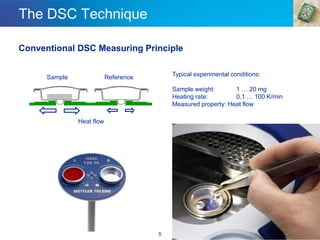
The DSC Technique
Conventional DSC Measuring Principle
Reference
Sample
Heat flow
Typical experimental conditions:
Sample weight: 1 … 20 mg
Heating rate: 0.1 … 100 K/min
Measured property: Heat flow
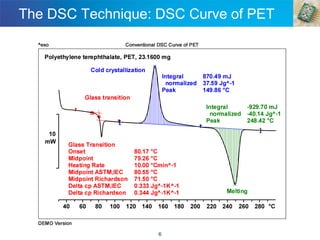
The DSC Technique: DSC Curve of PET
6
0
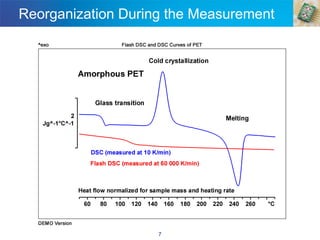
Reorganization During the Measurement
7
0
Flash DSC (FDSC)
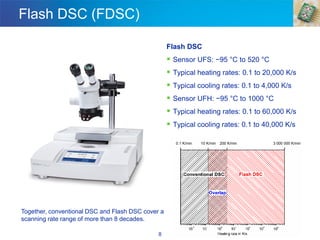
Flash DSC
▪ Sensor UFS: −95 °C to 520 °C
▪ Typical heating rates: 0.1 to 20,000 K/s
▪ Typical cooling rates: 0.1 to 4,000 K/s
▪ Sensor UFH: −95 °C to 1000 °C
▪ Typical heating rates: 0.1 to 60,000 K/s
▪ Typical cooling rates: 0.1 to 40,000 K/s
8
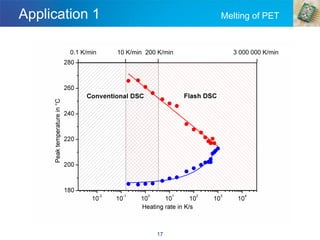
Together, conventional DSC and Flash DSC cover a
scanning rate range of more than 8 decades.
0.1 K/min 10 K/min 200 K/min 3 000 000 K/min
FDSC: Ergonomic Design
9
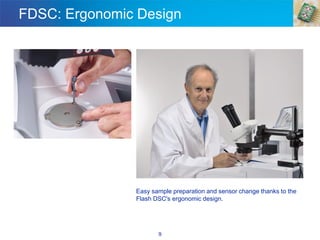
Easy sample preparation and sensor change thanks to the
Flash DSC's ergonomic design.
FDSC Chip Sensor Principle
10
Ceramic
plate
Silicon
frame
Bonding
wire
Thermocouple Resistance
heater
Metal plate
Standard UFS
MultiSTAR sensor
Standard UFS MultiSTAR
sensor: close up
The MultiSTAR UFS is a DSC chip sensor based on MEMS (Micro-Electro-Mechanical
Systems) technology. The sensor consists of two identical quadratic silicon-nitride/oxide
membranes with a length of 1.6 mm. The total thickness of the membrane is 2 μm. The
membranes are mounted on a 300 μm thick silicon frame.
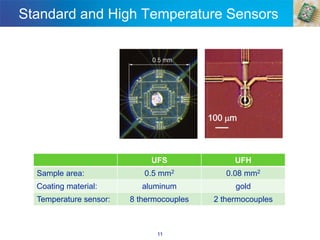
Standard and High Temperature Sensors
11
UFS UFH
Sample area: 0.5 mm2 0.08 mm2
Coating material: aluminum gold
Temperature sensor: 8 thermocouples 2 thermocouples
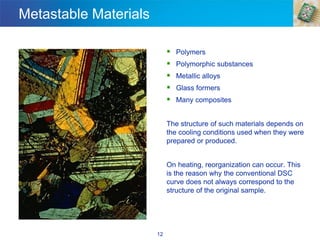
Metastable Materials
▪ Polymers
▪ Polymorphic substances
▪ Metallic alloys
▪ Glass formers
▪ Many composites
The structure of such materials depends on
the cooling conditions used when they were
prepared or produced.
On heating, reorganization can occur. This
is the reason why the conventional DSC
curve does not always correspond to the
structure of the original sample.
12
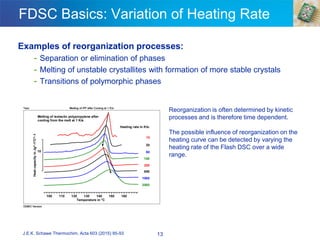
FDSC Basics: Variation of Heating Rate
Examples of reorganization processes:
- Separation or elimination of phases
- Melting of unstable crystallites with formation of more stable crystals
- Transitions of polymorphic phases
13
Reorganization is often determined by kinetic
processes and is therefore time dependent.
The possible influence of reorganization on the
heating curve can be detected by varying the
heating rate of the Flash DSC over a wide
range.
J.E.K. Schawe Thermochim. Acta 603 (2015) 85-93
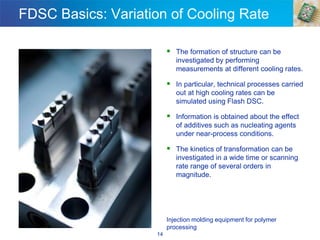
FDSC Basics: Variation of Cooling Rate
▪ The formation of structure can be
investigated by performing
measurements at different cooling rates.
▪ In particular, technical processes carried
out at high cooling rates can be
simulated using Flash DSC.
▪ Information is obtained about the effect
of additives such as nucleating agents
under near-process conditions.
▪ The kinetics of transformation can be
investigated in a wide time or scanning
rate range of several orders in
magnitude.
Injection molding equipment for polymer
processing
14
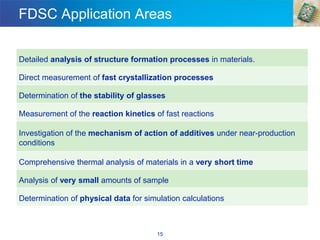
FDSC Application Areas
Detailed analysis of structure formation processes in materials.
Direct measurement of fast crystallization processes
Determination of the stability of glasses
Measurement of the reaction kinetics of fast reactions
Investigation of the mechanism of action of additives under near-production
conditions
Comprehensive thermal analysis of materials in a very short time
Analysis of very small amounts of sample
Determination of physical data for simulation calculations
15
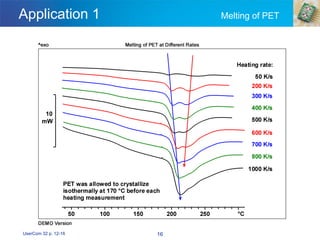
Application 1 Melting of PET
16
UserCom 32 p. 12-16
0
Application 1 Melting of PET
17
0.1 K/min 10 K/min 200 K/min 3 000 000 K/min
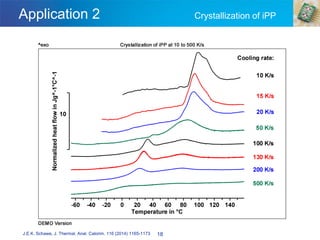
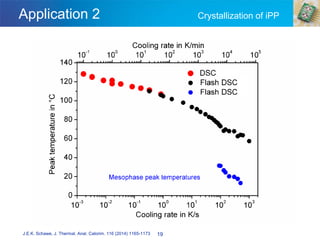
Application 2 Crystallization of iPP
18
J.E.K. Schawe, J. Thermal. Anal. Calorim. 116 (2014) 1165-1173
0
Application 2 Crystallization of iPP
19
J.E.K. Schawe, J. Thermal. Anal. Calorim. 116 (2014) 1165-1173
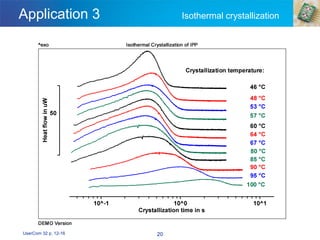
Application 3 Isothermal crystallization
20
UserCom 32 p. 12-16
0
Application 3 Isothermal crystallization
21
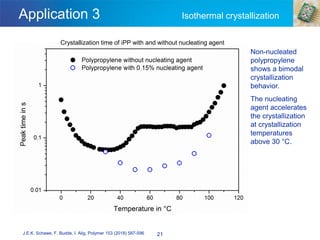
Non-nucleated
polypropylene
shows a bimodal
crystallization
behavior.
The nucleating
agent accelerates
the crystallization
at crystallization
temperatures
above 30 °C.
J.E.K. Schawe, F. Budde, I. Alig, Polymer 153 (2018) 587-596
Crystallization time of iPP with and without nucleating agent
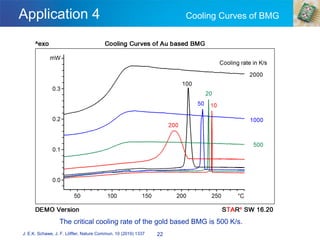
Application 4 Cooling Curves of BMG
22
The critical cooling rate of the gold based BMG is 500 K/s.
J. E.K. Schawe, J. F. Löffler, Nature Commun. 10 (2019) 1337
0
Application 5 Isothermal Crystallization
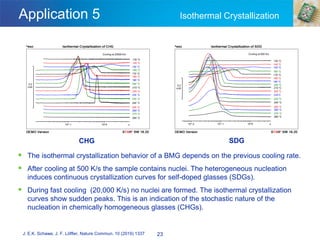
▪ The isothermal crystallization behavior of a BMG depends on the previous cooling rate.
▪ After cooling at 500 K/s the sample contains nuclei. The heterogeneous nucleation
induces continuous crystallization curves for self-doped glasses (SDGs).
▪ During fast cooling (20,000 K/s) no nuclei are formed. The isothermal crystallization
curves show sudden peaks. This is an indication of the stochastic nature of the
nucleation in chemically homogeneous glasses (CHGs).
23
J. E.K. Schawe, J. F. Löffler, Nature Commun. 10 (2019) 1337
CHG SDG
Application 5 TTT-Diagram
24
J. E.K. Schawe, J. F. Löffler, Nature Commun. 10 (2019) 1337
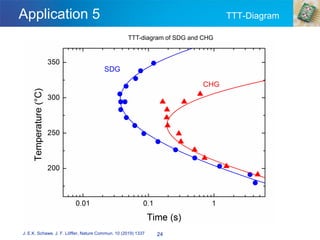
TTT-diagram of SDG and CHG
Application 6 Melting at High Temperatures
25
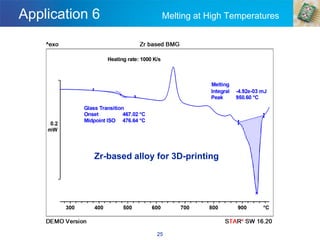
Zr-based alloy for 3D-printing
0
26
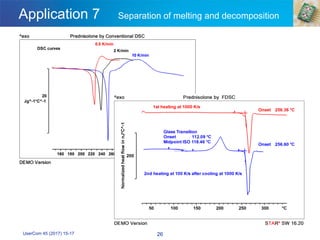
Application 7 Separation of melting and decomposition
UserCom 45 (2017) 15-17
0
0
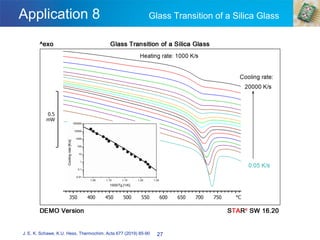
Application 8 Glass Transition of a Silica Glass
27
J. E. K. Schawe, K.U. Hess, Thermochim. Acta 677 (2019) 85-90
0
28
Summary
The Flash DSC is the ideal complement to conventional DSC for the
characterization of modern materials and optimization of production
processes.
Fast and variable measurements save time in the analysis and development of materials.
The quality of products can be improved through knowledge of structure formation under
actual process cooling conditions.
This data can be used to optimize material composition, processing conditions, molds, and
tools.
29
Summary
Features and Benefits of the Flash DSC
▪ Ultra-high heating rates – suppress reorganization processes
▪ Ultra-high cooling rates – allow the formation of materials with defined structural
properties
▪ High sensitivity – permits measurements at low heating rates that overlap with
conventional DSC
▪ Wide temperature range – perform measurements from –95 to 1000 °C
▪ Gas-tight measuring head – investigate samples under defined atmospheres
▪ Fast response sensor – enables the kinetics of extremely fast reactions or
crystallization processes to be studied
▪ Simplicity of use – From easy sample preparation and sensor change to convenient
result evaluation
▪ Oxygen-free environment – protects your sample against oxidation
▪ User-friendly ergonomics – for easy and quick sample preparation and sensor change
More Information:
Related articles in Thermal Analysis UserCom
UserCom articles can be downloaded from www.mt.com/ta-usercoms
The revolutionary Flash DSC 1: maximum performance for
metastable materials
UserCom32
Practical aspects of the Flash DSC 1: Sample preparation for
measurements of polymers.
UserCom36
Differentiation between two polypropylene samples using Flash DSC UserCom38
Curve interpretation, Part 2: Variation of heating and cooling rates UserCom39
Separation of melting and decomposition using high heating rates UserCom41
Use of the Flash DSC to determine the glass transition temperature
of crystalline materials that decompose during melting
UserCom45
Strategies for separating overlapping effects, Part 1: DSC UserCom45
Detection of previously unknown menthol polymorphs by Flash DSC UserCom46
Flash DSC measurements of amorphous-crystalline phase transitions
of Se1-xTex alloys
UserCom 47
Influence of calcium carbonate on the crystallization kinetics of
polypropylene at high supercooling
UserCom48
Fast Scanning DSC: Selected application examples UserCom49
30
31
For More Information on Thermal Analysis
▪ Webinars: www.mt.com/ta-webinars
▪ E-Training: www.mt.com/ta-etraining
▪ Training: www.mt.com/ta-training
▪ Handbooks: www.mt.com/ta-handbooks
▪ Applications: www.mt.com/ta-applications
▪ TA App: www.mt.com/ta-app
▪ Videos: www.mt.com/ta-videos
▪ Thermal analysis in general: www.mt.com/ta
▪ News: www.mt.com/ta-news
Thank You
Thank you for participating!
CLICK HERE to learn more and
watch the webinar
Jürgen Schawe, PhD
Senior Scientist, Thermal Analysis
Mettler Toledo

Fast Scanning Chip Calorimetry

  • 1.
    Fast Scanning Chip Calorimetry JürgenSchawe, PhD Senior Scientist, Thermal Analysis Mettler Toledo
  • 2.
    An expert presentsan overview of why fast scanning chip calorimetry is the ideal complement to conventional DSC Fast Scanning Chip Calorimetry
  • 3.
    Flash DSC Advanced MaterialsCharacterization by Fast Scanning Calorimetry Jürgen Schawe MSG MatChar August 2019
  • 4.
    4 Contents ▪ The DSCTechnique - Conventional DSC Curve of PET - Reorganization During the Measurement ▪ The Flash DSC - The Chip Sensor ▪ Metastable Materials ▪ Flash DSC Basics - Variation of Scanning Rates - Flash DSC Application Areas ▪ Application Examples ▪ Summary ▪ More Information
  • 5.
    5 The DSC Technique ConventionalDSC Measuring Principle Reference Sample Heat flow Typical experimental conditions: Sample weight: 1 … 20 mg Heating rate: 0.1 … 100 K/min Measured property: Heat flow
  • 6.
    The DSC Technique:DSC Curve of PET 6 0
  • 7.
  • 8.
    Flash DSC (FDSC) FlashDSC ▪ Sensor UFS: −95 °C to 520 °C ▪ Typical heating rates: 0.1 to 20,000 K/s ▪ Typical cooling rates: 0.1 to 4,000 K/s ▪ Sensor UFH: −95 °C to 1000 °C ▪ Typical heating rates: 0.1 to 60,000 K/s ▪ Typical cooling rates: 0.1 to 40,000 K/s 8 Together, conventional DSC and Flash DSC cover a scanning rate range of more than 8 decades. 0.1 K/min 10 K/min 200 K/min 3 000 000 K/min
  • 9.
    FDSC: Ergonomic Design 9 Easysample preparation and sensor change thanks to the Flash DSC's ergonomic design.
  • 10.
    FDSC Chip SensorPrinciple 10 Ceramic plate Silicon frame Bonding wire Thermocouple Resistance heater Metal plate Standard UFS MultiSTAR sensor Standard UFS MultiSTAR sensor: close up The MultiSTAR UFS is a DSC chip sensor based on MEMS (Micro-Electro-Mechanical Systems) technology. The sensor consists of two identical quadratic silicon-nitride/oxide membranes with a length of 1.6 mm. The total thickness of the membrane is 2 μm. The membranes are mounted on a 300 μm thick silicon frame.
  • 11.
    Standard and HighTemperature Sensors 11 UFS UFH Sample area: 0.5 mm2 0.08 mm2 Coating material: aluminum gold Temperature sensor: 8 thermocouples 2 thermocouples
  • 12.
    Metastable Materials ▪ Polymers ▪Polymorphic substances ▪ Metallic alloys ▪ Glass formers ▪ Many composites The structure of such materials depends on the cooling conditions used when they were prepared or produced. On heating, reorganization can occur. This is the reason why the conventional DSC curve does not always correspond to the structure of the original sample. 12
  • 13.
    FDSC Basics: Variationof Heating Rate Examples of reorganization processes: - Separation or elimination of phases - Melting of unstable crystallites with formation of more stable crystals - Transitions of polymorphic phases 13 Reorganization is often determined by kinetic processes and is therefore time dependent. The possible influence of reorganization on the heating curve can be detected by varying the heating rate of the Flash DSC over a wide range. J.E.K. Schawe Thermochim. Acta 603 (2015) 85-93
  • 14.
    FDSC Basics: Variationof Cooling Rate ▪ The formation of structure can be investigated by performing measurements at different cooling rates. ▪ In particular, technical processes carried out at high cooling rates can be simulated using Flash DSC. ▪ Information is obtained about the effect of additives such as nucleating agents under near-process conditions. ▪ The kinetics of transformation can be investigated in a wide time or scanning rate range of several orders in magnitude. Injection molding equipment for polymer processing 14
  • 15.
    FDSC Application Areas Detailedanalysis of structure formation processes in materials. Direct measurement of fast crystallization processes Determination of the stability of glasses Measurement of the reaction kinetics of fast reactions Investigation of the mechanism of action of additives under near-production conditions Comprehensive thermal analysis of materials in a very short time Analysis of very small amounts of sample Determination of physical data for simulation calculations 15
  • 16.
    Application 1 Meltingof PET 16 UserCom 32 p. 12-16 0
  • 17.
    Application 1 Meltingof PET 17 0.1 K/min 10 K/min 200 K/min 3 000 000 K/min
  • 18.
    Application 2 Crystallizationof iPP 18 J.E.K. Schawe, J. Thermal. Anal. Calorim. 116 (2014) 1165-1173 0
  • 19.
    Application 2 Crystallizationof iPP 19 J.E.K. Schawe, J. Thermal. Anal. Calorim. 116 (2014) 1165-1173
  • 20.
    Application 3 Isothermalcrystallization 20 UserCom 32 p. 12-16 0
  • 21.
    Application 3 Isothermalcrystallization 21 Non-nucleated polypropylene shows a bimodal crystallization behavior. The nucleating agent accelerates the crystallization at crystallization temperatures above 30 °C. J.E.K. Schawe, F. Budde, I. Alig, Polymer 153 (2018) 587-596 Crystallization time of iPP with and without nucleating agent
  • 22.
    Application 4 CoolingCurves of BMG 22 The critical cooling rate of the gold based BMG is 500 K/s. J. E.K. Schawe, J. F. Löffler, Nature Commun. 10 (2019) 1337 0
  • 23.
    Application 5 IsothermalCrystallization ▪ The isothermal crystallization behavior of a BMG depends on the previous cooling rate. ▪ After cooling at 500 K/s the sample contains nuclei. The heterogeneous nucleation induces continuous crystallization curves for self-doped glasses (SDGs). ▪ During fast cooling (20,000 K/s) no nuclei are formed. The isothermal crystallization curves show sudden peaks. This is an indication of the stochastic nature of the nucleation in chemically homogeneous glasses (CHGs). 23 J. E.K. Schawe, J. F. Löffler, Nature Commun. 10 (2019) 1337 CHG SDG
  • 24.
    Application 5 TTT-Diagram 24 J.E.K. Schawe, J. F. Löffler, Nature Commun. 10 (2019) 1337 TTT-diagram of SDG and CHG
  • 25.
    Application 6 Meltingat High Temperatures 25 Zr-based alloy for 3D-printing 0
  • 26.
    26 Application 7 Separationof melting and decomposition UserCom 45 (2017) 15-17 0 0
  • 27.
    Application 8 GlassTransition of a Silica Glass 27 J. E. K. Schawe, K.U. Hess, Thermochim. Acta 677 (2019) 85-90 0
  • 28.
    28 Summary The Flash DSCis the ideal complement to conventional DSC for the characterization of modern materials and optimization of production processes. Fast and variable measurements save time in the analysis and development of materials. The quality of products can be improved through knowledge of structure formation under actual process cooling conditions. This data can be used to optimize material composition, processing conditions, molds, and tools.
  • 29.
    29 Summary Features and Benefitsof the Flash DSC ▪ Ultra-high heating rates – suppress reorganization processes ▪ Ultra-high cooling rates – allow the formation of materials with defined structural properties ▪ High sensitivity – permits measurements at low heating rates that overlap with conventional DSC ▪ Wide temperature range – perform measurements from –95 to 1000 °C ▪ Gas-tight measuring head – investigate samples under defined atmospheres ▪ Fast response sensor – enables the kinetics of extremely fast reactions or crystallization processes to be studied ▪ Simplicity of use – From easy sample preparation and sensor change to convenient result evaluation ▪ Oxygen-free environment – protects your sample against oxidation ▪ User-friendly ergonomics – for easy and quick sample preparation and sensor change
  • 30.
    More Information: Related articlesin Thermal Analysis UserCom UserCom articles can be downloaded from www.mt.com/ta-usercoms The revolutionary Flash DSC 1: maximum performance for metastable materials UserCom32 Practical aspects of the Flash DSC 1: Sample preparation for measurements of polymers. UserCom36 Differentiation between two polypropylene samples using Flash DSC UserCom38 Curve interpretation, Part 2: Variation of heating and cooling rates UserCom39 Separation of melting and decomposition using high heating rates UserCom41 Use of the Flash DSC to determine the glass transition temperature of crystalline materials that decompose during melting UserCom45 Strategies for separating overlapping effects, Part 1: DSC UserCom45 Detection of previously unknown menthol polymorphs by Flash DSC UserCom46 Flash DSC measurements of amorphous-crystalline phase transitions of Se1-xTex alloys UserCom 47 Influence of calcium carbonate on the crystallization kinetics of polypropylene at high supercooling UserCom48 Fast Scanning DSC: Selected application examples UserCom49 30
  • 31.
    31 For More Informationon Thermal Analysis ▪ Webinars: www.mt.com/ta-webinars ▪ E-Training: www.mt.com/ta-etraining ▪ Training: www.mt.com/ta-training ▪ Handbooks: www.mt.com/ta-handbooks ▪ Applications: www.mt.com/ta-applications ▪ TA App: www.mt.com/ta-app ▪ Videos: www.mt.com/ta-videos ▪ Thermal analysis in general: www.mt.com/ta ▪ News: www.mt.com/ta-news
  • 32.
  • 33.
    Thank you forparticipating! CLICK HERE to learn more and watch the webinar Jürgen Schawe, PhD Senior Scientist, Thermal Analysis Mettler Toledo